Results by title
1882 books match the query 'Criticism and interpretation' and 51 start with g
Galileo's Instruments of Credit
Telescopes, Images, SecrecyMario Biagioli
University of Chicago Press, 2006
Galileo's Instruments of Credit proposes radical new interpretations of several key episodes of Galileo's career, including his early telescopic discoveries of 1610, the dispute over sunspots, and the conflict with the Holy Office over the relationship between Copernicanism and Scripture. Galileo's tactics during this time shifted as rapidly as his circumstances, argues Mario Biagioli, and the pace of these changes forced him to respond swiftly to the opportunities and risks posed by unforeseen inventions, further discoveries, and the interventions of his opponents.
Focusing on the aspects of Galileo's scientific life that extend beyond the framework of court culture and patronage, Biagioli offers a revisionist account of the different systems of exchanges, communication, and credibility at work in various phases of Galileo's career. Galileo's Instruments of Credit will find grateful readers among scholars of science studies, historical epistemology, visual studies, Galilean science, and late Renaissance astronomy.
Games of Inheritance
Kabbalah, Tradition, and Authorship in Jorge Luis BorgesYitzhak Lewis
Rutgers University Press, 2025
Gary Snyder and the Pacific Rim
Creating Countercultural CommunityTimothy Gray
University of Iowa Press, 2006
Gray’s introduction tracks the increased use of “Pacific Rim discourse” by politicians and business leaders following World War II. Ensuing chapters analyze Snyder’s countercultural invocation of this regional idea, concentrating on the poet’s migratory or “creaturely” sensibility, his gift for literary translation, his physical embodiment of trans-Pacific ideals, his role as tribal spokesperson for Haight-Ashbury hippies, and his burgeoning interest in environmental issues. Throughout, Gray’s citations of such writers as Allen Ginsberg, Philip Whalen, and Joanne Kyger shed light on Snyder’s communal role, providing an amazingly intimate portrait of the west coast counterculture. An interdisciplinary project that utilizes models of ecology, sociology, and comparative religion to supplement traditional methods of literary biography, Gary Snyder and the Pacific Rim offers a unique perspective on Snyder’s life and work.
This book will fascinate literary and Asian studies scholars as well as the general reader interested in the Beat movement and multicultural influences on poetry.
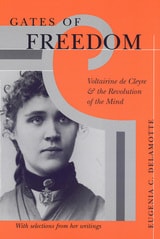
Gates of Freedom
Voltairine de Cleyre and the Revolution of the MindEugenia C. DeLamotte
University of Michigan Press, 2004
---Cary Nelson, University of Illinois
"The question of souls is old; we demand our bodies, now." These words are not from a feminist manifesto of the late twentieth century, but from a fiery speech given a hundred years earlier by Voltairine de Cleyre, a leading anarchist and radical thinker. A contemporary of Emma Goldman---who called her "the most gifted and brilliant anarchist woman America ever produced"---de Cleyre was a significant force in a major social movement that sought to transform American society and culture at its root. But she belongs to a group of late-nineteenth-century freethinkers, anarchists, and sex-radicals whose writing continues to be excluded from the U.S. literary and historical canon.
Gates of Freedom considers de Cleyre's speeches, letters, and essays, including her most well known essay, "Sex Slavery." Part I brings current critical concerns to bear on de Cleyre's writings, exploring her contributions to the anarchist movement, her analyses of justice and violence, and her views on women, sexuality, and the body. Eugenia DeLamotte demonstrates both de Cleyre's literary significance and the importance of her work to feminist theory, women's studies, literary and cultural studies, U.S. history, and contemporary social and cultural analysis. Part II presents a thematically organized selection of de Cleyre's stirring writings, making Gates of Freedom appealing to scholars, students, and anyone interested in Voltairine de Cleyre's fascinating life and rousing work.
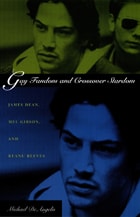
Gay Fandom and Crossover Stardom
James Dean, Mel Gibson, and Keanu ReevesMichael DeAngelis
Duke University Press, 2001
DeAngelis examines a variety of cultural documents, including studio publicity and promotional campaigns, star biographies, scandal magazines, and film reviews, as well as gay political and fan literature that ranges from the closeted pages of One and Mattachine Review in the 1950s to the very “out” dish columns, listserv postings, and on-line star fantasy narratives of the past decade. At the heart of this close historical study are treatments of particular film narratives, including East of Eden, Rebel Without a Cause, The Road Warrior, Lethal Weapon, My Own Private Idaho, and Speed. Using theories of fantasy and melodrama, Gay Fandom and Crossover Stardom demonstrates how studios, agents, and even stars themselves often actively facilitate an audience’s strategic blurring of the already tenuous distinction between the heterosexual mainstream and the gay margins of American popular culture.
In addition to fans of James Dean, Mel Gibson, and Keanu Reeves, those interested in film history, cultural studies, popular culture, queer theory, gender studies, sociology, psychoanalytic theory, melodrama, fantasy, and fandom will enjoy this book.
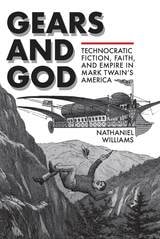
Gears and God
Technocratic Fiction, Faith, and Empire in Mark Twain's AmericaNathaniel Williams
University of Alabama Press, 2018
In Gears and God: Technocratic Fiction, Faith, and Empire in Mark Twain’s America, Nathaniel Williams analyzes the genre of technology-themed exploration novels—dime novel adventure stories featuring steam-powered and electrified robots, airships, and submersibles. This genre proliferated during the same cultural moment when evolutionary science was dismantling Americans’ prevailing, biblically based understanding of human history.
While their heyday occurred in the late 1800s, technocratic adventure novels like Twain’s A Connecticut Yankee in King Arthur’s Court inspired later fiction about science and technology. Similar to the science fiction plotlines of writers like Jules Verne and H. Rider Haggard, and anticipating the adventures of Tom Swift some decades later, these novels feature Americans using technology to visit and seize control of remote locales, a trait that has led many scholars to view them primarily as protoimperialist narratives. Their legacy, however, is more complicated. As they grew in popularity, such works became as concerned with the preservation of a fraught Anglo-Protestant American identity as they were with spreading that identity across the globe.
Many of these novels frequently assert the Bible’s authority as a historical source. Collectively, such stories popularized the notion that technology and travel might essentially “prove” the Bible’s veracity—a message that continues to be deployed in contemporary debates over intelligent design, the teaching of evolution in public schools, and in reality TV shows that seek historical evidence for biblical events. Williams argues that these fictions performed significant cultural work, and he consolidates evidence from the novels themselves, as well as news articles, sermons, and other sources of the era, outlining and mapping the development of technocratic fiction.
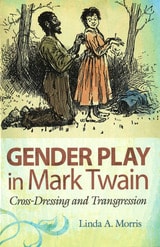
Gender Play in Mark Twain
Cross-Dressing and TransgressionLinda A. Morris
University of Missouri Press, 2007
Huckleberry Finn dressing as a girl is a famously comic scene in Mark Twain’s novel but hardly out of character—for the author, that is. Twain “troubled gender” in much of his otherwise traditional fiction, depicting children whose sexual identities are switched at birth, tomboys, same-sex married couples, and even a male French painter who impersonates his own fictive sister and becomes engaged to another man.
This book explores Mark Twain’s extensive use of cross-dressing across his career by exposing the substantial cast of characters who masqueraded as members of the opposite sex or who otherwise defied gender expectations. Linda Morris grounds her study in an understanding of the era’s theatrical cross-dressing and changing mores and even events in the Clemens household. She examines and interprets Twain’s exploration of characters who transgress gendered conventions while tracing the degree to which themes of gender disruption interact with other themes, such as his critique of race, his concern with death in his classic “boys’ books,” and his career-long preoccupation with twins and twinning.
Approaching familiar texts in surprising new ways, Morris reexamines the relationship between Huck and Jim; discusses racial and gender crossing in Pudd’nhead Wilson; and sheds new light on Twain’s difficulty in depicting the most famous cross-dresser in history, Joan of Arc. She also considers a number of his later “transvestite tales” that feature transgressive figures such as Hellfire Hotchkiss, who is hampered by her “misplaced sex.”
Morris challenges views of Twain that see his work as reinforcing traditional notions of gender along sharply divided lines. She shows that Twain depicts cross-dressing sometimes as comic or absurd, other times as darkly tragic—but that even at his most playful, he contests traditional Victorian notions about the fixity of gender roles.
Analyzing such characteristics of Twain’s fiction as his fascination with details of clothing and the ever-present element of play, Morris shows us his understanding that gender, like race, is a social construction—and above all a performance. Gender Play in Mark Twain: Cross-Dressing and Transgression broadens our understanding of the writer as it lends rich insight into his works.
Gender and the Gothic in the Fiction of Edith Wharton
Kathy A. Fedorko
University of Alabama Press, 1995
Revealing the Gothic foundations of Edith Wharton's vision of gender and identity.
Gender and the Gothic in the Fiction of Edith Wharton is an innovative study that provides fresh insights into Wharton’s male characters while at the same time showing how Wharton’s imagining of a fe/male self evolves throughout her career. Using feminist archetypal theory and theory of the female Gothic, Kathy A. Fedorko shows how Wharton, in sixteen short stories and six major novels written during four distinct periods of her life, adopts and adapts Gothic elements to explore the nature of feminine and masculine ways of knowing and being and to dramatize the tension between them.
Edith Wharton’s contradictory views of women and men—her attitudes toward the feminine and the masculine—reflect a complicated interweaving of family and social environment, historical time, and individual psychology. Studies of Wharton have exhibited this same kind of contradiction, with some seeing her as disparaging men and the masculine and others depicting her as disparaging women and the feminine. The use of Gothic elements in her fiction provided Wharton, who was often considered the consummate realist, with a way to dramatize the conflict between feminine and masculine selves as she experienced them and to evolve an alternative to the dualism.
Fedorko’s work is unique in its careful consideration of Wharton’s sixteen Gothic works, which are seldom discussed. Further, the revelation of how these Gothic stories are reflected in her major realistic novels. In the novels with Gothic texts, Wharton draws multiple parallels between male and female protagonists, indicating the commonalities between women and men and the potential for a female self. Eventually, in her last completed novel and her last short story, Wharton imagines human beings who are comfortable with both gender selves.
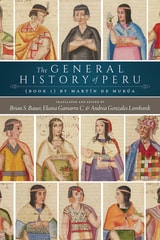
General History of Peru
Book 1Martín de Murúa
University Press of Colorado, 2024
Book 1 covers both the history of the Inca Empire and the first forty years of the Spanish occupation, up to and including the fall of Vilcabamba in 1572. While the J. Paul Getty Museum produced a digital facsimile of Murúa’s full Historia in 2008, it remained underused and, until now, untranslated. This translation revitalizes the momentous early volume with an introduction offering a window into Murúa’s life and the writing of his Historia, and extensive footnotes that provide the scholarly context of Murúa’s work.
This edition of The General History of Peru: Book 1 provides long-awaited access to Murúa’s contribution to Indigenous Andean history and early colonial Peru. The book is valuable for English-speaking students and scholars of pre-Hispanic Andean history, especially those interested in the ancient Andean world and colonial Peru’s literary production.
Gente Decente
A Borderlands Response to the Rhetoric of DominanceBy Leticia Magda Garza-Falcón
University of Texas Press, 1998
In his books The Great Plains, The Great Frontier, and The Texas Rangers, historian Walter Prescott Webb created an enduring image of fearless, white, Anglo male settlers and lawmen bringing civilization to an American Southwest plagued with "savage" Indians and Mexicans. So popular was Webb's vision that it influenced generations of historians and artists in all media and effectively silenced the counter-narratives that Mexican American writers and historians were concurrently producing to claim their standing as "gente decente," people of worth.
These counter-narratives form the subject of Leticia M. Garza-Falcón's study. She explores how prominent writers of Mexican descent-such as Jovita González, Américo Paredes, María Cristina Mena, Fermina Guerra, Beatriz de la Garza, and Helena María Viramontes -have used literature to respond to the dominative history of the United States, which offered retrospective justification for expansionist policies in the Southwest and South Texas. Garza-Falcón shows how these counter-narratives capture a body of knowledge and experience excluded from "official" histories, whose "facts" often emerged more from literary techniques than from objective analysis of historical data.
George Eliot's Religious Imagination
A Theopoetics of EvolutionMarilyn Orr
Northwestern University Press, 2018
Orr’s wide-ranging and fascinating analysis situates George Eliot in the fertile intellectual landscape of the nineteenth century, among thinkers as diverse as Ludwig Feuerbach, David Strauss, and Søren Kierkegaard. She also argues for a connection between George Eliot and the twentieth-century evolutionary Christian thinker Pierre Teilhard de Chardin. Her analysis draws on the work of contemporary philosopher Richard Kearney as well as writers on mysticism, particularly Karl Rahner.
The book takes an original look at questions many believe settled, encouraging readers to revisit George Eliot’s work. Orr illuminates the creative tension that still exists between science and religion, a tension made fruitful through the exercise of the imagination. Through close readings of Eliot's writings, Orr demonstrates how deeply the novelist's religious imagination continued to operate in her fiction and poetry.
George Eliot’s Serial Fiction
Carol A. Martin
The Ohio State University Press, 1994
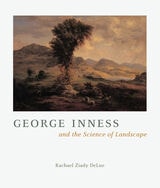
George Inness and the Science of Landscape
Rachael Ziady DeLue
University of Chicago Press, 2005
Throughout his career, Inness struggled to make visible what was invisible to the human eye by combining a deep interest in nineteenth-century scientific inquiry—including optics, psychology, physiology, and mathematics—with an idiosyncratic brand of mysticism. Rachael Ziady DeLue's George Inness and the Science of Landscape—the first in-depth examination of Inness's career to appear in several decades—demonstrates how the artistic, spiritual, and scientific aspects of Inness's art found expression in his masterful landscapes. In fact, Inness's practice was not merely shaped by his preoccupation with the nature and limits of human perception; he conceived of his labor as a science in its own right.
This lavishly illustrated work reveals Inness as profoundly invested in the science and philosophy of his time and illuminates the complex manner in which the fields of art and science intersected in nineteenth-century America. Long-awaited, this reevaluation of one of the major figures of nineteenth-century American art will prove to be a seminal text in the fields of art history and American studies.

George Sand
Writing for Her LifeIsabelle Hoog Naginski
Rutgers University Press, 1991

Georges Bataille
A Critical IntroductionBenjamin Noys
Pluto Press, 2000
Treating Bataille's work as a whole rather than focusing, as other studies have done, on aspects of his work (i.e. as social theory or philosophy), Noys' study is intended to be sensitive to the needs of students new to Bataille's work while at the same time drawing on the latest research on Bataille to offer new interpretations of Bataille's oeuvre for more experienced readers. This is the first clear, introductory reading of Bataille in English - challenging current reductive readings, and stressing the range of disciplines affected by Bataille's work, at a time when interest in Bataille is growing.
Gerda Walther
A Life in PhenomenologyAntonio Calcagno
Northwestern University Press, 2027
Exploring the rich phenomenological and psychological insights of Gerda Walther
This is the first major study of Gerda Walther (1897–1977), an important but underappreciated figure in the early phenomenological movement and one of the founding members of the coeducational Freiburg Phenomenological Society. Walther saw herself, along with Hedwig Conrad Martius and Edith Stein, as a student of the phenomenological movement charged with the preservation of its philosophical legacy and the extension of its practice. As Antonio Calcagno elucidates in this learned but accessible biographical account, she served as an important bridge between the Freiburg school of phenomenology, marked by Edmund Husserl’s idealism, and the realist branch that emerged in Munich, where she completed her studies with Alexander Pfänder. Her work has remained little known, however, especially to English-language readers.
Calcagno provides a comprehensive picture of Walther’s philosophical corpus and ideas, from her early investigations to her later writings, while highlighting the originality of her own phenomenological work. He shows how she challenged certain key claims of phenomenology and provided unique solutions to the problems she encountered. The phenomenology that Walther leaves us with is deeply marked by her emphasis on the importance of psyche, spirit, and personhood for achieving a phenomenological methodology and understanding. We find in her work a rich phenomenological psychology that explores not only the limit phenomena of the discipline but also the deep structure of inner psychic life framed in personalist terms.
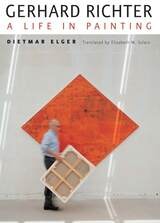
Gerhard Richter
A Life in PaintingDietmar Elger
University of Chicago Press, 2010
Gerhard Richter is one of the most important and influential artists of the post-war era. For decades he has sought innovative ways to make painting more relevant, often through a multifaceted dialogue with photography. Today Richter is most widely recognized for the photo-paintings he made during the 1960s that rely on images culled from mass media and pop culture. Always fascinated with the limits and uncertainties of representation, he has since then produced landscapes, abstractions, glass and mirror constructions, prints, sculptures, and installations.
Though Richter has been known in the United States for quite some time, the highly successful retrospective of his work at the MoMA in 2002 catapulted him to unprecedented fame. Enter noted curator Dietmar Elger, who here presents the first biography of this contemporary artist. Written with full access to Richter and his archives, this fascinating book offers unprecedented insight into his life and work. Elger explores Richter’s childhood in Nazi Germany; his years as a student and mural painter in communist East Germany; his time in the West during the turbulent 1960s and ’70s, when student protests, political strife, and violence tore the Federal Republic of Germany apart; and his rise to international acclaim during the 1980s and beyond.
Richter has always been a difficult personality to parse and the seemingly contradictory strands of his artistic practice have frustrated and sometimes confounded critics. But the extensive interviews on which this book is based disclose a Richter who is far more candid, personal, and vivid than ever before. The result is a book that will be the foundational portrait of this artist for years to come.
Germaine Dulac
A Cinema of SensationsTami Williams
University of Illinois Press, 2014
Best known for directing the Impressionist classic The Smiling Madame Beudet and the first Surrealist film The Seashell and the Clergyman, Germaine Dulac, feminist and pioneer of 1920s French avant-garde cinema, made close to thirty fiction films as well as numerous documentaries and newsreels. Through her filmmaking, writing, and cine-club activism, Dulac’s passionate defense of the cinema as a lyrical art and social practice had a major influence on twentieth century film history and theory.
In Germaine Dulac: A Cinema of Sensations, Tami Williams makes unprecedented use of the filmmaker's personal papers, production files, and archival film prints to produce the first full-length historical study and critical biography of Dulac. Williams's analysis explores the artistic and sociopolitical currents that shaped Dulac's approach to cinema while interrogating the ground breaking techniques and strategies she used to critique conservative notions of gender and sexuality. Moving beyond the director’s work of the 1920s, Williams examines Dulac's largely ignored 1930s documentaries and newsreels establishing clear links with the more experimental impressionist and abstract works of her early period.
This vivid portrait will be of interest to general readers, as well as to scholars of cinema and visual culture, performance, French history, women’s studies, queer cinema, in addition to studies of narrative avant-garde, experimental, and documentary film history and theory.
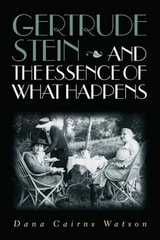
Gertrude Stein and the Essence of What Happens
Dana Cairns Watson
Vanderbilt University Press, 2005
Seeking to sustain Stein's lively, pleasant, populist spirit, Watson shows how the writer's playful entanglement of sight and sound--of silent reading and social speaking--reveals the crucial ambiguity by which reading and conversation build communities of meaning, and thus form not only personal relationships but also our very selves and the larger political structures we inhabit. Stein reminds us that the residual properties of words and the implications behind the give-and-take of ordinary conversation offer alternatives to linear structures of social order, alternatives especially precious in times of political oppression. For example, her novels Mrs. Reynolds and Brewsie and Willie, both written in embattled Vichy France, contemplate the speech patterns of totalitarian leaders and the ways in which everyday discourse might capitulate to--or resist--such verbal tyranny.
Like recent theorists, Stein recognized the repressiveness of conventional order--carried in language and thus in thought and social organization--but as Watson persuasively shows, she also insisted that the free will of individuals can persist in language and enable change. In the play of literary aesthetics, Stein saw a liberating force.
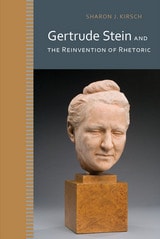
Gertrude Stein and the Reinvention of Rhetoric
Sharon J. Kirsch
University of Alabama Press, 2014
For humanities scholars as well as popular audiences, the relationship between rhetoric and literature remains vexed, in part due to rhetoric’s contemporary affiliation with composition, which makes it separate from, if not subordinate to, the study of literature. Gertrude Stein recognized no such separation, and this disciplinary policing of the study of English has diminished our understanding of her work, Kirsch argues. Stein’s career unfolded at the crossroads of literary composition and rhetorical theory, a site where she alternately challenged, satirized, and reinvented the five classical canons of rhetoric—invention, arrangement, style, memory, and delivery—even as she invented new trajectories of literary experimentation.
Kirsch follows Stein from her days studying composition and philosophy at Harvard through her expatriate years in France, fame in the 1930s, and experience of the Second World War. She frames Stein’s explorations of language as an inventive poetics that reconceived practices and theories of rhetorical invention during a period that saw the rise of literary studies and the decline of rhetorical studies. Through careful readings of canonical and lesser-known works, Kirsch offers a convincing critical portrait of Stein as a Sophistic provocateur who reinvented the canons by making a productive mess of canonical rhetoric and modernist categories of thought.
Readers will find much of interest in Gertrude Stein and the Reinvention of Rhetoric. Kirsch offers myriad insights to scholars of Stein, to those interested in the interdisciplinary intersections of literature, rhetoric, and philosophy, as well as to scholars and students in the field of rhetoric and communication studies. Positioning Stein as a major twentieth-century rhetorical theorist is particularly timely given increasing interest in historical and theoretical resonances between rhetoric and poetics and given the continued lack of recognition for women theorists in rhetorical studies.
Gertrude Stein's Surrealist Years
Ery Shin
University of Alabama Press, 2020
Gertrude Stein’s Surrealist Years brings to life Stein’s surrealist sensibilities and personal values borne from her WWII anxieties, not least of which originated in a dread of anti-Semitism. Stein’s earlier works such as Tender Buttons and Lucy Church Amiably tend to prioritize formal innovations over narrative-building and overt political motifs. However, Ery Shin argues that Stein’s later works engage more with storytelling and life-writing in startling ways—most emphatically and poignantly through the surrealist lens.
Beginning with The Autobiography of Alice B. Toklas and continuing in later works, Stein renders legible her war-torn era’s jarring dystopian energies through narratives filled with hallucinatory visions, teleportation, extreme coincidences, action reversals, doppelgangers, dream sequences spanning both sleeping and waking states, and great whiffs of the occult. Such surrealist gestures are predicated on Stein’s return to the independent clause and, by extension, to plot, characterization, and anecdotes. By summoning the marvelous in a historically situated world, Stein joins her surrealist contemporaries in their own ambivalent crusade on behalf of historiography.
Besides illuminating Stein’s art and life, the surrealist framework developed here brings readers deeper into those philosophical ideas invoked by war. Topics of discussion emphasize how varied Jewish experiences were in Hitler’s Europe, how outliers like Stein can be included in the surrealist project, surrealism’s theoretical bind in the face of WWII, and the age-old question of artistic legacy.
Ghostly Fragments
Essays on Shakespeare and PerformanceBarbara C. Hodgdon
University of Michigan Press, 2021
Ghostly Fragments gathers the essays of the late Barbara C. Hodgdon, a renowned scholar of Shakespeare and performance studies. Her influential publications over thirty years reflected a remarkable intelligence, wit, and originality, as did her lectures and conference papers. Richard Abel and Peter Holland have selected essays that represent the wide sweep of Hodgdon’s scholarship, including unpublished pieces and those from hard-to-access sources. The essays reveal a thinker and writer who grows more self-reflective over time, with a distinctive, engaging, often wryly humorous voice that is accessible even to nonspecialist readers.
Following a general introduction by Peter Holland, the book’s five subsections (Teaching Shakespeare, Analyzing Stage Performances, Editing Shakespeare Texts, Analyzing Shakespeare Films, and “Shopping” in the Archives) are introduced in turn by scholars Miriam Gilbert, W.B. Worthen, Margaret Jane Kidnie, Richard Abel, and Pascale Aebischer. Collectively, the pieces confirm the originality and élan of Hodgdon’s thinking and writing over time, and reveal her as a natural essayist and stylist, with a distinctive engaging voice. The collection is unique in not only bringing together so much of Hodgdon's work in one place (with an extensive bibliography of her published work) but also in demonstrating how groundbreaking and influential that work has been in the field.
Gilbert Austin's "Chironomia" Revisited
Sympathy, Science, and the Representation of MovementSara Newman and Sigrid Streit
Southern Illinois University Press, 2020
Austin did not simply categorize gesture mechanically, separating delivery from rhetoric and the discipline’s overall goals, but instead he provided a theoretical framework of written descriptions and illustrations that positions delivery as central to effective rhetoric and civic interactions. Balancing the variable physical elements of human interactions as well as the demands of communication, Austin’s system fortuitously anticipated contemporary inquiries into embodied and nonverbal communication. Enlightenment rhetoricians, scientists, and physicians relied on sympathy and its attendant vivacious and lively ideas to convey feelings and facts to their varied audiences. During the seventeenth and eighteenth-centuries, as these disciplines formed increasingly distinct, specialized boundaries, they repurposed existing, shared communication conventions to new ends. While the emerging standards necessarily diverged, each was grounded in the subjective, embodied bedrock of the sympathetic, magical tradition.

Gilles Deleuze's Time Machine
D. N. Rodowick
Duke University Press, 1997
Rodowick illuminates the connections between Deleuze’s writings on visual and scientific texts and describes the formal logic of his theory of images and signs. Revealing how Deleuzian views on film speak to the broader network of philosophical problems addressed in Deleuze’s other books—including his influential work with Félix Guattari—Rodowick shows not only how Deleuze modifies the dominant traditions of film theory, but also how the study of cinema is central to the project of modern philosophy.

Giorgione's Tempest
Interpreting the Hidden SubjectSalvatore Settis
University of Chicago Press, 1990
Glamorous Sorcery
Magic and Literacy in the High Middle AgesDavid Rollo
University of Minnesota Press, 2000
Glass! Love!! Perpetual Motion!!!
A Paul Scheerbart ReaderPaul Scheerbart
University of Chicago Press, 2014
Glass! Love!! Perpetual Motion!!! is the first collection of Scheerbart’s multifarious writings to be published in English. In addition to a selection of his fantastical short stories, it includes the influential architectural manifesto Glass Architecture and his literary tour-de-force Perpetual Motion: The Story of an Invention. The latter, written in the guise of a scientific work (complete with technical diagrams), was taken as such when first published but in reality is a fiction—albeit one with an important message. Glass! Love!! Perpetual Motion!!! is richly illustrated with period material, much of it never before reproduced, including a selection of artwork by Paul Scheerbart himself. Accompanying this original material is a selection of essays by scholars, novelists, and filmmakers commissioned for this publication to illuminate Scheerbart’s importance, then and now, in the worlds of art, architecture, and culture.
Coedited by artist Josiah McElheny and Christine Burgin, with new artwork created for this publication by McElheny, Glass! Love!! Perpetual Motion!!! is a long-overdue monument to a modern master.
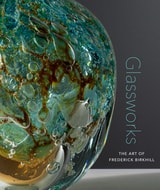
Glassworks
The Art of Frederick BirkhillFrederick Birkhill
The Artist Book Foundation, 2020
Glass as an art form has an ancient tradition; the archaeological record suggests that artisans in Egypt and Mesopotamia were fabricating glass vessels and ornaments during the fourth millennium BCE. Its durable nature, range of colors, malleability, and most of all, its optical transparency are qualities that have made glass a premiere art medium. Over a lifetime, Frederick Birkhill (1951–2023) has explored the unique qualities of glass and the numerous techniques and intricacies of working with it. The result of these decades of study is a body of work that is extraordinary in scope, technical expertise, and sheer virtuosity. The Artist Book Foundation is delighted to present a new monograph honoring this gifted artist: Glassworks: The Art of Frederick Birkhill.
From his time in England at Burleighfield House, the studio of stained-glass artist Patrick Reyntiens, to his unprecedented visit to Lauscha, the village in the former East Germany famous for both its art and scientific glass production, and his subsequent career as an explorer, teacher, and master of the glass arts, Birkhill has devoted himself to furthering the appreciation of the medium and sharing his vast experience with colleagues, collectors, and students.
Complementing the scholarly contributions by authors with significant backgrounds in the glass arts, the book features in its extensive plate section the lavish photography of Henry Leutwyler, which offers readers an opportunity to examine the complex details and artistic mastery of Birkhill's oeuvre. In addition, the monograph offers a glossary of glass-art terms, a detailed chronology of the artist's life, his extensive exhibition history, and a list of the numerous awards he has received. For those who are passionate about the glass arts, this monograph is a feast for the eyes.
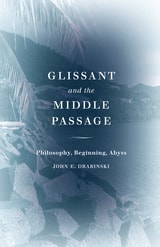
Glissant and the Middle Passage
Philosophy, Beginning, AbyssJohn E. Drabinski
University of Minnesota Press, 2019
A reevaluation of Édouard Glissant that centers on the catastrophe of the Middle Passage and creates deep, original theories of trauma and Caribbeanness
While philosophy has undertaken the work of accounting for Europe’s traumatic history, the field has not shown the same attention to the catastrophe known as the Middle Passage. It is a history that requires its own ideas that emerge organically from the societies that experienced the Middle Passage and its consequences firsthand. Glissant and the Middle Passage offers a new, important approach to this neglected calamity by examining the thought of Édouard Glissant, particularly his development of Caribbeanness as a critical concept rooted in the experience of the slave trade and its aftermath in colonialism.
In dialogue with key theorists of catastrophe and trauma—including Aimé Césaire, Frantz Fanon, George Lamming, Gilles Deleuze, Félix Guattari, Derek Walcott, as well as key figures in Holocaust studies—Glissant and the Middle Passage hones a sharp sense of the specifically Caribbean varieties of loss, developing them into a transformative philosophical idea. Using the Plantation as a critical concept, John E. Drabinski creolizes notions of rhizome and nomad, examining what kinds of aesthetics grow from these roots and offering reconsiderations of what constitutes intellectual work and cultural production.
Glissant and the Middle Passage establishes Glissant’s proper place as a key theorist of ruin, catastrophe, abyss, and memory. Identifying his insistence on memories and histories tied to place as the crucial geography at the heart of his work, this book imparts an innovative new response to the specific historical experiences of the Middle Passage.
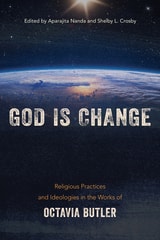
God is Change
Religious Practices and Ideologies in the Works of Octavia ButlerEdited by Aparajita Nanda and Shelby L. Crosby
Temple University Press, 2021
Throughout her work, Octavia E. Butler explored, critiqued, and created religious ideology. Her prescient thoughts on the synergy between politics and religion in America are evident in her 1993 dystopian novel, Parable of the Sower, and its 1998 sequel, Parable of the Talents. They explored, respectively, what happens during a divisive “cultural war” that unjustly impacts the disenfranchised, and the rise of a fascistic president, allied with white fundamentalist Christianity, who chants the slogan, “Make America Great Again.”
But religion, for Butler, need not be a restricting force. The editors of and contributors to God Is Change heighten our appreciation for the range and depth of Butler’s thinking about spirituality and religion, as well as how Butler’s work—especially the Parable and Xenogenesis series—offers resources for healing and community building. Essays consider the role of spirituality in Butler’s canon and the themes of confronting trauma as well as experiencing transformation and freedom. God Is Change meditates on alternate religious possibilities that open different political and cultural futures to illustrate humanity’s ability to endure change and thrive.
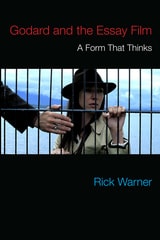
Godard and the Essay Film
A Form That ThinksRick Warner
Northwestern University Press, 2018
The essay film has often been understood by scholars as an eccentric development within documentary, but Warner shows how an essayistic process of thinking can materialize just as potently within narrative fiction films, through self-critical investigations into the aesthetic, political, and philosophical resources of the medium. Studying examples by Godard and other directors, such as Orson Welles, Chris Marker, Agnès Varda, and Harun Farocki, Warner elaborates a fresh account of essayistic reflection that turns on the imaginative, constructive role of the viewer.
Through fine-grained analyses, this book contributes the most nuanced description yet of the relational interface between viewer and screen in the context of the essay film. Shedding new light on Godard’s work, from the 1960s to the 2010s, in film, television, video, and digital stereoscopy, Warner distills an understanding of essayistic cinema as a shared exercise of critical rumination and perceptual discovery.
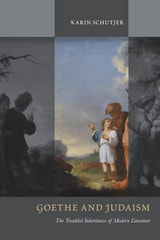
Goethe and Judaism
The Troubled Inheritance of Modern LiteratureKarin Schutjer
Northwestern University Press, 2015
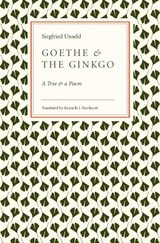
Goethe and the Ginkgo
A Tree and a PoemSiegfried Unseld
University of Chicago Press, 2003
In this beautiful little book, renowned Goethe scholar Siegfried Unseld considers what this episode means to our estimation of a writer many consider nearly godlike in stature. Unseld begins by exploring the botanical and medical lore of the ginkgo, including the use of its nut as an aphrodisiac and anti-aging serum. He then delves into Goethe's writings for the light they shed on his relationship with Marianne. Unseld reveals Goethe as a great yet human being, subject, as any other man, to the vagaries of passion.
Gogol's Artistry
Andrei Bely, translated by Christopher Colbath
Northwestern University Press, 2009
When one great author engages another, as Andrei Bely so brilliantly does in Gogol’s Artistry, the result is inevitably a telling portrait of both writers. So it is in Gogol’s Artistry. Translated into English for the first time, this idiosyncratic, exhaustive critical study is as interesting for what it tells us about Bely’s thought and method as it is for its insights into the oeuvre of his literary predecessor. Bely’s argument in this book is that Gogol’s earlier writing should be given more consideration than most critics have granted. Employing what might be called a scientific perspective, Bely considers how often certain colors appear; he diagrams sentences and discusses Gogol’s prose in terms of mathematical equations. The result, as strange and engaging as Bely’s best fiction, is also an innovative, thorough, and remarkably revealing work of criticism.
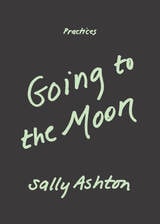
Going to the Moon
Sally Ashton
Duke University Press, 2026
In 2022, poet Sally Ashton learned that one of her poems would be included in a time capsule to be sent to the Moon via Astrobotic’s 2024 Griffin/VIPER as part of the Lunar Codex project. For her, this event seemed like the high point in a life spent chasing the Moon, from a childhood inspired by the space race of the 1960s to an adulthood spent in contemplation and conversation with the sky. In Going to the Moon, Ashton marvels at the Moon’s powerful influence since the dawn of humanity—how we have, in our own ways, gone to the Moon, and what we have found. Contemplating lunar settlement in the light of history, culture, the rise of the space industry, and geopolitical conflict, Ashton shares her sense of wonder at the simple beauty of our unchanged Moon and reveals what is at stake in our contemporary attempts to colonize it.
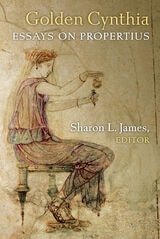
Golden Cynthia
Essays on PropertiusSharon L. James, Editor
University of Michigan Press, 2022
The elegiac poet Propertius responds in his verse to the complex changes that Rome underwent in his period, taking on numerous topics including poetic and sexual rivalry, visual art, violence, inability to control the elusive mistress, imperialism, colonialism, civil war, the radical new shape of the Roman state under the new monarch Augustus, and more. These essays, by well-known scholars of Roman elegy, offer new ways of reading Propertius’ topics, attitudes, and poetics.
This book begins with two distinguished essays by the late Barbara Flaschenriem, whose work on Propertius remains influential. The other contributions, offered in honor of her, are by Diane Rayor, Andrew Feldherr, Ellen Greene, Lowell Bowditch, Alison Keith, and volume editor Sharon L. James. These essays explore topics including Propertian didacticism, dream interpretation, visual art and formalism, sex and violence, Roman imperialism and its connection to the elegiac puella, and Propertius’ engagement, in Book 4, with Vergil’s poetry.
Good Pictures Are a Strong Weapon
Laura Gilpin, Queerness, and Navajo SovereigntyLouise Siddons
University of Minnesota Press, 2024
What are the limits of political solidarity, and how can visual culture contribute to social change?
A fundamental dilemma exists in documentary photography: can white artists successfully portray Indigenous lives and communities in a manner that neither appropriates nor romanticizes them? With an attentive and sensitive eye, Louise Siddons examines lesbian photographer Laura Gilpin’s classic 1968 book The Enduring Navaho to illuminate the intersectional politics of photography, Navajo sovereignty, and queerness over the course of the twentieth century.
Gilpin was a New York–trained fine arts photographer who started working with Navajo people when her partner accepted a job as a nurse in Arizona. She spent more than three decades documenting Navajo life and creating her book in collaboration with Navajo friends and colleagues. Framing her lesbian identity and her long relationship with the Navajo people around questions of allyship, Good Pictures Are a Strong Weapon addresses the long and problematic history of White photographers capturing images of Native life. Simultaneously, Siddons uses Gilpin’s work to explore the limitations of White advocacy in a political moment that emphasized the need for Indigenous visibility and voices.
Good Pictures Are a Strong Weapon introduces contemporary Diné (Navajo) artists as interlocutors, critics, and activists whose work embodies and extends the cultural sovereignty politics of earlier generations and makes visible the queerness often left implicit in Gilpin’s photographs. Siddons puts their work in conversation with Gilpin’s, taking up her mandate to viewers and readers of The Enduring Navajo to address Navajo aesthetics, traditions, politics, and people on their own terms.
Retail e-book files for this title are screen-reader friendly with images accompanied by short alt text and/or extended descriptions.
Good Vibrations
Brian Wilson and the Beach Boys in Critical PerspectivePhilip Lambert, Editor
University of Michigan Press, 2016
The book joins a growing body of literature on the popular music of the 1960s, in general, and on Brian Wilson and the Beach Boys in particular. But Good Vibrations extends the investigation further and deeper than it has gone before, not only offering new understanding and insights into individual songs and albums, but also providing close examination of compositional techniques and reflections on the group’s place in American popular culture.
Goya and the Mystery of Reading
Luis Martín-Estudillo
Vanderbilt University Press, 2023
Goya and the Mystery of Reading explores the critical impact this transition had on the work of an artist who aimed not to copy the world around him, but to see it anew—to read it. Goya's creations offer a sustained reflection on the implications of reading, which he depicted as an ambiguous, often mysterious activity: one which could lead to knowledge or ecstasy, to self-fulfillment or self-destruction, to piety or perdition. At the same time, he used reading to elicit new possibilities of interpretation. This book reveals for the first time the historical, intellectual, and artistic underpinnings of reading as one of the pillars of his art.
This book is the recipient of the 2023 Norman L. and Roselea J. Goldberg Prize from Vanderbilt University Press for the best book in the area of art or medicine.
Grace Paley
Illuminating Dark LivesBy Jacqueline Taylor
University of Texas Press, 1990
Grace Paley is a "writer's writer," admired by both scholars and the reading public for her originality and unique voice. In this first book-length study of her work, Jacqueline Taylor explores the source of Paley's originality, locating it in the way Paley transforms language to create strongly woman-centered stories.
Drawing on interviews with the author, as well as the stories themselves, Taylor emphasizes Paley's awareness that women's voices have been muted and their stories ignored or left untold in our culture's male-oriented dominant discourse. She watches Paley in the process of reshaping language at both the semantic and narrative levels to make it express women's perceptions and experiences. In Paley's stories, it becomes possible to ignore traditional heroic and dramatic themes and instead talk about women and children in such everyday settings as the playground, the kitchen, and the grocery store.
Some of the specific techniques Paley uses to accomplish this include identifying and repudiating sexist language in the dominant discourse and redefining ordinary words from the perspective of women. At the narrative level, Taylor reveals how she draws on women's oral traditions to tell open-ended stories that resist rigid beginning-middle-and-end structuring.
This transformed language enables Paley to construct a social world where woman-centered meanings can flourish. In her nontraditional stories, no single narrator or version of events dominates. Anyone can be a storyteller and no one has the last word.
Graceful Errors
Pindar and the Performance of PraiseHilary Mackie
University of Michigan Press, 2003
Reading Pindar's poems with their public performance in mind, Hilary Mackie suggests that the poet was forced to tread a precarious path: weighing the interests of various groups of audience members against one another, balancing praise of the victorious athlete with praise of the deeds of mythic heroes, and catering at the same time to an uncertain future. Mackie's new approach illuminates apparent contradictions in the poet's pronouncements by bringing to the fore the variety of messages conveyed in his wishes and prayers. Her innovative examination of the moment-to-moment dynamic between Pindar and his audience shows that the poet's performance often contained one message for the victor and his family, and quite another for the gods.
Graceful Errors significantly changes our perspective on Pindar's work, providing a lucid appreciation of Pindaric poetry that takes into account the oral context of these poems' performance. It will be of interest not only to classicists but also to scholars and students interested in oral performance, the social function of poetry, and the role and status of poets in traditional cultures, whether ancient or modern.
Hilary Mackie is Associate Professor of Classics at Rice University.
Graham Greene's Fictions
The Virtues of ExtremityCates Baldridge
University of Missouri Press, 2000
The first critical evaluation of Greene's novels since his death in 1991, Graham Greene's Fictions: The Virtues of Extremity is a reconsideration of the author's major literary achievements, as well as a recasting of his overall worldview. Hitherto, most criticism of Greene's fiction has forced him into the constricting category of the "Catholic novelist," consequently flattening the peaks and valleys of his uncompromising vision of life. Graham Greene's Fictions is Cates Baldridge's response to this critical disservice—an exploration that ignores the conventional preconceptions about Greene's fiction and reveals him to be one of the leading British novelists of the twentieth century.
More than a general assessment, Graham Greene's Fictions offers a fresh interpretation of familiar texts and attempts to discover within Greene's work a structure of thought that has not yet been seen with sufficient clarity. Each chapter focuses on a major aspect of Greene's vision as expressed through his novels. Greene's caustic attitude toward middle-class orthodoxies and his critiques of the three reigning ideologies of his time--Christianity, Marxism, and liberalism—are just two of the areas that Baldridge explores. Although five of Greene's novels are singled out for extensive evaluation—Brighton Rock, The Power and the Glory, The Heart of the Matter, The Comedians, and The Honorary Consul—what Baldridge attempts is nothing less than a comprehensive re-imagination of "Greeneland's" fictional topography.
Written for both the scholar and the general audience, this innovative study successfully captures the attention of all readers whether it is the first or the fifty-first work of Greene criticism one has read.
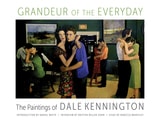
Grandeur of the Everyday
The Paintings of Dale KenningtonDale Kennington, Introduction by Daniel White, Conversation with Kristen Miller Zohn, Essay by Rebecca Brantley
University of Alabama Press, 2017
Grandeur of the Everyday is the first full-length volume dedicated to the life and work of Dale Kennington—an accomplished master of contemporary American realism. Kennington’s works often hold a strange familiarity, even for those coming to her work for the first time. Her paintings are at once familiar and yet defy specificity of place, clear and lucid while also dense in content. These effects derive from her unique ability to capture the essence of everyday living, the ordinary “in between” moments we often overlook in our day-to-day habits and transactions.
Kennington referred to her paintings as “merged memories.” Combining elements of photography, memory, and imagination, Kennington’s art is an entrancing blend of contemporary and magical realism, with themes ranging from loneliness to community and culture, from class and race relations to the juxtaposition of private and public life. Rather than study the spectacular, she concentrated on commonplace moments of human interaction, inviting observers of her paintings to ponder their significance and to complete their implicit narratives. Often relying on local subjects for her paintings—barbershops, bars, restaurants, gospel concerts, motel rooms, nursing homes—she presented a diversity of local experience.
Grandeur of the Everyday is a treasure trove of her most accomplished creations and includes more than eighty-five examples of both Kennington’s easel paintings on canvas and her freestanding wooden folding screens. The volume also offers an original interview with the artist conducted by Kristen Miller Zohn, an introduction by art historian Daniel White, and a critical essay by the director of the Wiregrass Museum of Art, Rebecca Brantley.
Greasepaint Puritan
Boston to 42nd Street in the Queer Backstage Novels of Bradford RopesMaya Cantu
University of Michigan Press, 2024
Greasepaint Puritan aims to find out and reclaim his story. Descended from Mayflower Pilgrims, Ropes rebelled against the “Proper Bostonian” life, in a career that touched upon the Jazz Age, American vaudeville, and theater censorship. We follow Ropes’s successful career as both a performer and the author of the trilogy of backstage novels: 42nd Street, Stage Mother, and Go Into Your Dance. Populated by scheming stage mothers, precocious stage children, grandiose bit players, and tart-tongued chorines, these novels centered on the lives and relationships of gay men on Broadway during the Jazz Age and Prohibition era. Rigorously researched, Greasepaint Puritan chronicles Ropes’s career as a successful screenwriter in 1930s and ’40s Hollywood, where he continued to be a part of a dynamic gay subculture within the movie industry before returning to obscurity in the 1950s. His legacy lives on in the Hollywood and Broadway incarnations of 42nd Street—but Greasepaint Puritan restores the “forgotten melody” of the man who first envisioned its colorful characters.
Greg Egan
Karen Burnham
University of Illinois Press, 2014
Greg Egan (1961- ) publishes works that challenge readers with rigorous, deeply-informed scientific speculation. He unapologetically delves into mathematics, physics, and other disciplines in his prose, putting him in the vanguard of the hard science fiction renaissance of the 1990s.
A working physicist and engineer, Karen Burnham is uniquely positioned to provide an in-depth study of Egan's science-heavy oeuvre. Her survey of the author's career covers novels like Permutation City and Schild's Ladder and the Hugo Award-winning novella "Oceanic," analyzing how Egan used cutting-edge scientific theory to explore ethical questions and the nature of humanity. As Burnham shows, Egan's collected works constitute a bold artistic statement: that narratives of science are equal to those of poetry and drama, and that science holds a place in the human condition as exalted as religion or art.
The volume includes a rare interview with the famously press-shy Egan covering his works, themes, intellectual interests, and thought processes.
Gregory Benford
George Slusser
University of Illinois Press, 2014
Like many other current science fiction writers, Benford has tackled the major genres: space travel, time travel, technology running amok, prolonged longevity, searing apocalyptic cosmic events, and alien life, which he theorizes to be more likely viral than intelligent. An astrophysicist by training and profession, Benford has published more than twenty novels, over one hundred short stories, some fifty essays, and myriad articles that display both his scientific rigor as well as a recognition of literary traditions.
In this study, George Slusser explores the extraordinary, seemingly inexhaustible display of creative energy in Gregory Benford's life and work. Presenting Benford's ideas on science and the writing of science fiction, the volume addresses the writer's literary production and his place in contemporary science fiction. By identifying direct sources and making parallels with other works and writers, Slusser reveals the vast scope of Benford's knowledge, both of literature and of the major scientific and philosophical issues of our time. Slusser also discusses Benford's numerous scientific articles and nonfiction books and includes a new interview with Benford.
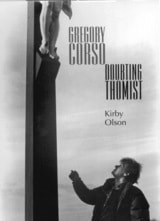
Gregory Corso
Doubting ThomistKirby Olson
Southern Illinois University Press, 2002
Gregory Corso is the most intensely spiritual of the Beat generation poets and still by far the least explored. The virtue of Kirby Olson’s Gregory Corso: Doubting Thomist is that it is the first book to place all of Corso’s work in a philosophical perspective, concentrating on Corso as a poet torn between a static Catholic Thomist viewpoint and that of a progressive surrealist.
While Corso is a subject of great controversy—his work often being seen as nihilistic and wildly comic—Olson argues that Corso’s poetry, in fact, maintains an insistent theme of doubt and faith with regard to his early Catholicism. Although many critics have attempted to read his poetry, and some have done so brilliantly, Olson—in his approach and focus—is the first to attempt to give a holistic understanding of the oeuvre as essentially one not of entertainment or hilarity but of a deep spiritual and philosophical quest by an important and profound mind.
In nine chapters, Olson addresses Corso from a broad philosophical perspective and shows how Corso takes on particular philosophical issues and contributes to new understandings. Corso’s concerns, like his influence, extend beyond the Beat generation as he speaks about concerns that have troubled thinkers from the beginning of the Western tradition, and his answers offer provocative new openings for thought.
Corso may very well be the most important Catholic poet in the American literary canon, a visionary like Burroughs and Ginsberg, whose work illuminated a generation. Written in a lively and engaging style, Gregory Corso: Doubting Thomist seeks to keep Corso’s memory alive and at last delve fully into Corso’s poetry.

Grotowski's Bridge Made of Memory
Embodied Memory, Witnessing and Transmission in the Grotowski WorkDominika Laster
Seagull Books, 2016
Considered one of the most influential theatre practitioners of the 20th century, Polish director Jerzy Grotowski revolutionized contemporary theatre in multiple ways. Perhaps best known for his notion of ‘poor theatre,’ Grotowski went beyond the confines of conventional theatre to systematically explore the possibilities of the human being in a performative context. In Grotowski’s Bridge Made of Memory, Dominika Laster analyzes core aspects of Grotowski’s work such as body-memory, vigilance, witnessing, verticality, and transmission, arguing that these performance praxes involve a deliberate blurring of the boundaries of the self and other.
This comprehensive study traces key thematic threads across Grotowski’s research, examining lesser-known aspects of his work such as performance compositions structured around African and Afro-Caribbean traditional songs and ritual movement as well as textual material from the Christian Gnostic tradition. As an active process of research and questioning conducted through the “body-being” of the performer, Grotowski’s work represents a practical realization of the often highly theoretical and abstract discussions of one of the field’s main preoccupations: embodied practice as a way of knowing.

Guilty Pleasures
Feminist Camp from Mae West to MadonnaPamela Robertson
Duke University Press, 1996
Robertson grounds her theoretical discussion of female performance and spectatorship in detailed studies of figures such as Mae West, Joan Crawford, and Madonna. She locates these figures in turn within a tradition of feminist camp—a female form of aestheticism related to masquerade and rooted in burlesque, parallel to but different from gay male camp. Through analyses of films from Gold Diggers of 1933 to Johnny Guitar, as well as video and television, Robertson shows how the gold digger is to feminist camp what the dandy is to gay male camp—its original personification and defining voice. Set against a backdrop of social history, her analysis demonstrates that feminist camp flourishes during periods of antifeminist backlash in America, and that it reflects a working-class sensibility particularly attuned to changing attitudes toward women’s work and sexuality.
Appealing to a wide range of scholars spanning the fields of film and mass culture, feminism, gay/lesbian/queer studies, and cultural studies, Guilty Pleasures will also attract an audience of general readers interested in camp and popular culture.
Gustave Caillebotte and the Fashioning of Identity in Impressionist Paris
Edited by Norma Broude
Rutgers University Press, 2002
The essays that comprise this volume exemplify the best aspects of recent Caillebotte scholarship. They employ a variety of perspectives to examine the ways in which his art sheds light on the formation of individual and class identities in Paris during the early years of the Third Republic—an era of transition marked by the burgeoning of capitalism and the instabilities of newly shifting gender roles in the modern world.
Addressing a wide range of major paintings by Caillebotte, the contributors reveal the compound ways in which the artist encoded his images and the multiple interpretations to which these images are susceptible. Juxtaposed so as to complement and challenge one another, these essays build a provocative whole as they probe issues of spectatorship and authorial intention. The contributors—all internationally known scholars and art professionals—create an important theoretical framework for the discussion of Caillebotte’s work.