Results by title
69 books match the query 'Hegel, Georg Wilhelm Friedrich' and 27 start with h
Hegel Myths and Legends
Jon Stewart
Northwestern University Press, 1996
Hegel and Deleuze
Together Again for the First TimeKaren Houle
Northwestern University Press, 2013
Hegel and Deleuze cannily examines the various resonances and dissonances between these two major philosophers. The collection represents the best in contemporary international scholarship on G. W. F. Hegel and Gilles Deleuze, and the contributing authors inhabit the as-yet uncharted space between the two thinkers, collectively addressing most of the major tensions and resonances between their ideas and laying a solid ground for future scholarship.
The essays are organized thematically into two groups: those that maintain a firm but nuanced disjunction or opposition between Hegel and Deleuze, and those that chart possible connections, syntheses, or both. As is clear from this range of texts, the challenges involved in grasping, appraising, appropriating, and developing the systems of Deleuze and Hegel are varied and immense. While neither Hegel nor Deleuze gets the last word, the contributors ably demonstrate that partisans of either can no longer ignore the voice of the other.
Hegel and Spinoza
Substance and NegativityGregor Moder, with a foreword by Mladen Dolar
Northwestern University Press, 2017
Hegel and Spinoza traces the historical roots of these alternatives and shows how contemporary discussions between Heideggerians and Althusserians, Lacanians and Deleuzians are a variation of the disagreement between Hegel and Spinoza. Throughout, Moder persuasively demonstrates that the best way to read Hegel and Spinoza is not in opposition or contrast but together: as Hegel and Spinoza.
Hegel and the Arts
Stephen Houlgate
Northwestern University Press, 2007
Addressing a range of important topics, the essays examine the conceptual bases of Hegel's organization of his aesthetics, his treatment of various specific arts (architecture, sculpture, painting, music, and tragedy), and several of the most famous issues in the literature--including the "end of art" thesis, the relation between art and religion, and the vexed relationship between Hegel and the romantics. Together they shed light on the profound reflections on art contained in Hegel's philosophy and also suggest ways in which his aesthetics might resonate well beyond the field of philosophical aesthetics, perhaps beyond philosophy itself.
Hegel and the Freedom of Moderns
Domenico Losurdo
Duke University Press, 2004
Hegel and the Freedom of Moderns persuasively argues that the tug of war between “conservative” and “liberal” interpretations of Hegel has obscured and distorted the most important aspects of his political thought. Losurdo unravels this misleading dualism and provides an illuminating discussion of the relation between Hegel’s political philosophy and the thinking of Karl Marx and Friedrich Engels. He also discusses Hegel’s ideas in relation to the pertinent writings of other major figures of modern political philosophy such as Jean-Jacques Rousseau, John Locke, Edmund Burke, John Stuart Mill, Jeremy Bentham, Karl Popper, Norberto Bobbio, and Friedrich Hayek.
Hegel and the Problem of Multiplicity
Andrew Haas
Northwestern University Press, 2000
Hegel on Hamann
G. W. F. Hegel
Northwestern University Press, 2008
In 1828, G. W. F. Hegel published a critical review of Johann George Hamann, a retrospective of the life and works of one of Germany's most enigmatic and challenging thinkers and writers. While Hegel's review had enjoyed a central place in Hamann studies since its appearance, Hegel on Hamann is the first English translation of the important work. Philosophers, theologians, and literary critics welcome Anderson's stunning translation since Hamann is gaining renewed attention, not only as a key figure of German intellectual history, but also as an early forerunner of postmodern thought. Relationships between Enlightenment, Counter Enlightenment, and Idealism come to the fore as Hegel reflects on Hamann's critiques of his contemporaries Immanuel Kant, Moses Mendelssohn, J. G. Herder, and F. H. Jacobi. Hegel on Hamann also includes an introduction to Hegel's review, as well as an essay on the role of friendship in Hamann's life, in Hegel's thought, and in German intellectual culture more broadly. Rounding out the volume are its extensive annotations and bibliography, which facilitate further study of eighteenth- and nineteenth-century philosophy in English and German. This book is essential both for readers of Hegel or Hamann and for those interested in the history of German thought, the philosophy of religion, language and hermeneutics, or friendship as a philosophical category.

Hegel on Political Identity
Patriotism, Nationality, CosmopolitanismLydia L. Moland
Northwestern University Press, 2012

Hegel or Spinoza
Pierre Macherey
University of Minnesota Press, 2011
Hegel or Spinoza is the first English-language translation of the modern classic Hegel ou Spinoza. Published in French in 1979, it has been widely influential, particularly in the work of the philosophers Alain Badiou, Antonio Negri, and Gilles Deleuze.
Hegel or Spinoza is a surgically precise interrogation of the points of misreading of Spinoza by Hegel. Pierre Macherey explains the necessity of Hegel’s misreading in the kernel of thought that is “indigestible” for Hegel, which makes the Spinozist system move in a way that Hegel cannot grasp. In doing so, Macherey exposes the limited and situated truth of Hegel’s perspective—which reveals more about Hegel himself than about his object of analysis. Against Hegel’s characterization of Spinoza’s work as immobile, Macherey offers a lively alternative that upsets the accepted historical progression of philosophical knowledge. He finds in Spinoza an immanent philosophy that is not subordinated to the guarantee of an a priori truth.
Not simply authorizing a particular reading—a “good” Spinoza against a “bad” Hegel—Hegel or Spinoza initiates an encounter that produces a new understanding, a common truth that emerges in the interval that separates the two.
Hegel's Critique of Liberalism
Rights in ContextSteven B. Smith
University of Chicago Press, 1989
Hegel's Energy
A Reading of The Phenomenology of SpiritMichael Marder
Northwestern University Press, 2021
Hegel's Idea of a Phenomenology of Spirit
Michael N. Forster
University of Chicago Press, 1998
The Phenomenology of Spirit emerges as an extraordinarily coherent work with a rich array of important and original ideas. These include a diagnosis of the ills of modernity in terms of its commitment to a series of dualisms, and a project for overcoming them; a sweeping naturalism; a deep rethinking of and response to problems of skepticism; subtle arguments for social theories of meaning and truth; and ideas based on the insight that human thought changes in fundamental ways over the course of history. Forster's unique and compelling reading unlocks the mysteries of Hegel's seminal work.
Hegel's Logic
Between Dialectic and HistoryClark Butler
Northwestern University Press, 2011
Hegel's Phenomenology of Spirit
A Commentary Based on the Preface and IntroductionWerner Marx
University of Chicago Press, 1988
The primary focus of Marx's book is on the account. Hegel gives of the phenomenological journey from natural consciousness to philosophical wisdom (or absolute knowledge, as Hegel calls it). In showing that Hegel's many statements concerning consciousness 'finding itself' or 'knowing itself' in its world can be understood as discovering the rationality of the conditioning world, Marx offers a solution to several sets of interrelated problems that have troubled students of Hegel. His book contains valuable analyses of the relation between Hegel's thought and that of Descartes and Kant as well as that of Karl Marx, and it also sheds considerable light on the question of the internal unity or coherence of the Phenomenology.
Hegel's Phenomenology, Part 1
Analysis and CommentaryHoward P. Kainz
Ohio University Press, 1976
Kainz provides an accessible entry into the complexities of Hegelian thought by asking a series of questions about such matters as the literary form of the Phenomenology, its "plot," its relation to the "system," its subject matter, the problem of objectivity, dialectical necessity, the concept of "experience," and the Hegelian concept of consciousness. Building of the work of previous commentators, and presenting the work of these commentators in a clear and unbiased manner, Kainz offers an analysis that will be helpful both to experienced Hegelian scholars and to those readers preparing to approach the large and bewildering territory of the Phenomenology for the first time.
Hegel's Realm of Shadows
Logic as Metaphysics in “The Science of Logic”Robert B. Pippin
University of Chicago Press, 2018
Robert B. Pippin offers here a bold, original interpretation of Hegel’s claim that only now, after Kant’s critical breakthrough in philosophy, can we understand how logic can be a metaphysics. Pippin addresses Hegel’s deep, constant reliance on Aristotle’s conception of metaphysics, the difference between Hegel’s project and modern rationalist metaphysics, and the links between the “logic as metaphysics” claim and modern developments in the philosophy of logic. Pippin goes on to explore many other facets of Hegel’s thought, including the significance for a philosophical logic of the self-conscious character of thought, the dynamism of reason in Kant and Hegel, life as a logical category, and what Hegel might mean by the unity of the idea of the true and the idea of the good in the “Absolute Idea.” The culmination of Pippin’s work on Hegel and German idealism, this is a book that no Hegel scholar or historian of philosophy will want to miss.
Hegel's Sole Idea
The Last Great Metaphysical SystemMark Alznauer
University of Chicago Press, 2026
An accessible reconstruction of Hegel’s attempt to derive all reality from a single concept.
In the early decades of the nineteenth century, G. W. F. Hegel came to believe that philosophy was finally in a position to achieve something it had striven for since ancient Greece: becoming an objective, demonstrative science. But to achieve this aim, he thought philosophical knowledge needed to be reconceived in a radically new way—as content contained in a single concept just as the oak tree is hidden in the acorn. In Hegel’s Sole Idea, Mark Alznauer reads Hegel’s mature philosophical system as the unprecedented attempt to comprehend the entire world as the full unfolding of that single concept, which he mysteriously calls “the absolute idea.”
Ever since Hegel set out this program in his Encyclopedia of the Philosophical Sciences in Outline, Hegel’s system has been regarded as the last best hope of philosophy as an autonomous, fully rational science. But while Hegel’s followers regarded the Encyclopedia as the successful realization of the traditional aims of philosophy, his most influential successors thought it instead showed the exhaustion and collapse of that project. Hegel’s Sole Idea offers a comprehensive interpretation of Hegelian philosophy that allows a fair confrontation with its most provocative and ambitious claims.
Hegel's Theory of Intelligibility
Rocío Zambrana
University of Chicago Press, 2015
Zambrana clarifies crucial features of Hegel’s theory of normativity previously thought to be absent from the argument of the Science of Logic—what she calls normative precariousness and normative ambivalence. She shows that Hegel’s theory of determinacy views intelligibility as both precarious, the result of practices and institutions that gain and lose authority throughout history, and ambivalent, accommodating opposite meanings and valences even when enjoying normative authority. In this way, Zambrana shows that the Science of Logic provides the philosophical justification for the necessary historicity of intelligibility. Intervening in several recent developments in the study of Kant, Hegel, and German Idealism more broadly, this book provides a productive new understanding of the value of Hegel’s systematic ambitions.
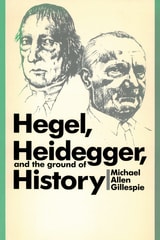
Hegel, Heidegger, and the Ground of History
Michael Allen Gillespie
University of Chicago Press, 1984
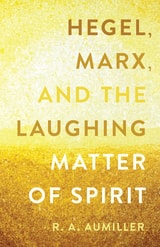
Hegel, Marx, and the Laughing Matter of Spirit
R. A. Aumiller
Northwestern University Press, 2026
What happens when those who have been denied political subjectivity fully play out their negative role in a historical drama that damned them from the beginning? Hegel, Marx, and the Laughing Matter of Spirit locates the eruption of revolutionary laughter in historical cracks across nineteenth- and twentieth-century Europe, where exiled philosophers, partisan fighters, and artists framed their political resistance as a historical comedy. Hegelian comedy fuels the Young Hegelian critique of Prussian censorship, Walter Benjamin’s staging of the anti-fascist resistance, and the Yugoslavian partisan attempt to begin again in fascism’s aftermath. Revolution erupts from a historical stage that can no longer look on its own contradictions with a straight face. Drawing on the defiant spirit of comedy, this Hegelian feminist manifesto defies political despair, overturning the perception that history tragically repeats itself. Invoking the phrase “Nothing changes” as a mantra, R. A. Aumiller turns a concession of defeat into a battle cry for political resistance.
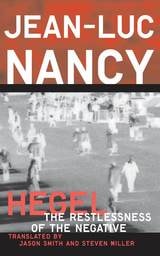
Hegel
The Restlessness Of The NegativeJean-Luc Nancy
University of Minnesota Press, 2002
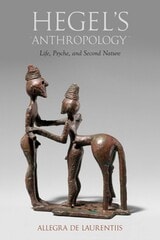
Hegel’s Anthropology
Life, Psyche, and Second NatureAllegra de Laurentiis
Northwestern University Press, 2021
A groundbreaking contribution to scholarship on Hegel and nineteenth-century philosophy, this book shows that the Anthropology is essential to understanding Hegel’s concept of spirit, not only in its connection with nature but also in its more sophisticated realizations as objective and absolute spirit. Future scholarship on this subject will recount—and build upon—de Laurentiis’s innovative study.

Hegel’s Phenomenology, Part 2
The Evolution of Ethical and Religious Consciousness to the Absolute StandpointHoward P. Kainz
Ohio University Press, 1983
The publication in 1807 of Georg Wilhelm Frederich Hegel’s Phanomenologie des Geistes (translated alternately as “Phenomenology of Mind” or “Phenomenology of Spirit”) marked the beginning of the modern era in philosophy. Hegel’s remarkable insights formed the basis for what eventually became the Existentialist movement. Yet the Phenomenology remains one of the most difficult and forbidding works in the canon of philosophical literature.
Hegel’s Theory of Normativity
The Systematic Foundations of the Philosophical Science of RightKevin Thompson
Northwestern University Press, 2019
Heidegger and Marx
A Productive Dialogue over the Language of HumanismLaurence Paul Hemming
Northwestern University Press, 2013
Homo Aestheticus
The Invention of Taste in the Democratic AgeLuc Ferry
University of Chicago Press, 1993
Ferry's treatise begins in the mid-1600s with the simultaneous invention of the notions of taste (the essence of art as subjective pleasure) and modern democracy (the idea of the State as a consensus among individuals). He explores the differences between subjectivity and individuality by examining aesthetic theory as developed first by Kant's predecessors and then by Kant, Hegel, Nietzsche, and proponents of the avant-garde. Ferry discerns two "moments" of the avant-garde aesthetic: the hyperindividualistic iconoclasm of creating something entirely new, and the hyperrealistic striving to achieve an extraordinary truth. The tension between these two, Ferry argues, preserves an essential element of the Enlightenment concern for reconciling the subjective and the objective—a problem that is at once aesthetic, ethical, and political.
Rejecting postmodern proposals for either a radical break with or return to tradition, Ferry embraces a postmodernism that recasts Enlightenment notions of value as a new intersubjectivity. His original analysis of the growth and decline of the twentieth-century avant-garde movement sheds new light on the connections between aesthetics, ethics, and political theory.
How to Read Hegel Now
Shannon Hoff
University of Chicago Press, 2026
One might be forgiven for feeling that the philosophical tradition, notoriously replete with seemingly aloof and problematic men like Hegel, has little to offer contemporary conversations about justice. Yet for Shannon Hoff, Hegel’s ideas about freedom in particular contain vital resources for efforts to redress racism, sexism, colonialism, ableism, and capitalism today.
In How to Read Hegel Now, Hoff rereads the German philosopher alongside our most compelling thinkers about how oppression disavows our common humanity, including Frantz Fanon, Jessica Benjamin, Saba Mahmood, la paperson, Jean-Paul Sartre, Georges Canguilhem, and Rosemarie Garland-Thomson. Along the way, Hoff recovers in Hegel a new vision for human freedom that challenges the heritage of modern liberalism he helped to construct.