Results by title
2194 books match the query 'Women's Studies' and 71 start with h
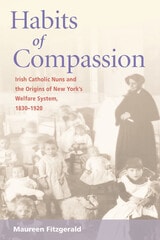
Habits of Compassion
Irish Catholic Nuns and the Origins of New York's Welfare System, 1830-1920Maureen Fitzgerald
University of Illinois Press, 2006
The Irish-Catholic Sisters accomplished tremendously successful work in founding charitable organizations in New York City from the Irish famine through the early twentieth century. Maureen Fitzgerald argues that their championing of the rights of the poor—especially poor women—resulted in an explosion of state-supported services and programs.
Parting from Protestant belief in meager and means-tested aid, Irish Catholic nuns argued for an approach based on compassion for the poor. Fitzgerald positions the nuns' activism as resistance to Protestantism's cultural hegemony. As she shows, Roman Catholic nuns offered strong and unequivocal moral leadership in condemning those who punished the poor for their poverty and unmarried women for sexual transgression. Fitzgerald also delves into the nuns' own communities, from the class-based hierarchies within the convents to the political power they wielded within the city. That power, amplified by an alliance with the local Irish Catholic political machine, allowed the women to expand public charities in the city on an unprecedented scale.
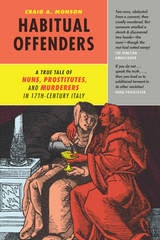
Habitual Offenders
A True Tale of Nuns, Prostitutes, and Murderers in Seventeenth-Century ItalyCraig A. Monson
University of Chicago Press, 2016
Drawing on over four thousand pages of primary sources, the intrepid Craig A. Monson reconstructs this fascinating history of crime and punishment in seventeenth-century Italy. Along the way, he explores Italy’s back streets and back stairs, giving us access to voices we rarely encounter in conventional histories: prostitutes and maidservants, mercenaries and bandits, along with other “dubious” figures negotiating the boundaries of polite society. Painstakingly researched and breathlessly told, Habitual Offenders will delight historians and true-crime fans alike.
Half Humankind
Contexts and Texts of the Controversy about Women in England, 1540-1640Katherine Usher Henderson and Barbara F. McManus
University of Illinois Press, 1985
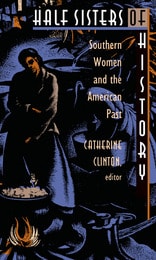
Half Sisters of History
Southern Women and the American PastCatherine Clinton
Duke University Press, 1994
This collection of essays by pioneering scholars surveys the roots and development of southern women’s history and examines the roles of white women and women of color across the boundaries of class and social status from the founding of the nation to the present. Authors including Anne Firor Scott, Elizabeth Fox-Genovese, Jacquelyn Dowd Hall, and Nell Irwin Painter, among others, analyze women’s participation in prewar slavery, their representation in popular fiction, and their involvement in social movements. In no way restricted to views of the plantation South, other essays examine the role of women during the American Revolution, the social status of Native American women, the involvement of Appalachian women in labor struggles, and the significance of women in the battle for civil rights. Because of their indelible impact on gender relations, issues of class, race, and sexuality figure centrally in these analyses.
Half Sisters of History will be important not only to women’s historians, but also to southern historians and women’s studies scholars. It will prove invaluable to anyone in search of a full understanding of the history of women, the South, or the nation itself.
Contributors. Catherine Clinton, Sara Evans, Elizabeth Fox-Genovese, Jacquelyn Dowd Hall, Jacqueline Jones, Suzanne D. Lebsock, Nell Irwin Painter, Theda Perdue, Anne Firor Scott, Deborah Gray White
Handbook of Medical Sociology, Sixth Edition
Chloe E. Bird
Vanderbilt University Press, 2010
• social networks, neighborhoods, and social capital
• disability
• dying and "the right to die"
• health disparities
• the growing influence of the pharmaceutical industry
• the Internet
• evidence-based medicine and quality of care
• health social movements
• genetics
• religion, spirituality, and health
Handmaid of the Holy Spirit
Dame Eleanor Davies, Never Soe Mad a LadieEsther S. Cope
University of Michigan Press, 1993
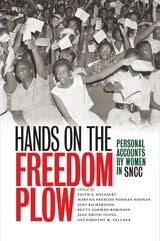
Hands on the Freedom Plow
Personal Accounts by Women in SNCCFaith S. Holsaert
University of Illinois Press, 2012

Hannah Ryggen
Threads of DefianceMarit Paasche
University of Chicago Press, 2019
A widely recognized authority on Ryggen, Marit Paasche brings this important Scandinavian artist to the foreground in this biography, the first published on Ryggen in English. Paasche looks at Ryggen within the social, political, and cultural contexts of her time and explores how these issues informed her work, from her anti-fascist tapestry that depicted a spear piercing Mussolini’s head to one protesting the war in Vietnam. Published to correspond with a major retrospective in Frankfurt, of which Paasche is one of the curators, Hannah Ryggen is a foundational book that will provide a crucial introduction of this artist to a broader audience.

Hanoi Jane
War, Sex, and Fantasies of BetrayalJerry Lembcke
University of Massachusetts Press, 2010
From Aristophanes' Lysistrata to the notorious Mata Hari and the legendary Tokyo Rose, stories of female betrayal during wartime have recurred throughout human history. The myth of Hanoi Jane, Jerry Lembcke argues, is simply the latest variation on this enduring theme. Like most of the iconic femmes fatales who came before, it is based on a real person, Jane Fonda. And also like its predecessors, it combines traces of fact with heavy doses of fiction to create a potent symbol of feminine perfidy—part erotic warrior-woman Barbarella, part savvy antiwar activist, and part powerful entrepreneur.
Hanoi Jane, the book, deconstructs Hanoi Jane, the myth, to locate its origins in the need of Americans to explain defeat in Vietnam through fantasies of home-front betrayal and the emasculation of the national will-to-war. Lembcke shows that the expression “Hanoi Jane” did not reach the eyes and ears of most Americans until five or six years after the end of the war in Vietnam. By then, anxieties about America's declining global status and deteriorating economy were fueling a populist reaction that pointed to the loss of the war as the taproot of those problems. Blaming the antiwar movement for undermining the military's resolve, many found in the imaginary Hanoi Jane the personification of their stab-in-the- back theories.
Ground zero of the myth was the city of Hanoi itself, which Jane Fonda had visited as a peace activist in July 1972. Rumors surrounding Fonda's visits with U.S. POWs and radio broadcasts to troops combined to conjure allegations of treason that had cost American lives. That such tales were more imagined than real did not prevent them from insinuating themselves into public memory, where they have continued to infect American politics and culture.
Hanoi Jane is a book about the making of Hanoi Jane by those who saw a formidable threat in the Jane Fonda who supported soldiers and veterans opposed to the war they fought, in the postcolonial struggle of the Vietnamese people to make their own future, and in the movements of women everywhere for gender equality.
Hanoi Journal, 1967
Carol McEldowney
University of Massachusetts Press, 2007
McEldowney first gained the respect of her fellow activists as a student organizer at the University of Michigan. High regard for her intelligence, skill, and hard work with SDS's Economic Recovery Action Program during the years following her graduation in 1964 earned her an invitation to attend an international conference in Czechoslovakia and an offer to continue on to North Vietnam. Though her journal displays only traces of the feminist consciousness that would mark her later political activism, she recorded her observations of North Vietnam clearly aware that she was an outsider—a woman not subject to the military draft, not married to a soldier, and without the heartache of a brother or even a close friend serving in the war.
McEldowney searched for glimpses of everyday life that would help her to better relate to women in Hanoi and the hardships they faced during wartime. As she traveled in North Vietnam, she sought a deeper understanding of the events of her time. Her journal provides readers with a unique lens through which to study those events and gain a new perspective on the Vietnam War era.
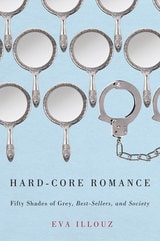
Hard-Core Romance
"Fifty Shades of Grey," Best-Sellers, and SocietyEva Illouz
University of Chicago Press, 2014
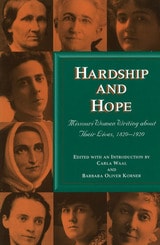
Hardship and Hope
Missouri Women Writing about Their Lives, 1820-1920Carla Waal and Barbara Oliver Korner, eds.
University of Missouri Press, 1997
Over the years Missouri women have endured many hardships: Civil War troops in their homes, the harshness of westward travel, the loneliness of the Gold Rush, and slavery. They have also greatly influenced the state's history. Marie Watkins Oliver made the state flag; Margaret Nelson Stephens was a gifted politician; Carry A. Nation fought for prohibition; and Mary Ezit Bulkley was active in the woman suffrage movement.
Hardship and Hope brings to life these and other known and unknown Missouri women through their own writings in journals, letters, diaries, and memoirs. Most of these pieces have never been published or have long been out of print. Carla Waal and Barbara Oliver Korner have skillfully crafted this anthology to represent myriad Missouri women. There are pieces representing the experiences of Jewish, Irish, and German immigrants, African Americans, well-educated women, and deeply religious women. Preceding each entry is a useful introduction that provides history and background on the woman and her work.
Readers will meet women like Phoebe Wilson Couzins, who was the first woman law graduate in Missouri. She went on to work with Susan B. Anthony for the suffrage movement but died in poverty, physically handicapped and emotionally unstable. Emma J. Ray was born a slave just before the Civil War. She and her husband did missionary work in jails and on the streets of Kansas City. Other women represented are Laura Ingalls Wilder, Kate Chopin, Fannie Hurst, and Henriette Geisberg Bruns.
Hardship and Hope began as a series of performances around the state of Missouri through which the book's editors demonstrated the roles women played in that state's past. Because of the enthusiastic response to their performances, Waal and Korner continued searching for documents by Missouri women and now share their discoveries in book form. Covering a little more than a century, from just before Missouri's admission to the Union in 1821 to the ratification of the Nineteenth Amendment that gave women the right to vote in 1920, the excerpts here both captivate and inform.
This anthology will appeal to those interested in women's studies, Missouri and midwestern history, and oral interpretation.
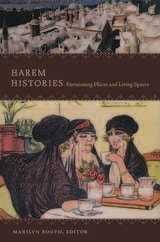
Harem Histories
Envisioning Places and Living SpacesMarilyn Booth, ed.
Duke University Press, 2010
Contributors. Asma Afsaruddin, Orit Bashkin, Marilyn Booth, Nadia Maria El Cheikh, Julia Clancy-Smith, Joan DelPlato, Jateen Lad, Nancy Micklewright, Yaseen Noorani, Leslie Peirce, Irvin Cemil Schick, A. Holly Schissler, Heghnar Zeitlian Watenpaugh
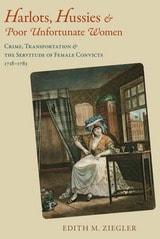
Harlots, Hussies, and Poor Unfortunate Women
Crime, Transportation, and the Servitude of Female Convicts, 1718-1783Edith M. Ziegler
University of Alabama Press, 2014
In Harlots, Hussies, and Poor Unfortunate Women, Edith M. Ziegler recounts the history of British convict women involuntarily transported to Maryland in the eighteenth century.
Great Britain’s forced transportation of convicts to colonial Australia is well known. Less widely known is Britain’s earlier program of sending convicts—including women—to North America. Many of these women were assigned as servants in Maryland. Titled using epithets that their colonial masters applied to the convicts, Edith M. Ziegler’s Harlots, Hussies, and Poor Unfortunate Women examines the lives of this intriguing subset of American immigrants.
Basing much of her powerful narrative on the experiences of actual women, Ziegler restores individual faces to women stripped of their basic freedoms. She begins by vividly invoking the social conditions of eighteenth-century Britain, which suffered high levels of criminal activity, frequently petty thievery. Contemporary readers and scholars will be fascinated by Ziegler’s explanation of how gender-influenced punishments were meted out to women and often ensnared them in Britain’s system of convict labor.
Ziegler depicts the methods and operation of the convict trade and sale procedures in colonial markets. She describes the places where convict servants were deployed and highlights the roles these women played in colonial Maryland and their contributions to the region’s society and economy. Ziegler’s research also sheds light on escape attempts and the lives that awaited those who survived servitude.
Mostly illiterate, convict women left few primary sources such as diaries or letters in their own words. Ziegler has masterfully researched the penumbra of associated documents and accounts to reconstruct the worlds of eighteenth-century Britain and colonial Maryland and the lives of these unwilling American settlers. In illuminating this little-known episode in American history, Ziegler also discusses not just the fact that these women have been largely forgotten, but why. Harlots, Hussies, and Poor Unfortunate Women makes a valuable contribution to American history, women’s studies, and labor history.
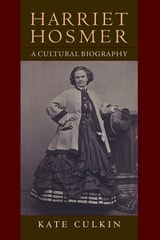
Harriet Hosmer
A Cultural BiographyKate Culkin
University of Massachusetts Press, 2010
In 1852 Hosmer moved from Boston to Rome, where she shared a house with actress Charlotte Cushman and soon formed close friendships with such prominent expatriates as Robert and Elizabeth Barrett Browning and fellow sculptors John Gibson, Emma Stebbins, and William Wetmore Story. References to Hosmer or characters inspired by her appear in the work of Nathaniel Hawthorne, Louisa May Alcott, and Kate Field among others. Culkin argues that Hosmer's success was made possible by her extensive network of supporters, including her famous friends, boosters of American gentility, and women's rights advocates. This unlikely coalition, along with her talent, ambition, and careful maintenance of her public profile, ultimately brought her great acclaim. Culkin also addresses Hosmer's critique of women's position in nineteenth-century culture through her sculpture, women's rights advocates' use of high art to promote their cause, the role Hosmer's relationships with women played in her life and success, and the complex position a female artist occupied within a country increasingly interested in proving its gentility.
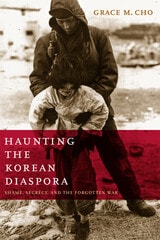
Haunting the Korean Diaspora
Shame, Secrecy, and the Forgotten WarGrace M. Cho
University of Minnesota Press, 2008
Grace M. Cho exposes how Koreans in the United States have been profoundly affected by the forgotten war and uncovers the silences and secrets that still surround it, arguing that trauma memories have been passed unconsciously through a process psychoanalysts call “transgenerational haunting.” Tracing how such secrets have turned into “ghosts,” Cho investigates the mythic figure of the yanggongju, literally the “Western princess,” who provides sexual favors to American military personnel. She reveals how this figure haunts both the intimate realm of memory and public discourse, in which narratives of U.S. benevolence abroad and assimilation of immigrants at home go unchallenged. Memories of U.S. violence, Cho writes, threaten to undo these narratives—and so they have been rendered unspeakable.
At once political and deeply personal, Cho’s wide-ranging and innovative analysis of U.S. neocolonialism and militarism under contemporary globalization brings forth a new way of understanding—and remembering—the impact of the Korean War.
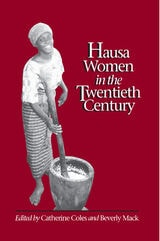
Hausa Women in the Twentieth Century
Edited by Catherine M. Coles and Beverly Mack
University of Wisconsin Press, 1991
Hausa Women in the Twentieth Century refutes the notion that Hausa women are pawns in a patriarchal Muslim society. The contributors, all of whom have done field research in Hausaland, explore the ways Hausa women have balanced the demands of Islamic expectations and Western choices as their society moved from a precolonial system through British colonial administration to inclusion in the modern Nigerian nation. This volume examines the roles of a wide variety of women, from wives and workers to political activists and mythical figures, and it emphasizes that women have been educators and spiritual leaders in Hausa society since precolonial times. From royalty to slaves and concubines, in traditional Hausa cities and in newer towns, from the urban poor to the newly educated elite, the "invisible women" whose lives are documented here demonstrate that standard accounts of Hausa society must be revised.
Scholars of Hausa and neighboring West African societies will find in this collection a wealth of new material and a model of how research on women can be integrated with general accounts of Hausa social, religious, political, and economic life. For students and scholars looking at gender and women's roles cross-culturally, this volume provides an invaluable African perspective.
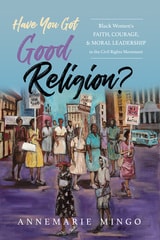
Have You Got Good Religion?
Black Women's Faith, Courage, and Moral Leadership in the Civil Rights MovementAnneMarie Mingo
University of Illinois Press, 2024
A depiction of moral imagination that resonates today, Have You Got Good Religion? reveals how Black Churchwomen’s understanding of God became action and transformed a nation.
Hawthorne and Women
Engendering and Expanding the Hawthorne TraditionJohn L. Idol
University of Massachusetts Press, 1999
This collection of original essays presents a more complex and positive view of Hawthorne's attitudes toward women, demonstrating his recognition of the crucial role that women played--as critics, reviewers, readers, and authors--in building a national readership that made his writing career so successful.
The book begins with an examination of the influence exerted by the women in Hawthorne's immediate family. It goes on to explore his links to a broad range of women writers, as well as his attitudes toward the female characters he created. Among the authors discussed are Margaret Fuller, Harriet Beecher Stowe, Louisa May Alcott, Emily Dickinson, Sarah Orne Jewett, Willa Cather, Charlotte Perkins Gilman, George Eliot, Virginia Woolf, Flannery O'Connor, and Toni Morrison.
Hawthorne's Fuller Mystery
Thomas R. Mitchell
University of Massachusetts Press, 2009
Drawing on recently published letters and journals, Thomas R. Mitchell describes how Julian Hawthorne's misrepresentation of his father's relationship with Fuller destroyed her literary reputation, promoted Hawthorne as a defender of conservative values, and continues to obscure the depth of Hawthorne's personal and intellectual involvement with her. Mitchell concludes that far from being repulsed by Fuller and her assertiveness--as many scholars have claimed--Hawthorne experienced with her perhaps the most intimate relationship that he ever had with a woman, his wife alone excepted.
Blending biography, cultural history, and literary and psychological analysis, Hawthorne's Fuller Mystery raises provocative questions about the origins and intent of Hawthorne's greatest works and offers compelling new readings of "Rapaccini's Daughter," The Scarlet Letter, The Blithedale Romance, and The Marble Faun.

He Knew She Was Right
The Independent Woman in the Novels of Anthony TrollopeJane Nardin
Southern Illinois University Press, 1989
Trollope’s mother, wife, and a friend he loved platonically most of his life provided him three very different views of the Victorian woman. And, according to Jane Nardin, they were responsible for the dramatic shift in his treatment of women in his novels.
This is the first book in Sandra Gilbert’s Ad Feminam series to examine a male author. Nardin initially analyzes the novels Trollope wrote from 1855 to 1861, in which male concerns are central to the plot and women are angelic heroines, submissive and self-sacrificing. Even the titles of his novels written during this period are totally male oriented. The Three Clerks, Doctor Thorne, and The Bertrams all refer to men. Shortly after meeting Kate Field, Trollope wrote Orley Farm, which refers to the estate an angry woman steals from her husband and which marks a change in the attitudes toward women evident in his novels.
His next four books, The Small House at Allington, Rachel Ray, Can You Forgive Her?, and Miss Mackenzie, prove that women’s concerns had become central in his writing. Nardin examines specific novels written from 1861 to 1865 in which Trollope, with increasing vigor, subverts the conventional notions of gender that his earlier novels had endorsed.
Nardin argues that his novels written after 1865 and often recognized as feminist are not really departures but merely refinements of attitudes Trollope exhibited in earlier works.
Hear #MeToo in India
News, Social Media, and Anti-Rape and Sexual Harassment ActivismPallavi Guha
Rutgers University Press, 2021
Hear Our Truths
The Creative Potential of Black GirlhoodRuth Nicole Brown
University of Illinois Press, 2013
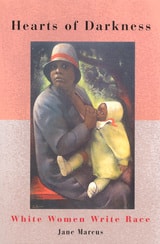
Hearts of Darkness
White Women Write RaceMarcus, Jane
Rutgers University Press, 2004
The centerpiece of the book is Marcus's dialogue with one of her best-known essays, "Britannia Rules The Waves." In that piece, she argues that The Waves makes a strong anti-imperialist statement. Although many already support that argument, she now goes further in order to question the moral value of such a buried critique on Woolf's part. In "A Very Fine Negress" she analyzes the painful subject of Virginia Woolf's racism in A Room of One's Own. Other chapters traverse the connected issues of modernism, race, and imperialism. In two of them, we follow Nancy Cunard through the making of the Negro anthology and her appearance in a popular novel of the freewheeling Jazz Age. Elsewhere, Marcus delivers a complex analysis of A Passage to India, in a reading that interrogates E. M. Forster's displacement of his fear of white Englishwomen struggling for the vote.
Marcus, as always, brings considerable gifts as both researcher and writer to this collection of new and reprinted essays, a combination resulting in a powerful interpretation of many of modernism's most cherished figures.
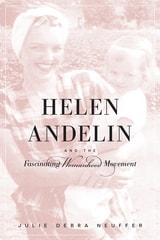
Helen Andelin and the Fascinating Womanhood Movement
Julie Debra Neuffer
University of Utah Press, 2014
Countering second-wave feminists in the 1960s, Andelin preached family values and urged women not to have careers, but to become good wives, mothers, and homemakers instead. A woman’s true happiness, taught Andelin, could only be realized if she admired, cared for, and obeyed her husband. As Andelin’s notoriety grew, so did the backlash from her critics. Undeterred, she became a national celebrity, who was interviewed extensively and appeared in sold-out speaking engagements.
Andelin’s message calling for the return to traditional roles appealed to many in a time of uncertainty and radical social change. This study provides an evenhanded and important look at a crucial, but often overlooked cross section of American women as they navigated their way through the turbulent decades following the post-war calm of the 1950s.
Winner of the Mormon History Association's Best Biography Award.
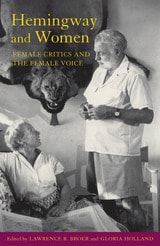
Hemingway and Women
Female Critics and the Female VoiceLawrence R. Broer
University of Alabama Press, 2003
Ernest Hemingway has often been criticized as a misogynist because of his portrayal of women. But some of the most exciting Hemingway scholarship of recent years has come from women scholars who challenge traditional views of Hemingway and women. The essays in this collection range from discussions of Hemingway’s famous heroines Brett Ashley and Catherine Barkley to examinations of the central role of gender in his short stories and in the novel The Garden of Eden. Other essays address the real women in Hemingway’s life—those who cared for him, competed with him, and, ultimately, helped to shape his art. While Hemingway was certainly influenced by traditional perceptions of women, these essays show that he was also aware of the struggle of the emerging new woman of his time. Making this gender struggle a primary concern of his fiction, these critics argue, Hemingway created women with strength, depth, and a complexity that readers are only beginning to appreciate.
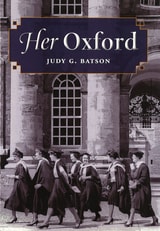
Her Oxford
Judy G. Batson
Vanderbilt University Press, 2008
Her Oxford looks at the people and the political and social forces that produced this dramatic transformation. Drawing on a vast array of biographies, histories, obituaries, and archives, Batson traces not only the institutional struggles over privileges and disciplinary rules for women, but also the rich texture of everyday life-women's amateur theatricals, debating societies, sports, and college escapades (Dorothy Sayers is the subject of quite a few). She tells the stories of women's active roles in two war efforts and in the suffrage movement.
An unusual feature of the book is the set of 120 biographical profiles of women who attended Oxford between 1879 and 1960. They constitute a Who's Who of women scientists, anthropologists, psychotherapists, educators, novelists, and social reformers in the English-speaking world.
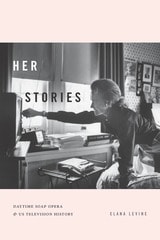
Her Stories
Daytime Soap Opera and US Television HistoryElana Levine
Duke University Press, 2020
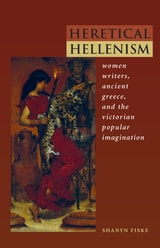
Heretical Hellenism
Women Writers, Ancient Greece, and the Victorian Popular ImaginationShanyn Fiske
Ohio University Press, 2008
The prevailing assumption regarding the Victorians’ relationship to ancient Greece is that Greek knowledge constituted an exclusive discourse within elite male domains. Heretical Hellenism: Women Writers, Ancient Greece, and the Victorian Popular Imagination challenges that theory and argues that while the information women received from popular sources was fragmentary and often fostered intellectual insecurities, it was precisely the ineffability of the Greek world refracted through popular sources and reconceived through new fields of study that appealed to women writers’ imaginations.
Examining underconsidered sources such as theater history and popular journals, Shanyn Fiske uncovers the many ways that women acquired knowledge of Greek literature, history, and philosophy without formal classical training. Through discussions of women writers such as Charlotte Brontë, George Eliot, and Jane Harrison, Heretical Hellenism demonstrates that women established the foundations of a heretical challenge to traditional humanist assumptions about the uniformity of classical knowledge and about women’s place in literary history.
Heretical Hellenism provides a historical rationale for a more expansive definition of classical knowledge and offers an interdisciplinary method for understanding the place of classics both in the nineteenth century and in our own time.
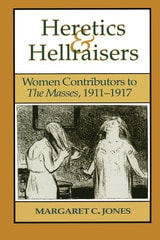
Heretics and Hellraisers
Women Contributors to The Masses, 1911-1917By Margaret C. Jones
University of Texas Press, 1993
The Masses was the most dynamic and influential left-wing magazine of the early twentieth century, a touchstone for understanding radical thought and social movements in the United States during that era. As a magazine that supported feminist issues, it played a crucial role in shaping public discourse about women's concerns. Women editors, fiction writers, poets, and activists like Mary Heaton Vorse, Louise Bryant, Adriana Spadoni, Elsie Clews Parsons, Inez Haynes Gillmore, and Helen Hull contributed as significantly to the magazine as better-known male figures.
In this major revisionist work, Margaret C. Jones calls for reexamination of the relevance of Masses feminism to that of the 1990s. She explores women contributors' perspectives on crucial issues: patriarchy, birth control, the labor movement, woman suffrage, pacifism, and ethnicity. The book includes numerous examples of the writings and visual art of Masses women and a series of biographical/bibliographical sketches designed to aid other researchers.
Herlands
Exploring the Women's Land Movement in the United StatesKeridwen N. Luis
University of Minnesota Press, 2018
How women-only communities provide spaces for new forms of culture, sociality, gender, and sexuality
Women’s lands are intentional, collective communities composed entirely of women. Rooted in 1970s feminist politics, they continue to thrive in a range of ways, from urban households to isolated rural communes, providing spaces where ideas about gender, sexuality, and sociality are challenged in both deliberate and accidental ways. Herlands, a compelling ethnography of women’s land networks in the United States, highlights the ongoing relevance of these communities as vibrant cultural enclaves that also have an impact on broader ideas about gender, women’s bodies, lesbian identity, and right ways of living.
As a participant-observer, Keridwen N. Luis brings unique insights to the lives and stories of the women living in these communities. While documenting the experiences of specific spaces in Massachusetts, Tennessee, New Mexico, and Ohio, Herlands also explores the history of women’s lands and breaks new ground exploring culture theory, gender theory, and how lesbian identity is conceived and constructed in North America. Luis also discusses how issues of race and class are addressed, the ways in which nudity and public hygiene challenge dominant constructions of the healthy or aging body, and the pervasive influence of hegemonic thinking on debates about transgender women. Luis finds that although changing dominant thinking can be difficult and incremental, women’s lands provide exciting possibilities for revolutionary transformation in society.
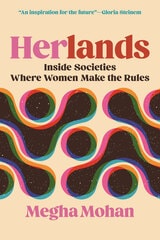
Herlands
Inside Societies Where Women Make the RulesMegha Mohan
Michigan State University Press, 2027
In this vital and groundbreaking book, Megha Mohan introduces readers to a range of fascinating, women-led societies. Inspired by her great-grandmother’s matrilineal community in South India, Mohan explores communities around the globe—from controversial feminist online troll networks in South Korea to older women co-housing in Paris and North London to the Rain Queens of South Africa. The result is a vivid, global portrait of women’s communities.
Through extensive research and exclusive first-hand reporting, Mohan goes in search of the roots of women-led societies, revealing a vibrant global history brought together for the first time. She also takes us into modern spaces where women live on their own terms, showing us how we can rethink society for new ways of living, working, and collaborating.
For anyone interested in our collective histories, cultures, economics, and governance, Herlands shows the power and possibility of new ways of living—and leading—for us all. It’s an important landmark exploration for our times that not only explores fascinating ways of living but also addresses broader questions about new ways to think and govern and why it matters.

Heroines of Popular Culture
Edited by Ray B. Browne
University of Wisconsin Press, 1987
Hidden Hands
Working-Class Women and Victorian Social-Problem FictionPatricia E. Johnson
Ohio University Press, 2001
Tracing the Victorian crisis over the representation of working-class women to the 1842 Parliamentary bluebook on mines, with its controversial images of women at work, Hidden Hands argues that the female industrial worker became even more dangerous to represent than the prostitute or the male radical because she exposed crucial contradictions between the class and gender ideologies of the period and its economic realities.
Drawing on the recent work of feminist historians, Patricia Johnson lays the groundwork for a reinterpretation of Victorian social-problem fiction that highlights its treatment of issues that particularly affected working-class women: sexual harassment; the interconnections between domestic ideology and domestic violence; their relationships to male-dominated working-class movements such as Luddism, Chartism, and unionism; and their troubled connection to middle-class feminism.
Uncovering a series of images in Victorian fiction ranging from hot-tempered servants and sexually harassed factory girls to working-class homemakers pictured as beaten dogs, Hidden Hands demonstrates that representations of working-class women, however marginalized or incoherent, reveal the very contradictions they are constructed to hide and that the dynamics of these representations have broad implications both for other groups, such as middle-class women, and for the emergence of working-class women as writers themselves.
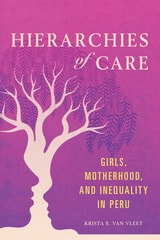
Hierarchies of Care
Girls, Motherhood, and Inequality in PeruKrista E. Van Vleet
University of Illinois Press, 2019
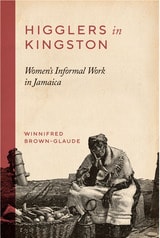
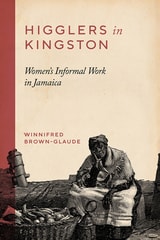
Higglers in Kingston
Women's Informal Work in JamaicaWinnifred Brown-Glaude
Vanderbilt University Press, 2011
In Higglers in Kingston, Winnifred Brown-Glaude puts the reader on the ground in frenetic urban Kingston, the capital and largest city in Jamaica. She explores the lives of informal market laborers, called "higglers," across the city as they navigate a corrupt and inaccessible "official" Jamaican economy. But rather than focus merely on the present-day situation, she contextualizes how Jamaica arrived at this point, delving deep into the island's history as a former colony, a home to slaves and masters alike, and an eventual nation of competing and conflicted racial sectors.
Higglers in Kingston weaves together contemporary ethnography, economic history, and sociology of race to address a broad audience of readers on a crucial economic and cultural center.
Higglers in Kingston
Women's Informal Work in JamaicaWinnifred Brown-Glaude
Vanderbilt University Press, 2011
In Higglers in Kingston, Winnifred Brown-Glaude puts the reader on the ground in frenetic urban Kingston, the capital and largest city in Jamaica. She explores the lives of informal market laborers, called "higglers," across the city as they navigate a corrupt and inaccessible "official" Jamaican economy. But rather than focus merely on the present-day situation, she contextualizes how Jamaica arrived at this point, delving deep into the island's history as a former colony, a home to slaves and masters alike, and an eventual nation of competing and conflicted racial sectors.
Higglers in Kingston weaves together contemporary ethnography, economic history, and sociology of race to address a broad audience of readers on a crucial economic and cultural center.
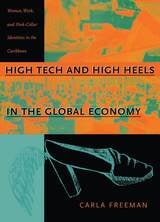
High Tech and High Heels in the Global Economy
Women, Work, and Pink-Collar Identities in the CaribbeanCarla Freeman
Duke University Press, 2000
Freeman examines the expansion of the global assembly line into the realm of computer-based work, and focuses specifically on the incorporation of young Barbadian women into these high-tech informatics jobs. As such, Caribbean women are seen as integral not simply to the workings of globalization but as helping to shape its very form. Through the enactment of “professionalism” in both appearances and labor practices, and by insisting that motherhood and work go hand in hand, they re-define the companies’ profile of “ideal” workers and create their own “pink-collar” identities. Through new modes of dress and imagemaking, the informatics workers seek to distinguish themselves from factory workers, and to achieve these new modes of consumption, they engage in a wide array of extra income earning activities. Freeman argues that for the new Barbadian pink-collar workers, the globalization of production cannot be viewed apart from the globalization of consumption. In doing so, she shows the connections between formal and informal economies, and challenges long-standing oppositions between first world consumers and third world producers, as well as white-collar and blue-collar labor.
Written in a style that allows the voices of the pink-collar workers to demonstrate the simultaneous burdens and pleasures of their work, High Tech and High Heels in the Global Economy will appeal to scholars and students in a wide range of disciplines, including anthropology, cultural studies, sociology, women’s studies, political economy, and Caribbean studies, as well as labor and postcolonial studies.
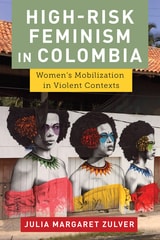
High-Risk Feminism in Colombia
Women's Mobilization in Violent ContextsJulia Margaret Zulver
Rutgers University Press, 2022
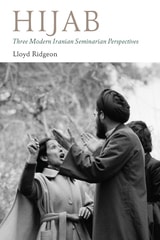
Hijab
Three Modern Iranian Seminarian PerspectivesLloyd Ridgeon
Gingko, 2021
Ḥijāb addresses the differences of opinion among seminarians on the hijab in the Islamic Republic of Iran, focusing on three representative thinkers: Murtaza Mutahhari who held veiling to be compulsory, Ahmad Qabil who argued for the desirability of the hijab, and Muhsin Kadivar who considers it neither necessary nor desirable. In the first chapter, the views of these three scholars are contextualized within the framework known as ‘new religious thinking’ among the seminarians. Comprehending the hermeneutics of this new religious thinking is key to appreciating how and why the younger generation of scholars have offered divergent judgements about the hijab. Following the first chapter, the book is divided into three parallel sections, each devoted to one of the three seminarians. These present a chronological approach, and each scholar’s position on the hijab is assessed with reference to historical specificity and their own general jurisprudential perspective. Extensive examples of the writings of the three scholars on the hijab are also provided.
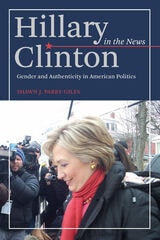
Hillary Clinton in the News
Gender and Authenticity in American PoliticsShawn J. Parry-Giles
University of Illinois Press, 2014
The charge of inauthenticity has trailed Hillary Clinton from the moment she entered the national spotlight and stood in front of television cameras. Hillary Clinton in the News: Gender and Authenticity in American Politics shows how the U.S. news media created their own news frames of Clinton's political authenticity and image-making, from her participation in Bill Clinton's 1992 presidential campaign through her own 2008 presidential bid.
Using theories of nationalism, feminism, and authenticity, Parry-Giles tracks the evolving ways the major networks and cable news programs framed Clinton's image as she assumed roles ranging from surrogate campaigner, legislative advocate, and financial investor to international emissary, scorned wife, and political candidate. This study magnifies how the coverage that preceded Clinton's entry into electoral politics was grounded in her earliest presence in the national spotlight, and in long-standing nationalistic beliefs about the boundaries of authentic womanhood and first lady comportment. Once Clinton dared to cross those gender boundaries and vie for office in her own right, the news exuded a rhetoric of sexual violence. These portrayals served as a warning to other women who dared to enter the political arena and violate the protocols of authentic womanhood.

Hillbilly Maidens, Okies, and Cowgirls
Women's Country Music, 1930-1960Stephanie Vander Wel
University of Illinois Press, 2020
From the 1930s to the 1960s, the booming popularity of country music threw a spotlight on a new generation of innovative women artists. These individuals blazed trails as singers, musicians, and performers even as the industry hemmed in their potential popularity with labels like woman hillbilly, singing cowgirl, and honky-tonk angel.
Stephanie Vander Wel looks at the careers of artists like Patsy Montana, Rose Maddox, and Kitty Wells against the backdrop of country music's golden age. Analyzing recordings and appearances on radio, film, and television, she connects performances to real and imagined places and examines how the music sparked new ways for women listeners to imagine the open range, the honky-tonk, and the home. The music also captured the tensions felt by women facing geographic disruption and economic uncertainty. While classic songs and heartfelt performances might ease anxieties, the subject matter underlined women's ambivalent relationships to industrialism, middle-class security, and established notions of femininity.
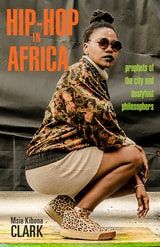
Hip-Hop in Africa
Prophets of the City and Dustyfoot PhilosophersMsia Kibona Clark
Ohio University Press, 2018
Throughout Africa, artists use hip-hop both to describe their lives and to create shared spaces for uncensored social commentary, feminist challenges to patriarchy, and resistance against state institutions, while at the same time engaging with the global hip-hop community. In Hip-Hop in Africa, Msia Kibona Clark examines some of Africa’s biggest hip-hop scenes and shows how hip-hop helps us understand specifically African narratives of social, political, and economic realities.
Clark looks at the use of hip-hop in protest, both as a means of articulating social problems and as a tool for mobilizing listeners around those problems. She also details the spread of hip-hop culture in Africa following its emergence in the United States, assessing the impact of urbanization and demographics on the spread of hip-hop culture.
Hip-Hop in Africa is a tribute to a genre and its artists as well as a timely examination that pushes the study of music and diaspora in critical new directions. Accessibly written by one of the foremost experts on African hip-hop, this book will easily find its place in the classroom.
Hobomok and Other Writings on Indians
Karcher, Carolyn L
Rutgers University Press, 1986
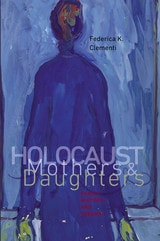
Holocaust Mothers and Daughters
Family, History, and TraumaFederica K. Clementi
Brandeis University Press, 2013
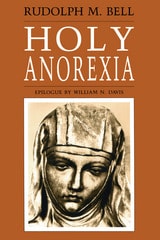
Holy Anorexia
Rudolph M. Bell
University of Chicago Press, 1985
"Everyone interested in anorexia nervosa . . . should skim this book or study it. It will make you realize how dependent upon culture the definition of disease is. I will never look at an anorexic patient in the same way again."—Howard Spiro, M.D., Gastroenterology
"[This] book is a first-class social history and is well-documented both in its historical and scientific portions."—Vern L. Bullough, American Historical Review
"A significant contribution to revisionist history, which re-examines events in light of feminist thought. . . . Bell is particularly skillful in describing behavior within its time and culture, which would be bizarre by today's norms, without reducing it to the pathological."—Mary Lassance Parthun, Toronto Globe and Mail
"Bell is both enlightened and convincing. His book is impressively researched, easy to read, and utterly fascinating."—Sheila MacLeod, New Statesman
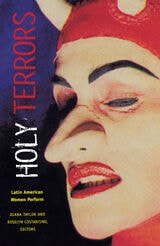
Holy Terrors
Latin American Women PerformDiana Taylor and Roselyn Costantino, eds.
Duke University Press, 2003
The performance pieces in Holy Terrors are powerful testimonies to the artists' political and personal struggles. These women confront patriarchy, racism, and repressive government regimes and challenge brutality and corruption through a variety of artistic genres. Several have formed theatre collectives—among them FOMMA (a Mayan women’s theatre company in Chiapas) and El Teatro de la máscara in Colombia. Some draw from cabaret and ‘frivolous’ theatre traditions to create intense and humorous performances that challenge church and state. Engaging in self-mutilation and abandoning traditional dress, others use their bodies as the platforms on which to stage their defiant critiques of injustice. Holy Terrors is a unique English-language presentation of some of Latin America's fiercest, most provocative art.
Contributors
Sabina Berman
Tania Bruguera
Petrona de la Cruz Cruz
Diamela Eltit
Griselda Gambaro
Astrid Hadad
Teresa Hernández
Rosa Luisa Márquez
Teresa Ralli
Diana Raznovich
Jesusa Rodríguez
Denise Stoklos
Katia Tirado
Ema Villanueva

Home Away from Home
Japanese Corporate Wives in the United StatesSawa Kurotani
Duke University Press, 2005
Kurotani interviewed and spent time with more than 120 women in three U.S. locations with sizable expatriate Japanese communities: Centerville, a pseudonymous Midwestern town; the New York metropolitan area; and North Carolina’s Research Triangle area. She highlights the contradictory situations faced by the transient wives. Their husbands’ assignments in the United States typically last from three to five years, and they frequently emphasize the temporariness of their situation, referring to it as a “long vacation.” Yet they are responsible for creating comfortable homes for their families, which necessitates producing a familiar and permanent environment. Kurotani looks at the dynamic friendships that develop among the wives and describes their feelings about returning to Japan. She conveys how their sense of themselves as Japanese women, of home, and of their relationships with family members are altered by their personal experiences of transnational homemaking.
Home Girls, 40th Anniversary Edition
A Black Feminist AnthologyBarbara Smith
Rutgers University Press, 2024
Contributors: Tania Abdulahad, Donna Allegra, Barbara A. Banks, Becky Birtha, Cenen, Cheryl Clarke, Michelle Cliff, Michelle T. Clinton, Willi (Willie) M. Coleman, Toi Derricotte, Alexis De Veaux, Jewelle L. Gomez, Akasha (Gloria) Hull, Patricia Spears Jones, June Jordan, Audre Lorde, Raymina Y. Mays, Deidre McCalla, Chirlane McCray, Pat Parker, Linda C. Powell, Bernice Johnson Reagon, Spring Redd, Gwendolyn Rogers, Kate Rushin, Ann Allen Shockley, Barbara Smith, Beverly Smith, Shirley O. Steele, Luisah Teish, Jameelah Waheed, Alice Walker, and Renita J. Weems.
Home Movies and Other Necessary Fictions
Michelle Citron
University of Minnesota Press, 1998