Results by title
8113 books match the query 'Literary Criticism' and 211 start with h
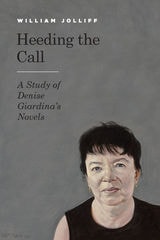
Heeding the Call
A Study of Denise Giardina's NovelsWilliam Jolliff
West Virginia University Press, 2020
In chapters devoted to each of Giardina’s novels, Jolliff attends to her uses of history, her formal techniques, and the central themes that make each work significant. What becomes clear is that while the author’s religious beliefs inform her fiction, she never offers easy answers. Her narratives consistently push her characters—and her readers—into more challenging and meaningful questions. Jolliff concludes by arguing that although Giardina’s initial fame has been tied to her significance as an Appalachian novelist, future studies must look beyond the regional to the deeply human questions her novels so persistently engage.
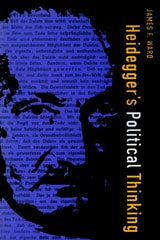
Heidegger's Political Thinking
James F. Ward
University of Massachusetts Press, 1995
In recent years there has been much controversy concerning Martin Heidegger’s politics, prompted by new research on the nature and extent of his engagement with National Socialism. Examining the political ideas embedded in Heidegger’s larger philosophical oeuvre, James F. Ward moves beyond the narrow preoccupation with Heidegger’s overtly pro-Nazi utterances and activities to show how the central theme of Heidegger’s philosophy—the question of Being—is itself inherently political.
Ward builds his case on close readings of texts drawn from nearly all of the writings published during Heidegger’s lifetime as well as from lectures, course transcripts, and other materials that appeared posthumously. With subtlety and insight, he uncovers the political content of Heidegger’s thinking on such topics as the temporality of Being, the role of science in the crisis of the West, and the presumed special status and destiny of the German people. In an epilogue, Ward reflects on the implications of Heidegger’s political thinking for postmodern political theory.
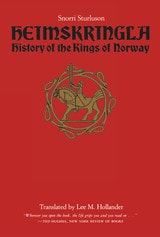
Heimskringla
History of the Kings of NorwayBy Snorri Sturluson
University of Texas Press, 1964
Beginning with the dim prehistory of the mythical gods and their descendants, Heimskringla recounts the history of the kings of Norway through the reign of Olaf Haraldsson, who became Norway's patron saint. Once found in most homes and schools and still regarded as a national treasure, Heimskringla influenced the thinking and literary style of Scandinavia over several centuries.

Heiress of All the Ages
Sex and Sentiment in the Genteel TraditionWilliam Wasserstrom
University of Minnesota Press, 1959
Heiress of All the Ages was first published in 1959. Minnesota Archive Editions uses digital technology to make long-unavailable books once again accessible, and are published unaltered from the original University of Minnesota Press editions.
In a provocative study of American literature, Professor Wasserstrom reappraises the genteel tradition and its place in social and intellectual history. He shows that our image of this tradition has been inadequate, that most of our writers and critics have failed to recognize its profound effects.
Basing his discussion primarily on a study of the major novelists of the period from 1830 to the present, the author examines the role of women in fiction and defines some of our national attitudes toward love. He discusses especially the world of Henry James (from whose phrase "heir of all the ages" the title of this book is derived), William Dean Howells, Nathaniel Hawthorne, James Fenimore Cooper, Edith Wharton, and Robert Penn Warren. He also considers such well known novelists of their day as Bret Harte, Edgar Fawcett, Robert Herrick, Henry B. Fuller, Hamlin Garland, and Gertrude Atherton. In addition, his study is based on source material of the period: diaries, recipe books, family magazines, early issues of sociology and psychology journals, and travel books.
This book will interest not only students of literature and history but also those in the general field of American civilization and sociologists and psychologists concerned with the relation of American literature to our mores.
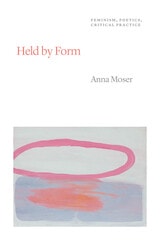
Held by Form
Feminism, Poetics, Critical PracticeAnna Moser
University of Chicago Press, 2026
How contemporary poetry illuminates the workings—and struggles—of commitment in feminism.
In this lucid and vigorous defense of poetics for feminism, Anna Moser situates the practice of contemporary poetry in an exploratory dialogue with the work of philosophical, critical, and historical thinkers—placing Denise Riley in conversation with Judith Butler, Lyn Hejinian with Hannah Arendt, m. nourbeSe philip with Saidiya Hartman, and Susan Howe with Emily Dickinson.
Moser’s central theme is these poets’ questioning, agonistic commitment to feminism. What, the book asks, does it mean to be committed? How does such a commitment materialize? What are its consequences? What does it mean not to take for granted an affiliation like “feminist” (or even “woman”), but rather to involve one’s art in probing its historical formations, present conditions, and future trajectories? Moser explores both the risks and possibilities of making art in this equivocal condition. She reveals that the poetry of certain contemporary writers not only unfolds within this space of agonistic commitment, but that, in doing so, it offers an important contribution to feminist thinking. Moser’s book also shows that while form is a constraint that limits these poets’ freedom, it also holds them in a more sustaining sense, allowing something belatedly and imperfectly to be said.
In dialogue with feminist political theory, philosophy, historiography, and aesthetics, Held by Form reveals poetics as a unique mode of critical practice: one that models relations of care and collectivity, refigures inherited forms in ways that contest their hierarchies of value, and responds with generosity and openness to the complexities of living in gender.
Heliand
Text and CommentaryEdited by James E. Cathey
West Virginia University Press, 2002
James E. Cathey's Hêliand: Text and Commentary is a simply unique, wonderfully encompassing, and helpful text, and nothing quite like it exists anywhere in the world. The commentary portion of the book consists of an interweaving of interpretation and philological consideration. This work presents the reader with explanatory commentary that encompasses both the scientific and the poetic and treats them both with equal felicity. The volume also contains something that is exceptionally valuable and cannot be found in English: a compact and serviceable grammar of Old Saxon and an appended glossary that defines all of the vocabulary found in this edited version of the Hêliand.
Hell of a Vision
Regionalism and the Modern American WestRobert L. Dorman
University of Arizona Press, 2012
The American West has taken on a rich and evocative array of regional identities since the late nineteenth century. Wilderness wonderland, Hispanic borderland, homesteader’s frontier, cattle kingdom, urban dynamo, Native American homeland. Hell of a Vision explores the evolution of these diverse identities during the twentieth century, revealing how Western regionalism has been defined by generations of people seeking to understand the West’s vast landscapes and varied cultures.
Focusing on the American West from the 1890s up to the present, Dorman provides us with a wide-ranging view of the impact of regionalist ideas in pop culture and diverse fields such as geography, land-use planning, anthropology, journalism, and environmental policy-making.
Going well beyond the realm of literature, Dorman broadens the discussion by examining a unique mix of texts. He looks at major novelists such as Cather, Steinbeck, and Stegner, as well as leading Native American writers. But he also analyzes a variety of nonliterary sources in his book, such as government reports, planning documents, and environmental impact studies.
Hell of a Vision is a compelling journey through the modern history of the American West—a key region in the nation of regions known as the United States.

Hellenistic Greek Texts
Allen P. Wikgren
University of Chicago Press, 1947
An introduction to koine Greek and Hellenistic culture and religion, a selected bibliography, brief prefaces to the selections, and a complete vocabulary are also included in this volume.
Hemingway and Women
Female Critics and the Female VoiceLawrence R. Broer
University of Alabama Press, 2003
Ernest Hemingway has often been criticized as a misogynist because of his portrayal of women. But some of the most exciting Hemingway scholarship of recent years has come from women scholars who challenge traditional views of Hemingway and women. The essays in this collection range from discussions of Hemingway’s famous heroines Brett Ashley and Catherine Barkley to examinations of the central role of gender in his short stories and in the novel The Garden of Eden. Other essays address the real women in Hemingway’s life—those who cared for him, competed with him, and, ultimately, helped to shape his art. While Hemingway was certainly influenced by traditional perceptions of women, these essays show that he was also aware of the struggle of the emerging new woman of his time. Making this gender struggle a primary concern of his fiction, these critics argue, Hemingway created women with strength, depth, and a complexity that readers are only beginning to appreciate.
Hemingway and the Black Renaissance
Edited by Gary Edward Holcomb and Charles Scruggs
The Ohio State University Press, 2012
Hemingway and the Black Renaissance, edited by Gary Edward Holcomb and Charles Scruggs, explores a conspicuously overlooked topic: Hemingway’s wide-ranging influence on writers from the Harlem Renaissance to the present day. An observable who’s who of black writers—Ralph Ellison, James Baldwin, Langston Hughes, Claude McKay, Wallace Thurman, Chester Himes, Alex la Guma, Derek Walcott, Gayl Jones, and more—cite Hemingway as a vital influence. This inspiration extends from style, Hemingway’s minimalist art, to themes of isolation and loneliness, the dilemma of the expatriate, and the terrifying experience of living in a time of war. The relationship, nevertheless, was not unilateral, as in the case of Jean Toomer’s 1923 hybrid, short-story cycle Cane, which influenced Hemingway’s collage-like 1925 In Our Time.
Hemingway on Love
By Robert W. Lewis, Jr.
University of Texas Press, 1965
Love was a central theme of Ernest Hemingway’s major works. And although his passages on sexual love and on romantic love may be widely remembered and frequently quoted, says Robert W. Lewis in this scholarly and detailed consideration, Hemingway’s later work revealed his ultimate belief that brotherly love was the supreme love of mankind. Eros, Hemingway concluded, was a neutral value, neither good nor bad in itself, but yet capable of complementing agape in giving man pleasure.
By examining the forms and essences of the various kinds of love, Hemingway worked out an explanation and tentative solution to the troubles of the human condition. The tradition of romantic love that had prevailed in Western literature had challenged sexual love and brotherly love and had been confused with them since the Middle Ages. Hemingway’s early work was destructive of romantic love, says Lewis; the work of his middle career was crucial in his exploration for the supreme love and the means to whatever peace and happiness man may achieve. By the time he wrote The Old Man and the Sea, his ethic was formulated and he could write conclusively of the trial and lesson of love in Western civilization in a way that reflected his discovery that true love must be a reciprocal blend of eros and agape between man and woman, man and man, and man and his world.

Hemingway's Laboratory
The Paris in our timeMilton A. Cohen
University of Alabama Press, 2005
In 1924 Ernest Hemingway published a small book of eighteen vignettes, each little more than one page long, with a small press in Paris. Titled in our time, the volume was later absorbed into Hemingway’s story collection In Our Time. Those vignettes, as Milton Cohen demonstrates in Hemingway’s Laboratory, reveal a range of voices, narrative strategies, and fictional interests more wide-ranging and experimental than any other extant work of Hemingway’s. Further, they provide a vivid view of his earliest tendencies and influences, first manifestations of the style that would become his hallmark, and daring departures into narrative forms that he would forever leave behind.
Many of the chapters are pointillistic glimpses of violence--bullfights, a botched execution, the fleeting thoughts of the wounded on the battlefield. Others reach back into childhood. Still others adopt the wry, mannered voice of English aristocracy. Though critics have often read these chapters as secondary asides to the longer stories that constitute the commercial collection, Cohen argues that not only do the vignettes merit consideration as a unit unto themselves, but that they exhibit a plethora of styles and narrative gambits that show Hemingway at his most versatile.
The final section examines in detail the individual chapters of in our time, their historical origins, their drafts, themes, and styles. The result is an account of what is arguably Hemingway’s most crucial formative period.
Hemingway's Neglected Short Fiction
New PerspectivesSusan F. Beegel
University of Alabama Press, 1991
“This critical anthology is the result of a brilliant idea….A volume which not only will lead most readers to place more value on a number of stories previously passed over but that will likely extend the reader’s sense of Hemingway’s artistry.” —Studies in American Fiction
Hemingway’s Neglected Short Fiction is a groundbreaking exploration of Ernest Hemingway’s least‑examined stories, works long overshadowed by the towering fame of his novels. The collection reveals how many of Hemingway’s short stories have been cursorily summarized, misread, or simply ignored. Through twenty‑five original essays, leading scholars illuminate the breadth, experimentation, irony, and emotional range found in over thirty stories—tales that challenge the conventional “code hero” paradigm and expose a richer, more complex Hemingway. What emerges is a vivid portrait of an artist whose most overlooked pieces frequently contain his sharpest innovations and deepest moral provocations.
Structured with historical awareness and critical freshness, the volume ranges from Hemingway’s earliest apprentice fiction (“The Mercenaries,” “Up in Michigan,” “My Old Man”) to his experimental, metafictional, or posthumously published works (“A Natural History of the Dead,” “Get a Seeing‑Eyed Dog,” “A Man of the World”). Contributors draw from an impressive range of approaches—rhetorical theory, linguistics, psychoanalysis, semiotics, religious studies, Bakhtinian dialogism, and close textual analysis. Along the way, they revisit stories distorted by biography (“Out of Season,” “Mr. and Mrs. Elliot”), reconsider stories dismissed as trivial (“A Pursuit Race,” “A Day’s Wait”), and restore neglected gems such as “Wine of Wyoming,” “The Sea Change,” and “Homage to Switzerland.”
This book will captivate scholars of modernism, Hemingway specialists, teachers seeking fresh classroom material, and general readers who want to discover the Hemingway hidden between the lines. It is essential reading for anyone interested in the evolution of a major American writer and the vibrant life of the short story form.
Hemingway
The Writer’s Art of Self-DefenseJackson J. Benson
University of Minnesota Press, 1970
Hemingway was first published in 1970. Minnesota Archive Editions uses digital technology to make long-unavailable books once again accessible, and are published unaltered from the original University of Minnesota Press editions.
In a close critical analysis of five of Ernest Hemingway's novels and a number of his most important short stories, Professor Benson provides a fascinating new view of his work. The novels discussed are The Sun Also Rises, A Farewell to Arms, For Whom the Bell Tolls, Across the River and into the Trees,and the Old Man and the Sea.
Hemingway's art of self-defense, which Professor Benson refers to in his subtitle, was, as he demonstrates in his perceptive criticism, the writer's use of style and technique to attack the sentimentalities which were Hemingway's own weakness. Emotion was central to the task which Hemingway defined for himself, Professor Benson explains, and a critical appraisal of his work must, therefore, focus particularly on the ways in which he dealt with and expressed emotion.
Hemingway’s Second War
Bearing Witness to the Spanish Civil WarAlex Vernon
University of Iowa Press, 2011
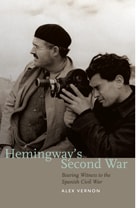
In 1937 and 1938, Ernest Hemingway made four trips to Spain to cover its civil war for the North American News Alliance wire service and to help create the pro-Republican documentary film The Spanish Earth. Hemingway’s Second War is the first book-length scholarly work devoted to this subject.
Hemispheres and Stratospheres
The Idea and Experience of Distance in the International EnlightenmentKevin L. Cope
Bucknell University Press, 2021
Published by Bucknell University Press. Distributed worldwide by Rutgers University Press.
Hemispheric American Studies
Levander, Caroline F
Rutgers University Press, 2007
With essays that examine stamps, cartoons, novels, film, art, music, travel documents, and governmental publications, Hemispheric American Studies seeks to excavate the complex cultural history of texts and discourses across the ever-changing and stratified geopolitical and cultural fields that collectively comprise the American hemisphere. This collection promises to chart new directions in American literary and cultural studies.
Hemispheric Imaginations
North American Fictions of Latin AmericaHelmbrecht Breinig
Dartmouth College Press, 2016
Hemispheric Imaginings
The Monroe Doctrine and Narratives of U.S. EmpireGretchen Murphy
Duke University Press, 2005
Murphy juxtaposes close readings of novels with analyses of nonfiction texts. From uncovering the literary inspirations for the Monroe Doctrine itself to tracing visions of hemispheric unity and transatlantic separation in novels by Lydia Maria Child, Nathaniel Hawthorne, María Amparo Ruiz de Burton, Lew Wallace, and Richard Harding Davis, she reveals the Doctrine’s forgotten cultural history. In making a vital contribution to the effort to move American Studies beyond its limited focus on the United States, Murphy questions recent proposals to reframe the discipline in hemispheric terms. She warns that to do so risks replicating the Monroe Doctrine’s proprietary claim to isolate the Americas from the rest of the world.

Hemispheric Waves
Havana's Avant-Garde Theatre, 1965-2000Eric Mayer-García
University of Iowa Press, 2027
Henri Bergson’s Creative Evolution 100 Years Later
Special Issue of SubStance, Issue 114, 36:3 (2007)Michael Kolkman
University of Wisconsin Press, 2007
This special issue of SubStance (2007) celebrates the centennial of Henri Bergson’s Creative Evolution, published in 1907. Since evolution is a living process and not a completed history, any understanding of it must necessarily be open-ended. If no one can have the last word, Bergson writes, the project of understanding evolution “will only be built up by the collective and progressive effort of many thinkers, of many observers also, completing, correcting and improving one another.”
Included in the issue are articles from Bergson scholars from the United States, Japan, France and Great Britain. Topics in the issue range from Bergson’s encounters with Darwin, Nietzsche, Derrida and Deleuze, and from the analytical to the metaphysical.
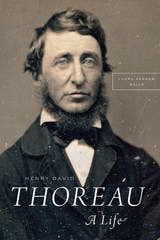
Henry David Thoreau
A LifeLaura Dassow Walls
University of Chicago Press, 2017
But there was much more to Thoreau than his brief experiment in living at Walden Pond. A member of the vibrant intellectual circle centered on his neighbor Ralph Waldo Emerson, he was also an ardent naturalist, a manual laborer and inventor, a radical political activist, and more. Many books have taken up various aspects of Thoreau’s character and achievements, but, as Laura Dassow Walls writes, “Thoreau has never been captured between covers; he was too quixotic, mischievous, many-sided.” Two hundred years after his birth, and two generations after the last full-scale biography, Walls restores Henry David Thoreau to us in all his profound, inspiring complexity.
Walls traces the full arc of Thoreau’s life, from his early days in the intellectual hothouse of Concord, when the American experiment still felt fresh and precarious, and “America was a family affair, earned by one generation and about to pass to the next.” By the time he died in 1862, at only forty-four years of age, Thoreau had witnessed the transformation of his world from a community of farmers and artisans into a bustling, interconnected commercial nation. What did that portend for the contemplative individual and abundant, wild nature that Thoreau celebrated?
Drawing on Thoreau’s copious writings, published and unpublished, Walls presents a Thoreau vigorously alive in all his quirks and contradictions: the young man shattered by the sudden death of his brother; the ambitious Harvard College student; the ecstatic visionary who closed Walden with an account of the regenerative power of the Cosmos. We meet the man whose belief in human freedom and the value of labor made him an uncompromising abolitionist; the solitary walker who found society in nature, but also found his own nature in the society of which he was a deeply interwoven part. And, running through it all, Thoreau the passionate naturalist, who, long before the age of environmentalism, saw tragedy for future generations in the human heedlessness around him.
“The Thoreau I sought was not in any book, so I wrote this one,” says Walls. The result is a Thoreau unlike any seen since he walked the streets of Concord, a Thoreau for our time and all time.
Henry James and the Mass Market
Marcia Jacobson
University of Alabama Press, 1983
The author considers James’s work from The Bostonians to The Awkward Age – from 1883 to 1889 – a period in which James was resident in London and searching for material to replace the “international theme.” Jacobson considers this context in relation to the emergence of a mass market and sees James’s major fiction of this period as an attempt to exploit the conventions of popular fiction in an analysis of his society’s assumptions. James’s work at this time must also be viewed as an artist’s effort to secure popular attention and acceptance.
Henry James and the Queerness of Style
Kevin Ohi
University of Minnesota Press, 2010
For Ohi, there are many elements in the style that make James’s writing queer. But if there is a thematic marker, Ohi shows through his careful engagements with these texts, it is belatedness. The recurrent concern with belatedness, Ohi explains, should be understood not psychologically but stylistically, not as confessing the sad predicament of being out of sync with one’s life but as revealing the consequences of style’s refashioning of experience. Belatedness marks life’s encounter with style, and it describes an experience not of deprivation but of the rich potentiality of the literary work that James calls “freedom.” In Ohi’s reading, belatedness is the indicator not of sublimation or repression, nor of authorial self-sacrifice, but of the potentiality of the literary—and hence of the queerness of style.
Presenting original readings of a series of late Jamesian texts, the book also represents an exciting possibility for queer theory and literary studies in the future: a renewed attention to literary form and a new sounding—energized by literary questions of style and form—of the theoretical implications of queerness.
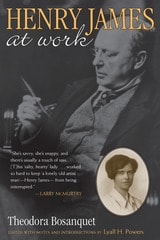
Henry James at Work
Theodora Bosanquet
University of Michigan Press, 2010
Theodora Bosanquet was Henry James's secretary from 1907 until his death in 1916, one of the most significant periods of his long writing career. Her memoir Henry James at Work, originally published by Leonard and Virginia Woolf's Hogarth Press in 1924, recounts Bosanquet's association with James and provides a lively and engaging commentary on James's milieu, preferences, and attitudes, as well as on his process of writing and revision. Bosanquet is an intelligent and observant witness and reporter, and her objective and comparatively unbiased point of view makes the memoir especially valuable.
This enlarged and annotated edition rescues Bosanquet from the shadows of literary history and shows her to be a fascinating figure in her own right, a skilled writer and editor, an early feminist, and a contemporary of the Bloomsbury literary community. The book is enhanced by an essay about Bosanquet and her circle, and fascinating snippets from her diaries and letters, now in the Harvard University archives.
Soon after Henry James hired Theodora Bosanquet in 1907, the well-educated and dedicated Bosanquet became indispensable to James. In addition to the memoir Henry James at Work she published two other books, critical studies on Harriet Martineau and Paul Valéry. Following James’s death she became Executive Secretary of the International Federation of University Women and traveled extensively in support of the women’s suffrage movement. From 1935 to 1958 she was literary editor, then director, of the publication Time and Tide.
Lyall H. Powers is Professor of English Emeritus at the University of Michigan and author of numerous books, including Alien Heart: The Life and Work of Margaret Laurence.
Praise for Henry James at Work:
—Larry McMurtry
“I’m sure [your book] ought to have a success with anyone who cared for Henry James and his work, and I think we are very lucky to get it.”
—Letter from Virginia Woolf to Theodora Bosanquet, 1924
“It's fascinating to encounter, in the era just before high modernism, a female intellectual like Bosanquet—one as fully engaged in the life of ideas and cultural production as her male counterparts—making as much of her putatively secondary status as she possibly could. The book is important as a primary document in its own right as well as a gloss on the methods and material of the magisterial James.”
—Jonathan Freedman, University of Michigan
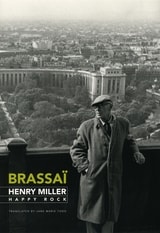
Henry Miller, Happy Rock
Brassaï
University of Chicago Press, 2002
That's Henry Miller's advice for young aspiring artists, as remembered by his very good friend Brassaï in this lively book. One of two that Brassaï wrote about the man who called himself a "happy rock," this volume covers their lives and friendship from the 1950s to 1973. Over the course of a number of warm, intimate conversations, Brassaï and Miller revisit their careers; discuss art, literature, Paris, Greece, Japan, World War II, and more; and consider the lives and works of many others in their circle, including Lawrence Durrell, Henri Matisse, Salvador Dalí, Georges Simenon, André Malraux, Hans Reichel, Paul Klee, and Amedeo Modigliani. Throughout Miller's zest for life shines through, as do his love of art and his passionate intensity for just about everything he does, from discussing a movie or play he'd just seen to reminiscing about a decades-long love.
Brassaï's Henry Miller, Happy Rock presents a vivid portrait of two close friends who thoroughly enjoy each other's company—and just happen to be world—famous artists too.
Here Is a Figure
Grounding Literary FormSarah Dowling
Northwestern University Press, 2025
A study of supine, prone, and recumbent figures in contemporary literature
The prostitute, the protester, the murder victim, the invalid, the layabout, the depressive: all are associated with lying down. Skewing and flattening the perpendicular axis that defines the human in Western philosophy, art, and humanist inquiry, these downward-directed figures’ refusals or failures to hew to the moral and postural logics of uprightness enable a reassessment of subjectivity, ecological relation, and representation—that last of which is, after all, a process of standing-in-for. Here Is a Figure: Grounding Literary Form works across an array of well-known and counter-canonical texts, showing that recumbent figures saturate the literary arts of the present and respond to the proliferation of contemporary forms of grounding, in all its meanings. Reading these figures in dialogue with critical Indigenous studies, disability studies, and horizontalist feminisms, Sarah Dowling reveals the potential in thinking with and through a position stretched out across, dependent on, and undetachable from the earth.
Hereditas
Seven Essays on the Modern Experience of the ClassicalEdited with an introduction by Frederic Will
University of Texas Press, 1964
Is Ancient Greece still meaningful to the twenty-first-century world? The vitality of the classical tradition, which has been a long-enduring and important element in our culture, is the concern of the seven scholars who in this book present their answers to this question.
In various ways their essays support editor Frederic Will's statement that the "complex and mature group of awarenesses" embodied in the classical tradition still help to maintain the continuity of human culture, thus sharing in the unbroken process of developing a Western civilization. These awarenesses are not self-perpetuating but must be sustained by the guardians of tradition—schools, literary creators and critics, libraries, and scholars. In this book, particular attention is devoted to the literary creators. In discussing the impact of Greek myth, Greek literature, and Greek philosophy on modern writers, the present essayists try to determine how alive Greek classical culture is today, how meaningful it is, and how it can be perpetuated. Through their presentations in these seven essays, the contributors prove that the tradition does not suffer from lack of able guardians.
These studies in the interpretation of literature and thought afford stimulating evidence that the classical tradition is still alive in our modern age.
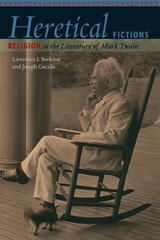
Heretical Fictions
Religion in the Literature of Mark TwainLAWRENCE I. BERKOVE
University of Iowa Press, 2010
Challenging the prevailing belief that Mark Twain’s position on religion hovered somewhere between skepticism and outright heresy, Lawrence Berkove and Joseph Csicsila marshal biographical details of Twain’s life alongside close readings of his work to explore the religious faith of America’s most beloved writer and humorist. They conclude not only that religion was an important factor in Twain’s life but also that the popular conception of Twain as agnostic, atheist, or apostate is simply wrong.
Heretical Fictions is the first full-length study to assess the importance of Twain’s heretical Calvinism as the foundation of his major works, bringing to light important thematic ties that connect the author’s early work to his high period and from there to his late work. Berkove and Csicsila set forth the main elements of Twain’s “countertheological” interpretation of Calvinism and analyze in detail the way it shapes five of his major books—Roughing It, The Adventures of Tom Sawyer, Adventures of Huckleberry Finn, A Connecticut Yankee in King Arthur's Court, and No. 44, The Mysterious Stranger—as well as some of his major short stories. The result is a ground-breaking and unconventional portrait of a seminal figure in American letters.
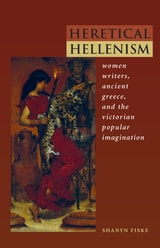
Heretical Hellenism
Women Writers, Ancient Greece, and the Victorian Popular ImaginationShanyn Fiske
Ohio University Press, 2008
The prevailing assumption regarding the Victorians’ relationship to ancient Greece is that Greek knowledge constituted an exclusive discourse within elite male domains. Heretical Hellenism: Women Writers, Ancient Greece, and the Victorian Popular Imagination challenges that theory and argues that while the information women received from popular sources was fragmentary and often fostered intellectual insecurities, it was precisely the ineffability of the Greek world refracted through popular sources and reconceived through new fields of study that appealed to women writers’ imaginations.
Examining underconsidered sources such as theater history and popular journals, Shanyn Fiske uncovers the many ways that women acquired knowledge of Greek literature, history, and philosophy without formal classical training. Through discussions of women writers such as Charlotte Brontë, George Eliot, and Jane Harrison, Heretical Hellenism demonstrates that women established the foundations of a heretical challenge to traditional humanist assumptions about the uniformity of classical knowledge and about women’s place in literary history.
Heretical Hellenism provides a historical rationale for a more expansive definition of classical knowledge and offers an interdisciplinary method for understanding the place of classics both in the nineteenth century and in our own time.
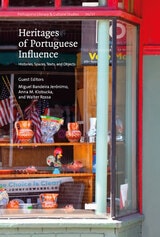
Heritages of Portuguese Influence
Histories, Spaces, Texts, and ObjectsGuest edited by Miguel Bandeira Jerónimo, Anna M. Klobucka, and Walter Rossa
Tagus Press, 2022
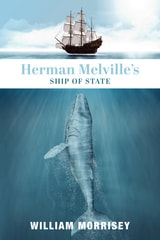
Herman Melville's Ship of State
will morrisey
St. Augustine's Press, 2020
“Does Melville also intend to be a founder in the ‘New World’?” Morrisey’s study is a compelling look at the early political moments of a new nation, but one that at the time perceived itself as already aging and maturing in the process of political voyage and adventure. Dangers lie ahead, Melville seems to warn, and in his disenchantment of the vigor of the Young America he once endorsed he tells the story of what really happens when democracy is idealized and the surrounding waters of chaos are thereby veiled; and yet also of what happens when one would seek to command the chaos only to transform into the unpredictably destructive prey he pursues, especially under the guise of moral outrage.
Melville, like Ishmael, urges a new vision of both God and nature, and challenges the notion of rule in all its expressions. Americans, the people of the New World, are invited to be unafraid, but also careful. In wandering as on the open waters one wonders, beyond civic boundaries and conventions, and in that wonder one may finally come face to face with what is good and grand––but in beholding the great white whale, can one resist the urge to conquest, now that he is likewise by the leviathan beholden? Is the rule of man and the coronation of a specific dialectic of power an untenable victory, given that “‘Nature is nobody’s ally’: it wounds or kills any person or nation that violates it, impartially”?
Morrisey writes with lucidity and weaves together elements of history, literature, politics and perhaps his own affinity for Ishmael’s passenger spirit to reveal just how broad and boundless of a narrative Melville’s Moby Dick truly is.
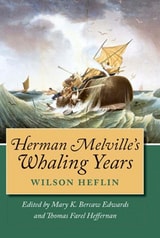
Herman Melville's Whaling Years
Wilson Heflin
Vanderbilt University Press, 2004
During his time in the Pacific, Melville served on three whaling ships, as well as on a U.S. Navy man-of-war. As a deserter from one whaleship, he spent four weeks among the cannibals of Nukahiva in the Marquesas, seeing those islands in a relatively untouched state before they were irrevocably changed by French annexation in 1842. Rebelling against duty on another ship, he was held as a prisoner in a native calaboose in Tahiti. He prowled South American ports while on liberty, hunted giant tortoises in the Galapagos Islands, and explored the islands of Eimeo (Moorea) and Maui. He also saw the Society and Sandwich (Hawaiian) Islands when the Western missionary presence was at its height.
Heflin combed the logbooks of any ship at sea at the time of Melville's voyages and examined nineteenth-century newspaper items, especially the marine intelligence columns, for mention of Melville's vessels. He also studied British consular records pertaining to the mutiny aboard the Australian whaler Lucy Ann, an insurrection in which Melville participated and which inspired his second novel, Omoo.
Distilling the life's work of a leading Melville expert into book form for the first time, this scrupulously edited volume is the most in-depth account ever published of Melville's years on whaleships and how those singular experiences influenced his writing.
Herman Melville
Among the MagazinesGraham Thompson
University of Massachusetts Press, 2018
What I feel most moved to write, that is banned,—it will not pay. Yet, altogether, write the other way I cannot. Herman Melville wrote these words as he struggled to survive as a failing novelist. Between 1853 and 1856, he did write “the other way,” working exclusively for magazines. He earned more money from his stories than from the combined sales of his most well known novels, Moby-Dick, Pierre, and The Confidence-Man.
In Herman Melville Graham Thompson examines the author's magazine work in its original publication context, including stories that became classics, such as “Bartelby, the Scrivener” and “Benito Cereno,” alongside lesser-known work. Using a concept he calls “embedded authorship,” Thompson explores what it meant to be a magazine writer in the 1850s and discovers a new Melville enmeshed with forgotten materials, editors, writers, and literary traditions. He reveals how Melville responded to the practical demands of magazine writing with dazzling displays of innovation that reinvented magazine traditions and helped create the modern short story.

Herman Melville
Modernity and the Material TextKatie McGettigan
University of New Hampshire Press, 2018
Combining archival research in print and publishing history with close reading, McGettigan situates Melville's works alongside advertising materials, magazine articles, trade manuals, and British and American commentary on the literary industry to demonstrate how Melville's literary practice relies on and aestheticizes the specific conditions of literary production in which he worked. For Melville, the book is a physical object produced by particular technological processes, as well as an entity that manifests social and economic values. His characters carry books, write on them, and even sleep on them; they also imagine, observe, and participate in the buying and selling of books. Melville employs the book's print, paper, and binding—and its market circulations—to construct literary figures, to shape textual form, and to create irony and ambiguity.
Exploring the printed book in Melville's writings brings neglected sections of his poetry and prose to the fore and invites new readings of familiar passages and images. These readings encourage a reassessment of Melville's career as shaped by his creative engagements with print, rather than his failures in the literary marketplace. McGettigan demonstrates that a sustained and deliberate imaginative dialogue with the material text is at the core of Melville's expressive practice and that, for Melville, the printed book served as a site for imagining the problems and possibilities of modernity.
Hardcover is un-jacketed.
Hero Me Not
The Containment of the Most Powerful Black, Female SuperheroChesya Burke
Rutgers University Press, 2023
First introduced in the pages of X-Men, Storm is probably the most recognized Black female superhero. She is also one of the most powerful characters in the Marvel Universe, with abilities that allow her to control the weather itself. Yet that power is almost always deployed in the service of White characters, and Storm is rarely treated as an authority figure.
Hero Me Not offers an in-depth look at this fascinating yet often frustrating character through all her manifestations in comics, animation, and films. Chesya Burke examines the coding of Storm as racially “exotic,” an African woman who nonetheless has bright white hair and blue eyes and was portrayed onscreen by biracial actresses Halle Berry and Alexandra Shipp. She shows how Storm, created by White writers and artists, was an amalgam of various Black stereotypes, from the Mammy and the Jezebel to the Magical Negro, resulting in a new stereotype she terms the Negro Spiritual Woman.
With chapters focusing on the history, transmedia representation, and racial politics of Storm, Burke offers a very personal account of what it means to be a Black female comics fan searching popular culture for positive images of powerful women who look like you.
Herodotus in the Anthropocene
Joel Alden Schlosser
University of Chicago Press, 2020
Schlosser shows that the Histories, which chronicle the interactions among the Greek city-states and their neighbors that culminated in the Persian Wars, illuminate a telling paradox: at those times when humans appear capable of exerting more influence than ever before, they must also assert collective agency to avoid their own downfall. Here, success depends on nomoi, or the culture, customs, and laws that organize human communities and make them adaptable through cooperation. Nomoi arise through sustained contact between humans and their surroundings and function best when practiced willingly and with the support of strong commitments to the equality of all participants. Thus, nomoi are the very substance of political agency and, ultimately, the key to freedom and ecological survival because they guide communities to work together to respond to challenges. An ingenious contribution to political theory, political philosophy, and ecology, Herodotus in the Anthropocene reminds us that the best perspective on the present can often be gained through the lens of the past.
Heroic Knowledge
An Interpretation of Paradise Regained and Samson AgonistesArnold Stein
University of Minnesota Press, 1957
Heroic Knowledge was first published in 1957. Minnesota Archive Editions uses digital technology to make long-unavailable books once again accessible, and are published unaltered from the original University of Minnesota Press editions.
Professor Stein's critical work on Milton which was launched in his earlier book, Answerable Style: Essays on Paradise Lost, is completed in this volume. He devotes eight essays to Paradise Regained and five to Samson Agonistes. In addition, a preface explains his assumptions and a postscript connects and extends the implications of his work. The author's purpose and method are, perhaps, best described in his own words: "For the most part I have tried to demonstrate rather than to argue, and have (except in some notes) avoided engaging the established critical problems separately; but have instead trusted that a fresh critical interpretation of the poems would come to terms with the major problems while in motion, as part of a developing grasp of the integrated working of the poems."
Heterologies
Discourse on the OtherMichel De Certeau
University of Minnesota Press, 1986
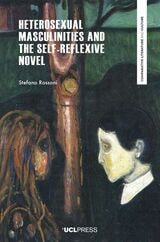
Heterosexual Masculinities and the Self-Reflexive Novel
Stefano Rossoni
University College London, 2025
Rossoni brings the work of four renowned contemporary authors—J.M. Coetzee, Milan Kundera, Philip Roth, and Mario Vargas Llosa—into an unexpected dialogue to address the inscription of heterosexual masculinity into the Western literary legacy and how masculinity is refashioned in contemporary self-reflexive novels. Their oeuvres are considered together for the first time, while also being positioned within the European literary tradition inaugurated by Don Quixote and continued by authors like Gustave Flaubert, Franz Kafka, and Ezra Pound. Heterosexual Masculinities evaluates Coetzee, Kundera, Roth, and Vargas Llosa’s novels in light of critical contributions in literary masculinity studies that highlight men’s emotional illiteracy and struggle to develop a language for self-reflection.
Heterosyncrasies
Female Sexuality When Normal Wasn’tKarma Lochrie
University of Minnesota Press, 2005
Hewing to Experience
Essays and Reviews on Recent American Poetry and Poetics, Nature and CultureSherman Paul
University of Iowa Press, 1989
Hey Presto!
Swift and the QuacksHugh Ormsby-Lennon
University of Delaware Press, 2011
Published by University of Delaware Press. Distributed worldwide by Rutgers University Press.
Hidden Hands
Working-Class Women and Victorian Social-Problem FictionPatricia E. Johnson
Ohio University Press, 2001
Tracing the Victorian crisis over the representation of working-class women to the 1842 Parliamentary bluebook on mines, with its controversial images of women at work, Hidden Hands argues that the female industrial worker became even more dangerous to represent than the prostitute or the male radical because she exposed crucial contradictions between the class and gender ideologies of the period and its economic realities.
Drawing on the recent work of feminist historians, Patricia Johnson lays the groundwork for a reinterpretation of Victorian social-problem fiction that highlights its treatment of issues that particularly affected working-class women: sexual harassment; the interconnections between domestic ideology and domestic violence; their relationships to male-dominated working-class movements such as Luddism, Chartism, and unionism; and their troubled connection to middle-class feminism.
Uncovering a series of images in Victorian fiction ranging from hot-tempered servants and sexually harassed factory girls to working-class homemakers pictured as beaten dogs, Hidden Hands demonstrates that representations of working-class women, however marginalized or incoherent, reveal the very contradictions they are constructed to hide and that the dynamics of these representations have broad implications both for other groups, such as middle-class women, and for the emergence of working-class women as writers themselves.
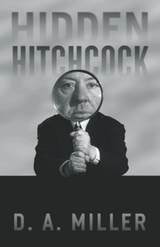
Hidden Hitchcock
D. A. Miller
University of Chicago Press, 2016
Focusing on three films—Strangers on a Train, Rope, and The Wrong Man—Miller shows how Hitchcock anticipates, even demands a “Too-Close Viewer.” Dwelling within us all and vigilant even when everything appears to be in good order, this Too-Close Viewer attempts to see more than the director points out, to expand the space of the film and the duration of the viewing experience. And, thanks to Hidden Hitchcock, that obsessive attention is rewarded. In Hitchcock’s visual puns, his so-called continuity errors, and his hidden appearances (not to be confused with his cameos), Miller finds wellsprings of enigma.
Hidden Hitchcock is a revelatory work that not only shows how little we know this best known of filmmakers, but also how near such too-close viewing comes to cinephilic madness.
Hidden in Plain Sight
Jews and Jewishness in British Film, Television, and Popular CultureEdited by Nathan Abrams
Northwestern University Press, 2016

Hide and Seek
The Child between Psychoanalysis and FictionVirginia L. Blum
University of Illinois Press, 1995
Concentrating on the "go-between" function of the child in nineteenth- and twentieth-century American and British fiction, Virginia Blum shows how selected children in the works of L. P. Hartley, Charles Dickens, Henry James, and Vladimir Nabokov were actually fictional messengers who ultimately were unsuccessful at reconciling impasses in the adult world.
Throughout her book Blum draws on pop images of real and fictional children, ranging from the Baby Jessica case, in which the idea of "real" paternity and family bonds comes to the mythic fore, to the film Home Alone, in which the abandoned child becomes protector of his family's hearth and home. Hide and Seek raises provocative questions about the ways in which our culture fetishizes the idea of the child at the same time that we treat with comparative indifference the conditions under which many real children actually live.
"A work of striking originality and consistent intellectual honesty, forcing us into genuinely profound and darkly uncomfortable areas of speculation." -- James R. Kincaid, author of Child-Loving: The Erotic Child and Victorian
Culture
Hideous Characters and Beautiful Pagans
Performing Jewish Identity on the Antebellum American StageHeather S. Nathans
University of Michigan Press, 2017
Using an eclectic range of sources including theatrical reviews, diaries, letters, cartoons, portraiture, tax records, rumors flying around the tavern, and more, Heather S. Nathans has listened for the echoes of vanished audiences who witnessed and responded to these stereotypes onstage, from the earliest appearance of Shylock on an American stage in 1752 to Jewish theater artists on the eve of the Civil War. The book integrates social, political, and cultural histories, with an examination of those texts (both dramatic and literary) that shaped the stage Jew.
High Stakes of Identity
Gambling in the Life and Literature of Nineteenth-Century RussiaIan M. Helfant
Northwestern University Press, 2002
During the reigns of Alexander I and Nicholas I, Ian Helfant argues, gambling became an essential proving-ground and symbolic locus for noble identity in Russia--a way for the nobility to assert its values (fearlessness, disdain for money, implacable self-possession, deification of whim and will, and stylish performance) against nineteenth-century economics and bourgeois sentimentality. In <i>The High Stakes of Identity</i> Helfant's twin concerns are to analyze the structural components of the myth of the noble "beau joueur" and to show how gambling performances in society and in literature reciprocally reinforced, complicated, and eventually disintegrated its mystique.
Using a broad variety of sources--memoiristic, epistolary, journalistic, legal, fictional, theatrical--Helfant reconstructs both the prevalence and the particular codes of gambling's cultural system in the first few decades of the nineteenth century. These codes allow him to interpret the iconoclastic performances of truly legendary gamblers and to assess the importance and purpose of gambling in works ranging from Pushkin's "Queen of Spades" to Lermontov's "Masquerade." Throughout, Helfant gives voice to the rich variety of discourses, from tsarist laws to moralistic tracts, that came to bear on the culture of gambling in the 1830s and eventually led to its displacement as the key marker of nobility.
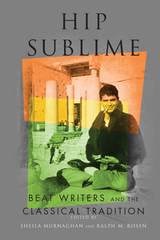
Hip Sublime
Beat Writers and the Classical TraditionEdited by Sheila Murnaghan and Ralph M. Rosen
The Ohio State University Press, 2018
In this volume, a diverse group of contributors explore for the first time the fascinating tensions and paradoxes that arose from interactions between these avant-garde writers and a literary tradition often seen as conservative and culturally hegemonic. With essays that cover the canonical Beat authors—such as Allen Ginsberg, Jack Kerouac, and William Burroughs—along with less well-known figures—including Kenneth Rexroth, Ed Sanders, and Diane di Prima—Hip Sublime: Beat Writers and the Classical Tradition brings long overdue attention to the Beat movement’s formative appropriation of the Greek and Latin classics.