Results by title
67 books match the query 'Imagination' and 10 start with i
I Was a Cold War Monster
Horror Films, Eroticism, and the Cold War ImaginationCyndy Hendershot
University of Wisconsin Press, 2001
Image and Reality
Kekulé, Kopp, and the Scientific ImaginationAlan J. Rocke
University of Chicago Press, 2010
Nineteenth-century chemists were faced with a particular problem: how to depict the atoms and molecules that are beyond the direct reach of our bodily senses. In visualizing this microworld, these scientists were the first to move beyond high-level philosophical speculations regarding the unseen. In Image and Reality, Alan Rocke focuses on the community of organic chemists in Germany to provide the basis for a fuller understanding of the nature of scientific creativity.
Arguing that visual mental images regularly assisted many of these scientists in thinking through old problems and new possibilities, Rocke uses a variety of sources, including private correspondence, diagrams and illustrations, scientific papers, and public statements, to investigate their ability to not only imagine the invisibly tiny atoms and molecules upon which they operated daily, but to build detailed and empirically based pictures of how all of the atoms in complicated molecules were interconnected. These portrayals of “chemical structures,” both as mental images and as paper tools, gradually became an accepted part of science during these years and are now regarded as one of the central defining features of chemistry. In telling this fascinating story in a manner accessible to the lay reader, Rocke also suggests that imagistic thinking is often at the heart of creative thinking in all fields.
Image and Reality is the first book in the Synthesis series, a series in the history of chemistry, broadly construed, edited by Angela N. H. Creager, John E. Lesch, Stuart W. Leslie, Lawrence M. Principe, Alan Rocke, E.C. Spary, and Audra J. Wolfe, in partnership with the Chemical Heritage Foundation.
Image
Three Inquiries in Technology and ImaginationMark C. Taylor, Mary-Jane Rubenstein, and Thomas A. Carlson
University of Chicago Press, 2021
Modern life is steeped in images, image-making, and attempts to control the world through vision. Mastery of images has been advanced by technologies that expand and reshape vision and enable us to create, store, transmit, and display images. The three essays in Image, written by leading philosophers of religion Mark C. Taylor, Mary-Jane Rubenstein, and Thomas A. Carlson, explore the power of the visual at the intersection of the human and the technological. Building on Heidegger’s notion that modern humanity aims to master the world by picturing or representing the real, they investigate the contemporary culture of the image in its philosophical, religious, economic, political, imperial, and military dimensions, challenging the abstraction, anonymity, and dangerous disconnection of contemporary images.
Taylor traces a history of capitalism, focusing on its lack of humility, particularly in the face of mortality, and he considers art as a possible way to reconnect us to the earth. Through a genealogy of iconic views from space, Rubenstein exposes the delusions of conquest associated with extraterrestrial travel. Starting with the pressing issues of surveillance capitalism and facial recognition technology, Carlson extends Heidegger’s analysis through a meditation on the telematic elimination of the individual brought about by totalizing technologies. Together, these essays call for a consideration of how we can act responsibly toward the past in a way that preserves the earth for future generations. Attending to the fragility of material things and to our own mortality, they propose new practices of imagination grounded in love and humility.
Imagination and Interpretation in Kant
The Hermeneutical Import of the Critique of JudgmentRudolf A. Makkreel
University of Chicago Press, 1990
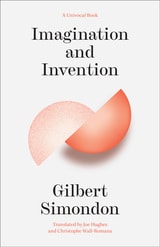
Imagination and Invention
Gilbert Simondon
University of Minnesota Press, 2023
A radical rethinking of the theory and the experience of mental images
Here, in English translation for the first time, is Gilbert Simondon’s fundamental reconception of the mental image and the theory of imagination and invention. Drawing on a vast range of mid-twentieth-century theoretical resources—from experimental psychology, cybernetics, and ethology to the phenomenological reflections of Sartre and Merleau-Ponty—Imagination and Invention provides a comprehensive account of the mental image and adds a vital new dimension to the theory of psychical individuation in Simondon’s earlier, highly influential work.
Simondon traces the development of the mental image through four phases: first a bundle of motor anticipations, the image becomes a cognitive system that mediates the organism’s relation to its milieu, then a symbolic and abstract integration of motor and affective experience to, finally, invention, a solution to a problem of life that requires the externalization of the mental image and the creation of a technical object. An image cannot be understood from the perspective of one phase alone, he argues, but only within the trajectory of its progressive metamorphosis.
Imagination and the Arts in C.S. Lewis
Journeying to Narnia and Other WorldsPeter J. Schakel
University of Missouri Press, 2002
Imagination has long been regarded as central to C. S. Lewis's life and to his creative and critical works, but this is the first study to provide a thorough analysis of his theory of imagination, including the different ways he used the word and how those uses relate to each other. Peter Schakel begins by concentrating on the way reading or engaging with the other arts is an imaginative activity. He focuses on three books in which imagination is the central theme—Surprised by Joy, An Experiment in Criticism, and The Discarded Image—and shows the important role of imagination in Lewis's theory of education.
He then examines imagination and reading in Lewis's fiction, concentrating specifically on the Chronicles of Narnia, the most imaginative of his works. He looks at how the imaginative experience of reading the Chronicles is affected by the physical texture of the books, the illustrations, revisions of the texts, the order in which the books are read, and their narrative "voice," the "storyteller" who becomes almost a character in the stories.
Imagination and the Arts in C. S. Lewis also explores Lewis's ideas about imagination in the nonliterary arts. Although Lewis regarded engagement with the arts as essential to a well- rounded and satisfying life, critics of his work and even biographers have given little attention to this aspect of his life. Schakel reviews the place of music, dance, art, and architecture in Lewis's life, the ways in which he uses them as content in his poems and stories, and how he develops some of the deepest, most significant themes of his stories through them.
Schakel concludes by analyzing the uses and abuses of imagination. He looks first at "moral imagination." Although Lewis did not use this term, Schakel shows how Lewis developed the concept in That Hideous Strength and The Abolition of Man long before it became popularized in the 1980s and 1990s. While readers often concentrate on the Christian dimension of Lewis's works, equally or more important to him was their moral dimension.
Imagination and the Arts in C. S. Lewis will appeal to students and teachers of both children's literature and twentieth-century British writers. It will also be of value to readers who wish to compare Lewis's creations with more recent imaginative works such as the Harry Potter series.
Imagination in Teaching and Learning
The Middle School YearsKieran Egan
University of Chicago Press, 1992
stimulated and developed in education. Yet, few teachers
understand what imagination is or how it lends itself to
practical methods and techniques that can be used easily in
classroom instruction. In this book, Kieran Egan—winner of
the prestigious Grawemeyer Award for his work on
imagination—takes up where his Teaching as Story Telling
left off, offering practical help for teachers who want to
engage, stimulate, and develop the imaginative and learning
processes of children between the ages of eight to fifteen.
This book is not about unusually imaginative students and
teachers. Rather, it is about the typical student's
imaginative life and how it can be stimulated in learning,
how the average teacher can plan to achieve this aim, and how
the curriculum can be structured to help achieve this aim.
Slim and determinedly practical, this book contains a wealth
of concrete examples of curriculum design and teaching
techniques structured to appeal specifically to children in
their middle school years.
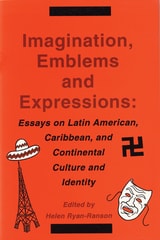
Imagination, Emblems, and Expressions
Essays on Latin American, Carribean, and Continental Culture and IdentityHelen Ryan-Ranson
University of Wisconsin Press, 1993
This book of essays—carefully written by twenty-four authorities on their subjects—provides a deep understanding of and appreciation for the coherence, primacy, and importance of the search for identity in the divergent areas of Latin America, the Caribbean, and Europe.
Imagination, Meditation, and Cognition in the Middle Ages
Michelle Karnes
University of Chicago Press, 2011

Isak Dinesen
The Life And Imagination Of A SeducerOlga Anastasia Pelensky
Ohio University Press, 1991
Born into a Victorian Danish family, Karen Christentze Dinesen married her second cousin, a high-spirited and philandering baron, and moved to Kenya where she ran a coffee plantation, painted, and wrote. She later returned to Denmark, lived through the German occupation during World War II, and became a pivotal figure in Heretica, a major literary movement that flourished in Denmark after the war. By the time of her death, Dinesen was an international figure. Truman Capote would later call Out of Africa one of the most beautiful books of the century.
Despite the popularity of her writing, little is known about her life. For this provocative biography, Pelensky has uncovered hundreds of papers in libraries and private collections, and discovered new interview sources in Africa, Denmark, and England to help put the pieces of Dinesen’s life together. Her father’s outspoken sympathy for the plight of the American Indians, his suicide and the effects of his personal anguish as a failed adventurer are illuminated as major forces on Dinesen’s imagination. The Danish history of romance and masquerade and the tradition of pantomime in Denmark are also explored as themes that recur in Dinesen’s work.