Results by title
89 books match the query 'Invention' and 10 start with i

INVENTION OF SECRECY
David Citino
The Ohio State University Press, 2001
The underlying concern of these poems is the very notion of secrecy, and in his explorations Citino investigates the lives, and credentials, of our saints—both secular and otherworldly. Ramses the Great, the prophet Hosea, the Roman emperor Vespasian, Caravaggio, the Wicked Witch of the West, Padre Pio, Mario Lanza, and Princess Diana are among the larger-than-life personages materializing on these pages. Continually in these poems, the past is read by light of the present and the present from perspectives of the past.
Accessible yet ambitious, and treating all of history as the concern of those living today, these poems seek to measure the span of our lives and the distance that separates one life from another.
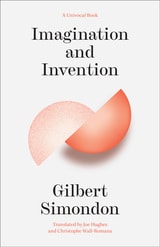
Imagination and Invention
Gilbert Simondon
University of Minnesota Press, 2023
A radical rethinking of the theory and the experience of mental images
Here, in English translation for the first time, is Gilbert Simondon’s fundamental reconception of the mental image and the theory of imagination and invention. Drawing on a vast range of mid-twentieth-century theoretical resources—from experimental psychology, cybernetics, and ethology to the phenomenological reflections of Sartre and Merleau-Ponty—Imagination and Invention provides a comprehensive account of the mental image and adds a vital new dimension to the theory of psychical individuation in Simondon’s earlier, highly influential work.
Simondon traces the development of the mental image through four phases: first a bundle of motor anticipations, the image becomes a cognitive system that mediates the organism’s relation to its milieu, then a symbolic and abstract integration of motor and affective experience to, finally, invention, a solution to a problem of life that requires the externalization of the mental image and the creation of a technical object. An image cannot be understood from the perspective of one phase alone, he argues, but only within the trajectory of its progressive metamorphosis.
Invention Of Communication
Armand Mattelart
University of Minnesota Press, 1996

Invention Of Dolores Del Rio
Joanne Hershfield
University of Minnesota Press, 2000
Dolores del Río first came to Hollywood from Mexico in 1925 and within a year had become an international star for her role in Raoul Walsh's 1926 film What Price Glory. She would go on to work with Hollywood’s top directors, including John Ford and King Vidor, and star opposite such leading men as Henry Fonda, Fred Astaire, Orson Welles (with whom she had a scandalous affair), and Elvis Presley. Voted by Photoplay magazine in 1933 as having "the most perfect feminine figure in Hollywood," del Río was billed as one of cinema’s most "exotic" and "aristocratic" beauties. This image-carefully crafted by her producers, her studio publicists, and by del Río herself-reveals many fascinating insights into Hollywood’s evolving attitudes toward race and femininity.
In The Invention of Dolores del Río, Joanne Hershfield explores the intersection of ethnicity, gender, and stardom in American popular culture through the lens of del Río’s successful and unusually lengthy career, which lasted until the 1960s. Hershfield offers close readings of del Río’s films—discussing in detail the roles she played, her costumes and makeup, the music and mise-en-scène, advertising, publicity, and reviews—that provide a nuanced understanding of how Hollywood constructed del Río as an exotic commodity and blunted the inherent challenge her sexual and ethnic image posed to both prevailing standards of white femininity and widespread injunctions against miscegenation. Throughout this astute and imaginative case study, Hershfield looks at del Río’s Hollywood films in relation to shifting ideologies about nationality, gender, and race between the 1920s and 1960s, offering an important contribution to the debate surrounding Hollywood’s ability to both reflect the nation’s racial and sexual obsessions and influence its perceptions about ethnic and gender identity.
Invention Of Modern Science
Isabelle Stengers
University of Minnesota Press, 2000
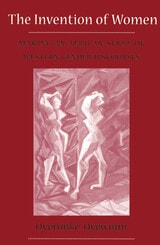
Invention Of Women
Making An African Sense Of Western Gender DiscoursesOyeronke Oyewumi
University of Minnesota Press, 1997
Oyewumi traces the misapplication of Western, body-oriented concepts of gender through the history of gender discourses in Yoruba studies. Her analysis shows the paradoxical nature of two fundamental assumptions of feminist theory: that gender is socially constructed and that the subordination of women is universal. The Invention of Women demonstrates, to the contrary, that gender was not constructed in old Yoruba society, and that social organization was determined by relative age.
A meticulous historical and epistemological account of an African culture on its own terms, this book makes a persuasive argument for a cultural, context-dependent interpretation of social reality. It calls for a reconception of gender discourse and the categories on which such study relies. More than that, the book lays bare the hidden assumptions in the ways these different cultures think. A truly comparative sociology of an African culture and the Western tradition, it will change the way African studies and gender studies proceed.
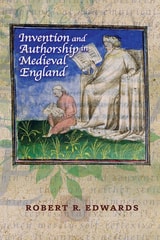
Invention and Authorship in Medieval England
Robert R. Edwards
The Ohio State University Press, 2017
Authorial invention in the Middle Ages is the base of a national tradition that English writers in the Renaissance saw as stable and capable of emulating the canons of classical languages and the Italian and French vernaculars. In Invention and Authorship in Medieval England, Robert R. Edwards brings new interpretive perspectives to Walter Map, Marie de France, John Gower, Geoffrey Chaucer, Thomas Hoccleve, and John Lydgate. He offers a critical reading of key moments that define the emergence of medieval English authorship by showing how writers adapt the commonplaces of authorship to define themselves and their works externally and to construct literary meaning internally.
Invention as a Social Act
Karen Burke LevFevre. Foreword by Frank D'Angelo
Southern Illinois University Press, 1986
The act of inventing relates to the process of inquiry, to creativity, to poetic and aesthetic invention.
Building on the work of rhetoricians, philosophers, linguists, and theorists in other disciplines, Karen Burke LeFevre challenges a widely-held view of rhetorical invention as the act of an atomistic individual. She proposes that invention be viewed as a social act, in which individuals interact dialectically with society and culture in distinctive ways.
Even when the primary agent of invention is an individual, invention is pervasively affected by relationships of that individual to others through language and other socially shared symbol systems. LeFevre draws implications of a view of invention as a social act for writers, researchers, and teachers of writing.

Invention of the First-Century Synagogue
Lidia D. Matassa
SBL Press, 2018
Invention, Copyright, and Digital Writing
Martine Courant Rife
Southern Illinois University Press, 2013
This is the first empirical, mixed-methods study of copyright issues that speaks to writing specialists and legal scholars about the complicated intersections of rhetoric, technology, copyright law, and writing for the Internet. Martine Courant Rife opens up new conversations about how invention and copyright work together in the composing process for digital writers and how this relationship is central to contemporary issues in composition pedagogy and curriculum.
In this era of digital writing and publishing, composition and legal scholars have identified various problems with writers’ processes and the law’s construction of textual ownership, such as issues of appropriation, infringement, and fair use within academic and online contexts. Invention, Copyright, and Digital Writing unpacks digital writers’ complex perceptions of copyright, revealing how it influences what they choose to write and how it complicates their work. Rife uses quantitative and qualitative approaches and focuses on writing as a tool and a technology-mediated activity, arguing the copyright problem is about not law but invention and the attendant issues of authorship.
Looking at copyright and writing through a rhetorical lens, Rife leverages the tools and history of rhetoric to offer insights into how some of our most ancient concepts inform our understanding of the problems copyright law creates for writers. In this innovative study that will be of interest to professional and technical writers, scholars and students of writing and rhetoric, and legal professionals, Rife offers possibilities for future research, teaching, curriculum design, and public advocacy in regard to composition and changing copyright laws.