Results by title
328 books match the query 'Islam' and 63 start with i
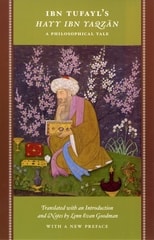
Ibn Tufayl's Hayy Ibn Yaqzan
A Philosophical TaleIbn Tufayl
University of Chicago Press, 2009
The Arabic philosophical fable Hayy Ibn Yaqzan is a classic of medieval Islamic philosophy. Ibn Tufayl (d. 1185), the Andalusian philosopher, tells of a child raised by a doe on an equatorial island who grows up to discover the truth about the world and his own place in it, unaided—but also unimpeded—by society, language, or tradition. Hayy’s discoveries about God, nature, and man challenge the values of the culture in which the tale was written as well as those of every contemporary society.
Goodman’s commentary places Hayy Ibn Yaqzan in its historical and philosophical context. The volume features a new preface and index, and an updated bibliography.
“One of the most remarkable books of the Middle Ages.”—Times Literary Supplement
“An enchanting and puzzling story. . . . The book transcends all historical and cultural environments to settle upon the questions of human life that perpetually intrigue men.”—Middle East Journal
“Goodman has done a service to the modern English reader by providing a readable translation of a philosophically significant allegory.”—Philosophy East and West
“Add[s] bright new pieces to an Islamic mosaic whose general shape is already known.”—American Historical Review
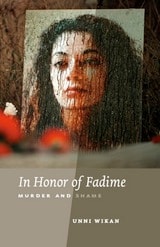
In Honor of Fadime
Murder and ShameUnni Wikan
University of Chicago Press, 2008
Unni Wikan narrates Fadime’s heartbreaking story through her own eloquent words, along with the testimonies of her father, mother, and two sisters. What unfolds is a tale of courage and betrayal, loyalty and love, power and humiliation, and a nearly unfathomable clash of cultures. Despite enduring years of threats over her emancipated life, Fadime advocated compassion for her killer to the end, believing him to be trapped by an unyielding code of honor. Wikan puts this shocking event in context by analyzing similar honor killings throughout Europe, Canada, and the United States. She also examines the concept of honor in historical and cross-cultural depth, concluding that Islam itself is not to blame—indeed, honor killings occur across religious and ethnic traditions—but rather the way that many cultures have resolutely linked honor with violence.
In Honor of Fadime holds profound and timely insights into conservative Kurdish culture, but ultimately the heart of this powerful book is Fadime’s courageous and tragic story—and Wikan’s telling of it is riveting.
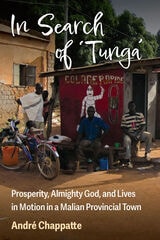
In Search of Tunga
Prosperity, Almighty God, and Lives in Motion in a Malian Provincial TownAndré Chappatte
University of Michigan Press, 2022
In the context of the current global war on terrorism, most studies of Muslim life have focused on the politics of piety of reformist movements, their leaders, and members. By contrast, In Search of “Tunga” takes a perspective from below. It opens piety up to “simply Muslims,” although the religious elites have always claimed authority and legitimacy over piety. Is piety an exclusive field of experiences for those who claim to strive for it? What does piety involve for the majority of Muslims, the non-elite and unaffiliated Muslims? This volume “democratizes” piety by documenting its practice as going beyond sharply defined religious affiliations and Islamic scholarship, and by showing it is both alive and normative, existential and prescriptive. As opposed to studies that build on the classic historical connections between the Maghreb and the Sahel, the southbound migration from the Sahel documented in this book stresses the overlooked historical connections between the southern shores of the Sahara and the lands south of those shores. It demonstrates how the Malian savanna, this former buffer-zone between ancient Mande kingdoms and thereafter remote areas of French Sudan, is increasingly becoming central in today’s Sahel contexts of desiccation and insecurity.
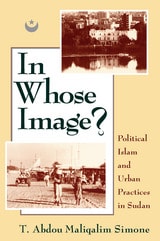
In Whose Image?
Political Islam and Urban Practices in SudanT. Abdou Maliqalim Simone
University of Chicago Press, 1994
Drawing a detailed portrait of political fundamentalism during the 1985-89 period of democratic rule in the Sudan, Simone shows how the Shari‘a Movement attempted to shape a viable social order by linking religious integrity and economic development, where religious practice was to dominate all aspects of society and individuals' daily lives. However, because Sudanese society is remarkably diverse ethnically and religiously, this often led to conflict, fragmentation, and violence in the name of Islam.
Simone's own Islamic background leads him to deplore the violence and the devastating psychological, economic, and cultural consequences of one form of Islamic radicalism, while holding to hope that a viable form of this inherently political religion can in fact be applied. As a counterpoint, he ends with a discussion of South Africa's Call of Islam, which seeks political unity through a more tolerant interpretation of Islam.
As an introduction to religious discourse in Africa, this book will be widely read by students and scholars throughout African Studies, Religious Studies, Anthropology, and Political Science.
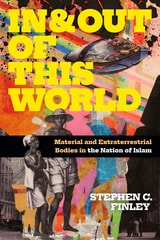
In and Out of This World
Material and Extraterrestrial Bodies in the Nation of IslamStephen C. Finley
Duke University Press, 2022
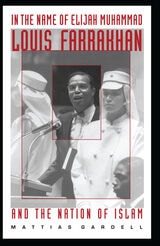
In the Name of Elijah Muhammad
Louis Farrakhan and The Nation of IslamMattias Gardell
Duke University Press, 1996
Beginning with Master Farad Muhammad, believed to be God in Person, Gardell examines the origins of the Nation. His research on the period of Elijah Muhammad’s long leadership draws on previously unreleased FBI files that reveal a clear picture of the bureau’s attempts to neutralize the Nation of Islam. In addition, they shed new light on the circumstances surrounding the murder of Malcolm X. With the main part of the book focused on the fortunes of the Nation after Elijah Muhammad’s death, Gardell then turns to the figure of Minister Farrakhan. From his emergence as the dominant voice of the radical black Islamic community to his leadership of the Million Man March, Farrakhan has often been portrayed as a demagogue, bigot, racist, and anti-Semite. Gardell balances the media’s view of the Nation and Farrakhan with the Nation’s own views and with the perspectives of the black community in which the organization actively works. His investigation, based on field research, taped lectures, and interviews, leads to the fullest account yet of the Nation of Islam’s ideology and theology, and its complicated relations with mainstream Islam, the black church, the Jewish community, extremist white nationalists, and the urban culture of black American youth, particularly the hip-hop movement and gangs.
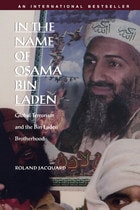
In the Name of Osama Bin Laden
Global Terrorism and the Bin Laden BrotherhoodRoland Jacquard
Duke University Press, 2002
International terrorism expert Roland Jacquard’s In the Name of Osama bin Laden presents a dramatic portrait of the world's most wanted terrorist and his extensive brotherhood--the network of people who operate “in his name.” Published originally in France the very week of September 11, as events in the United States shook the world, the book has become an international bestseller.
Jacquard details how bin Laden became an international emblem of fundamentalist, pan-Islamic, anti-U.S. fervor and the leader of a brotherhood so passionate that devotees who have never met him will act autonomously in his name. The author explains the global character of bin Laden’s organization, elaborating the extent of his sphere of influence in Europe and Asia. Jacquard reveals the construction of bin Laden’s networks—including a profile of his inner circle—and their collaboration with overlapping webs of banking, drug trafficking, religious, and terrorist organizations. He considers the brotherhood’s access to biological, chemical, and nuclear weapons and warns that, with or without bin Laden, this global terrorist force will remain a threat.
Now in English, this edition has been substantially updated in light of recent world events and expanded to include previously unpublished materials, featuring a new introduction and afterword. New documents include an April 2001 interview by the author with bin Laden; a September 24 proclamation by bin Laden to Muslims in Pakistan; and a key page from Dr. Ayman al-Zawahiri’s book justifying eternal jihad, which was smuggled out of Afghanistan in October 2001.
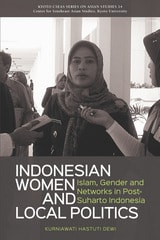
Indonesian Women and Local Politics
Islam, Gender and Networks in Post-Suharto IndonesiaKurniawati Hastuti Dewi
National University of Singapore Press, 2015
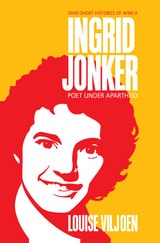
Ingrid Jonker
Poet under ApartheidLouise Viljoen
Ohio University Press, 2012
Nelson Mandela brought the poetry of Ingrid Jonker to the attention of South Africa and the wider world when he read her poem “Die kind” (The Child) at the opening of South Africa’s first democratic parliament on May 24, 1994. Though Jonker was already a significant figure in South African literary circles, Mandela’s reference contributed to a revival of interest in Jonker and her work that continues to this day.
Viljoen’s biography illuminates the brief and dramatic life of Jonker, who created a literary oeuvre—as searing in its intensity as it is brief—before taking her own life at the age of thirty-one. Jonker wrote against a background of escalating apartheid laws, violent repression of black political activists, and the banning of the African National Congress and the Pan Africanist Congress. Viljoen tells the story of Ingrid Jonker in the political and cultural context of her time, provides sensitive insights into her poetry, and considers the reasons for the enduring fascination with her life and death.
Her writings, her association with bohemian literary circles, and her identification with the oppressed brought her into conflict with her father, a politician in the white ruling party, and with other authority figures from her Afrikaner background. Her life and work demonstrate the difficulty and importance of artistic endeavor in a place of terrible conflict.

Inside Al-Qaeda and the Taliban
Beyond Bin Laden and 9/11Syed Saleem Shahzad
Pluto Press, 2011
President Obama may have delivered on his campaign promise to kill Osama bin Laden, but as an Al-Qaeda strategist bin Laden has been dead for years. This book introduces and examines the new generation of Al-Qaeda leaders who have been behind the most recent attacks.
Investigative journalist Syed Saleem Shahzad dedicated his life to revealing the strategies and inner workings of Al-Qaeda and the Taliban. He had access to top-level commanders in both movements, as well as within the ISI, Pakistan's intelligence service. Shahzad's work was praised by US Secretary of State Hillary Clinton for 'bringing to light the troubles extremism poses to Pakistan's stability.' Inside Al-Qaeda and the Taliban explains the wider aims of both organisations and provides an essential analysis of major terrorist incidents, including the 2008 Mumbai attacks.
In May 2011, Shahzad was abducted and killed in Pakistan, days after writing an article suggesting that insiders in the Pakistani navy had colluded with Al-Qaeda in an attack on a naval air station. This book is a testament to his fearless reporting and analytical rigour. It will provide readers worldwide with an invaluable introduction to a new phase of the ongoing struggle against terrorism which threatens lives in so many countries.

Intelligent Souls?
Feminist Orientalism in Eighteenth-Century English LiteratureSamara Anne Cahill
Bucknell University Press, 2019
Published by Bucknell University Press. Distributed worldwide by Rutgers University Press.
International Security in a World of Fragile States
Islamic States and Islamist OrganizationsS. Yaqub Ibrahimi
University of Michigan Press, 2022
Following the 9/11 attacks on New York and Washington, DC, there has been an increasing interest among scholars, students, and the interested public to study and learn about the Islamist-oriented terrorist organizations called Jihadi Salafi Groups (JSGs). Considering that these organizations emerged in highly fragile states, S. Yaqub Ibrahimi asks: how and why is state fragility linked to the emergence of JSGs?
Ibrahimi bases his study on three events: the establishment of al-Qaeda in Afghanistan in 1998, the rise of Islamic State in the post-Saddam Hussein Iraq, and the failed al-Qaeda effort to establish a base in Saudi Arabia in 2003. These case studies contain major aspects and features of the rise of JSGs and, together, explain the contribution of state fragility to the process of the formation and expansion of these terrorist organizations.
International Security in a World of Fragile States stands out as a pivotal work on the interconnection between the root causes of JSGs and state fragility conditions and their amalgamated role in the formation and evolution of these organizations. It contributes to IR and international security debates by developing a comprehensive but readily understandable narrative of the rise of JSGs in Islamic countries, and examining them in an analytical framework in which their root causes are categorized on individual, group, and international levels.
Intimate Connections
Love and Marriage in Pakistan’s High MountainsAnna-Maria Walter
Rutgers University Press, 2022
Iran on the Brink
Rising Workers and Threats of WarAndreas Malm and Shora Esmailian
Pluto Press, 2007
The authors offer a unique portrait of the social upheaval, why it is happening and where it may take the country. Following the fall of reformism, the rise of Ahmadinejad and the recent outbursts of ethnic violence, this book provides rare insights into the inner contradictions of the Islamic Republic.
The second part of the book deals with the international issues facing Iran - in particular the nuclear question, Iran's oil reserves and the serious threat of invasion. It is a sobering account of the realities of life in Iran, and the threat that war poses to the democratic aspirations of the Iranian people.
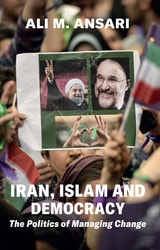
Iran, Islam and Democracy
The Politics of Managing ChangeAli M. Ansari
Gingko, 2019
Islam
Fazlur Rahman
University of Chicago Press, 1979
Islam In Urban America
Sunni Muslims In ChicagoGarbi Schmidt
Temple University Press, 2004
Islam Observed
Religious Development in Morocco and IndonesiaClifford Geertz
University of Chicago Press, 1971
Mr. Geertz begins his argument by outlining the problem conceptually and providing an overview of the two countries. He then traces the evolution of their classical religious styles which, with disparate settings and unique histories, produced strikingly different spiritual climates. So in Morocco, the Islamic conception of life came to mean activism, moralism, and intense individuality, while in Indonesia the same concept emphasized aestheticism, inwardness, and the radical dissolution of personality. In order to assess the significance of these interesting developments, Mr. Geertz sets forth a series of theoretical observations concerning the social role of religion.
Islam Translated
Literature, Conversion, and the Arabic Cosmopolis of South and Southeast AsiaRonit Ricci
University of Chicago Press, 2011
In Islam Translated, Ronit Ricci uses the Book of One Thousand Questions—from its Arabic original to its adaptations into the Javanese, Malay, and Tamil languages between the sixteenth and twentieth centuries—as a means to consider connections that linked Muslims across divides of distance and culture. Examining the circulation of this Islamic text and its varied literary forms, Ricci explores how processes of literary translation and religious conversion were historically interconnected forms of globalization, mutually dependent, and creatively reformulated within societies making the transition to Islam.
Islam and Anarchism
Relationships and ResonancesMohamed Abdou
Pluto Press, 2021
Discourse around Muslims and Islam all too often lapses into a false dichotomy of Orientalist and fundamentalist tropes. A popular reimagining of Islam is urgently needed. Yet it is a perhaps unexpected political philosophical tradition that has the most to offer in this pursuit: anarchism.
Islam and Anarchism is a highly original and interdisciplinary work, which simultaneously disrupts two commonly held beliefs - that Islam is necessarily authoritarian and capitalist; and that anarchism is necessarily anti-religious and anti-spiritual. Deeply rooted in key Islamic concepts and textual sources, and drawing on radical Indigenous, Islamic anarchistic and social movement discourses, Abdou proposes 'Anarcha-Islam'.
Constructing a decolonial, non-authoritarian and non-capitalist Islamic anarchism, Islam and Anarchism philosophically and theologically challenges the classist, sexist, racist, ageist, queerphobic and ableist inequalities in both post- and neo-colonial societies like Egypt, and settler-colonial societies such as Canada and the USA.
Islam and Education
Myths and TruthsEdited by Wadad Kadi and Victor Billeh
University of Chicago Press, 2007
In this timely volume based on a special issue of Comparative Education Review, leading comparative education scholars explore the world of education in Islam from the medieval era to today, illuminating the continuing struggle among Islamic scholars and educators over whether to reform or resist as a way of preserving identity. Islam and Education offers a rare overview of the great diversity in forms of Islamic education, dispelling misinterpretations and documenting the ever-evolving relationship of Islamic education to the West. It should be necessary reading for all humanists and social scientists wishing to understand the nexus between schools and societies, the spiritual dimensions of learning, and the social configuration of educational institutions.
Islam and Me
Narrating a DiasporaShirin Ramzanali Fazel
Rutgers University Press, 2023
In Islam and Me, Fazel tells her story and shares the experiences of other Muslim women living in Italy, revealing the wide variety of Muslim identities and the common prejudices they encounter. Looking at Italian school textbooks, newspapers, and TV programs, she invites us to change the way Muslim immigrants, and especially women, are depicted in both news reports and scholarly research. Islam and Me is a meditation on our multireligious, multiethnic, and multilingual reality, as well as an exploration of how we might reimagine national culture and identity so that they become more diverse, inclusive, and anti-racist.
Islam and Modernity
Transformation of an Intellectual TraditionFazlur Rahman
University of Chicago Press, 1984
"In this work, Professor Fazlur Rahman presents a positively ambitious blueprint for the transformation of the intellectual tradition of Islam: theology, ethics, philosophy and jurisprudence. Over the voices advocating a return to Islam or the reestablishment of the Sharia, the guide for action, he astutely and soberly asks: What and which Islam? More importantly, how does one get to 'normative' Islam? The author counsels, and passionately demonstrates, that for Islam to be actually what Muslims claim it to be—comprehensive in scope and efficacious for every age and place—Muslim scholars and educationists must reevaluate their methodology and hermeneutics. In spelling out the necessary and sound methodology, he is at once courageous, serious and profound."—Wadi Z. Haddad, American-Arab Affairs

Islam and Politics in East Africa
The Sufi Order in TanzaniaAugust H. Nimtz Jr.
University of Minnesota Press, 1980
Islam and Politics in East Africa was first published in 1980. Minnesota Archive Editions uses digital technology to make long-unavailable books once again accessible, and are published unaltered from the original University of Minnesota Press editions.
Focusing on the interplay of religion, society, and politics, August Nimtz examines the role of sufi tariqas (brotherhoods) in Tanzania, where he observed an African Muslim society at first hand. Nimtz opens this book with a historical account of Islam in East Africa, and in subsequent chapters analyzes the role of tariqas in Tanzania and, more specifically, in the coastal city of Bagamoyo. Using a conceptual framework derived from contemporary political theories on social cleavages and individual interests. Nimtz explains why the tariqa is important in the process of political change.
The fundamental cleavage in Muslim East Africa, he notes, is that of "whites" versus blacks. Nimtz contends that the tariqus, in serving the interest of blacks (that is, Africans), became in turn vehicles for the mass mobilization of African Muslims during the anti-colonial struggle. In Bagamoyo he finds a similar process and, in addition, reveals that the tariqas have served African interests in opposition to those of "whites" because of the individual benefits they provide. At the same time, Nimtz concludes, the social structure of East African Muslim society has ensured that Africans would be particularly attracted to these benefits. This work will interest both observers of African political development and specialists in the Islamic studies.
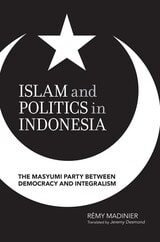
Islam and Politics in Indonesia
The Masyumi Party between Democracy and IntegralismRémy Madinier
National University of Singapore Press, 2015
This book examines the Masyumi Party from its roots in early 20th-century Muslim reformism to its contemporary legacy, and offers a perspective on political Islam which provides an alternative to the more widely-studied model of Middle-Eastern Islam. The party’s experience teaches us much about the fine line separating a moderate form of Islam open to democracy and a certain degree of secularisation from the sort of religious intransigence which can threaten the country’s denominational coexistence.
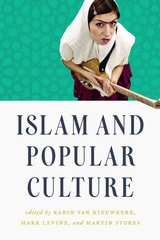
Islam and Popular Culture
Edited by Karin van Nieuwkerk, Mark LeVine, and Martin Stokes
University of Texas Press, 2016
Popular culture serves as a fresh and revealing window on contemporary developments in the Muslim world because it is a site where many important and controversial issues are explored and debated. Aesthetic expression has become intertwined with politics and religion due to the uprisings of the “Arab Spring,” while, at the same time, Islamist authorities are showing increasingly accommodating and populist attitudes toward popular culture. Not simply a “westernizing” or “secularizing” force, as some have asserted, popular culture now plays a growing role in defining what it means to be Muslim.
With well-structured chapters that explain key concepts clearly, Islam and Popular Culture addresses new trends and developments that merge popular arts and Islam. Its eighteen case studies by eminent scholars cover a wide range of topics, such as lifestyle, dress, revolutionary street theater, graffiti, popular music, poetry, television drama, visual culture, and dance throughout the Muslim world from Indonesia, Africa, and the Middle East to Europe. The first comprehensive overview of this important subject, Islam and Popular Culture offers essential new ways of understanding the diverse religious discourses and pious ethics expressed in popular art productions, the cultural politics of states and movements, and the global flows of popular culture in the Muslim world.
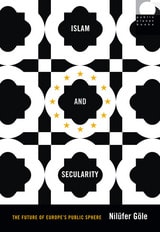
Islam and Secularity
The Future of Europe's Public SphereNilüfer Göle
Duke University Press, 2015
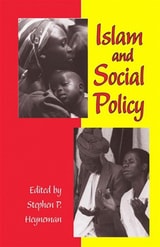
Islam and Social Policy
Stephen P. Heyneman
Vanderbilt University Press, 2004
The essays encompass many regional cultures and draw on court records and legal debates, field work on government ministries, and an extensive reading of Islamic law. In his overview of waqf (similar to the Western idea of a foundation, in which an endowment is set aside in perpetuity for specified purposes), Ahmad Dallal explains how charity, a central organizing principle in Islam, is itself organized and how waqf, traditionally a source of revenue for charitable purposes, can also become a source of tension and conflict. Donna Lee Bowen, in her essay on the position of women in Islamic law, points out the crucial differences between the Islamic principles of family equity and the Western notion of individual equality. In a subsequent essay, Bowen addresses the problems surrounding family planning and the dilemmas that have arisen within the Muslim world over differing ideas about birth control. The two final essays look at specific instances of how the modern state has treated Islamic social policy. Gail Richardson examines zakat, an Islamic tax used to assist the poor, and its administration in Pakistan. Carol Underwood, meanwhile, explores public health policy in Iran, both before and after the Islamic revolution that deposed the Shah.
Addressing some of the most profound misunderstandings between Islamic and Western societies, Islam and Social Policy will be of vital interest not only to scholars and policymakers but to anyone concerned with Islam's critical place in the modern world.
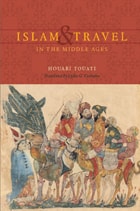
Islam and Travel in the Middle Ages
Houari Touati
University of Chicago Press, 2010
In the Middle Ages, Muslim travelers embarked on a rihla, or world tour, as surveyors, emissaries, and educators. On these journeys, voyagers not only interacted with foreign cultures—touring Greek civilization, exploring the Middle East and North Africa, and seeing parts of Europe—they also established both philosophical and geographic boundaries between the faithful and the heathen. These voyages thus gave the Islamic world, which at the time extended from the Maghreb to the Indus Valley, a coherent identity.
Islam and Travel in the Middle Ages assesses both the religious and philosophical aspects of travel, as well as the economic and cultural conditions that made the rihla possible. Houari Touati tracks the compilers of the hadith who culled oral traditions linked to the prophet, the linguists and lexicologists who journeyed to the desert to learn Bedouin Arabic, the geographers who mapped the Muslim world, and the students who ventured to study with holy men and scholars. Travel, with its costs, discomforts, and dangers, emerges in this study as both a means of spiritual growth and a metaphor for progress. Touati’s book will interest a broad range of scholars in history, literature, and anthropology.

Islam and World History
The Ventures of Marshall HodgsonEdited by Edmund Burke and Robert J. Mankin
University of Chicago Press, 2018
In our post-9/11 world, Hodgson’s historical vision and moral engagement have never been more relevant. A towering achievement, Islam and World History will prove to be the definitive statement on Hodgson’s relevance in the twenty-first century and will introduce his influential work to a new generation of readers.
Islam and the Political
Theory, Governance and International RelationsAmr G. E. Sabet
Pluto Press, 2008
This book compares Islamic and Western political formulations, highlighting areas of agreement and disparity. Building on this analysis, the author goes on to show that political Islam offers a serious alternative to the dominant political system and ideology of the West.
Sabet argues that rather than leading to a "Clash of Civlizations" or the assimilation of Islam into the Western system, a positive process of interactive self-reflection between Islam and liberal democracy is the best way forward.
Beginning this process, Sabet highlights key concepts of Islamic political thought and brings them into dialogue with Western modernity. The resulting synthesis is essential reading for advanced undergraduate and graduate students of Islamic and Middle Eastern politics, political theory, comparative politics and international relations.
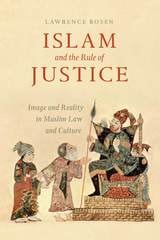
Islam and the Rule of Justice
Image and Reality in Muslim Law and CultureLawrence Rosen
University of Chicago Press, 2018
With Islam and the Rule of Justice, Lawrence Rosen analyzes a number of these misperceptions. Drawing on specific cases, he explores the application of Islamic law to the treatment of women (who win most of their cases), the relations between Muslims and Jews (which frequently involve close personal and financial ties), and the structure of widespread corruption (which played a key role in prompting the Arab Spring). From these case studie the role of informal mechanisms in the resolution of local disputes. The author also provides a close reading of the trial of Zacarias Moussaoui, who was charged in an American court with helping to carry out the 9/11 attacks, using insights into how Islamic justice works to explain the defendant’s actions during the trial. The book closes with an examination of how Islamic cultural concepts may come to bear on the constitutional structure and legal reforms many Muslim countries have been undertaking.
Islam and the West
A Conversation with Jacques DerridaMustapha Chérif
University of Chicago Press, 2008
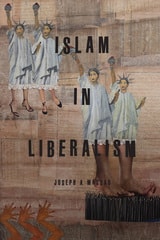
Islam in Liberalism
Joseph A. Massad
University of Chicago Press, 2014
Joseph Massad’s Islam in Liberalism explores what Islam has become in today’s world, with full attention to the multiplication of its meanings and interpretations. He seeks to understand how anxieties about tyranny, intolerance, misogyny, and homophobia, seen in the politics of the Middle East, are projected onto Islam itself. Massad shows that through this projection Europe emerges as democratic and tolerant, feminist, and pro-LGBT rights—or, in short, Islam-free. Massad documents the Christian and liberal idea that we should missionize democracy, women’s rights, sexual rights, tolerance, equality, and even therapies to cure Muslims of their un-European, un-Christian, and illiberal ways. Along the way he sheds light on a variety of controversial topics, including the meanings of democracy—and the ideological assumption that Islam is not compatible with it while Christianity is—women in Islam, sexuality and sexual freedom, and the idea of Abrahamic religions valorizing an interfaith agenda. Islam in Liberalism is an unflinching critique of Western assumptions and of the liberalism that Europe and Euro-America blindly present as a type of salvation to an assumingly unenlightened Islam.
Islam in the Digital Age
E-Jihad, Online Fatwas and Cyber Islamic EnvironmentsGary R. Bunt
Pluto Press, 2003
The Internet is an increasingly important source of information for many people in the Muslim world. Many Muslims in majority and minority contexts rely on the Internet -- including websites and e-mail -- as a primary source of news, information and communication about Islam. As a result, a new media culture is emerging which is having a significant impact on areas of global Muslim consciousness. Post-September 11th, this phenomenon has grown more rapidly than ever.
Gary R. Bunt provides a fascinating account of the issues at stake, identifying two radical new concepts:
Firstly, the emergence of e-jihad ('Electronic Jihad') originating from diverse Muslim perspectives -- this is described in its many forms relating to the different definitions of 'jihad', including on-line activism (ranging from promoting militaristic activities to hacking, to co-ordinating peaceful protests) and Muslim expression post 9/11.
Secondly, he discusses religious authority on the Internet -- including the concept of on-line fatwas and their influence in diverse settings, and the complexities of conflicting notions of religious authority.
Islam's Political Culture
Religion and Politics in Predivided PakistanBy Nasim Ahmad Jawed
University of Texas Press, 1999
This book examines the political dimension of Islam in predivided Pakistan (1947-1971), one of the first new Muslim nations to commit itself to an Islamic political order and one in which the national debate on Islamic, political, and ideological issues has been the most persistent, focused, and rich of any dialogues in the contemporary Muslim world.
Nasim Jawed draws on the findings of a survey he conducted among two influential social groups—the ulama (traditional religious leaders) and the modern professionals—as well as on the writings of Muslim intellectuals. He probes the major Islamic positions on critical issues concerning national identity, the purpose of the state, the form of government, and free, socialist, and mixed economies.
This study contributes to an enhanced understanding of Islam's political culture worldwide, since the issues, positions, and arguments are often similar across the Muslim world. The empirical findings of the study not only outline the ideological backdrop of contemporary Islamic reassertion, but also reveal diversity as well as tensions within it.
Islam, Justice, and Democracy
Sabri Ciftci
Temple University Press, 2022
Justice (al-‘adl) is one of the principal values of the Islamic faith. In Islam, Justice, and Democracy, Sabri Ciftci explores the historical, philosophical, and empirical foundations of justice to examine how religious values relate to Muslim political preferences and behavior. He focuses on Muslim agency and democracy to explain how ordinary Muslims use the conceptions of divine justice—either servitude to God or exercising free will against oppressors—to make sense of real-world problems.
Using ethnographic research, interviews, and public opinion surveys as well as the works of Islamist ideologues, archives of Islamist journals, and other sources, Ciftci shows that building contemporary incarnations of Islamist justice is, in essence, a highly practical political project that has formative effects on Muslim political attitudes. Islam, Justice, and Democracy compares the recent Arab Spring protests to the constitutionalist movements of the nineteenth and twentieth centuries in the Middle East to demonstrate the continuities and rifts a century apart.
By putting justice at the center of democratic thinking in the Muslim world, Ciftci reconsiders Islam's potential in engendering both democratic ideals and authoritarian preferences.
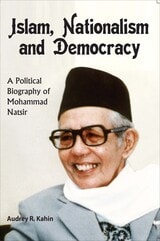
Islam, Nationalism and Democracy
a Political Biography of Mohammad NatsirAudrey R. Kahin
National University of Singapore Press, 2012
Islam, Postmodernism and Other Futures
A Ziauddin Sardar ReaderEdited by Sohail Inayatullah and Gail Boxwell
Pluto Press, 2003
Ziauddin Sardar is a prolific writer and an insightful cultural commentator. His latest book, Why Do People Hate America?, has been a regular feature in bestseller lists in several countries. In the UK, he is known as a leading intellectual and his regular contributions to the Observer, the Independent and the New Statesman have brought his writings to a wide audience. As one of our most high-profile Muslim intellectuals, he has also become an increasingly important voice in the media since the events of September 11th 2001.
This is the first collection of his writings that offers a comprehensive introduction to his thought. Starting with his analysis of his own position as a British Muslim and a writer, it goes on to explore issues of Islam and cultural change, education, identity, post-modernism and the future. Drawn from a broad range of his work in scholarly journals as well as from his many books on aspects of culture and society, it includes his most frequently cited papers and makes an ideal introduction to the immense scope of his work in cultural studies.
Ziaddin Sardar is currently the editor of Third Text and Visiting Professor of Cultural Studies at City University, London. His books for Pluto Press include Postmodernism and the Other and Aliens R Us.
Islam
A Way of LifePhilip Hitti
University of Minnesota Press, 1970
Islam
Between Divine Message and HistoryAbdelmajid Sharfi
Central European University Press, 2005
Islam
Origin and BeliefBy Emory C. Bogle
University of Texas Press, 1998
Islam is the fastest-growing religion in the world today. An understanding of its beliefs and practices has become essential knowledge not only for religious and political leaders but also for ordinary citizens who increasingly interact with Muslims as neighbors, coworkers, and schoolmates.
This book is designed to offer the general public a concise overview of the origins, basic beliefs, and common practices of Islam, as well as the reasons for its dramatic resurgence in recent times. Emory Bogle details the life mission of the prophet Muhammad and describes the spread of Islam after his death. He accounts for the rise and contemporary influence of Shi'i Islam, a topic of particular interest to Western readers. Bogle also explains the basic beliefs ("The Five Pillars") of Islam, as well as the role played by the Qur'an (Islam's scriptures), the hadith (the words and behavior of Muhammad), and the shari'a (Islamic law).
Islamic Activists
The Anti-Enlightenment DemocratsDeina Ali Abdelkader
Pluto Press, 2011
In the hysteria surrounding Political Islam, it is difficult to find analysis that doesn't feel the need to justify the existence of Islamic leaders or react to the West's fear of 'extremists'. In Islamic Activists, Deina Ali Abdelkader shows us what Islamic leaders and activists believe and what they think about just governance.
Explaining and comparing Islamist ideas, including those about leadership, justice and minority rights, Abdelkader explains how these have been represented in the writings of important historical and contemporary Islamists. In doing so, Abdelkader reveals that democracy is not the sole preserve of those who support Enlightenment values, offering the reader a chance to understand the populist non-violent side of Islamic activism. This includes an examination of the ideas of the leaders of the populist Islamist movements in Egypt, Tunisia and Morocco.
Islamic Africa 1.1
Muhammad Sani Umar
Northwestern University Press, 2010
Islamic Africa promotes interaction between scholars of Islam and Africa across all continents and across historical periods. We welcome papers on any aspect of Islam and Muslim life pertaining to Africa and/or Africans from the humanities and the social sciences, especially those originating from the African continent.
Islamic Africa 1.2
Muhammad Sani Umar
Northwestern University Press, 2010
Islamic Africa promotes interaction between scholars of Islam and Africa across all continents and across historical periods. We welcome papers on any aspect of Islam and Muslim life pertaining to Africa and/or Africans from the humanities and the social sciences, especially those originating from the African continent.
Islamic Africa 2.1
Muhammad S. Umar
Northwestern University Press, 2011
Islamic Africa promotes interaction between scholars of Islam and Africa across all continents and across historical periods. We welcome papers on any aspect of Islam and Muslim life pertaining to Africa and/or Africans from the humanities and the social sciences, especially those originating from the African continent.
Islamic Africa 2.2
Muhammad Sani Umar
Northwestern University Press, 2011
Islamic Africa promotes interaction between scholars of Islam and Africa across all continents and across historical periods. We welcome papers on any aspect of Islam and Muslim life pertaining to Africa and/or Africans from the humanities and the social sciences, especially those originating from the African continent.
Islamic Africa 3.1
Muhammad Sani Umar
Northwestern University Press, 2012
Islamic Africa promotes interaction between scholars of Islam and Africa across all continents and across historical periods. We welcome papers on any aspect of Islam and Muslim life pertaining to Africa and/or Africans from the humanities and the social sciences, especially those originating from the African continent.
Islamic Africa 3.2
Scott Reese
Northwestern University Press, 2012
Islamic Africa promotes interaction between scholars of Islam and Africa across all continents and across historical periods. We welcome papers on any aspect of Islam and Muslim life pertaining to Africa and/or Africans from the humanities and the social sciences, especially those originating from the African continent.
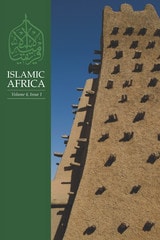
Islamic Africa 4.1
Scott Reese
Northwestern University Press, 2013
Islamic Africa promotes interaction between scholars of Islam and Africa across all continents and across historical periods. We welcome papers on any aspect of Islam and Muslim life pertaining to Africa and/or Africans from the humanities and the social sciences, especially those originating from the African continent.
Islamic Africa Electronic Journal
Volume 4, Issue 1 Spring 2013