Results by title
1917 books match the query 'Law' and 75 start with i

INSIDE WEST VIRGINIA
PUBLIC POLICY PERSPECTIVES FOR THE 21ST CENTURYBRUCE KEITH
West Virginia University Press, 1999
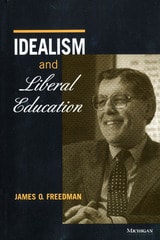
Idealism and Liberal Education
James O. Freedman
University of Michigan Press, 2001
Identities, Politics, and Rights
Austin Sarat and Thomas R. Kearns, Editors
University of Michigan Press, 1997
Identity and the Case for Gay Rights
Race, Gender, Religion as AnalogiesDavid A. J. Richards
University of Chicago Press, 1999
Richards argues that racial and gender struggles are informative but partial models. As in these movements, achieving gay rights requires eliminating unjust stereotypes and allowing one's identity to develop free from intolerant views. Richards stresses, however, that gay identity is an ethical choice based on gender equality. Thus the right to religious freedom offers the most compelling analogy for a gay rights movement because gay identity should be protected legally as an ethical decision of conscience.
A thoughtful and highly original voice in the struggle for gay rights, David Richards is the first to argue that discrimination is like religious intolerance-denial of full humanity to individuals because of their identity and moral commitments to gender equality.
Ill-Gotten Gains
Evasion, Blackmail, Fraud, and Kindred Puzzles of the LawLeo Katz
University of Chicago Press, 1996
"An ambitious and well-written book of legal and moral theory to overthrow both utilitarianism and its cousin, the economic approach to law."—Richard A. Posner, New Republic
"A good, well-written book full of interesting examples."—Library Journal
"[An] elegant defense of circumvention and subterfuge . . . a heroically counterintuitive book."—Malcolm Gladwell, New Yorker

Illegal Migrations and the Huckleberry Finn Problem
John S W Park
Temple University Press, 2013

Illegitimacy in Renaissance Florence
Thomas Kuehn
University of Michigan Press, 2002
The Florentine catasto, a fiscal survey of households taken at several points in the fifteenth century, locates hundreds of illegitimate children and reveals a great deal about their household circumstances and parentage. Supplementing this information are notarial documents and family account books. Illegitimacy in Renaissance Florence places Florentine illegitimate children in a complete legal context, culminating in examination of several Florentine legal cases. Thomas Kuehn shows how lawyers were called on to cope with and make legal sense of the actions and prejudices of Florentines toward their illegitimate kin.
It is clear, in its simplest terms, that illegitimacy in Florence was a permanent, if not fixed, status. Most illegitimate children, especially girls, were abandoned; infanticide was undoubtedly practiced. But even those children raised by benevolent fathers and granted legitimation always remained "legitimatus" and not "legitimus." Florentines whose illegitimate paternity was admitted were overwhelmingly born of elite fathers but poor or servile mothers. In neither social nor legal terms did the illegitimate share fully in the personhood of the legitimate adult male Florentine citizen. Still, ambiguities of status could be useful for those with sufficient wealth and social standing to exploit their potential.
Illegitimacy in Renaissance Florence will appeal to social historians of Europe, medieval and early modern, especially those concerned with family life, women, and children, as well as all those interested in Florentine history. Legal historians will find it useful as well.
Thomas Kuehn is Professor of History, Clemson University.
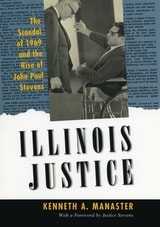
Illinois Justice
The Scandal of 1969 and the Rise of John Paul StevensKenneth A. Manaster
University of Chicago Press, 2001
In 1969, citizen gadfly Sherman Skolnick accused two Illinois Supreme Court justices of accepting valuable bank stock from an influential Chicago lawyer in exchange for deciding an important case in the lawyer’s favor. The resulting feverish media coverage prompted the state supreme court to appoint a special commission to investigate. Within six weeks and on a shoestring budget, the commission mobilized a small volunteer staff to reveal the facts. Stevens, then a relatively unknown Chicago lawyer, served as chief counsel. His work on this investigation would launch him into the public spotlight and onto the bench.
Manaster, who served on the commission, tells the real story of the investigation, detailing the dead ends, tactics, and triumphs. Manaster expertly traces Stevens’s masterful courtroom strategies and vividly portrays the high-profile personalities involved, as well as the subtleties of judicial corruption. A reflective foreword by Justice Stevens himself looks back at the case and how it influenced his career.
Now the subject of the documentary Unexpected Justice: The Rise of John Paul Stevens, Manaster’s book is both a fascinating chapter of political history and a revealing portrait of the early career of a Supreme Court justice.
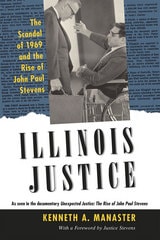
Illinois Justice
The Scandal of 1969 and the Rise of John Paul StevensKenneth A. Manaster
University of Chicago Press, 2001
In 1969, citizen gadfly Sherman Skolnick accused two Illinois Supreme Court justices of accepting valuable bank stock from an influential Chicago lawyer in exchange for deciding an important case in the lawyer’s favor. The resulting feverish media coverage prompted the state supreme court to appoint a special commission to investigate. Within six weeks and on a shoestring budget, the commission mobilized a small volunteer staff to reveal the facts. Stevens, then a relatively unknown Chicago lawyer, served as chief counsel. His work on this investigation would launch him into the public spotlight and onto the bench.
Manaster, who served on the commission, tells the real story of the investigation, detailing the dead ends, tactics, and triumphs. Manaster expertly traces Stevens’s masterful courtroom strategies and vividly portrays the high-profile personalities involved, as well as the subtleties of judicial corruption. A reflective foreword by Justice Stevens himself looks back at the case and how it influenced his career.
Now the subject of the documentary Unexpected Justice: The Rise of John Paul Stevens, Manaster’s book is both a fascinating chapter of political history and a revealing portrait of the early career of a Supreme Court justice.

Illness or Deviance?
Drug Courts, Drug Treatment, and the Ambiguity of AddictionJennifer Murphy
Temple University Press, 2015
Illness or Deviance? highlights the confusion and contradictions about labeling addiction. Murphy’s fieldwork in a drug court and an outpatient drug treatment facility yields fascinating insights, such as how courts and treatment centers both enforce the “disease” label of addiction, yet their management tactics overlap treatment with “therapeutic punishment.” The “addict" label is a result not just of using drugs, but also of being a part of the drug lifestyle, by selling drugs. In addition, Murphy observes that drug courts and treatment facilities benefit economically from their cooperation, creating a very powerful institutional arrangement.
Murphy contextualizes her findings within theories of medical sociology as well as criminology to identify the policy implications of a medicalized view of addiction.

Images of a Free Press
Lee C. Bollinger
University of Chicago Press, 1991
"Images of a Free Press is the natural sequel to Lee Bollinger's first book, The Tolerant Society, and is destined to become a standard in first amendment scholarship."—Rodney A. Smolla, Constitutional Commentary
"Revisiting themes he first explored some fifteen years ago, Bollinger now adds further to our understanding of the complex relationship among the First Amendment, the Supreme Court, the public, the press and the democratic process. This is a work of insight, sensitivity, and power. Bollinger has a profound knowledge of and a deep affection for his subject, and it shows."—Geoffrey R. Stone, Michigan Law Review
"This thoughtful, understated book remains a call to come join the town meeting and hammer out some new rules of order. Scholars and citizens alike could do well to read Bollinger's book and accept his challenge."—Yale Law Review
"For a number of years, Lee Bollinger has argued that the First Amendment has been applied differently to the print media than it has been to the broadcast media. In his new book, Images of a Free Press, Bollinger provides a concise, persuasive account of why this is so—and why it ought to be so."—Columbia Law Review
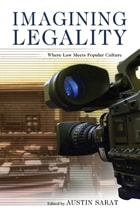
Imagining Legality
Where Law Meets Popular CultureAustin Sarat
University of Alabama Press, 2011
Imagining Legality argues that images of law suggested by television and film are as numerous as they are various, and that they give rise to a potent and pervasive imaginative life of the law. The media’s projections of the legal system remind us not only of the way law lives in our imagination but also of the contingencies of our own legal and social arrangements.
Contributors to Imagining Legality are less interested in the accuracy of the portrayals of law in film and television than in exploring the conditions of law’s representation, circulation, and consumption in those media. In the same way that legal scholars have taken on the disciplinary perspectives of history, economics, sociology, anthropology, and psychology in relation to the law, these writers bring historical, sociological, and cultural analysis, as well as legal theory, to aid in the understanding of law and popular culture.
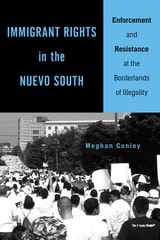
Immigrant Rights in the Nuevo South
Enforcement and Resistance at the Borderlands of IllegalityMeghan Conley
Temple University Press, 2020
Every day, undocumented immigrants are rendered vulnerable through policies and practices that illegalize them. Moreover, they are socially constructed into dangerous criminals and taxpayer burdens who are undeserving of rights, dignity, and respect. Meghan Conley’s timely book, Immigrant Rights in the Nuevo South, seeks to expose and challenge these dehumanizing ideas and practices byexamining the connections between repression and resistance for unauthorized immigrants in communities across the American Southeast.
Conley uses on-the-ground interviews to describe fear and resistance from the perspective of those most affected by it. She shows how, for example, the Illegal Immigration Reform and Enforcement Act in Georgia prompted marches and an action that became “a day of non-compliance.” Likewise, an “enforcement lottery” that created unpredictable threats of arrest and deportation in the region mobilized immigrants to organize and demonstrate. However, as immigrant rights activists mobilize in opposition to the criminalization of undocumented people, they may unintentionally embrace stories of who deserves to be in the United States and who does not. Immigrant Rights in the Nuevo South explores these paradoxes while offering keen observations about the nature and power of Latinx resistance.
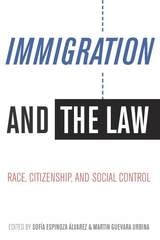
Immigration and the Law
Race, Citizenship, and Social ControlEdited by Sofía Espinoza Álvarez and Martin Guevara Urbina
University of Arizona Press, 2018
In today’s highly charged atmosphere, Immigration and the Law gives readers a grounded and broad overview of U.S. immigration law in a single book. Encompassing issues such as shifting demographics, a changing criminal justice system, and volatile political climate, the book is critically significant for academic, political, legal, and social arenas.
The contributors offer sound evidence to expose the historical legacy of violence, brutality, manipulation, oppression, marginalization, prejudice, discrimination, power, and control. Demystifying the ways that current ideas of ethnicity, race, gender, and class govern immigration and uphold the functioning and legitimacy of the criminal justice system, Immigration and the Law presents a variety of studies and perspectives that offer a pathway toward addressing long-neglected but vital topics in the discourse on immigration and the law.
Contributors
Sofía Espinoza Álvarez
Steven W. Bender
Leo R. Chávez
Arnoldo De León
Daniel Justino Delgado
Roxanne Lynn Doty
Brenda I. Gill
Ruth Gomberg-Muñoz
Peter Laufer
Lupe S. Salinas
Mary C. Sengstock
Martin Guevara Urbina
Claudio G. Vera Sánchez
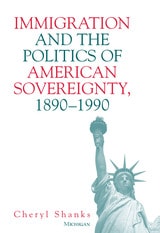
Immigration and the Politics of American Sovereignty, 1890-1990
Cheryl Shanks
University of Michigan Press, 2001
Imperfect Alternatives
Choosing Institutions in Law, Economics, and Public PolicyNeil K. Komesar
University of Chicago Press, 1994
Pointing out that all three institutions are massive, complex, and imperfect, Komesar develops a strategy for comparative institutional analysis that assesses variations in institutional ability. He then powerfully demonstrates the value of this analytical framework by using it to examine important contemporary issues ranging from tort reform to constitution-making.
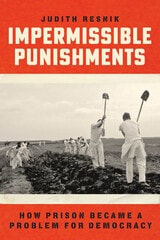
Impermissible Punishments
How Prison Became a Problem for DemocracyJudith Resnik
University of Chicago Press, 2025
An original transatlantic history of the invention of the corrections profession and of ensuing debates about punishment’s purposes and prisoners’ rights.
Impermissible Punishments explores the history of punishment inside prisons and how governments grappled with obligations to justify the punishments they impose. Legal scholar Judith Resnik charts the creation of the corrections profession and weaves together the stories of people who made rules for prisons and the stories of those living under the resulting regimes.
Resnik maps three centuries of shifting ideas, norms, and legal standards aiming to draw lines between permissible and impermissible punishments. Her account documents the impact of World War II, the United Nations, the US Civil Rights movement, and the pioneering prisoners who insisted that law should protect their individual dignity. Taking us to the present, Resnik analyzes the expansion of imprisonment, the inability of public and private prisons to provide safe housing, and the impact of abolition politics.
Exploring the interdependency of people in and out of prisons, Impermissible Punishments examines what governments committed to equality owe to the people they detain and argues that many contemporary forms of punishment need to end.

Impersonating Animals
Rhetoric, Ecofeminism, and Animal Rights LawS. Marek Muller
Michigan State University Press, 2020

Imprints
The Pokagon Band of Potawatomi Indians and the City of ChicagoJohn N. Low
Michigan State University Press, 2016
Imprints: The Pokagon Band of Potawatomi Indians and the City of Chicago examines the ways some Pokagon Potawatomi tribal members have maintained a distinct Native identity, their rejection of assimilation into the mainstream, and their desire for inclusion in the larger contemporary society without forfeiting their “Indianness.” Mindful that contact is never a one-way street, Low also examines the ways in which experiences in Chicago have influenced the Pokagon Potawatomi. Imprints continues the recent scholarship on the urban Indian experience before as well as after World War II.
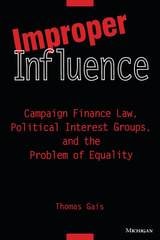
Improper Influence
Campaign Finance Law, Political Interest Groups, and the Problem of EqualityThomas Gais
University of Michigan Press, 1998
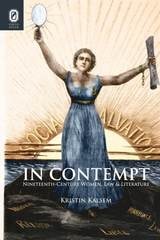
In Contempt
Nineteenth-Century Women, Law, and LiteratureKristin Kalsem
The Ohio State University Press, 2012
In Contempt: Nineteenth-Century Women, Law, and Literature, by Kristin Kalsem, explores the legal advocacy performed by nineteenth-century women writers in publications of nonfiction and fiction, as well as in real-life courtrooms and in the legal forum provided by the novel form.
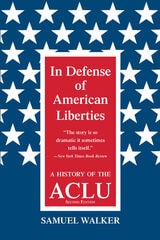
In Defense of American Liberties, Second Edition
A History of the ACLUSamuel Walker
Southern Illinois University Press, 1999
This updated comprehensive history of the American Civil Liberties Union recounts the ACLU's stormy history since its founding in 1920 to fight for free speech and explores its involvement in some of the most famous causes in American history, including the Scopes "monkey trial," the internment of Japanese Americans during World War II, the Cold War anti-Communist witch hunts, and the civil rights movement. The new introduction covers the history of the organization and developments in civil liberties in the 1990s, including the U.S. Supreme Court's declaration of the Communications Decency Act as unconstitutional in ACLU v. Reno.
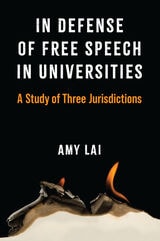
In Defense of Free Speech in Universities
A Study of Three JurisdictionsAmy Lai
University of Michigan Press, 2023
In this book, Amy Lai examines the current free speech crisis in Western universities. She studies the origin, history, and importance of freedom of speech in the university setting, and addresses the relevance and pitfalls of political correctness and microaggressions on campuses, where laws on harassment, discrimination, and hate speech are already in place, along with other concepts that have gained currency in the free speech debate, including deplatforming, trigger warning, and safe space. Looking at numerous free speech disputes in the United Kingdom, the United States, and Canada, the book argues for the equal application of the free speech principle to all expressions to facilitate respectful debates. All in all, it affirms that the right to free expression is a natural right essential to the pursuit of truth, democratic governance, and self-development, and this right is nowhere more important than in the university.

In Defense of Honor
Sexual Morality, Modernity, and Nation in Early-Twentieth-Century BrazilSueann Caulfield
Duke University Press, 2000
While some Brazilian elites used the issue of sexual purity to boast of their country’s moral superiority, others claimed that the veneration of such concepts as virginity actually frustrated efforts at modernization. Moreover, although individuals of all social classes invoked values they considered “traditional,” such as the confinement of women’s sexuality within marriage, these values were at odds with social practices—such as premarital sex, cohabitation, divorce, and female-headed households—that had been common throughout Brazil’s history. The persistence of these practices, together with post-World War I changes in both official and popular moral ideals, presented formidable obstacles to the Estado Novo’s renewed drive to define and enforce public morality and private family values in the late 1930s.
With sophisticated theoretical underpinnings, In Defense of Honor is written in a clear and lively manner, making it accessible to students and scholars in a variety of disciplines, including Brazilian and Latin American studies, gender studies, and legal history.

In Defense of Monopoly
How Market Power Fosters Creative ProductionRichard B. McKenzie and Dwight R. Lee
University of Michigan Press, 2008
In Defense of Monopoly offers an unconventional but empirically grounded argument in favor of market monopolies. Authors McKenzie and Lee claim that conventional, static models exaggerate the harm done by real-world monopolies, and they show why some degree of monopoly presence is necessary to maximize the improvement of human welfare over time.
Inspired by Joseph Schumpeter's suggestion that market imperfections can drive an economy's long-term progress, In Defense of Monopoly defies conventional assumptions to show readers why an economic system's failure to efficiently allocate its resources is actually a necessary precondition for maximizing the system's long-term performance: the perfectly fluid, competitive economy idealized by most economists is decidedly inferior to one characterized by market entry and exit restrictions or costs.
An economy is not a board game in which players compete for a limited number of properties, nor is it much like the kind of blackboard games that economists use to develop their monopoly models. As McKenzie and Lee demonstrate, the creation of goods and services in the real world requires not only competition but the prospect of gains beyond a normal competitive rate of return.
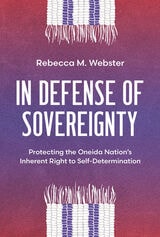
In Defense of Sovereignty
Protecting the Oneida Nation's Inherent Right to Self-DeterminationRebecca M. Webster
University of Wisconsin Press, 2023
As in so many conflicts between Indigenous nations and local municipalities, the media narrative about the Oneida Nation’s battle for sovereignty has been dominated by the local government’s standpoint. In Defense of Sovereignty offers another perspective, that of a nation citizen directly involved in the litigation, augmented by contributions from historians, attorneys, and a retired nation employee. It makes an important contribution to public debates about the inherent right of Indigenous nations to continue to exist and exercise self-governance within their territories without being challenged at every turn.
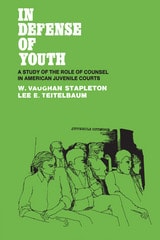
In Defense of Youth
A Study of the Role of Counsel in American Juvenile CourtsWilliam Vaughn Stapleton
Russell Sage Foundation, 1972

In Quest of History
On Czech Statehood and IdentityJirí Pribán and Karel Hvíždala
Karolinum Press, 2019
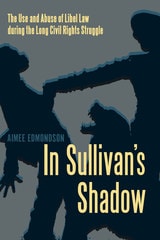
In Sullivan's Shadow
The Use and Abuse of Libel Law during the Long Civil Rights StruggleAimee Edmondson
University of Massachusetts Press, 2019
Drawing on archival research and scholarship in journalism, legal history, and African American studies, Edmondson offers a new narrative of brave activists, bold journalists and publishers, and hardheaded southern officials. These little-known courtroom dramas at the intersection of race, libel, and journalism go beyond the activism of the 1960s and span much of the country's history, beginning with lawsuits filed against abolitionist William Lloyd Garrison and concluding with a suit spawned by the 1988 film Mississippi Burning.
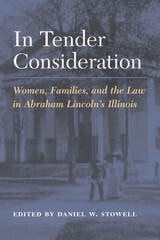
In Tender Consideration
Women, Families, and the Law in Abraham Lincoln's IllinoisEdited by Daniel W. Stowell
University of Illinois Press, 2002
Drawing on the rich resources of The Law Practice of Abraham Lincoln: Complete Documentary Edition, a DVD version of Lincoln's complete legal papers, In Tender Consideration scans the full range of family woes that antebellum Americans took to the law. Deserted wives, destitute widows, jilted brides with illegitimate children, and slandered women brought their cases before the courts, often receiving a surprising degree of sympathy and support.
Through the stories of dozens of individuals who took legal action to obtain a divorce, contest a will, prosecute a rapist, or assert rights to family property, this volume illuminates the legal status of women and children in Illinois and their experiences with the law in action. Contributors document how the courts viewed children and how they responded to inheritance, custody, and other types of cases involving children or their interests. These cases also highlight Lincoln's life in law, placing him more clearly within the context of the legal culture in which he lived and raising intriguing questions about the influence of his legal life on his subsequent political one.
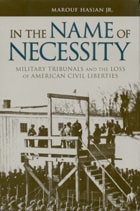
In the Name of Necessity
Military Tribunals and the Loss of American Civil LibertiesMarouf Hasian
University of Alabama Press, 2005
Examining how claims of necessity have reshaped American liberty in times of war.
Though the war on terrorism is said to have generated unprecedented military situations, arguments for the Patriot Act and military tribunals following 9/11 resemble many historical claims for restricting civil liberties, more often than not in the name of necessity.
Marouf Hasian Jr. examines the major legal cases that show how various generations have represented the need for military tribunals, and how officials historically have applied the term “necessity.” George Washington cited the necessity of martial discipline in executing the British operative Major André. Tribunals tried and convicted more than 200 Sioux warriors during the Dakota Wars. President Lincoln suspended habeas corpus for many civilian and military prisoners during the Civil War. Twentieth Century military and civilian leaders selectively drafted their own codes, leading to the execution of German saboteurs during World War II. Further, General MacArthur’s tribunal to investigate the wartime activities of Japanese General Yamashita raised the specter of “victor’s justice,” anticipating the outcry that attended the Nuremberg trials.
In those cases as in current debates about the prosecution of terrorists, Hasian argues that the past is often cited selectively, neglecting historical contexts and the controversies these cases engendered.
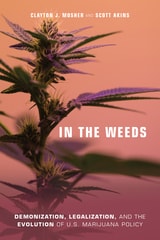
In the Weeds
Demonization, Legalization, and the Evolution of U.S. Marijuana PolicyClayton J. Mosher and Scott Aikins
Temple University Press, 2019
More and more states are legalizing marijuana in some form. Moreover, a majority of the U.S. population is in favor of the drug for recreational use. In the Weeds looks at how our society has become more permissive in the past 150 years—even though marijuana is still considered a Schedule I drug by the American government.
Sociologists Clayton Mosher and Scott Akins take a deep dive into marijuana policy reform, looking at the incremental developments and the historical, legal, social, and political implications of these changes. They investigate the effects, medicinal applications, and possible harms of marijuana. In the Weeds also considers arguments that youth will be heavy users of legalized cannabis, and shows how “weed” is demonized by exaggerations of the drug’s risks and claims of its lack of medicinal value. Mosher and Akins end their timely and insightful book by tracing the distinct paths to the legalization of recreational marijuana in the United States and other countries as well as discussing what the future of marijuana law holds.
Incidental Racialization
Performative Assimilation in Law SchoolYung-Yi Diana Pan
Temple University Press, 2017
Despite the growing number ofAsian American and Latino/a law students, many panethnic students still feel as if they do not belong in this elite microcosm, which reflects the racial inequalities in mainstream American society. While in law school, these students—often from immigrant families, and often the first to go to college—have to fight against racialized and gendered stereotypes. In Incidental Racialization, Diana Pan rigorously explores how systemic inequalities are produced and sustained in law schools.
Through interviews with more than 100 law students and participant observations at two law schools, Pan examines how racialization happens alongside professional socialization. She investigates how panethnic students negotiate their identities, race, and gender in an institutional context. She also considers how their lived experiences factor into their student organization association choices and career paths.
Incidental Racialization sheds light on how race operates in a law school setting for both students of color and in the minds of white students. It also provides broader insights regarding racial inequalities in society in general.
Inconsistency and Indecision in the United States Supreme Court
Matthew P. Hitt
University of Michigan Press, 2019
Yet a Court that prioritizes resolving many disputes will at times produce contradictory sets of opinions or fail to provide a rationale and legal precedent for its decision at all. In either case, it produces an unreasoned judgment. Conversely, a Court that prioritizes logically consistent doctrine will fail to resolve many underlying disputes in law and society. Inconsistency and Indecision in the United States Supreme Court demonstrates that over time, institutional changes, lobbied for by the justices, substantially reduced unreasoned judgments in the Court’s output, coinciding with a reduction in the Court’s caseload. Hence, the Supreme Court historically emphasized the first goal of dispute resolution, but evolved into a Court that prioritizes the second goal of logically consistent doctrine. As a result, the Court today fails to resolve more underlying questions in law and society in order to minimize criticism of its output from other elites. In so doing, the modern Court often fails to live up to its Constitutional obligation.
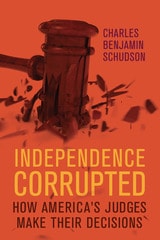
Independence Corrupted
How America's Judges Make Their DecisionsCharles Benjamin Schudson
University of Wisconsin Press, 2018
As political attacks on judges increase, Schudson calls for reforms to protect judicial independence and for vigilance to ensure justice for all. Independence Corrupted is invaluable for students and scholars, lawyers and judges, and all citizens concerned about the future of America's courts.
Indian Water in the New West
Thomas R. McGuire
University of Arizona Press, 1993

Indigenous Environmental Justice
Edited by Karen Jarratt-Snider and Marianne O. Nielsen
University of Arizona Press, 2020
With focused essays on important topics such as the uranium mining on Navajo and Hopi lands, the Dakota Access Pipeline dispute on the Standing Rock Indian Reservation, environmental cleanup efforts in Alaska, and many other pertinent examples, this volume offers a timely view of the environmental devastation that occurs in Indian Country. It also serves to emphasize the importance of self-determination and sovereignty in victories of Indigenous environmental justice.
The book explores the ongoing effects of colonization and emphasizes Native American tribes as governments rather than ethnic minorities. Combining elements of legal issues, human rights issues, and sovereignty issues, Indigenous Environmental Justice creates a clear example of community resilience in the face of corporate greed and state indifference.
Indigenous Peoples and Borders
Sheryl Lightfoot and Elsa Stamatopoulou, editors
Duke University Press, 2024
Contributors. Tone Bleie, Andrea Carmen, Jacqueline Gillis, Rauna Kuokkanen, Elifuraha Laltaika, Sheryl Lightfoot, David Bruce MacDonald, Toa Elisa Maldonado Ruiz, Binalakshmi “Bina” Nepram, Melissa Z. Patel, Manoel B. do Prado Junior, Hana Shams Ahmed, Elsa Stamatopoulou, Liubov Suliandziga, Rodion Sulyandziga, Yifat Susskind, Erika M. Yamada
Individual Justice in Mass Tort Litigation
Jack B. Weinstein
Northwestern University Press, 1994
Inherent Vice
Bootleg Histories of Videotape and CopyrightLucas Hilderbrand
Duke University Press, 2009
Videotape not only radically changed how audiences accessed the content they wanted and loved but also altered how they watched it. Hilderbrand develops an aesthetic theory of analog video, an “aesthetics of access” most boldly embodied by bootleg videos. He contends that the medium specificity of videotape becomes most apparent through repeated duplication, wear, and technical failure; video’s visible and audible degeneration signals its uses for legal transgressions and illicit pleasures. Bringing formal and cultural analysis into dialogue with industrial history and case law, Hilderbrand examines four decades of often overlooked histories of video recording, including the first network news archive, the underground circulation of Superstar: The Karen Carpenter Story, a feminist tape-sharing network, and the phenomenally popular website YouTube. This book reveals the creative uses of videotape that have made essential content more accessible and expanded our understanding of copyright law. It is a politically provocative, unabashedly nostalgic ode to analog.
Inside Appellate Courts
The Impact of Court Organization on Judicial Decision Making in the United States Courts of AppealsJonathan Matthew Cohen
University of Michigan Press, 2002

Inside a Class Action
The Holocaust and the Swiss BanksJane Schapiro
University of Wisconsin Press, 2003
On October 21, 1996, attorney Michael Hausfeld, with a team of lawyers, filed a class-action complaint against Union Bank of Switzerland, Swiss Bank Corporation, and Credit Suisse on behalf of Holocaust victims. The suit accused the banks of, among other things, acting as the chief financiers for Nazi Germany. Hausfeld wanted to use the suit to prove that the banks not only concealed and refused to return millions of dollars in dormant accounts, but that they acted as a conduit for looted assets and slave labor profits. Such behavior, he charged, violated the code of ethics known as customary international law. On August 12, 1998, the plaintiffs and banks reached a $1.25 billion settlement.
Through interviews with a wide range of people involved in the case and detailed research of documents and court transcripts, Jane Schapiro shows the ways that egos, personalities, and values clash in such a complex and emotionally charged case. Inside a Class Action provides an insider’s view of a major lawsuit from its inception to its conclusion, which will appeal to anyone interested in human rights, reparations, and international law.

Insiders and Outsiders in the History of Law
Edited by Gwen Seabourne and Joanna McCunn
University of London Press, 2026
Writing the history of law involves choices: whose stories are to be told, and how?
While earlier scholarship centered on judges, lawyers, and legislators, recent work increasingly examines the experiences of women, colonial subjects, and gender-nonconforming people, using new sources and methods. Insiders and Outsiders in the History of Lawpresents research on the boundaries between legal insiders and outsiders across seven centuries of British legal history.
Drawing on underused records from contexts ranging from medieval Wales to twentieth-century British India, the chapters explore how individuals became insiders or outsiders, how the law treated them, and how they used legal processes. This book highlights the fluidity of this divide and calls for a more representative legal history.

Institutional Foundations of Impersonal Exchange
Theory and Policy of Contractual RegistriesBenito Arruñada
University of Chicago Press, 2012
Benito Arruñada aims to avoid such failures by deepening our understanding of both the value of registries and the organizational requirements for constructing them. Presenting a theory of how registries strengthen property rights and reduce transaction costs, he analyzes the major trade-offs and proposes principles for successfully building registries in countries at different stages of development. Arruñada focuses on land and company registries, explaining the difficulties they face, including current challenges like the subprime mortgage crisis in the United States and the dubious efforts made in developing countries toward universal land titling. Broadening the account, he extends his analytical framework to other registries, including intellectual property and organized exchanges of financial derivatives. With its nuanced presentation of the theoretical and practical implications, Institutional Foundations of Impersonal Exchange significantly expands our understanding of how public registries facilitate economic growth.
Institutions and Investments
Foreign Direct Investment in China during an Era of ReformsJun Fu
University of Michigan Press, 2000

Insult to Injury
Libel, Slander, and Invasions of PrivacyChrista Jones
University Press of Colorado, 2003
Intellectual Commons and the Law
A Normative Theory for Commons-Based Peer ProductionAntonios Broumas
University of Westminster Press, 2020
‘With clarity and sophistication, Antonios Broumas presents a bold new theory of intellectual commons and powerful arguments for a new body of supportive law. This book not only reveals the misleading logic of intellectual property law in our time; it reveals the rich possibilities for constructive change that legally protected commoning can bring. Highly recommended!’ — David Bollier, Director, Reinventing the Commons Program, Schumacher Center for a New Economics.
‘Liberating the Intellectual Commons from the fetters of capital accumulation and appropriation, would give us a renaissance of creative energies and empowered communities: exactly what the world needs to move away from the social and ecological devastations of our times. This book is a thoughtful and compelling argument for making this possible through the works of the law and the redesign of public domain as a common space.’ — Massimo De Angelis, Professor of Political Economy and Social Change, Co-director of the Centre for Social Justice and Change, University of East London.
‘In this pioneering book, Antonios Broumas argues that philosophically, morally, politically and economically we are in urgent need of a new legal regime that recognizes the intellectual commons, peer production and sharing as the primary practices of intellectual production, distribution and consumption. I cannot imagine a more urgent task today. A legally protected intellectual commons will lead to greater scientific and cultural innovation and creativity and will lead to an urgently needed second Enlightenment. This book should be read by lawyers, critical theorists, economists and the many professionals of science, culture and the academy.’ — Costas Douzinas, Professor of Law, Birkbeck, University of London.
‘Antonios Broumas’ book is an excellent critical analysis of the cultural commons and a must-read for everyone interested in understanding what the commons, the cultural commons, and the digital commons are all about. This work brilliantly outlines the foundations of an empirically grounded critical theory of the commons and the cultural commons in the context of the interactions of law and society.’ — Christian Fuchs, Professor of Media and Communication Studies, author of Communication and Capitalism: A Critical Theory (2020).
‘Broumas takes us on a spellbinding tour of how and why the law could and should change to accommodate the creative multitude, which engages into an emerging mode of production. He tells a vibrant story that makes us shout: “Lawmakers of the world, unite!”’ — Vasilis Kostakis, Professor of P2P Governance, Tallinn University of Technology, Faculty Associate at Harvard Law School.
At the cutting edge of contemporary wealth creation people form self-governed communities of collaborative innovation in conditions of relative equipotency and produce resources with free access to all. The emergent intellectual commons have the potential to commonify intellectual production and distribution, unleash human creativity through collaboration and democratise innovation with wider positive effects for our societies. Contemporary intellectual property laws fail to address this potential. We are, therefore, in pressing need of an institutional alternative beyond the inherent limitations of intellectual property law. This book offers an overall analysis of the moral significance of the intellectual commons and outlines appropriate modes for their regulation. Its principal thesis is that our legal systems are in need of an independent body of law for the protection and promotion of the intellectual commons, in parallel to intellectual property law. In this context, the author of the book proposes the reconstruction of the doctrine of the public domain and the exceptions and limitations of exclusive intellectual property rights into an intellectual commons law, which will underpin a vibrant non-commercial zone of creativity and innovation in intellectual production, distribution and consumption alongside commodity markets enabled by intellectual property law.
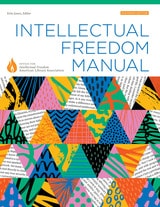
Intellectual Freedom Manual, Eleventh Edition
Erin Office for Intellectual Freedom
American Library Association, 2026
When someone faces a difficult intellectual freedom (IF) issue, they usually don’t have time to wade through dense text to find the answers they need. Designed as a real-world reference, OIF’s Intellectual Freedom Manual provides trusted, comprehensive guidance for every library worker, from the volunteer to the director, in plain language. Whether you’re developing or reviewing policies, on-boarding new staff or trustees, responding to challenges and controversies, or studying librarianship, you’ll find this a vital tool, with features such as
- contributions that center the voices of Black, Indigenous, and other People of Color (BIPOC) and LGBTQIA+ people, who are often targeted by censorship efforts;
- chapters that begin with an overview explaining the big ideas and offering reflection questions;
- an introduction to IF and why it matters, drawing on ALA's core IF documents and supported with adaptable policy worksheets;
- information and best practice guidance on key topics such as access, children and youth, censorship and internet filtering, collection development and management, copyright, meeting rooms and exhibit spaces, library programming, politics and religion, privacy, and visits and requests from law enforcement;
- stories from real people whose lives have been impacted by IF, showing how library policies shape culture, protect staff and users, and affect real people;
- concise breakdowns of IF issues from legal experts, helping you understand the laws and how they apply in real situations;
- practical advice on advocating for IF, getting help when challenges arise, lobbying, and working with your elected officials;
- a thorough index to help you quickly find the information you need; and
- a helpful glossary and selected bibliography of additional resources.
Intellectual Property on Campus
Students' Rights and ResponsibilitiesTyAnna K. Herrington
Southern Illinois University Press, 2010
What issues arise when students’ uses of intellectual materials are legally challenged, and how does the academic context affect them? What happens when users of intellectual property, either within or outside the academic structure, violate students’ rights to their intellectual products? In Intellectual Property on Campus, TyAnna K. Herrington addresses these concerns and more, clearing up the confusion often surrounding intellectual property law and its application in an academic setting. Filled with practical information and simple yet thorough explanations, this enlightening volume provides educators and students with a solid basis for understanding the broader impacts of legal and ethical dilemmas involving intellectual materials.
Herrington provides insight for students into how complex concepts such as patent, trademark, copyright, fair use, and plagiarism affect their work. She outlines the potential effects of the choices students make, as well as the benefits and limitations of legal protection for intellectual property, including the thorny issues of authorship and authority under the 1976 Copyright Act. Herrington also explores the topic of student collaboration—now very common on college campuses—and how it affects intellectual property issues and legal relationships, as well as the impact of new technologies, such as blogs, on student work in educational environments.
Intellectual Property on Campus also provides useful information for administrators and educators. In particular, Herrington investigates the possible ramifications of their pedagogical and policy choices, and examines in depth the responsibility of instructors to treat students’ intellectual property legally, ethically, and conscientiously. Cautioning educators about the limitations on their control over intellectual materials in an academic setting, Herrington encourages teachers to minimize their influence over student works, instead giving pupils more freedom to control their own creations.
The volume also investigates the rights, responsibilities, and limitations for users of intellectual property, as opposed to creators, especially as related to student or instructor use of copyrighted materials. Discussed in detail are such issues as fair use and the TEACH Act, as well as the often-intertwined areas of plagiarism, authorship, and copyright. In addition, Herrington addresses recent cultural developments regarding the use and creation of intellectual property by students and instructors.
Written in a jargon-free style that is easy to understand, Intellectual Property on Campus gives students, instructors, and administrators the information they need to navigate the intricate landscape of law and integrity in the realm of academic creation.
Intellectual Property
Trade, Competition, and Sustainable Development The World Trade Forum, Volume 3Thomas Cottier and Petros C. Mavroidis, Editors
University of Michigan Press, 2003
Largely a victory for OECD countries, the present state of intellectual property rights has important implications for developing countries. The incorporation of intellectual property rights into the WTO system will eventually change the relationship of trade, competition, and intellectual property. It will equally have to assist in providing equitable sharing of benefits in the use of plant genetic resources. All of these issues are essential for the revision of exclusions from patenting in TRIPs. This volume offers insights into how this difficult task could and should be approached in a balanced manner and will be essential reading for economists and trade and intellectual property lawyers interested in the subject. Moreover, the volume will be relevant to agricultural economists as it addresses complex problems in the interstices of trade, intellectual property, plant genetic resources, and sustainable development.
Thomas Cottier is Professor of European and International Economic Law, University of Bern, and Managing Director, World Trade Institute, University of Bern.
Petros C. Mavroidis is Professor of Law, University of Neuchâtel. He formerly worked in the Legal Affairs Division of the World Trade Organization.
Marion Panizzon is Research Fellow, University of Bern.
Simon Lacey is Research Fellow, University of Bern.