Results by title
22277 books match the query 'Social Science' and 851 start with i
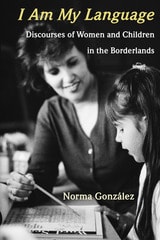
I Am My Language
Discourses of Women and Children in the BorderlandsNorma González
University of Arizona Press, 2001
“I am my language,” says the poet Gloria Anzaldúa, because language is at the heart of who we are. But what happens when a person has more than one language? Is there an overlay of language on identity, and do we shift identities as we shift languages? More important, what identities do children construct for themselves when they use different languages in particular ways?
In this book, Norma González uses language as a window on the multiple levels of identity construction in children—as well as on the complexities of life in the borderlands—to explore language practices and discourse patterns of Mexican-origin mothers and the language socialization of their children. She shows how the unique discourses that result from the interplay of two cultures shape perceptions of self and community, and how they influence the ways in which children learn and families engage with their children’s schools.
González demonstrates that the physical presence of the border profoundly affects the practices and ideologies of Mexican-origin women and children. She then argues that language and cultural background should be used as a basis for building academic competencies, and she demonstrates why the evocative/emotive dimension of language should play a major part in studies of discourse, language socialization, and language ideology.
Drawing on women’s own narratives of their experiences as both mothers and borderland residents, I Am My Language is firmly rooted in the words of common people in their everyday lives. It combines personal odyssey with cutting-edge ethnographic research, allowing us to hear voices that have been muted in the academic and public policy discussions of “what it means to be Latina/o” and showing us new ways to connect language to complex issues of education, political economy, and social identity.
I Am of Ireland
Women of the North Speak OutElizabeth Shannon
University of Massachusetts Press, 1997

I Ask for Justice
Maya Women, Dictators, and Crime in Guatemala, 1898–1944By David Carey Jr.
University of Texas Press, 2013
This study of the Guatemalan legal system during the regimes of two of Latin America’s most repressive dictators reveals the surprising extent to which Maya women used the courts to air their grievances and defend their human rights.
Winner, Bryce Wood Book Award, Latin American Studies Association, 2015
Given Guatemala’s record of human rights abuses, its legal system has often been portrayed as illegitimate and anemic. I Ask for Justice challenges that perception by demonstrating that even though the legal system was not always just, rural Guatemalans considered it a legitimate arbiter of their grievances and an important tool for advancing their agendas. As both a mirror and an instrument of the state, the judicial system simultaneously illuminates the limits of state rule and the state’s ability to co-opt Guatemalans by hearing their voices in court.
Against the backdrop of two of Latin America’s most oppressive regimes—the dictatorships of Manuel Estrada Cabrera (1898–1920) and General Jorge Ubico (1931–1944)—David Carey Jr. explores the ways in which indigenous people, women, and the poor used Guatemala’s legal system to manipulate the boundaries between legality and criminality. Using court records that are surprisingly rich in Maya women’s voices, he analyzes how bootleggers, cross-dressers, and other litigants crafted their narratives to defend their human rights. Revealing how nuances of power, gender, ethnicity, class, and morality were constructed and contested, this history of crime and criminality demonstrates how Maya men and women attempted to improve their socioeconomic positions and to press for their rights with strategies that ranged from the pursuit of illicit activities to the deployment of the legal system.

I Believe I'll Go Back Home
Roots and Revival in New England Folk MusicThomas S. Curren
University of Massachusetts Press, 2021
Fueled by interviews with key players from the folk music scene, I Believe I'll Go Back Home traces a direct line from Yankee revolutionaries, up-country dancers, and nineteenth-century pacifists to the emergence of blues and rock 'n' roll, ultimately landing at the period of the folk revival. Thomas S. Curren presents the richness and diversity of the New England folk tradition, which continues to provide perspective, inspiration, and healing in the present day.

I Belong to This Band, Hallelujah!
Community, Spirituality, and Tradition among Sacred Harp SingersLaura Clawson
University of Chicago Press, 2011
The Sacred Harp choral singing tradition originated in the American South in the mid-nineteenth century, spread widely across the country, and continues to thrive today. Sacred Harp isn’t performed but participated in, ideally in large gatherings where, as the a cappella singers face each other around a hollow square, the massed voices take on a moving and almost physical power. I Belong to This Band, Hallelujah! is a vivid portrait of several Sacred Harp groups and an insightful exploration of how they manage to maintain a sense of community despite their members’ often profound differences.
Laura Clawson’s research took her to Alabama and Georgia, to Chicago and Minneapolis, and to Hollywood for a Sacred Harp performance at the Academy Awards, a potent symbol of the conflicting forces at play in the twenty-first-century incarnation of this old genre. Clawson finds that in order for Sacred Harp singers to maintain the bond forged by their love of music, they must grapple with a host of difficult issues, including how to maintain the authenticity of their tradition and how to carefully negotiate the tensions created by their disparate cultural, religious, and political beliefs.
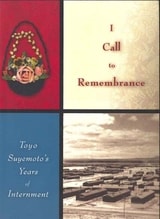
I Call to Remembrance
Toyo Suyemoto's Years of InternmentToyo Suyemoto and Edited by Susan B. Richardson
Rutgers University Press, 2007
A uniquely poetic contribution to the small body of internment memoirs, Suyemoto's account includes information about policies and wartime decisions that are not widely known, and recounts in detail the way in which internees adjusted their notions of selfhood and citizenship, lending insight to the complicated and controversial questions of citizenship, accountability, and resistance of first- and second-generation Japanese Americans.
Suyemoto's poems, many written during internment, are interwoven throughout the text and serve as counterpoints to the contextualizing narrative. Suyemoto's poems, many written during internment, are interwoven throughout the text and serve as counterpoints to the contextualizing narrative. A small collection of poems written in the years following her incarceration further reveal the psychological effects of her experience.
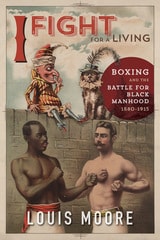
I Fight for a Living
Boxing and the Battle for Black Manhood, 1880-1915Louis Moore
University of Illinois Press, 2017
Louis Moore draws on the life stories of African American fighters active from 1880 to 1915 to explore working-class black manhood. As he details, boxers bought into American ideas about masculinity and free enterprise to prove their equality while using their bodies to become self-made men. The African American middle class, meanwhile, grappled with an expression of public black maleness they saw related to disreputable leisure rather than respectable labor. Moore shows how each fighter conformed to middle-class ideas of masculinity based on his own judgment of what culture would accept. Finally, he argues that African American success in the ring shattered the myth of black inferiority despite media and government efforts to defend white privilege.
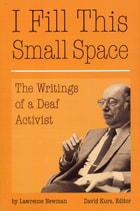
I Fill This Small Space
The Writings of a Deaf ActivistLawrence Newman
Gallaudet University Press, 2009
Lawrence Newman became deaf at the age of five in 1930, and saw his father fight back tears knowing that his son would never hear again. The next time he saw his father cry was in 1978, when Newman received an honorary doctorate from Gallaudet University, his alma mater. Newman was recognized for his achievements as a life-long advocate for deaf education, including receiving California’s Teacher of the Year award in 1968. Perhaps his greatest influence, however, stemmed from his many articles and columns that appeared in various publications, the best of which are featured in I Fill This Small Space: The Writings of a Deaf Activist.
Editor David Kurs has organized Newman’s writings around his passions — deaf education, communication and language, miscellaneous columns and poems on Deaf life, and humorous insights on his activism. His articles excel both as seamless arguments supporting his positions and as windows on the historical conflicts that he fought: against the Least Restrictive Environment in favor of residential deaf schools; for sign language, Total Communication, and bilingual education; and as a deaf teacher addressing parents of deaf children. A gifted writer in all genres, Newman amuses with ease (“On Mini and Midi-Skirts”), and moves readers with his heartfelt verse (“Girl with a Whirligig”). Newman ranges wide in his ability, but he always maintains his focus on equal tights for deaf people, as he demonstrates in his title poem “I Fill This Small Space:”
I fill this small space, this time
Who is to say yours is better
Than mine or mine yours
I Guess This Is Activism?
Youth, Political Education, and Free-Market Common SenseKevin L. Clay
University of Minnesota Press, 2026
How neoliberal capitalism and pedagogical deideologization constrain the radical possibilities of youth activism
In I Guess This Is Activism? Kevin L. Clay presents an eye-opening account of his experience with Youth Participatory Action Research (YPAR) as an Upward Bound educator. Grounded in Paulo Freire’s tradition of critical pedagogy, YPAR has been championed by community-based educators and scholars in the United States as an approach for supporting critical consciousness development and social change with working-class Black and Latino youth. Clay, however, questions whether YPAR can effectively prepare youths to subvert the systems reproducing their material conditions under neoliberal capitalism. Exposing the political and pedagogical limits of YPAR’s progressive education model, he reveals how omnipresent neoliberalism undermines youths’ radical potential when political education is not prioritized in youth activism.
I Guess This Is Activism? engages Black radical thinkers, including Ella Baker and Fred Hampton, to reveal the faulty assumptions implicit in YPAR’s program. Looking deeply into how he and his students navigated questions of community problems and social change at the twilight of the Obama presidency, Clay demonstrates how, in the absence of political education on the structures of race, class, and capitalism, youth activism is always eclipsed by the common sense of the free market.
As working-class Black and Latino youth inherit a society deeply shaped by neoliberal dogma, I Guess This Is Activism? delivers a much-needed reexamination of YPAR and visions for the future of youth activist education.
Retail e-book files for this title are screen-reader friendly with images accompanied by short alt text and/or extended descriptions.

I Have Spoken
American History Through The Voices Of The IndiansVirginia I. Armstrong
Ohio University Press, 1971
I Have Spoken is a collection of American Indian oratory from the 17th to the 20th century, concentrating on speeches focusing around Indian-white relationships, especially treaty-making negotiations. A few letters and other writings are also included.
Here, in their own words, is the Indian’s story told with integrity, with drama, with caustic wit, with statesmanship, with poetic impact; a story of proffered friendship, of broken promises, of hope, of disillusionment, of pride, of a whole land and life gone sour.

I Heart Obama
Erin Aubry Kaplan
University Press of New England, 2016
I Hope I Join the Band
Narrative, Affiliation, and Antiraciset RhetoricFrankie Condon
Utah State University Press, 2012
"Both from the Right and from the Left, we are stymied in talking well with one another about race and racism, by intransigent beliefs in our own goodness as well as by our conviction that such talk is useless. . . . White antiracist epistemology needs to begin not with our beliefs, but with our individual and collective awakening to that which we do not know."
Drawing on scholarship across disciplines ranging from writing and rhetoric studies to critical race theory to philosophy, I Hope I Join the Band examines the limits and the possibilities for performative engagement in antiracist activism. Focusing particularly on the challenges posed by raced-white identity to performativity, and moving between narrative and theoretical engagement, thebook names and argues for critical shifts in the understandings and rhetorical practices that attend antiracist activism.

I Just Let Life Rain Down on Me
Selected Letters and ReflectionsRahel Levin Varnhagen
Seagull Books, 2024
At times poetic but not a poem, prosaic but not an essay, a letter is often pure writing for writing’s sake. Such is the case for Rahel Varnhagen von Ense, née Levin, the illustrious German-Jewish Berlin literary salon hostess from the early nineteenth century. She penned over ten thousand letters to more than three hundred recipients, including princes, philosophers, poets, family members, and the family cook. Written with a wink at posterity, collected and first published after her passing by her husband, Karl August Varnhagen von Ense, these letters constitute a singular contribution to German literature.
Varied in subject—from family affairs to linguistic, literary, and pressing social concerns—the poignant lyricism of her letters is all the more remarkable when we take into account that High German was not her first language; she grew up speaking, reading, and writing primarily Yiddish. Her shaky social status as a woman and a member of a precarious minority, combined with an astounding lucidity and a rare capacity to put her thoughts into words, made her a force to be reckoned with in her lifetime and thereafter as one of Germany’s preeminent women of letters. As we see in I Just Let Life Rain Down on Me, her voice is as fresh and original as that of any of the recognized poets and thinkers of her day. As Rahel herself put it: “[O]ur language is our lived life; I invented mine for my own purposes, I was less able than many others to make use of preconceived turns of phrase, which is why mine are often clumsy, and in all respects faulty, but always true.”
Compiled and translated by Peter Wortsman, this rewarding volume affords English-speaking readers the first privileged peek at the mindset of one of Europe’s first and foremost women of letters.

I Know It’s Dangerous
Why Mexicans Risk Their Lives to Cross the BorderLynnaire M. Sheridan
University of Arizona Press, 2009
As an Australian national, Lynnaire Sheridan brings a refreshingly neutral voice to this hot-button topic. With data gathered over two years of living in Baja California, Mexico, Sheridan draws out individual stories, motivations, and conceptions of risk that ultimately allow us a deeper understanding of migration. Sheridan enriches the migrants’ stories with examinations of popular songs, graffiti art on the border, analyses of newspaper articles, and in-depth interviews with migrants. Together these narratives show us that risk has become a strong motivating factor for migrants and that stricter border policies have not necessarily stemmed the rates of migration; they have merely changed how people migrate.
Sheridan’s findings have broad implications for both those interested in migration from Mexico to the United States and international migration scholars. This book will appeal to a range of disciplines in the humanities, from anthropology and criminology to art and ethnic studies. It will also resonate among legal professionals, policy makers, and social workers.
While numerous books have focused on the act of migration and its ripples across both the United States and Mexico, this book is unique in its attention to migrants in Mexico and its ability to draw out their individual stories.
I Know You Are, but What Am I?
On Pee-wee HermanCait McKinney
University of Minnesota Press, 2024
How Pee-wee and his playhouse help us reimagine our relationships to technology
I Know You Are, but What Am I? explores the cultural legacy of Pee-wee Herman, the cult television star of Pee-wee’s Playhouse. This children’s show—that was also for adults—ran on network TV from 1986 to 1990 and starred comedian Paul Reubens as Herman, a queer man-boy whose playhouse, the set for the show, was tricked out with a profusion of animate computational toys and technologies.
Cait McKinney shows how three defining scenes from the show inform, and even foretell and challenge, our present moment: the playhouse as an alternative precursor to networked smart homes that foregrounds caring and ethical relationships between humans and technologies; a reparative retelling of Reubens’s career-wrecking 1991 arrest for indecent exposure inside a Florida adult film theater as part of an AIDS-phobic, antigay sting operation; and worn-out, Talking Pee-wee dolls and their broken afterlives on eBay and YouTube.
McKinney looks at how queer people who were children in the 1980s remember and relate to Pee-wee now, showing that the moral panic about sexuality, gender, and children from the past can help us refute anti-trans and anti-queer political movements organized today.

I Must Not Think Bad Thoughts
Drive-by Essays on American Dread, American DreamsMark Dery
University of Minnesota Press, 2014
From the cultural critic Wired called “provocative and cuttingly humorous” comes a viciously funny, joltingly insightful collection of drive-by critiques of contemporary America where chaos is the new normal. Exploring the darkest corners of the national psyche and the nethermost regions of the self—the gothic, the grotesque, and the carnivalesque—Mark Dery makes sense of the cultural dynamics of the American madhouse early in the twenty-first century.
Here are essays on the pornographic fantasies of Star Trek fans, Facebook as Limbo of the Lost, George W. Bush’s fear of his inner queer, the theme-parking of the Holocaust, the homoerotic subtext of the Super Bowl, the hidden agendas of IQ tests, Santa’s secret kinship with Satan, the sadism of dentists, Hitler’s afterlife on YouTube, the sexual identity of 2001’s HAL, the suicide note considered as a literary genre, the surrealist poetry of robot spam, the zombie apocalypse, Lady Gaga, the Church of Euthanasia, toy guns in the dream lives of American boys, and the polymorphous perversity of Madonna’s big toe.
Dery casts a critical eye on the accepted order of things, boldly crossing into the intellectual no-fly zones demarcated by cultural warriors on both sides of America’s ideological divide: controversy-phobic corporate media, blinkered academic elites, and middlebrow tastemakers. Intellectually omnivorous and promiscuously interdisciplinary, Dery’s writing is a generalist’s guilty pleasure in an age of nanospecialization and niche marketing. From Menckenesque polemics on American society and deft deconstructions of pop culture to unflinching personal essays in which Dery turns his scalpel-sharp wit on himself, I Must Not Think Bad Thoughts is a head-spinning intellectual ride through American dreams and American nightmares.

I Never Made Love with James Baldwin
A MemoirStanley Cohen
Seagull Books, 2026
One man's life unfolds into a memoir of the defining cultural figures of the mid-twentieth century and beyond.
I Never Made Love with James Baldwin is a dazzling memoir told through a succession of attorney Stanley Cohen's vivid encounters with some of the most compelling figures of the twentieth century and beyond. Moving between America, Europe, and Asia, Cohen recounts moments shared with artists, writers, jurists, and financiers, including Alexander Calder, Joseph Heller, Robert Caro, Ruth Bader Ginsburg, Yehuda Hanani, and members of the Rothschild family. These figures appear not as distant icons but as sharp, human presences—brilliant, eccentric, generous, and flawed. Cohen’s life unfolds like a performance, shaped less by planning than by intensity: conversations, friendships, arguments, and coincidences that flare briefly and leave lasting marks. With wit, candor, and an eye for the telling detail, he captures a vast social and creative network spanning the mid-twentieth century to the present. The result is an intimate, unconventional portrait of an exceptional life and of the people who lit its path.

I Remember Julia
Voices of the DisappearedEric Carlson
Temple University Press, 1996
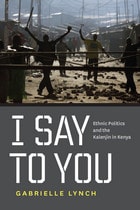
I Say to You
Ethnic Politics and the Kalenjin in KenyaGabrielle Lynch
University of Chicago Press, 2011
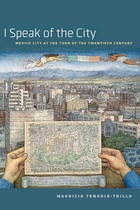
I Speak of the City
Mexico City at the Turn of the Twentieth CenturyMauricio Tenorio-Trillo
University of Chicago Press, 2013
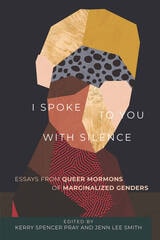
I Spoke to You with Silence
Essays from Queer Mormons of Marginalized GendersEdited by Kerry Spencer Pray and Jenn Lee Smith
University of Utah Press, 2022
This collection of essays gives voice to queer Mormons. The authors who share their stories—many speaking for the first time from the closet—do so here in simple narrative prose. They talk about their identities, their experiences, their relationships, their heartbreaks, their beliefs, and the challenges they face. Some stay in the church, some do not, some are in constant battles with themselves and the people around them as they make agonizing decisions about love and faith and community. Their stories bravely convey what it means to be queer, Mormon, and marginalized—what it means to have no voice and yet to speak anyway.
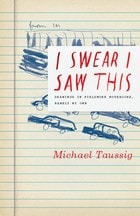
I Swear I Saw This
Drawings in Fieldwork Notebooks, Namely My OwnMichael Taussig
University of Chicago Press, 2011
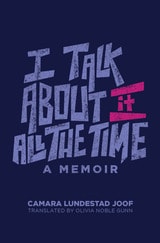
I Talk about It All the Time
Camara Lundestad Joof
University of Wisconsin Press, 2024
“I regularly decide to quit talking to white people about racism,” writes Joof. Such discussions often feel unproductive, the occasional spark of hope coming at enormous personal cost. But not talking about it is impossible, a betrayal of self. The book is a self-examination as well as societal indictment. It is an open challenge to readers, to hear her as she talks about it, all the time.

I The Song
Jill M Soens
University of Utah Press, 1999
Built on early transcriptions of Native American “songs” and arranged by subject, these poems are informed by additional context that enables readers to appreciate more fully their imagery, their cultural basis, and the moment that produced them. They let us look at our continent through the eyes of a wide range of people: poets, hunters, farmers, holy men and women, and children. This poetry achieved its vividness, clarity, and intense emotional powers partly because the singers made their poems for active use as well as beauty, and also because they made them for singing or chanting rather than isolated reading.
Most striking, classical North American Indian poetry brings us flashes of timeless vision and absolute perception: a gull’s wing red over the dawn; snow-capped peaks in the moonlight; a death song. Flowing beneath them is a powerful current: the urge to achieve a selfless attention to the universe and a determination to see and delight in the universe on its own terms.

I Want to Believe
Posadism, UFOs and Apocalypse CommunismA.M. Gittlitz
Pluto Press, 2020
Advocating nuclear war, attempting communication with dolphins, and taking an interest in the paranormal and UFOs, there is perhaps no greater (or stranger) cautionary tale for the Left than that of Posadism. Named after the Argentine Trotskyist J. Posadas, the movement’s journey through the fractious and sectarian world of mid-20th century revolutionary socialism was unique. This book is a “dumpster dive” into the weird and wonderful world of the Posadists.
Although at times significant, Posadas' movement was ultimately a failure. As it disintegrated, it increasingly grew to resemble a bizarre cult, detached from the working class it sought to liberate. The renewed interest in Posadism today, especially for its more outlandish fixations, speaks to both a cynicism towards the past and nostalgia for the earnest belief that a better world is possible. Chapters include:
*Revolutionary Youth or Patriotic Youth
*The Death Throes of Capitalism
*The Origins of Posadism
*Flying Saucers, the Process of Matter and Energy, Science, the Revolutionary and Working-Class Stuggle, and the Socialist Future of Mankind
*What Exists Cannot be True
*Why Don’t Extraterrestrials Make Public Contact
*UFOs to the People
In the Introduction, A.M. Gittlitz writes, “Insurrection or first contact could come any day, Marxists and ufologists both tell us, but both are far more likely if we desire them, embracing a sentiment enigmatically expressed in a meme come before its time, a poster on the wall of rouge FBI agent Fox Mulder in the ‘90s sci-fi noir The X-Files: hovering alongside a granny image of a comically unconvincingly flying saucer and the words I WANT TO BELIEVE".
Drawing on considerable archival research, and numerous interviews with ex- and current Posadists, I Want to Believe tells the fascinating story of this most unusual socialist movement and considers why it continues to capture the imaginations of leftists today.

I Want to Get Married!
One Wannabe Bride’s Misadventures with Handsome Houdinis, Technicolor Grooms, Morality Police, and Other Mr. Not Quite RightsBy Ghada Abdel Aal
University of Texas Press, 2010
The rules may differ from country to country, but the dating game is a universal constant.
After years of searching for Mr. Right in living-room meetings arranged by family or friends, Ghada Abdel Aal, a young Egyptian professional, decided to take to the blogosphere to share her experiences and vent her frustrations at being young, single, and female in Egypt. Her blog, I Want to Get Married!, quickly became a hit with both men and women in the Arab world. With a keen sense of humor and biting social commentary, Abdel Aal recounts in painful detail her adventures with failed proposals and unacceptable suitors. There's Mr. Precious, who storms out during their first meeting when he feels his favorite athlete has been slighted, and another suitor who robs her in broad daylight, to name just a few of the characters she runs across in her pursuit of wedded bliss.
I Want to Get Married! has since become a best-selling book in Egypt and the inspiration for a television series. This witty look at dating challenges skewed representations of the Middle East and presents a realistic picture of what it means to be a single young woman in the Arab world, where, like elsewhere, a good man can be hard to find.
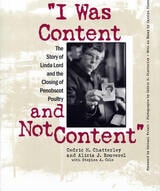
I Was Content and Not Content
The Story of Linda Lord and the Closing of Penobscot PoultryCedric N. Chatterley and Alicia J. Rouverol with Stephen A. Cole. Foreword by Michael Frisch. Photographs by Cedric N. Chatterly. With an Essay by Carolyn Chute
Southern Illinois University Press, 1999
Most studies of deindustrialization in the United States emphasize the economic impact of industrial decline; few consider the social, human costs. "I Was Content and Not Content": The Story of Linda Lord and the Closing of Penobscot Poultry is a firsthand account of a plant closure, heavily illustrated through photographs and told through edited oral history interviews. It tells the story of Linda Lord, a veteran of Penobscot Poultry Company in Belfast, Maine, and her experience when the plant—Maine’s last poultry-processing plant— closed its doors in 1988, costing over four hundred people their jobs and bringing an end to a once productive and nationally competitive agribusiness.
Linda Lord’s story could be that of any number of Americans—blue- and white-collar—effected by the rampant and widespread downsizing over the past several decades. She began working at Penobscot straight out of high school and remained with the company for over twenty years. Lord worked in all aspects of poultry processing, primarily in the "blood tunnel," where she finished off the birds that had been missed by the automatic neck-cutting device—a job held by few women. Single and self-supporting, Lord was thirty-nine years old when the plant closed. In part because she was the primary caretaker for her elderly parents, Lord did not want to leave Maine for a better job but did want to stay in the area that had been her home since birth.
The book is comprised of distinct sections representing different perspectives on Lord’s story and the plant’s demise. Cedric N. Chatterley’s gritty black-and-white photographs, reproduced here as duotones, document the final days at the poultry plant and chronicle Lord’s job search, as well as her daily life and community events. Lord’s oral history interviews, interspersed with the photographs, reveal her experiences working in poultry processing and her perspectives on the plant’s closing. Carolyn Chute’s essay reflects on her own struggles as a worker in Maine, and, more generally, on the way workers are perceived in America. Alicia J. Rouverol’s historical essay explores the rise and fall of Maine’s poultry industry and the reasons for its demise. Stephen A. Cole’s epilogue brings the story full circle when he tells of his most recent visit with Linda Lord. Michael Frisch (Portraits in Steel, A Shared Authority) contributes a foreword.
Lord’s story and the story of Penobscot’s closing brings into question the relationship of business to community, reminding us that businesses and communities are in fact integrally linked—or, perhaps more accurately, should be. Her narrative makes plain that plant closings have particular ramifications for women workers, but her experience also points to the way in which all individuals cope with change, hardship, and uncertain times to create possibilities where few exist. Perhaps most important, her story reveals some of the challenges and complexities that most human beings share.
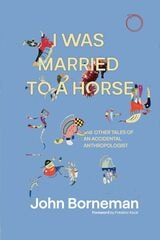
I Was Married to a Horse, and Other Tales of an Accidental Anthropologist
John Borneman
HAU, 2026
How does the youngest of eight children, raised on a family farm in northern Wisconsin by parents with only half a grammar school education, become an Ivy League professor and a witness to some of the most transformative events of the late twentieth and early twenty-first centuries? In this remarkable memoir, John Borneman tells the story of his life as an “accidental anthropologist” with searing honesty, humor, and emotional depth.
Tracing a path from his upbringing as a queer farm boy to a career in anthropology, Borneman’s memoir reflects on social mobility, the decline of the American family farm, and shifting understandings of queerness and masculinity. Meanwhile, as a fourth-generation German American, his journey carried him to divided Berlin, where he captures the moods of East and West, and back again during the arrival of Syrian refugees—culminating in a long-standing friendship and a poignant reunion with a refugee he had first met years earlier.
Through these encounters, Borneman shows how empathy and attention can reveal the hidden textures of history, identity, and belonging. Rich in insight and humanity, this is a story of personal discovery, intercultural encounter, and the search for meaning in a rapidly changing world—one that speaks to scholars and general readers alike.

I Was a Cold War Monster
Horror Films, Eroticism, and the Cold War ImaginationCyndy Hendershot
University of Wisconsin Press, 2001

I Will Mix Your Blood with Coal
Snapshots from the East of UkraineOleksandr Mykhed, Tanya Savchynska, and David Mossop
Northwestern University Press, 2025
In 2014, the Russian army, with support from local militants, occupied parts of Ukraine’s two easternmost regions—once the beating industrial heart of the Soviet Union—where coal extraction has since exhausted both the human population and the natural resources. In late 2016, Oleksandr Mykhed set out on a research trip to explore the deep history and contested present of the area from the perspective of a fellow countryman who’d never been there.
Mykhed brings us on a painful yet hopeful journey across the Ukrainian east, sharing conversations with locals, snippets from archival documents, and the complicated perspectives of prominent cultural figures, such as writer Serhiy Zhadan, historian Olena Stiazhkina, and philosopher Ihor Kozlovsky, who was imprisoned and tortured for nearly two years.
I Will Mix Your Blood with Coal invites us to meet generations of coal miners. To learn about the Belgian and British investors who founded the east’s industrial cities. To remember the harrowing events of the First and Second World Wars and the incalculable brutality of Soviet history. To see the activists who are even now working to improve the country. To hear sweet memories of a lost utopia that never existed. Mykhed provides a unique portrait of life in the east during the war, before the full-scale invasion that would change everything.
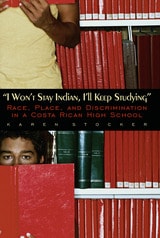
I Won't Stay Indian, I'll Keep Studying
Race, Place, and Discrimination in a Costa Rican High SchoolKaren Stocker
University Press of Colorado, 2005
Stocker reveals how overt and hidden curricula taught ethnic, racial, and gendered identities and how the dominant ideology of the town, present in school, conveyed racist messages to students.
"I Won't Stay Indian, I'll Keep Studying" documents how students from the reservation reacted to, coped with, and resisted discrimination. Considering the students' experiences in the context of the Costa Rican educational system as a whole, Stocker discusses policy shifts that might reduce institutionalized discrimination. Her interpretation of the experiences of these students makes a significant contribution to anthropology, Latin American studies, critical race theory, and educational theory.

I Wonder U
How Prince Went beyond Race and BackAdilifu Nama
Rutgers University Press, 2020
In 1993, Prince infamously changed his name to a unique, unpronounceable symbol. Yet this was only one of a long string of self-reinventions orchestrated by Prince as he refused to be typecast by the music industry’s limiting definitions of masculinity and femininity, of straightness and queerness, of authenticity and artifice, or of black music and white music.
Revealing how he continually subverted cultural expectations, I Wonder U examines the entirety of Prince’s diverse career as a singer, multi-instrumentalist, songwriter, producer, record label mogul, movie star, and director. It shows how, by blending elements of R&B, rock, and new wave into an extremely videogenic package, Prince was able to overcome the color barrier that kept black artists off of MTV. Yet even at his greatest crossover success, he still worked hard to retain his credibility among black music fans. In this way, Adilifu Nama suggests, Prince was able to assert a distinctly black political sensibility while still being perceived as a unique musical genius whose appeal transcended racial boundaries.
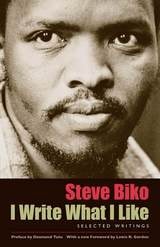
I Write What I Like
Selected WritingsSteve Biko
University of Chicago Press, 2002
I Write What I Like contains a selection of Biko's writings from 1969, when he became the president of the South African Students' Organization, to 1972, when he was prohibited from publishing. The collection also includes a preface by Archbishop Desmond Tutu; an introduction by Malusi and Thoko Mpumlwana, who were both involved with Biko in the Black Consciousness movement; a memoir of Biko by Father Aelred Stubbs, his longtime pastor and friend; and a new foreword by Professor Lewis Gordon.
Biko's writings will inspire and educate anyone concerned with issues of racism, postcolonialism, and black nationalism.
I the People
The Rhetoric of Conservative Populism in the United StatesPaul Elliott Johnson
University of Alabama Press, 2022
WINNER OF THE NATIONAL COMMUNICATION ASSOCIATION'S 2023 HOCHMUTH-NICHOLS AWARD
A definitive rhetorical history of conservative populism, exposing how identity, victimhood, and populist appeals have shaped—and constrained—modern American conservatism.
I The People: The Rhetoric of Conservative Populism in the United States examines a variety of texts—ranging from speeches and campaign advertisements to news reports and political pamphlets—to outline the populist character of conservatism in the United States. Paul Elliott Johnson focuses on key inflection points in the development of populist conservatism, including its manifestation in the racially charged presidential election of 1964, its consolidation at the height of Ronald Reagan’s reelection campaign in 1984, and its character in successive moments that saw its fortunes wax and wane, including 1994, the Obama era, and the rise of Donald J. Trump. theorizing conservative populism as a rhetorical form, Johnson advances scholarship about populism away from a binary ideological framework while offering a useful lens for contextualizing scholarship on American conservatism. I The People emphasizes that the populist roots of conservative hegemony exercise a powerful constraining force on conservative intellectuals, whose power to shape and control the movement to which they belong is circumscribed by the form of its public-facing appeals.
The study also reframes scholarly understandings of the conservative tradition’s seeming multiplicity, especially the tendency to suggest an abiding conservative unease regarding capitalism, showing how racist hostility underwrote a compromise with an increasingly economized understanding of humanity. Johnson also contests the narrative that conservatives learned to practice identity politics from social progressives. From the beginning, conservatism’s public vernacular was a white and masculine identity politics reliant on a rhetoric of victimhood, whether critiquing the liberal Cold War consensus or President Barack Obama.

I'd Just as Soon Kiss a Wookiee
Uncovering Racialized Desire in the Star Wars GalaxyGreg Carter
University of Texas Press, 2025
How the Star Wars trilogies and their fandoms have engaged with and mirrored American beliefs about race and gender.
2026 Award for Best Single Work, Popular Culture Association (MPCA)
The Star Wars saga takes place in a galaxy far, far away, but its social structures—in particular its racial realities—are thoroughly American. So argues Greg Carter in this thought-provoking analysis, which blends historical and theoretical treatments of science fiction cinema and Star Wars fandom to explore the subtle mirroring between fantasy and the communities that create and consume it.
I’d Just as Soon Kiss a Wookiee draws on insights from prominent scholars to examine fictional relationships between groups perceived to be biologically different. Three areas of commonality between the United States and Star Wars arise: stiff regulation of racial mixture; racialized servitude, with nonhumans placed in positions of bondage; and the presumption of white male supremacy. None of these are functions of the of the Star Wars story; rather, they index the expectations of US society. But expectations have also shifted since Star Wars launched in 1977, and the franchise with it. Carter gauges minority and mainstream fan reactions, finding that, while science fiction enthusiasts have a reputation for progressiveness, the truth turns out to be as complicated as US racism itself.

I'm Afraid of That Water
A Collaborative Ethnography of a West Virginia Water CrisisLuke Eric Lassiter
West Virginia University Press, 2020
On January 9, 2014, residents across Charleston, West Virginia, awoke to an unusual licorice smell in the air and a similar taste in the public drinking water. That evening residents were informed the tap water in tens of thousands of homes, hundreds of businesses, and dozens of schools and hospitals—the water made available to as many as 300,000 citizens in a nine-county region—had been contaminated with a chemical used for cleaning crushed coal.
This book tells a particular set of stories about that chemical spill and its aftermath, an unfolding water crisis that would lead to months, even years, of fear and distrust. It is both oral history and collaborative ethnography, jointly conceptualized, researched, and written by people—more than fifty in all—across various positions in academia and local communities. I’m Afraid of That Water foregrounds the ongoing concerns of West Virginians (and people in comparable situations in places like Flint, Michigan) confronted by the problem of contamination, where thresholds for official safety may be crossed, but a genuine return to normality is elusive.
I'm Neither Here nor There
Mexicans' Quotidian Struggles with Migration and PovertyPatricia Zavella
Duke University Press, 2011
Drawing on close interactions with Mexicans on both sides of the border, Zavella examines migrant journeys to and within the United States, gendered racialization, and exploitation at workplaces, and the challenges that migrants face in forming and maintaining families. As she demonstrates, the desires of migrants to express their identities publicly and to establish a sense of cultural memory are realized partly through Latin American and Chicano protest music, and Mexican and indigenous folks songs played by musicians and cultural activists.
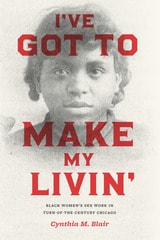
I've Got to Make My Livin'
Black Women's Sex Work in Turn-of-the-Century ChicagoCynthia M. Blair
University of Chicago Press, 2010
For many years, the interrelated histories of prostitution and cities have perked the ears of urban scholars, but until now the history of urban sex work has dealt only in passing with questions of race. In I’ve Got to Make My Livin’, Cynthia Blair explores African American women’s sex work in Chicago during the decades of some of the city’s most explosive growth, expanding not just our view of prostitution, but also of black women’s labor, the Great Migration, black and white reform movements, and the emergence of modern sexuality.
Focusing on the notorious sex districts of the city’s south side, Blair paints a complex portrait of black prostitutes as conscious actors and historical agents; prostitution, she argues here, was both an arena of exploitation and abuse, as well as a means of resisting middle-class sexual and economic norms. Blair ultimately illustrates just how powerful these norms were, offering stories about the struggles that emerged among black and white urbanites in response to black women’s increasing visibility in the city’s sex economy. Through these powerful narratives, I’ve Got to Make My Livin’ reveals the intersecting racial struggles and sexual anxieties that underpinned the celebration of Chicago as the quintessentially modern twentieth-century city.

I, Lobster
A Crustacean OdysseyNancy Frazier
University of New Hampshire Press, 2012
Nancy Frazier explores diverse facets of our fascination with the lobster, whether in art, myth, or science. She describes how the lobster lives in its natural surroundings: its food, sex life, social life, predators, and general behavior. But I, Lobster goes beyond what we think about and do to the lobster, to explore how lobsters speak to us as signs, symbols, metaphors, code words, myth, lore, and fantasy. With recipes drawn from such notable lobster connoisseurs as M. F. K. Fisher, Alice B. Toklas, and Craig Claiborne, I, Lobster is a quirky, charming, and weirdly fascinating compendium of lobster lore.
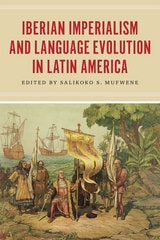
Iberian Imperialism and Language Evolution in Latin America
Edited by Salikoko S. Mufwene
University of Chicago Press, 2014
The essays approach language development through an ecological lens, exploring the effects of politics, economics, cultural contact, and natural resources on the indigenization of Spanish and Portuguese in a variety of local settings. They show how languages adapt to new environments, peoples, and practices, and the ramifications of this for the spread of colonial languages, the loss or survival of indigenous ones, and the way hybrid vernaculars get situated in larger political and cultural forces. The result is a sophisticated look at language as a natural phenomenon, one that meets a host of influences with remarkable plasticity.
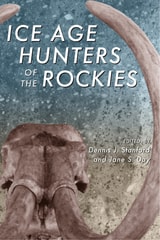
Ice Age Hunters of the Rockies
Dennis J. Stanford
University Press of Colorado, 1992

Ice Age Peoples of North America
Robonson Bonnichsen
Oregon State University Press, 1999

Ice Geographies
The Colonial Politics of Race and Indigeneity in the ArcticJen Rose Smith
Duke University Press, 2025
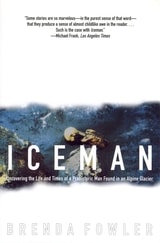
Iceman
Uncovering the Life and Times of a Prehistoric Man Found in an Alpine GlacierBrenda Fowler
University of Chicago Press, 2001

Icon Dresden
Baroque City, Air War Symbol, Political TokenSusanne Vees-Gulani
University of Michigan Press, 2026
Drawing on urban, heritage, and tourism studies, visual and memory studies, and environmental psychology, Icon Dresden examines Dresden’s history, identity, visual representations, and rebuilding decisions. It exposes the narratives that define its place in German and international memory and how, paradoxically, they support both Dresden’s current image as a symbol of peace and reconciliation and its backing of nativist and far-right movements.
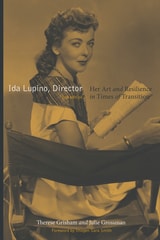
Ida Lupino, Director, 2nd edition
Her Art and Resilience in Times of TransitionTherese Grisham
Rutgers University Press, 2026
The updated edition of Ida Lupino, Director: Her Art and Resilience in Times of Transition, an in-depth exploration of Lupino’s film and television directing work, provides close readings of the films and TV episodes Lupino directed and accounts for the history of Lupino’s reception, continuing into the mid-2020s, in media and film scholarship. The book gives readers a fuller understanding of Lupino’s major contribution to the history of American cinema and media. The revisions update this book, the first on Lupino’s directing, to address recent scholarship on Lupino’s work and reinforce her abiding relevance for cinephiles and film scholars. It incorporates scholarly and popular culture references to Lupino in the last seven years. Updates include a foreword by writer and film critic Imogen Sara Smith, whose work in film scholarship and the public arena has drawn attention to Lupino and the importance of gender to film noir. Authors Therese Grisham and Julie Grossman have added a complete list of the TV episodes Lupino directed in the 1950s and '60s, as well as an updated epilogue.
This new edition addresses how our views of Lupino’s innovative cinema and her prodigious contributions to classic television have been taken up by others, proving that Lupino, whose reputation has waxed and waned since the middle of the twentieth century, is here to stay as a major figure in the history of American media.
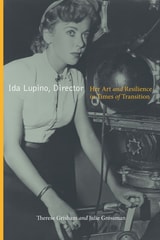
Ida Lupino, Director
Her Art and Resilience in Times of TransitionGrisham, Therese
Rutgers University Press, 2017
The first in-depth study devoted to Lupino’s directorial work, this book makes a strong case for her as a trailblazing feminist auteur, a filmmaker with a clear signature style and an abiding interest in depicting the plights of postwar American women. Ida Lupino, Director not only examines her work as a cinematic auteur, but also offers a serious consideration of her diverse and long-ranging career, getting her start in Hollywood as an actress in her teens and twenties, directing her first films in her early thirties, and later working as an acclaimed director of television westerns, sitcoms, and suspense dramas. It also demonstrates how Lupino fused generic elements of film noir and the social problem film to create a distinctive directorial style that was both highly expressionistic and grittily realistic. Ida Lupino, Director thus shines a long-awaited spotlight on one of our greatest filmmakers.
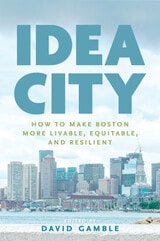
Idea City
How to Make Boston More Livable, Equitable, and ResilientEdited by David Gamble, Foreword by Renée Loth
University of Massachusetts Press, 2023
Racial strife, increased social and economic discrimination, amplified political friction, and growing uncertainty around the impacts of the COVID-19 pandemic and climate change have laid bare many inequalities within the city of Boston. How will these disruptions and inequities influence the city’s future, especially as Boston celebrates its quadricentennial in 2030?
This collection of original essays addresses the many challenges Boston contends with in the twenty-first century and considers ways to improve the city for everyone. Presenting a range of perspectives written by area experts—academics, reflective practitioners, and policymakers—these essays tackle issues of resiliency, mobility, affordable housing, health outcomes, social equity, economic equality, zoning, regionalism, and more. Reflecting the diversity of the city and the challenges and opportunities Boston currently faces, Idea City will help readers think differently about their own areas of expertise and draw conclusions from urban regeneration work in other fields.
Ideal Subjects
The Abstract People of AIOlga Goriunova
University of Minnesota Press, 2025
How data and artificial intelligence create a new, abstract digital subject
Ideal Subjects examines how samples of our lives and daily behaviors have come to reside in the world of data and artificial intelligence—and what this means for who we are and what we may become. Detailing how AI-facilitated algorithmic prediction and data modeling make “ideal subjects” of us, Olga Goriunova explores the complex ways we relate to these digital abstractions.
As more and more of our experience is funneled through computational records and models, datafied aspects of our lives are segmented and reconfigured to operate as new entities. Rather than viewing these abstract assemblages as extensions of our selves, Goriunova encourages us to consider these products of computational processes as an entirely new kind of subject, one that is both more and less than a human.
Through close readings of contemporary digital practices and data analytics, Goriunova exposes the profound ethical, aesthetic, and political implications of producing and managing these new digital subjects. Highlighting the distinctive impact of computation on contemporary subject formation while placing the present within a history of shifting conceptions of the subject, she gives us much-needed tools for understanding how our intimate selves are rendered by the abstract entities of big data. Ideal Subjects presents an uncanny and deeply fascinating portrait of modern subjectivity in the technological age.
Retail e-book files for this title are screen-reader friendly with images accompanied by short alt text and/or extended descriptions.
Identifying Consumption
Subjects and Objects in Consumer SocietyRobert G. Dunn
Temple University Press, 2008
Identifying Consumption illustrates how an individual’s buying habits are shaped by the dynamics of the consumer marketplace—and thus how consumption and identity inform each other. Robert Dunn brings together the various theories of spending and develops a mode of analysis concentrating on the individual subjectivity of consumption. By doing so, he addresses how we spend and its relationship with status and lifestyle.
Dunn provides a comprehensive guide to the study of modern consumer behavior before summarizing and critiquing the major theories of consumption. At this juncture, he proposes a method of analysis that focuses on the significance of status and lifestyle in social relations that can help explain how the consumer marketplace is shaped. He concludes by raising issues about different ways of consuming and the relationship between consumption and identity.