Results by title
18284 books match the query 'United States' and 636 start with i
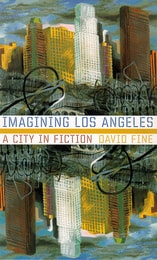
Imagining Los Angeles
A City In FictionDavid Fine
University of Nevada Press, 2004
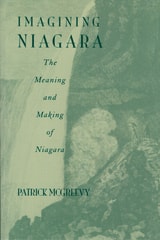
Imagining Niagara
The Meaning and Making of Niagara FallsPatrick McGreevy
University of Massachusetts Press, 2009
Patrick McGreevy begins with the question, What can these visions of Niagara tell us about the place itself? The landscape surrounding the falls contains not only parks and religious shrines but also circuses, horror museums, and factories. People travel to Niagara not only to experience nature but also to celebrate marriages or commit suicide.
One way to make sense of these bizarre "human accumulations," as H. G. Wells called them, is to take seriously the Niagaras people have imagined. This book focuses on four interlocking themes that recur time and again in descriptions of the falls: Niagara as a thing imagined from afar, as a metaphor for death, as an embodiment of nature, and as a focus of future events. Using the skills of a cultural geographer, McGreevy discovers some surprising connections between the Niagara people have imagined and the one they made, between its natural grandeur and its industrial exploitation, between Frederick Law Olmsted's Reservation and the Love Canal.

Imagining Persecution
Why American Christians Believe There Is a Global War against Their FaithJason Bruner
Rutgers University Press, 2021

Imagining Politics
Interpretations in Political Science and Political TelevisionStephen Benedict Dyson
University of Michigan Press, 2019
Imagining Politics critically examines two interpretations of government. The first comes from pop culture fictions about politics, the second from academic political science. Stephen Benedict Dyson argues that televised political fictions and political science theories are attempts at meaning-making, reflecting and shaping how a society thinks about its politics.
By taking fiction seriously, and by arguing that political science theory is homologous to fiction, the book offers a fresh perspective on both, using fictions such as The West Wing, House of Cards, Borgen, Black Mirror, and Scandal to challenge the assumptions that construct the discipline of political science itself.
Imagining Politics is also about a political moment in the West. Two great political shocks—Brexit and the election of Donald Trump—are set in a new context here. Dyson traces how Brexit and Trump campaigned against our image of politics as usual, and won.
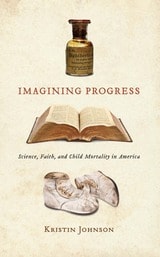
Imagining Progress
Science, Faith, and Child Mortality in AmericaKristin Johnson
University of Alabama Press, 2024
Explores the intellectual history of how Americans imagined science, faith, and human improvement through the most wrenching of experiences—the deaths of children.
Offering fascinating examples from the works of diverse writers and thinkers such as Benjamin Franklin, Frederick Douglass, Mark Twain, W. E. B. Du Bois, Elizabeth Cady Stanton, and Harriet Shelton Dover, Kristin Johnson traces the history of Americans’ complicated faith in science and the various triumphs and tragedies that faith has inspired. Imagining Progress reveals many of the complex factors involved in the polarized state of contemporary American attitudes toward science, scientists, public health, medicine, and science policy.
Humankind has always wrestled with the existence of suffering, how to respond to suffering, whom to care for, and in what ways. For two centuries, many American ministers, physicians, and scientists believed that an omnipotent and omniscient God created the world such that people might relieve suffering through ingenuity and learning. Others responded to the new worldview introduced by the scientific revolution as a threat to the divine order. In Imagining Progress, Johnson traces the history of Americans’ evolving relationship with science and religion at “one of its most dramatic places”—the bedsides of dying children. It’s here, in the crucible of parental despair, that she illuminates diverging assumptions about God, nature, and history.
From Cotton Mather’s campaign for smallpox inoculation to battles over teaching evolution in the 1920s, Johnson adroitly weaves an interdisciplinary history of medicine, science, theology, and activism. She follows a wide cast of characters from across theological, scientific, and political spectrums. What emerges is a kaleidoscopic portrait of diverse, often contradictory hopes and anxieties inspired by new theories of nature and human existence. Johnson also discerns a problematic pattern of invoking science both to ameliorate the suffering of some children while ignoring the suffering of others.
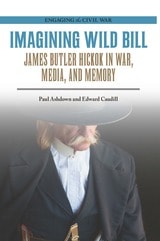
Imagining Wild Bill
James Butler Hickok in War, Media, and MemoryPaul Ashdown and Edward Caudill
Southern Illinois University Press, 2020
When it came to the Wild West, the nineteenth-century press rarely let truth get in the way of a good story. James Butler “Wild Bill” Hickok’s story was no exception. Mythologized and sensationalized, Hickok was turned into the deadliest gunfighter of all, a so-called moral killer, a national phenomenon even while he was alive.
Rather than attempt to tease truth from fiction, coauthors Paul Ashdown and Edward Caudill investigate the ways in which Hickok embodied the culture of glamorized violence Americans embraced after the Civil War and examine the process of how his story emerged, evolved, and turned into a viral multimedia sensation full of the excitement, danger, and romance of the West.
Journalists, the coauthors demonstrate, invented “Wild Bill” Hickok, glorifying him as a civilizer. They inflated his body count and constructed his legend in the midst of an emerging celebrity culture that grew up around penny newspapers. His death by treachery, at a relatively young age, made the story tragic, and dime-store novelists took over where the press left off. Reimagined as entertainment, Hickok’s legend continued to enthrall Americans in literature, on radio, on television, and in the movies, and it still draws tourists to notorious Deadwood, South Dakota.
American culture often embraces myths that later become accepted as popular history. By investigating the allure and power of Hickok’s myth, Ashdown and Caudill explain how American journalism and popular culture have shaped the way Civil War–era figures are remembered and reveal how Americans have embraced violence as entertainment.

Imagining the Forest
Narratives of Michigan and the Upper MidwestJohn Knott
University of Michigan Press, 2011
Forests have always been more than just their trees. The forests in Michigan (and similar forests in other Great Lakes states such as Wisconsin and Minnesota) played a role in the American cultural imagination from the beginnings of European settlement in the early nineteenth century to the present. Our relationships with those forests have been shaped by the cultural attitudes of the times, and people have invested in them both moral and spiritual meanings.
Author John Knott draws upon such works as Simon Schama's Landscape and Memory and Robert Pogue Harrison's Forests: The Shadow of Civilization in exploring ways in which our
relationships with forests have been shaped, using Michigan---its history of settlement, popular literature, and forest management controversies---as an exemplary case. Knott looks at such well-known figures as William Bradford, James Fenimore Cooper, John Muir, John Burroughs, and Teddy Roosevelt; Ojibwa conceptions of the forest and natural world (including how Longfellow mythologized them); early explorer accounts; and contemporary literature set in the Upper Peninsula, including Jim Harrison's True North and Philip Caputo's Indian Country.
Two competing metaphors evolved over time, Knott shows: the forest as howling wilderness, impeding the progress of civilization and in need of subjugation, and the forest as temple or cathedral, worthy of reverence and protection. Imagining the Forestshows the origin and development of both.
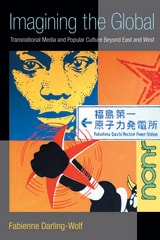
Imagining the Global
Transnational Media and Popular Culture Beyond East and WestFabienne Darling-Wolf
University of Michigan Press, 2014
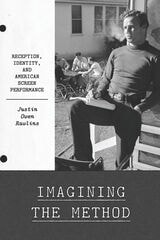
Imagining the Method
Reception, Identity, and American Screen PerformanceJustin Owen Rawlins
University of Texas Press, 2024
A revisionist history of Method acting that connects the popular reception of “methodness” to entrenched understandings of screen performance still dominating American film discourse today.
Only one performance style has dominated the lexicon of the casual moviegoer: “Method acting.” The first reception-based analysis of film acting, Imagining the Method investigates how popular understandings of the so-called Method—what its author Justin Rawlins calls "methodness"—created an exclusive brand for white, male actors while associating such actors with rebellion and marginalization. Drawing on extensive archival research, the book maps the forces giving shape to methodness and policing its boundaries.
Imagining the Method traces the primordial conditions under which the Method was conceived. It explores John Garfield's tenuous relationship with methodness due to his identity. It considers the links between John Wayne's reliance on "anti-Method" stardom and Marlon Brando and James Dean's ascribed embodiment of Method features. It dissects contemporary emphases on transformation and considers the implications of methodness in the encoding of AI performers. Altogether, Justin Rawlins offers a revisionist history of the Method that shines a light on the cultural politics of methodness and the still-dominant assumptions about race, gender, and screen actors and acting that inform how we talk about performance and performers.
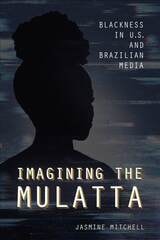
Imagining the Mulatta
Blackness in U.S. and Brazilian MediaJasmine Mitchell
University of Illinois Press, 2020
Jasmine Mitchell investigates the development and exploitation of the mulatta figure in Brazilian and U.S. popular culture. Drawing on a wide range of case studies, she analyzes policy debates and reveals the use of mixed-Black female celebrities as subjects of racial and gendered discussions. Mitchell also unveils the ways the media moralizes about the mulatta figure and uses her as an example of an ”acceptable” version of blackness that at once dreams of erasing undesirable blackness while maintaining the qualities that serve as outlets for interracial desire.

Imagining the Primitive in Naturalist and Modernist Literature
Gina M. Rossetti
University of Missouri Press, 2006
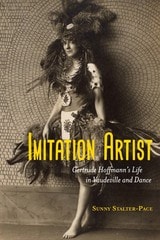
Imitation Artist
Gertrude Hoffmann’s Life in Vaudeville and DanceSunny Stalter-Pace
Northwestern University Press, 2020
Gertrude Hoffmann made her name in the early twentieth century as an imitator, copying highbrow performances staged in Europe and popularizing them for a broader American audience. Born in San Francisco, Hoffmann started working as a ballet girl in pantomime spectacles during the Gay Nineties. She performed through the heyday of vaudeville and later taught dancers and choreographed nightclub revues. After her career ended, she reflected on how vaudeville’s history was represented in film and television.
Drawn from extensive archival research, Imitation Artist shows how Hoffmann’s life intersected with those of central figures in twentieth-century popular culture and dance, including Florenz Ziegfeld, George M. Cohan, Isadora Duncan, and Ruth St. Denis. Sunny Stalter-Pace discusses the ways in which Hoffmann navigated the complexities of performing gender, race, and national identity at the dawn of contemporary celebrity culture. This book is essential reading for those interested in the history of theater and dance, modernism, women’s history, and copyright.
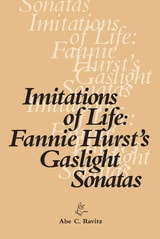
Imitations of Life
Fannie Hurst’s Gaslight SonatasAbe C. Ravitz
Southern Illinois University Press, 2009
In the early 1920s, Fannie Hurst’s enormous popularity made her the highest-paid writer in America. She conquered the literary scene at the same time the silent movie industry began to emerge as a tremendously profitable and popular form of entertainment. Abe C. Ravitz parallels Hurst’s growing acclaim with the evolution of silent films, from which she borrowed ideas and techniques that furthered her career. Ravitz notes that Hurst was amazingly adept at anticipating what the public wanted. Sensing that the national interest was shifting from rural to urban subjects, Hurst set her immigrant tales and her "woiking goil" tales in urban America. In her early stories, she tried to bridge the gap between Old World and New World citizens, each somewhat fearful and suspicious of the other. She wrote of love and ethnicity—bringing the Jewish Mother to prominence—of race relations and prejudice, of the woman alone in her quest for selfhood. Ravitz argues, in fact, that her socially oriented tales and her portraits of women in the city clearly identify her as a forerunner of contemporary feminism.
Ravitz brings to life the popular culture from 1910 through the 1920s, tracing the meteoric rise of Hurst and depicting the colorful cast of characters surrounding her. He reproduces for the first time the Hurst correspondence with Theodore Dreiser, Charles and Kathleen Norris, and Gertrude Atherton. Fellow writers Rex Beach and Vachel Lindsay also play important roles in Ravitz’s portrait of Hurst, as does Zora Neale Hurston, who awakened Hurst’s interest in the Harlem Renaissance and in race relations, as shown in Hurst’s novel Imitation of Life.
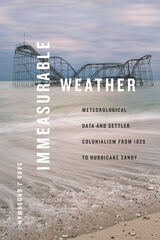
Immeasurable Weather
Meteorological Data and Settler Colonialism from 1820 to Hurricane SandySara J. Grossman
Duke University Press, 2023
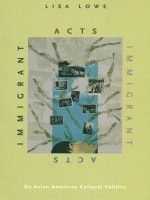
Immigrant Acts
On Asian American Cultural PoliticsLisa Lowe
Duke University Press, 1996
Lowe argues that a national memory haunts the conception of Asian American, persisting beyond the repeal of individual laws and sustained by U.S. wars in Asia, in which the Asian is seen as the perpetual immigrant, as the “foreigner-within.” In Immigrant Acts, she argues that rather than attesting to the absorption of cultural difference into the universality of the national political sphere, the Asian immigrant—at odds with the cultural, racial, and linguistic forms of the nation—displaces the temporality of assimilation. Distance from the American national culture constitutes Asian American culture as an alternative site that produces cultural forms materially and aesthetically in contradiction with the institutions of citizenship and national identity. Rather than a sign of a “failed” integration of Asians into the American cultural sphere, this critique preserves and opens up different possibilities for political practice and coalition across racial and national borders.
In this uniquely interdisciplinary study, Lowe examines the historical, political, cultural, and aesthetic meanings of immigration in relation to Asian Americans. Extending the range of Asian American critique, Immigrant Acts will interest readers concerned with race and ethnicity in the United States, American cultures, immigration, and transnationalism.
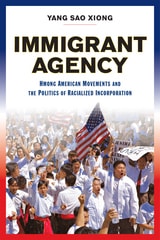
Immigrant Agency
Hmong American Movements and the Politics of Racialized IncorporationYang Sao Xiong
Rutgers University Press, 2022
Immigrant Identity and the Politics of Citizenship
A Collection of Articles from the Journal of American Ethnic HistoryJohn J Bukowczyk
University of Illinois Press, 2016

Immigrant Minds, American Identities
Making the United States Home, 1870-1930Orm Overland
University of Illinois Press, 2000
Devised by middle-class ethnic leaders and spread through ethnic media, banquets, and rallies, homemaking myths uncovered a role for immigrants in the nation's founding, a place of honor in the nation's wars, and traces of American democratic political ideology in the immigrants' ethnic past. These stories proclaim that immigrants, in the person of their ancestors, disembarked from Christopher Columbus's ships, fought for victory over the Axis, and brought American values of freedom and democracy from their native lands. By virtue of their ethnic group's contributions, these myths maintain, non-Anglo European immigrants came to America not as foreigners but as ready-made ideal citizens of the Republic.
Øverland shows that the plots and themes of homemaking myths share so many characteristics that they must be considered an American phenomenon rather than one peculiar to an individual ethnic group. As a symbol of the immigrant's insider status, these stories have played a crucial role in forming American ethnic identities and in carving out a place for immigrants in an Anglo-dominated society.
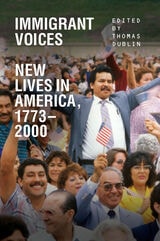
Immigrant Voices
New Lives in America, 1773-2000Edited by Thomas Dublin
University of Illinois Press, 2014
A classroom staple, Immigrant Voices: New Lives in America, 1773-2000 has been updated with writings that reflect trends in immigration to the United States through the turn of the twenty-first century. New chapters include a selection of letters from Irish immigrants fleeing the famine of the 1840s, writings from an immigrant who escaped the civil war in Liberia during the 1980s, and letters that crossed the U.S.-Mexico border during the late 1980s and early '90s. With each addition editor Thomas Dublin has kept to his original goals, which was to show the commonalities of the U.S. immigrant experience across lines of gender, nation of origin, race, and even time.
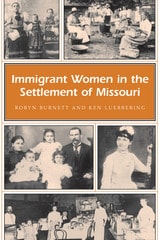
Immigrant Women in the Settlement of Missouri
Robyn Burnett & Ken Luebbering
University of Missouri Press, 2005
Because it examines the lives of women from many social classes and ethnic backgrounds, Immigrant Women in the Settlement of Missouri does much to explain the rich cultural diversity Missouri enjoys today. The photographs and narratives relating to Czech, French, German, Hungarian, Irish, Italian, and Polish life will remind descendants of immigrants that many customs and traditions they grew up practicing have roots in their home countries and will also promote understanding of the customs of other cultures. In addition to the ethnic and class differences that affected these women’s lives, the book also notes the impact of the various eras in which they lived, their education, the circumstances of their migrations, and their destinations across Missouri.
With their engaging and straightforward narrative, Burnett and Luebbering take the reader chronologically through the history of the state from the colonial period to the Civil War and industrialization. Like all Missouri Heritage Readers, this one is presented in an accessible format with abundant illustrations, and it is sure to please both general readers and those engaged in immigrant and women’s studies.

Immigrants Raising Citizens
Undocumented Parents and Their ChildrenHirokazu Yoshikawa
Russell Sage Foundation, 2011
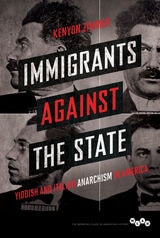
Immigrants against the State
Yiddish and Italian Anarchism in AmericaKenyon Zimmer
University of Illinois Press, 2015
Zimmer focuses on Italians and Eastern European Jews in San Francisco, New York City, and Paterson, New Jersey. Tracing the movement's changing fortunes from the pre–World War I era through the Spanish Civil War, Zimmer argues that anarchists, opposed to both American and Old World nationalism, severed all attachments to their nations of origin but also resisted assimilation into their host society. Their radical cosmopolitan outlook and identity instead embraced diversity and extended solidarity across national, ethnic, and racial divides. Though ultimately unable to withstand the onslaught of Americanism and other nationalisms, the anarchist movement nonetheless provided a shining example of a transnational collective identity delinked from the nation-state and racial hierarchies.
Immigrants and Boomers
Forging a New Social Contract for the Future of AmericaDowell Myers
Russell Sage Foundation, 2007
Immigrants and Welfare
The Impact of Welfare Reform on America's NewcomersMichael E. Fix
Russell Sage Foundation, 2009
Immigrants in the Far West
Historical Identities and ExperiencesJessie L. Embry
University of Utah Press, 2014
Immigrants in the Valley
Irish, Germans, and Americans in the Upper Mississippi Country, 1830-1860Mark Wyman
Southern Illinois University Press, 1984
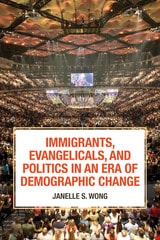
Immigrants, Evangelicals, and Politics in an Era of Demographic Change
Janelle S. Wong
Russell Sage Foundation, 2018
Asian Americans and Latinos currently constitute 13 percent of evangelicals, and their churches are among the largest, fastest growing organizations in their communities. While evangelical identity is associated with conservative politics, Wong draws from national surveys and interviews to show that non-white evangelicals express political attitudes that are significantly less conservative than those of their white counterparts. Black, Asian American, and Latino evangelicals are much more likely to support policies such as expanded immigration rights, increased taxation of the wealthy, and government interventions to slow climate change. As Wong argues, non-white evangelicals’ experiences as members of racial or ethnic minority groups often lead them to adopt more progressive political views compared to their white counterparts.
However, despite their growth in numbers, non-white evangelicals—particularly Asian Americans and Latinos—are concentrated outside of swing states, have lower levels of political participation than white evangelicals, and are less likely to be targeted by political campaigns. As a result, white evangelicals dominate the evangelical policy agenda and are overrepresented at the polls. Also, many white evangelicals have adopted even more conservative political views in response to rapid demographic change, perceiving, for example, that discrimination against Christians now rivals discrimination against racial and ethnic minorities.
Wong demonstrates that immigrant evangelicals are neither “natural” Republicans nor “natural” Democrats. By examining the changing demographics of the evangelical movement, Immigrants, Evangelicals, and Politics in an Era of Demographic Change sheds light on an understudied constituency that has yet to find its political home.

Immigration Law and the U.S.–Mexico Border
¿Sí se puede?Kevin R. Johnson and Bernard Trujillo
University of Arizona Press, 2011
In clear, reasonable prose, Johnson and Trujillo explore the long history of discrimination against US citizens of Mexican ancestry in the United States and the current movement against “illegal aliens”—persons depicted as not deserving fair treatment by US law. The authors argue that the United States has a special relationship with Mexico by virtue of sharing a 2,000-mile border and a “land-grab of epic proportions” when the United States “acquired” nearly two-thirds of Mexican territory between 1836 and 1853.
The authors explain US immigration law and policy in its many aspects—including the migration of labor, the place of state and local regulation over immigration, and the contributions of Mexican immigrants to the US economy. Their objective is to help thinking citizens on both sides of the border to sort through an issue with a long, emotional history that will undoubtedly continue to inflame politics until cooler, and better-informed, heads can prevail. The authors conclude by outlining possibilities for the future, sketching a possible movement to promote social justice. Great for use by students of immigration law, border studies, and Latino studies, this book will also be of interest to anyone wondering about the general state of immigration law as it pertains to our most troublesome border.
Immigration and Opportuntity
Race, Ethnicity, and Employment in the United StatesFrank D. Bean
Russell Sage Foundation, 1999
Immigration and the Law
Race, Citizenship, and Social ControlEdited by Sofía Espinoza Álvarez and Martin Guevara Urbina
University of Arizona Press, 2018
In today’s highly charged atmosphere, Immigration and the Law gives readers a grounded and broad overview of U.S. immigration law in a single book. Encompassing issues such as shifting demographics, a changing criminal justice system, and volatile political climate, the book is critically significant for academic, political, legal, and social arenas.
The contributors offer sound evidence to expose the historical legacy of violence, brutality, manipulation, oppression, marginalization, prejudice, discrimination, power, and control. Demystifying the ways that current ideas of ethnicity, race, gender, and class govern immigration and uphold the functioning and legitimacy of the criminal justice system, Immigration and the Law presents a variety of studies and perspectives that offer a pathway toward addressing long-neglected but vital topics in the discourse on immigration and the law.
Contributors
Sofía Espinoza Álvarez
Steven W. Bender
Leo R. Chávez
Arnoldo De León
Daniel Justino Delgado
Roxanne Lynn Doty
Brenda I. Gill
Ruth Gomberg-Muñoz
Peter Laufer
Lupe S. Salinas
Mary C. Sengstock
Martin Guevara Urbina
Claudio G. Vera Sánchez
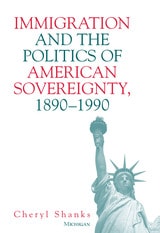
Immigration and the Politics of American Sovereignty, 1890-1990
Cheryl Shanks
University of Michigan Press, 2001
Immigration and the Remaking of Black America
Tod G. Hamilton
Russell Sage Foundation, 2019
Honorable Mention for the 2020 Thomas and Znaniecki Award from the International Migration Section of the American Sociological Association
Over the last four decades, immigration from the Caribbean and sub-Saharan Africa to the U. S. has increased rapidly. In several states, African immigrants are now major drivers of growth in the black population. While social scientists and commentators have noted that these black immigrants’ social and economic outcomes often differ from those of their native-born counterparts, few studies have carefully analyzed the mechanisms that produce these disparities. In Immigration and the Remaking of Black America, sociologist and demographer Tod Hamilton shows how immigration is reshaping black America. He weaves together interdisciplinary scholarship with new data to enhance our understanding of the causes of socioeconomic stratification among both the native-born and newcomers.
Hamilton demonstrates that immigration from the Caribbean and sub-Saharan Africa is driven by selective migration, meaning that newcomers from these countries tend to have higher educational attainment than those who stay behind. As a result, they arrive in the U.S. with some advantages over native-born blacks, and, in some cases, over whites. He also shows the importance of historical context: prior to the Civil Rights Movement, black immigrants’ socioeconomic outcomes resembled native-born blacks’ much more closely, regardless of their educational attainment in their country of origin. Today, however, certain groups of black immigrants have better outcomes than native-born black Americans—such as lower unemployment rates and higher rates of homeownership—in part because they immigrated at a time of expanding opportunities for minorities and women in general. Hamilton further finds that rates of marriage and labor force participation among native-born blacks that move away from their birth states resemble those of many black immigrants, suggesting that some disparities within the black population stem from processes associated with migration, rather than from nativity alone.
Hamilton argues that failing to account for this diversity among the black population can lead to incorrect estimates of the social progress made by black Americans and the persistence of racism and discrimination. He calls for future research on racial inequality to disaggregate different black populations. By richly detailing the changing nature of black America, Immigration and the Remaking of Black America helps scholars and policymakers to better understand the complexity of racial disparities in the twenty-first century.
Immigration and the Work Force
Economic Consequences for the United States and Source AreasEdited by George J. Borjas and Richard B. Freeman
University of Chicago Press, 1992
This timely study is unique in presenting new data sets on the labor force, wage rates, and demographic conditions of both the U.S. and source-area economies through the 1980s. The contributors analyze the economic effects of immigration on the United States and selected source areas, with a focus on Puerto Rico and El Salvador. They examine the education and job performance of foreign-born workers; assimilation, fertility, and wage rates; and the impact of remittances by immigrants to family members on the overall gross domestic product of source areas.
A revealing and original examination of a topic of growing importance, this book will stand as a guide for further research on immigration and on the economies of developing countries.
Immigration, Diversity, and Broadcasting in the United States 1990—2001
Vibert C. Cambridge
Ohio University Press, 2004
Immigration, Trade, and the Labor Market
Edited by John M. Abowd and Richard B. Freeman
University of Chicago Press, 1991
Prompted by the growing internationalization of the U.S. labor market since the 1970s, contributors to Immigration, Trade, and the Labor Market provide an innovative and comprehensive analysis of the labor market impact of the international movements of people, goods, and capital. Their provocative findings are brought into perspective by studies of two other major immigrant-recipient countries, Canada and Australia. The differing experiences of each nation stress the degree to which labor market institutions and economic policies can condition the effect of immigration and trade on economic outcomes
Contributors trace the flow of immigrants by comparing the labor market and migration behavior of individual immigrants, explore the effects of immigration on wages and employment by comparing the composition of the work force in local labor markets, and analyze the impact of trade on labor markets in different industries. A unique data set was developed especially for this study—ranging from an effort to link exports/imports with wages and employment in manufacturing industries, to a survey of illegal Mexican immigrants in the San Diego area—which will prove enormously valuable for future research.
Immortal River
The Upper Mississippi in Ancient and Modern TimesCalvin R. Fremling
University of Wisconsin Press, 2005
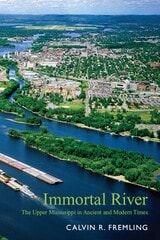
Like the Mississippi itself, Immortal River often leaves the main channel to explore the river's backwaters, floodplain, and drainage basin. The book's focus is the Upper Mississippi, from Minneapolis, Minnesota, to Cairo, Illinois. But it also includes information about the river's headwaters in northern Minnesota and about the Lower Mississippi from Cairo south to the river's mouth ninety miles below New Orleans. It offers an understanding of the basic geology underlying the river's landscapes, ecology, environmental problems, and grandeur.

Immortal for Quite Some Time
Scott Abbott
University of Utah Press, 2016
Winner of the Utah Arts Council's Original Writing Competition Book Manuscript Prize in Creative Nonfiction
Winner of the 15 Bytes Book Award for Creative Nonfiction
“This is not a memoir. Rather, this is a fraternal meditation on the question: ‘Are we friends, my brother?’ The story is uncertain, the characters are in flux, the voices are plural, the photographs are as troubled as the prose. This is not a memoir.”
Thus Scott Abbott introduces the reader to his exploration of the life of his brother John, a man who died of AIDS in 1991 at the age of forty. Writing about his brother, he finds he is writing about himself and about the warm-hearted, educated, and homophobic LDS family that forged the core of his identity.
Images and quotations are interwoven with the reflections, as is a critical female voice that questions his assertions and ridicules his rhetoric. The book moves from the starkness of a morgue’s autopsy through familial disintegration and adult defiance to a culminating fraternal conversation. This exquisitely written work will challenge notions of resolution and wholeness.
Impact Zone
The Battle of the DMZ in Vietnam, 1967–1968Jim Brown
University of Alabama Press, 2004
In the heart of the DMZ, one Marine faced the war—and the truth behind it.
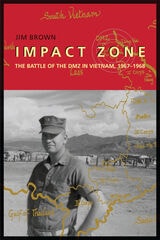
Impact Zone documents Marine First Lieutenant James S. Brown's intense battle experiences, including those at Khe Sanh and Con Thien, throughout his thirteen months of service on the DMZ during 1967-68. This high-action account also reflects Brown's growing belief that the Vietnam War was mis-fought due to the unproductive political leadership of President Johnson and his administration. Brown's naiveté developed into hardening skepticism and cynicism as he faced the harsh realities of war, though he still managed to retain a sense of honor, pride, and patriotism for his country.
Impact Zone is a distinctive book on the Vietnam War because it is told from the perspective of an artilleryman, and the increasingly dangerous events gain momentum as they progress from one adventure to the next. Impact Zone is not only an important historical document of the Vietnam conflict, but also a moving record of the personal and emotional costs of war.
Imperial Affects
Sensational Melodrama and the Attractions of American CinemaEagle, Jonna
Rutgers University Press, 2017

Imperial Blues
Geographies of Race and Sex in Jazz Age New YorkFiona I. B. Ngô
Duke University Press, 2013
Imperial Brotherhood
Gender and the Making of Cold War Foreign PolicyRobert D. Dean
University of Massachusetts Press, 2001
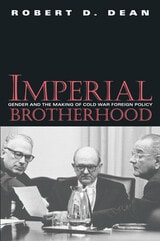
This provocative book begins with a question about the Vietnam War. How is it, asks Robert D. Dean, that American policymakers—men who prided themselves on “hardheaded pragmatism” and shunned “fuzzy idealism”—could have committed the nation to such a ruinous, costly, and protracted war? The answer, he argues, lies not simply in the imperatives of anticommunist ideology or in any reasonable calculation of national interest. At least as decisive in determining the form and content of American Cold War foreign policy were the common background and shared values of its makers, especially their deeply ingrained sense of upper-class masculinity.
Dean begins by examining the institutions that shaped the members of the U.S. foreign policy establishment—all-male prep schools, Ivy League universities, collegiate secret societies, and exclusive men's clubs—that instilled stoic ideals of competition, duty, and loyalty. Service in elite military units during World War II further reinforced this pattern of socialization, eventually creating an “imperial brotherhood” imbued with a common global vision. More than that, according to Dean, the commitment to tough-minded masculinity shared by these men encouraged the pursuit of policies that were aggressively interventionist abroad and intolerant of dissent at home.
Applying his gendered analysis to the McCarthy era, Dean reveals how the purge of suspected homosexuals in the State Department not only paralleled the repression of the political left, but also reflected a bitter contest for power between the foreign policy elite and provincial Congressional conservatives. He then shows how issues of manliness similarly influenced the politics and policies of the Kennedy and Johnson administrations. Just as programs like the Peace Corps were grounded in ideals of masculine heroism, decisions about intervention in Vietnam were inextricably bound up with ideas about male strength and power. In the end, Dean makes a persuasive case that these elite constructions of male identity fundamentally shaped the course of American foreign policy during the early decades of the Cold War.

Imperial Material
National Symbols in the US Colonial EmpireAlvita Akiboh
University of Chicago Press, 2023
In Imperial Material, Alvita Akiboh reveals how US national identity has been created, challenged, and transformed through embodiments of empire found in US territories, from the US dollar bill to the fifty-star flag. These symbolic objects encode the relationships between territories—including the Philippines, the Hawaiian Islands, Puerto Rico, and Guam—and the empire with which they have been entangled. Akiboh shows how such items became objects of local power, their original intent transmogrified. For even if imperial territories were not always front and center for federal lawmakers and administrators, their inhabitants remained continuously aware of the imperial United States, whose presence announced itself on every bit of currency, every stamp, and the local flag.
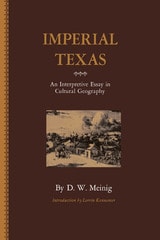
Imperial Texas
An Interpretive Essay in Cultural GeographyBy D. W. Meinig
University of Texas Press, 1969
Imperial Texas examines the development of Texas as a human region, from the simple outline of the Spanish colony to the complex patterns of the modern state. In this study in cultural geography set into a historical framework, D. W. Meinig discusses the "various peoples of Texas, who they are, where they came from, where they settled, and how they are proportioned one to another from place to place." After examining the historical framework, he then presents detailed analyses of the major regions of modem Texas and an over-all characterization of the state and its people. He concludes that, although Texas has never been the empire that it has sometimes been called, "nevertheless... Texas is something more than just one-fourteenth of the American area, one-twentieth of the American people, and one-fiftieth of the American union."
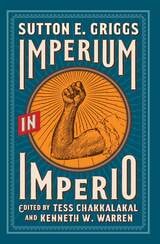
Imperium in Imperio
Sutton E. Griggs
West Virginia University Press, 2022
A new critical edition of Sutton Griggs’s turn-of-the-twentieth-century novel, which continues to shed light on understandings of Black politics.
Sutton E. Griggs’s first novel, originally published in 1899, paints a searing picture of the violent enforcement of disfranchisement and Jim Crow racial segregation. Based on events of the time, including US imperial policies, revolutionary movements, and racial protests, Imperium in Imperio introduces the fictional Belton Piedmont and Bernard Belgrave as “future leaders of their race” and uses these characters to make sense of the violence that marked the dawn of the twentieth century. Taking on contemporary battles over separatism and integration, Griggs’s novel continues to play a crucial role in understandings of Black politics.
Edited and introduced by Tess Chakkalakal and Kenneth W. Warren, this new critical edition offers not only an incisive biographical and historical introduction to the novel and its author but also a wealth of references that make the events and characters of Griggs’s Imperium in Imperio, and its aftermath, accessible to readers today.
Imperium in Imperio
Tess Chakkalakal
University of Delaware Press, 0
Edited and introduced by Tess Chakkalakal and Kenneth W. Warren, this new critical edition offers not only an incisive biographical and historical introduction to the novel and its author but also a wealth of references that make the events and characters of Griggs’s Imperium in Imperio, and its aftermath, accessible to readers today.

Impermanence
Life and Loss on Superior's South Shoreleaf
University of Minnesota Press, 2024
A personal journey through the ever-changing natural and cultural history of Lake Superior’s South Shore
Lake Superior’s South Shore is as malleable as it is enduring, its red sandstone cliffs, clay bluffs, and golden sand beaches reshaped by winds and water from season to season—and sometimes from one hour to the next. Generations of people have inhabited the South Shore, harvesting the forests and fish, mining copper, altering the land for pleasure and profit, for better or worse. In Impermanence, author Sue Leaf explores the natural and human histories that make the South Shore what it is, from the gritty port city of Superior, Wisconsin, to the shipping locks at Sault Ste. Marie, Michigan.
For Leaf, what began as a bicycling adventure on the coast of Lake Superior in 1977 turned into a lifelong connection with the area, and her experience, not least as owner of a rustic cabin on a rapidly eroding lakeside cliff, imbues these essays with a passionate sense of place and an abiding curiosity about its past and precarious future. As waves slowly consume the shoreline where her family has spent countless summers, Leaf is forced to confront the complexity of loving a place that all too quickly is being reclaimed by the great lake.
Impermanence is a journey through the South Shore’s story, from the early days of the Anishinaabe and fur traders through the heyday of commercial fishing, lumber camps, and copper mining on the Keweenaw Peninsula to the awakening of the Northland to the perils and consequences of plundering its natural splendor. Noting the geological, ecological, and cultural features of each stop on her tour along the South Shore, Leaf writes about the restoration of the heavily touristed Apostle Islands National Lakeshore to its pristine conditions, even as Lake Superior maintains its allure for ice fishers, kayakers, and long-distance swimmers. She describes efforts to protect the endangered piping plover and to preserve the diverse sand dunes on the Michigan coast, and she observes the slough that supports rare intact wild rice beds central to Anishinaabe culture.
Part memoir, part travelogue, part natural and cultural history, Leaf’s love letter to Lake Superior’s South Shore is an invitation to see this liminal world in all its seasons and guises, to appreciate its ageless, ever-changing wonders and intimate charms.
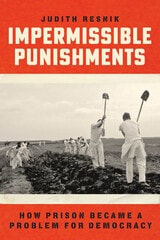
Impermissible Punishments
How Prison Became a Problem for DemocracyJudith Resnik
University of Chicago Press, 2025
An original transatlantic history of the invention of the corrections profession and of ensuing debates about punishment’s purposes and prisoners’ rights.
Impermissible Punishments explores the history of punishment inside prisons and how governments grappled with obligations to justify the punishments they impose. Legal scholar Judith Resnik charts the creation of the corrections profession and weaves together the stories of people who made rules for prisons and the stories of those living under the resulting regimes.
Resnik maps three centuries of shifting ideas, norms, and legal standards aiming to draw lines between permissible and impermissible punishments. Her account documents the impact of World War II, the United Nations, the US Civil Rights movement, and the pioneering prisoners who insisted that law should protect their individual dignity. Taking us to the present, Resnik analyzes the expansion of imprisonment, the inability of public and private prisons to provide safe housing, and the impact of abolition politics.
Exploring the interdependency of people in and out of prisons, Impermissible Punishments examines what governments committed to equality owe to the people they detain and argues that many contemporary forms of punishment need to end.
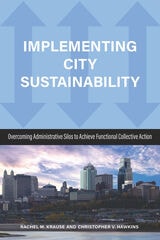
Implementing City Sustainability
Overcoming Administrative Silos to Achieve Functional Collective ActionRachel M. Krause and Christopher V. Hawkins
Temple University Press, 2021
Implementing City Sustainability examines the structures and processes that city governments employ to pursue environmental, social, and economic well-being within their communities. As American cities adopt sustainability objectives, they are faced with the need to overcome fuzzy-boundary, coordination, and collective action challenges to achieve successful implementation.
Sustainability goals often do not fit neatly into traditional city government structures, which tend to be organized around specific functional responsibilities, such as planning, public works, parks and recreation, and community development. The authors advance a theory of Functional Collective Action and apply it to local sustainability to explain how cities can—and in some cases do—organize to successfully administer changes to achieve complex objectives that transcend these organizational separations. Implementing City Sustainability uses a mixed-method research design and original data to provide a national overview of cities’ sustainability arrangements, as well as eight city case studies highlighting different means of organizing to achieve functional collective action.
By focusing not just on what cities are doing to further sustainability, but also on how they are doing it, the authors show how administrative structure enables—or inhibits—cities to overcome functional divides and achieve successful outcomes.

Implementing Cost-Effective Assistive Computer Technology
A How-To-Do-It Manual for LibrariansJane Vincent
American Library Association, 2012
Implementing Virtual Reference Services
Beth Thomsett-Scott
American Library Association, 2013