Results by title
4154 books match the query 'State & Local' and 53 start with j
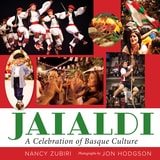
Jaialdi
A Celebration of Basque CultureNancy Zubiri
University of Nevada Press, 2022
Organized and staffed entirely by volunteers, Jaialdi attracts 35,000 to 50,000 visitors from around the world. Attendees enjoy festivities featuring Basque culture, including dancing, music, food, and competitive feats of strength. Photographer Jon C. Hodgson captures the spirit and merriment of the festival in vivid detail, taking readers on a journey into the heart of Basque culture. Coupled with author Nancy Zubiri’s observations from her own attendance at nearly every Jaialdi since 1987, the book reveals how Boise’s Basque community has committed to host the festival and why the celebration remains so popular today.
The Basque diaspora to the United States began in the late 1800s when these determined immigrants came seeking a new life filled with opportunities. Many were sheepherders who adapted to American life while maintaining their ties to the traditions of the Basque Country. Jaialdi: A Celebration of Basque Culture illuminates how this festival honors these traditions and captures the essence of the ancient Basque people, who are preserving their heritage while embracing life in the twenty-first-century West.
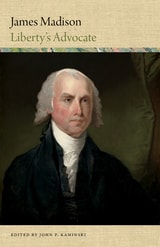
James Madison
Liberty's AdvocateJohn P. Kaminski
Wisconsin Historical Society Press, 2018
America has had few political thinkers who have rivalled James Madison. The son of a wealthy planter, Madison was an unhealthy child and was beset by physical infirmities throughout his long life, and grew into a cerebral man. Madison left Virginia to attend the College of New Jersey, but returned to his native state after completing his studies. Though he aspired to be a college professor, Madison instead went into public service and became one of the most influential, guiding voices of the Founding Era. Madison’s Virginia Plan would be used as a blueprint for the Constitutional Convention, where the Articles of Confederation would be replaced with a new Constitution that bore traces of Madison’s influence throughout.
Editor John Kaminski has gathered a remarkable collection of quotations by and about James Madison for the third installment of his Word Portraits of America’s Founders series. Through these words by and about Madison, we learn more about one of the country’s most influential Founding Fathers, who held a lifelong commitment to liberty and opposed oppression.
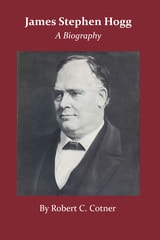
James Stephen Hogg
A BiographyBy Robert C. Cotner
University of Texas Press, 1959
No other governor has become so completely identified with Texas and its citizens as Jim Hogg, the first native Texan to hold the state's highest office. His fame was not, however, easily earned. Orphaned at twelve, he worked as farmhand, typesetter, and country editor to finance his study of law, an endeavor that eventually led him into public life.
Even before his admission to the bar in 1875 he served as justice of the peace in Wood County. Later, in two terms as district attorney (1881–1885), he proved himself a fearless prosecutor. His growing reputation, with his magnetic personality, brought him the attorney generalship in 1887, and in that office he fulfilled his campaign promises to enforce all laws. During Hogg's tenure, suits brought by his department resulted in the restoration of more than a million acres of state lands held by the railroads.
In 1890 Hogg was elected governor. Early the next year he began urging his reform program, the keystone of which was establishment of the Railroad Commission. He also brought about the passage of laws preventing the watering of railroad securities, the indiscriminate issuance of municipal securities, and the establishment of landholding companies. Land ownership by aliens was likewise restricted.
Throughout Hogg's public life, from iustice of the peace to governor, he was motivated by his concern for the welfare of the people. Invariably his criterion for evaluation of an issue was the effect of a decision upon the common welfare. In this democratic progressivism he was the Texas version of Thomas Jefferson or Theodore Roosevelt. Molded by his varied experiences, Jim Hogg was a man of many professions—printer, lawyer, politician, statesman, oil magnate. In these relationships he was still a warmly human person, a loving son, brother, husband, father, friend. His ambition to provide abundantly for his family was expansive enough to include all Texans; so his love for "the people" was reiterated in his public benefactions, through which Texans are even today still sharing his wealth.
Jim Hogg's varied public life and his heart-warming personal life are dramatically presented in this absorbing biography. In it, the far-sweeping panorama of Texas development in the late nineteenth and early twentieth centuries is shown in relation to his dreams and achievements.
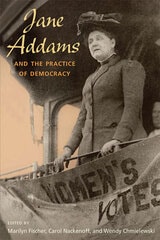
Jane Addams and the Practice of Democracy
Edited by Marilyn Fischer, Carol Nackenoff, and Wendy Chmielewski
University of Illinois Press, 2008
Using a rich array of newly available sources and contemporary methodologies from many disciplines, the ten original essays in this volume give a fresh appraisal of Addams as a theorist and practitioner of democracy. In an increasingly interdependent world, Addams's life work offers resources for activists, scholars, policy makers, and theorists alike. This volume demonstrates how scholars continue to interpret Addams as a model for transcending disciplinary boundaries, generating theory out of concrete experience, and keeping theory and practice in close and fruitful dialogue.
Contributors are Harriet Hyman Alonso, Victoria Bissell Brown, Wendy Chmielewski, Marilyn Fischer, Shannon Jackson, Louise W. Knight, Carol Nackenoff, Karen Pastorello, Wendy Sarvasay, Charlene Haddock Seigfried, and Camilla Stivers.

Jazz from Detroit
Mark Stryker
University of Michigan Press, 2019
Stryker’s story starts in the 1940s and ’50s, when the auto industry created a thriving black working and middle class in Detroit that supported a vibrant nightlife, and exceptional public school music programs and mentors in the community like pianist Barry Harris transformed the city into a jazz juggernaut. This golden age nurtured many legendary musicians—Hank, Thad, and Elvin Jones, Gerald Wilson, Milt Jackson, Yusef Lateef, Donald Byrd, Tommy Flanagan, Kenny Burrell, Ron Carter, Joe Henderson, and others. As the city’s fortunes change, Stryker turns his spotlight toward often overlooked but prescient musician-run cooperatives and self-determination groups of the 1960s and ’70s, such as the Strata Corporation and Tribe. In more recent decades, the city’s culture of mentorship, embodied by trumpeter and teacher Marcus Belgrave, ensured that Detroit continued to incubate world-class talent; Belgrave protégés like Geri Allen, Kenny Garrett, Robert Hurst, Regina Carter, Gerald Cleaver, and Karriem Riggins helped define contemporary jazz. The resilience of Detroit’s jazz tradition provides a powerful symbol of the city’s lasting cultural influence.
Stryker’s 21 years as an arts reporter and critic at the Detroit Free Press are evident in his vivid storytelling and insightful criticism. Stryker has fully updated the paperback since the publication of the hardcover. This award-winning book will appeal to jazz aficionados, casual fans, and anyone interested in the vibrant and complex history of cultural life in Detroit.
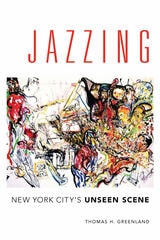
Jazzing
New York City's Unseen SceneThomas H. Greenland
University of Illinois Press, 2016
Jeffrey Introduces Thirteen More Southern Ghosts
Commemorative EditionKathryn Tucker Windham
University of Alabama Press, 2015
A commemorative edition of the beloved and best-selling second book in famed folklorist Kathryn Tucker Windham’s southern ghosts series.
Jeffrey was the resident apparition in the Selma, Alabama, home of nationally-known folklorist Kathryn Tucker Windham and the inspiration for Windham’s best-selling collection of macabre tales that reveal two hundred years of Alabama’s ghostly secrets, Thirteen Alabama Ghosts and Jeffrey. One of the most popular books ever published in the state, generations of Alabama children and students have been thrilled and chilled by Windham’s spectral legends.
Following the overwhelming success of Thirteen Alabama Ghosts and Jeffrey, Windham and Jeffrey began to journey across the South assembling a second collection of ghastly tales that repeat Windham’s winning combination of traditional folklore, Southern history and culture, and family-friendly story-telling. In Jeffrey Introduces Thirteen More Southern Ghosts, Windham’s disembodied friend roams the states of Kentucky, Tennessee, Georgia, Mississippi, Louisiana, and Florida to recall thirteen more timeless, spine-tingling tales of baneful and melancholy spirits that spook the most stoic heart.
Opening this volume is “The Girl Nobody Knew.” One midsummer night in the genteel Kentucky mineral spring resort of Harrodsburg, a beautiful lady arrived at the town’s grand hotel. The belle danced late into the night with the town’s smitten gallants only to expire suddenly with the notes of the last quadrille. The spooked residents of Harrodsburg guard a grave you can see to this day. Readers then visit the world-famous Bell Witch of Robinson County, Tennessee. Jeffrey also makes his first trip to old New Orleans to reveal a revenant in residence on Royal Street before continuing his ghostly progress across Dixie.
This new edition returns Jeffrey Introduces Thirteen More Southern Ghosts to its original format in jacketed cloth full of original, black-and-white illustrations in a handsome keepsake edition perfect for gift-giving and for families, folklorists of all ages, and libraries.
Jeffrey's Latest Thirteen
More Alabama Ghosts, Commemorative EditionKathryn Tucker Windham
University of Alabama Press, 2016
A deluxe, commemorative edition of a beloved collection of ghostly stories from famed southern author and folklorist Kathryn Tucker Windham’s home state of Alabama.
Accompanied by her faithful companion, Jeffrey, a friendly spirit who resided in her home in Selma, Alabama, Kathryn Tucker Windham traveled the South, visiting the sites of spectral legends in Mississippi, Georgia, and Tennessee, among other places. In Jeffrey’s Latest Thirteen: More Alabama Ghosts, a sequel to her landmark Thirteen Alabama Ghosts and Jeffrey, Windham introduces readers to thirteen more of Jeffrey's ghostly acquaintances, each with the charm and universal appeal that has created hundreds of thousands of Jeffrey fans.
Among the other hair-raising tales in this collection, Windham spotlights the apparitions of academia. From the three Yankee soldiers who haunt the University of Alabama’s Civil War–era Little Round House to the Confederate soldier who resides in the University Chapel at Auburn University, Alabama’s institutions of higher learning seem to have more than a few paranormal pupils.
Photographs of the sites about which Windham writes are one of the best-loved features of her series of “Jeffrey the Ghost” books. Jeffrey’s Latest Thirteen features the image of a beautiful child who, though not photographed in life, reappeared long enough to be photographed with his bereaved father's borrowed camera. Bewitched readers will find the startling photograph of the child in the next-to-last chapter, just pages before he book’s photograph of Windham’s own spectral muse, Jeffrey.
This commemorative edition returns Windham’s thrilling classic to its original 1982 keepsake quality and includes a new afterword by the author’s children.
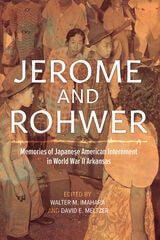
Jerome and Rohwer
Memories of Japanese American Internment in World War II ArkansasWalter M. Imahara
University of Arkansas Press, 2022
This book is a collection of brief memoirs written by former internees of Jerome and Rohwer and their close family members. Here dozens of individuals, almost all of whom are now in their eighties or nineties, share their personal accounts as well as photographs and other illustrations related to their life-changing experiences. The collection, likely to be one of the last of its kind, is the only work composed solely of autobiographical remembrances of life in Jerome and Rohwer, and one of the very few that gathers in a single volume the experiences of internees in their own words.
What emerges is a vivid portrait of lives lived behind barbed wire, where inalienable rights were flouted and American values suspended to bring a misguided sense of security to a race-obsessed nation at war. However, in the barracks and the fields, the mess halls and the makeshift gathering places, values of perseverance, tolerance, and dignity—the gaman the internees shared—gave significance to a transformative experience that changed forever what it means to call oneself an American.
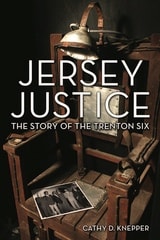
Jersey Justice
The Story of the Trenton SixCathy D. Knepper
Rutgers University Press, 2011
The case of the Trenton Six attracted international attention in its time (1948–1952) and was once known as the “northern Scottsboro Boys case.” Yet, there is no memory of it. The shame of racism evident in the case has been nearly erased from the public record. Now, historian Cathy D. Knepper takes us back to the courtroom to make us aware of this shocking chapter in American history.
Jersey Justice: The Story of the Trenton Six begins in 1948 when William Horner, an elderly junk dealer, was murdered in his downtown Trenton shop. Over a two-week period, six local African American men were arrested and charged with collectively killing Horner. Violating every rule in the book, the Trenton police held the six men in incommunicado detention, without warrants, and threatened them until they confessed. At the end of the trial the all-white jury sentenced the six men to die in the electric chair.
That might have been the end of the story were it not for the tireless efforts of Bessie Mitchell, the sister of one of the accused men. Undaunted by the refusal of the NAACP and the ACLU to help appeal the conviction of the Trenton Six, Mitchell enlisted the aid of the Civil Rights Congress, ultimately taking the case as far as the New Jersey Supreme Court. Along the way, the Trenton Six garnered the attention and involvement of many prominent activists, politicians, and artists, including Paul Robeson, Thurgood Marshall, Eleanor Roosevelt, Pete Seeger, Arthur Miller, and Albert Einstein. Jersey Justice brings to light a shameful moment in our nation’s history, but it also tells the story of a personal battle for social justice that changed America.

Jersey Troopers
A Fifty Year History of the New Jersey State PoliceLeo J. Coakley
Rutgers University Press, 1971
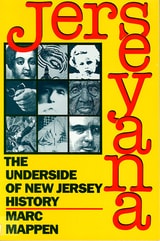
Jerseyana
The Underside of New Jersey HistoryMappen, Marc
Rutgers University Press, 1992
Readers of the New Jersey section of the Sunday New York Times eagerly look forward to Marc Mappen's astonishing tales of New Jersey history. Jerseyana is his first collection of these popular monthly columns. Here you will meet villains like Dutch Schultz, the mobster gunned down in a Newark gangland rubout, and heroes like Minerva Miller, a black woman who fought segregation at the turn of the century. There are famous events, like the explosion of Hindenburg, and obscure ones, like the assassination of the king of Italy by an anarchist from Paterson. There are amusing stories, like a buried treasure hoax in Morristown after the Revolutionary War, bizarre stories like the fact that the discoverer of New Jersey was allegedly devoured by cannibals, and dramatic stories, like the Jersey woman who survived Indian captivity.
Arranged chronologically, these columns constitute a lively New Jersey perspective on American history. Individual essays deal with major themes in American history and how they affected New Jersey: the colonial era, the Revolution, Civil War and Reconstruction, the Gilded Age, the Progressive Era, World War I, the '20s and '30s, World War II, McCarthyism, women's history, and black history.
Each of the fifty-four columns in this book stands as a colorful exploration in history. Together they constitute a sweeping survey of our state's rich heritage.
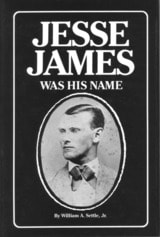
Jesse James Was His Name
William A. Settle, Jr.
University of Missouri Press, 1966
William A. Settle, Jr. has, for a number of years, trailed the James brothers through the columns of old newspapers and the records of county courts. In his search for the facts concerning these men--heroes to some, criminals to others--he has critically examined the contemporary accounts of their activities and has interviewed men and women who could give eyewitness or close hearsay evidence of them. Employing the techniques of scholarly research, Professor Settle has winnowed the fact from the fiction to produce this study of these most notorious American bandits.
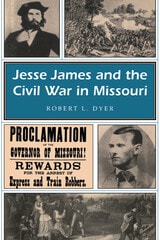
Jesse James and the Civil War in Missouri
Robert L. Dyer
University of Missouri Press, 1994
The Civil War in Missouri was a time of great confusion, violence, and destruction. Although several major battles were fought in the state between Confederate and Union forces, much of the fighting in Missouri was an ugly form of terrorism carried out by loose bands of Missouri guerrillas, by Kansas "Jayhawkers," or by marauding patrols of Union soldiers. This irregular warfare provided a training ground for people like Jesse and Frank James who, after the war, used their newly learned skills to form an outlaw band that ultimately became known all over the world.
Jesse James and the Civil War in Missouri discusses the underlying causes of the Civil War as they relate to Missouri and reveals how the war helped create both the legend and the reality of Jesse James and his gang. Written in an accessible style, this valuable little book will be welcomed by anyone with an interest in the Civil War, the legend of Jesse James, or Missouri history.
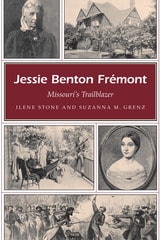
Jessie Benton Frémont
Missouri's TrailblazerIlene Stone & Suzanna M. Grenz
University of Missouri Press, 2005
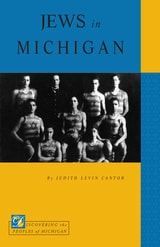
Jews in Michigan
Judith Levin Cantor
Michigan State University Press, 2001
Since the earliest days of the British fur trade, Jewish pioneers have made Michigan their home. Judith Levin Cantor's Jews in Michigan captures the struggles and triumphs of Michigan's Jews as they worked to establish farms, businesses and synagogues, sparking commercial and residential development throughout the state, and even into the far reaches of the Upper Peninsula. Cantor celebrates both urban and rural immigrants, who supplied essential goods and services to those in lumbering, mining, and automobile manufacturing. She also deals honestly with questions of anti-Semitism and prejudice. Cantor's book shows how, in the quest to build strong communities, Jewish residents also helped create the foundations of the Michigan we know today.
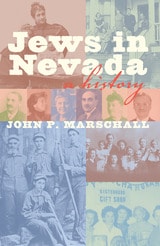
Jews in Nevada
A HistoryJohn P. Marschall
University of Nevada Press, 2011
Jews have always been one of Nevada’s most active and influential ethnic minorities. They were among the state’s earliest Euro-American settlers, and from the beginning they have been involved in every area of the state’s life as businessmen, agrarians, scholars, educators, artists, politicians, and civic, professional, and religious leaders. Jews in Nevada is an engaging, multilayered chronicle of their lives and contributions to the state. Here are absorbing accounts of individuals and families who helped to settle and develop the state, as well as thoughtful analyses of larger issues, such as the reasons Jews came to Nevada in the first place, how they created homes and interacted with non-Jews, and how they preserved their religious and cultural traditions as a small minority in a sparsely populated region.
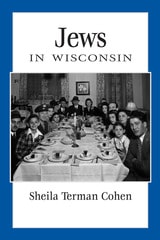
Jews in Wisconsin
Sheila Terman Cohen
Wisconsin Historical Society Press, 2016
Unlike the other cultural groups covered in the People of Wisconsin series, the Jews who have made their home in Wisconsin are united not by a single country of origin, but by a shared history and set of religious beliefs. This diverse group found their way to America’s heartland over several centuries from Germany, Russia, and beyond, some fleeing violence and persecution, others searching for new opportunities, but all making important contributions to the fabric of this state’s history. Through detailed historical information and personal accounts, Sheila Terman Cohen brings to life the stories of their various trials and triumphs. Jews in Wisconsin details their battles against anti-Semitism, their efforts to participate in the communities they joined, and their successes at holding onto their own cultural identities.
In addition to excerpts of Cohen’s many interviews with Wisconsin Jews, Jews in Wisconsin also features the compelling journals of German immigrant Louis Heller, a tradesman who established himself in Milwaukee, and Russian immigrant Azriel Kanter, who details the perilous journey his family embarked on to escape anti-Semitism in his home country and make a new life in Wisconsin.
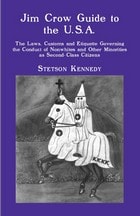
Jim Crow Guide to the U.S.A.
The Laws, Customs and Etiquette Governing the Conduct of Nonwhites and Other Minorities as Second-Class CitizensStetson Kennedy
University of Alabama Press, 2011
“A history of the United States that is almost incredible.” —Jean-Paul Sartre, Les Temps Modernes
Jim Crow Guide to the U.S.A. by Stetson Kennedy is a bold exposé of America’s institutionalized racism, originally published in 1959 and hailed as a landmark in civil rights literature. With unflinching clarity, Kennedy documents the laws, customs, and social codes that relegated nonwhite citizens to second-class status under the Jim Crow system. From the mistreatment of Native Americans to the exclusionary immigration policies targeting Asians and Africans, the book maps the presence of race-based politics across every facet of American life—housing, education, employment, and even burial.
What makes this work especially influential is its international resonance. The famed French existentialist Jean-Paul Sartre championed the book’s publication in Europe, recognizing its power to illuminate the contradictions between American democratic ideals and racial realities. Sartre’s endorsement helped position the book as a global indictment of racial injustice, aligning it with anti-colonial and human rights movements worldwide. Provocative, meticulously researched, and deeply human, Jim Crow Guide to the U.S.A. remains a vital historical document and a call to conscience. It is not merely a guide—it is a mirror held up to a nation, reflecting truths that later generations were called on to address.
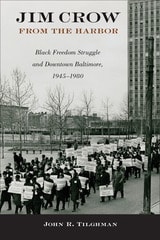
Jim Crow from the Harbor
Black Freedom Struggle and Downtown Baltimore, 1945–1980John R. Tilghman
Temple University Press, 2026
How do poor Black communities co-exist with downtown revitalization? How do Black social movements respond to urban renewal to ensure access to better housing and city spaces? John Tilghman investigates these interlocking questions in Jim Crow from the Harbor. Looking at Baltimore, Maryland’s redevelopment in the post-war era of deindustrialization and population decline through white flight, Tilghman tells the story of how Black activists clashed with urban regimes.
Tilghman follows the money—redevelopment profits—which created tensions that prompted anti-freeway campaigns and affirmative action efforts. Through grassroots activism, protests, and community building, participants in the Black Freedom Struggle undermined downtown interests’ efforts to reinforce racial segregation as well as other civil, political, and economic inequalities.
While their efforts met with both success and limitations, Tilghman emphasizes the strengths of this minority majority population as they strove for urban equality. Jim Crow from the Harbor provides a new perspective that helps explain what has provoked today’s struggles in Baltimore for Black Americans.
John A. Logan
Stalwart Republican from IllinoisJames Pickett Jones
Southern Illinois University Press, 2001
Not available.

John Barleycorn Must Die
The War Against Drink in ArkansasBen F. Johnson III
University of Arkansas Press, 2005
John Bascom and the Origins of the Wisconsin Idea
J. David Hoeveler Jr.
University of Wisconsin Press, 2017
During his term as governor (1901–1906), Robert La Follette routinely consulted with University of Wisconsin researchers to devise groundbreaking programs and legislation. Although the Wisconsin Idea is often attributed to a 1904 speech by Charles Van Hise, then president of the University of Wisconsin, David Hoeveler argues that it originated decades earlier, in the creative and fertile mind of John Bascom.
A philosopher, theologian, and sociologist, Bascom (1827–1922) deeply influenced a generation of students at the University of Wisconsin, including La Follette and Van Hise. Hoeveler documents how Bascom drew concepts from German idealism, liberal Protestantism, and evolutionary theory, transforming them into advocacy for social and political reform. He was a champion of temperance, women's rights, and labor, all of which brought him controversy as president of the university from 1874 to 1887. In a way unmatched by any of his peers at other institutions, Bascom outlined a social gospel that called for an expanded role for state governments and universities as agencies of moral improvement.
Hoeveler traces the intellectual history of the Wisconsin Idea from the nineteenth century to such influential Progressive Era thinkers as Richard T. Ely and John R. Commons, who believed university researchers should be a vital source of expertise for government and citizens.
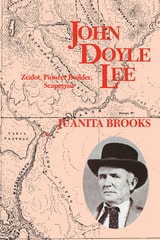
John Doyle Lee
Juanita Brooks
Utah State University Press, 1992
John D. Lee is most often remembered as the only man executed for his role in the infamous 1857 massacre by Mormons of a California-bound emigrant train at Mountain Meadows in southern Utah. This classic biography examines the circumstances and events which brought Lee to that end. It also, however, looks at the other dimensions of his active life, showing that he was a far more important and complex man than subsequent generations, eager for a dark symbol, have acknowledged. He was a leader in the Mormon colonization of southern Utah and northern Arizona. With the title Indian Farmer, he became his church's emissary to Indians in the area. During and prior to the Mormon migration west, he participated in and kept detailed accounts of the conflicts and other events in Missouri, Illinois, and along the trail. An early practitioner, and recorder, of the custom of plural marriage, he was the adopted son of Brigham Young and a close associate of other Mormon leaders. His occupations included builder, farmer, missionary, ferry operator, town founder, and faith leader.
Using Lee's extensive diaries, bolstered by numerous supporting accounts, Juanita Brooks has not only written a thorough and objective portrait of one man's life, a life which would be worthy of study even if it were not controversial, she also has provided numerous insights into early Mormon society and culture. Anyone interested in Mormon polygamy, family life, leadership, relations with Indians, or other aspects of their frontier existence will find this a storehouse of information.
This classic biography is now in its fourth Utah State University Press printing. It is unparalleled in providing a thorough and accurate account of John D. Lee's involvement in the tragic 1857 Mountain Meadows Massacre.
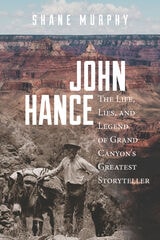
John Hance
The Life, Lies, and Legend of Grand Canyon's Greatest StorytellerShane Murphy
University of Utah Press, 2020
A legend in his own lifetime, John Hance (1837–1919) was synonymous with early Grand Canyon tourism. Between the late 1880s and early 1900s, to say “John Hance” was to say “Grand Canyon.” Hance was well known to travelers and visiting dignitaries alike, men such as William “Buffalo Bill” Cody and Theodore Roosevelt, the president who affectionately referred to him as “the greatest liar on earth.” It was said that Hance tried to jump the canyon on his horse Darby only to turn back when he was halfway over and realized he would never make it across.
The truth behind Hance’s life is remarkable even without embellishment. In this book, Shane Murphy chronicles Hance’s childhood in Tennessee and Missouri, his service in the Confederacy during the Civil War, his time in Union prisons as a POW, and his later adventures with the Hickok brothers crossing the plains. Settling in Arizona’s fruitful Verde Valley, Hance farmed and filled military contracts before taking up residence as Grand Canyon’s first permanent Euro-American settler, trail builder, guide, and renowned storyteller.
Hance left no correspondence, personal memoirs, or other writings. Only informal portraits from magazines and newspaper accounts remain. Murphy investigated assessors’ rolls, rare mercantile ledgers, and mining claims to create a full and compelling narrative of a man who was once an icon of the American West and should be remembered as the founding father of Grand Canyon tourism.
John Henry Livingston and the Dutch Reformed Tradition in the Early American Nation
John W. Coakley
Rutgers University Press, 2027
John Henry Livingston (1746-1825) was from a prominent New York family of merchants, lawyers and statesmen but chose to become a minister in the Dutch Reformed Church. In his twenties he studied in the Netherlands, absorbing ideas that upheld simultaneously the authority of the individual conscience and the traditional Reformed beliefs rooted in the authority of a state-supported church. Returning to New York City he served as a pastor, as his denomination’s professor charged with educating students for ministry, and eventually, president of the American Dutch church’s college, then called Queens (but later called Rutgers). Throughout his career he articulated, and defended what he saw as the harmony between the traditional body of Reformed belief and the ideals of the American state.
John Horry Dent
South Carolina Aristocrat On Alabama FrontierRay Mathis
University of Alabama Press, 1979
Jonah Horry Dent was born on 5 August 1815 in Newport, Rhode Island, the son of John Herbert Dent and Elizabeth Anne Horry Dent. Dent grew up in Charleston, South Carolina, and spent summers with his family on a plantation in Colleton County, South Carolina. When he was still a young child, his name was changed from “Jonah” to “John” when an older brother, named John, died, leaving little Jonah as the oldest living son. He was known as John Horry Dent the rest of his life.
Dent married Mary Elizabeth Morrison in 1835 and moved to Barbour County, Alabama, in 1836. He purchased 360 acres of land on Cowikee Creek, paying $15 an acre, and named the new plantation “Good Hope.” Dent amassed a good fortune but lost most of it after the Civil War when slavery was abolished and his slaves became freemen. In 1866 he sold his properties in Barbour County and moved to Cave Springs, Floyd County, Georgia.
Dent kept detailed records about his crops and properties until very late in life. He died in Cave Springs on 17 May 1892.
John Josselyn, Colonial Traveler
A Critical Edition of Two Voyages to New-England.John. Josselyn and Paul J. Lindholdt
Brandeis University Press, 1988
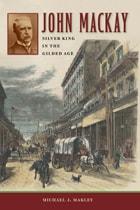
John Mackay
Silver King in the Gilded AgeMichael J. Makley
University of Nevada Press, 2015
John Mackay offers new insight into the life and achievements of this remarkable man. It also places Mackay in the broader context of his time, an era of robber barons and rampant corruption, rapidly advancing technology, national and international capitalism, and flagrant displays of newfound wealth. Even in this context, he stood out, not only for his contributions to Nevada and mining history, but also for his reputation as an important business leader fighting the consolidation and venality of corporate power in the Gilded Age. His actions freed the Comstock from a financial monopoly, resulting in moderated rates for the milling, timber, shipping, transportation, and water that made mining possible and precipitated the discovery and development of the ore field known as the “Big Bonanza.”
Makley’s book recounts the life and career of one of the most successful men of his age, a capitalist of immense wealth who generously helped those around him and worked diligently in the public interest. This engaging biography will appeal to readers interested in the Comstock Lode and mining in the West during the latter part of the nineteenth century as well as general western history enthusiasts.
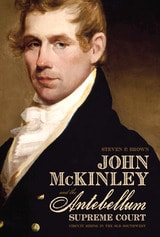
John McKinley and the Antebellum Supreme Court
Circuit Riding in the Old SouthwestSteven P. Brown
University of Alabama Press, 2012
A Southern voice on a national bench—McKinley’s legacy in antebellum law.
John McKinley and the Antebellum Supreme Court offers the first comprehensive biography of Justice John McKinley (1780–1852), a largely forgotten figure in American legal history who played a pivotal role during a formative period of the U.S. Supreme Court. Steven P. Brown rescues McKinley from historical obscurity, presenting a compelling portrait of a man deeply embedded in the political, legal, and financial life of the early 19th-century South.
Born in Kentucky and later settling in northern Alabama, McKinley served in both the U.S. Senate and House of Representatives before being appointed to the Supreme Court by President Martin Van Buren in 1837. His tenure on the bench coincided with the creation of the Ninth Circuit, a vast and challenging judicial territory encompassing Alabama, Arkansas, Louisiana, and Mississippi. Brown details McKinley’s arduous circuit-riding duties, which required extensive travel and exposed him to the legal complexities of a rapidly expanding frontier.
More than a biography, the book provides a penetrating analysis of antebellum legal culture, Alabama state politics, and the internal workings of the Supreme Court during a time of national transformation. Brown challenges the prevailing view of McKinley as a mediocre jurist, arguing instead that his contributions—particularly his dissents defending states’ rights—deserve renewed scholarly attention. With rich historical context and meticulous research, John McKinley and the Antebellum Supreme Court sheds light on the burdens of justice in a divided nation and the legacy of a justice whose career mirrored the tensions of his time.

John Mercer Langston and the Fight for Black Freedom, 1829-65
William and Aimee Lee Cheek
University of Illinois Press, 1989
Privileged beyond other members of his race, yet sharing their disadvantages, the young John Mercer Langston stood in an uncertain position in the years before the Civil War. His confrontation with a critical personal question was tempered by a crucial national reality: from what sources could he derive his model of manhood and human dignity? This book explores John Mercer Langston's decisions to work out his destiny through the resources and fortunes of the northern black community.
Although Langston, who died in 1897, was a black Politician, orator, lawyer, intellectual, diplomat, and congressman, he has never before been accorded fullscale biographical treatment. Born free on a Virginia plantation, Langston graduated from Oberlin College in 1849, gained admission to the Ohio bar, and by the age of twenty-five, became the first black American to hold elective office. Still in the years of his political apprenticeship, he promoted black civil rights, helped shape the nascent Republican party, aided in the Oberlin-Wellington Rescue and John Brown's raid, and recruited black soldier for the Union cause. In 1864 he became the first president of the National Equal Rights League.
From an extensive search of primary sources, the authors construct a richly textured picture of the beginnings of Langston's career as a national black leader. More than a biography, the work also incorporates social and political history. Embedded firmly in a study of northern black community life and activism, it reveals the degree to which Langston and his cohorts set the terms of the fight for freedom and citizenship.
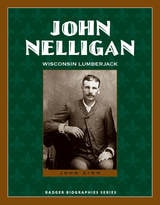
John Nelligan
Wisconsin LumberjackJohn Zimm
Wisconsin Historical Society Press, 2015
Born in 1852, Nelligan rose through the lumberjack ranks, starting out as a humble laborer and working his way up to foreman. He worked and lived in Maine, Pennsylvania, and even Canada before coming to Wisconsin in 1871. Learn what surviving and sawing wood for a living was like many years ago—from the story of one Wisconsin man who lived it!
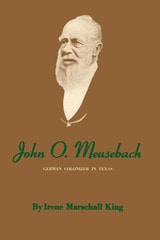
John O. Meusebach
German Colonizer in TexasBy Irene Marschall King
University of Texas Press, 1967
Otfried Hans Freiherr von Meusebach chose a life of hardship and freedom in Texas rather than a life of comfort and influence in his native Germany, where he had lived his formative years within a framework of unconstitutional government.
In 1845 the young liberal relinquished his hereditary German title, left behind his close family ties and his various intellectual and political associations, and arrived in Texas as John O. Meusebach, commissioner-general for the Society for the Protection of German Immigrants. His background enabled him to assume an enlightened leadership of fellow immigrants who were pouring in from Germany. Lacking adequate financial backing, he nevertheless led the settling of some five thousand people in a land that was largely occupied by Indians.
Irene Marschall King presents the full sweep of Meusebach's vigorous life: Meusebach as the young liberal in Germany, as the colonizer in the 1840s, as a Texas senator and, later, an observer of the Civil War, and as a Texan who devoted his later years to bringing the Texas soil to fruition—all set against a background of the immigration movement and frontier life.
"Freedom is not free; it is costly," Meusebach believed. In Texas he found for himself and others freedom worth the price he paid.
Rich in historic detail, King's story recounts the founding of Fredericksburg, the crippling effect of the Mexican War upon the mass of immigrants huddled in illness on the coast, the signing of the Indian Treaty, which opened to settlement over three million acres of land, and the final collapse of the Society for the Protection of German Immigrants. Also depicted is the colonists' influence on the land—the gardens and orchards of south central Texas, the "Easter Fires" that blaze on the hills surrounding Fredericksburg, the mixture of German custom with American necessity that created a unique culture. Throughout the narrative Mrs. King presents a fascinating cast of characters: the noble Prince Solms, who tries to establish a German military outpost in Texas; Henry Fisher, who attempts by devious methods to control the colonists and their land and finally incites a mob which tries to hang Meusebach; Philip Cappes, a special commissioner and Meusebach's assistant, who plots through intriguing correspondence with Count Castell, the executive secretary in Germany, to overthrow Meusebach; and the colorful and courageous Indian fighter and Texas Ranger, Colonel Jack Hays.
Primarily, however, this is the story of a man who found strength in his family's motto, "Perseverance in Purpose," and gave of his energies to build Texas.
John Spring's Arizona
A. M. Gustafson
University of Arizona Press, 1966
John Spring first saw Arizona from an encampment on the west side of the Colorado River at "a small town called Yuma . . . then called Arizona City . . . it did a thriving fandango and saloon business during the period of continual going and coming of troops and teamsters." Southern Arizona, as Spring first saw and described it, was "a country where every highway, every path, every hamlet, and nearly every rancho could tell (had they the gift of speech) of devilish deeds, of crafty ambuscade, murdered settlers and travellers."
Supported by knowledge of several languages and wide reading, John Spring was able to extend his reporting to geographical and botanical description, to detailed reports of agriculture in the Santa Cruz Valley, and mercantile activity in Tucson. But he returned always to people--an irresistible center of interest for John Spring.
The lively and authentic serial reports of John Spring to the National Tribune in Washington, D.C., have been assembled and edited in this volume by A. M. Gustafson.
John Williams Walker
A Study in the Political, Social, and Cultural Life of the Old SouthwestHugh C. Bailey
University of Alabama Press, 1964
A biography of Alabama’s first Senator, this book is also the fascinating story of Southern frontier life as portrayed in contemporary letters and documents. When Madison County, Alabama, was still wilderness, Walker trekked across the mountains from Georgia with his bride, Matilda Pope, his slaves, and all his household possessions, to build a plantation near Huntsville. Here he began his extraordinary political career: member of the first territorial legislature; speaker of the house in the second; U.S. territorial judge; president of Alabama’s Constitutional Convention; and when statehood was won, first U.S. Senator.

John Xántus
The Fort Tejon Letters, 1857–1859Ann Zwinger
University of Arizona Press, 1986
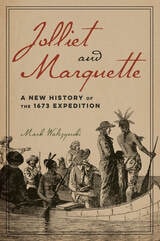
Jolliet and Marquette
A New History of the 1673 ExpeditionMark Walczynski
University of Illinois Press, 2023
A multifaceted voyage into the past, Jolliet and Marquette expands and updates the oft-told story of a pivotal event in American history.

Joseph Carter Corbin
Educator Extraordinaire and Founder of the University of Arkansas at Pine BluffGladys Turner Finney
Butler Center for Arkansas Studies, 2017
Having operated now for more than 140 years, the University of Arkansas at Pine Bluff (UAPB) was founded in 1875 as Branch Normal College by Joseph Carter Corbin, a native of Ohio and the son of former slaves. Corbin, who had a classical education, was the first African American superintendent of public education in Arkansas and literally built the school from the ground up. There was a desperate need for teachers in Arkansas, as there was a great desire for education by former slaves who had been prohibited from learning to read and write.
Corbin himself cleared the land that would soon house the college and then set about to create a school that would produce the first African American teachers following the Reconstruction years. For almost three decades, he worked tirelessly on behalf of Arkansas’s black community to meet the need for educators.
In the early days, Corbin worked both as the president and the janitor so that he could control costs and keep the school going. He often waived matriculation fees and other expenses to allow impoverished students the opportunity to graduate and become qualified to teach throughout Arkansas.
Although he might not have realized it at the time, Corbin was a member of the so-called aristocrats of color, the African American elite of national prominence and a group that included such luminaries as Booker T. Washington. Corbin was a true giant in the history of education in Arkansas. His story, told by a former UAPB student, is monumental for the scope of what one man was able to accomplish.
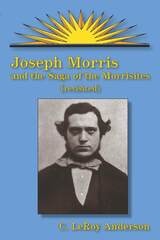
Joseph Morris
and the Saga of the Morrisites RevisitedC. Leroy Anderson
Utah State University Press, 2010
LeRoy Anderson in 1981 first published, under the title For Christ Will Come Tomorrow, his definitive study of a charismatic, millenarian prophet and the Church of Jesus Christ of the Most High. He told there of a Mormon posse’s 1862 attack on the Morrisite compound, killing Joseph Morris, and of the continuing Morrisite movement, which survived into the mid-twentieth century. In this newly revised edition, Anderson revisits his subject by referring to more recently discovered documents, considering other scholars’ continuing work on Morris’s sect and related subjects, and examining a 1980s messianic sect that claimed a direct connection to the Morrisites.
New documentary sources include a holograph “History of George Morris,” written by Joseph Morris’s brother, which Anderson quotes at length. What was once a little-studied subject has since received attention from a number of scholars. Anderson references such current work on Mormon schismatic movements and broader subjects, much of which drew on his work. Perhaps the book’s most interesting and unintended influence was on that obscure 1980s messianic sect, in Montana, which learned of Morris through Joseph Morris and the Saga of the Morrisites.
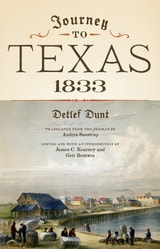
Journey to Texas, 1833
By Detlef Dunt. Translated by Anders Saustrup, edited and with an introduction by James C. Kearney and Geir Bentzen
University of Texas Press, 2015
In 1834, a German immigrant to Texas, D. T. F. (Detlef Thomas Friedrich) Jordt, aka Detlef Dunt, published Reise nach Texas, a delightful little book that praised Texas as “a land which puts riches in [the immigrant’s] lap, which can bring happiness to thousands and to their descendants.” Dunt’s volume was the first one written by an on-the-ground observer to encourage German immigration to Texas, and it provides an unparalleled portrait of Austin’s Colony from the lower Brazos region and San Felipe to the Industry and Frelsburg areas, where Dunt resided with Friedrich Ernst and his family.
Journey to Texas, 1833 offers the first English translation of Reise nach Texas. It brings to vivid life the personalities, scenic landscapes, and customs that Dunt encountered in colonial Texas on the eve of revolution, along with his many practical suggestions for Germans who intended to emigrate. The editors’ introduction describes the social, political, and economic conditions that prompted Europeans to emigrate to Texas and provides biographical background on Dunt and his connection with Friedrich Ernst. Also included in the volume are a bibliography of German works about Texas and an interpretive essay discussing all of the early German literature about Texas and Dunt’s place within it. Expanding our knowledge of German immigration to Texas beyond the more fully documented Hill Country communities, Journey to Texas, 1833 also adds an important chapter to the story of pre-Revolutionary Texas by a sophisticated commentator.
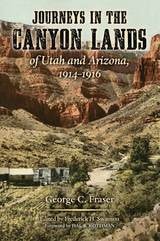
Journeys in the Canyon Lands of Utah and Arizona, 1914-1916
George C. Fraser; Edited by Frederick H. Swanson; Foreword by Hal K. Rothman
University of Arizona Press, 2005
Frederick H. Swanson has edited Fraser’s voluminous journals into a single volume covering three trips taken from 1914 to 1916. As Fraser wades the bone-chilling waters of the Zion Narrows, crosses the Grand Canyon in midsummer heat, and rides through the trackless forest of the Aquarius Plateau, he conveys impressions of the land that will fascinate any reader who wonders what the canyon country was like before it became a popular tourist destination—and one that will inform historians interested in early accounts of the region. Accompanied by a selection of photographs taken by Fraser and his fellow travelers, Journeys in the Canyon Lands brings to life the Southwest’s breathtaking backcountry on the brink of discovery.
Juan Bautista de Anza
Basque Explorer in the New World, 1693-1740Donald T. Garate
University of Nevada Press, 2005
The first biography of an eighteenth-century Basque immigrant who became a silver miner, a cattle rancher, and commander of the cavalry in Sonora, Mexico. The name of Juan Bautista de Anza the younger is a fairly familiar one in the contemporary Southwest because of the various streets, schools, and other places that bear his name. Few people, however, are familiar with his father, the elder Juan Bautista de Anza, whose activities were crucial to the survival of the tenuous and far-flung settlements of Spain’s northernmost colonial frontier. For this first comprehensive biography of the elder Anza, Donald T. Garate spent more than ten years researching archives in Spain and the Americas. The result is a lively picture of the Spanish borderlands and the hardy, ambitious colonists who peopled them.
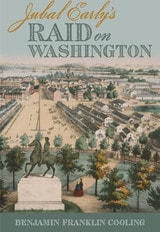
Jubal Early's Raid on Washington
Benjamin Franklin Cooling
University of Alabama Press, 2008
The raid that exposed the Union capital’s greatest danger.
The definitive description of the last Confederate invasion of the Union in 1864. The Civil War was in its fourth year, and the Union’s victory was not at all certain. The Lincoln administration seemed weak as the autumn election approached. Lee’s army remained strong in Virginia while Johnston’s forces feinted and dodged in north Georgia to shield Atlanta. The Union army and navy grew in strength, but Confederate forces continued to fight tenaciously.
Amid an air of stalemate, the Confederates planned a bold move to strike at Washington, DC and capture or scatter Lincoln and his cabinet. In command of the operation was the colorful and unpredictable Jubal “Old Jube” Anderson Early, brought in to replace the fallen Stonewall Jackson. Less well known than the bloodier Antietam and Gettysburg, Early's campaign, Cooling argues, had greater significance.
In addition to the persnickety bachelor Anderson, this account introduces many colorful participants, including railroad president John W. Garrett, the politically influential Blair family, and Elizabeth “Aunt Betty” Thomas, a free Black woman, who was said to have saved Lincoln’s life by shouting at him: “Get down, you fool!” when he came under fire at Fort Stevens. Exciting and comprehensive, Civil War scholars and readers will delight in this masterful account.
Jumano and Patarabueye
Relations at La Junta de los RiosJ. Charles Kelley with a foreword by John D. Speth
University of Michigan Press, 1986

Just Enough to Put Him Away Decent
Death Care, Life Extension, and the Making of a Healthier South, 1900-1955Kristine M. McCusker
University of Illinois Press, 2023
Kristine McCusker charts the dramatic transformation that took place when southerners in particular and Americans in general changed their thinking about when one should die, how that death could occur, and what decent burial really means. As she shows, death care evolved from being a community act to a commercial one where purchasing a purple coffin and hearse ride to the cemetery became a political statement and the norm. That evolution also required interactions between perfect strangers, especially during the world wars as families searched for their missing soldiers. In either case, being put away decent, as southerners called burial, came to mean something fundamentally different in 1955 than it had just fifty years earlier.
Just Queer Folks
Gender and Sexuality in Rural AmericaColin R. Johnson
Temple University Press, 2013
Most studies of lesbian and gay history focus on urban environments. Yet gender and sexual diversity were anything but rare in nonmetropolitan areas in the first half of the twentieth century. Just Queer Folks explores the seldom-discussed history of same-sex intimacy and gender nonconformity in rural and small-town America during a period when the now familiar concepts of heterosexuality and homosexuality were just beginning to take shape.
Eschewing the notion that identity is always the best measure of what can be known about gender and sexuality, Colin R. Johnson argues instead for a queer historicist approach. In so doing, he uncovers a startlingly unruly rural past in which small-town eccentrics, "mannish" farm women, and cross-dressing Civilian Conservation Corps enrollees were often just queer folks so far as their neighbors were concerned. Written with wit and verve, Just Queer Folks upsets a whole host of contemporary commonplaces, including the notion that queer history is always urban history.
Just Three Minutes, Please
Thinking Out Loud on Public RadioMichael Blumenthal
West Virginia University Press, 2014
What’s wrong with the contemporary American medical system? What does it mean when a state’s democratic presidential primary casts 40% of its votes for a felon incarcerated in another state? What’s so bad about teaching by PowerPoint? What is truly the dirtiest word in America?
These are just a few of the engaging and controversial issues that Michael Blumenthal, poet, novelist, essayist, and law professor, tackles in this collection of poignant essays commissioned by West Virginia Public Radio.
In these brief essays, Blumenthal provides unconventional insights into our contemporary political, educational, and social systems, challenging us to look beyond the headlines to the psychological and sociological realities that underlie our conventional thinking.
As a widely published poet and novelist, Blumenthal brings along a lawyer’s analytical ability with his literary sensibility, effortlessly facilitating a distinction between the clichés of today’s pallid political discourse and the deeper realities that lie beneath. This collection will captivate and provoke those with an interest in literature, politics, law, and the unwritten rules of our social and political engagements.
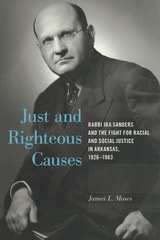
Just and Righteous Causes
Rabbi Ira Sanders and the Fight for Racial and Social Justice in Arkansas, 1926-1963James L. Moses
University of Arkansas Press, 2018
Winner, 2019 Booker Worthen Prize from the Central Arkansas Library System.
A dedicated advocate for social justice long before the term entered everyday usage, Rabbi Ira Sanders began striving against the Jim Crow system soon after he arrived in Little Rock from New York in 1926. Sanders, who led Little Rock’s Temple B’nai Israel for nearly forty years, was a trained social worker as well as a rabbi and his career as a dynamic religious and community leader in Little Rock spanned the traumas of the Great Depression, World War II and the Holocaust, and the social and racial struggles of the 1950s and 1960s.
Just and Righteous Causes—a full biographical study of this bold social-activist rabbi—examines how Sanders expertly navigated the intersections of race, religion, and gender to advocate for a more just society. It joins a growing body of literature about the lives and histories of Southern rabbis, deftly balancing scholarly and narrative tones to provide a personal look into the complicated position of the Southern rabbi and the Jewish community throughout the political struggles of the twentieth-century South.
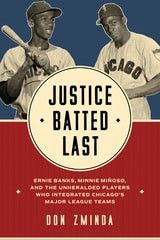
Justice Batted Last
Ernie Banks, Minnie Miñoso, and the Unheralded Players Who Integrated Chicago's Major League TeamsDon Zminda
University of Illinois Press, 2025
Don Zminda’s account looks at these interconnected events alongside the little-known chronicle of Chicago’s slow track to integrating major league baseball. By the early 1950s, the Cubs and White Sox organizations had become rich in Black and Afro-Latino stars and talented prospects. Unlike Miñoso and Banks, however, most of these minor leaguers never advanced to the majors or, if they did, it was for little more than a cup of coffee. Zminda also profiles these players, from Charles Pope, the Cubs’ first Black signee, to larger-than-life fireballer Blood Burns.
Essential and dramatic, Justice Batted Last uses the lives and careers of two Chicago legends to tell a story of integration on and off the diamond.
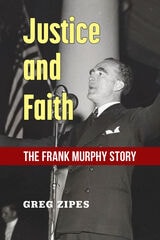
Justice and Faith
The Frank Murphy StoryGreg Zipes
University of Michigan Press, 2021
Murphy is best remembered for his immense legal contributions supporting individual liberty and fighting discrimination, particularly discrimination against the most vulnerable. Despite being a loyal ally of Franklin Delano Roosevelt, when FDR ordered the removal of Japanese Americans during World War II, Supreme Court Justice Murphy condemned the policy as “racist” in a scathing dissent to the Korematsu v. United States decision—the first use of the word in a Supreme Court opinion. Every American, whether arriving by first class or in chains in the galley of a slave ship, fell under Murphy’s definition of those entitled to the full benefits of the American dream.
Justice and Faith explores Murphy’s life and times by incorporating troves of archive materials not available to previous biographers, including local newspaper records from across the country. Frank Murphy is proof that even in dark times, the United States has extraordinary resilience and an ability to produce leaders of morality and courage.