Results by title
18284 books match the query 'United States' and 274 start with j
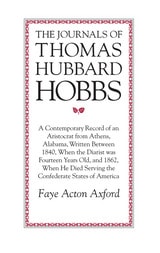
Journals of Thomas H. Hobbs
Thomas Hubbard Hobbs
University of Alabama Press, 1976
Written between 1840, when the diarist was fourteen years old, and 1862, when he died serving the Confederate States of America.
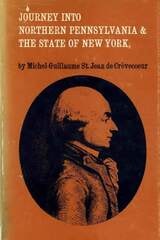
Journey into Northern Pennsylvania and the State of New York
Michel-Guillaume St. Jean de Crèvecoeur
University of Michigan Press, 1964

Journey of an American Pianist
Johannesen, Grant
University of Utah Press, 2007
Journey of an American Pianist presents an extensive examination of Johannesen’s artistic commitment and the importance of certain kinds of training and experience, framed in large part as advice to the young pianist seeking a concert career. At the same time, it has plenty of everyday-living experience, showing what pianists do and think about when they are not actually playing or performing.
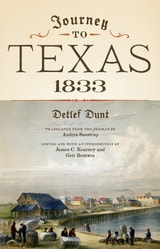
Journey to Texas, 1833
By Detlef Dunt. Translated by Anders Saustrup, edited and with an introduction by James C. Kearney and Geir Bentzen
University of Texas Press, 2015
In 1834, a German immigrant to Texas, D. T. F. (Detlef Thomas Friedrich) Jordt, aka Detlef Dunt, published Reise nach Texas, a delightful little book that praised Texas as “a land which puts riches in [the immigrant’s] lap, which can bring happiness to thousands and to their descendants.” Dunt’s volume was the first one written by an on-the-ground observer to encourage German immigration to Texas, and it provides an unparalleled portrait of Austin’s Colony from the lower Brazos region and San Felipe to the Industry and Frelsburg areas, where Dunt resided with Friedrich Ernst and his family.
Journey to Texas, 1833 offers the first English translation of Reise nach Texas. It brings to vivid life the personalities, scenic landscapes, and customs that Dunt encountered in colonial Texas on the eve of revolution, along with his many practical suggestions for Germans who intended to emigrate. The editors’ introduction describes the social, political, and economic conditions that prompted Europeans to emigrate to Texas and provides biographical background on Dunt and his connection with Friedrich Ernst. Also included in the volume are a bibliography of German works about Texas and an interpretive essay discussing all of the early German literature about Texas and Dunt’s place within it. Expanding our knowledge of German immigration to Texas beyond the more fully documented Hill Country communities, Journey to Texas, 1833 also adds an important chapter to the story of pre-Revolutionary Texas by a sophisticated commentator.
Journey without End
Migration from the Global South through the AmericasRob Curran and Andrew Nelson
Vanderbilt University Press, 2022
The book begins with Kidane, an Eritrean migrant who has left his pregnant wife behind to make the four-year trip to North America; it then picks up the natural disaster–riddled voyage of Roshan and Kamala Dhakal from Nepal to Ecuador; and it continues to the trials of Cameroonian exile Jane Mtebe, who becomes trapped in a bizarre beachside resort town on the edge of the Darién Gap—the gateway from South to Central America.
Journey without End follows these migrants as their fitful voyages put them in a semi-permanent state of legal and existential liminality. Mercurial policy creates profit opportunities that transform migration bottlenecks—Quito's tourist district, a Colombian beachside resort, Panama's Darién Gap, and a Mexican border town—into spontaneous migration-oriented spaces rife with racial, gender, and class exploitation. Throughout this struggle, migrant solidarity allows for occasional glimpses of subaltern cosmopolitanism and the possibility of mobile futures.
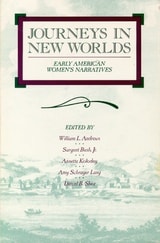
Journeys in New Worlds
Early American Women's NarrativesWilliam L. Andrews
University of Wisconsin Press, 1990
Four early American women tell their own stories: Mary Rowlandson on her capture by Indians in 1676, Boston businesswoman Sarah Kemble Knight on her travels in New England, Elizabeth Ashbridge on her personal odyssey from indentured servant to Quaker preacher, and Elizabeth House Trist, correspondent of Thomas Jefferson, on her travels from Philadelphia to Natchez. Accompanied by introductions and extensive notes.
"The writings of four hearty women who braved considerable privation and suffering in a wild, uncultivated 17th- and 18th-century America. Although confined by Old World patriarchy, these women, through their narratives, have endowed the frontier experience with a feminine identity that is generally absent from early American literature."—Publishers Weekly
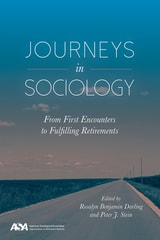
Journeys in Sociology
From First Encounters to Fulfilling RetirementsRosalyn Benjamin Darling and Peter J. Stein
Temple University Press, 2017
For most sociologists, their life’s work does not end with retirement. Many professors and practitioners continue to teach, publish, or explore related activities after leaving academia. They also connect with others in the field to lessen the isolation they sometimes feel outside the ivory tower or an applied work setting.
The editors and twenty contributors to the essential anthology Journeys in Sociology use a life-course perspective to address the role of sociology in their lives. The power of their personal experiences—during the Great Depression, World War II, or the student protests and social movements in the 1960s and ‘70s—magnify how and why social change prompted these men and women to study sociology. Moreover, all of the contributors include a discussion of their activities in retirement.
From Bob Perrucci, Tuck Green, and Wendell Bell, who write about issues of class, to Debra Kaufman and Elinore Lurie, who explain how gender played a role in their careers, the diverse entries in Journeys in Sociology provide a fascinating look at both the influence of their lives on the discipline and the discipline on these sociologists’ lives.
Contributors include: David J. Armor, Wendell Bell, Glen H. Elder, Jr., Henry W. Fischer, Janet Zollinger Giele, Charles S. (Tuck) Green, Peter Mandel Hall, Elizabeth Higginbotham, Debra Renee Kaufman, Corinne Kirchner, Elinore E. Lurie, Gary T. Marx, Robert Perrucci, Fred Pincus, Thomas Scheff, Arthur Shostak, David Simon, Natalie J. Sokoloff, Edward Tiryakian, Joyce E. Williams, and the editors.
Published in collaboration with the American Sociological Association Opportunities in Retirement Network.
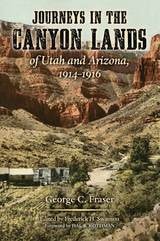
Journeys in the Canyon Lands of Utah and Arizona, 1914-1916
George C. Fraser; Edited by Frederick H. Swanson; Foreword by Hal K. Rothman
University of Arizona Press, 2005
Frederick H. Swanson has edited Fraser’s voluminous journals into a single volume covering three trips taken from 1914 to 1916. As Fraser wades the bone-chilling waters of the Zion Narrows, crosses the Grand Canyon in midsummer heat, and rides through the trackless forest of the Aquarius Plateau, he conveys impressions of the land that will fascinate any reader who wonders what the canyon country was like before it became a popular tourist destination—and one that will inform historians interested in early accounts of the region. Accompanied by a selection of photographs taken by Fraser and his fellow travelers, Journeys in the Canyon Lands brings to life the Southwest’s breathtaking backcountry on the brink of discovery.
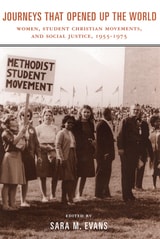
Journeys that Opened up the World
Women, Student Christian Movements, and Social Justice, 1955-1975Evans, Sara M.
Rutgers University Press, 2003
For thousands of young women in the 1950s and 1960s, involvement with the student Christian movement (SCM) changed their worldviews. Religious organizations fostered women’s leadership at a time when secular groups like Students for a Democratic Society, and the Left in general, relegated most female participants to stereotypical roles.
The SCM introduced young women to activism in other parts of the country and around the world. As leaders, thinkers, and organizers, they encountered the social realities of poverty and racial prejudice and worked to combat them. The SCM took women to Selma and Montgomery, to Africa and Latin America, and to a lifelong commitment to work for social justice.
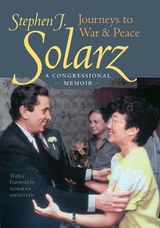
Journeys to War and Peace
A Congressional MemoirStephen J. Solarz
Brandeis University Press, 2011
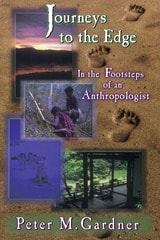
Journeys to the Edge
In the Footsteps of an AnthropologistPeter M. Gardner
University of Missouri Press, 2013
Because Gardner’s primary research since 1962 has been with hunter-gatherers, much of his story transpires either in the equatorial jungle of south India or more than one hundred miles beyond the end of the road in Canada’s Northwest Territories. Other ventures transport readers to Japan and back to India, allowing them to savor ancient sights and sounds. Gardner closes the book with a journey of quite another sort, as he takes us into the world of nature, Taoist philosophy, and the experimental treatment of advanced cancer.
Throughout this fast-moving book, Gardner deftly describes the goals and techniques of his research, as well as his growing understanding of the cultures to which he was exposed. Few personal accounts of fieldwork describe enough of the research to give a complete sense of the experience in the way this book does. Anyone with an interest in travel and adventure, including the student of anthropology as well as the general reader, will be totally intrigued by Gardner’s story, one of a daily existence so very different from our own.

Journeys with Flies
Edwin N. Wilmsen
University of Chicago Press, 1999
Combining biography, poetry, and anthropology, Wilmsen vividly portrays the intense realities of life in the Kalahari and carries the reader across space and time as events in the present trigger emotions and memories. Images of apartheid, for example, evoke memories of Wilmsen's childhood in the segregated South. Poems, journal entries, and moving accounts of deepening personal relationships all intertwine as Wilmsen conveys the experiences he shares with his "subjects" in spite of vast differences in their backgrounds—extreme thirst under the desert sun, grief over the death of a child, and the constant irritation of ubiquitous flies.
"Our understanding of other peoples," he writes, "lies not in themselves or in anything that they do but in our experience of them. Experience that is lived partly in their world and partly in a shell of our world that we wear when we meet them."
Sophisticated, lyrical, and passionately written, Journeys with Flies will inspire all those who travel to places far from home.

Joyce Westerman
Baseball HeroBob Kann
Wisconsin Historical Society Press, 2012
Joyce Westerman grew up on a farm in Pleasant Prairie, Wisconsin. As a kid, she cleaned the barn, picked vegetables, and helped her father cut down trees. But what she really loved to do was play baseball. Joyce played ball at recess and with friends whenever she could. She even joined her aunt’s adult softball team when she was only twelve.
As Joyce got older, she went to work at a factory in Kenosha. But when World War II broke out, she got a chance to try out for the All American Girls Professional Baseball League. Women from all over the country signed up to show off their skills. Only a few were good enough, and Joyce was one of them. For eight years, Joyce travelled around the United Stated playing ball, winning the league championship in her last season.
This addition to the Badger Biographies series for young readers tells the story of a woman who lived her dream of becoming a professional athlete. In a time when women had few opportunities for careers, and next to none in professional sports, Joyce and her teammates showed that women have what it takes.
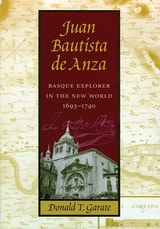
Juan Bautista de Anza
Basque Explorer in the New World, 1693-1740Donald T. Garate
University of Nevada Press, 2005
The first biography of an eighteenth-century Basque immigrant who became a silver miner, a cattle rancher, and commander of the cavalry in Sonora, Mexico. The name of Juan Bautista de Anza the younger is a fairly familiar one in the contemporary Southwest because of the various streets, schools, and other places that bear his name. Few people, however, are familiar with his father, the elder Juan Bautista de Anza, whose activities were crucial to the survival of the tenuous and far-flung settlements of Spain’s northernmost colonial frontier. For this first comprehensive biography of the elder Anza, Donald T. Garate spent more than ten years researching archives in Spain and the Americas. The result is a lively picture of the Spanish borderlands and the hardy, ambitious colonists who peopled them.
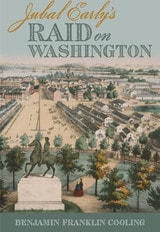
Jubal Early's Raid on Washington
Benjamin Franklin Cooling
University of Alabama Press, 2008
The raid that exposed the Union capital’s greatest danger.
The definitive description of the last Confederate invasion of the Union in 1864. The Civil War was in its fourth year, and the Union’s victory was not at all certain. The Lincoln administration seemed weak as the autumn election approached. Lee’s army remained strong in Virginia while Johnston’s forces feinted and dodged in north Georgia to shield Atlanta. The Union army and navy grew in strength, but Confederate forces continued to fight tenaciously.
Amid an air of stalemate, the Confederates planned a bold move to strike at Washington, DC and capture or scatter Lincoln and his cabinet. In command of the operation was the colorful and unpredictable Jubal “Old Jube” Anderson Early, brought in to replace the fallen Stonewall Jackson. Less well known than the bloodier Antietam and Gettysburg, Early's campaign, Cooling argues, had greater significance.
In addition to the persnickety bachelor Anderson, this account introduces many colorful participants, including railroad president John W. Garrett, the politically influential Blair family, and Elizabeth “Aunt Betty” Thomas, a free Black woman, who was said to have saved Lincoln’s life by shouting at him: “Get down, you fool!” when he came under fire at Fort Stevens. Exciting and comprehensive, Civil War scholars and readers will delight in this masterful account.
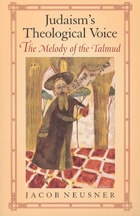
Judaism's Theological Voice
The Melody of the TalmudJacob Neusner
University of Chicago Press, 1995
In his attempt to answer these questions, Neusner sets forth the character and the form of the Torah as sung theology. Israel, the holy community, meets God in the synagogue, while at prayer, and in the yeshiva, when studying the Torah—at the moment in each setting when the Torah is received. In both circumstances people do not read but sing out its words. With the written part of the Torah sung in the synagogue, and the oral part declaimed in centers of sacred learning, music provides the medium for Judaism's theological voice.
Neusner identifies a reciprocal exchange between the holy community Israel and God: Israel sings to God when the Torah is studied, and God sings to Israel when the Torah is declaimed. Through the metaphor of music, Neusner offers an account of how he believes those faithful to the Torah meet God in the Torah, and how they should listen to the melody of God's self-revelation. The result is an original theological reflection that will interest all students of Judaism.
Judges and Unjust Laws
Common Law Constitutionalism and the Foundations of Judicial ReviewDouglas E. Edlin
University of Michigan Press, 2010
"With keen insight into the common law mind, Edlin argues that there are rich resources within the law for judges to ground their opposition to morally outrageous laws, and a legal obligation on them to overturn it, consequent on the general common law obligation to develop the law. Thus, seriously unjust laws pose for common law judges a dilemma within the law, not just a moral challenge to the law, a conflict of obligations, not just a crisis of conscience. While rooted firmly in the history of common law jurisprudence, Edlin offers an entirely fresh perspective on an age-old jurisprudential conundrum. Edlin's case for his thesis is compelling."
---Gerald J. Postema, Cary C. Boshamer Professor of Philosophy and Professor of Law, University of North Carolina at Chapel Hill, and author of Bentham and the Common Law Tradition
"Douglas Edlin builds a powerful historical, conceptual, and moral case for the proposition that judges on common law grounds should refuse to enforce unjust legislation. This is sure to be controversial in an age in which critics already excoriate judges for excessive activism when conducting constitutional judicial review. Edlin's challenge to conventional views is bold and compelling."
---Brian Z. Tamanaha, Chief Judge Benjamin N. Cardozo Professor of Law, St. John's University, and author of Law as a Means to an End: Threat to the Rule of Law
"Professor Edlin's fascinating and well-researched distinction between constitutional review and common law review should influence substantially both scholarship on the history of judicial power in the United States and contemporary jurisprudential debates on the appropriate use of that power."
---Mark Graber, Professor of Law and Government, University of Maryland, and author of Dred Scott and the Problem of Constitutional Evil
Is a judge legally obligated to enforce an unjust law?
In Judges and Unjust Laws, Douglas E. Edlin uses case law analysis, legal theory, constitutional history, and political philosophy to examine the power of judicial review in the common law tradition. He finds that common law tradition gives judges a dual mandate: to apply the law and to develop it. There is no conflict between their official duty and their moral responsibility. Consequently, judges have the authority---perhaps even the obligation---to refuse to enforce laws that they determine unjust. As Edlin demonstrates, exploring the problems posed by unjust laws helps to illuminate the institutional role and responsibilities of common law judges.
Douglas E. Edlin is Associate Professor of Political Science at Dickinson College.
Judges and the Cities
Interpreting Local AutonomyGordon L. Clark
University of Chicago Press, 1985
As concrete examples, Clark analyzes four court disputes in depth, showing that the concept of local autonomy has very different meanings and implications in each of them. These cases—Boston's defense of resident-preference hiring policies, conflict over urban land-use zoning in Toronto, a Chicago's suburb's fight against a sewage treatment plant, and the evolution of the City of Denver's power since 1900—demonstrate that legal reasoning is not impervious to other kinds of reasoning, and the solutions provided by the courts are not unique. To ground his explorations, Clark investigates both liberalism and structuralism, showing that both are inadequate bases for determining social policy. He mounts provocative critiques of the works of de Tocqueville, Nozick, Tiebout, and Posner on the one hand and Castells and Poulantzas on the other.
This ambitious and important work will command the interest of geographers, political scientists, economists, sociologists, and legal scholars.

Judging Children As Children
A Proposal for a Juvenile Justice SystemMichael A. Corriero
Temple University Press, 2007
Judging Credentials
Nonlawyer Judges and the Politics of ProfessionalismDoris Marie Provine
University of Chicago Press, 1986
Provine presents a persuasive argument that the case against nonlawyer judges has been weighted in favor of the professional interests of lawyers, not public concerns. Her examination reveals as much about the presuppositions of legal professionals as it does about the competency of nonlawyer judges to old judicial office. To substantiate her claims, Provine has conducted the most comprehensive survey of nonlawyer and lawyer judges yet undertaken, augmenting this material with court observations and extensive interviews of judges. She integrates the results of this survey into the historical context of the lay versus lawyer judge debate, showing how the legally trained judge came to predominate in the American judicial system and analyzing in detail the campaign both in and out of the courts to make legal training a prerequisite for being a judge. Ultimately, Provine suggests, Americans are too committed to the significance of credentials and to the legal profession's vision of the judicial process to respond very favorably to nonlawyer judges, however well they might perform.
Judging Credentials will force lawyers, judges, scholars, and the public to reconsider the role nonlawyer judges play in the American judicial system. Provine's provocative views and exhaustive research adds new dimensions to our understanding of the ethics of professionalism and its consequences.
Judging Inequality
State Supreme Courts and the Inequality CrisisJames L. Gibson
Russell Sage Foundation, 2021
Drawing on an analysis of an original database of nearly 6,000 decisions made by over 900 judges on 50 state supreme courts over a quarter century, Judging Inequality documents two ways that state high courts have crafted policies relevant to inequality: through substantive policy decisions that fail to advance equality and by rulings favoring more privileged litigants (typically known as “upperdogs”). The authors discover that whether court-sanctioned policies lead to greater or lesser inequality depends on the ideologies of the justices serving on these high benches, the policy preferences of their constituents (the people of their state), and the institutional structures that determine who becomes a judge as well as who decides whether those individuals remain in office.
Gibson and Nelson decisively reject the conventional theory that state supreme courts tend to protect underdog litigants from the wrath of majorities. Instead, the authors demonstrate that the ideological compositions of state supreme courts most often mirror the dominant political coalition in their state at a given point in time. As a result, state supreme courts are unlikely to stand as an independent force against the rise of inequality in the United States, instead making decisions compatible with the preferences of political elites already in power. At least at the state high court level, the myth of judicial independence truly is a myth.
Judging Inequality offers a comprehensive examination of the powerful role that state supreme courts play in shaping public policies pertinent to inequality. This volume is a landmark contribution to scholarly work on the intersection of American jurisprudence and inequality, one that essentially rewrites the “conventional wisdom” on the role of courts in America’s democracy.
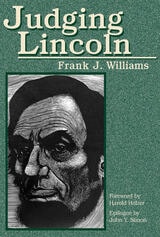
Judging Lincoln
Frank J. Williams. Foreword by Harold Holzer. Epilogue by John Y. Simon
Southern Illinois University Press, 2007
Judging the Supreme Court
Constructions of Motives in Bush v. GoreClarke Rountree
Michigan State University Press, 2007
This volume questions the motives of Supreme Court justices in a landmark case: The Supreme Court's intervention in the presidential election of 2000, and its subsequent decision in favor of George W. Bush, elicited immediate, heated, and widespread debate. Critics argued that the justices used weak legal arguments to overturn the Florida Supreme Court's ruling, ending a ballot recount and awarding the presidency to Bush. More fundamentally, they questioned the motives of conservative judges who arrived at a decision in favor of the candidate who reflected their political leanings.
Judging the Supreme Court examines this controversial case and the extensive attention it has received. To fully understand the case, Clarke Rountree argues, we must understand "judicial motives." These are comprised of more than each judge's personal opinions. Judges' motives, which Rountree calls "rhetorical performances," are as influential and publicly discussed as their decisions themselves. Before they are dissected in the media, judges' motives are carefully crafted by the decision- makers themselves, their critics, and their defenders. Justices consider not only the motives of the government, of military officials, of criminals, of public speakers, and of others, they also consider, construct, construe, spin, and deconstruct the motives of dissenters (whom they want to show are "misguided"), earlier courts, lower courts, and, especially, themselves.
Every judicial opinion is essentially a portrait of motives that says, "Here's what we did and here's why we did it." Well-constructed judicial motives reinforce the idea that we live under "the rule of law," while motives articulated less successfully raise questions about the legitimacy not just of individual judicial decisions but also of our political system and its foundation on an impartial judiciary. In Bush v. Gore, Rountree concludes, the judges of the majority opinion were not motivated by judicial concerns about law and justice, but rather by their own political and personal motives.
Judicial Merit Selection
Institutional Design and Performance for State CourtsGreg Goelzhauser
Temple University Press, 2019
The judicial selection debate continues. Merit selection is used by a majority of states but remains the least well understood method for choosing judges. Proponents claim that it emphasizes qualifications and diversity over politics, but there is little empirical evidence regarding its performance.
In Judicial Merit Selection, Greg Goelzhauser amasses a wealth of data to examine merit selection’s institutional performance from an internal perspective. While his previous book, Choosing State Supreme Court Justices, compares outcomes across selection mechanisms, here he delves into what makes merit selection unique—its use of nominating commissions to winnow applicants prior to gubernatorial appointment.
Goelzhauser’s analyses include a rich case study from inside a nominating commission’s proceedings as it works to choose nominees; the use of public records to examine which applicants commissions choose and which nominees governors choose; evaluation of which attorneys apply for consideration and which judges apply for promotion; and examination of whether design differences across systems impact performance in the seating of qualified and diverse judges.
The results have critical public policy implications.

Judicial Politics in Polarized Times
Thomas M. Keck
University of Chicago Press, 2014
Drawing on a sweeping survey of litigation on abortion, affirmative action, gay rights, and gun rights across the Clinton, Bush, and Obama eras, Thomas M. Keck argues that, while each of these stories captures part of the significance of judicial politics in polarized times, each is also misleading. Despite judges’ claims, actual legal decisions are not the politically neutral products of disembodied legal texts. But neither are judges “tyrants in robes,” undermining democratic values by imposing their own preferences. Just as often, judges and the public seem to be pushing in the same direction. As for the argument that the courts are powerless institutions, Keck shows that their decisions have profound political effects. And, while advocates on both the left and right engage constantly in litigation to achieve their ends, neither side has consistently won. Ultimately, Keck argues, judges respond not simply as umpires, activists, or political actors, but in light of distinctive judicial values and practices.
Judicial Power and Reconstruction Politics
Stanley I. Kutler
University of Chicago Press, 1968
This book investigates the political and public standing of the Supreme Court following the Dred Scott decision. Arguing against interpretations by previous historians, Kutler asserts instead that the "Chase Court" was neither enfeebled by the decision itself, nor by congressional Republicans during reconstruction. Instead, Kutler suggests that during reconstruction, the Court was characterized by forcefulness and judicious restraint rather than timidity and cowardice, holding a creative and determining role rather than abdicating its rightful powers. This volume assembles a series of essays by Kutler arguing for this characterization. Provocative and persuasive at turns, this collection of essays provides a bold and innovative reinterpretation of the Supreme Court after the Civil War.
Judicial Rhapsodies
Rhetoric and Fundamental Rights in the Supreme CourtDoug Coulson
Amherst College Press, 2023
First examining the classical origins of divisions between law and rhetoric, Coulson tracks what he calls an epideictic register—highly affective forms of expression that utilize hyperbole, amplification, and vocabularies of praise—through a surprising number of landmark Supreme Court opinions. Judicial Rhapsodies recovers and revalues these instances as significant to establishing and maintaining shared perspectives that form the basis for common experience and cooperation.
“Judicial Rhapsodies is both compelling and important. Coulson brings his well-developed knowledge of rhetoric to bear on one of the most central (and most democratically fraught) means of governance in the United States: the Supreme Court opinion. He demonstrates that the epideictic, far from being a dispensable or detestable element of judicial rhetoric, is an essential feature of how the Court operates and seeks to persuade.” —Keith Bybee, Syracuse University
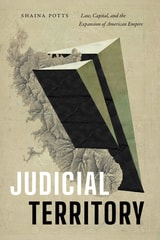
Judicial Territory
Law, Capital, and the Expansion of American EmpireShaina Potts
Duke University Press, 2024

Judith Resnik
Unsung AstronautMarlene Targ Brill
Ohio University Press, 0
Judith Resnik didn’t grow up dreaming of space, but when NASA opened its doors to women astronauts in the late 1970s, she stepped forward—and soared. One of the first six women ever accepted into NASA’s space shuttle astronaut-training program, Resnik brought her sharp mind, determination, and creativity to a field that had long been closed to women. Although she wasn’t the first American woman in space, she became one of the most accomplished astronauts of her time.
Resnik’s journey wasn’t easy. She faced challenges at home and in school, but she never let obstacles stop her. A gifted student, she excelled in math, science, and music—she even considered becoming a concert pianist before choosing a career in engineering. Her hard work paid off: She earned multiple degrees and helped design improvements for the space shuttle itself. She proved that astronauts aren’t just pilots—they’re problem solvers, inventors, and explorers.
In 1984, Resnik launched into space for the first time aboard the shuttle Discovery. Two years later, she joined the crew of Challenger. Tragically, that mission ended in disaster, cutting her life short. While the world focused on the loss of teacher Christa McAuliffe, who was a passenger on that flight, Resnik’s story was often overlooked. Yet her contributions to science and space exploration live on through programs, schools, and scholarships that bear her name.
This inspiring biography brings Resnik’s remarkable life to light. Readers will discover how a girl from Ohio became a trailblazer in space and how her courage and brilliance continue to inspire new generations. Her story reminds us that even if you’re not first, you can still make history—and that reaching for the stars starts with believing in yourself.

Julia Child's The French Chef
Dana Polan
Duke University Press, 2011
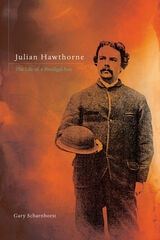
Julian Hawthorne
The Life of a Prodigal SonGary Scharnhorst
University of Illinois Press, 2014
Julian Hawthorne (1846-1934), Nathaniel Hawthorne's only son, lived a long and influential life marked by bad circumstances and worse choices. Raised among luminaries such as Thoreau, Emerson, and the Beecher family, Julian became a promising novelist in his twenties, but his writing soon devolved into mediocrity.
What talent the young Hawthorne had was spent chasing across the changing literary and publishing landscapes of the period in search of a paycheck, writing everything from potboilers to ad copy. Julian was consistently short of funds because--as biographer Gary Scharnhorst is the first to reveal--he was supporting two households: his wife in one and a longtime mistress in the other.
The younger Hawthorne's name and work ethic gave him influence in spite of his haphazard writing. Julian helped to found Cosmopolitan and Collier's Weekly. As a Hearst stringer, he covered some of the era's most important events: McKinley's assassination, the Galveston hurricane, and the Spanish-American War, among others.
When Julian died at age 87, he had written millions of words and more than 3,000 pieces, out-publishing his father by a ratio of twenty to one. Gary Scharnhorst, after his own long career including works on Mark Twain, Oscar Wilde, and other famous writers, became fascinated by the leaps and falls of Julian Hawthorne. This biography shows why.
Jumano and Patarabueye
Relations at La Junta de los RiosJ. Charles Kelley with a foreword by John D. Speth
University of Michigan Press, 1986

Jump for Joy
Jazz, Basketball, and Black Culture in 1930s AmericaGena Caponi-Tabery
University of Massachusetts Press, 2008
If the 1930s was the Swing Era, then the years from 1937 on might well be called the Jump Era. That summer Count Basie recorded “Jumping at the Woodside,” and suddenly jump tunes seemed to be everywhere. Along with the bouncy beat came a new dance step—the high-flying aerials of the jitterbuggers—and the basketball games that took place in the dance halls of African America became faster, higher, and flashier. Duke Ellington and a cast of hundreds put the buoyant spirit of the era on stage with their 1941 musical revue, Jump for Joy, a title that captured the momentum and direction of the new culture of exuberance.
Several high-profile public victories accompanied this increasing optimism: the spectacular successes of African American athletes at the 1936 Olympics, the 1937 union victory of the Brotherhood of Sleeping Car Porters, and Joe Louis's 1937 and 1938 heavyweight championship fights. For the first time in history, Black Americans emerged as cultural heroes and ambassadors, and many felt a new pride in citizenship.
In this book, Gena Caponi-Tabery chronicles these triumphs and shows how they shaped American music, sports, and dance of the 1930s and beyond. But she also shows how they emboldened ordinary African Americans to push for greater recognition and civil liberties—how cultural change preceded and catalyzed political action.
Tracing the path of one symbolic gesture—the jump—across cultural and disciplinary boundaries, Caponi-Tabery provides a unique political, intellectual, and artistic analysis of the years immediately preceding World War II.
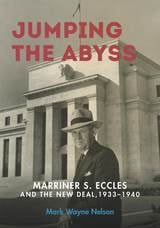
Jumping the Abyss
Marriner S. Eccles and the New Deal, 1933–1940Mark Wayne Nelson
University of Utah Press, 2017
Mark Wayne Nelson details the efforts of one of America’s most underappreciated public servants. In 1934, Franklin D. Roosevelt invited Marriner S. Eccles, a Mormon from Utah, to join his administration. As a Republican businessman, Eccles seemed an unlikely candidate for the role of leading crusader for a fairer and more economically sound distribution of the nation’s wealth. From his first position in the Treasury Department, though, he emerged as the central mover in revolutionizing the mortgage structure of the private home market in the United States.
After FDR appointed him to head the Federal Reserve, Eccles drafted legislation that restructured that institution as well. Throughout the remainder of the New Deal, he was the most powerful advocate of what came to be called “Keynesian Policy,” which involved direct federal stimulus of the economy. Presenting the first comprehensive and independent analysis of Eccles’s influential career, Jumping the Abyss wrestles with economic issues that remain relevant today.
Finalist for the Utah State Historical Society Best Book Award.
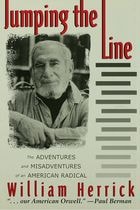
Jumping the Line
The Adventures and Misadventures of an American RadicalWilliam Herrick
University of Wisconsin Press, 1998
An eye-opening account of time served in the great battles of our century— for workers’ rights, against Fascism, Communism, and racism—Jumping the Line is the life story of an American original. William Herrick chronicles his adventures and misadventures on the front lines of the Spanish Civil War, in (and very much out of) the Communist Party, driving a tractor on a communal farm in Michigan, jumping the line as a hobo, organizing African American sharecroppers in Georgia, at work with Orson Welles, and immersed in his own writing.
Herrick chronicles a life of great conviction and great disillusion. He went to Spain in 1936 to fight against the Fascists and there witnessed the horrifying acts that Fascists and Communists alike committed, before he was felled by a near-fatal wound. Here he tells about the life that led him, a working-class Jewish kid from New York, into the idealism and then the murky politics of this internecine conflict. From the bloody fight in Spain he takes us to the battlefields of the Communist movement in the U.S., where he found himself parading up and down the garment district of Manhattan, denouncing his former comrades.
When Paul Berman interviewed Herrick in the Village Voice in 1986, for the fiftieth anniversary of the Spanish Civil War, Herrick’s remarks so incensed other veterans of the Abraham Lincoln battalion that they picketed the paper. What William Herrick has to say doesn’t always go down easily. But for those who like the truth, with a dash of wit and a healthy dose of history, it can be exhilarating.

Junctures in Women's Leadership
BusinessHetfield, Lisa
Rutgers University Press, 2016
Junctures in Women's Leadership
Higher EducationCarmen Twillie Ambar
Rutgers University Press, 2020
Junius And Joseph
Presidential Politics and the Assassination of the First Mormon ProphetRobert S. Wicks & Fred R. Foister
Utah State University Press, 2005

Junius Brutus Booth
Theatrical PrometheusStephen M. Archer
Southern Illinois University Press, 1992
In this, the first thoroughly researched scholarly biography of British actor Junius Brutus Booth, Stephen M. Archer reveals Booth to have been an artist of considerable range and a man of sensitivity and intellect. Archer provides a clear account of Booth’s professional and personal life and places him in relationship to his contemporaries, particularly Edmund Kean and William Charles Macready.
The worldwide fame assured for the Booth family of actors by John Wilkes Booth’s bone-shattering leap from the President’s box had eluded Junius Brutus Booth throughout his lifelong exile in America. But from that event until today, no American family of actors has stimulated such scrutiny as the Booths.
Eight years of research, pursuing Booth from Amsterdam to San Francisco, has resulted in an accurate, fascinating narrative that both records and illuminates the actor’s life.

Jurors' Stories of Death
How America's Death Penalty Invests in InequalityBenjamin Fleury-Steiner
University of Michigan Press, 2004
-David Cole, from the Foreword
"Perhaps the most powerful, routinely enacted civic ritual in American public life is that of capital punishment. This state-sanctioned extirpation of human life in the collective pursuit of justice is a searing act of civic pedagogy, made legitimate only by the deliberative endorsement of a small group of ordinary citizens-the jury. In Jurors' Stories of Death, Benjamin Fleury-Steiner has taken a cold, hard look at how these ordinary citizens come to terms with their extraordinary role, and how they rationalize their irreversible decisions. The result is a chilling portrait of how we---that is, all of us Americans---constitute ourselves as a political community."
-Glenn Loury, Director, Institute on Race and Social Division
"This illuminating and insightful examination of jury deliberations makes a terrific contribution to the study of capital punishment. Fleury-Steiner's synthesis of sociological, legal and theoretical concepts with vivid juror narratives and statistical data, thoughtfully animates and details how race and class consciousness continue to shape America's death penalty."
---Bryan Stevenson, Professor of Clinical Law, NYU School of Law, Executive Director, Equal Justice Initiative of Alabama
Jurors' Stories of Death is more than just another book on the death penalty; it is the first systematic survey of how death penalty decisions are made.
Benjamin Fleury-Steiner draws on real-life accounts of white and black jurors in capital punishment trials to discuss the effect of race on the sentencing process. He finds that race is invariably a factor in sentencing, with jurors relying on accounts that deny the often marginalized defendants their individuality and complexity, while reinforcing the jurors' own identities as superior, moral, and law-abiding citizens-a system that punishes in the name of dominance. This biased story of "us versus them" continues to infuse political rhetoric on crime and punishment in the United States even today.
Jurors' Stories of Death concludes with an original argument for abolition of the death penalty: If America values multiculturalism and cultural diversity, it must do away with institutions such as state-sanctioned capital punishment in order to begin to free itself from the racism and classicism that so insidiously plague social relations today.

Just A Temp
Kevin Henson
Temple University Press, 1996
"So this is where the brain starts to shut down and that which we treasure most, our personal identities, begins to slip away....I suppose I should be thankful; it's a paycheck." With this disturbing sentiment, Kevin Henson begins a voyage into the world of "the temp." For several years while a graduate student, Henson logged in thousands of hours as a temporary worker in offices throughout Chicago's Loop. Those experiences, and numerous interviews with other temps and temporary counselors, create a vivid and often disheartening picture of working 9 to 5 behind the receptionist's desk, telephone console, or data-entry terminal.
In their own voices, the temps in this book lament the frequently demeaning and mundane nature of many assignments:
•"You're not paid to think."
•
"Temps don't have names; they are just 'the temp.'"
•
"They always harass me...because I just wear a sweater and slacks."
•
"The worst part is telling people what you do. They always ask 'When are you going to get a real job?'"
Where the temporary service industry is quick to extol the virtues of temp work—mainly its flexibility—Henson and his cast of temps reveal the tacit pressure to persevere through an unpleasant assignment, to accept every assignment offered, and to readjust personal lives to do so. Outsiders to the established office culture and hierarchy, most temps are asked to do low-skill work and leave more detailed or complicated tasks for the return of the permanent employee.
Whether temp life is a preferred choice or grudgingly accepted as the last option when "real" or permanent work is unavailable, all temps must confront issues of gender, identity, and self-esteem. Henson examines these issues, documenting the concerns and interpretations of temp workers about their own work lives.
Just Around The Corner
The Paradox Of The Jobless RecoveryStanley Aronowitz
Temple University Press, 2005
Just Below the Line
Disability, Housing, and Equity in the SouthKorydon H. Smith
University of Arkansas Press, 2010
Published in collaboration with the Fay Jones School of Architecture.
Just Care
Messy Entanglements of Disability, Dependency, and DesireAkemi Nishida
Temple University Press, 2022
Just Care is Akemi Nishida’s thoughtful examination of care injustice and social justice enabled through care. The current neoliberal political economy has turned care into a business opportunity for the healthcare industrial complex and a mechanism of social oppression and control. Nishida analyzes the challenges people negotiate whether they are situated as caregivers, receivers, or both. Also illuminated is how people with disabilities come together to assemble community care collectives and bed activism (resistance and visions emerging from the space of bed) to reimagine care as a key element for social change.
The structure of care, Nishida writes, is deeply embedded in and embodies the cruel social order—based on disability, race, gender, migration status, and wealth—that determines who survives or deteriorates. Simultaneously, many marginalized communities treat care as the foundation of activism. Using interviews, focus groups, and participant observation with care workers and people with disabilities, Just Care looks into lives unfolding in the assemblage of Medicaid long-term care programs, community-based care collectives, and bed activism. Just Care identifies what care does, and asks: How can we activate care justice or just care where people feel cared affirmatively and care being used for the wellbeing of community and for just world making?
Just Elections
Creating a Fair Electoral Process in the United StatesDennis F. Thompson
University of Chicago Press, 2002
Thompson argues that three central democratic principles—equal respect, free choice, and popular sovereignty—underlie our electoral institutions, and should inform any assessment of the justice of elections. Although we may all endorse these principles in theory, Thompson shows that in practice we disagree about their meaning and application. He shows how they create conflicts among basic values across a broad spectrum of electoral controversies, from disagreements about term limits and primaries to disputes about recounts and presidential electors.
To create a fair electoral system, Thompson argues, we must deliberate together about these principles and take greater control of the procedures that govern our elections. He demonstrates how applying the principles of justice to electoral practices can help us answer questions that our electoral system poses: Should race count in redistricting? Should the media call elections before the polls close? How should we limit the power of money in elections?
Accessible and wide ranging, Just Elections masterfully weaves together the philosophical, legal, and political aspects of the electoral process. Anyone who wants to understand the deeper issues at stake in American elections and the consequences that follow them will need to read it.
In answering these and other questions, Thompson examines the arguments that citizens and their representatives actually use in political forums, congressional debates and hearings, state legislative proceedings, and meetings of commissions and local councils. In addition, the book draws on a broad range of literature: democratic theory, including writings by Madison, Hamilton, and Tocqueville, and contemporary philosophers, as well as recent studies in political science, and work in election law.
Just Enough to Put Him Away Decent
Death Care, Life Extension, and the Making of a Healthier South, 1900-1955Kristine M. McCusker
University of Illinois Press, 2023
Kristine McCusker charts the dramatic transformation that took place when southerners in particular and Americans in general changed their thinking about when one should die, how that death could occur, and what decent burial really means. As she shows, death care evolved from being a community act to a commercial one where purchasing a purple coffin and hearse ride to the cemetery became a political statement and the norm. That evolution also required interactions between perfect strangers, especially during the world wars as families searched for their missing soldiers. In either case, being put away decent, as southerners called burial, came to mean something fundamentally different in 1955 than it had just fifty years earlier.

Just Neighbors?
Research on African American and Latino Relations in the United StatesEdward Telles
Russell Sage Foundation, 2012
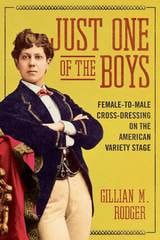
Just One of the Boys
Female-to-Male Cross-Dressing on the American Variety StageGillian Rodger
University of Illinois Press, 2018
Gillian M. Rodger uses the development of male impersonation from the early nineteenth century to the early twentieth century to illuminate the history of the variety show. Exploding notions of high- and lowbrow entertainment, Rodger looks at how both performers and forms consistently expanded upward toward respectable—and richer—audiences. At the same time, she illuminates a lost theatrical world where women made fun of middle-class restrictions even as they bumped up against rules imposed in part by audiences. Onstage, the actresses' changing performance styles reflected gender construction in the working class and shifts in class affiliation by parts of the audiences. Rodger observes how restrictive standards of femininity increasingly bound male impersonators as new gender constructions allowed women greater access to public space while tolerating less independent behavior from them.
Just Queer Folks
Gender and Sexuality in Rural AmericaColin R. Johnson
Temple University Press, 2013
Most studies of lesbian and gay history focus on urban environments. Yet gender and sexual diversity were anything but rare in nonmetropolitan areas in the first half of the twentieth century. Just Queer Folks explores the seldom-discussed history of same-sex intimacy and gender nonconformity in rural and small-town America during a period when the now familiar concepts of heterosexuality and homosexuality were just beginning to take shape.
Eschewing the notion that identity is always the best measure of what can be known about gender and sexuality, Colin R. Johnson argues instead for a queer historicist approach. In so doing, he uncovers a startlingly unruly rural past in which small-town eccentrics, "mannish" farm women, and cross-dressing Civilian Conservation Corps enrollees were often just queer folks so far as their neighbors were concerned. Written with wit and verve, Just Queer Folks upsets a whole host of contemporary commonplaces, including the notion that queer history is always urban history.
Just Schools
Pursuing Equality in Societies of DifferenceMartha Minow
Russell Sage Foundation, 2008