Results by title
1563 books match the query 'African American & Black Studies' and 9 start with k
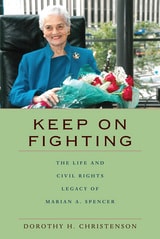
Keep On Fighting
The Life and Civil Rights Legacy of Marian A. SpencerDorothy H. Christenson
Ohio University Press, 2015
Marian Alexander Spencer was born in 1920 in the Ohio River town of Gallipolis, Ohio, one year after the “Red Summer” of 1919 that saw an upsurge in race riots and lynchings. Following the example of her grandfather, an ex-slave and community leader, Marian joined the NAACP at thirteen and grew up to achieve not only a number of civic leadership firsts in her adopted home city of Cincinnati, but a legacy of lasting civil rights victories.
Of these, the best known is the desegregation of Cincinnati’s Coney Island amusement park. She also fought to desegregate Cincinnati schools and to stop the introduction of observers in black voting precincts in Ohio. Her campaign to raise awareness of industrial toxic-waste practices in minority neighborhoods was later adapted into national Superfund legislation.
In 2012, Marian’s friend and colleague Dot Christenson sat down with her to record her memories. The resulting biography not only gives us the life story of remarkable leader but encapsulates many of the twentieth century’s greatest struggles and advances. Spencer’s story will prove inspirational and instructive to citizens and students alike.
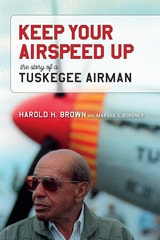
Keep Your Airspeed Up
The Story of a Tuskegee AirmanHarold H. Brown and Marsha S. Bordner
University of Alabama Press, 2017
Inspiring memoir of Colonel Harold H. Brown, one of the 930 original Tuskegee pilots, whose dramatic wartime exploits and postwar professional successes contribute to this extraordinary account.
Keep Your Airspeed Up: The Story of a Tuskegee Airman is the memoir of an African American man who, through dedication to his goals and vision, overcame the despair of racial segregation to great heights, not only as a military aviator, but also as an educator and as an American citizen.
Unlike other historical and autobiographical portrayals of Tuskegee airmen, Harold H. Brown’s memoir is told from its beginnings: not on the first day of combat, not on the first day of training, but at the very moment Brown realized he was meant to be a pilot. He revisits his childhood in Minneapolis where his fascination with planes pushed him to save up enough of his own money to take flying lessons. Brown also details his first trip to the South, where he was met with a level of segregation he had never before experienced and had never imagined possible.
During the 1930s and 1940s, longstanding policies of racial discrimination were called into question as it became clear that America would likely be drawn into World War II. The military reluctantly allowed for the development of a flight-training program for a limited number of African Americans on a segregated base in Tuskegee, Alabama. The Tuskegee Airmen, as well as other African Americans in the armed forces, had the unique experience of fighting two wars at once: one against Hitler’s fascist regime overseas and one against racial segregation at home.
Colonel Brown fought as a combat pilot with the 332nd Fighter Group during World War II, and was captured and imprisoned in Stalag VII A in Moosburg, Germany, where he was liberated by General George S. Patton on April 29, 1945. Upon returning home, Brown noted with acute disappointment that race relations in the United States hadn’t changed. It wasn’t until 1948 that the military desegregated, which many scholars argue would not have been possible without the exemplary performance of the Tuskegee Airmen.
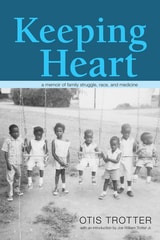
Keeping Heart
A Memoir of Family Struggle, Race, and MedicineOtis Trotter
Ohio University Press, 2015
“After saying our good-byes to friends and neighbors, we all got in the cars and headed up the hill and down the road toward a future in Ohio that we hoped would be brighter,” Otis Trotter writes in his affecting memoir, Keeping Heart: A Memoir of Family Struggle, Race, and Medicine.
Organized around the life histories, medical struggles, and recollections of Trotter and his thirteen siblings, the story begins in 1914 with his parents, Joe William Trotter Sr. and Thelma Odell Foster Trotter, in rural Alabama. By telling his story alongside the experiences of his parents as well as his siblings, Otis reveals cohesion and tensions in twentieth-century African American family and community life in Alabama, West Virginia, and Ohio.
This engaging chronicle illuminates the journeys not only of a black man born with heart disease in the southern Appalachian coalfields, but of his family and community. It fills an important gap in the literature on an underexamined aspect of American experience: the lives of blacks in rural Appalachia and in the nonurban endpoints of the Great Migration. Its emotional power is a testament to the importance of ordinary lives.
Killing Poetry
Blackness and the Making of Slam and Spoken Word CommunitiesJohnson, Javon
Rutgers University Press, 2017
Co-winner of the 2018 Ethnography Division’s Best Book from the NCA
In recent decades, poetry slams and the spoken word artists who compete in them have sparked a resurgent fascination with the world of poetry. However, there is little critical dialogue that fully engages with the cultural complexities present in slam and spoken word poetry communities, as well as their ramifications.
In Killing Poetry, renowned slam poet, Javon Johnson unpacks some of the complicated issues that comprise performance poetry spaces. He argues that the truly radical potential in slam and spoken word communities lies not just in proving literary worth, speaking back to power, or even in altering power structures, but instead in imagining and working towards altogether different social relationships. His illuminating ethnography provides a critical history of the slam, contextualizes contemporary black poets in larger black literary traditions, and does away with the notion that poetry slams are inherently radically democratic and utopic.
Killing Poetry—at times autobiographical, poetic, and journalistic—analyzes the masculine posturing in the Southern California community in particular, the sexual assault in the national community, and the ways in which related social media inadvertently replicate many of the same white supremacist, patriarchal, and mainstream logics so many spoken word poets seem to be working against. Throughout, Johnson examines the promises and problems within slam and spoken word, while illustrating how community is made and remade in hopes of eventually creating the radical spaces so many of these poets strive to achieve.

Kindred Specters
Death, Mourning, and American AffinityChristopher Peterson
University of Minnesota Press, 2007
The refusal to recognize kinship relations among slaves, interracial couples, and same-sex partners is steeped in historical and cultural taboos. In Kindred Specters, Christopher Peterson explores the ways in which non-normative relationships bear the stigma of death that American culture vehemently denies.
Probing Derrida’s notion of spectrality as well as Orlando Patterson’s concept of “social death,” Peterson examines how death, mourning, and violence condition all kinship relations. Through Charles Chesnutt’s The Conjure Woman, Peterson lays bare concepts of self-possession and dispossession, freedom and slavery. He reads Toni Morrison’s Beloved against theoretical and historical accounts of ethics, kinship, and violence in order to ask what it means to claim one’s kin as property. Using William Faulkner’s Absalom, Absalom! he considers the political and ethical implications of comparing bans on miscegenation and gay marriage.
Tracing the connections between kinship and mourning in American literature and culture, Peterson demonstrates how racial, sexual, and gender minorities often resist their social death by adopting patterns of affinity that are strikingly similar to those that govern normative relationships. He concludes that socially dead “others” can be reanimated only if we avow the mortality and mourning that lie at the root of all kinship relations.
Christopher Peterson is visiting assistant professor of literature at Claremont McKenna College.
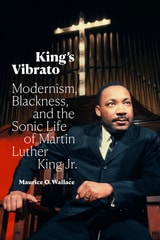
King's Vibrato
Modernism, Blackness, and the Sonic Life of Martin Luther King Jr.Maurice O. Wallace
Duke University Press, 2022
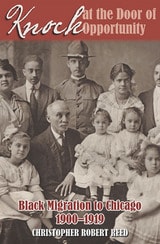
Knock at the Door of Opportunity
Black Migration to Chicago, 1900-1919Christopher Robert Reed
Southern Illinois University Press, 2014
Disputing the so-called ghetto studies that depicted the early part of the twentieth century as the nadir of African American society, this thoughtful volume by Christopher Robert Reed investigates black life in turn-of-the-century Chicago, revealing a vibrant community that grew and developed on Chicago’s South Side in the early 1900s. Reed also explores the impact of the fifty thousand black southerners who streamed into the city during the Great Migration of 1916–1918, effectively doubling Chicago’s African American population. Those already residing in Chicago’s black neighborhoods had a lot in common with those who migrated, Reed demonstrates, and the two groups became unified, building a broad community base able to face discrimination and prejudice while contributing to Chicago’s growth and development.
Reed not only explains how Chicago’s African Americans openly competed with white people for jobs, housing and an independent political voice but also examines the structure of the society migrants entered and helped shape. Other topics include South Side housing, black politics and protest, the role of institutionalized religion, the economic aspects of African American life, the push for citizenship rights and political power for African Americans, and the impact of World War I and the race riot of 1919. The first comprehensive exploration of black life in turn-of-the-century Chicago beyond the mold of a ghetto perspective, this revealing work demonstrates how the melding of migrants and residents allowed for the building of a Black Metropolis in the 1920s.
2015 ISHS Superior Achievement Award
Knowing What We Know
African American Women's Experiences of Violence and ViolationGarfield, Gail
Rutgers University Press, 2005
In recent years there has been an attempt by activists, service providers, and feminists to think about violence against women in more inclusive ways. In Knowing What We Know, activist and sociologist Gail Garfield argues that this effort has not gone far enough and that in order to understand violence, we must take the lived experiences of African American women seriously. Doing so, she cautions, goes far beyond simply adding voices of black women to existing academic and activist discourses, but rather, requires a radical shift in our knowledge of these women’s lives and the rhetoric used to describe them.
Bringing together a series of life-history interviews with nine women, this unique study urges a departure from established approaches that position women as victims of exclusively male violence. Instead, Garfield explores what happens when women’s ability to make decisions and act upon those choices comes into conflict with cultural and social constraints. Chapters explore how women experience racialized or class-based violence, how these forms of violence are related to gendered violence, and what these violations mean to a woman’s sense of identity. By showing how women maintain, sustain, and in some instances regain their sense of human worth as a result of their experiences of violation, Garfield complicates the existing dialogue on violence against women in new and important ways.
Kuria Cattle Raiders
Violence and Vigilantism on the Tanzania/Kenya FrontierMichael L. Fleisher
University of Michigan Press, 2000
The reciprocal raiding of cattle by pastoralists has a long and venerable history in East Africa, but there has been, until now, no book-length treatment of the practice, and, more importantly, no detailed case study of the newer, "modern" form of cattle raiding described here. In addition, the phenomenon of Kuria cattle raiding conveys significant implications for our understanding of informal economies and globalization processes.
Kuria Cattle Raiders engages issues of theoretical as well as practical significance for anthropologists, sociologists, criminologists, cultural ecologists, economic development agencies, and all those concerned with the pressing issues of globalization and rapid social and cultural change.
Michael L. Fleisher, a Post-Doctoral Research Fellow in the Department of Rangeland Resources, Utah State University, is currently engaged in a study of conflict among pastoralists in southern Ethiopia as part of a research project jointly administered by the University of Kentucky, Utah State University, and Cornell University under a grant from U.S.A.I.D.