Results by title
52 books match the query 'Kant, Immanuel' and 13 start with k
Kant and Phenomenology
Tom Rockmore
University of Chicago Press, 2010
Phenomenology, together with Marxism, pragmatism, and analytic philosophy, dominated philosophy in the twentieth century—and Edmund Husserl is usually thought to have been the first to develop the concept. His views influenced a variety of important later thinkers, such as Heidegger and Merleau-Ponty, who eventually turned phenomenology away from questions of knowledge. But here Tom Rockmore argues for a return to phenomenology’s origins in epistemology, and he does so by locating its roots in the work of Immanuel Kant.
Kant and Phenomenology traces the formulation of Kant’s phenomenological approach back to the second edition of Kant’s Critique of Pure Reason. In response to various criticisms of the first edition, Kant more forcefully put forth a constructivist theory of knowledge. This shift in Kant’s thinking challenged the representational approach to epistemology, and it is this turn, Rockmore contends, that makes Kant the first great phenomenologist. He then follows this phenomenological line through the work of Kant’s idealist successors, Fichte and Hegel. Steeped in the sources and literature it examines, Kant and Phenomenology persuasively reshapes our conception of both of its main subjects.
Kant and the Role of Pleasure in Moral Action
Iain P. D. Morrisson
Ohio University Press, 2008
Kant scholars since the early nineteenth century have disaxadgreed about how to interpret his theory of moral motivation. Kant tells us that the feeling of respect is the incentive to moral action, but he is notoriously ambiguous on the question of what exactly this means. In Kant and the Role of Pleasure in Moral Action, Iain Morrisson offers a new view on Kant’s theory of moral action.
In a clear, straightforward style, Morrisson responds to the ongoing interpretive stalemate by taking an original approach to the problem. Whereas previous commentators have attempted to understand Kant’s feeling of respect by studying the relevant textual evidence in isolation, Morrisson illuminates this evidence by determining what Kant’s more general theory of action commits him to regarding moral action. After looking at how Kant’s treatment of desire and feeling can be reconciled with his famous account of free maxim-based action, Morrisson argues that respect moves us to moral action in a way that is structurally parallel to the way in which nonmoral pleasure motivates nonmoral action.
In reconstructing a unified theory of action in Kant, Morrisson integrates a number of distinct elements in his practical philosophy. Kant and the Role of Pleasure in Moral Action is part of a new wave of interest in Kant’s anthropological (that is, psychological) works.

Kant on Causality, Freedom, and Objectivity
William L. Harper and Ralf Meerbote, Editors
University of Minnesota Press, 1984
Kant on Causality, Freedom, and Objectivity was first published in 1984. Minnesota Archive Editions uses digital technology to make long-unavailable books once again accessible, and are published unaltered from the original University of Minnesota Press editions.
Kant's account of causation is central to his views on objective truth and freedom. The Second Analogy of Experience, in the Critique of Pure Reason,where he provides his defense of the causal principle, has long been the focus of intense philosophical research. In the past twenty years, there have been two major periods of interest in Kantian themes, The first coincided with a general turn away from positivism by analytic philosophers, and resulted in a fruitful interchange between Kant scholars and those who applied Kantian ideas to contemporary philosophical problems. In recent years, a new surge of interest in Kant's work occurred along with the developing controversy over realism generated by the work of Dummett and Putnam. Scholars now appreciate the extent to which the Kantian causal principle is illuminated by the philosopher's argument that his transcendental idealism supports an empirical realism. And in turn, Kant's views on objectivity, causation, and freedom are especially relevant to the philosophical concerns raised by the new debate over realism.
The eight papers in this book are drawn from two conferences that honored Lewis White Beck, an influential Kant scholar. Together with the introductory essay by the editors, they show the continuing relevance of Kant's analysis for the present-day philosophy of causation.
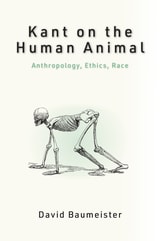
Kant on the Human Animal
Anthropology, Ethics, RaceDavid Baumeister
Northwestern University Press, 2022
David Baumeister tracks four decades of Kant’s intellectual development, surveying works published in Kant’s lifetime along with posthumously published notes and student lecture transcripts. They show the crucial role that animality plays in many previously unconnected areas of Kant’s thought, such as his account of the human’s originally quadrupedal posture, his theory of early childhood development, and his conception of the process of human racial differentiation. Beginning with a delineation of Kant’s understanding of the commonalities and differences between humans and other animals, Baumeister focuses on the contribution of animality to Kant’s views of ethics, anthropology, human nature, and race.
Placing divergent features of Kant’s thought within a unified interpretive framework, Kant on the Human Animal reveals how, for Kant, becoming human requires that animality not be eclipsed and overcome but rather disciplined and developed. What emerges is a new appreciation of Kant’s human being as the human animal it is.
Kant's Conception of Moral Character
The "Critical" Link of Morality, Anthropology, and Reflective JudgmentG. Felicitas Munzel
University of Chicago Press, 1999
The first book to focus on character formation in Kant's moral philosophy, it builds on important recent work on Kant's aesthetics and anthropology, and brings these to bear on moral issues. Munzel traces Kant's multifaceted definition of character through the broad range of his writings, and then explores the structure of character, its actual exercise in the world, and its cultivation.
An outstanding work of original textual analysis and interpretation, Kant's Conception of Moral Character is a major contribution to Kant studies and moral philosophy in general.
Kant's Conception of Pedagogy
Toward Education for FreedomG. Felicitas Munzel
Northwestern University Press, 2012
Although Kant was involved in the education debates of his time, it is widely held that in his mature philosophical writings he remained silent on the subject. In her groundbreaking Kant’s Conception of Pedagogy, G. Felicitas Munzel finds extant in Kant’s writings the so-called missing critical treatise on education. It appears in the Doctrines of Method with which he concludes each of his major works.
In it, Kant identifies the fundamental principles for the cultivation of reason’s judgment when it comes to cognition, beauty, nature, and the exercise of morality while subject to the passions and inclinations that characterize the human experience.
From her analysis, Munzel extrapolates principles for a cosmopolitan education that parallels the structure of Kant’s republican constitution for perpetual peace. With the formal principles in place, the argument concludes with a query of the material principles that would fulfill the formal conditions required for an education for freedom.
Kant's International Relations
The Political Theology of Perpetual PeaceSeán Molloy
University of Michigan Press, 2017
Kant's Organicism
Epigenesis and the Development of Critical PhilosophyJennifer Mensch
University of Chicago Press, 2013
Kant's Worldview
How Judgment Shapes Human ComprehensionRudolf A. Makkreel
Northwestern University Press, 2022
To comprehend, according to Kant, is to possess sufficient insight into situations so as to also achieve some purpose. This requires that reason be applied with the discernment that reflective judgment makes possible. Comprehension, practical as well as theoretical, can fill in Kant’s world concept and his sublime evocation of a Weltanschauung with a more down-to-earth worldview.
Scholars have recently stressed Kant’s impure ethics, his nonideal politics, and his pragmatism. Makkreel complements these efforts by using Kant’s ethical, sociopolitical, religious, and anthropological writings to provide a more encompassing account of the role of human beings in the world. The result is a major contribution to our understanding of Kant and the history of European philosophy.
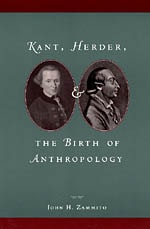
Kant, Herder, and the Birth of Anthropology
John H. Zammito
University of Chicago Press, 2001
Relying on previously unexamined sources, Zammito traces Kant's friendship with Herder as well as the personal tensions that destroyed their relationship. From this he shows how two very different philosophers emerged from the same beginnings and how, because of Herder's reformulation of Kant, anthropology was born out of philosophy.
Shedding light on an overlooked period of philosophical development, this book is a major contribution to the history of philosophy and the social sciences, and especially to the history of anthropology.
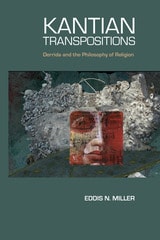
Kantian Transpositions
Derrida and the Philosophy of ReligionEddis N. Miller
Northwestern University Press, 2019
Kantian Transpositions presents an important new reading of Jacques Derrida’s writings on religion and ethics. Eddis Miller argues that Derrida’s late texts on religion constitute an interrogation of the meaning and possibility of a “philosophy of religion.” It is the first book to fully engage Derrida’s claim, in “Faith and Knowledge: The Two Sources of ‘Religion’ at the Limits of Reason Alone” to be transposing the Kantian gesture of thinking religion “within the limits of reason alone.”
Miller outlines the terms of this “transposition” and reads Derrida’s work as an attempt to enact such a transposition. Along the way, he stakes out new ground in the debate over deconstruction and ethics, showing—against recent interpretations of Derrida’s work—that there is an ethical moment in Derrida’s writings that cannot be understood properly without accounting for the decisive role played by Kant’s ethics. The result is the most sustained demonstration yet offered of Kant’s indispensible contribution to Derrida’s thought.

Kant’s Methodology
An Essay in Philosophical ArcheologyCharles P. Bigger
Ohio University Press, 1995
Kant’s revolution in methodology limited metaphysics to the conditions of possible experience. Since, following Hume, analysis—the “method of discovery” in early modern physics—could no longer ground itself in sense or in God’s constituting reason a new arché, “origin” and “principle,” was required, which Kant found in the synthesis of the productive imagination, the common root of sensibility and understanding. Charles Bigger argues that this imaginative “between” recapitulates the ancient Gaia myth which, as used by Plato in the Timaeus, offers a way into this originary arché. Since it depends on myth and the “likely story” rather than on a self-certain apprehension of Being, this facilitates an imaginative approach to the natural sciences which, through its synthetic a priori formations, can claim to be Kantian.
Bigger explores Kant’s ethics as an alternative to metaphysics that holds open the prospect of a Good beyond Being—and phenomenology—whose traces nevertheless appear in original synthesis. Though wary of its reductive implications, Bigger uses Derrida’s difference, a medial, feminine arché, as a way into this creative and procreative metaxu (between). As Emmanuel Levinas suggests, this is Plato’s gap [chaos] between being and becoming, whose possibility, beyond both, lies in chora and the Good. This Open also presents the possibility for a new, yet still Kantian, understanding of the formal and material conditions for the natural sciences.
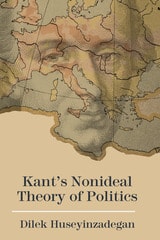
Kant’s Nonideal Theory of Politics
Dilek Huseyinzadegan
Northwestern University Press, 2019
This novel analysis thus challenges the common assumption that an ideal theory of cosmopolitanism constitutes Kant’s sole political legacy. Dilek Huseyinzadegan demonstrates that Kant employs a teleological worldview throughout his political writings as a means of grappling with the pressing issues of multiplicity, diversity, and plurality—issues that confront us to this day.
Kant’s Nonideal Theory of Politics is the first book-length treatment of Kant’s political thought that gives full attention to the role that history, anthropology, and geography play in his mainstream political writings. Interweaving close textual analyses of Kant’s writings with more contemporary political frameworks, this book also makes Kant accessible and responsive to fields other than philosophy. As such, it will be of interest to students and scholars working at the intersections of political theory, feminism, critical race theory, and post- and decolonial thought.