Results by title
4917 books match the query 'Philosophy' and 47 start with k
Kafka and Wittgenstein
The Case for an Analytic ModernismRebecca Schuman
Northwestern University Press, 2015
In Kafka and Wittgenstein, Rebecca Schuman undertakes the first ever book-length scholarly examination of Ludwig Wittgenstein’s philosophy of language alongside Franz Kafka’s prose fiction. In groundbreaking readings, she argues that although many readers of Kafka are searching for what his texts mean, in this search we are sorely mistaken. Instead, the problems and illusions we portend to uncover, the im-portant questions we attempt to answer—Is Josef K. guilty? If so, of what? What does Gregor Samsa’s transformed body mean? Is Land-Surveyor K. a real land surveyor?— themselves presuppose a bigger delusion: that such questions can be asked in the first place. Drawing deeply on the entire range of Wittgenstein’s writings, Schuman can-nily sheds new light on the enigmatic Kafka.
Kant and Phenomenology
Tom Rockmore
University of Chicago Press, 2010
Phenomenology, together with Marxism, pragmatism, and analytic philosophy, dominated philosophy in the twentieth century—and Edmund Husserl is usually thought to have been the first to develop the concept. His views influenced a variety of important later thinkers, such as Heidegger and Merleau-Ponty, who eventually turned phenomenology away from questions of knowledge. But here Tom Rockmore argues for a return to phenomenology’s origins in epistemology, and he does so by locating its roots in the work of Immanuel Kant.
Kant and Phenomenology traces the formulation of Kant’s phenomenological approach back to the second edition of Kant’s Critique of Pure Reason. In response to various criticisms of the first edition, Kant more forcefully put forth a constructivist theory of knowledge. This shift in Kant’s thinking challenged the representational approach to epistemology, and it is this turn, Rockmore contends, that makes Kant the first great phenomenologist. He then follows this phenomenological line through the work of Kant’s idealist successors, Fichte and Hegel. Steeped in the sources and literature it examines, Kant and Phenomenology persuasively reshapes our conception of both of its main subjects.
Kant and the Role of Pleasure in Moral Action
Iain P. D. Morrisson
Ohio University Press, 2008
Kant scholars since the early nineteenth century have disaxadgreed about how to interpret his theory of moral motivation. Kant tells us that the feeling of respect is the incentive to moral action, but he is notoriously ambiguous on the question of what exactly this means. In Kant and the Role of Pleasure in Moral Action, Iain Morrisson offers a new view on Kant’s theory of moral action.
In a clear, straightforward style, Morrisson responds to the ongoing interpretive stalemate by taking an original approach to the problem. Whereas previous commentators have attempted to understand Kant’s feeling of respect by studying the relevant textual evidence in isolation, Morrisson illuminates this evidence by determining what Kant’s more general theory of action commits him to regarding moral action. After looking at how Kant’s treatment of desire and feeling can be reconciled with his famous account of free maxim-based action, Morrisson argues that respect moves us to moral action in a way that is structurally parallel to the way in which nonmoral pleasure motivates nonmoral action.
In reconstructing a unified theory of action in Kant, Morrisson integrates a number of distinct elements in his practical philosophy. Kant and the Role of Pleasure in Moral Action is part of a new wave of interest in Kant’s anthropological (that is, psychological) works.

Kant on Causality, Freedom, and Objectivity
William L. Harper and Ralf Meerbote, Editors
University of Minnesota Press, 1984
Kant on Causality, Freedom, and Objectivity was first published in 1984. Minnesota Archive Editions uses digital technology to make long-unavailable books once again accessible, and are published unaltered from the original University of Minnesota Press editions.
Kant's account of causation is central to his views on objective truth and freedom. The Second Analogy of Experience, in the Critique of Pure Reason,where he provides his defense of the causal principle, has long been the focus of intense philosophical research. In the past twenty years, there have been two major periods of interest in Kantian themes, The first coincided with a general turn away from positivism by analytic philosophers, and resulted in a fruitful interchange between Kant scholars and those who applied Kantian ideas to contemporary philosophical problems. In recent years, a new surge of interest in Kant's work occurred along with the developing controversy over realism generated by the work of Dummett and Putnam. Scholars now appreciate the extent to which the Kantian causal principle is illuminated by the philosopher's argument that his transcendental idealism supports an empirical realism. And in turn, Kant's views on objectivity, causation, and freedom are especially relevant to the philosophical concerns raised by the new debate over realism.
The eight papers in this book are drawn from two conferences that honored Lewis White Beck, an influential Kant scholar. Together with the introductory essay by the editors, they show the continuing relevance of Kant's analysis for the present-day philosophy of causation.
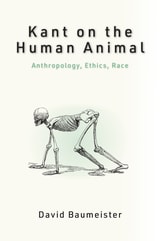
Kant on the Human Animal
Anthropology, Ethics, RaceDavid Baumeister
Northwestern University Press, 2022
David Baumeister tracks four decades of Kant’s intellectual development, surveying works published in Kant’s lifetime along with posthumously published notes and student lecture transcripts. They show the crucial role that animality plays in many previously unconnected areas of Kant’s thought, such as his account of the human’s originally quadrupedal posture, his theory of early childhood development, and his conception of the process of human racial differentiation. Beginning with a delineation of Kant’s understanding of the commonalities and differences between humans and other animals, Baumeister focuses on the contribution of animality to Kant’s views of ethics, anthropology, human nature, and race.
Placing divergent features of Kant’s thought within a unified interpretive framework, Kant on the Human Animal reveals how, for Kant, becoming human requires that animality not be eclipsed and overcome but rather disciplined and developed. What emerges is a new appreciation of Kant’s human being as the human animal it is.
Kant's Conception of Moral Character
The "Critical" Link of Morality, Anthropology, and Reflective JudgmentG. Felicitas Munzel
University of Chicago Press, 1999
The first book to focus on character formation in Kant's moral philosophy, it builds on important recent work on Kant's aesthetics and anthropology, and brings these to bear on moral issues. Munzel traces Kant's multifaceted definition of character through the broad range of his writings, and then explores the structure of character, its actual exercise in the world, and its cultivation.
An outstanding work of original textual analysis and interpretation, Kant's Conception of Moral Character is a major contribution to Kant studies and moral philosophy in general.
Kant's Conception of Pedagogy
Toward Education for FreedomG. Felicitas Munzel
Northwestern University Press, 2012
Although Kant was involved in the education debates of his time, it is widely held that in his mature philosophical writings he remained silent on the subject. In her groundbreaking Kant’s Conception of Pedagogy, G. Felicitas Munzel finds extant in Kant’s writings the so-called missing critical treatise on education. It appears in the Doctrines of Method with which he concludes each of his major works.
In it, Kant identifies the fundamental principles for the cultivation of reason’s judgment when it comes to cognition, beauty, nature, and the exercise of morality while subject to the passions and inclinations that characterize the human experience.
From her analysis, Munzel extrapolates principles for a cosmopolitan education that parallels the structure of Kant’s republican constitution for perpetual peace. With the formal principles in place, the argument concludes with a query of the material principles that would fulfill the formal conditions required for an education for freedom.
Kant's International Relations
The Political Theology of Perpetual PeaceSeán Molloy
University of Michigan Press, 2017
Kant's Organicism
Epigenesis and the Development of Critical PhilosophyJennifer Mensch
University of Chicago Press, 2013
Kant's Worldview
How Judgment Shapes Human ComprehensionRudolf A. Makkreel
Northwestern University Press, 2022
To comprehend, according to Kant, is to possess sufficient insight into situations so as to also achieve some purpose. This requires that reason be applied with the discernment that reflective judgment makes possible. Comprehension, practical as well as theoretical, can fill in Kant’s world concept and his sublime evocation of a Weltanschauung with a more down-to-earth worldview.
Scholars have recently stressed Kant’s impure ethics, his nonideal politics, and his pragmatism. Makkreel complements these efforts by using Kant’s ethical, sociopolitical, religious, and anthropological writings to provide a more encompassing account of the role of human beings in the world. The result is a major contribution to our understanding of Kant and the history of European philosophy.
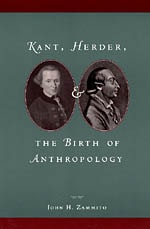
Kant, Herder, and the Birth of Anthropology
John H. Zammito
University of Chicago Press, 2001
Relying on previously unexamined sources, Zammito traces Kant's friendship with Herder as well as the personal tensions that destroyed their relationship. From this he shows how two very different philosophers emerged from the same beginnings and how, because of Herder's reformulation of Kant, anthropology was born out of philosophy.
Shedding light on an overlooked period of philosophical development, this book is a major contribution to the history of philosophy and the social sciences, and especially to the history of anthropology.

Kant, Kantianism, and Idealism
The Origins of Continental PhilosophyEdited by Thomas J. Nenon
University of Chicago Press, 2010
From Kant to Kierkegaard, from Hegel to Heidegger, continental philosophers have indelibly shaped the trajectory of Western thought since the eighteenth century. Although much has been written about these monumental thinkers, students and scholars lack a definitive guide to the entire scope of the continental tradition. The most comprehensive reference work to date, this eight-volume History of Continental Philosophy will both encapsulate the subject and reorient our understanding of it. Beginning with an overview of Kant’s philosophy and its initial reception, the History traces the evolution of continental philosophy through major figures as well as movements such as existentialism, phenomenology, hermeneutics, and poststructuralism. The final volume outlines the current state of the field, bringing the work of both historical and modern thinkers to bear on such contemporary topics as feminism, globalization, and the environment. Throughout, the volumes examine important philosophical figures and developments in their historical, political, and cultural contexts.
The first reference of its kind, A History of Continental Philosophy has been written and edited by internationally recognized experts with a commitment to explaining complex thinkers, texts, and movements in rigorous yet jargon-free essays suitable for both undergraduates and seasoned specialists. These volumes also elucidate ongoing debates about the nature of continental and analytic philosophy, surveying the distinctive, sometimes overlapping characteristics and approaches of each tradition. Featuring helpful overviews of major topics and plotting road maps to their underlying contexts, A History of Continental Philosophy is destined to be the resource of first and last resort for students and scholars alike.
Kant, Ontology, and the A Priori
Moltke S. Gram
Northwestern University Press, 1968
Kantian Transpositions
Derrida and the Philosophy of ReligionEddis N. Miller
Northwestern University Press, 2019
Kantian Transpositions presents an important new reading of Jacques Derrida’s writings on religion and ethics. Eddis Miller argues that Derrida’s late texts on religion constitute an interrogation of the meaning and possibility of a “philosophy of religion.” It is the first book to fully engage Derrida’s claim, in “Faith and Knowledge: The Two Sources of ‘Religion’ at the Limits of Reason Alone” to be transposing the Kantian gesture of thinking religion “within the limits of reason alone.”
Miller outlines the terms of this “transposition” and reads Derrida’s work as an attempt to enact such a transposition. Along the way, he stakes out new ground in the debate over deconstruction and ethics, showing—against recent interpretations of Derrida’s work—that there is an ethical moment in Derrida’s writings that cannot be understood properly without accounting for the decisive role played by Kant’s ethics. The result is the most sustained demonstration yet offered of Kant’s indispensible contribution to Derrida’s thought.
Kant’s Critical Philosophy
The Doctrine of the FacultiesGilles Deleuze
University of Minnesota Press, 1985

Kant’s Methodology
An Essay in Philosophical ArcheologyCharles P. Bigger
Ohio University Press, 1995
Kant’s revolution in methodology limited metaphysics to the conditions of possible experience. Since, following Hume, analysis—the “method of discovery” in early modern physics—could no longer ground itself in sense or in God’s constituting reason a new arché, “origin” and “principle,” was required, which Kant found in the synthesis of the productive imagination, the common root of sensibility and understanding. Charles Bigger argues that this imaginative “between” recapitulates the ancient Gaia myth which, as used by Plato in the Timaeus, offers a way into this originary arché. Since it depends on myth and the “likely story” rather than on a self-certain apprehension of Being, this facilitates an imaginative approach to the natural sciences which, through its synthetic a priori formations, can claim to be Kantian.
Bigger explores Kant’s ethics as an alternative to metaphysics that holds open the prospect of a Good beyond Being—and phenomenology—whose traces nevertheless appear in original synthesis. Though wary of its reductive implications, Bigger uses Derrida’s difference, a medial, feminine arché, as a way into this creative and procreative metaxu (between). As Emmanuel Levinas suggests, this is Plato’s gap [chaos] between being and becoming, whose possibility, beyond both, lies in chora and the Good. This Open also presents the possibility for a new, yet still Kantian, understanding of the formal and material conditions for the natural sciences.
Kant’s Nonideal Theory of Politics
Dilek Huseyinzadegan
Northwestern University Press, 2019
This novel analysis thus challenges the common assumption that an ideal theory of cosmopolitanism constitutes Kant’s sole political legacy. Dilek Huseyinzadegan demonstrates that Kant employs a teleological worldview throughout his political writings as a means of grappling with the pressing issues of multiplicity, diversity, and plurality—issues that confront us to this day.
Kant’s Nonideal Theory of Politics is the first book-length treatment of Kant’s political thought that gives full attention to the role that history, anthropology, and geography play in his mainstream political writings. Interweaving close textual analyses of Kant’s writings with more contemporary political frameworks, this book also makes Kant accessible and responsive to fields other than philosophy. As such, it will be of interest to students and scholars working at the intersections of political theory, feminism, critical race theory, and post- and decolonial thought.
Karl Korsch
Revolutionary TheoryBy Karl Korsch
University of Texas Press, 1977
There is growing interest in Europe and the United States in the work of the major German social-political philosopher Karl Korsch. Korsch participated in the turbulent struggles in Weimar Germany and while in exile continually reflected on history and politics. His work affords one of the most important interpretations of the role of Marxism in twentieth-century revolutionary movements, while developing an ongoing critical interrogation of Marxism. His thought provides an illuminating perspective on the process of revolution and counterrevolution in recent history. Karl Korsch: Revolutionary Theory is the first English anthology of his most important writings.
This collection presents Korsch's essays on a wide range of subjects, including Marxism and socialization, Lenin and the Soviet Union, the crisis of Marxism, models of revolutionary practice, fascism and counterrevolution, and Korsch's final evaluation of Marxism. Much of this work is translated into English for the first time, and many unknown essays first published in radical journals which are no longer available appear here. The volume includes Korsch's major essays written during the 1920s and 1930s as well as some of his later work.
Douglas Kellner's detailed introduction, "Korsch's Revolutionary Marxism," contains the first comprehensive critical interpretation of Korsch's work to appear in English. It provides a historical-theoretical reconstruction of Korsch's life and thought and roots his political theory in the sociopolitical context in which it evolved. The introduction has been described by Korsch scholars as a "first-class piece of exposition and interpretation" and a "serious, first-rate contribution likely to preempt the field in the English language." The editor's introduction along with the representative selection of essays provide firm grounding in the ideas and historical significance of Karl Korsch.
Karl Marx in America
Andrew Hartman
University of Chicago Press, 2025
To read Karl Marx is to contemplate a world created by capitalism. People have long viewed the United States as the quintessential anti-Marxist nation, but Marx’s ideas have inspired a wide range of people to formulate a more precise sense of the stakes of the American project. Historians have highlighted the imprint made on the United States by Enlightenment thinkers such as Adam Smith, John Locke, and Thomas Paine, but Marx is rarely considered alongside these figures. Yet his ideas are the most relevant today because of capitalism’s centrality to American life.
In Karl Marx in America, historian Andrew Hartman argues that even though Karl Marx never visited America, the country has been infused, shaped, and transformed by him. Since the beginning of the Civil War, Marx has been a specter in the American machine. During the Gilded Age, socialists read Marx as an antidote to the unchecked power of corporations. In the Great Depression, communists turned to Marx in hopes of transcending the destructive capitalist economy. The young activists of the 1960s were inspired by Marx as they gathered to protest an overseas war. Marx’s influence today is evident, too, as Americans have become increasingly attuned to issues of inequality, labor, and power.
After decades of being pushed to the far-left corner of intellectual thought, Marx’s ideologies have crossed over into the mainstream and are more alive than ever. Working-class consciousness is on the rise, and, as Marx argued, the future of a capitalist society rests in the hands of the people who work at the point of production. A valuable resource for anyone interested in Marx’s influence on American political discourse, Karl Marx in America is a thought-provoking account of the past, present, and future of his philosophies in American society.
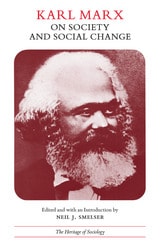
Karl Marx on Society and Social Change
With Selections by Friedrich EngelsKarl Marx
University of Chicago Press, 1975
The first section, "The Structure of Society," contains Marx's writings on the material basis of classes, the basis of the state, and the basis of the family. Among the writings included in this section are Marx's well-known summary from the Preface of A Contribution to a Critique of Political Economy and his equally famous observations on the functional significance of religion in relation to politics.
The second section is titled "The Sweep of Historical Change." The first selection here contains Marx's first statement of the main precapitalist forms of production. The second selection focuses on capitalism, its contradictions, and its impending destruction. Two brief final selections treat the nature of communism, particularly its freedom from the kinds of contradictions that have plagued all earlier forms of societies.
The last section, "The Mechanisms of Change," reproduces several parts of Marx's analysis of the mechanisms by which contradictions develop in capitalism and generate group conflicts. Included is an analysis of competition and its effects on the various classes, a discussion of economic crises and their effects on workers, and Marx's presentation of the historical specifics of the class struggle.
In his comprehensive Introduction to the selections, Professor Smelser provides a biography of Marx, indentifies the various intellectual traditions which formed the background for Marx's writings, and discusses the selections which follow. The editor describes Marx's conception of society as a social system, the differences between functionalism and Marx's theories, and the dynamics of economic and political change as analyzed by Marx.
Karl Marx on Society and Social Change
With Selections by Friedrich EngelsKarl Marx
University of Chicago Press, 1975
This volume presents those writings of Marx that best reveal his contribution to sociology, particularly to the theory of society and social change. The editor, Neil J. Smelser, has divided these selections into three topical sections and has also included works by Friedrich Engels.
The first section, "The Structure of Society," contains Marx's writings on the material basis of classes, the basis of the state, and the basis of the family. Among the writings included in this section are Marx's well-known summary from the Preface of A Contribution to a Critique of Political Economy and his equally famous observations on the functional significance of religion in relation to politics.
The second section is titled "The Sweep of Historical Change." The first selection here contains Marx's first statement of the main precapitalist forms of production. The second selection focuses on capitalism, its contradictions, and its impending destruction. Two brief final selections treat the nature of communism, particularly its freedom from the kinds of contradictions that have plagued all earlier forms of societies.
The last section, "The Mechanisms of Change," reproduces several parts of Marx's analysis of the mechanisms by which contradictions develop in capitalism and generate group conflicts. Included is an analysis of competition and its effects on the various classes, a discussion of economic crises and their effects on workers, and Marx's presentation of the historical specifics of the class struggle.
In his comprehensive Introduction to the selections, Professor Smelser provides a biography of Marx, indentifies the various intellectual traditions which formed the background for Marx's writings, and discusses the selections which follow. The editor describes Marx's conception of society as a social system, the differences between functionalism and Marx's theories, and the dynamics of economic and political change as analyzed by Marx.
Karl Popper, Science and Enlightenment
Nicholas Maxwell
University College London, 2017
Karol Wojtyla's Personalist Philosophy
Miguel Acosta
Catholic University of America Press, 2016
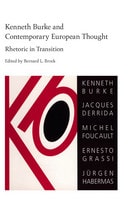
Kenneth Burke and Contemporary European Thought
Rhetoric in TransitionBernard L. Brock
University of Alabama Press, 1995
Kenneth Burke and Contemporary European Thought: A Rhetoric in Transition reflects the present transitional nature of rhetoric and society. Its purpose is to relate the rhetorical theory of Burke to the theories of four major European philosophers—Jürgen Habermas, Ernesto Grassi, Foucault, and Jacques Derrida—as they discuss the nature of language and its central role in society.
This book describes a rhetorical world in transition but not a world in chaos. It points to the centrality of symbolism in theories of language and rhetoric and illustrates Burke’s influence as a pivotal things and theorist in the communication arts and sciences, suggesting that the observations regarding shifting paradigms and perspectives made by other scholars are indeed emergent in the realm of rhetoric. It also regards the powerful impact of language and symbolic action in both the critique and construction of human knowledge and augurs a central role for rhetoric in the intellectual and social transformations of this and the next century.
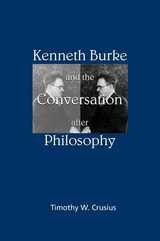
Kenneth Burke and the Conversation after Philosophy
Timothy W. Crusius
Southern Illinois University Press, 1999
Throughout much of his long life (1897–1993), Kenneth Burke was recognized as a leading American intellectual, perhaps the most significant critic writing in English since Coleridge. From about 1950 on, rhetoricians in both English and speech began to see him as a major contributor to the New Rhetoric. But despite Burke's own claims to be writing philosophy and some notice from reviewers and critics that his work was philosophically significant, Timothy W. Crusius is the first to access his work as philosophy.
Crusius traces Burke's commitment and contributions to philosophy prior to 1945, from Counter-Statement (1931) through The Philosophy of Literary Form (1941). While Burke might have been a late modernist thinker, Crusius shows that Burke actually starts from a position closely akin to such postmodern figures as Michel Foucault and Richard Rorty.
Crusius then examines Burke's work from A Grammar of Motives (1945) up to his last published essays, drawing most heavily on A Rhetoric of Motives, The Rhetoric of Religion, and uncollected essays from the 1970s. This part concerns Burke's contributions to human activities always closely associated with rhetoric-hermeneutics, dialectic, and praxis. Burke's highly developed notion of our species as the "symbol-using animal," argues Crusius, draws together the various strands of his later philosophy—his concern with interpretation, with dialectic and dialogue, with a praxis devoted to awareness and control of the self-deceiving and potentially self-destructive motives inherent in language itself.
Kierkegaard And The Ends Of Language
Geoffrey A. Hale
University of Minnesota Press, 2002
A timely and original intervention in our understanding of this major philosopher through the lens of his influence on others
What do we read when we read Kierkegaard? How do we know? Insisting that Kierkegaard remains a far more enigmatic and paradoxical writer than is often assumed, Geoffrey A. Hale argues that the best way to approach Kierkegaard’s work and understand its significance for our own thought is to retrace its formative influence on major intellectuals of the early twentieth century.
In mutually reflective readings of Kierkegaard’s foundational texts through the work of three pivotal authors—Franz Kafka, Theodor Adorno, and Rainer Maria Rilke—Hale shows how each of these writers draws attention to the unwavering sense of human finitude that pervades all of Kierkegaard’s work and, with it, the profoundly unsettling indeterminacy in which it results. It is the very limitations of language, Hale argues, that hold it open to meaning, to interpretation, and thus to freedom. Resisting clear circumscription in this way, Kierkegaard’s work becomes all the more fruitful to us—and all the more challenging—to the extent that it resists our understanding.
Kierkegaard as Phenomenologist
An ExperimentJeffrey Hanson
Northwestern University Press, 2010
In Kierkegaard as Phenomenologist: An Experiment, Jeffrey Hanson embarks on a project to locate Kierkegaard within the current phenomenological discussion. This work is an experiment inasmuch as the plausibility of the undertaking itself will be determined only by the outcome. Some of the contributors clearly regard it as possible to read Kierkegaard as a phenomenologist. Others plainly do not and will contest the very hypothesis that forms the basis of this experiment.
As with any experiment, the larger discussion will determine its success, but Kierkegaard as Phenomenologist lays the groundwork for two exciting possibilities: first, that Kierkegaard scholarship will be renewed, and second, that the meaning of phenomenology itself will be reconsidered.
Kierkegaard as Psychologist
Vincent A. McCarthy
Northwestern University Press, 2015

Kierkegaard, Literature, and the Arts
Edited by Eric Ziolkowski
Northwestern University Press, 2018
The essays in Kierkegaard, Literature, and the Arts, contextualized with an insightful introduction by Eric Ziolkowski, explore Kierkegaard’s relationship to literature (poetry, prose, and storytelling), the performing arts (theater, music, opera, and dance), and the visual arts, including film. The collection is rounded out with a comparative section that considers Kierkegaard in juxtaposition with a romantic poet (William Blake), a modern composer (Arnold Schoenberg), and a contemporary singer‑songwriter (Bob Dylan). Kierkegaard was as much an aesthetic thinker as a philosopher, and his philosophical writings are complemented by his literary and music criticism.
Kierkegaard, Literature, and the Arts will offer much of interest to scholars concerned with Kierkegaard as well as teachers, performers, and readers in the various aesthetic fields discussed.
CONTRIBUTORS: Christopher B. Barnett, Martijn Boven, Anne Margrete Fiskvik, Joakim Garff, Ronald M. Green, Peder Jothen, Ragni Linnet, Jamie A. Lorentzen, Edward F. Mooney, George Pattison, Nils Holger Petersen, Howard Pickett, Marcia C. Robinson, James Rovira
Kierkegaard
Construction of the AestheticTheodor Adorno
University of Minnesota Press, 1989
Killing Time
The Autobiography of Paul FeyerabendPaul Feyerabend
University of Chicago Press, 1995
Trained in physics and astronomy, Feyerabend was best known as a philosopher of science. But he emphatically was not a builder of theories or a writer of rules. Rather, his fame was in powerful, plain-spoken critiques of "big" science and "big" philosophy. Feyerabend gave voice to a radically democratic "epistemological anarchism:" he argued forcefully that there is not one way to knowledge, but many principled paths; not one truth or one rationality but different, competing pictures of the workings of the world. "Anything goes," he said about the ways of science in his most famous book, Against Method. And he meant it.
Here, for the first time, Feyerabend traces the trajectory that led him from an isolated, lower-middle-class childhood in Vienna to the height of international academic success. He writes of his experience in the German army on the Russian front, where three bullets left him crippled, impotent, and in lifelong pain. He recalls his promising talent as an operatic tenor (a lifelong passion), his encounters with everyone from Martin Buber to Bertolt Brecht, innumerable love affairs, four marriages, and a career so rich he once held tenured positions at four universities at the same time.
Although not written as an intellectual autobiography, Killing Time sketches the people, ideas, and conflicts of sixty years. Feyerabend writes frankly of complicated relationships with his mentor Karl Popper and his friend and frequent opponent Imre Lakatos, and his reactions to a growing reputation as the "worst enemy of science."
Kinaesthetic Knowing
Aesthetics, Epistemology, Modern DesignZeynep Çelik Alexander
University of Chicago Press, 2017
In this book, Alexander offers the first major intellectual history of kinaesthetic knowing and its influence on the formation of modern art and architecture and especially modern design education. Focusing in particular on Germany and tracing the story up to the start of World War II, Alexander reveals the tension between intellectual meditation and immediate experience to be at the heart of the modern discourse of aesthetics, playing a major part in the artistic and teaching practices of numerous key figures of the period, including Heinrich Wölfflin, Hermann Obrist, August Endell, László Moholy-Nagy, and many others. Ultimately, she shows, kinaesthetic knowing did not become the foundation of the human sciences, as some of its advocates had hoped, but it did lay the groundwork—at such institutions as the Bauhaus—for modern art and architecture in the twentieth century.
Kinds of Value
An Experiment in Modal AnthropologyPaul Kockelman
Prickly Paradigm Press, 2020
Knossos and the Prophets of Modernism
Cathy Gere
University of Chicago Press, 2009
In the spring of 1900, British archaeologist Arthur Evans began to excavate the palace of Knossos on Crete, bringing ancient Greek legends to life just as a new century dawned amid far-reaching questions about human history, art, and culture. With Knossos and the Prophets of Modernism, Cathy Gere relates the fascinating story of Evans’s excavation and its long-term effects on Western culture. After the World War I left the Enlightenment dream in tatters, the lost paradise that Evans offered in the concrete labyrinth—pacifist and matriarchal, pagan and cosmic—seemed to offer a new way forward for writers, artists, and thinkers such as Sigmund Freud, James Joyce, Giorgio de Chirico, Robert Graves, and Hilda Doolittle.
Assembling a brilliant, talented, and eccentric cast at a moment of tremendous intellectual vitality and wrenching change, Cathy Gere paints an unforgettable portrait of the age of concrete and the birth of modernism.
Knowing and Being
Michael Polanyi
University of Chicago Press, 1973
This collection of essays, assembled by Marjorie Grene, exemplifies the development of Polanyi's theory of knowledge which was first presented in Science, Faith, and Society and later systematized in Personal Knowledge.
Knowing by Heart
Loving as Participation and CritiqueAnthony J. Steinbock
Northwestern University Press, 2021
Knowing by Heart describes the movement of loving as a participation that bears on all beings. Eschewing the dichotomy of rationalism and sensibility that has dominated discussions of love and emotion, Steinbock understands the heart as a vast schema ranging from the deepest loving to affects and felt conditions. The book brings into focus the importance of a full‑bodied relational account of a normative critique based in emotion. From a phenomenological description of diverse feelings to the normativity of loving as the discernment of the heart, this work evaluates hating’s relation to loving. At the basis of all this is a phenomenological and philosophical anthropology in response to the basic question: In reality, who and what are we?
Knowing the Natural Law
Steven Jensen
Catholic University of America Press, 2015
Knowing, Seeing, Being
Jonathan Edwards, Emily Dickinson, Marianne Moore, and the American Typological TraditionJennifer L. Leader
University of Massachusetts Press, 2016
Scholars no longer see Jonathan Edwards as the fire-and-brimstone preacher who deemed his parishioners “sinners in the hands of an angry god.” Edwards now figures as caring and socially conscious and exerts increased influence as a philosopher of the American school of Protestantism. In this study, he becomes the progenitor of an alternative tradition in American letters.
In Knowing, Seeing, Being, Jennifer L. Leader argues that Edwards, the nineteenth-century poet Emily Dickinson, and the twentieth-century poet Marianne Moore share a heretofore underrecognized set of religious and philosophical preoccupations. She contends that they represent an alternative tradition within American literature, one that differs from Transcendentalism and is grounded in Reformed Protestantism and its ways of reading and interpreting the King James Bible and the natural world. According to Leader, these three writers' most significant commonality is the Protestant tradition of typology, a rigorous mode of interpreting scripture and nature through which certain figures or phenomena are read as the fulfillment of prophecy and of God's work. Following from their similar ways of reading, they also share philosophical and spiritual questions about language, epistemology (knowing), perception (seeing), and physical and spiritual ontology (being). In connecting Edwards to these two poets, in exploring each writer's typological imagination, and through a series of insightful readings, this innovative book reevaluates three major figures in American intellectual and literary history and compels a reconsideration of these writers and their legacies.
Knowledge and Computing
Computer Epistemology and Constructive SkepticismTibor Vámos
Central European University Press, 2010
Knowledge and Knowing in Media and Film Studies
Steve Connolly
University College London, 2025
The nature of knowledge in the curriculum is well-defined for traditional subjects like History and Science, but for newer disciplines like Media and Film Studies, the boundaries are far less clear. Knowledge and Knowing in Media and Film Studies is the first book to explore this question in depth, tracing the epistemological foundations of these subjects and their place in the English school curriculum.
Steve Connolly argues that while both Media and Film Studies have distinct intellectual traditions, their inclusion of craft skills alongside theoretical and factual knowledge has shaped a different set of criteria for what counts as valuable knowledge. Consisting of historical sources and interviews with teachers, this work goes against the assumption that these are novel subjects and shows their deep parallels with more established fields. Essential reading for educators and researchers, the book provides a necessary framework for understanding how knowledge in these disciplines is taught and legitimized in schools today.
Knowledge and Representation
Albert Newen, Andreas Bartels, and Eva-Maria Jung
CSLI, 2011
This compilation of cutting-edge philosophical and scientific research comprises a survey of recent neuroscientific research on representational systems in animals and humans. Representational systems provide their owners with useful information about their environment and are shaped by the special informational needs of the organism with respect to its environment. In this volume, the authors address the long-standing dispute about the usefulness of the notion of representation in the study of behavior systems and offer a fresh perspective on representational systems that combines philosophical insights and experimental experience.
Knowledge and Social Imagery
David Bloor
University of Chicago Press, 1991
Knowledge and the Flow of Information
Fred I. Dretske
CSLI, 1999
Knowledge and the Transcendent
An Inquiry into the Mind's Relationship to GodPaul A. Macdonald Jr.
Catholic University of America Press, 2009
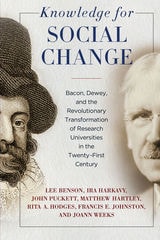
Knowledge for Social Change
Bacon, Dewey, and the Revolutionary Transformation of Research Universities in the Twenty-First CenturyLee Benson, Ira Harkavy, Matthew Hartley
Temple University Press, 2017
Employing history, social theory, and a detailed contemporary case study, Knowledge for Social Change argues for fundamentally reshaping research universities to function as democratic, civic, and community-engaged institutions dedicated to advancing learning and knowledge for social change. The authors focus on significant contributions to learning made by Francis Bacon, Benjamin Franklin, Seth Low, Jane Addams, William Rainey Harper, and John Dewey—as well as their own work at Penn’s Netter Center for Community Partnerships—to help create and sustain democratically-engaged colleges and universities for the public good.
Knowledge for Social Change highlights university-assisted community schools to effect a thoroughgoing change of research universities that will contribute to more democratic schools, communities, and societies. The authors also call on democratic-minded academics to create and sustain a global movement dedicated to advancing learning for the “relief of man’s estate”—an iconic phrase by Francis Bacon that emphasized the continued betterment of the human condition—and to realize Dewey’s vision of an organic “Great Community” composed of participatory, democratic, collaborative, and interdependent societies.
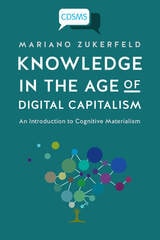
Knowledge in the Age of Digital Capitalism
An Introduction to Cognitive MaterialismMariano Zukerfeld
University of Westminster Press, 2017
Author Mariano Zukerfeld was awarded the best book prize by The Association ESOCITE (Asociación Latinamericana de Estudios Sociales de la Cience y la Tecnología).
“the book is a refreshing, dynamic approach leading back into discussions which have been neglected during the last 20 years.” -https://www.triple-c.at/index.php/tripleC/article/view/971
Knowledge in the Age of Digital Capitalism proposes a new critical theory concerning the functioning of capitalism and how we consider knowledge and information. This ambitious book systematically and lucidly introduces contemporary phenomena into the framework of cognitive materialism to address some of the great themes of the social sciences: knowledge, exploitation and social class in an account of capitalism's totality in the present day. Author Mariano Zukerfeld reinvigorates materialist study of communications, presenting a typology of knowledge to explain the underlying material forms of information, intellectual property and cognitive work in contemporary societies. Using current examples the book also examines concerns such as free labour and the pivotal role of intellectual property. The book offers nothing less than an introduction to the theory of cognitive materialism and an account of the entirety of the digital (or knowledge) capitalism of our time.
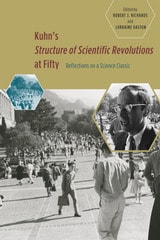
Kuhn's 'Structure of Scientific Revolutions' at Fifty
Reflections on a Science ClassicEdited by Robert J. Richards and Lorraine Daston
University of Chicago Press, 2016
In Kuhn’s “Structure of Scientific Revolutions” at Fifty, leading social scientists and philosophers explore the origins of Kuhn’s masterwork and its legacy fifty years on. These essays exhume important historical context for Kuhn’s work, critically analyzing its foundations in twentieth-century science, politics, and Kuhn’s own intellectual biography: his experiences as a physics graduate student, his close relationship with psychologists before and after the publication of Structure, and the Cold War framework of terms such as “world view” and “paradigm.”