Results by title
944 books match the query 'Indians of North America' and 33 start with l
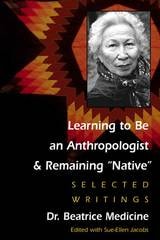
LEARNING TO BE AN ANTHROPOLOGIST
SELECTED WRITINGSDr. Beatrice Medicine
University of Illinois Press, 2001
For half a century, Dr. Medicine has defied stereotypes, racism, and sexism in her life and work while combating the reductive, patronizing views of Native Americans perpetuated by mainstream anthropologists. This retrospective collection reflects her unswerving commitment to furthering Native Americans' ability to speak for themselves and deal with the problems of contemporary life.
Learning to Be an Anthropologist and Remaining "Native" includes Medicine's clear-eyed views of assimilation, bilingual education, and the adaptive strategies by which Native Americans have conserved and preserved their ancestral languages. Her discussions of sex roles in contemporary Native American societies encompass homosexual orientation among males and females and the "warrior woman" role among Plains Indians as one of several culturally accepted positions according power and prestige to women. The volume also includes Medicine's thoughtful assessments of kinship and family structures, alcoholism and sobriety, the activism implicit in the religious ritual of the Lakota Sioux Sun Dance, and the ceremonial uses of Lakota star quilts.
"The Native American is possibly the least understood ethnic minority in contemporary American society," Medicine observes. Her decades of deliberate, generous, dedicated work have done much to reveal the workings of Native culture while illuminating the effects of racism and oppression on Indian families, kinship units, and social and cultural practices.
La Harpe's Post
Tales of French-Wichita Contact on the Eastern PlainsGeorge H. Odell
University of Alabama Press, 2002
This major contribution to contact period studies points to the Lasley Vore site in modern Oklahoma as the most likely first meeting place of Plains Indians and Europeans more than 300 years ago.
In 1718, Jean-Baptiste Bénard, Sieur de la Harpe, departed St. Malo in Brittany for the New World. La Harpe, a member of the French bourgeoisie, arrived at Dauphin Island on the Gulf coast to take up the entrepreneurial concession provided by the director of the French colony, Jean Baptiste LeMoyne de Bienville. La Harpe's charge was to open a trading post on the Red River just above a Caddoan village not far from present-day Texarkana. Following the establishment of this post, La Harpe ventured farther north to extend his trade market into the region occupied by the Wichita Indians. Here he encountered a Tawakoni village with an estimated 6,000 inhabitants, a number that swelled to 7,000 during the ten-day visit.
Despite years of ethnohistoric and archaeological research, no scholar had successfully established where this important meeting took place. Then in 1988, George Odell and his crew surveyed and excavated an area 13 miles south of Tulsa, along the Arkansas River, that revealed undeniable association of Native American habitation refuse with 18th-century European trade goods.
Odell here presents a full account of the presumed location of the Tawakoni village as revealed through the analysis of excavated materials from nine specialist collaborators. In a strikingly well-written narrative report, employing careful study and innovative analysis supported by appendixes containing the excavation data, Odell combines documentary history and archaeological evidence to pinpoint the probable site of the first European contact with North American Plains Indians.
Lamar Archaeology
Mississippian Chiefdoms in the Deep SouthEdited by Mark Williams and Gary Shapiro
University of Alabama Press, 1990
A Dan Josselyn Memorial Publication
Lamar Archaeology provides a comprehensive and detailed review of our knowledge of the late prehistoric Indian societies in the Southern Appalachian area and its peripheries. These Lamar societies were chiefdom-level groups who built most of the mounds in this large region and were ancestors of later tribes, including the Creeks and Cherokees. This book begins with a history of the last 50 years of archaeological and historical research and brings together for the first time all the available data on this early culture. It also provides an invaluable model for books about Southeastern Indian societies by combining purely descriptive information with innovative analyses, advancing our knowledge of the past while remaining firmly grounded in the archaeological evidence as fact.
Contributors include:
Frankie Snow, Chad O. Braley, James B. Langford Jr., Marvin T. Smith, Daniel T. Elliott, Richard R. Polhemus, C. Roger Nance, Gary Shapiro, Mark Williams, John F. Scarry, David G. Anderson, andCharles M. Hudson

Lamp Back
Plays and Other GrievancesAnthony Hudson, Kate Bredeson
Northwestern University Press, 2027
A major collection of performance works by artist and agitator Anthony Hudson
Lamp Back: Plays and Other Grievances collects nearly a decade of work by Anthony Hudson, a queer Indigenous artist and agitator also known as Portland, Oregon’s premier drag clown, Carla Rossi. Whether fumbling with a lamp in a satirical takedown of land acknowledgments or confronting the history of redface in pop culture, Hudson alternates between Rossi’s cackling “ghost of white privilege” and more earnest, vulnerable confessionals as himself—all with a deep commitment to bitter humor and brutal honesty. In these performance works, a mixed-race Native boy plays a pilgrim in his kindergarten Thanksgiving pageant. A young artist recounts the racism in their favorite musical and the larger American theater system. A drag queen storytime goes disastrously wrong and calls for an exorcism with a plunger. Kate Bredeson’s unflinching introduction speaks to Hudson’s work through a cultural and historical lens and illuminates the importance of his project to filet the American Empire.
Land Hunger
Ohio and the Western FrontiersMansel G. Blackford
Ohio University Press, 2025
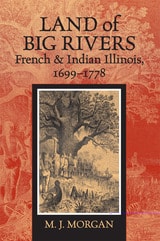
Land of Big Rivers
French and Indian Illinois, 1699-1778M. J. Morgan
Southern Illinois University Press, 2010
Drawing on research from a variety of academic fields, such as archaeology, history, botany, ecology, and physical science, M. J. Morgan explores the intersection of people and the environment in early eighteenth-century Illinois Country—a stretch of fecund, alluvial river plain along the Mississippi river. Arguing against the traditional narrative that describes Illinois as an untouched wilderness until the influx of American settlers, Morgan illustrates how the story began much earlier.
She focuses her study on early French and Indian communities, and later on the British, nestled within the tripartite environment of floodplain, riverine cliffs and bluffs, and open, upland till plain/prairie and examines the impact of these diverse groups of people on the ecological landscape. By placing human lives within the natural setting of the period—the abundant streams and creeks, the prairies, plants and wildlife—she traces the environmental change that unfolded across almost a century. She describes how it was a land in motion; how the occupying peoples used, extracted, and extirpated its resources while simultaneously introducing new species; and how the flux and flow of life mirrored the movement of the rivers. Morgan emphasizes the importance of population sequences, the relationship between the aboriginals and the Europeans, the shared use of resources, and the effects of each on the habitat.
Land of Big Rivers is a unique, many-themed account of the big-picture ecological change that occurred during the early history of the Illinois Country. It is the first book to consider the environmental aspects of the Illinois Indian experience and to reconsider the role of the French and British in environmental change in the mid-Mississippi Valley. It engagingly recreates presettlement Illinois with a remarkable interdisciplinary approach and provides new details that will encourage understanding of the interaction between physical geography and the plants, animals, and people in the Illinois Country. Furthermore, it exhibits the importance of looking at the past in the context of environmental transformation, which is especially relevant in light of today’s global climate change.
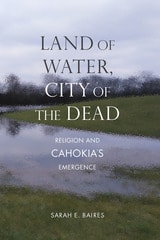
Land of Water, City of the Dead
Religion and Cahokia's EmergenceSarah E. Baires
University of Alabama Press, 2017
Explores the embodiment of religion in the Cahokia land and how places create, make meaningful, and transform practices and beliefs
Cahokia, the largest city of the Mississippian mound cultures, lies outside present-day East St. Louis. Land of Water, City of the Dead reconceptualizes Cahokia’s emergence and expansion (ca. 1050–1200), focusing on understanding a newly imagined religion and complexity through a non-Western lens. Sarah E. Baires argues that this system of beliefs was a dynamic, lived component, based on a broader ontology, with roots in other mound societies. This religion was realized through novel mortuary practices and burial mounds as well as through the careful planning and development of this early city’s urban landscape.
Baires analyzes the organization and alignment of the precinct of downtown Cahokia with a specific focus on the newly discovered and excavated Rattlesnake Causeway and the ridge-top mortuary mounds located along the site axes. Land of Water, City of the Dead also presents new data from the 1954 excavations of the ridge-top mortuary Wilson Mound and a complete analysis of the associated human remains. Through this skeletal analysis, Baires discusses the ways that Cahokians processed and buried their ancestors, identifying unique mortuary practices that include the intentional dismemberment of human bodies and burial with marine shell beads and other materials.
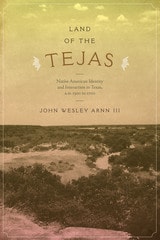
Land of the Tejas
Native American Identity and Interaction in Texas, A.D. 1300 to 1700By John Wesley Arnn III
University of Texas Press, 2012
Combining archaeological, historical, ethnographic, and environmental data, Land of the Tejas represents a sweeping, interdisciplinary look at Texas during the late prehistoric and early historic periods. Through this revolutionary approach, John Wesley Arnn reconstructs Native identity and social structures among both mobile foragers and sedentary agriculturalists. Providing a new methodology for studying such populations, Arnn describes a complex, vast, exotic region marked by sociocultural and geographical complexity, tracing numerous distinct peoples over multiple centuries.
Drawing heavily on a detailed analysis of Toyah (a Late Prehistoric II material culture), as well as early European documentary records, an investigation of the regional environment, and comparisons of these data with similar regions around the world, Land of the Tejas examines a full scope of previously overlooked details. From the enigmatic Jumano Indian leader Juan Sabata to Spanish friar Casanas's 1691 account of the vast Native American Tejas alliance, Arnn's study shines new light on Texas's poorly understood past and debunks long-held misconceptions of prehistory and history while proposing a provocative new approach to the process by which we attempt to reconstruct the history of humanity.
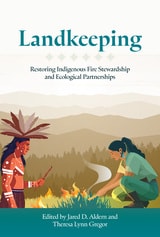
Landkeeping
Restoring Indigenous Fire Stewardship and Ecological PartnershipsJared D. Aldern
Oregon State University Press, 2026
With rising temperatures, longer summers, drought, and more wildfires occurring in the United States and Canada, there is growing interest in the impact and efficacy of Indigenous fire and cultural burning practices. Indigenous communities throughout this region known as Turtle Island have long used fire to manage their homelands. An interdisciplinary anthology that includes extensive Native views, Landkeeping provides engaging perspectives on the role of Indigenous fire and its importance to our ecological health, cultural continuity, and land-based kinship.
Indigenous-identified and non-Indigenous allies and researchers in ecology, natural resource management, forestry, ethnobotany, and Native American/Indigenous Studies demonstrate how Indigenous knowledge offers sustainable, relational approaches to land care and resilience. Each chapter builds on the idea that fire stewardship is a manifestation of Traditional Ecological Knowledge (TEK)—a system of knowledge that is rooted in place, transmitted through oral traditions and embodied practices, and guided by values such as reciprocity, responsibility, and interdependence with more-than-humans. By recognizing that fire is part of a larger cosmology, Landkeeping contributors share how fire stewardship is a path toward ecological balance, cultural revitalization, and just climate futures.
Landscapes and Social Transformations on the Northwest Coast
Colonial Encounters in the Fraser ValleyJeff Oliver
University of Arizona Press, 2010
The Fraser Valley has long been a scene of natural resource appropriation—furs and fish, timber and agriculture—with settlement patterns and land claims centering on the use of these materials. Oliver demonstrates how social change and cultural understanding are tied to the way that people use and remake the landscape. Drawing on ethnographic texts, archaeological evidence, cartography, and historical writing, he has created a deep history of the valley that enables us to view how human entanglements with landscape were creative of a variety of contentious issues. By capturing the multiple dynamics that were operating in the past, Oliver shows us not only how landscape transformations were implicated in constructing different perceptions of place but also how such changes influenced peoples’ understanding of history and identity.
This groundbreaking work examines engagement between people and the environment across a variety of themes, from aboriginal appropriation of nature to colonists’ reworking of physical and conceptual geographies, demonstrating the consequences of these interactions as they permeated various social and cultural spheres. It offers a new lens for viewing a region as it provides fresh insight into such topics as landscape change, perceptions of place, and Indigenous-white relations.
Late Holocene Research on Foragers and Farmers in the Desert West
Barbara J. Roth and Maxine E. McBrinn
University of Utah Press, 2015
Three main themes link these papers: the role of the environment in shaping prehistoric behavior, flexibility in foraging and farming adaptations, and diversity in settlement strategies. Contributors cover a range of topics including the varied ways hunter-gatherers adapted to arid environments, the transition from hunting and gathering to farming and the reasons for it, the variation in early farmers across the Southwest and Great Basin, and the differing paths followed as they developed settled villages.
Late Intermediate Occupation at Cerro Azul, Perú, A Preliminary Report
Joyce Marcus
University of Michigan Press, 1987
Late Prehistoric Bison Procurement in Southeastern New Mexico
The 1977 Season at the Garnsey SiteJohn D. Speth and William J. Parry
University of Michigan Press, 1978
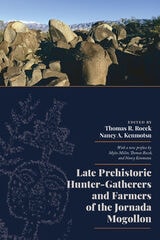
Late Prehistoric Hunter-Gatherers and Farmers of the Jornada Mogollon
Thomas R. Rocek
University Press of Colorado, 2023
The Jornada branch of the Mogollon culture and its inhabitants played a significant economic, political, and social role at multiple scales. This volume draws together results from recent large-scale CRM work that has amassed among the largest data sets in the Southwest with up-to-date chronological, architectural, faunal, ceramic, obsidian sourcing, and other specialized studies. Chapters by some of the most active researchers in the area address topics that reach beyond the American Southwest, such as mobility, forager adaptations, the transition to farming, responses to environmental challenges, and patterns of social interaction.
Late Prehistoric Hunter-Gatherers and Farmers of the Jornada Mogollon is an up-to-date summary of the major developments in the region and their implications for Southwest archaeology in particular and anthropological archaeological research more generally.
The publication of this book is supported in part by the Arizona Archaeological and Historical Society and the Center for Material Culture Studies at the University of Delaware.
Contributors: Rafael Cruz Antillón, Douglas H. M. Boggess, Peter C. Condon, Linda Scott Cummings, Moira Ernst, Tim Graves, David V. Hill, Nancy A. Kenmotsu, Shaun M. Lynch, Arthur C. MacWilliams, Mary Malainey, Timothy D. Maxwell, Myles R. Miller, John Montgomery, Jim A. Railey, Thomas R. Rocek, Matt Swanson, Christopher A. Turnbow, Javier Vasquez, Regge N. Wiseman, Chad L. Yost
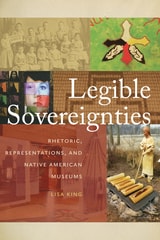
Legible Sovereignties
Rhetoric, Representations, and Native American MuseumsLisa King
Oregon State University Press, 2017
King tracks the exhibit spaces at the Saginaw Chippewa Indian Tribe of Michigan’s Ziibiwing Center, Haskell Indian Nation University’s Cultural Center and Museum, and the Smithsonian’s Washington, DC branch of the National Museum of the American Indian over their first ten years, from their opening until the summer of 2014. Far from formulaic, each site has developed its own rhetorical approaches to reaching its public, revealing multiple challenges and successes in making Native self-representation legible and accessible.
Through documentation and analysis of the inaugural exhibits and recent installations, interviews with curators and staff, and investigation into audience reception of these spaces, Legible Sovereignties argues that there can be no single blanket solution for effective Indigenous self-representation. Instead, Legible Sovereignties demonstrates the nuanced ways in which each site must balance its rhetorical goals and its audience's needs, as well as its material constraints and opportunities, in order to reach its visitors and have Indigenous voices heard.
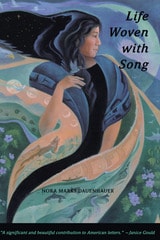
Life Woven with Song
Nora Marks Dauenhauer
University of Arizona Press, 2000
In prose, Dauenhauer presents stories such as "Egg Boat"--the tale of a twelve-year-old girl fishing the North Pacific for the first time alone--and an autobiographical piece that reveals much about Tlingit lifeways. Then in a section of short lyrical poems she offers crystalline tributes to her land and people. In a concluding selection of plays, Dauenhauer presents three Raven stories that were adapted as stage plays from oral versions told in Tlingit by three storytellers of her community. These plays were commissioned by the Naa Kahidi Theater and have been performed throughout America and Europe. They take the form of a storyteller delivering a narrative while other members of the cast act and dance in masks and costumes.
Collectively, Dauenhauer's writings form an "autoethnography," offering new insight into how the Tlingit have been affected by modernization and how Native American culture perseveres in the face of change. Despite the hardships her people have seen, this woman affirms the goodness of life as found in family and community, in daily work and play, and in tribal traditions.
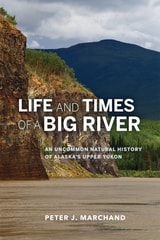
Life and Times of a Big River
An Uncommon Natural History of Alaska's Upper YukonPeter J. Marchand
University of Alaska Press, 2015
Life and Times of a Big River follows Peter J. Marchand and his team of biologists as they set out to explore the land that would ultimately become the Yukon-Charley Rivers National Preserve. Their encounters with strange plants, rare insects, and little-known mammals bring to life a land once thought to be static and monotonous. And their struggles to navigate and adapt to an unforgiving environment capture the rigorous demands of remote field work. Weaving in and out of Marchand's narrative is an account of the natural and cultural history of the area as it relates to the expedition and the region’s Native peoples. Life and Times of a Big River chorincles this riveting, one-of-a-kind journey of uncertainty and discovery from a disparate (and at one point desperate) group of biologists.
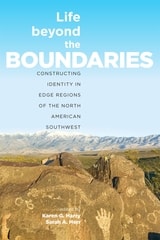
Life beyond the Boundaries
Constructing Identity in Edge Regions of the North American SouthwestKaren Harry
University Press of Colorado, 2018
Life beyond the Boundaries explores identity formation on the edges of the ancient Southwest. Focusing on some of the more poorly understood regions, including the Jornada Mogollon, the Gallina, and the Pimería Alta, the authors use methods drawn from material culture science, anthropology, and history to investigate themes related to the construction of social identity along the perimeters of the American Southwest.
Through an archaeological lens, the volume examines the social experiences of people who lived in edge regions. Through mobility and the development of extensive social networks, people living in these areas were introduced to the ideas and practices of other cultural groups. As their spatial distances from core areas increased, the degree to which they participated in the economic, social, political, and ritual practices of ancestral core areas increasingly varied. As a result, the social identities of people living in edge zones were often—though not always—fluid and situational.
Drawing on an increase of available information and bringing new attention to understudied areas, the book will be of interest to scholars of Southwestern archaeology and other researchers interested in the archaeology of low-populated and decentralized regions and identity formation. Life beyond the Boundaries considers the various roles that edge regions played in local and regional trajectories of the prehistoric and protohistoric Southwest and how place influenced the development of social identity.
Contributors: Lewis Borck, Dale S. Brenneman, Jeffery J. Clark, Severin Fowles, Patricia A. Gilman, Lauren E. Jelinek, Myles R. Miller, Barbara J. Mills, Matthew A. Peeples, Kellam Throgmorton, James T. Watson
Life in a Mississippian Warscape
Common Field, Cahokia, and the Effects of WarfareMeghan E. Buchanan
University of Alabama Press, 2022
Analyzes Mississippian daily life at Cahokia’s environs during wartime
In Life in a Mississippian Warscape: Common Field, Cahokia, and the Effects of Warfare Meghan E. Buchanan posits that to understand the big histories of warfare, political fragmentation, and resilience in the past archaeologists must also analyze and interpret the microscale actions of the past. These are the daily activities of people before, during, and after historical events. Within warscapes, battles take place in peoples’ front yards, family members die, and the impacts of violence in near and distant places are experienced on a daily basis. This book explores the microscale of daily lives of people living at Common Field, a large, palisaded mound center, during the period of Cahokia’s abandonment and the spread of violence and warfare throughout the Southeast.
Linking together ethnographic, historic, and archaeological sources, Buchanan discusses the evidence that the people of Common Field engaged in novel and hybrid practices in these dangerous times. At the microscale, they adopted new ceramic tempering techniques, produced large numbers of serving vessels decorated with warfare-related imagery, adapted their food practices, and erected a substantial palisade with specially prepared deposits. The overall picture that emerges at Common Field is of a people who engaged in risk-averse practices that minimized their exposure to outside of the palisade and attempted to seek intercession from otherworldly realms through public ceremonies involving warfare-related iconography.
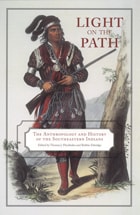
Light on the Path
The Anthropology and History of the Southeastern IndiansThomas J. Pluckhahn
University of Alabama Press, 2006
The scholarship underlying this shift comes from many directions, but much of the groundwork can be attributed to Charles Hudson. The papers in this volume were contributed by Hudson’s colleagues and former students (many now leading scholars themselves) in his honor. The assumption links these papers is that of a historical transformation between Mississippian societies and the Indian societies of the historic era that requires explanation and critical analysis.
In all of the chapters, the legacy of Hudson’s work is evident. Anthropologists, archaeologists, and historians are storming the bridge that connects prehistory and history in a manner unimaginable 20 years ago. While there remains much work to do on the path toward understanding this transformation and constructing a complete social history of the Southeastern Indians, the work of Charles Hudson and his colleagues have shown the way.
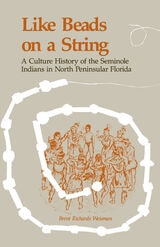
Like Beads on a String
A Culture History of the Seminole Indians in North Peninsular FloridaBrent Richards Weisman
University of Alabama Press, 1989
Florida's Seminole Indians are exerting an ever increasing influence on crucial issues in state politics, economy, and law. From a position of near obscurity less than a century ago, these Native Americans have staged a remarkable comeback to take an active hand in shaping Florida society, present and future. Anthropologists have long been fascinated with the Seminoles and have often remarked upon their ability to adapt to new circumstances while preserving the core features of their traditional culture. Early observers of the Seminoles also commented on the dynamic tension that existed for the individual, clan, and tribe, that drew them together, "like beads on a string," into a resilient and viable society. This study traces the emergence of these qualities in the late prehistoric and early historic period in the Southeast and demonstrates their influence on the course of Seminole culture history.

Like a Loaded Weapon
The Rehnquist Court, Indian Rights, and the Legal History of Racism in AmericaRobert Williams Jr.
University of Minnesota Press, 2005
Beginning with Chief Justice John Marshall’s foundational opinions in the early nineteenth century and continuing today in the judgments of the Rehnquist Court, Williams shows how undeniably racist language and precedent are still used in Indian law to justify the denial of important rights of property, self-government, and cultural survival to Indians. Building on the insights of Malcolm X, Thurgood Marshall, and Frantz Fanon, Williams argues that racist language has been employed by the courts to legalize a uniquely American form of racial dictatorship over Indian tribes by the U.S. government.
Williams concludes with a revolutionary proposal for reimagining the rights of American Indians in international law, as well as strategies for compelling the current Supreme Court to confront the racist origins of Indian law and for challenging bigoted ways of talking, thinking, and writing about American Indians.
Robert A. Williams Jr. is professor of law and American Indian studies at the James E. Rogers College of Law, University of Arizona. A member of the Lumbee Indian Tribe, he is author of The American Indian in Western Legal Thought: The Discourses of Conquest and coauthor of Federal Indian Law.
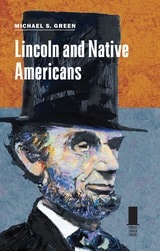
Lincoln and Native Americans
Michael S. Green
Southern Illinois University Press, 2021
First exploration of Lincoln’s relationship with the Native population in more than four decades
President Abraham Lincoln ordered the largest mass execution of Indigenous people in American history, following the 1862 uprising of hungry Dakota in Minnesota and suspiciously speedy trials. He also issued the largest commutation of executions in American history for the same act. But there is much more to the story of Lincoln’s interactions and involvement, personal and political, with Native Americans, as Michael S. Green shows. His evenhanded assessment explains how Lincoln thought about Native Americans, interacted with them, and was affected by them.
Although ignorant of Native customs, Lincoln revealed none of the hatred or single-minded opposition to Native culture that animated other leaders and some of his own political and military officials. Lincoln did far too little to ease the problems afflicting Indigenous people at the time, but he also expressed more sympathy for their situation than most other politicians of the day. Still, he was not what those who wanted legitimate improvements in the lives of Native Americans would have liked him to be.
At best, Lincoln’s record is mixed. He served in the Black Hawk War against tribes who were combating white encroachment. Later he supported policies that exacerbated the situation. Finally, he led the United States in a war that culminated in expanding white settlement. Although as president, Lincoln paid less attention to Native Americans than he did to African Americans and the Civil War, the Indigenous population received considerably more attention from him than previous historians have revealed.
In addition to focusing on Lincoln’s personal and familial experiences, such as the death of his paternal grandfather at the hands of Indians, Green enhances our understanding of federal policies toward Native Americans before and during the Civil War and how Lincoln’s decisions affected what came after the war. His patronage appointments shaped Indian affairs, and his plans for the West would also have vast consequences. Green weighs Lincoln’s impact on the lives of Native Americans and imagines what might have happened if Lincoln had lived past the war’s end. More than any many other historians, Green delves into Lincoln’s racial views about people of color who were not African American.
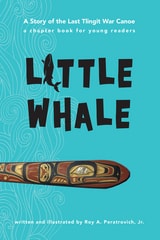
Little Whale
A Story of the Last Tlingit War CanoeRoy A. Peratrovich, Jr.
University of Alaska Press, 2016
And it’s mostly true. Roy Peratrovich here builds a wonderful children’s tale on the bones of a story his own grandfather passed down. His accompanying illustrations bring the people and landscapes of Alaska—to say nothing of the adventures!—to stunning life, drawing young readers into a long-gone time when the whims of nature and man could suddenly test a boy’s courage.
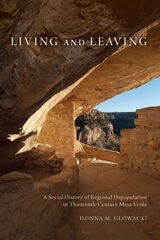
Living and Leaving
A Social History of Regional Depopulation in Thirteenth-Century Mesa VerdeDonna M. Glowacki
University of Arizona Press, 2015
Much of the focus on this topic has been directed at understanding the role of climate change, drought, violence, and population pressure. The role of social factors, particularly religious change and sociopolitical organization, are less well understood. Bringing together multiple lines of evidence, including settlement patterns, pottery exchange networks, and changes in ceremonial and civic architecture, this book takes a historical perspective that naturally forefronts the social factors underlying the depopulation of Mesa Verde.
Author Donna M. Glowacki shows how “living and leaving” were experienced across the region and what role differing stressors and enablers had in causing emigration. The author’s analysis explains how different histories and contingencies—which were shaped by deeply rooted eastern and western identities, a broad-reaching Aztec-Chaco ideology, and the McElmo Intensification—converged, prompting everyone to leave the region. This book will be of interest to southwestern specialists and anyone interested in societal collapse, transformation, and resilience.
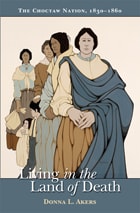
Living in the Land of Death
The Choctaw Nation, 1830-1860Donna L. Akers
Michigan State University Press, 2004
With the Indian Removal Act of 1830, the Choctaw people began their journey over the Trail of Tears from their homelands in Mississippi to the new lands of the Choctaw Nation. Suffering a death rate of nearly 20 percent due to exposure, disease, mismanagement, and fraud, they limped into Indian Territory, or, as they knew it, the Land of the Dead (the route taken by the souls of Choctaw people after death on their way to the Choctaw afterlife). Their first few years in the new nation affirmed their name for the land, as hundreds more died from whooping cough, floods, starvation, cholera, and smallpox.
Living in the Land of the Dead depicts the story of Choctaw survival, and the evolution of the Choctaw people in their new environment. Culturally, over time, their adaptation was one of homesteads and agriculture, eventually making them self-sufficient in the rich new lands of Indian Territory. Along the Red River and other major waterways several Choctaw families of mixed heritage built plantations, and imported large crews of slave labor to work cotton fields. They developed a sub-economy based on interaction with the world market. However, the vast majority of Choctaws continued with their traditional subsistence economy that was easily adapted to their new environment.
The immigrant Choctaws did not, however, move into land that was vacant. The U.S. government, through many questionable and some outright corrupt extralegal maneuvers, chose to believe it had gained title through negotiations with some of the peoples whose homelands and hunting grounds formed Indian Territory. Many of these indigenous peoples reacted furiously to the incursion of the Choctaws onto their rightful lands. They threatened and attacked the Choctaws and other immigrant Indian Nations for years. Intruding on others’ rightful homelands, the farming-based Choctaws, through occupation and economics, disrupted the traditional hunting economy practiced by the Southern Plains Indians, and contributed to the demise of the Plains ways of life.
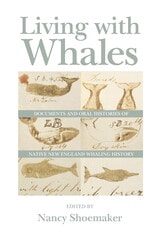
Living with Whales
Documents and Oral Histories of Native New England Whaling HistoryNancy Shoemaker
University of Massachusetts Press, 2014
Native Americans along the coasts of southern New England and Long Island have had close ties to whales for thousands of years. They made a living from the sea and saw in the world's largest beings special power and meaning. After English settlement in the early seventeenth century, the region's natural bounty of these creatures drew Natives and colonists alike to develop whale hunting on an industrial scale. By the nineteenth century, New England dominated the world in whaling, and Native Americans contributed substantially to whaleship crews.
In Living with Whales, Nancy Shoemaker reconstructs the history of Native whaling in New England through a diversity of primary documents: explorers' descriptions of their “first encounters,” indentures, deeds, merchants' accounts, Indian overseer reports, crew lists, memoirs, obituaries, and excerpts from journals kept by Native whalemen on their voyages. These materials span the centuries-long rise and fall of the American whalefishery and give insight into the far-reaching impact of whaling on Native North American communities. One chapter even follows a Pequot Native to New Zealand, where many of his Maori descendants still reside today.
Whaling has left behind a legacy of ambivalent emotions. In oral histories included in this volume, descendants of Wampanoag and Shinnecock whalemen reflect on how whales, whaling, and the ocean were vital to the survival of coastal Native communities in the Northeast, but at great cost to human life, family life, whales, and the ocean environment.
Logorrhea
PoemsAdrian C. Louis
Northwestern University Press, 2006
In a torrent of rage, love, and irony, Adrian C. Louis explodes all the myths and hypocrisy of Middle America in the twenty-first century. This is how Walt Whitman or Allen Ginsburg might have written about our post-9/11 world--where the realities of poverty on Indian reservations and the plight of Hurricane Katrina victims come in second place to the vagaries of Homeland Security. For Louis, both he and our nation face an uncertain future. Like many of us he is trapped in a surreal void of the present, where he is faced with middle age and isolation, the death of loved ones, an unsatisfying job, and the battle against loneliness and self-destruction. He writes as if he has nothing left to lose but then fills the page with bittersweet sorrow for everything that has been lost. Armed with unforgettable images, relentless rhythms, and a dark and scathing humor, Louis takes aim at this American life.
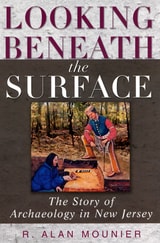
Looking Beneath the Surface
The Story of Archaeology in New JerseyMounier, R. Alan
Rutgers University Press, 2002
For more than ten thousand years, humans have lived in New Jersey. From Summit to Cape May, from Trenton to the Jersey Shore, the state is a treasure trove of archaeological artifacts, revealing much about those who occupied the region prior to European settlement. As a rule, only the most durable of human creations¾items of stone and pottery¾survive the ravages of time. To complicate matters, the onslaught of our own culture and the indiscriminate looting of sites by greedy collectors have further diminished the cultural materials left behind. The task of the archaeologist is to gather and interpret these scraps for the benefit of science and the public. But digging up relics is a trivial pursuit if the only outcome is a collection of artifacts, however attractive or valuable they may be. Understanding what those relics mean in human terms is crucial.
In Looking beneath the Surface, R. Alan Mounier looks at the human past of New Jersey. With particular focus on the ancient past and native cultures, the author tells the story of archaeology in the state as it has unfolded, and as it continues to unfold. New investigations and discoveries continually change our views and interpretations of the past. In jargon-free language, Mounier provides an in-depth introduction offering information to understand general archaeological practices as well as research in New Jersey. Subsequent chapters describe artifact types, archaeological settlements, and burial practices in detail. He concludes with vignettes of twenty-one archaeological investigations throughout the state to illustrate the variability of sites and the accomplishments of dedicated archaeologists, both professional and amateur.
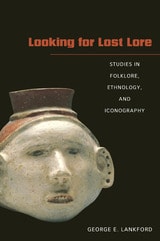
Looking for Lost Lore
Studies in Folklore, Ethnology, and IconographyGeorge E. Lankford
University of Alabama Press, 2008
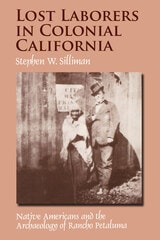
Lost Laborers in Colonial California
Native Americans and the Archaeology of Rancho PetalumaStephen W. Silliman
University of Arizona Press, 2004
This study focuses on Rancho Petaluma north of San Francisco Bay, a large livestock, agricultural, and manufacturing operation on which several hundred—perhaps as many as two thousand—Native Americans worked as field hands, cowboys, artisans, cooks, and servants. One of the largest ranchos in the region, it was owned from 1834 to 1857 by Mariano Guadalupe Vallejo, one of the most prominent political figures of Mexican California. While historians have studied Vallejo, few have considered the Native Americans he controlled, so we know little of what their lives were like or how they adjusted to the colonial labor regime.
Because Vallejo’s Petaluma Adobe is now a state historic park and one of the most well-protected rancho sites in California, this site offers unparalleled opportunities to investigate nineteenth-century rancho life via archaeology. Using the Vallejo rancho as a case study, Stephen W. Silliman examines this California rancho with a particular eye toward Native American participation. Through the archaeological record—tools and implements, containers, beads, bone and shell artifacts, food remains—he reconstructs the daily practices of Native peoples at Rancho Petaluma and the labor relations that structured indigenous participation in and experience of rancho life. This research enables him to expose the multi-ethnic nature of colonialism, counterbalancing popular misconceptions of Native Americans as either non-participants in the ranchos or passive workers with little to contribute to history.
Lost Laborers in Colonial California draws on archaeological data, material studies, and archival research, and meshes them with theoretical issues of labor, gender, and social practice to examine not only how colonial worlds controlled indigenous peoples and practices but also how Native Americans lived through and often resisted those impositions. The book fills a gap in the regional archaeological and historical literature as it makes a unique contribution to colonial and contact-period studies in the Spanish/Mexican borderlands and beyond.
Lulu Linear Punctated
Essays in Honor of George Irving QuimbyEdited by Robert C. Dunnell, Donald K. Grayson, and Walter N. Koelz
University of Michigan Press, 1983

Luminaries of the Humble
Elizabeth Woody
University of Arizona Press, 1994
In opening remarks, Woody shares anecdotes of her youth that contributed to her sense of personal history and her development as a poet. "The petroglyphs on rock in the Columbia River Gorge are part of my literary heritage," she writes. Now through the medium of the printed word, Luminaries of the Humble marks an important continuation of that tradition.