Results by title
2284 books match the query 'Women' and 83 start with l

LITIGATION AS LOBBYING
REPRODUCTIVE HAZARDS & INTEREST AGGREGATIONJULIANNA S. GONEN
The Ohio State University Press, 2003
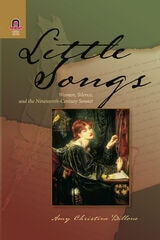
LITTLE SONGS
WOMEN, SILENCE, AND THE NINETEENTH-CENTURY SONNETAMY CHRISTINE BILLONE
The Ohio State University Press, 2002
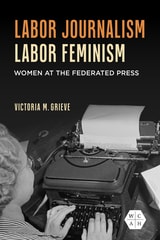
Labor Journalism, Labor Feminism
Women at the Federated PressVictoria M. Grieve
University of Illinois Press, 2026
These journalists wrote women into labor news by shedding light on essential issues like the need for equal pay and an end to discrimination. Their work increased women’s visibility in unions and the workforce while revealing that not only class but gender and race shaped their on-the-job experiences. Grieve also examines labor feminism within the larger stories of links between the Old Left and New Left and the FP’s pioneering role in articulating early iterations of intersectional feminism.
A compelling portrait of four women and a movement, Labor Journalism, Labor Feminism looks at an essential labor press organization and profiles politically active, leftist women who created relationships, established networks, and worked for social change.
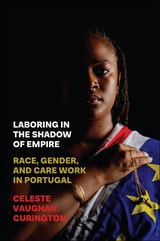
Laboring in the Shadow of Empire
Race, Gender, and Care Work in PortugalCeleste Vaughan Curington
Rutgers University Press, 2024
Winner of the ASA Race, Gender, and Class section's Distinguished Contribution to Scholarship Award
Winner of the ASA Racial and Ethnic Minorities section’s Oliver Cromwell Cox Book Award
Laboring in the Shadow of Empire: Race, Gender, and Care Work in Portugal examines the everyday lives of an African-descendant care service workforce that labors in an ostensibly “anti-racial” Europe and against the backdrop of the Portuguese colonial empire. While much of the literature on global care work has focused on Asian and Latine migrant care workers, there is comparatively less research that explicitly examines African care workers and their migration histories to Europe. Sociologist Celeste Vaughan Curington focuses on Portugal—a European setting with comparatively liberal policies around family settlement and naturalization for migrants. In this setting, rapid urbanization in the late twentieth century, along with a national push to reconcile work and family, has shaped the growth of paid home care and cleaning service industries. Many researchers focus on informal work settings, where immigrant rights are restricted and many workers are undocumented or without permanent residence status. Curington instead examines workers who have accessed citizenship or permanent residence status and also explores African women’s experiences laboring in care and service industries in the formal market, revealing how deeply colonial and intersectional logics of a racialized and international division of reproductive labor in Portugal render these women “hyper-invisible” and “hyper-visible” as “appropriate” workers in Lisbon.
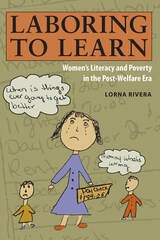
Laboring to Learn
Women's Literacy and Poverty in the Post-Welfare EraLorna Rivera
University of Illinois Press, 2007
The American adult education system has become an alternative for school dropouts, with some state welfare policies requiring teen mothers and women without high school diplomas to participate in adult education programs to receive aid. Currently, low-income women of color are more likely to be enrolled in the lowest levels of adult basic education. Very little has been published about women's experiences in these mandatory programs and whether the programs reproduce the conditions that forced women to drop out in the first place.
Lorna Rivera bridges the gap with this important study, the product of ten years' active ethnographic research with formerly homeless women who participated in adult literacy education classes before and after welfare reform. She draws on rich interviews with organizers and participants in the Adult Learners Program at Project Hope, a women's shelter and community development organization in Boston's Dudley neighborhood, one of the poorest in the city.
Analyzing the web of ideological contradictions regarding "work first" welfare reform policies, Rivera argues that poverty is produced and reproduced when women with low literacy skills are pushed into welfare-to-work programs and denied education. She examines how various discourses about individual choice and self-sufficiency shape the purposes of literacy, how low-income women express a sense of personal responsibility for being poor, and how neoliberal ideologies and practices compromise the goals of critical literacy programs. Throughout this study, the voices and experiences of formerly homeless women challenge cultural stereotypes about poor women, showing in personal and structural terms how social and economic forces shape and restrict opportunities for low-income women of color.
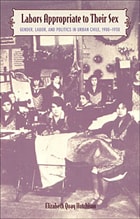
Labors Appropriate to Their Sex
Gender, Labor, and Politics in Urban Chile, 1900–1930Elizabeth Quay Hutchison
Duke University Press, 2001
In addition to population and industrial censuses, Hutchison culls published and archival sources to illuminate such misconceptions and to reveal how women’s paid labor became a locus of anxiety for a society confronting social problems—both real and imagined—that were linked to industrialization and modernization. The limited options of working women were viewed by politicians, elite women, industrialists, and labor organizers as indicative of a society in crisis, she claims, yet their struggles were also viewed as the potential springboard for reform. Labors Appropriate to Their Sex thus demonstrates how changing norms concerning gender and work were central factors in conditioning the behavior of both male and female workers, relations between capital and labor, and political change and reform in Chile.

Ladders To Fire
New Expanded EditionAnaïs Nin
Ohio University Press, 1959
After struggling with her own press and printing her own works, Anaïs Nin succeeded in getting Ladders to Fire accepted and published in 1946. This recognition marked a milestone in her life and career. Admitted into the fellowship of American novelists, she maintained the individuality of her literary style. She resisted realistic writing and drew on the experience and intuitions of her diary to forge a novelistic style emphasizing free association, the language of emotion, spontaneity, and improvisation.
Ladders to Fire is the first volume of Nin’s celebrated series of novels called Cities of the Interior
For Anaïs Nin, her writing and her life were not separable, they were both part of the same experience. She claimed that “is it the fiction writer who edited the diary.”
Anaïs Nin continues to find an audience, whether for her fiction, her diaries, or her own life story, which has enjoyed the attention of biographers and filmmakers. This 1995 reissue of Ladders to Fire has a new cover and foreword.

Ladders to Fire
Anaïs Nin
Ohio University Press, 2014
Anaïs Nin’s Ladders to Fire interweaves the stories of several women, each emotionally inhibited in her own way: through self-doubt, fear, guilt, moral drift, and distrust. The novel follows their inner struggles to overcome these barriers to happiness and wholeness. The author’s own experiences, as recorded in her famous diaries, supplied the raw material for her fiction. It was her intuitive, experimental, and always original style that transformed one into the other. Nin herself memorably claimed that “it was the fiction writer who edited the diary.”
Ladders to Fire is the first book of Nin’s continuous novel, Cities of the Interior, which also includes Children of the Albatross,The Four-Chambered Heart,A Spy in the House of Love, and Seduction of the Minotaur. These loosely interlinked stories develop the characters and themes established in the first volume, leading slowly toward a resolution of inner turmoil and conflict.
This Swallow Press reissue of Ladders to Fire includes a new introduction by Nin scholar Benjamin Franklin V, as well as Gunther Stuhlmann’s classic foreword to the 1995 edition.
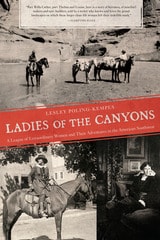
Ladies of the Canyons
A League of Extraordinary Women and Their Adventures in the American SouthwestLesley Poling-Kempes
University of Arizona Press, 2015
Educated, restless, and inquisitive, Natalie Curtis, Carol Stanley, Alice Klauber, and Mary Cabot Wheelwright were plucky, intrepid women whose lives were transformed in the first decades of the twentieth century by the people and the landscape of the American Southwest. Part of an influential circle of women that included Louisa Wade Wetherill, Alice Corbin Henderson, Mabel Dodge Luhan, Mary Austin, and Willa Cather, these ladies imagined and created a new home territory, a new society, and a new identity for themselves and for the women who would follow them.
Their adventures were shared with the likes of Theodore Roosevelt and Robert Henri, Edgar Hewett and Charles Lummis, Chief Tawakwaptiwa of the Hopi, and Hostiin Klah of the Navajo. Their journeys took them to Monument Valley and Rainbow Bridge, into Canyon de Chelly, and across the high mesas of the Hopi, down through the Grand Canyon, and over the red desert of the Four Corners, to the pueblos along the Rio Grande and the villages in the mountains between Santa Fe and Taos.
Although their stories converge in the outback of the American Southwest, the saga of Ladies of the Canyons is also the tale of Boston’s Brahmins, the Greenwich Village avant-garde, the birth of American modern art, and Santa Fe’s art and literary colony.
Ladies of the Canyons is the story of New Women stepping boldly into the New World of inconspicuous success, ambitious failure, and the personal challenges experienced by women and men during the emergence of the Modern Age.
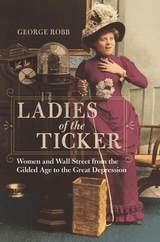
Ladies of the Ticker
Women and Wall Street from the Gilded Age to the Great DepressionGeorge Robb
University of Illinois Press, 2017
George Robb’s pioneering study explores the financial methods, accomplishments, and careers of three generations of women. Plumbing sources from stock brokers’ ledgers to media coverage, Robb reveals the many ways women invested their capital while exploring their differing sources of information, approaches to finance, interactions with markets, and levels of expertise. He also rediscovers the forgotten women bankers, brokers, and speculators who blazed new trails--and sparked public outcries over women’s unsuitability for the predatory rough-and-tumble of market capitalism.
Entertaining and vivid with details, Ladies of the Ticker sheds light on the trailblazers who transformed Wall Street into a place for women’s work.
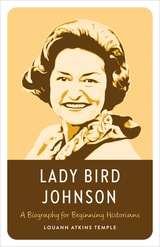
Lady Bird Johnson
A Biography for Beginning HistoriansLouann Atkins Temple
University of Texas Press, 2025
A brief biography of Lady Bird Johnson for young readers.
Louann Temple is a lifelong Texan with a personal passion for arts and education who believes that biography, with its emphasis on personalities, is ideal for introducing young people to history, with its focus on events. Temple is uniquely situated to write this biography for young readers, as she has been personally acquainted with many important people in presidential history, Lady Bird Johnson included, and she has mentored countless middle and high school students, preparing them for college admission.
Lady Bird Johnson highlights the key events in the life of the First Lady; explores the life lessons afforded by her legacy; and reflects on the broad historical issues during her time in the White House from 1963 to 1969. Married to the thirty-sixth president, Lyndon B. Johnson, Lady Bird Johnson dedicated her time as First Lady to beautifying America and conserving natural spaces. Enhanced with a carefully curated selection of black and white photographs from three presidential libraries, this biography for beginning historians is poised to bring the best of biography and history to a new generation of readers.

Lady Daredevils
American Women and Early AviationBarbara Ganson
University of Illinois Press, 2026
Women aviators challenged social norms that considered them inept with machinery and incapable of handling early flight’s very real dangers. Ganson follows how the New Woman ethos of freedom of movement and career inspired engagement with aviation. Despite resistance, women pushed limits by setting records for speed, altitude, distance, and endurance. The fashions of airwomen, meanwhile, reflected changing attitudes of women toward traditional roles and the pursuit of their career aspirations.
Informed by interviews and rare archival information, Lady Daredevils tells the stories of the pioneering women of early aviation history and reveals their dynamic interactions with social and technological change.
Lady Lushes
Gender, Alcoholism, and Medicine in Modern AmericaMcClellan, Michelle L
Rutgers University Press, 2017
In Lady Lushes, medical historian Michelle L. McClellan traces the story of the female alcoholic from the late-nineteenth through the twentieth century. She draws on a range of sources to demonstrate the persistence of the belief that alcohol use is antithetical to an idealized feminine role, particularly one that glorifies motherhood. Lady Lushes offers a fresh perspective on the importance of gender role ideology in the formation of medical knowledge and authority.
Lala's Story
A Memoir of the HolocaustLala Fishman
Northwestern University Press, 1997
Born into a middle-class Jewish family in 1932, Lala Weintraub grew up in Lvov, Poland. When the Nazis came, Lala—who had blond hair and blue eyes—survived by convincing them she was a Christian. This book tells her remarkable story. Fiercely determined and greatly aided by her Aryan looks, she managed to convince everyone—German soldiers, interrogators, fellow Poles—that she was a Polish gentile. Within a year after the Germans captured Lvov, many of Lala's family members were missing and presumed dead.
Lala's Story follows her as she moves from town to town, driven by her fear of being discovered. More than a story of survival, this is the story of a young girl's resolute struggle to defy, resist, and ultimately defeat the evil forces pursuing her.
Landscape for a Good Woman
A Story of Two LivesCarolyn Kay Steedman
Rutgers University Press, 1987
This book is about lives lived out on the borderlands, lives for which the central interpretative devices of the culture don't quite work. It has a childhood at its centre - my childhood, a personal past - and it is about the disruption of that fifties childhood by the one my mother had lived out before me, and the stories she told about it.'
Intricate and inspiring, this unusual book uses autobiographical elements to depict a mother and her daughter and two working-class childhoods (Burnley in the 1920s, South London in the 1950s) and to find a place for their stories in history and politics, in psychoanalysis and feminism.
'Provocative and quite dazzling in its ambitions. . . Beautifully written, intellectually compelling'.' Judith Walkowitz
--From 500 Great Books by Women; review by Jesse Larsen.
Las hijas de Juan
Daughters BetrayedJosie Méndez-Negrete
Duke University Press, 2006
Méndez-Negrete was born in Mexico, in the state of Zacatecas. She recalls a joyous childhood growing up in the midst of Tabasco, a vibrant town filled with extended family. Her father, though, had dreams of acquiring wealth in el norte. He worked sun-up to sun-down in the fields of south Texas. Returning home to Mexico, his pockets full of dollars, he spent evenings drinking and womanizing.
When Méndez-Negrete was eleven, her father moved the family to the United States, where they eventually settled in California’s Santa Clara Valley. There her father began molesting his daughters, viciously beating them and their mother. Within the impoverished immigrant family, the abuse continued for years, until a family friend brought it to the attention of child welfare authorities. Méndez-Negrete’s father was tried, convicted, and imprisoned.
Las hijas de Juan is told chronologically, from the time Méndez-Negrete was a child until she was a young adult trying, along with the rest of her family, to come to terms with her father’s brutal legacy. It is a harrowing story of abuse and shame compounded by cultural and linguistic isolation and a system of patriarchy that devalues the experiences of women and girls. At the same time, Las hijas de Juan is an inspiring tale, filled with strong women and hard-won solace found in traditional Mexican cooking, songs, and storytelling.
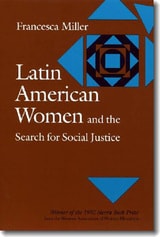
Latin American Women and the Search for Social Justice
Francesca Miller
University Press of New England, 1991
Latinamericanism after 9/11
John Beverley
Duke University Press, 2011
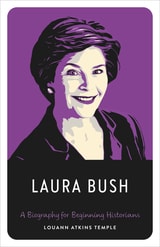
Laura Bush
A Biography for Beginning HistoriansLouann Atkins Temple
University of Texas Press, 2025
A brief biography of Laura Bush for young readers.
Louann Temple is a lifelong Texan with a personal passion for arts and education who believes that biography, with its emphasis on personalities, is ideal for introducing young people to history, with its focus on events. Temple is uniquely situated to write this biography for young readers, as she has been personally acquainted with many important people in presidential history, First Lady Laura Bush included, and she has mentored countless middle and high school students, preparing them for college admission.
Laura Bush highlights the key events in the life of the First Lady; explores the life lessons afforded by her legacy; and reflects on the broad historical issues during her time in the White House from 2001 to 2009. Married to the forty-third president, George W. Bush, Laura Bush dedicated her time as First Lady to promoting education and literacy for Americans. Enhanced with a carefully curated selection of black and white photographs from three presidential libraries, this biography for beginning historians is poised to bring the best of biography and history to a new generation of readers.
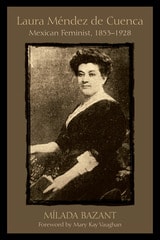
Laura Méndez de Cuenca
Mexican Feminist, 1853–1928Mílada Bazant; Foreword by Mary Kay Vaughan
University of Arizona Press, 2018
In the early 1870s, when conservative religious thought permeated all aspects of Mexican life, she was one of very few women to gain admission to an extraordinary constellation of male poets, playwrights, and novelists, who were also the publicists and statesmen of the time. She entered this world through her poetry, intellect, curiosity, assertiveness, but her personal life was fraught with tragedy: she had a child out of wedlock by poet Manuel Acuña, who killed himself shortly thereafter. She later married another poet, Agustín Fidencio Cuenca, and had seven other children. All but two of her children died, as did Agustín.
As a penniless young widow facing social rejection, Laura became a teacher and an important force in Mexico’s burgeoning educational reform program. She moved abroad—first to San Francisco, then St. Louis, then Berlin. In these places where she was not known and women had begun to move confidently in the public sphere, she could walk freely, observe, mingle, make friends across many circles, learn, think, and express her opinions. She wrote primarily for a Mexican public and always returned to Mexico because it was her country’s future that she strove to create.
Now, for the first time in English, Mílada Bazant shares with us the trajectory of a leading Mexican thinker who applied the power of the pen to human feeling, suffering, striving, and achievement.
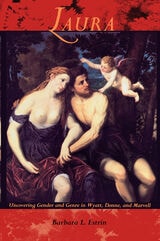
Laura
Uncovering Gender and Genre in Wyatt, Donne and MarvellBarbara L. Estrin
Duke University Press, 1994
Through close readings of the Rime sparse and the works of Wyatt, Donne, and Marvell, Estrin uncovers three Lauras: Laura-Daphne, who denies sexuality; Laura-Eve, who returns the poet’s love; and Laura-Mercury, who reinvents her own life. Estrin claims that in these three guises Laura subverts both genre and gender, thereby introducing multiple desires into the many layers of the poems. Drawing upon genre and gender theories advanced by Jean-François Lyotard and Judith Butler to situate female desire in the poem’s framework, Estrin shows how genre and gender in the Petrarchan tradition work together to undermine the stability of these very concepts.
Estrin’s Laura constitutes a fundamental reconceptualization of the Petrarchan tradition and contributes greatly to the postmodern reassessment of the Renaissance period. In its descriptions of how early modern poets formulate questions about sexuality, society and poetry, Laura will appeal to scholars of the English and Italian Renaissance, of gender studies, and of literary criticism and theory generally.
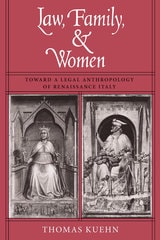
Law, Family, and Women
Toward a Legal Anthropology of Renaissance ItalyThomas Kuehn
University of Chicago Press, 1991
influence of law on Italian society during the Renaissance,
especially in the spheres of family and women. Kuehn's use
of legal sources along with letters, diaries, and
contemporary accounts allows him to present a compelling
image of the social processes that affected the shape and
function of the law.
The numerous law courts of Italian city-states
constantly devised and revised statutes. Kuehn traces the
permutations of these laws, then examines their use by
Florentines to arbitrate conflict and regulate social
behavior regarding such issues as kinship, marriage,
business, inheritance, illlegitimacy, and gender. Ranging
from one man's embittered denunciation of his father to
another's reaction to his kinsmen's rejection of him as
illegitimate, Law, Family, and Women provides
fascinating evidence of the tensions riddling family life in
Renaissance Florence. Kuehn shows how these same tensions,
often articulated in and through the law, affected women. He
examines the role of the mundualdus—a male legal guardian
for women—in Florence, the control of fathers over their
married daughters, and issues of inheritance by and through
women. An ambitious attempt to reformulate the agenda of
Renaissance social history, Kuehn's work will be of value to
both legal anthropologists and social historians.
Thomas Kuehn is professor of history at Clemson
University.
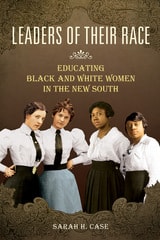
Leaders of Their Race
Educating Black and White Women in the New SouthSarah Case
University of Illinois Press, 2017
Leadership From the Margins
Women and Civil Society Organizations in Argentina, Chile, and El SalvadorCosgrove, Serena
Rutgers University Press, 2010
Leadership from the Margins describes and analyzes the unique leadership styles and challenges facing the women leaders of CSOs in Argentina, Chile, and El Salvador. Based on ethnographic research, Serena Cosgrove's analysis offers a nuanced account of the distinct struggles facing women, and how differences of class, political ideology, and ethnicity have informed their outlook and organizing strategies. Using a gendered lens, she reveals the power and potential of women's leadership to impact the direction of local, regional, and global development agendas.
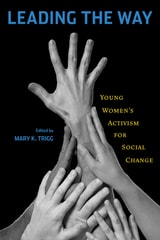
Leading the Way
Young Women's Activism for Social ChangeTrigg, Mary K
Rutgers University Press, 2009
Bringing together graduates of a women's leadership certificate program at Rutgers University's Institute for Women's Leadership, these essays provide a contrasting picture to assumptions about the current death of feminism, the rise of selfishness and individualism, and the disaffected Millennium Generation. Reflecting on a critical juncture in their lives, the years during college and the beginning of careers or graduate studies, the contributors' voices demonstrate the ways that diverse, young, educated women in the United States are embodying and formulating new models of leadership, at the same time as they are finding their own professional paths, ways of being, and places in the world. They reflect on controversial issues such as gay marriage, gender, racial profiling, war, immigration, poverty, urban education, and health care reform in a post-9/11 era.
Leading the Way introduces readers to young women who are being prepared and empowered to assume leadership roles with men in all public arenas, and to accept equal responsibility for making positive social change in the twenty-first century.
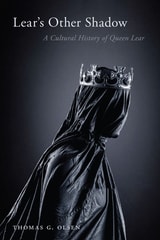
Lear’s Other Shadow
A Cultural History of Queen LearThomas G. Olsen
University of Delaware Press, 2025
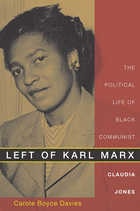
Left of Karl Marx
The Political Life of Black Communist Claudia JonesCarole Boyce Davies
Duke University Press, 2007
Claudia Cumberbatch Jones was born in Trinidad. In 1924, she moved to New York, where she lived for the next thirty years. She was active in the Communist Party from her early twenties onward. A talented writer and speaker, she traveled throughout the United States lecturing and organizing. In the early 1950s, she wrote a well-known column, “Half the World,” for the Daily Worker. As the U.S. government intensified its efforts to prosecute communists, Jones was arrested several times. She served nearly a year in a U.S. prison before being deported and given asylum by Great Britain in 1955. There she founded The West Indian Gazette and Afro-Asian Caribbean News and the Caribbean Carnival, an annual London festival that continues today as the Notting Hill Carnival. Boyce Davies examines Jones’s thought and journalism, her political and community organizing, and poetry that the activist wrote while she was imprisoned. Looking at the contents of the FBI file on Jones, Boyce Davies contrasts Jones’s own narration of her life with the federal government’s. Left of Karl Marx establishes Jones as a significant figure within Caribbean intellectual traditions, black U.S. feminism, and the history of communism.
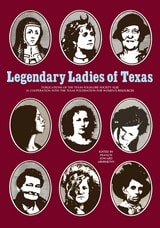
Legendary Ladies of Texas
Francis Edward Abernethy
University of North Texas Press, 1994
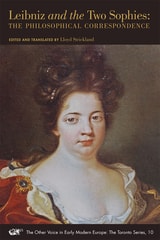
Leibniz and the Two Sophies
The Philosophical CorrespondenceGottfried Wilhelm Leibniz, Sophie Electress of Hanover, Queen Sophie Charlotte of Prussia
Iter Press, 2011

Lesbian Empire
Radical Crosswriting in the TwentiesGay Wachman
Rutgers University Press, 2001
Wachman places at the center of this tradition Sylvia Townsend Warner's achievement in undermining the inhibitions that faced women writing about forbidden love. She discusses Warner's use of crosswriting to transpose the otherwise unrepresentable lives of invisible lesbians into narratives about gay men, destabilizing the borders of race, class, and gender and challenging the codes of expression on which imperialist patriarchy and capitalism depended.

Less Than Charming
A NovelRebecca A. Demarest
Parkhurst Brothers, Inc., 2016
One character sands in the Prince’s way—Princess Sophia from Grimm’s lesser known “12 Dancing Princesses.” She’s stable—mostly—but Prince Charming is most definitely not. The good Storyteller and the First Character have tasked Sophia with stopping the Prince from destroying their world, and, by extension, ours.
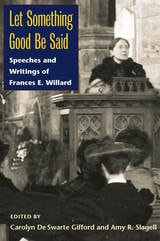
Let Something Good Be Said
Speeches and Writings of Frances E. WillardFrances E. Willard. Edited by Carolyn De Swarte Gifford and Amy R. Slagell
University of Illinois Press, 2007
Celebrated as the most famous woman in America at the time of her death in 1898, Frances E. Willard was a leading nineteenth-century American temperance and women's rights reformer and a powerful orator. President of Evanston College for Ladies (before it merged with Northwestern University) and then professor of rhetoric and aesthetics and the first dean of women at Northwestern, Willard is best known for leading the Woman's Christian Temperance Union (WCTU), America's largest women's organization. The WCTU shaped both domestic and international opinion on major political, economic, and social reform issues, including temperance, women's rights, and the rising labor movement. In what Willard regarded as her most important and far-reaching reform, she championed a new ideal of a powerful, independent womanhood and encouraged women to become active agents of social change. Willard's reputation as a powerful reformer reached its height with her election as president of the National Council of Women in 1888.
This definitive collection follows Willard's public reform career, providing primary documents as well as the historical context necessary to clearly demonstrate her skill as a speaker and writer who addressed audiences as diverse as political conventions, national women's organizations, teen girls, state legislators, church groups, and temperance advocates. Including Willard's representative speeches and published writings on everything from temperance and women's rights to the new labor movement and Christian socialism, Let Something Good Be Said is the first volume to collect the messages of one of America's most important social reformers who inspired a generation of women to activism.
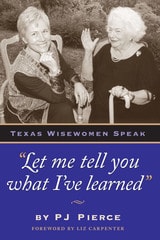
Let me tell you what I've learned
Texas Wisewomen SpeakBy PJ Pierce
University of Texas Press, 2002
Barbara Jordan spoke for many Texas women when she told a reporter, "I get from the soil and spirit of Texas the feeling that I, as an individual, can accomplish whatever I want to, and that there are no limits, that you can just keep going, just keep soaring. I like that spirit." Indeed, the sense of limitless possibilities has inspired countless Texas women—sometimes in the face of daunting obstacles—to build lives rich in work, family, friends, faith, and community involvement.
In this collection of interviews conducted by PJ Pierce, twenty-five Texas women ranging in age from 53 to 93 share the wisdom they've acquired through living unconventional lives. Responding to the question "What have you found that really matters about life?" they offer keen insights into motherhood, career challenges, being a minority, marriage and widowhood, anger, assertiveness, managing change, persevering, power, speaking out, fashioning success from failure, writing your own job description, loving a younger man, and recognizing opportunities disguised as disaster—to name only a few of their topics. In her introduction, Pierce describes how she came to write the book and how she chose her subjects to represent a cross-section of career paths and ethnic groups and all geographic areas of Texas. A topical index makes it easy to compare several women's views on a given subject.
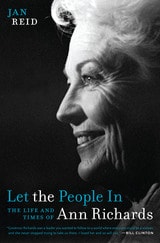
Let the People In
The Life and Times of Ann RichardsBy Jan Reid
University of Texas Press, 2012
Winner, Coral Horton Tullis Memorial Prize, Texas State Historical Association, 2012
Liz Carpenter Award for Research in the History of Women, Texas State Historical Association, 2012
When Ann Richards delivered the keynote of the 1988 Democratic National Convention and mocked President George H. W. Bush—“Poor George, he can’t help it. He was born with a silver foot in his mouth”—she instantly became a media celebrity and triggered a rivalry that would alter the course of American history. In 1990, Richards won the governorship of Texas, upsetting the GOP’s colorful rancher and oilman Clayton Williams. The first ardent feminist elected to high office in America, she opened up public service to women, blacks, Hispanics, Asian Americans, gays, and the disabled. Her progressive achievements and the force of her personality created a lasting legacy that far transcends her rise and fall as governor of Texas.
In Let the People In, Jan Reid draws on his long friendship with Richards, interviews with her family and many of her closest associates, her unpublished correspondence with longtime companion Bud Shrake, and extensive research to tell a very personal, human story of Ann Richards’s remarkable rise to power as a liberal Democrat in a conservative Republican state. Reid traces the whole arc of Richards’s life, beginning with her youth in Waco, her marriage to attorney David Richards, her frustration and boredom with being a young housewife and mother in Dallas, and her shocking encounters with Lyndon Johnson and Jimmy Carter. He follows Richards to Austin and the wild 1970s scene and describes her painful but successful struggle against alcoholism. He tells the full, inside story of Richards’s rise from county office and the state treasurer’s office to the governorship, where she championed gun control, prison reform, environmental protection, and school finance reform, and he explains why she lost her reelection bid to George W. Bush, which evened his family’s score and launched him toward the presidency. Reid describes Richards’s final years as a world traveler, lobbyist, public speaker, and mentor and inspiration to office holders, including Hillary Clinton. His nuanced portrait reveals a complex woman who battled her own frailties and a good-old-boy establishment to claim a place on the national political stage and prove “what can happen in government if we simply open the doors and let the people in.”

Lethal Decisions
The Unnecessary Deaths of Women and Children from HIV/AIDSArthur J. Ammann
Vanderbilt University Press, 2017
Inexplicably, the World Health Organization recommended withholding treatment for the majority of HIV-infected individuals in poor countries, and clinical researchers embarked on studies to evaluate inferior treatment approaches even while the pandemic continued to claim the lives of millions of women and children. Why did it take an additional twenty years for international health organizations to recommend the treatment and prevention measures that had had such a profound impact on the pandemic in wealthy countries? The surprising answers are likely to be debated by medical historians and ethicists.
At last, in 2015, came a universal call for treating all HIV-infected individuals with triple-combination antiretroviral drugs. But this can only be accomplished if the mistakes of the past are rectified. The book ends with recommendations on how the pediatric HIV/AIDS epidemic can finally be brought to an end.

Letters
Isabella Andreini
Iter Press, 2023
Isabella Andreini (1562–1604) was a commedia dell’arte diva who toured Italy and France as part of the Compagnia dei Comici Gelosi. Letters is a collection of epistles written by Andreini in fictional, anonymous, male, and female voices, a “hermaphroditic” alternation of gender unlike any that had been seen in letter writing to that time. In her letters, Andreini remade the humanistic epistolary genre into a distinctive fusion of literary and dramatic performance. The guise of epistolary intimacy cedes to a knowing artificiality, which allows for the emergence of Andreini’s modern critique of the gendered self as a uniform entity. The collection centers on love and examines—from surprising perspectives—pertinent issues such as death, the birth of a girl, prostitution, patriarchal marital practices, love in old age, courtiership, country and city life, human nature, and defenses and critiques of both sexes.

Letters from Clara
One Intrepid Woman's Travels on the Eve of War, 1936-1939Janet Newman
Wisconsin Historical Society Press, 2022
Letters on Natural Philosophy
The Scientific Correspondence of a Sixteenth-Century Pharmacist, with Related TextsCamilla Erculiani
Iter Press, 2020
This edition presents the first full English translation of Erculiani’s book and other relevant texts, bringing to light the cultural context and scientific thought of this unique natural philosopher.

Letters to Francesco Datini
Margherita Datini
Iter Press, 2012
—Jane Tylus
Professor of Italian Studies and vice provost for academic affairs, New York University
Letters to Her Sons, 1447–1470
Alessandra Macinghi Strozzi
Iter Press, 2016
The seventy-three surviving letters written by Florentine widow, Alessandra Macinghi Strozzi (c.1406–1471), to her distant sons first appeared in print well over a century ago, but are here translated into English in their entirety for the first time. Whether for the professional historian or for the general reader interested in Renaissance Florence, they constitute a most precious testimony regarding both private and public life in the mid-fifteenth century, with themes ranging from familial relations, motherhood, marriage, and aspects of material culture to the harsh realities of political exile meted out by the Medici to their perceived opponents, these latter including her husband and, subsequently, her sons.

Letters to Women
New Letters, volume 2Theodore Dreiser. Edited by Thomas P. Riggio
University of Illinois Press, 2008
Theodore Dreiser led a long and controversial life, almost always pursuing some serious question, and not rarely pursuing women. This collection, the second volume of Dreiser correspondence to be published by the University of Illinois Press, gathers previously unpublished letters Dreiser wrote to women between 1893 and 1945, many of them showing personal feelings Dreiser revealed nowhere else. Here he both preens and mocks himself, natters and scolds, relates his jaunts with Mencken and his skirmishes with editors and publishers. He admits his worries, bemoans his longings, and self-consciously embarks on love letters that are unafraid to smolder and flame. To one reader he sends “Kisses, Kisses, Kisses, for your sweety mouth” and urges his needy requests: “Write me a love-letter Honey girl.” Alongside such amorous play, he often expressed his deepest feelings on philosophical, religious, and social issues that characterize his public writing.
Chronologically arranged and meticulously edited by Thomas P. Riggio, these letters reveal how wide and deep Dreiser’s needs were. Dreiser often discussed his writing in his letters to women friends, telling them what he wanted to do, where he thought he succeeded and failed, and seeking approval or criticism. By turns seductive, candid, coy, and informative, these letters provide an intimate view of a master writer who knew exactly what he was after.
Letters
A Bilingual EditionHortense Mancini
Iter Press, 2025
During the seventeenth century, Hortense Mancini, Duchess of Mazarin (1646–99), became an icon of women’s emancipation. In 1668, she shocked Europe when she fled her coercive husband and began a nomadic exile. Her notoriety increased in 1675 with the publication of her memoir—one of the first to appear in French by a woman—and was later magnified by her stint as the royal mistress of Charles II of England and by her establishment of a freethinking salon in London. As a salonnière, an exile, and a litigant fighting for legal separation from her husband, Mancini’s letters were a means of connection, collusion, and survival as well as cultural collaboration. Collected and translated here for the first time, this correspondence charts her struggle for autonomy in her own words.
Liberal Christianity and Women's Global Activism
The YWCA of the USA and the Maryknoll SistersAmanda L. Izzo
Rutgers University Press, 2018
Focusing on the histories of two highly influential groups, the Young Women’s Christian Association of the USA, an interdenominational Protestant organization, and the Maryknoll Sisters, a Roman Catholic religious order, Izzo offers new perspectives on the contributions of these women to transnational social movements, women’s history, and religious studies, as she traces the connections between turn-of-the-century Christian women’s reform culture and liberal and left-wing religious social movements of the 1960s and 1970s. Izzo suggests that shared ethical, theological, and institutional underpinnings can transcend denominational divides, and that strategies for social change often associated with secular feminism have ties to spiritually inspired social movements.
Liberating Economics, Second Edition
Feminist Perspectives on Families, Work, and GlobalizationDrucilla K. Barker, Suzanne Bergeron, and Susan F. Feiner
University of Michigan Press, 2021
With all new and updated chapters, the second edition of Liberating Economics examines recent trends in inequality, global indebtedness, crises of care, labor precarity, and climate change. Taking an interdisciplinary and intersectional feminist approach, the new edition places even more emphasis on the ways that gender, race, class, sexuality, and nationality shape the economy. It also highlights the centrality of social reproduction in economic systems and makes connections between the economic circumstances of women in global North and global South. Throughout, the authors reject the idea that there is no alternative to our current neoliberal market economy and offer alternative ways of thinking about and organizing economic systems in order to achieve gender-equitable outcomes.
Written in an accessible and engaging style, this book will be of interest to students and scholars across a range of fields, policymakers, and any reader interested in creating just futures.
Liberating Economics
Feminist Perspectives on Families, Work, and GlobalizationDrucilla K. Barker and Susan F. Feiner
University of Michigan Press, 2004
Rooted in the two disciplines, this book draws on the rich tradition of interdisciplinary work in feminist social science scholarship to construct a parallel between the notions that the "personal is political" and "the personal is economic."
Drucilla K. Barker is Professor of Economics and Women's Studies, Hollins University.
Susan F. Feiner is Associate Professor of Economics and Women's Studies, University of Southern Maine.
Life Writing in the Long Run
A Smith and Watson Autobiography Studies ReaderSidonie Smith and Julia Watson
Michigan Publishing Services, 2016
Available in print, eBook, and open access versions, this collection captures decades of exciting developments in the field, making it indispensable reading for courses on modes and media of self-presentation in cultural, gender, and literary studies and feminist theory.
Life of Lidian Jackson Emerson
Delores Bird Carpenter
Michigan State University Press, 2012
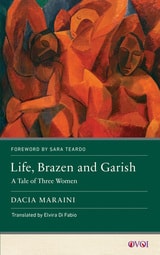
Life, Brazen and Garish
A Tale of Three WomenDacia Maraini
Rutgers University Press, 2024
Life, Brazen and Garish offers a fresh take on the epistolary novel, telling the story of a family through the fragmented and disparate perspectives of daughter, mother, and grandmother. Yet even as each woman endures her private struggles with love and betrayal, youth and maturity, knowledge and ignorance, reality and illusion, the Cascadeis forge a solidarity that transcends generations. In turns heartbreaking and laugh-out-loud funny, this novel is a triumph of narrative voice and literary style from one of Italy’s most renowned writers.
Questo libro è stato tradotto grazie a un contributo del Ministero degli Affari Esteri e della Cooperazione Internazionale italiano.
This book has been translated thanks to a contribution from the Italian Ministry of Foreign Affairs and International Cooperation.
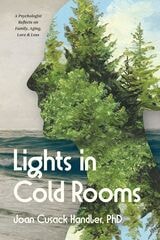
Lights in Cold Rooms
A Psychologist Reflects on Family, Aging, Love & LossJoan Cusack Handler
CavanKerry Press, 2025
Lights in Cold Rooms shares Joan Cusack Handler’s personal experiences with depression as a licensed psychologist with forty years of experience treating patients. For many, including Handler, quarantine precluded the preferred treatment of psychotherapy. Handler turned to her own pathology to teach herself and others how to navigate both isolation and depression. Feelings of anxiousness and impending mortality intensified as she faced the death of her older sister and grappled with the guilt that erupted when she learned that an in-person memorial service was impossible. Opening both her personal history and pathology to public view, Handler chronicles her confrontation with eighty years of family dynamics and explores the path she took to return to a place of hope.

Like Love
Michele Morano
The Ohio State University Press, 2020
Crushes. Infatuations. Attractions. Unexpected, inexplicable allure. Entanglements steeped in taboo and disruption. In Like Love, nothing is off limits.
In these remarkable essays, Michele Morano explores the pleasures, possibilities, strangeness, and lessons of unconsummated romance. With insight and imagination, Like Love interweaves poignant, humorous episodes from adulthood with the backstory of a young family’s turbulent breakup. When Morano was an adolescent in blue-collar Poughkeepsie, New York, her mother left her father for a woman in an era when LGBTQ parents were widely viewed as “unfit.” Through the turmoil, adolescent Morano paid attention, tucking away the stories that were shaping her and guiding her understanding of love.
Turning romantic clichés inside out and challenging us to rethink our notions about what it means to love, Like Love tells hard and necessary truths about the importance of desire in growing, traveling, mourning, parenting, and figuring out who you are in the world. With precision and depth, Morano explores what it means to find ourselves in relationships that are not quite—but almost—like love.