Results by title
8812 books match the query 'Political Science' and 280 start with l
Latin American Neostructuralism
The Contradictions of Post-Neoliberal DevelopmentFernando Ignacio Leiva
University of Minnesota Press, 2008
Interrogates this ascending political and economic paradigm
This landmark work is the first sustained critique of Latin American neostructuralism, the prevailing narrative that has sought to replace “market fundamentalism” and humanize the “savage capitalism” imposed by neoliberal dogmatism. Fernando Leiva analyzes neostructuralism and questions its credibility as the answer to the region’s economic, political, and social woes.
Recent electoral victories by progressive governments in Latin America promising economic growth, social equity, and political democracy raise a number of urgent questions, including: What are the key strengths and weaknesses of the emerging paradigm? What kinds of transformations can this movement enact? Leiva addresses these issues and argues that the power relations embedded in local institutions, culture, and populations must be recognized when building alternatives to the present order. Considering the governments in countries such as Chile, Argentina, and Brazil, Leiva examines neostructuralism’s impact on global politics and challenges whether this paradigm constitutes a genuine alternative to neoliberalism or is, rather, a more sophisticated form of consolidating existing systems.
Latin American Politics
A Theoretical ApproachBy Torcuato S. Di Tella
University of Texas Press, 2001
First published in English in 1990 as Latin American Politics: A Theoretical Framework, a translation of Torcuato S. Di Tella's original Sociología de los procesos políticos, this new edition also focuses on the prerequisites for democracy in any society and on the role of the popular classes in social change. Di Tella draws on the work of Montesquieu, Burke, Tocqueville, Marx, Weber, and Durkheim in formulating his explanatory theories. These theories are then tested against crucial events in Latin American history—from the rebellions of the eighteenth century to the caudillos of the nineteenth century and the militarism of the twentieth century.
This edition is more attuned to an English-speaking audience, with a new chapter addressing the historical process in Argentina from the 1930s to 2000. Latin American Politics is written in a style easily accessible to the general reader or student, while its emphasis on the growth of democracy in Latin America makes it particularly timely.
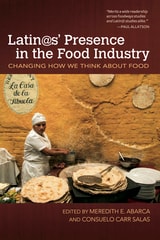
Latin@s' Presence in the Food Industry
Changing How We Think about FoodMeredith E. Abarca
University of Arkansas Press, 2016
The networks Latin@s create, the types of identities they fashion through food, and their relationship to the US food industry are analyzed to understand Latin@s as active creators of food-based communities, as distinctive cultural representations, and as professionals. This vibrant new collection acknowledges issues of labor conditions, economic politics, and immigration laws—structural vulnerabilities that certainly cannot be ignored—and strives to understand more fully the active and conscious ways that Latina@s create spaces to maneuver global and local food systems.
LatinAsian Cartographies
History, Writing, and the National ImaginaryThananopavarn, Susan
Rutgers University Press, 2018
Thananopavarn creates a new “LatinAsian” view of the United States that emphasizes previously suppressed aspects of national history, including imperialism, domestic racism during World War II, Cold War operations in Latin America and Asia, and the politics of borders in an age of globalization. LatinAsian Cartographies ultimately reimagines national narratives in a way that transforms dominant ideas of what it means to be American.
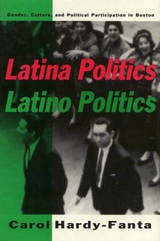
Latina Politics, Latino Politics
Gender, Culture, and Political Participation in BostonCarol Hardy-Fanta
Temple University Press, 1993
Through an in-depth study of the Latino community in Boston, Carol hardy-Fanta addressees three key debates in American politics: how to look at the ways in which women and men envision the meaning of politics and political participation; how to understand culture and the political life of expanding immigrant populations; and how to create a more participatory America. The author's interviews with Latinos from Puerto Rico, the Dominican Republic, and Central and South America and her participation in community events in North Dorchester, Jamaica Plain, and the South End document the often ignored contribution of Latina women as candidates, political mobilizers, and community organizers. Hardy-Fanta examines critical gender differences in how politics is defined, what strategies Latina women and Latino men use to generate political participation, and how culture and gender interact in the political empowerment of the ethic communities.
Hardy-Fanta challenges the notion of political apathy among Latinos and presents factors that stimulate political participation. She finds that the vision of politics promoted by Latina women—one based on connectedness, collectivity, community, and consiousness-raising—contrasts sharply with a male political concern for status, hierarchy, and personal opportunity.
Latinamericanism after 9/11
John Beverley
Duke University Press, 2011
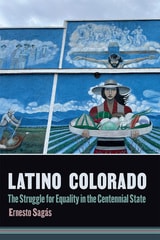
Latino Colorado
The Struggle for Equality in the Centennial StateErnesto Sagás
University Press of Colorado, 2026
Author Ernesto Sagás also explores the ways in which Latinos—as a racialized, subordinate group—have historically interacted with Colorado’s Anglo society in carving out their own spaces while struggling for social and legal equality. He presents a demographic and socioeconomic profile of Latinos in Colorado based on field research and the latest US Census data to dispel common stereotypes while also pointing out areas of concern for state policymakers.
Latino Colorado sheds light on this marginalized community and advances the understanding of the state’s racialized dynamics. It is about everyone in the American West—Anglos, Latinos, and others—and how they interact with and continue to (re)define one another in real and imagined ways in the most mythologized of American regions.
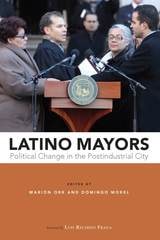
Latino Mayors
Political Change in the Postindustrial CityMarion Orr
Temple University Press, 2018
As recently as the early 1960s, Latinos were almost totally excluded from city politics. This makes the rise of Latino mayors in the past three decades a remarkable American story—one that explains ethnic succession, changing urban demography, and political contexts. The vibrant collection Latino Mayors features case studies of eleven Latino mayors in six American cities: San Antonio, Los Angeles, Denver, Hartford, Miami, and Providence.
The editors and contributors analyze Latino mayors for their governing styles and policies. They describe how candidates shaped race, class, and economic issues—particularly in deracialized campaigns. Latino Mayors also addresses coalition politics, political incorporation, and how community groups operate, as well as the challenges these pioneers have faced in office from political tensions and governance issues that sometimes even harm Latinos.
Ultimately, Latino Mayors charts the performances, successes, and failures of these elected officials to represent their constituents in a changing economic and urban environment.
Contributors include: Stefanie Chambers, Carlos E. Cuéllar, Emily M. Farris, Maria Ilcheva, Robert Preuhs, Heywood T. Sanders, Ellen Shiau, and the editors.
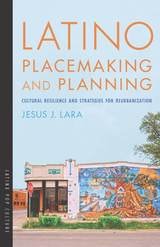
Latino Placemaking and Planning
Cultural Resilience and Strategies for ReurbanizationJesus J. Lara
University of Arizona Press, 2018
Latino Placemaking and Planning offers a pathway to define, analyze, and evaluate the role that placemaking can have with respect to Latino communities in the context of contemporary urban planning, policy, and design practices. Using strategically selected case studies, Jesus J. Lara examines how Latinos contribute to the phenomenon of urban revitalization through the (re)appropriation of physical space for their own use and the consequent transformation of what were previously economically downtrodden areas into vibrant commercial and residential centers.
The book examines the formation of urban cultures and reurbanization strategies from the perspective of Latino urbanism and is divided into four key sections, which address (1) emerging new urban geographies; (2) the power of place and neighborhood selection; (3) Latino urbanism case studies; and (4) lessons and recommendations for “reurbanizing” the city. Latino Placemaking and Planning illustrates the importance of placemaking for Latino communities and provides accessible strategies for planners, students, and activists to sustainable urban revitalization.
Latinos and Nationhood
Two Centuries of Intellectual ThoughtNicolás Kanellos
University of Arizona Press, 2023
Over the course of two centuries, these Latino or Hispanic intellectuals were natural-born citizens of the United States, immigrants, or political refugees. Many of these intellectuals, whether citizens or not, strove to embrace and enliven such democratic principles as freedom of speech and of the press, the protection of minorities in the Bill of Rights and in subsequent laws, and the protection of linguistic and property rights, among many others, guaranteed by treaties when the United States incorporated their homelands into the Union.
The first six chapters present the work of lesser-known historical figures—most of whom have been consistently ignored by Anglo- and Euro-centric history and whose works have been widely inaccessible until recently—who were revolutionaries, editors of magazines and newspapers, and speechmakers who influenced the development of a Latino consciousness. The last three chapters deal with three foundational figures of the Chicano Movement, the last two of whom either subverted the concept of nationhood or went beyond it to embrace internationalism in an outreach to humanity as a whole.
Latinos and Nationhood sheds new light on the biographies of Félix Varela, José Alvarez de Toledo y Dubois, Francisco Ramírez, Tomás Rivera, Rolando Hinojosa-Smith, and Gloria E. Anzaldúa, among others.
Latinos and the 2012 Election
The New Face of the American VoterGabriel R. Sanchez
Michigan State University Press, 2015
Latinos and the 2016 Election
Latino Resistance and the Election of Donald TrumpGabriel R. Sanchez
Michigan State University Press, 2020
Latinos and the U.S. Political System
Two-Tiered PluralismRodney E. Hero
Temple University Press, 1992
Bringing together political science research on Latinos and an analysis of American politics from the vantage point of the Latino political condition, Rodney Hero presents a comprehensive discussion of contemporary Latino politics. The distinct and tenuous nature of Latino status in the U.S. has made it difficult to explain their unique status. This "uniqueness" stems from a variety of circumstances, including the differences among Mexican Americans, Puerto Ricans, and Cubans, and their ambivalent racial classification (white but not "Anglo," or nonwhite but not black).
Hero introduces the concept of "two-tiered pluralism," which describes the political situation for Latinos and other minorities in which equality is largely formal or procedural, but not substantive. He observes that this formal but marginalized inclusion exists for minorities in most facets of the political process. In his critical overview of American politics, Hero explores the major theoretical perspectives that have been used to understand Latino "cultural politics"; he contrasts the three largest Hispanic population in this country; and he considers major political activities and American institutions with specific reference to Latinos. This timely work addresses the politics of an increasingly important segment of the U.S. population and an area in which previous research has been scant.
Latinos in Chicago
Quest for a Political VoiceWilfredo Cruz
Southern Illinois University Press, 2022
The path to political power for Latinos in Chicago
In the Midwest’s largest city, Latinos have been fighting for political representation for more than half a century. In this exploration of urban politics in Chicago, Wilfredo Cruz shows for the first time how Latinos went from being ignored by the Irish-controlled political machine to becoming a respected constituency.
Beginning with the Latino community’s first attempt to acquire a political voice in Chicago politics in 1911 and continuing through Latino officeholders of the early twenty-first century, Cruz surveys not only the struggles of this community—specifically the two largest Latino groups in the city, Mexicans and Puerto Ricans—but also the ways in which Chicago’s Latinos overcame those challenges to gain their political voice.
For most of the twentieth century, Chicago politicians ignored the growing Latino community. This disregard changed with the 1983 election of Mayor Harold Washington, an African American who defied the political machine and actively recruited Latinos to his administration and helped them win city and statewide political offices. His actions opened the doors of government for Latinos in Chicago. Subsequent mayors, seeing the political success of Washington’s move, continued his policies.
Many up-and-coming Latino politicians making strides in Chicago, including state representative Aarón Ortíz, Alderman Andre Vasquez, and Alderman Rossana Rodríguez-Sanchez, contribute their takes on the struggle for political power and the challenges facing the rising new generation of elected officials. With this book, Cruz asks and answers this question: What does the future hold for Latinos politically in Chicago?
Latinos in Nevada
A Political, Economic, and Social ProfileJohn P. Tuman
University of Nevada Press, 2021
This extensive study by a distinguished and multidisciplinary team of scholars discusses the impact of the Latinx population from the early development of the state of Nevada and highlights their roles in society, as well as the specific implications of their growing presence in the state. It also contemplates the future of the Latinx population and the role they will continue to play in politics and the economy.
This in-depth examination of a large and relatively understudied population will be of interest to scholars and students who study disparities in health and education opportunities as well as the political and economic climate among Latinos and other groups in Nevada and beyond. A political, economic, and demographic profile, this book:
- Explores the history, growth, and diversity of the Latinx population.
- Draws on an array of census data, voter surveys, statistics, interviews, and health, education, employment, wages, and immigration statistics.
- Evaluates key trends in employment, education, religion, and health.
- Analyzes the dynamics of political participation, including implications of a growing Latino political electorate in a western swing state.
- Assesses key determinants of health disparities, educational inequities, and civic engagement among Latinos in the state.
- Demonstrates the impact of the Great Recession of 2008 and provides a preliminary assessment of the COVID-19 pandemic on Latino employment.
Law and Democracy in the Empire of Force
H. Jefferson Powell and James Boyd White, editors
University of Michigan Press, 2009
James Boyd White is Hart Wright Professor of Law emeritus and Professor of English emeritus, at the University of Michigan. His latest book is Living Speech: Resisting the Empire of Force.
"An extraordinary collection of provocative, insightful, and inspiring essays on the future of law and democracy in the twenty-first century."
---Geoffrey R. Stone, Edward H. Levi Distinguished Service Professor of Law, University of Chicago
"These thoughtful essays diagnose democracy's perilous present, and---more importantly---they explore avenues to democracy's rescue through humanization of law."
---Kenneth L. Karst, David G. Price and Dallas P. Price Professor of Law Emeritus, UCLA
Contributors
Martin Böhmer, Universidad de San Andres, Buenos Aires, Argentina
M. Cathleen Kaveny, University of Notre Dame
Howard Lesnick, University of Pennsylvania
The Honorable John T. Noonan Jr., Ninth Circuit Court of Appeals
H. Jefferson Powell, Duke University
Jedediah Purdy, Duke University
Jed Rubenfeld, Yale University
A.W. Brian Simpson, University of Michigan
Barry Sullivan, Jenner and Block LLP, Chicago
Joseph Vining, University of Michigan
Robin West, Georgetown University
James Boyd White, University of Michigan
Law and Economic Policy in America
The Evolution of the Sherman Antitrust ActWilliam Letwin
University of Chicago Press, 1981
Law and Economy in Planning
By Walter Firey
University of Texas Press, 1965
From the beginnings of human association, social planning has been an accepted method for effecting improvements in community, regional, and national life. In Law and Economy in Planning, Walter Firey has made a start in the development of an intellectual framework that will give meaning to the craft of planning and establish a relationship between practice and first principles.
In this study he investigates basic elements of this framework existing in two normative orders: the state, in which a collectivity has the obligation to enforce obedience; and the market, in which the individual has the right to be rational. These normative orders, whose laws are formulated in the disciplines of jurisprudence and economics, have a common concern with the utilization of scarce means to given ends.
These orders, the state and the market, are formulated by the art of planning and have a common relationship to the natural order, which cannot be planned, but only predicted, and which is explained by the science of planning. To bridge the gap between the natural order and the normative order is the function of a philosophy of planning, for which an intellectual framework—of necessity interdisciplinary—is essential.
This study is the culmination of several years of research in the fields of planning and social theory. During the course of this research Firey came to appreciate more and more keenly the need for an interdisciplinary formulation of the planning process and, with this, the need for a philosophical foundation for interdisciplinary work. A year’s fellowship at the Center for Advanced Study in the Behavioral Sciences at Stanford gave him the opportunity to develop his ideas bearing on this subject and to put them in writing.
Law and Illiberalism
Edited by Austin Sarat, Lawrence Douglas, and Martha Merrill Umphrey
University of Massachusetts Press, 2022
Does the law shield citizens from authoritarian regimes? Are the core beliefs of classical liberalism—namely the rights of all individuals and constraints on state power—still protected by law? Liberalism and its expansion of rights could not exist without the legal system, and unsurprisingly, many scholars have explored the relationship between law and liberalism. However, the study of law and illiberalism is a relatively recent undertaking, a project that takes on urgency in light of the rise of authoritarian powers, among them Donald Trump’s administration, Viktor Orban’s Hungary, Recep Erdogan’s Turkey, and Jair Bolsanoro’s Brazil.
In this volume, six penetrating essays explore the dynamics of the law and illiberal quests for power, examining the anti-liberalism of neoliberalism; the weaponization of “free speech”; the role of the administrative state in current crises of liberal democracy; the broad and unstoppable assault on facts, truth, and reality; and the rise of conspiracism leading up to the Capitol insurrection. In addition to the editors, contributors include Sharon Krause, Elizabeth Anker, Jeremy Kessler, Lee McIntyre, and Nancy Rosenblum.

Law and Moral Action in World Politics
Cecelia Lynch
University of Minnesota Press, 2000
Law and Public Choice
A Critical IntroductionPhilip P. Frickey and Daniel A. Farber
University of Chicago Press, 1991
“Law and Public Choice is a most valuable contribution to the burgeoning literature. It
should be of great interest to lawyers, political scientists, and all others interested in issues at the intersection of government and law.”—Cass R. Sunstein, University of Chicago Law
School
Law and the Conditions of Freedom in the Nineteenth-Century United States
James Willard Hurst
University of Wisconsin Press, 1964
In these essays J. Willard Hurst shows the correlation between the conception of individual freedom and the application of law in the nineteenth-century United States—how individuals sought to use law to increase both their personal freedom and their opportunities for personal growth. These essays in jurisprudence and legal history are also a contribution to the study of social and intellectual history in the United States, to political science, and to economics as it concerns the role of public policy in our economy. The nonlawyer will find in them demonstration of how "technicalities" express deep issues of social values.

Law and the Conditions of Freedom in the Nineteenth-Century United States
J. Willard Hurst
University of Wisconsin Press, 1956
In these essays J. Willard Hurst shows the correlation between the conception of individual freedom and the application of law in the nineteenth-century United States—how individuals sought to use law to increase both their personal freedom and their opportunities for personal growth. These essays in jurisprudence and legal history are also a contribution to the study of social and intellectual history in the United States, to political science, and to economics as it concerns the role of public policy in our economy. The nonlawyer will find in them demonstration of how "technicalities" express deep issues of social values.
Law and the Economy in a Young Democracy
India 1947 and BeyondTirthankar Roy and Anand V. Swamy
University of Chicago Press, 2022
Economists have long lamented how the inefficiency of India's legal system undermines the country’s economic capacity. How has this come to be? The prevailing explanation is that the postcolonial legal system is understaffed and under-resourced, making adjudication and contract enforcement slow and costly.
Taking this as given, Law and the Economy in a Young Democracy examines the contents and historical antecedents of these laws, including how they have stifled economic development. Economists Roy and Swamy argue that legal evolution in independent India has been shaped by three factors: the desire to reduce inequality and poverty; the suspicion that market activity, both domestic and international, can be detrimental to these goals; and the strengthening of Indian democracy over time, giving voice to a growing fraction of society, including the poor.
Weaving the story of India's heralded economic transformation with its social and political history, Roy and Swamy show how inadequate legal infrastructure has been a key impediment to the country's economic growth during the last century. A stirring and authoritative history of a nation rife with contradictions, Law and the Economy in a Young Democracy is essential reading for anyone seeking to understand India's current crossroads—and the factors that may keep its dreams unrealized.
Law and the Gay Rights Story
The Long Search for Equal Justice in a Divided DemocracyFrank, Walter
Rutgers University Press, 2014
In his gripping new book, Walter Frank offers an in-depth look at the court cases that were pivotal in establishing gay rights. But he also tells the story of those individuals who were willing to make waves by fighting for those rights, taking enormous personal risks at a time when the tide of public opinion was against them. Frank’s accessible style brings complex legal issues down to earth but, as a former litigator, never loses sight of the law’s human dimension and the context of the events occurring outside the courtroom.
Chronicling the past half-century of gay and lesbian history, Law and the Gay Rights Story offers a unique perspective on familiar events like the Stonewall Riots, the AIDS crisis, and the repeal of “Don’t Ask, Don’t Tell.” Frank pays special attention to the constitutional issues surrounding same-sex marriage and closely analyzes the two recent Supreme Court cases addressing the issue. While a strong advocate for gay rights, Frank also examines critiques of the movement, including some coming from the gay community itself. Comprehensive in coverage, the book explains the legal and constitutional issues involved in each of the major goals of the gay rights movement: a safe and healthy school environment, workplace equality, an end to anti-gay violence, relationship recognition, and full integration into all the institutions of the larger society, including marriage and military service. Drawing from extensive archival research and from decades of experience as a practicing litigator, Frank not only provides a vivid history, but also shows where the battle for gay rights might go from here.
Law as Politics
Carl Schmitt’s Critique of LiberalismDavid Dyzenhaus, ed.
Duke University Press, 1998
One of the major players in the 1920s debates, an outspoken critic of the Versailles Treaty and the Weimar Constitution, and a member of the Nazi party who provided juridical respectability to Hitler’s policies, Schmitt contended that people are a polity only to the extent that they share common enemies. He saw the liberal notion of a peaceful world of universal citizens as a sheer impossibility and attributed the problems of Weimar to liberalism and its inability to cope with pluralism and political conflict. In the decade since his death, Schmitt’s writings have been taken up by both the right and the left and scholars differ greatly in their evaluation of Schmitt’s ideas. Law as Politics thematically organizes in one volume the varying engagements and confrontations with Schmitt’s work and allows scholars to acknowledge—and therefore be in a better position to negotiate—an important paradox inscribed in the very nature of liberal democracy.
Law as Politics will interest political philosophers, legal theorists, historians, and anyone interested in Schmitt’s relevance to current discussions of liberalism.
Contributors. Heiner Bielefeldt, Ronald Beiner, Ernst-Wolfgang Bockenforde, Renato Cristi, David Dyzenhaus, Robert Howse, Ellen Kennedy, Dominique Leydet, Ingeborg Maus, John P. McCormick, Reinhard Mehring, Chantal Mouffe, William E. Scheuerman, Jeffrey Seitzer
Law by Night
Jonathan Goldberg-Hiller
Duke University Press, 2023
Law in Everyday Life
Austin Sarat and Thomas R. Kearns, Editors
University of Michigan Press, 1995

Law of Accumulation and Breakdown of the Capitalist System
Henryk Grossmann
Pluto Press, 1992
Law's Madness
Austin Sarat, Lawrence Douglas, and Martha Merrill Umphrey, Editors
University of Michigan Press, 2006
The distinguished contributors to Law's Madness propose a fascinating interdisciplinary approach to the instability and mutual permeability of law and madness. Their essays examine a variety of discursive forms—from the literary to the historical to the psychoanalytic—in which law is driven more by narrative than by reason. Their studies delineate the ways in which the law takes its definition in part from that which it excludes, suppresses, or excises from itself, illuminating the drive to enforce barriers between non-reason and legality, while simultaneously shedding new light on the constitutive force of the irrational in legal doctrine.
Law's Madness suggests that the tense and paradoxical relationship between law and madness is precisely what erects and sustains law. This provocative collection asks what must be forgotten in order to uphold the rule of law.
Austin Sarat is William Nelson Cromwell Professor of Jurisprudence and Political Science at Amherst College. Lawrence Douglas is Associate Professor of Law, Jurisprudence, and Social Thought at Amherst College. Martha Merrill Umphrey is Associate Professor of Law, Jurisprudence, and Social Thought at Amherst College.
Law's Violence
Austin Sarat and Thomas R. Kearns, Editors
University of Michigan Press, 1995
Law, Legislation and Liberty, Volume 1
Rules and OrderF. A. Hayek
University of Chicago Press, 1978
Law, Legislation and Liberty, Volume 2
The Mirage of Social JusticeF. A. Hayek
University of Chicago Press, 1977
Law, Legislation and Liberty, Volume 3
The Political Order of a Free PeopleF. A. Hayek
University of Chicago Press, 1981
Law, Legislation, and Liberty, Volume 19
F. A. Hayek
University of Chicago Press, 2021
In this critical entry in the University of Chicago’s Collected Works of F. A. Hayek series, political philosopher Jeremy Shearmur collates Hayek’s three-part study of law and liberty and places Hayek’s writings in careful historical context. Incisive and unrestrained, Law, Legislation, and Liberty is Hayek at his late-life best, making it essential reading for understanding the philosopher’s politics and worldview.
These three volumes constitute a scaling up of the framework offered in Hayek’s famed The Road to Serfdom. Volume 1, Rules and Order, espouses the virtues of classical liberalism; Volume 2, The Mirage of Social Justice, examines the societal forces that undermine liberalism and, with it, liberalism’s capacity to induce “spontaneous order”; and Volume 3, The Political Order of a Free People, proposes alternatives and interventions against emerging anti-liberal movements, including a rule of law that resides in stasis with personal freedom.
Shearmur’s treatment of this challenging work—including an immersive new introduction, a conversion of Hayek’s copious endnotes to footnotes, corrections to Hayek’s references and quotations, and the provision of translations to material that Hayek cited only in languages other than English—lends it new importance and accessibility. Rendered anew for the next generations of scholars, this revision of Hayek’s Law, Legislation, and Liberty is sure to become the standard.
Law, Liberty, and the Pursuit of Terrorism
Roger Douglas
University of Michigan Press, 2014
Roger Douglas compares responses to terrorism by five liberal democracies—the United States, the United Kingdom, Canada, Australia, and New Zealand—over the past 15 years. He examines each nation’s development and implementation of counterterrorism law, specifically in the areas of information-gathering, the definition of terrorist offenses, due process for the accused, detention, and torture and other forms of coercive questioning.
Douglas finds that terrorist attacks elicit pressures for quick responses, often allowing national governments to accrue additional powers. But emergencies are neither a necessary nor a sufficient condition for such laws, which may persist even after fears have eased. He argues that responses are influenced by both institutional interests and prior beliefs, and complicated when the exigencies of office and beliefs point in different directions. He also argues that citizens are wary of government’s impingement on civil liberties and that courts exercise their capacity to restrain the legislative and executive branches. Douglas concludes that the worst antiterror excesses have taken place outside of the law rather than within, and that the legacy of 9/11 includes both laws that expand government powers and judicial decisions that limit those very powers.
Lawyers of the Right
Professionalizing the Conservative CoalitionAnn Southworth
University of Chicago Press, 2008
Drawing on in-depth interviews with more than seventy lawyers who represent conservative and libertarian nonprofit organizations, Ann Southworth explores their values and identities and traces the implications of their shared interest in promoting political strategies that give lawyers leading roles. She goes on to illuminate the function of mediator organizations—such as the Heritage Foundation and the Federalist Society for Law and Public Policy—that have succeeded in promoting cooperation among different factions of conservative lawyers. Such cooperation, she finds, has aided efforts to drive law and the legal profession politically rightward and to give lawyers greater prominence in the conservative movement. Southworth concludes, though, that tensions between the conservative law movement’s elite and populist elements may ultimately lead to its undoing.
Le Maya Q’atzij/Our Maya Word
Poetics of Resistance in GuatemalaEmil’ Keme
University of Minnesota Press, 2021
Bringing to the fore the voices of Maya authors and what their poetry tells us about resistance, sovereignty, trauma, and regeneration
In 1954, Guatemala suffered a coup d’etat, resulting in a decades-long civil war. During this period, Indigenous Mayans were subject to displacement, disappearance, and extrajudicial killing. Within the context of the armed conflict and the postwar period in Guatemala, K’iche’ Maya scholar Emil’ Keme identifies three historical phases of Indigenous Maya literary insurgency in which Maya authors use poetry to dignify their distinct cultural, political, gender, sexual, and linguistic identities.
Le Maya Q’atzij / Our Maya Word employs Indigenous and decolonial theoretical frameworks to critically analyze poetic works written by ten contemporary Maya writers from five different Maya nations in Iximulew/Guatemala. Similar to other Maya authors throughout colonial history, these authors and their poetry criticize, in their own creative ways, the continuing colonial assaults to their existence by the nation-state. Throughout, Keme displays the decolonial potentialities and shortcomings proposed by each Maya writer, establishing a new and productive way of understanding Maya living realities and their emancipatory challenges in Iximulew/Guatemala.
This innovative work shows how Indigenous Maya poetics carries out various processes of decolonization and, especially, how Maya literature offers diverse and heterogeneous perspectives about what it means to be Maya in the contemporary world.
Leadership Organizations in the House of Representatives
Party Participation and Partisan PoliticsScott R. Meinke
University of Michigan Press, 2016

Leadership and Organizational Culture
New Perspectives on Administrative Theory and PracticeEdited by Thomas J. Sergiovanni and John E. Corbally
University of Illinois Press, 1984
Leadership in Committee
A Comparative Analysis of Leadership Behavior in the U.S. SenateC. Lawrence Evans
University of Michigan Press, 2001
How does the leadership of a Senate committee influence the outcome of bills? In Leadership in Committee C. Lawrence Evans delves into the behavior of legislative leaders and the effects of what they do, how their tactics vary, and why. Using evidence gleaned from personal interviews with a large number of U.S. senators and Senate staff, the author compares the leadership styles of eight committee chairs and ranking minority members in the U.S. Senate. The result is a significant contribution to the literature on American politics, the first book-length, comparative analysis of legislative leadership behavior in the modern Senate.
". . . .this book is highly recommended reading for those interested in both legislative politics and political leadership. . . .Leadership in Committee establishes Evans as one of the handful of political scientists who have done justice to the subtleties of politics in the modern Senate."
---Randall Strahan, Journal of Politics
"Larry Evans has significantly influenced my own work over the years, and Leadership in Committee is one reason why. It is a model of great scholarship, the best work on committee leadership ever written. It has the discriminatory sense of context that appears only when the author truly knows his subject. It is theoretical without being reductionist or vacuously abstract. Its principal claims are general yet sufficiently concrete to be testable, and Evans provides systematic, comparative evidence to support (or qualify) each of them. Larger issues of agenda-setting, institutional structure, partisanship, anticipated reactions, participation, committee-floor bargaining, and strategic action of various kinds receive thoughtful and insightful examination. And the book is simply a terrific read. Too long in coming, the publication of Leadership in Committee in paperback ought to spark a well-deserved revival of interest in this work."
---Richard L. Hall, University of Michigan
Leadership in the Time of Covid
Pandemic Responses in Central EuropeMilada Polisenská
Central European University Press, 2023
The Covid pandemic has put all modern societies to a serious test of resilience. The interdisciplinary research on which this book is based examined how four European governments behaved in these circumstances. During the months of the crisis, the team of experts coordinated by the editors of this volume took a close look at the decision-making processes in the Czech Republic, Hungary, Poland, and Slovakia – the so-called Visegrad Four.
The inquiries focused on experiences from the academic, health, economic and social fields. The methods of comparison included surveys, interviews, discourse analysis, for which the adaptive leadership theory provided the conceptual framework.
The conclusions are both academic and practical. Aside the description of the pandemic responses, the research had a formative dimension: how can an adaptive leadership approach better help societies manage the health and societal impacts of similar challenges? The spectrum of emerging anti-democratic tendencies in the region provided the specific context of the exercise. The four states face varying degrees of democratic backsliding as well as illiberal influences that have affected their response to the pandemic, which gives this research on the Visegrad Four a worldwide resonance.
Leadership
Lessons from a Life in DiplomacySimon Mcdonald
Haus Publishing, 2023
Simon McDonald argues that we should reflect on the nature and strategies of leadership before entering a leadership role, and we should look to examples of others to help us in shaping our own approaches.
Over nearly four decades in Her Majesty's Diplomatic Service, McDonald worked for four permanent under-secretaries and a dozen senior ambassadors before becoming a permanent under-secretary himself and leading the Service—which has over 14,000 staff members in 270 countries—for five years. He also worked directly for six foreign secretaries and under five prime ministers. Observing these people undertaking such important and difficult work, McDonald saw the behaviors which helped them achieve their objectives, as well as those which hindered them.
In this book, McDonald synthesizes the skills he’s learned through his many years working in diplomacy, offering an insightful contribution amid heightening debates over the leadership of the United Kingdom. Considering the future of British leadership, he makes a case for the reform of the monarchy, the cabinet, civil service, and, in particular, the House of Lords, of which he has been a member since 2021.
Leading Cities
A Global Review of City LeadershipEdited by Elizabeth Rapoport, Michele Acuto, and Leonora Grcheva
University College London, 2019
Leading Questions
How Hegemony Affects the International Political EconomyRobert Pahre
University of Michigan Press, 1999
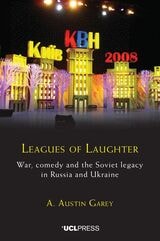
Leagues of Laughter
War, Comedy and the Soviet Legacy in Russia and UkraineA. Austin Garey
University College London, 2025
Leagues of Laughter traces the evolution of a Soviet-created youth game called KVN (Klub veselykh i nakhodchivykh or Club of the Cheerful and Clever) over sixty years as students’ nation-states collapsed, competed, and eventually went to war. Through cross-border narratives, the book shows how humor persists—and transforms—amid authoritarianism, censorship, and conflict. With insight and compassion, author A. Austin Garey reveals how laughter became a mode of resistance, identity, and cultural continuity in the long cultural context of the war in Ukraine. In addition to introducing a novel theory of “tradition as stance” to explain how traditions are reproduced and reinterpreted over time, the book offers a compelling comparative analysis of cultural production under political pressure.
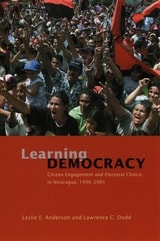
Learning Democracy
Citizen Engagement and Electoral Choice in Nicaragua, 1990-2001Leslie E. Anderson and Lawrence C. Dodd
University of Chicago Press, 2005
By analyzing nationwide surveys conducted during the 1990, 1996, and 2001 Nicaraguan presidential elections, Leslie E. Anderson and Lawrence C. Dodd provide insight into one of the most unexpected and intriguing recent advancements in third world politics. They offer a balanced account of the voting patterns and forward-thinking decisions that led Nicaraguans to first support the reformist Sandinista revolutionaries only to replace them with a conservative democratic regime a few years later. Addressing issues largely unexamined in Latin American studies, Learning Democracy is a unique and probing look at how the country's mass electorate moved beyond revolutionary struggle to establish a more stable democratic government by realizing the vital role of citizens in democratization processes.

Learning From Robben Island
Govan Mbeki’s Prison WritingsGovan Mbeki
Ohio University Press, 1991
In the late fifties and early sixties, Govan Mbeki was a central figure in the African National Congress and director of the ANC campaigns from underground. Born of a chief and the daughter of a Methodist minister in the Transkei of South Africa in 1910, he worked as a teacher, journalist, and tireless labor organizer in a lifetime of protest against the government policy of apartheid. Over two decades of imprisonment on Robben Island did not consign him to obscurity. Along with Nelson Mandela and Walter Sisulu, his name has become a symbol of resistance, not only to the oppressed people of South Africa, but also to the international community who have conferred on him many honors and awards.
Learning One’s Native Tongue
Citizenship, Contestation, and Conflict in AmericaTracy B. Strong
University of Chicago Press, 2019
With Learning One’s Native Tongue, Tracy B. Strong explores the development of the concept of American citizenship and what it means to belong to this country,
starting with the Puritans in the seventeenth century and continuing to the present day. He examines the conflicts over the meaning of citizenship in the writings and speeches of prominent thinkers and leaders ranging from John Winthrop and Roger Williams to Thomas Jefferson, Nathaniel Hawthorne, Abraham Lincoln, Frederick Douglass, and Franklin Roosevelt, among many others who have participated in these important cultural and political debates. The criteria that define what being a citizen entails change over time and in response to historical developments, and they are thus also often the source of controversy and conflict, as with voting rights for women and African Americans. Strong looks closely at these conflicts and the ensuing changes in the conception of citizenship, paying attention to what difference each change makes and what each particular conception entails socially and politically.
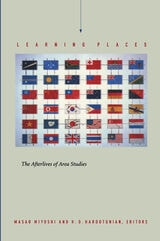
Learning Places
The Afterlives of Area StudiesMasao Miyoshi and H.D. Harootunian, eds.
Duke University Press, 2002
A tremendous amount of money flows—particularly within the sphere of East Asian studies, the contributors claim—from foreign agencies and governments to U.S. universities to underwrite courses on their histories and societies. In the process, this volume argues, such funds have gone beyond support to the wholesale subsidization of students in graduate programs, threatening the very integrity of research agendas. Native authority has been elevated to a position of primacy; Asian-born academics are presumed to be definitive commentators in Asian studies, for example. Area studies, the contributors believe, has outlived the original reason for its construction. The essays in this volume examine particular topics such as the development of cultural studies and hyphenated studies (such as African-American, Asian-American, Mexican-American) in the context of the failure of area studies, the corporatization of the contemporary university, the prehistory of postcolonial discourse, and the problematic impact of unformulated political goals on international activism.
Learning Places points to the necessity, the difficulty, and the possibility in higher education of breaking free from an entrenched Cold War narrative and making the study of a specific area part of the agenda of education generally. The book will appeal to all whose research has a local component, as well as to those interested in the future course of higher education generally.
Contributors. Paul A. Bové, Rey Chow, Bruce Cummings, James A. Fujii, Harry Harootunian, Masao Miyoshi, Tetsuo Najita, Richard H. Okada, Benita Parry, Moss Roberts, Bernard S. Silberman, Stefan Tanaka, Rob Wilson, Sylvia Yanagisako, Mitsuhiro Yoshimoto