Results by title
970 books match the query 'Movements' and 50 start with m
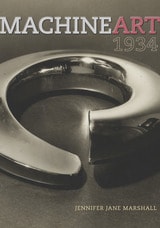
Machine Art, 1934
Jennifer Jane Marshall
University of Chicago Press, 2012
In 1934, New York’s Museum of Modern Art staged a major exhibition of ball bearings, airplane propellers, pots and pans, cocktail tumblers, petri dishes, protractors, and other machine parts and products. The exhibition, titled Machine Art, explored these ordinary objects as works of modern art, teaching museumgoers about the nature of beauty and value in the era of mass production.
Made in Newark
Cultivating Industrial Arts and Civic Identity in the Progressive EraShales, Ezra
Rutgers University Press, 2010
This is the story of experimental exhibitions in the library and the founding of the Newark Museum Associationùa project in which cultural literacy was intertwined with civics and consumption. Local artisans demonstrated crafts, connecting the cultural institution to the department store, school, and factory, all of which invoked the ideal of municipal patriotism. Today, as cultural institutions reappraise their relevance, Made in Newark explores precedents for contemporary debates over the ways the library and museum engage communities, define heritage in a multicultural era, and add value to the economy.
Madness, Language, Literature
Michel Foucault
University of Chicago Press, 2023
Perceiving an enigmatic relationship between madness, language, and literature, French philosopher Michel Foucault developed ideas during the 1960s that are less explicit in his later, more well-known writings. Collected here, these previously unpublished texts reveal a Foucault who undertakes an analysis of language and experience detached from their historical constraints. Three issues predominate: the experience of madness across societies; madness and language in Artaud, Roussel, and Baroque theater; and structuralist literary criticism. Not only do these texts pursue concepts unique to this period such as the “extra-linguistic,” but they also reveal a far more complex relationship between structuralism and Foucault than has typically been acknowledged.
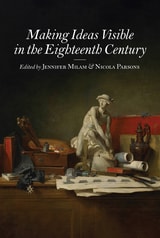
Making Ideas Visible in the Eighteenth Century
Jennifer Milam
University of Delaware Press, 2022
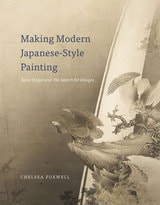
Making Modern Japanese-Style Painting
Kano Hogai and the Search for ImagesChelsea Foxwell
University of Chicago Press, 2015
Chelsea Foxwell sheds light on interlinked trends in Japanese nationalist discourse, government art policy, American and European commentary on Japanese art, and the demands of export. The seminal artist Kano Hogai (1828–88) is one telling example: originally a painter for the shogun, his art eventually evolved into novel, eerie images meant to satisfy both Japanese and Western audiences. Rather than simply absorbing Western approaches, nihonga as practiced by Hogai and others broke with pre-Meiji painting even as it worked to neutralize the rupture.
By arguing that fundamental changes to audience expectations led to the emergence of nihonga—a traditional interpretation of Japanese art for a contemporary, international market—Making Modern Japanese-Style Painting offers a fresh look at an important aspect of Japan’s development into a modern nation.
Man Made God
The Meaning of LifeLuc Ferry
University of Chicago Press, 2002
Luc Ferry argues that modernity and the emergence of secular humanism in Europe since the eighteenth century have not killed the search for meaning and the sacred, or even the idea of God, but rather have transformed both through a dual process: the humanization of the divine and the divinization of the human. Ferry sees evidence for the first of these in the Catholic Church's attempts to counter the growing rejection of dogmatism and to translate the religious tradition into contemporary language. The second he traces to the birth of modern love and humanitarianism, both of which demand a concern for others and even self-sacrifice in defense of values that transcend life itself. Ferry concludes with a powerful statement in favor of what he calls "transcendental humanism"—a concept that for the first time in human history gives us access to a genuine spirituality rooted in human beings instead of the divine.
Man against Mass Society
Gabriel Marcel
St. Augustine's Press, 2008
The central theme of this important book is that we are paying the price of an arrogance that refuses to recognize mystery. The author invites the reader to enter into the argument that he holds with himself on a great number of problems. Written in the early 1950s, Marcel’s discussion of these topics are remarkably contemporary, e.g.:
* Our crisis is a metaphysical, not merely social, one.
* What a man is depends partly on what he thinks he is, and a materialistic philosophy turns men into things.
* Can a man be free except in a free country?
* Stoicism is no longer a workable philosophy because today pressure can be put on the mind as well as on the body.
* Technical progress is not evil in itself, but a technique is a means that, regarded as an end, can become either an idol or an excuse for self-idolatry. State control of scientific research, leading to a concentration on new means of destruction, is a calamity.
* Fanaticism is an opinion that refuses to argue, and so the fanatic is an enemy of truth.
* The kind of unification that science is bringing about today is really an ironing out of differences, but the only valuable kind of unity is one that implies a respect for differences.
* We must beware of thinking in terms of great numbers and so blinding ourselves to the reality of individual suffering. Our philosophical approach to being is made possible only by our practical approach to our neighbor.
* We must encourage the spirit of fraternity and distrust the kind of egalitarianism that is based on envy and resentment.
* No man however humble should feel that he cannot spread the light among his friends. No easy solution is offered, but the author conveys his own faith that ultimately love and intelligence will triumph.

Man’s Soul
An Introductory Essay in Philosophical PsychologyS.L. Frank
Ohio University Press, 1993
“Seymon Lyudvigovich Frank, the author of the volume here made available for the first time in English translation, was one of the leading Russian philosophers of this century; some authorities consider him the most outstanding Russian philosopher of any age….
”Man’s Soul is a book which perfectly exemplifies the generous conception of the mission and competence of philosophy characteristic of Frank and the other members of the Russian metaphysical movement. Frank’s stated aim in the treatise is to reclaim for philosophy a field of investigation which, from the time of Plato and Aristotle to that of the Russian Idealists, philosophers had viewed as properly theirs, but which, since the mid-nineteenth century, they had allowed to fall into almost complete neglect: the study of the nature of the human soul (or psyche)….
“The moral message of Man’s Soul is well summed up by its epigraph, quoted from St. Augustine: ‘Let man first of all return to his own self, so that once he has, as it were, stepped therein, he may rise from thence and be elevated to God.’”
—from the foreword by Philip J. Swoboda

Margaret Fuller and Her Circles
Brigitte Bailey
University of New Hampshire Press, 2013
Margins of Philosophy
Jacques Derrida
University of Chicago Press, 1982
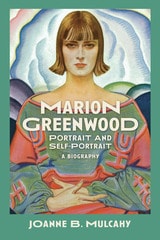
Marion Greenwood
Portrait and Self-Portrait—A BiographyJoanne B. Mulcahy
University of Alabama Press, 2025
This new biography reveals Marion Greenwood's central place in the pantheon of history’s remarkable women artists.
Marion Greenwood: Portrait and Self-Portrait—A Biography brings to life a woman who blazed through the twentieth-century art world. Born in Brooklyn in 1909, Greenwood thrived at storied institutions and arts centers such as the Art Students League, the studio of German modernist Winold Reiss, the Woodstock Colony, and Yaddo. In 1933, she catapulted to international fame as the first woman to paint a public mural in Mexico. Diego Rivera celebrated Greenwood as one of “the world’s greatest living women mural painters.” She traveled the globe to create award-winning portraits of people from diverse backgrounds, crossing racial, cultural, and class lines to reflect her vision for a more just world.
This biography, the first about Greenwood, is based on a decade of research and interviews. Author Joanne B. Mulcahy integrates the artist’s adventuresome personal life with her journey to artistic glory. Greenwood comes alive as a notable and spirited part of the heady art scenes of 1920s and 1930s Mexico, New York City, and Paris, and as one of two women artist-correspondents during World War II. After social realism and portraiture fell from favor, Greenwood doggedly stuck with what she called “the human thing” in art. Her freewheeling romantic life and independent spirit defied expectations for women, and she dismissed sexist critics who mixed acclaim for her work with commentary on her stunning beauty.
A feminist pioneer, Greenwood made a living as an artist in a time when few women could. In following Greenwood’s maverick path and artistic achievements, this book reveals her central place in the pantheon of history’s remarkable women artists.
Martin Buber's Ontology
An Analysis of I and ThouRobert Wood
Northwestern University Press, 1969
Marxism and the Interpretation of Culture
Edited by Cary Nelson and Lawrence Grossberg
University of Illinois Press, 1988
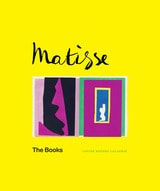
Matisse
The BooksLouise Rogers Lalaurie
University of Chicago Press, 2020
With deftness and sensitivity, Louise Rogers Lalaurie reintroduces us to Matisse by considering how in each volume, Matisse constructed an intriguing dialogue between word and image. Examining this page-by-page interplay, translating key sequences, and discussing the books’ distinct themes and production histories, Lalaurie offers the thoughtful analysis these works deserve. Together Matisse’s artist books reveal his deep engagement with questions of beauty and truth; his faith; his perspectives on aging, loss, and inspiration; and his relationship to his critics, the French art establishment, and the women in his life. In addition, Lalaurie illuminates Matisse’s often misunderstood political affinities—though Matisse was vilified in his time for choosing to live in the collaborationist Vichy zone, his wartime books reveal a body of work that stands as a deeply personal statement of resistance.
Lavishly illustrated, Matisse: The Books showcases a rich group of underappreciated works and brings unprecedented clarity to a controversial period in the artist’s life.

Mechanicity
The Material Force of Code in International PoliticsVic Castro
University of Michigan Press, 2027
Despite their seeming relegation to the digital world, code and software can have material, large-scale, and even violent effects. In just one example, the NotPetya ransomware paralyzed one-fifth of world maritime trade in 2017. Mechanicity is a philosophical investigation of what happens when the force of language merges with material force, and what this means for the great ideas of politics: political action, international anarchy, and the very concept of sovereign state.
In this book, Vic Castro returns to Thomas Hobbes’s idea of the mechanical as a force both determinate and unruly, just like machines and software, and examines the human body—both in Hobbes’s political philosophy and in mishaps of genetic code—as that which brings together language and materiality in political society. To develop the framework of mechanicity, Castro also revives the Copenhagen School’s poststructuralist realism, the Derridian approach to traditional International Relations, and particularly actor-network theory (ANT). Using the case studies on Apple’s 2016 encrypted iPhone and NSO Group’s Pegasus spyware, Mechanicity shows how software is not just constrained to immaterial cyberspace; it also reshapes the physical world and the politics possible therein.
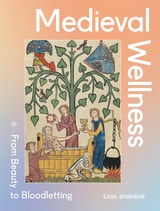
Medieval Wellness
From Beauty to BloodlettingLarisa Grollemond
J. Paul Getty Trust, The, 0
Dispelling myths of a dirty, superstitious Middle Ages, this entertaining volume explores medieval approaches to health and wellness.
Often maligned as an era of darkness and superstition, the Middle Ages in Europe have been stereotyped as lacking standards for basic hygiene, or, at the very least, for having a laughably simplistic approach to self-care and medicine. With wit and expert analysis, medievalist Larisa Grollemond explores everyday practices and beliefs of medieval life. She uncovers a world as nuanced and self-aware as our own while playfully connecting traditions from the Middle Ages to modern wellness culture.
- Challenges misconceptions of medieval Europe with engaging, evidence-based insights into hygiene and healthcare practices.
- Answers popular questions about daily life, including bathing, cosmetics, contraception, and the realities of medieval medical treatments.
- Features over 130 illustrations of illuminated manuscripts, medieval artifacts, and other art works that bring the past vividly to life.
- Connects medieval wellness practices to contemporary self-care trends, offering surprising parallels and fresh perspective.
If you think the Middle Ages were primitive and unsophisticated, this book will change your mind. With Medieval Wellness, you’ll discover a world of care, curiosity, and complexity that will feel familiar to your own.
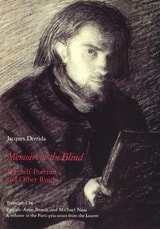
Memoirs of the Blind
The Self-Portrait and Other RuinsJacques Derrida
University of Chicago Press, 1993
vision, blindness, self-representation, and their relation to
drawing, while offering detailed readings of an extraordinary
collection of images. Selected by Derrida from the prints
and drawings department of the Louvre, the works depict
blindness—fictional, historical, and biblical. From Old
and New Testament scenes to the myth of Perseus and the
Gorgon and the blinding of Polyphemus, Derrida uncovers in
these images rich, provocative layers of interpretation.
For Derrida drawing is itself blind; as an act rooted in
memory and anticipation, drawing necessarily replaces one
kind of seeing (direct) with another (mediated). Ultimately,
he explains, the very lines which compose any drawing are
themselves never fully visible to the viewer since they exist
only in a tenuous state of multiple identities: as marks on
a page, as indicators of a contour. Lacking a "pure"
identity, the lines of a drawing summon the supplement of the
word, of verbal discourse, and, in doing so, obscure the
visual experience. Consequently, Derrida demonstrates, the
very act of depicting a blind person undertakes multiple
enactments and statements of blindness and sight.
Memoirs of the Blind is both a sophisticated
philosophical argument and a series of detailed readings.
Derrida provides compelling insights into famous and lesser
known works, interweaving analyses of texts—including
Diderot's Lettres sur les aveugles, the notion of
mnemonic art in Baudelaire's The Painter of Modern
Life, and Merleau-Ponty's The Visible and the
Invisible. Along with engaging meditations on the history
and philosophy of art, Derrida reveals the ways viewers
approach philosophical ideas through art, and the ways art
enriches philosophical reflection.
An exploration of sight, representation, and art,
Memoirs of the Blind extends and deepens the
meditation on vision and painting presented in Truth and
Painting. Readers of Derrida, both new and familiar, will
profit from this powerful contribution to the study of the
visual arts.
Memory, History, Forgetting
Paul Ricoeur
University of Chicago Press, 2004
Why do major historical events such as the Holocaust occupy the forefront of the collective consciousness, while profound moments such as the Armenian genocide, the McCarthy era, and France's role in North Africa stand distantly behind? Is it possible that history "overly remembers" some events at the expense of others? A landmark work in philosophy, Paul Ricoeur's Memory, History, Forgetting examines this reciprocal relationship between remembering and forgetting, showing how it affects both the perception of historical experience and the production of historical narrative.
Memory, History, Forgetting, like its title, is divided into three major sections. Ricoeur first takes a phenomenological approach to memory and mnemonical devices. The underlying question here is how a memory of present can be of something absent, the past. The second section addresses recent work by historians by reopening the question of the nature and truth of historical knowledge. Ricoeur explores whether historians, who can write a history of memory, can truly break with all dependence on memory, including memories that resist representation. The third and final section is a profound meditation on the necessity of forgetting as a condition for the possibility of remembering, and whether there can be something like happy forgetting in parallel to happy memory. Throughout the book there are careful and close readings of the texts of Aristotle and Plato, of Descartes and Kant, and of Halbwachs and Pierre Nora.
A momentous achievement in the career of one of the most significant philosophers of our age, Memory, History, Forgetting provides the crucial link between Ricoeur's Time and Narrative and Oneself as Another and his recent reflections on ethics and the problems of responsibility and representation.
Merleau-Ponty and Derrida
Intertwining Embodiment and AlterityJack Reynolds
Ohio University Press, 2005
While there have been many essays devoted to comparing the work of Maurice Merleau-Ponty with that of Jacques Derrida, there has been no sustained book-length treatment of these two French philosophers. Additionally, many of the essays presuppose an oppositional relationship between them, and between phenomenology and deconstruction more generally.
Jack Reynolds systematically explores their relationship by analyzing each philosopher in terms of two important and related issues—embodiment and alterity. Focusing on areas with which they are not commonly associated (e.g., Derrida on the body and Merleau-Ponty on alterity) makes clear that their work cannot be adequately characterized in a strictly oppositional way. Merleau-Ponty and Derrida: Intertwining Embodiment and Alterity proposes the possibility of a Merleau-Ponty-inspired philosophy that does not so avowedly seek to extricate itself from phenomenology, but that also cannot easily be dismissed as simply another instantiation of the metaphysics of presence. Reynolds argues that there are salient ethico-political reasons for choosing an alternative that accords greater attention to our embodied situation.
As the first full-length monograph comparing the philosophers, Merleau-Ponty and Derrida will interest scholars and students in European philosophy and teachers of courses dealing with deconstruction.
Merleau-Ponty's Last Vision
A Proposal for the Completion of "The Visible and the Invisible"Douglas Low
Northwestern University Press, 2000
Merleau-Ponty's Ontology
Second EditionM.C. Dillon
Northwestern University Press, 1997
Merleau-Ponty
Space, Place, ArchitecturePatricia M. Locke
Ohio University Press, 2015
Phenomenology has played a decisive role in the emergence of the discourse of place, now indispensable to many disciplines in the humanities and social sciences, and the contribution of Merleau-Ponty’s thought to architectural theory and practice is well established. Merleau-Ponty: Space, Place, Architecture is a vibrant collection of original essays by twelve eminent philosophers who mine Merleau-Ponty’s work to consider how we live and create as profoundly spatial beings. The resulting collection is essential to philosophers and creative artists as well as those concerned with the pressing ethical issues of our time.
Each contributor presents a different facet of space, place, or architecture. These essays carve paths from Merleau-Ponty to other thinkers such as Irigaray, Deleuze, Ettinger, and Piaget. As the first collection devoted specifically to developing Merleau-Ponty’s contribution to our understanding of place and architecture, this book will speak to philosophers interested in the problem of space, architectural theorists, and a wide range of others in the arts and design community.
Contributors: Nancy Barta-Smith, Edward S. Casey, Helen Fielding, Lisa Guenther, Galen A. Johnson, Randall Johnson, D. R. Koukal, Suzanne Cataldi Laba, Patricia M. Locke, Glen Mazis, Rachel McCann, David Morris, and Dorothea Olkowski.
Merleau-Ponty’s Developmental Ontology
David Morris
Northwestern University Press, 2018
Merleau-Ponty's Developmental Ontology shows how the philosophy of Maurice Merleau-Ponty, from its very beginnings, seeks to find sense or meaning within nature, and how this quest calls for and develops into a radically new ontology.
David Morris first gives an illuminating analysis of sense, showing how it requires understanding nature as engendering new norms. He then presents innovative studies of Merleau-Ponty's The Structure of Behavior and Phenomenology of Perception, revealing how these early works are oriented by the problem of sense and already lead to difficulties about nature, temporality, and ontology that preoccupy Merleau-Ponty's later work. Morris shows how resolving these difficulties requires seeking sense through its appearance in nature, prior to experience—ultimately leading to radically new concepts of nature, time, and philosophy.
Merleau-Ponty's Developmental Ontology makes key issues in Merleau-Ponty's philosophy clear and accessible to a broad audience while also advancing original philosophical conclusions.
Merleau-Ponty’s Philosophy of Nature
Ted Toadvine
Northwestern University Press, 2009
In our time, Ted Toadvine observes, the philosophical question of nature is almost entirely forgotten—obscured in part by a myopic focus on solving "environmental problems" without asking how these problems are framed. But an "environmental crisis," existing as it does in the human world of value and significance, is at heart a philosophical crisis. In this book, Toadvine demonstrates how Maurice Merleau-Ponty’s phenomenology has a special power to address such a crisis—a philosophical power far better suited to the questions than other modern approaches, with their over-reliance on assumptions drawn from the natural sciences.
The book examines key moments in the development of Merleau-Ponty’s philosophy of nature while roughly following the historical sequence of his major works. Toadvine begins by setting out an ontology of nature proposed in Merleau-Ponty’s first book, The Structure of Behavior. He takes up the theme of the expressive role of reflection in Phenomenology of Perception, as it negotiates the area between nature’s own "self-unfolding" and human subjectivity. Merleau-Ponty’s notion of "intertwining" and his account of space provide a transition to Toadvine’s study of the philosopher’s later work—in which the concept of "chiasm," the crossing or intertwining of sense and the sensible, forms the key to Merleau-Ponty’s mature ontology—and ultimately to the relationship between humans and nature.
Metaracial
Hegel, Antiblackness, and Political IdentityRei Terada
University of Chicago Press, 2023
Exploring anxieties raised by Atlantic slavery in radical enlightenment literature concerned about political unfreedom in Europe, Metaracial argues that Hegel's philosophy assuages these anxieties for the left. Interpreting Hegel beside Rousseau, Kant, Mary Shelley, and Marx, Terada traces Hegel's transposition of racial hierarchy into a hierarchy of stances toward reality. By doing so, she argues, Hegel is simultaneously antiracist and antiblack. In dialogue with Black Studies, psychoanalysis, and critical theory, Metaracial offers a genealogy of the limits of antiracism.
Michel Foucault
Beyond Structuralism and HermeneuticsHubert L. Dreyfus and Paul Rabinow
University of Chicago Press, 1983
To demonstrate the sense in which Foucault's work is beyond structuralism and hermeneutics, the authors unfold a careful, analytical exposition of his oeuvre. They argue that during the of Foucault's work became a sustained and largely successful effort to develop a new method—"interpretative analytics"—capable fo explaining both the logic of structuralism's claim to be an objective science and the apparent validity of the hermeneutical counterclaim that the human sciences can proceed only by understanding the deepest meaning of the subject and his tradition.
"There are many new secondary sources [on Foucault]. None surpass the book by Hubert Dreyfus and Paul Rabinow. . . . The American paperback edition contains Foucault's 'On the Genealogy of Ethics,' a lucid interview that is now our best source for seeing how he construed the whole project of the history of sexuality."—David Hoy, London Review of Books
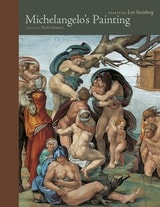
Michelangelo's Painting
Selected EssaysLeo Steinberg
University of Chicago Press, 2019
For half a century, Steinberg delved into Michelangelo’s work, revealing the symbolic structures underlying the artist’s highly charged idiom. This volume of essays and unpublished lectures elucidates many of Michelangelo’s paintings, from frescoes in the Sistine Chapel to the Conversion of St. Paul and the Crucifixion of St. Peter, the artist’s lesser-known works in the Vatican’s Pauline Chapel; also included is a study of the relationship of the Doni Madonna to Leonardo.
Steinberg’s perceptions evolved from long, hard looking. Almost everything he wrote included passages of old-fashioned formal analysis, but always put into the service of interpretation. He understood that Michelangelo’s rendering of figures, as well as their gestures and interrelations, conveys an emblematic significance masquerading under the guise of naturalism. Michelangelo pushed Renaissance naturalism into the furthest reaches of metaphor, using the language of the body to express fundamental Christian tenets once expressible only by poets and preachers.
Leo Steinberg was one of the most original art historians of the twentieth century, known for taking interpretive risks that challenged the profession by overturning reigning orthodoxies. Michelangelo’s Painting is the second volume in a series that presents Steinberg’s writings, selected and edited by his longtime associate Sheila Schwartz.
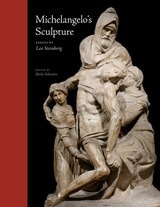
Michelangelo’s Sculpture
Selected EssaysLeo Steinberg
University of Chicago Press, 2018
For half a century, Steinberg delved into Michelangelo’s work, revealing the symbolic structures underlying the artist’s highly charged idiom. This volume of essays and unpublished lectures explicates many of Michelangelo’s most celebrated sculptures, applying principles gleaned from long, hard looking. Almost everything Steinberg wrote included passages of old-fashioned formal analysis, but here put to the service of interpretation. He understood that Michelangelo’s rendering of figures as well as their gestures and interrelations conveys an emblematic significance masquerading under the guise of naturalism. Michelangelo pushed Renaissance naturalism into the furthest reaches of metaphor, using the language of the body and its actions to express fundamental Christian tenets once expressible only by poets and preachers—or, as Steinberg put it, in Michelangelo’s art, “anatomy becomes theology.”
Michelangelo’s Sculpture is the first in a series of volumes of Steinberg’s selected writings and unpublished lectures, edited by his longtime associate Sheila Schwartz. The volume also includes a book review debunking psychoanalytic interpretation of the master’s work, a light-hearted look at Michelangelo and the medical profession and, finally, the shortest piece Steinberg ever published.
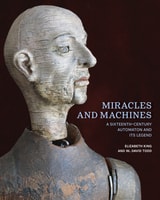
Miracles and Machines
A Sixteenth-Century Automaton and Its LegendElizabeth King
J. Paul Getty Trust, The, 0
This volume tells the singular story of an uncanny, rare object at the cusp of art and science: a 450-year-old automaton known as “the monk.” The walking, gesticulating figure of a friar, in the collection of the Smithsonian Institution’s National Museum of American History, is among the earliest extant ancestors of the self-propelled robot. According to legend connected to the court of Philip II of Spain, the monk represents a portrait of Diego de Alcalá, a humble Franciscan lay brother whose holy corpse was said to be agent to the miraculous cure of Spain’s crown prince as he lay dying in 1562.
In tracking the origins of the monk and its legend, the authors visited archives, libraries, and museums across the United States and Europe, probing the paradox of a mechanical object performing an apparently spiritual act. They identified seven kindred automata from the same period, which, they argue, form a paradigmatic class of walking “prime movers,” unprecedented in their combination of visual and functional realism. While most of the literature on automata focuses on the Enlightenment, this enthralling narrative journeys back to the late Renaissance, when clockwork machinery was entirely new, foretelling the evolution of artificial life to come.
Mobilizing Science
Movements, Participation, and the Remaking of KnowledgeSabrina McCormick
Temple University Press, 2009
Mobilizing Science theoretically and empirically explores the rise of a new kind of social movement—one that attempts to empower citizens through the use of expert scientific research. Sabrina Mccormick advances theories of social movements, development, and science and technology studies by examining how these fields intersect in cases around the globe.
Mccormick grounds her argument in two very different case studies: the anti-dam movement in Brazil and the environmental breast cancer prevention movement in the U.S. These, and many other cases, show that the scientization of society, where expert knowledge is inculcated in multiple institutions and lay people are marginalized, give rise to these new types of movements. While activists who consequently engage in science often instigate new methods that result in new findings and scientific tools, these movements still often fail due to superficial participatory institutions and tightly knit corporate/government relationships.
Moderately Modern
Rémi Brague
St. Augustine's Press, 2017
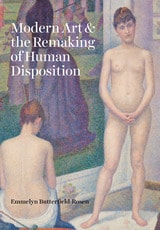
Modern Art and the Remaking of Human Disposition
Emmelyn Butterfield-Rosen
University of Chicago Press, 2021
With this book, Emmelyn Butterfield-Rosen brings a new formal and conceptual rubric to the study of turn-of-the-century modernism, transforming our understanding of the era’s canonical works. Butterfield-Rosen analyzes a hitherto unexamined formal phenomenon in European art: how artists departed from conventions for posing the human figure that had long been standard. In the decades around 1900, artists working in different countries and across different media began to present human figures in strictly frontal, lateral, and dorsal postures. The effect, both archaic and modern, broke with the centuries-old tradition of rendering bodies in torsion, with poses designed to simulate the human being’s physical volume and capacity for autonomous thought and movement. This formal departure destabilized prevailing visual codes for signifying the existence of the inner life of the human subject.
Exploring major works by Georges Seurat, Gustav Klimt, and the dancer and choreographer Vaslav Nijinsky— replete with new archival discoveries—Modern Art and the Remaking of Human Disposition combines intensive formal analysis with inquiries into the history of psychology and evolutionary biology. In doing so, it shows how modern understandings of human consciousness and the relation of mind to body were materialized in art through a new vocabulary of postures and poses.
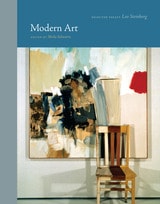
Modern Art
Selected EssaysLeo Steinberg
University of Chicago Press, 2023
Leo Steinberg was one of the most original art historians of the twentieth century, known for taking interpretive risks that challenged the profession by overturning reigning orthodoxies. In essays and lectures ranging from old masters to modern art, he combined scholarly erudition with eloquent prose that illuminated his subject and a credo that privileged the visual evidence of the image over the literature written about it. His writings, sometimes provocative and controversial, remain vital and influential reading. Steinberg’s perceptions evolved from long, hard looking at his objects of study. Almost everything he wrote included passages of formal analysis that were always put into the service of interpretation.
Following the series publication on Pablo Picasso, this volume focuses on other modern artists, including Cézanne, Monet, Matisse, Max Ernst, Jasper Johns, Robert Rauschenberg, Roy Lichtenstein, Hans Haacke, and Jeff Koons. Included are seven unpublished lectures and essays, Steinberg’s landmark essay “Encounters with Rauschenberg,” a survey of twentieth-century sculpture, and an examination of the role of authorial predilections in critical writing. The final chapter presents a collection of Steinberg’s humorous pieces, witty forays penned for his own amusement.
Modern Art is the fifth and final volume in a series that presents Steinberg’s writings, selected and edited by his longtime associate Sheila Schwartz.
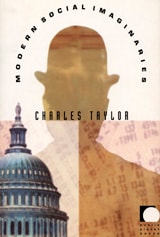
Modern Social Imaginaries
Charles Taylor
Duke University Press, 2004
Retelling the history of Western modernity, Taylor traces the development of a distinct social imaginary. Animated by the idea of a moral order based on the mutual benefit of equal participants, the Western social imaginary is characterized by three key cultural forms—the economy, the public sphere, and self-governance. Taylor’s account of these cultural formations provides a fresh perspective on how to read the specifics of Western modernity: how we came to imagine society primarily as an economy for exchanging goods and services to promote mutual prosperity, how we began to imagine the public sphere as a metaphorical place for deliberation and discussion among strangers on issues of mutual concern, and how we invented the idea of a self-governing people capable of secular “founding” acts without recourse to transcendent principles. Accessible in length and style, Modern Social Imaginaries offers a clear and concise framework for understanding the structure of modern life in the West and the different forms modernity has taken around the world.
Monad and Thou
Phenomenological Ontology Of Human BeingHiroshi Kojima
Ohio University Press, 2000
The genesis for this volume was in the bombing of Japan during World War II, where the author, as a young boy, watched the bombers overhead, speculating about the lives of the pilots and their relationship with those huddled on the ground.
From this disturbing diorama, Professor Hiroshi Kojima, the translator of Martin Buber into Japanese, unfolds a new approach to Buber’s “I-Thou” relation, drawing upon insights from Husserl, Heidegger, and others in the tradition of continental philosophy to extend and deepen Buber’s thought.
In chapters that reflect upon a wide range of phenomena—from religion, science, and technology, to imagination, embodiment, and power—Professor Kojima articulates a conception of what it means to be a human being that stands as an alternative to atomism and alienation of the modern world. Analyses of haiku and other aspects of Japanese culture demonstrate how Kojima’s theory can illuminate the spiritual traditions of both East and West.
Original in its thought and revealing in its insight into Japanese thought and culture, Monad and Thou represents the life’s work of one of Japan’s great thinkers.
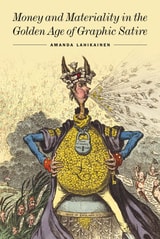
Money and Materiality in the Golden Age of Graphic Satire
Amanda Lahikainen
University of Delaware Press, 2022
This book examines the entwined and simultaneous rise of graphic satire and cultures of paper money in late eighteenth- and early nineteenth-century Britain. Asking how Britons learned to value both graphic art and money, the book makes surprising connections between two types of engraved images that grew in popularity and influence during this time. Graphic satire grew in visual risk-taking, while paper money became a more standard carrier of financial value, courting controversy as a medium, moral problem, and factor in inflation. Through analysis of satirical prints, as well as case studies of monetary satires beyond London, this book demonstrates several key ways that cultures attach value to printed paper, accepting it as social reality and institutional fact. Thus, satirical banknotes were objects that broke down the distinction between paper money and graphic satire altogether.
Money in the Air
Art Dealers and the Making of a Transatlantic Market, 1880–1930Gail Feigenbaum
J. Paul Getty Trust, The, 2024
“There was money in the air, ever so much money,” wrote Henry James in 1907, reflecting on the American appetite for art acquisitions. Indeed, collectors such as Henry Clay Frick and Andrew W. Mellon are credited with bringing noteworthy European art to the United States, with their collections forming the backbone of major American museums today. But what of the dealers, who possessed the expertise in art and recognized the potential of developing a new market model on both sides of the Atlantic?
Money in the Air investigates the often-overlooked role of these dealers in creating an international art world. Contributors examine the histories of well-known international firms like Duveen Brothers, M. Knoedler & Co., and Goupil & Cie and their relationships with American clients, as well as accounts of other remarkable dealers active in the transatlantic art market. Drawing on dealer archives, scholars reveal compelling findings, including previously unknown partnerships and systems of cooperation. This volume offers new perspectives on the development of art collections that formed the core of American art museums, such as the National Gallery of Art, the Metropolitan Museum of Art, and the Frick Collection.
Monuments Askew
An Elliptical History of the Factory of the Eccentric ActorMaria Corrigan
Rutgers University Press, 2025
Moral Action
A Phenomenological StudyRobert Sokolowski
Catholic University of America Press, 2017
Motivation and the Primacy of Perception
Merleau-Ponty's Phenomenology of KnowledgePeter Antich
Ohio University Press, 2021
Motive and Intention
An Essay in the Appreciation of ActionRoy Lawrence
Northwestern University Press, 1972
Movements in Times of Democratic Transition
Bert Klandermans
Temple University Press, 2015
The editors and contributors to Movements in Times of Democratic Transition examine in comparative detail how social movements act within the context of the democratic transitions they have been fighting for, and how they are affected by the changes they helped bring about. Offering insights into the nature of how social movements decline, radicalize, revitalize, or spark new cycles of activism, Movements in Times of Democratic Transition provides a comprehensive analysis of these key questions of mobilization research.
Contributors include: Paul Almeida, Christopher J. Colvin, Stephen Ellis, Grzegorz Ekiert, Grzegorz Forys, Krzysztof Gorlach, Camila Penna, Sebastián Pereyra, Steven Robbins, Ton Salman, Mate Szabo, Ineke van Kessel, Michal Wenzel, and the editors.
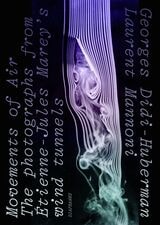
Movements of Air
The Photographs from Étienne-Jules Marey’s Wind TunnelsGeorges Didi-Huberman and Laurent Mannoni
Diaphanes, 2022
Featuring more than one hundred and fifty photographs and images, Movements of Air reprints the breathtaking pictures of Étienne-Jules Marey—images captured between 1899 and 1901 during his scientific experiments with moving air and smoke—and complements them with essays by Georges Didi-Huberman and Laurent Mannoni.
Mannoni begins by reflecting on Marey’s experimental approach. As the founder of the “graphic method,” Marey was also the developer of an aerodynamic wind tunnel. His experiments’ photographs of fluid motion introduced a whole world of movements and turbulences, and fluids, and influenced generations of scientists and artists alike. Didi-Huberman expands on the philosophical debates surrounding these aesthetically and technically instructive images. Even though Marey’s main interest was graphic information, Didi-Huberman shows us how the flow of all things drew this ingenious experimenter to a photographic practice that creates drags, streaks, expansions, and visual dances. Marey’s wind tunnel photographs were also themselves causes of turbulence in the history of images. The artists Dombois and Oeschger explore these “graphical” vortices of the last 120 years, providing at the end of the book a collage from historical and contemporary material interlaced with their own image-making in Dombois’s wind tunnel at the Zurich University of the Arts.
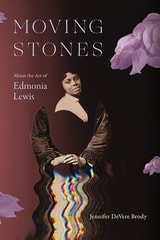
Moving Stones
About the Art of Edmonia LewisJennifer DeVere Brody
Duke University Press, 2026

Mundus Imaginalis
World Literatures After Phantom EmpiresHamid Dabashi
Duke University Press, 2027

Mutual Integration in Immigration Society
An Epistemic ArgumentBodi Wang
Campus Verlag, 2023
The public culture of the receiving society and the dominant understanding of belonging and political membership can influence the social participation of immigrants as much as immigration law. However, current discussions of integration focus primarily on the distribution of rights and neglect the role of tacit knowledge. Through a systematical and philosophical analysis of identity’s role in policymaking, governance, and social practice, Bodi Wang shows how a one-sided understanding of integration resembles “assimilation” and why integration should be expected from locals as well. This argument weaves together extensive findings in sociology, history, critical race theory, and Chinese philosophy with ethics and migration studies.
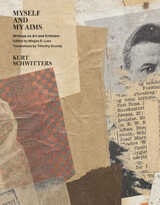
Myself and My Aims
Writings on Art and CriticismKurt Schwitters
University of Chicago Press, 2021
As the first anthology in English of the critical and theoretical writings of this influential artist, Myself and My Aims makes the case for Schwitters as one of the most creative thinkers of his generation. Including material that has never before been published, this volume presents the full range of his prolific writing on the art and attitudes of his time, joining existing translations of his children’s stories, poetry, and fiction to give new readers unprecedented access to his literary imagination. With an accessible introduction by Megan R. Luke and elegant English translations by Timothy Grundy, this book will prove an exceptional resource for artists, scholars, and enthusiasts of his art.
Mystery Of Being Vol 1
Reflection & MysteryGabriel Marcel
St. Augustine's Press, 2001
These volumes deal with almost all of the major themes of Marcel's thought: the nature of philosophy, our broken world, man's deep ontological need for being, i.e., for permanent eternal values, our incarnate bodily existence, primary and secondary reflection, participation, being in situation, the identity of the human self, intersubjectivity, mystery and problem, faith, hope, and the reality of God, and immortality.
Mystery Of Being Vol 2
Faith & RealityGabriel Marcel
St. Augustine's Press, 2001
The Mystery of Being contains the most systematic exposition of the philosophical thought of Gabriel Marcel, a convert to Catholicism and the most distinguished twentieth-century exponent of Christian existentialism. Its two volumes are the Gifford lectures which Marcel delivered in Aberdeen, Scotland, in 1949 and 1950. Marcel's work fundamentally challenges most of the major positions of the atheistic existentialists (Sartre, Beauvoir, Camus), especially their belief in an absurd, meaningless, godless universe.
These volumes deal with almost all of the major themes of Marcel's thought: the nature of philosophy, our broken world, man's deep ontological need for being, i.e., for permanent eternal values, our incarnate bodily existence, primary and secondary reflection, participation, being in situation, the identity of the human self, intersubjectivity, mystery and problem, faith, hope, and the reality of God, and immortality.
Mystery and Intelligibility
History of Philosophy as Pursuit of WisdomJeffrey Dirk Wilson
Catholic University of America Press, 2021