Results by title
18284 books match the query 'United States' and 949 start with m
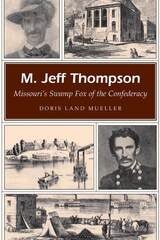
M. Jeff Thompson
Missouri's Swamp Fox of the ConfederacyDoris Land Mueller
University of Missouri Press, 2007
In the treacherous swamps of southeast Missouri, a different kind of Civil War was waged.
Meriwether Jeff Thompson was one of the most intriguing but least-known Missouri participants in the Civil War. He and his troops traveled fast and light to harass Union forces, materializing out of the countryside to surprise the enemy and evading the traps set for them by Northern commanders. Early in the war, Union General Ulysses S. Grant gave Thompson the name “Swamp Fox” for his exploits in the Bootheel region. This book now tells his story—an adventure that will be appreciated by readers of all ages. Doris Mueller has produced a meticulously researched account of Thompson’s life, from his Virginia boyhood and early successes to his wartime exploits and postwar life. When the war began, Thompson left his adopted city of St. Joseph—where he had served as mayor—to fight for the Confederacy. He was elected brigadier general in the First Military District of Southeast Missouri and led poorly equipped and loosely trained men in skirmishes and raids, often using guerrilla tactics. He was captured in August 1863. After being released twelve months later in a prisoner exchange, he joined Sterling Price’s ill-fated raid into Missouri. After the war, he was one of the first Southern leaders to seek reinstatement as a U.S. citizen and worked to allay hostilities among fellow Southerners.
Thompson was also known as the “Poet Laureate of the Marshes,” and Mueller includes numerous excerpts from his writings about his experiences. Her account not only provides a wealth of little-known biographical details about this important Missourian but also offers insight into the state’s unique experiences during that bloody era, personalizing events through the life of this brave soldier.
Scorned by the Northern press for impudence, but beloved as a leader by his men, Thompson was courageous in battle, often to the point of recklessness, making him a constant thorn in the side of Union forces; after the war he was an oft-maligned model for reconciliation. Doris Mueller’s recounting of his life is an action-adventure story that will delight readers as it attests to his important role in Missouri’s heritage.
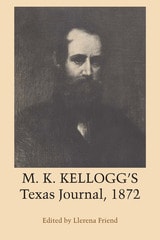
M. K. Kellogg's Texas Journal, 1872
Miner Kilbourne Kellogg
University of Texas Press, 1967
Miner Kilbourne Kellogg’s notes about his experiences with “the most completely and comfortably fitted-out expedition which ever went to Texas” is an account of the beauty, the wildness, and the dangers and inconveniences of 1872 Texas.
Editor Llerena Friend provides a setting for the journal by tracing the search for mineral wealth in post–Civil War Texas; by describing the aims of the Eastern-born Texas Copper and Land Association, whose expedition the diarist accompanied; and by narrating the life of Miner K. Kellogg—artist, world traveler, writer. Friend’s annotation of the journal fills in details about the names, places, and events that Kellogg mentions.
As the expedition travels across North Texas toward Double Mountain, Kellogg reveals himself not only as a man of artistic vision but also as a chronic complainer, an accomplished observer of human nature and individual personality, and a skillful interpreter of problems that beset the people in the uncivilized regions of Texas.
A cultured gentleman who had traveled the world and had sat in the company of presidents and princes, this non-Texan was disdainful of the “texans” of the wilderness, for whom “Cards & vulgar slang & stories of Indian adventures form the staple of their mental exercises.” An artist, he was often unable to draw, either because of his constant illnesses and frustrations or because of the unfavorable encampments of the party. Accustomed to the amenities and comforts of life, he criticized the lack of leadership and the purpose of the expedition, and complained incessantly of the chiggers, the “want of cleanliness decency & health,” and “the infernal bacon,” which became the stock fare.
Amid the complaints and derisions, however, appear vivid images of the Texas landscape, set down in word pictures by an artist’s pen: the night sky, “with a half moon now & then eclipsed by dark clouds passing over the clear starry vault of bluish grey”; the river-bank soil of “Vandyke brown color”; the mesquite trees in a melancholy and wild basin, “without a leaf upon their dead carcasses, yet still standing & clinging to the hope of resurrection from the life yet remaining in their roots”; and the “acres of the brilliant yellow Compositea & pink sabatea-like carpets spread in the morning air.”
Kellogg’s watercolor sketches were unfortunately lost in travel, but his literary record, “M. K. Kellogg’s Mems, Exploring Expedition to Texas, 1872,” remains as a personal account of an abortive attempt to exploit the natural resources of the Texas frontier during Reconstruction and an artist’s picture of the life and the land of that frontier.
M.I.A. or Mythmaking in America
How and why belief in live POWs has possessed a nationFranklin, H. Bruce
Rutgers University Press, 1992
This paperback edition of M.I.A. or Mythmaking in America adds major new material about Ross Perot's role, the 1991-1992 Senate investigation, and illegal operations authorized by Ronald Reagan.
M/E/A/N/I/N/G
An Anthology of Artists' Writings, Theory, and CriticismSusan Bee and Mira Schor, eds.
Duke University Press, 2000
With its emphasis on artists’ perspectives of aesthetic and social issues, this anthology provides a unique opportunity to enter into the fray of the most hotly contested art issues of the past few decades: the visibility of women artists, sexuality and the arts, censorship, art world racism, the legacies of modernism, artists as mothers, visual art in the digital age, and the rewards and toils of a lifelong career in art. The stellar cast of contributing artists and art writers includes Nancy Spero, Richard Tuttle, David Humphrey, Thomas McEvilley, Laura Cottingham, Johanna Drucker, David Reed, Carolee Schneemann, Whitney Chadwick, Robert Storr, Leon Golub, Charles Bernstein, and Alison Knowles.
This compelling and theoretically savvy collection will be of interest to artists, art historians, critics, and a general audience interested in the views of practicing artists.
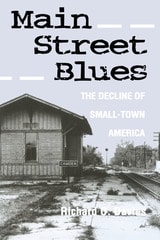
MAIN STREET BLUES
THE DECLINE OF SMALL-TOWN AMERICARichard O. Davies
The Ohio State University Press, 1998

MAKING MIDWIVES LEGAL
Childbirth, Medicine, and the Law, Second EditionRaymond G. DeVries
The Ohio State University Press, 1996
MAKING SENSE OF THE CITY
LOCAL GOVERNMENT, CIVIC CULTURE, AND COMMUNITY LIFE IN URBAN AMERICAROBERT B. FAIRBANKS
The Ohio State University Press, 2001
Making Sense of the City explores the ways in which urbanites have attempted to confront the challenges of urban life during the nineteenth and twentieth centuries. In the spirit of Zane L. Miller, whom this volume honors, the nine contributors focus closely on the words and actions of individuals, institutions, and organizations who participated in the public discourse about what the city was or could be. Through an examination of such topics as city charters, city planning texts, neighborhood organizations, municipal recreation programs, urban government reforms, urban identity, and fair housing campaigns, the authors offer insight into the process through which ideas about the nature of the city have affected action in the urban environment.
Contributing authors are
- Robert B. Fairbanks
- Patricia Mooney-Melvin
- Judith Spraul-Schmidt
- Alan I. Marcus
- Robert A. Burnham
- Andrea Tuttle Kornbluh
- Bradley D. Cross
- Charles F. Casey-Leininger
- Roger W. Lotchin

MAKING STORIES, MAKING SELVES
FEMINIST REFLECTIONS ON THE HOLOCAUSTR. Ruth Linden
The Ohio State University Press, 1995
Urged forward by these silences, Linden, a feminist and sociologist, began to interview Jewish Holocaust survivors in 1983. As Linden interprets survivors' accounts of the death camps and the resistance, she reveals complex ways in which selves are constructed through storytelling. The stories that unfold are continuously fashioned and refashioned—never stripped of context or frozen in time. What emerges is an unexpectedly elegant montage in which interviewee, interviewer, and author are intertwined.
Linden's meetings with survivors and her encounters with their stories transformed her as a feminist, a Jew, and a social scientist. Her analysis reveals the intimate connections between an ethnographer's lived experience and her interpretations of others'. Linden's reflections on the process of ethnography belie the rhetoric of positivism in the social sciences. They will inspire other scholars to break free of research and writing practices in their own disciplines that efface the ineluctable bond between knower and known. All readers will be challenged to reexamine the Holocaust in an intensely personal light and to reconsider the meanings of survival in our own time.
Cutting across the boundaries of ethnography and autobiography to create a new kind of text, Making Stories, Making Selves offers a significant contribution to interpretive social science and the literature of the Holocaust. Linden's original and courageous work is vital reading for Holocaust scholars, students of modern Jewish life, sociologists, feminist theorists, and all readers seeking to understand their own relationship to the Holocaust.
MAKING THE “AMERICA OF ART”
Cultural Nationalism and Nineteenth-Century Women WritersNaomi Z. Sofer
The Ohio State University Press, 2005
By the end of the 19th century it had become possible for American women to identify themselves as serious Artists. This was a relatively new phenomenon, one that became possible only after American women writers had dismantled the conceptual frameworks that had authorized their artistic production since the early days of the Republic.
Making the “America of Art” demonstrates that beginning in the 1850s, women writers challenged the terms of the Scottish Common Sense philosophy, which had made artistic endeavors acceptable in the new Republic by subordinating aesthetic motivation to moral and educational goals. Harriet Beecher Stowe and Augusta Jane Evans drew on Ruskin to argue for the creation of a religiously based national aesthetic. In the postbellum years Louisa May Alcott, Rebecca Harding Davis, Elizabeth Stuart Phelps, and Constance Fenimore Woolson continued the process in a series of writings that revolved around three central areas of concern: the place of the popular in the realm of high art; the role of the genius; and the legacy of the Civil War.
Sofer significantly revises the history of 19th-century American women’s authorship by detailing the gradual process that produced women writers wholly identified with literary high culture at the century’s end. Sofer argues that, counter to conventional wisdom, American women writers produced a large body of theoretical writing on the central aesthetic questions of the day. Although the writers Sofer studies were finally unable to construct viable new models for women’s artistic production, their attempts to do so are an essential piece of American literary history.

MANHOOD, CITIZENSHIP, AND THE NATIONAL GUARD
ILLINOIS, 1870–1917ELEANOR L HANNAH
The Ohio State University Press, 2007

MATTERS OF FACT
READING NONFICTION OVER THE EDGEDANIEL W. LEHMAN
The Ohio State University Press, 1998
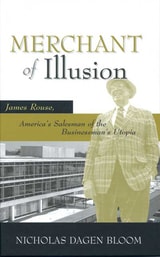
MERCHANT OF ILLUSION
James Rouse, America’s Salesman of the Businessman’s UtopiaNicholas Dagen Bloom
The Ohio State University Press, 2004
MOTHERS MOTHERHOOD
READINGS IN AMERICAN HISTORYEdited by Rima D. Apple and Janet Golden
The Ohio State University Press, 1997
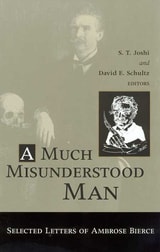
MUCH MISUNDERSTOOD MAN
SELECTED LETTERS OF AMBROSE BIERCES.T. JOSHI
The Ohio State University Press, 2003
MUSE IN THE MACHINE
AMERICAN FICTION AND MASS PUBLICITYMARK CONROY
The Ohio State University Press, 2004

Ma'am Jones of the Pecos
Eve Ball
University of Arizona Press, 1969
"An unusual story of an American pioneer woman who used a needle, skillet, or gun, as needed, and who tended the dying during frontier wars or outbreaks of equally deadly diseases." —The Old Bookaroos
"For vivid descriptions of pioneer life in southeastern New Mexico, no work of history or fiction can match Eve Ball's dramatic story of Barbara Jones and her family...Anyone who picks it up will be reluctant to stop reading... "Few western historians have made such expert use of oral history as Mrs. Ball. Colloquial language adds color; and carefully drawn sketches of the family, their acquaintances, and the major figures in Lincoln County provide a degree of intimacy seldom found in historical works. That the resulting tale is believable and deeply moving demonstrates just how effective these techniques can be." —Southwestern Historical Quarterly
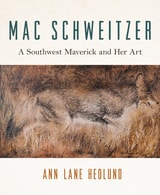
Mac Schweitzer
A Southwest Maverick and Her ArtAnn Lane Hedlund
University of Arizona Press, 2025
Southwest Books of the Year Top Pick
In Tucson during the 1950s, nearly everyone knew, or wanted to know, the southwestern artist Mac Schweitzer. Born Mary Alice Cox in Cleveland, Ohio, in 1921, she grew up a tomboy who adored horses, cowboys, and art. After training at the Cleveland School of Art and marrying, she adopted her maiden initials (M. A. C.) as her artistic name and settled in Tucson in 1946. With a circle of influential friends that included anthropologists, designer-craftsmen, and Native American artists, she joined Tucson’s “Early Moderns,” receiving exhibits, commissions, and awards for her artwork. When she died in 1962, Mac’s artistic legacy faded from public view, but her prize-winning works attest to a thriving career.
Author Ann Lane Hedlund draws from the artist’s letters, photo albums, and published reviews to tell the story of Mac’s creative and adventuresome life. Her watercolors, oil paintings, prints, and sculptures—a diverse body of work never before seen in public—range from naturalistic studies of Sonoran Desert animals to impressionistic landscapes to moody abstractions. A sharp observer of Indigenous life, she sketched and painted scenes of Navajo (Diné), Hopi, O’odham, and Yaqui people and events. These unique portrayals of the Southwest illustrate this saga of a maverick artist rediscovered.
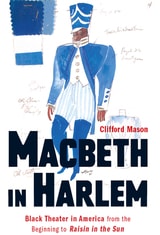
Macbeth in Harlem
Black Theater in America from the Beginning to Raisin in the SunClifford Mason
Rutgers University Press, 2020
2021 PROSE Awards Finalist, Music & the Performing Arts
In 1936 Orson Welles directed a celebrated all-black production of Macbeth that was hailed as a breakthrough for African Americans in the theater. For over a century, black performers had fought for the right to perform on the American stage, going all the way back to an 1820s Shakespearean troupe that performed Richard III, Othello, and Macbeth, without relying on white patronage.
"Macbeth" in Harlem tells the story of these actors and their fellow black theatrical artists, from the early nineteenth century to the dawn of the civil rights era. For the first time we see how African American performers fought to carve out a space for authentic black voices onstage, at a time when blockbuster plays like Uncle Tom’s Cabin and The Octoroon trafficked in cheap stereotypes. Though the Harlem Renaissance brought an influx of talented black writers and directors to the forefront of the American stage, they still struggled to gain recognition from an indifferent critical press.
Above all, "Macbeth" in Harlem is a testament to black artistry thriving in the face of adversity. It chronicles how even as the endemic racism in American society and its theatrical establishment forced black performers to abase themselves for white audiences’ amusement, African Americans overcame those obstacles to enrich the nation’s theater in countless ways.

Machine Politics in Transition
Party and Community in ChicagoThomas M. Guterbock
University of Chicago Press, 1980
For three years, Thomas M. Guterbock participated in the daily activities of the Regular Democratic Organization in one North Side Chicago ward in order to discover how political machines win the support of the urban electorate. Guterbock's participant observation data, supplemented by a sample survey of ward residents' attitudes toward, and contacts with the machine, provide convincing evidence that the most widely accepted notions of how political machines work are no longer correct.
Contrary to conventional wisdom about the machine, Guterbock finds that the party does not secure votes by doing "favors" for people, nor do services rendered determine actual voting behavior. Instead, party loyalty is governed by such factors as social status, educational achievement, and bureaucratic competence. Guterbock finds that Democratic loyalists are drawn disproportionately from the ward's lowest strata. Ironically, the characteristics of these loyal Democrats contrast sharpely with the characteristics of those most likely to use party services.
What keeps the machine going, then? To answer this question, Guterbock takes us behind the scenes for a unique look inside the ward club. He shows how members develop loyalty and motivation beyond concern for their own pocketbooks. And he analyzes the public involvement of machine politicians in neighborhood affairs, describing the skillful—sometimes devious—ways in which they appeal to their constituents' sense of community. By focusing on the interplay of party loyalty and community attachments, Guterbock is able to explain the continued hegemony of Chicago's political machine and its enduring image of legitimacy.
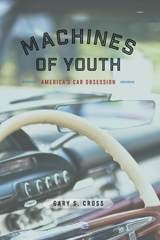
Machines of Youth
America’s Car ObsessionGary S. Cross
University of Chicago Press, 2018
Machines of Youth traces the rise, and more recently the fall, of car culture among American teens. In this book, Gary S. Cross details how an automobile obsession drove teen peer culture from the 1920s to the 1980s, seducing budding adults with privacy, freedom, mobility, and spontaneity. Cross shows how the automobile redefined relationships between parents and teenage children, becoming a rite of passage, producing new courtship rituals, and fueling the growth of numerous car subcultures. Yet for teenagers today the lure of the automobile as a transition to adulthood is in decline.Tinkerers are now sidelined by the advent of digital engine technology and premolded body construction, while the attention of teenagers has been captured by iPhones, video games, and other digital technology. And adults have become less tolerant of teens on the road, restricting both cruising and access to drivers’ licenses.
Cars are certainly not going out of style, Cross acknowledges, but how upcoming generations use them may be changing. He finds that while vibrant enthusiasm for them lives on, cars may no longer be at the center of how American youth define themselves. But, for generations of Americans, the modern teen experience was inextricably linked to this particularly American icon.
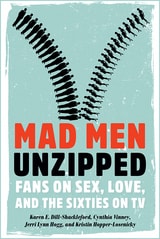
Mad Men Unzipped
Fans on Sex, Love, and the Sixties on TVKaren L. Dill-Shackleford, Cynthia Vinney, Jeri Lynn Hogg, Kristin Hopper-Losenicky
University of Iowa Press, 2015
In answering these questions, the authors explore not just the online commentary but also Mad Men fans’ fan fiction, cosplay, cocktail making, and vintage furniture collecting. Whether tweeting as one of the main characters (or just a lowly mail clerk), setting Peggy up with the man who’ll treat her right, or figuring out just which “Mad Man” they are at heart, fans integrate the show into their lives and use it to make sense of their own choices in work, leisure, and love.
Mad Men, Death and the American Dream
Elisabeth Bronfen
Diaphanes, 2016
We are drawn to Mad Men’s dapper cast of characters, argues Elisabeth Bronfen, because, although the series has drawn praise for its depiction of the 1960s and ’70s, it speaks equally well to cultural concerns of the present. The prototypical con man, Don makes a precarious journey from poverty to fame and prosperity that maps the pursuit of moral perfectionism that features prominently throughout American cultural history. Yet a lingering sense of dissatisfaction hints that the lifestyle Don strives for may be a mere manifestation of the illusory American dream—cemented in the same collective desires Don draws on to advertise cigarettes and luxury cars by day.
"Mad Men," Death and the American Dream takes readers through the cultural fantasies that underlie characters’ motivations in this sophisticated and immensely popular television series, showing how—then as now—we turn to fantasy in the face of conflicts that cannot be resolved in political reality. Fascinating and full of accessible insights, the book will appeal to the show’s many fans, as well as anyone interested in American studies, media studies, or cultural history.
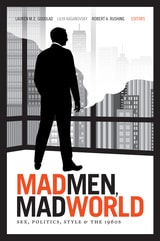
Mad Men, Mad World
Sex, Politics, Style, and the 1960sLauren M. E. Goodlad, Lilya Kaganovsky, and Robert A. Rushing, eds.
Duke University Press, 2013
In the introduction, the editors explore the show's popularity; its controversial representations of race, class, and gender; its powerful influence on aesthetics and style; and its unique use of period historicism and advertising as a way of speaking to our neoliberal moment. Mad Men, Mad World also includes an interview with Phil Abraham, an award-winning Mad Men director and cinematographer. Taken together, the essays demonstrate that understanding Mad Men means engaging the show not only as a reflection of the 1960s but also as a commentary on the present day.
Contributors. Michael Bérubé, Alexander Doty, Lauren M. E. Goodlad, Jim Hansen, Dianne Harris, Lynne Joyrich, Lilya Kaganovsky, Clarence Lang, Caroline Levine, Kent Ono, Dana Polan, Leslie Reagan, Mabel Rosenheck, Robert A. Rushing, Irene Small, Michael Szalay, Jeremy Varon
Mad Music
Charles Ives, the Nostalgic RebelStephen Budiansky
University Press of New England, 2014

Mad River, Marjorie Rowland, and the Quest for LGBTQ Teachers’ Rights
Margaret A. Nash
Rutgers University Press, 2022
In the first in-depth treatment of this foundational legal case, authors Margaret A. Nash and Karen L. Graves tell the story of that case and of Marjorie Rowland, the pioneer who fought for employment rights for LGBTQ educators and who paid a heavy price for that fight. It brings the story of LGBTQ educators’ rights to the present, including commentary on Bostock v Clayton County, the 2020 Supreme Court case that struck down employment discrimination against LGBT workers.

Mad to Be Saved
The Beats, the 50's, and FilmDavid Sterritt
Southern Illinois University Press, 1998
Film critic David Sterritt presents an interdisciplinary exploration of the Beat Generation, its intersections with main-stream and experimental film, and the interactions of all of these with American society and the culture of the 1950s. Sterritt balances the Beat countercultural goal of rebellion through both artistic creation and everyday behavior against the mainstream values of conformity and conservatism, growing worry over cold-war hostilities, and the "rat race" toward material success.
After an introductory overview of the Beat Generation, its history, its antecedents, and its influences, Sterritt shows the importance of "visual thinking" in the lives and works of major Beat authors, most notably Jack Kerouac, Allen Ginsberg, and William S. Burroughs. He turns to Mikhail Bakhtin's dialogic theory to portray the Beat writers-who were inspired by jazz and other liberating influences-as carnivalesque rebels against what they perceived as a rigid and stifling social order.
Showing the Beats as social critics, Sterritt looks at the work of 1950s photographers Robert Frank and William Klein; the attack against Beat culture in the pictures and prose of Life magazine; and the counterattack in Frank's film Pull My Daisy, featuring key Beat personalities. He further explores expressions of rebelliousness in film noir, the melodramas of director Douglas Sirk, and other Hollywood films.
Finally, Sterritt shows the changing attitudes toward the Beat sensibility in Beat-related Hollywood movies like A Bucket of Blood and The Beat Generation; television programs like Route 66 and The Many Loves of Dobie Gillis; nonstudio films like John Cassavetes's improvisational Shadows and Shirley Clarke's experimental The Connection; and radically avant-garde works by such doggedly independent screen artists as Stan Brakhage, Ron Rice, Bruce Connor, and Ken Jacobs, drawing connections between their achievements and the most subversive products of their Beat contemporaries.
Madam C. J. Walker's Gospel of Giving
Black Women's Philanthropy during Jim CrowTyrone McKinley Freeman
University of Illinois Press, 2020
- AFP/Skystone Partners Prize for Research on Fundraising and Philanthropy, Association of Fundraising Professionals, 2021
- Terry McAdam Book Award, given by the Alliance for Nonprofit Management
- 2023 Peter Dobkin Hall History of Philanthropy Prize from the Association for Research on Nonprofit and Voluntary Action (ARNOVA).
Founder of a beauty empire, Madam C. J. Walker was celebrated as America's first self-made female millionaire in the early 1900s. Known as a leading African American entrepreneur, Walker was also devoted to an activist philanthropy aimed at empowering African Americans and challenging the injustices inflicted by Jim Crow.
Tyrone McKinley Freeman's biography highlights how giving shaped Walker's life before and after she became wealthy. Poor and widowed when she arrived in St. Louis in her twenties, Walker found mentorship among black churchgoers and working black women. Her adoption of faith, racial uplift, education, and self-help soon informed her dedication to assisting black women's entrepreneurship, financial independence, and activism. Walker embedded her philanthropy in how she grew her business, forged alliances with groups like the National Association of Colored Women, funded schools and social service agencies led by African American women, and enlisted her company's sales agents in local charity and advocacy work.
Illuminating and dramatic, Madam C. J. Walker’s Gospel of Giving broadens our understanding of black women’s charitable giving and establishes Walker as a foremother of African American philanthropy.
Madam Chairman
Mary Louise Smith and the Republican Revival after WatergateSuzanne O'Dea
University of Missouri Press, 2012
Madame Chair
A Political Autobiography of an Unintentional PioneerJean Miles Westwood
Utah State University Press, 2007
A Utah national committeewoman and member of the reform committee that reorganized the party, Westwood answered George McGovern’s call to lead his presidential campaign. In the dramatic year of 1972, she became “chairman” of the party, McGovern lost in a landslide, Nixon was reelected, and a covert operation burglarized Democratic National Committee headquarters at the Watergate.
Westwood provides an inside account of a period that reshaped national politics. Second-wave feminism—“women’s liberation”—and the civil rights and antiwar movements opened the way. As a major player in political reform, Jean Westwood both helped build that road and traveled it.
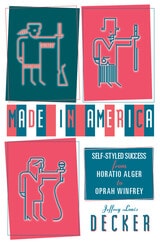
Made In America
Self-Styled Success from Horatio Alger to Oprah WinfreyJeffrey Louis Decker
University of Minnesota Press, 1997
The first look at self-made men and women from a multicultural perspective.
Brings gender, race, and ethnicity to bear on the myth of the “self-made man.”
Made in America presents the first look at self-made men and women from a multicultural perspective. Jeffrey Louis Decker discusses the emergence of self-starters like Andrew Carnegie, Booker T. Washington, Madam C. J. Walker, Younghill Kang, and Lee Iacocca in relation to the changing consumer markets of the twentieth century.Decker locates the new breed of entrepreneurs within the changing rhetoric of personal success, which shifted its emphasis over the past century from religious “character” to psychological “personality” to celebrity “image.” The book concludes by surveying the life stories of enterprising celebrities such as Oprah Winfrey and Arnold Schwarzenegger.Decker analyzes the autobiographical expressions of famous entrepreneurs, from Carnegie to Ross Perot, alongside more marginal ones in order to examine how mainstream society shapes and is shaped by the cultures of subordinate groups. In addition, he looks at the link between self-making and nation-building, and in doing so discovers the origins of another pervasive myth: the “American dream.”Underlying Decker’s study are these questions: What happened to the myth of self-making in America? If it is dead, what caused its demise? If it lives on, what form has it taken? Written in a lucid and engaging style, Made in America uncovers the richness, complexity, and diversity of self-styled success in our time. By bringing gender, race, and ethnicity to bear on the myth of the “self-made man,” this book provides a timely and fascinating reexamination of a traditional area of inquiry in American cultural studies.200 pages Translation rights: University of Minnesota Press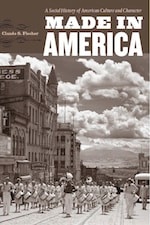
Made in America
A Social History of American Culture and CharacterClaude S. Fischer
University of Chicago Press, 2010
Our nation began with the simple phrase, “We the People.” But who were and are “We”? Who were we in 1776, in 1865, or 1968, and is there any continuity in character between the we of those years and the nearly 300 million people living in the radically different America of today?
With Made in America, Claude S. Fischer draws on decades of historical, psychological, and social research to answer that question by tracking the evolution of American character and culture over three centuries. He explodes myths—such as that contemporary Americans are more mobile and less religious than their ancestors, or that they are more focused on money and consumption—and reveals instead how greater security and wealth have only reinforced the independence, egalitarianism, and commitment to community that characterized our people from the earliest years. Skillfully drawing on personal stories of representative Americans, Fischer shows that affluence and social progress have allowed more people to participate fully in cultural and political life, thus broadening the category of “American” —yet at the same time what it means to be an American has retained surprising continuity with much earlier notions of American character.
Firmly in the vein of such classics as The Lonely Crowd and Habits of the Heart—yet challenging many of their conclusions—Made in America takes readers beyond the simplicity of headlines and the actions of elites to show us the lives, aspirations, and emotions of ordinary Americans, from the settling of the colonies to the settling of the suburbs.
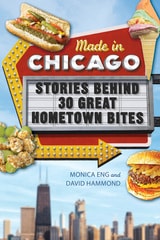
Made in Chicago
Stories Behind 30 Great Hometown BitesMonica Eng and David Hammond
University of Illinois Press, 2023
A BookRiot Most Anticipated Travel Book of 2023
Italian beef and hot dogs get the headlines. Cutting-edge cuisine and big-name chefs get the Michelin stars. But Chicago food shows its true depth in classic dishes conceived in the kitchens of immigrant innovators, neighborhood entrepreneurs, and mom-and-pop visionaries.
Monica Eng and David Hammond draw on decades of exploring the city’s food landscape to serve up thirty can’t-miss eats found in all corners of Chicago. From Mild Sauce to the Jibarito and from Taffy Grapes to Steak and Lemonade, Eng and Hammond present stories of the people and places behind each dish while illuminating how these local favorites reflect the multifaceted history of the city and the people who live there. Each entry provides all the information you need to track down whatever sounds good and selected recipes even let you prepare your own Flaming Saganaki or Akutagawa.
Generously illustrated with full-color photos, Made in Chicago provides locals and visitors alike with loving profiles of a great food city’s defining dishes.
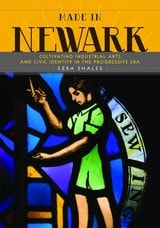
Made in Newark
Cultivating Industrial Arts and Civic Identity in the Progressive EraShales, Ezra
Rutgers University Press, 2010
This is the story of experimental exhibitions in the library and the founding of the Newark Museum Associationùa project in which cultural literacy was intertwined with civics and consumption. Local artisans demonstrated crafts, connecting the cultural institution to the department store, school, and factory, all of which invoked the ideal of municipal patriotism. Today, as cultural institutions reappraise their relevance, Made in Newark explores precedents for contemporary debates over the ways the library and museum engage communities, define heritage in a multicultural era, and add value to the economy.
Made-Up Asians
Yellowface During the Exclusion EraEsther Kim Lee
University of Michigan Press, 2022
Madeline Island & the Chequamegon Region
John O. Holzhueter
Wisconsin Historical Society Press, 1974
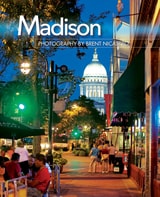
Madison
Brent Nicastro
University of Wisconsin Press, 2011
Brent Nicastro showcases the dynamic power, energy, and sheer beauty of Madison in this book of photography. Since the 1970s, Nicastro has been photographing the splendor of Madison, and his feel for his home is never more evident than in these images of the Dane County Farmers’ Market, the State Capitol building, the University of Wisconsin campus in all seasons, football at Camp Randall Stadium and basketball at the Kohl Center, the Monona Terrace Convention and Community Center designed by Frank Lloyd Wright, the Memorial Union Terrace, Picnic Point, and many more landmarks that evoke Madison’s charm.
Accompanying each image are captions in four languages—English, German, Spanish, and Chinese—making this book a perfect gift volume for all who love Madison. Visitors, students, and lifelong residents will savor this photographic portrait of beautiful Madison, Wisconsin.
Madison in the Sixties
Stuart D. Levitan
Wisconsin Historical Society Press, 2018
Landmark civil rights laws were passed. Pivotal campus protests were waged. A spring block party turned into a three-night riot. Factor in urban renewal troubles, a bitter battle over efforts to build Frank Lloyd Wright’s Monona Terrace, and the expanding influence of the University of Wisconsin, and the decade assumes legendary status.
In this first-ever comprehensive narrative of these issues—plus accounts of everything from politics to public schools, construction to crime, and more—Madison historian Stuart D. Levitan chronicles the birth of modern Madison with style and well-researched substance. This heavily illustrated book also features annotated photographs that document the dramatic changes occurring downtown, on campus, and to the Greenbush neighborhood throughout the decade. Madison in the Sixties is an absorbing account of ten years that changed the city forever.
Madison's Nightmare
How Executive Power Threatens American DemocracyPeter M. Shane
University of Chicago Press, 2009
The George W. Bush administration’s ambitious—even breathtaking—claims of unilateral executive authority raised deep concerns among constitutional scholars, civil libertarians, and ordinary citizens alike. But Bush’s attempts to assert his power are only the culmination of a near-thirty-year assault on the basic checks and balances of the U.S. government—a battle waged by presidents of both parties, and one that, as Peter M. Shane warns in Madison’s Nightmare, threatens to utterly subvert the founders’ vision of representative government.
Tracing this tendency back to the first Reagan administration, Shane shows how this era of "aggressive presidentialism" has seen presidents exerting ever more control over nearly every arena of policy, from military affairs and national security to domestic programs. Driven by political ambition and a growing culture of entitlement in the executive branch—and abetted by a complaisant Congress, riven by partisanship—this presidential aggrandizement has too often undermined wise policy making and led to shallow, ideological, and sometimes outright lawless decisions. The solution, Shane argues, will require a multipronged program of reform, including both specific changes in government practice and broader institutional changes aimed at supporting a renewed culture of government accountability.
From the war on science to the mismanaged war on terror, Madison’s Nightmare outlines the disastrous consequences of the unchecked executive—and issues a stern wake-up call to all who care about the fate of our long democratic experiment.

Madison
Portraits of Our NeighborsLaura Jo Amaral and Stacie Huckeba; Foreword by Carlene Carter
Vanderbilt University Press, 2025
Madison: Portraits of Our Neighbors, a photography book and living historical document of a unique Tennessee community, is the result of an artistic partnership between internationally recognized photographer Stacie Huckeba and Madison, Tennessee, community volunteer Laura Jo Amaral. This book captures the heart of the people who contribute to the Madison community as it is today, through portraits of a range of its citizens—a world-class bass player, a nonagenarian cattle farmer, a TikTok celebrity, a singer-songwriter, a mariachi band, the personal photographer for Johnny Cash, a beloved gymnastics coach, model airplane enthusiasts, educators, a fashion designer, a puppet enthusiast, a pastor and outreach worker, and an array of artists, small business owners, farmers, and local legends. Beyond a collection of portraits, it is a testament to an enduring urban community, a celebration of the shared human experience, and a reminder to see our neighbors in their best light. Madison: Portraits of Our Neighbors invites readers to celebrate the tapestry of humanity that weaves through this distinctive neighborhood.
This book is the recipient of the 2026 Norman L. and Roselea J. Goldberg Prize from Vanderbilt University Press for the best book in the area of art or medicine.
Madison
The Illustrated History, 1932–1979Stuart D. Levitan
University of Wisconsin Press, 2026
This second volume in the acclaimed illustrated civic history of Madison, Wisconsin, tells the story of this iconic midwestern city in the middle years of the twentieth century. Like the rest of America in this period, Madison was buffeted by a boom-and-bust economy, hot and cold wars abroad, and social and cultural changes on the homefront. Stuart D. Levitan, a mainstay of Madison media and government since 1975, offers a decade-by-decade visual and narrative account of the city’s transformation—as well as that of its major public university. Featuring hundreds of illustrations, this volume also highlights the local legends and luminaries who shaped the city, from bootleggers to world-famous architects to radicals and revolutionaries.
Madison
The Illustrated History, Volume 1, 1856–1931Stuart D. Levitan
University of Wisconsin Press, 2006
This engaging illustrated history, full of photographs, maps, and bird’s-eye views, captures Madison’s early history from its first days as a city to the Great Depression. Biographical vignettes tell the stories of early movers and shakers in the city. The volume includes many archival images of Madison that have never been published or have not been seen for a century or more.

Madness Is Civilization
When the Diagnosis Was Social, 1948-1980Michael E. Staub
University of Chicago Press, 2011
In the 1960s and 1970s, a popular diagnosis for America’s problems was that society was becoming a madhouse. In this intellectual and cultural history, Michael E. Staub examines a time when many believed insanity was a sane reaction to obscene social conditions, psychiatrists were agents of repression, asylums were gulags for society’s undesirables, and mental illness was a concept with no medical basis.
The first study to describe how social diagnostic thinking emerged, Madness Is Civilization casts new light on the politics of the postwar era.

Madonnaland
And Other Detours into Fame and FandomBy Alina Simone
University of Texas Press, 2016
When Alina Simone agreed to write a book about Madonna, she thought it might provide an interesting excuse to indulge her own eighties nostalgia. Wrong. What Simone discovered instead was a tidal wave of already published information about Madonna—and her own ambivalence about, maybe even jealousy of, the Material Girl’s overwhelming commercial success. With the straight-ahead course stymied, Simone set off on a quirky detour through the backroads of celebrity and fandom and the people who love or loathe Madonna.
In this witty, sometimes acerbic, always perceptive chronicle, Simone begins by trying to understand why Madonna’s birthplace, Bay City, Michigan, won’t even put up a sign to celebrate its most famous citizen, and ends by asking why local bands who make music that’s authentic and true can disappear with barely a trace. In between, she ranges from Madonna fans who cover themselves with tattoos of the singer’s face and try to make fortunes off selling her used bustiers and dresses, to Question Mark and the Mysterians—one-hit wonders best known for “96 Tears”—and Flying Wedge, a Detroit band that dropped off an amazing two-track record in the office of CREEM magazine in 1972 and vanished, until Simone tracked it down.
Filled with fresh insights about the music business, fandom, and what it takes to become a superstar, Madonnaland is as much a book for people who, like Simone, prefer “dark rooms, coffee, and state-subsidized European films filled with existential despair” as it is for people who can’t get enough of Madonna.

Madre and I
A Memoir of Our Immigrant LivesGuillermo Reyes
University of Wisconsin Press, 2010
In one memorable scene, after realizing that her friend Carmen is cleaning the house of one of the producers of Annie Hall, María recruits her to take her picture as she poses dramatically with Mr. Joffe’s Oscar in hand. It is María’s defiant yet determined attitude amidst her sacrifices that allows for Guillermo’s spirited coming of age and coming out.
Their common ground is the drama of their encounters with discovery, heartbreak, and passion—the explosive emotions that light up the stage of their two-actor theater.

Magical Habits
Monica Huerta
Duke University Press, 2021

Magna Carta
history, context and influence: Papers delivered at Peking University on the 800th anniversary of Magna CartaEdited by Lawrence Goldman
University of London Press, 2018

Mai Ya's Long Journey
Sheila Cohen
Wisconsin Historical Society Press, 2005
The story of Mai Ya Xiong and her family and their journey from the Ban Vinai refugee camp in Thailand to a new life in Madison, Wisconsin, is extraordinary. Yet it is typical of the stories of the 200,000 Hmong people who now live in the United States and who struggle to adjust to American society while maintaining their own culture as a free people.
Mai Ya's Long Journey follows Mai Ya Xiong, a young Hmong woman, from her childhood in Thailand's Ban Vinai Refugee Camp to her current home in Wisconsin. Mai Ya's parents fled Laos during the Vietnam War and were refugees in Thailand for several years before reaching the United States. But the story does not end there. Students will read the challenges Mai Ya faces in balancing her Hmong heritage and her adopted American culture as she grows into adulthood.
Maid as Muse
How Servants Changed Emily Dickinson’s Life and LanguageAífe Murray
University of New Hampshire Press, 2010
Main Street Public Library
Community Places and Reading Spaces in the Rural Heartland, 1876-956Wayne A. Wiegand
University of Iowa Press, 2011
Main Street Ready-Made
The New Deal Community of Greendale, WisconsinArnold R. Alanen
Wisconsin Historical Society Press, 2012
The dream of the suburb is an old one in America. For more than a century, city dwellers have sought to escape the crowding and pollution of industrial centers for the quiet streets and green spaces on their fringes. In the 1930s, that dream inspired the largest migration of Americans in the twentieth century and led to the creation of Greendale, Wisconsin, one of three planned communities initially begun to resettle the rural poor hit hard by the Great Depression. This idea, though, quickly developed into a plan to revitalize cities and stabilize farming communities around the nation. The result was three “greenbelt towns” built from scratch, expressly for working-class families and within easy commuting distance of urban employment. Greendale, completed in 1938, was consciously designed as a midwestern town in both its physical character and social organization, where ordinary citizens could live in a safe, attractive, economical community that was in harmony with the surrounding farmland.
“Main Street Ready-Made” examines Greendale as an outgrowth of public policy, an experiment in social engineering, and an organic community that eventually evolved to embrace a huge shopping mall, condominiums, and expensive homes while still preserving much of the architecture and ambiance of the original village. A snapshot of 1930s idealism and ingenuity, “Main Street Ready-Made” makes a significant contribution to the history of cities, suburbs, and social planning in mid-century America.