Results by title
28167 books match the query 'History' and 1583 start with m
Mervyn LeRoy Comes to Town
Murray Pomerance
Rutgers University Press, 2025
Mesa Verde National Park
Shadows of the Centuries, Revised EditionDuane A. Smith
University Press of Colorado, 2002
Mesmerized
Powers of Mind in Victorian BritainAlison Winter
University of Chicago Press, 1998
"Dazzling. . . . This splendid book . . . gives us a new form of historical understanding and a model for open and imaginative reading."—James R. Kinkaid, Boston Globe
"A landmark in the history of science scholarship."—John Sutherland, The Independent
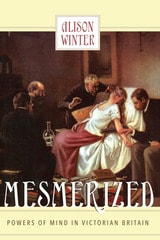
"It is difficult to imagine the documentary side of the story being better done than by Winter's well-researched and generously illustrated study. . . . She is a lively and keen observer; and her book is a pleasure to read purely for its range of material and wealth of detail. . . . Fruitful and suggestive."—Daniel Karlin, Times Literary Supplement
"An ambitious, sweeping and fascinating historical study. . . . Beautifully written, thoroughly researched, and well-illustrated."—Bernard Lightman, Washington Times
Mesoamerica's Classic Heritage
From Teotihuacan to the AztecsDavíd Carrasco
University Press of Colorado, 2000
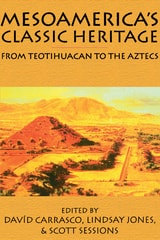
The contributors to Mesoamerica's Classic Heritage offer a wide range of individual interpretations, but they agree that Teotihuacan, more than any other pre-Hispanic center, was a paradigmatic source that formed the art and architecture, cosmology and ritual life, and conceptions of urbanism and political authority for significant parts of the Mesoamerican world. This great city achieved the prestige of being the site of the creation of the cosmos and of effective social and political space in Mesoamerica through its capacity to symbolize, perform, and export its imperial authority. These essays reveal the different ways in which Teotihuacan's classic heritage both fed and fed on the dynamic interactivity of the entire area. Whether or not a paradigm shift in Mesoamerican studies is taking place, certainly a new contextual understanding of Teotihuacan and the diversities and unities of Mesoamerica is emerging in these pages.
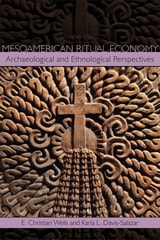
Mesoamerican Ritual Economy
Archaeological and Ethnological PerspectivesE. Christian Wells
University Press of Colorado, 2007
Exploring the intersection of spirituality and materiality, Mesoamerican Ritual Economy will be of interest to all scholars studying how worldview and belief motivate economic behavior. The authors consider a diverse set of Mesoamerican cultural patterns in order to investigate the ways in which ritual and economic practices influenced each other in the operation of communities, small-scale societies, and state-level polities. Contributors include: Sarah B. Barber, Frances F. Berdan, Karla L. Davis-Salazar, Barbara W. Fash, William L. Fash, Antonia E. Foias, Arthur A. Joyce, Brigitte Kovacevich, Ben A. Nelson, Enrique Rodríguez-Alegría, Katherine A. Spielmann, John M. Watanabe, E. Christian Wells.
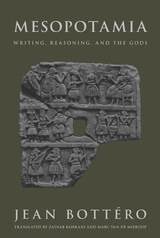
Mesopotamia
Writing, Reasoning, and the GodsJean Bottéro
University of Chicago Press, 1995
To give the reader some sense of how Mesopotamian civilization has been mediated and interpreted in its transmission through time, Bottero begins with an account of Assyriology, the discipline devoted to the ancient culture. This transmission, compounded with countless discoveries, would not have been possible without the surprising decipherment of the cuneiform writing system. Bottero also focuses on divination in the ancient world, contending that certain modes of worship in Mesopotamia, in their application of causality and proof, prefigure the "scientific mind."
Mesopotamian Chronicles
Jean-Jacques Glassner
SBL Press, 2004

Mesquite Pods to Mezcal
10,000 Years of Oaxacan CuisinesVerónica Pérez Rodriguez, Shanti Morell-Hart, and Stacie M. King
University of Texas Press, 2024
New case studies documenting ten thousand years of cuisines across the cultures of Oaxaca, Mexico, from the earliest gathered plants, such as guajes, to the contemporary production of tejate and its health implications.
Among the richest culinary traditions in Mexico are those of the “eight regions” of the state of Oaxaca. Mesquite Pods to Mezcal brings together some of the most prominent scholars in Oaxacan archaeology and related fields to explore the evolution of the area’s world-renowned cuisines. This volume, the first to address food practices across Oaxaca through a long-term historical lens, covers the full spectrum of human occupation in Oaxaca, from the early Holocene to contemporary times. Contributors consider the deep history of agroecological management and large-scale landscape transformation, framing food production as a human-environment relation. They explore how, after the arrival of the Spanish, Oaxacan cuisines adapted, diets changed, and food became a stronger marker of identity. Examining the present, further studies document how traditional foodways persist and what they mean for contemporary Oaxacans, whether they are traveling ancient roads, working outside the region, or rebuilding after an earthquake. Together, the original case studies in this volume demonstrate how new methods and diverse theoretical approaches can come together to trace the development of a rich food tradition, one that is thriving today.
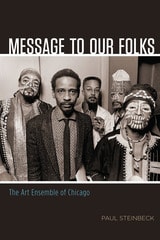
Message to Our Folks
The Art Ensemble of ChicagoPaul Steinbeck
University of Chicago Press, 2017
In Message to Our Folks, Paul Steinbeck combines musical analysis and historical inquiry to give us the definitive study of the Art Ensemble. In the book, he proposes a new theory of group improvisation that explains how the band members were able to improvise together in so many different styles while also drawing on an extensive repertoire of notated compositions. Steinbeck examines the multimedia dimensions of the Art Ensemble’s performances and the ways in which their distinctive model of social relations kept the group performing together for four decades. Message to Our Folks is a striking and valuable contribution to our understanding of one of the world’s premier musical groups.
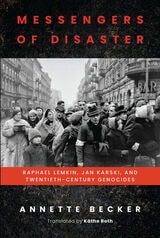
Messengers of Disaster
Raphael Lemkin, Jan Karski, and Twentieth-Century GenocidesAnnette Becker, Translated by Käthe Roth
University of Wisconsin Press, 2021
Messengers of Disaster draws upon little-known texts from an array of archives, including the International Committee of the Red Cross in Geneva and the International Tracing Service in Bad Arolsen. Carrying the knowledge of disaster took a toll on Lemkin and Karski, but their work prepared the way for the United Nations to unanimously adopt the first human rights convention in 1948 and influenced the language we use to talk about genocide today. Annette Becker's detailed study of these two important figures illuminates how distortions of fact can lead people to deny knowledge of what is happening in front of their own eyes.
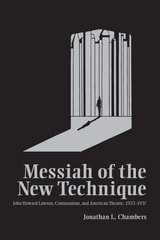
Messiah of the New Technique
John Howard Lawson, Communism, and American Theatre, 1923-1937Jonathan L. Chambers
Southern Illinois University Press, 2006
Messiah of the New Technique: John Howard Lawson, Communism, and American Theatre, 1923–1937 is a critical and political biography and a cultural and social history that focuses on Lawson’s career in the theatre. Using a materialist methodology, Jonathan L. Chambers emphasizes the evolution and interplay of the playwright’s artistic vision and political ideology, considering his art as both a documentation of this evolution and a product of the socio-political and cultural matrix in which he was immersed.
Spanning the playwright’s career, the volume details Lawson’s early indoctrination in and commitment to the avant-garde, his use and development of various nonrealistic playwriting techniques, his subtle though unfocused attacks on bourgeois society, and the varied critical responses he received. Chambers addresses Lawson’s involvement with the New Playwrights’ Theatre and his participation in the protests surrounding the case of Nicola Sacco and Bartolomeo Vanzetti, which stimulated his growing commitment to left-wing politics and radical causes.
Chambers also analyzes the social and cultural factors that shaped Lawson’s growing interest in revolutionary politics, his tutelage in Marxism under Edmund Wilson, and his tenure as president of the Screen Writers Guild. He also covers the final phase of Lawson’s playwriting career, which reveals the playwright’s internal struggle. That struggle, suggests Chambers, pitted Lawson’s view of aesthetics against his political ideology and is reflected in his scripts and theoretical writings.
Messiah of the New Technique provides a wealth of new material about both the playwright and the period, offering a critical synopsis of the artist’s career, addressing his often vehement rebuttals to his critics, and summarizing both his political activism and his creative and critical endeavors in the last forty years of his life.
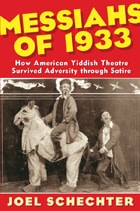
Messiahs of 1933
How American Yiddish Theatre Survived Adversity through SatireJoel Schechter
Temple University Press, 2008
Joel Schechter has rediscovered the funny and often politically-charged plays of the American Yiddish theatre of the 1930s. In Messiahs of 1933 he celebrates their satire, their radical imagination, and their commitment to social change. He introduces readers to the once-famous writers and actors—Moishe Nadir, David Pinski, Yosl Cutler, and others—who brought into artistic form their visions of peace, social justice, and satire for all.
Messiahs of 1933 greatly enlarges our understanding of Yiddish theatre and culture in the United States. It examines the innovative stage performances created by the Artef collective, the Modicut puppeteers, and the Yiddish Unit of the Federal Theatre Project. And it introduces to contemporary readers some of the most popular theatre actors of the 30s, including Leo Fuchs, Menasha Skulnik, and Yetta Zwerling. Throughout, it includes relevant photographs and contemporary comic strips, along with the first English-language publication of excerpts from the featured plays.
Messy Beginnings
Postcoloniality and Early American StudiesEdited by Malini Johar Schueller and Edward Watts
Rutgers University Press, 2003
When exploring the links between America and postcolonialism, scholars tend to think either in terms of contemporary multiculturalism, or of imperialism since 1898. This narrow view has left more than the two prior centuries of colonizing literary and political culture unexamined.
Messy Beginnings challenges the idea of early America’s immunity from issues of imperialism, that its history is not as “clean” as European colonialism. By addressing the literature ranging from the diaries of American women missionaries in the Middle East to the work of Benjamin Franklin and Nathaniel Hawthorne, and through appraisals of key postcolonial theorists such as Edward Said, Gayatri Spivak, and Homi Bhabha, the contributors to this volume explore the applicability of their models to early American culture.
Messy Beginnings argues against the simple concept that the colonization of what became the United States was a confrontation between European culture and the “other.” Contributors examine the formation of America through the messy or unstable negotiations of the idea of “nation.”
The essays forcefully show that the development of “Americanness” was a raced and classed phenomenon, achieved through a complex series of violent encounters, legal maneuvers, and political compromises. The complexity of early American colonization, where there was not one coherent “nation” to conquer, contradicts the simple label of imperialism used in other lands. The unique approach of Messy Beginnings will reshape both pre-conceived notions of postcolonialism, and how postcolonialists think about the development of the American nation.
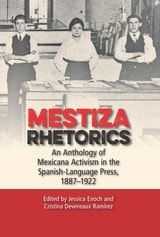
Mestiza Rhetorics
An Anthology of Mexicana Activism in the Spanish-Language Press, 1887-1922Edited by Jessica Enoch and Cristina Devereaux Ramirez
Southern Illinois University Press, 2019
Mestiza Rhetorics is the first anthology dedicated to mexicana rhetors and provides unmatched access to mexicana rhetorics. This collection puts forward the work of mexicana newspaperwomen in Spanish and English, provides evidence of their participation in political and educational debates at the turn of the twentieth century, and demonstrates how the Spanish-language press operated as a rhetorical space for mexicanas.
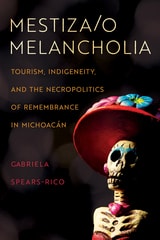
Mestiza/o Melancholia
Tourism, Indigeneity, and the Necropolitics of Remembrance in MichoacánGabriela Spears-Rico
University of Arizona Press, 2027
Through the concept of mestiza/o melancholia, scholar Gabriela Spears-Rico offers a new way to think about the relationship between mestizaje and indigeneity in Mexico. For Spears-Rico, the concept is a longing for the lost part of one’s identity, manifested in touristic visits and material appropriations of folklorized indigeneity, yet unconcerned with political reparations for Indigenous people.
Relying on a rich ethnography in mestiza/o and P’urhépecha pueblos in Michoacán, the book examines mestiza/o mourning and melancholia as it appears in Day of the Dead tourism and in Virgin of Guadalupe worship among Mexican mestizos. This book centers Indigenous resistance, articulating a P’urhépecha critique of regional necropolitics and obstinate appropriations, arguing for the need to decolonize mestizaje. A deep conversation with P’urhépecha dissent, this book elevates the need for solidarity with current Indigenous movements in a region fraught by extractive settler colonialism.
Mestiza/o Melancholia challenges readers to rethink identity, tourism, and belonging in Mexico.
Mestizo Genomics
Race Mixture, Nation, and Science in Latin AmericaPeter Wade, Carlos López Beltrán, Eduardo Restrepo and Ricardo Ventura Santos, eds.
Duke University Press, 2014
Drawing on ethnographic research in Brazil, Colombia, and Mexico, the contributors to Mestizo Genomics explore how the concepts of race, ethnicity, nation, and gender enter into and are affected by genomic research. In Latin America, national identities are often based on ideas about mestizaje (race mixture), rather than racial division. Since mestizaje is said to involve relations between European men and indigenous or African women, gender is a key factor in Latin American genomics and in the analyses in this book. Also important are links between contemporary genomics and recent moves toward official multiculturalism in Brazil, Colombia, and Mexico. One of the first studies of its kind, Mestizo Genomics sheds new light on the interrelations between "race," identity, and genomics in Latin America.
Contributors. Adriana Díaz del Castillo H., Roosbelinda Cárdenas, Vivette García Deister, Verlan Valle Gaspar Neto, Michael Kent, Carlos López Beltrán, María Fernanda Olarte Sierra, Eduardo Restrepo, Mariana Rios Sandoval, Ernesto Schwartz-Marín, Ricardo Ventura Santos, Peter Wade
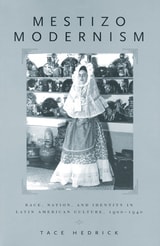
Mestizo Modernism
Race, Nation, and Identity in Latin American Culture, 1900-1940Hedrick, Tace
Rutgers University Press, 2003
We use the term “modernism” almost exclusively to characterize the work of European and American writers and artists who struggled to portray a new kind of fractured urban life typified by mechanization and speed. Between the 1880s and 1930s, Latin American artists were similarly engaged--but with a difference. While other modernists drew from “primitive” cultures for an alternative sense of creativity, Latin American modernists were taking a cue from local sources, primarily indigenous and black populations in their own countries. Although these artists remained outsiders to modernism elsewhere as a result of their race, nation, and identity, their racial heritage served as a positive tool in negotiating their relationship to the dichotomy between tradition and modernity.
In Mestizo Modernism Tace Hedrick focuses on four key artists who represent Latin American modernism—Peruvian poet Cesar Vallejo, Chilean poet Gabriela Mistral, Mexican muralist Diego Rivera, and Mexican artist Frida Kahlo. Hedrick interrogates what being “modern” and “American” meant for them and illuminates the cultural contexts within which they worked, as well as the formal methods they shared, including the connection they drew between ancient cultures and modern technologies. In so doing, she defines “modernism” more as a time frame at the turn of the twentieth century, marked broadly across the arts and national boundaries, than as a strict aesthetic or formal category. In fact, this look at Latin American artists will force the reconceptualization of what modernism has meant in academic study and what it might mean for future research.
Mestizo State
Reading Race in Modern MexicoJoshua Lund
University of Minnesota Press, 2012
The Mestizo State examines how the ideas, images, and public discourse around race, nation, and citizen formation have been transformed in Mexico from the mid-nineteenth century to the present. Starting with the Porfiriato, Joshua Lund investigates the rise of a racialized “mestizo state,” its reinvention after the Mexican Revolution, and its mobilization as a critical lever that would act both on behalf of and against mainstream Mexican political culture during the long hegemony of the Partido Revolucionario Institucional.
Lund takes race as his object of critical reflection in the context of modern Mexico. An analysis that does not confuse race with mestizaje, indigeneity, African identity, or whiteness, the book sheds light on the history of the materialism of race as it unfolds within the cultural production of modern Mexico, grounded on close readings of four writers whose work explicitly challenged the politics of race in Mexico: Luis Alva, Ignacio Manuel Altamirano, Rosario Castellanos, and Elena Garro.
In seeking to address race as a cultural-political problematic, Lund considers race as integral to the production of the materiality of Mexican national history: constitutive of the nation form, a mediator of capitalist accumulation, and a central actor in the rise of modernity.

Metabolic Living
Food, Fat, and the Absorption of Illness in IndiaHarris Solomon
Duke University Press, 2016
Metamedia
American Book Fictions and Literary Print Culture after DigitizationAlexander Starre
University of Iowa Press, 2015
Combining sustained textual analysis with impulses from the fields of book history, media studies, and systems theory, Starre explains the aesthetics and the cultural work of complex material fictions, such as Mark Z.Danielewski’s House of Leaves (2000), Chip Kidd’s The Cheese Monkeys (2001), Salvador Plascencia’s The People of Paper (2005), Reif Larsen’s The Selected Works of T. S. Spivet (2009), and Jonathan Safran Foer’s Tree of Codes (2010). He also broadens his analysis beyond the genre of the novel in an extensive account of the influential literary magazine McSweeney’s Quarterly Concern and its founder, Dave Eggers.
For this millennial generation of writers and publishers, the computer was never a threat to print culture, but a powerful tool to make better books. In careful close readings, Starre puts typefaces, layouts, and cover designs on the map of literary criticism. At the same time, the book steers clear of bibliophile nostalgia and technological euphoria as it follows writers, designers, and publishers in the process of shaping the surprising history of literary bookmaking after digitization.

Metamorphoses
Memoirs of a Life in MedicineWilliam G. Anlyan, M. D.
Duke University Press, 2004
Born in Alexandria, Egypt, in 1925, and schooled in the British tradition, Anlyan attended Yale University as an undergraduate and medical student before coming to the relatively unknown medical school at Duke University in 1949 for an internship in general and thoracic surgery. He stayed on, first as a resident, then as a staff surgeon. By 1961, he was a full professor of surgery. In 1964, Anlyan was named dean of the medical school, the first in a series of administrative posts at the medical school and hospital. Anlyan’s role in the transformation of the Duke University Medical Center into an internationally renowned health system is manifest: he restructured the medical school and hospital and supervised the addition of almost four million square feet of new or renovated space. He hired outstanding administrators and directed a staff that instituted innovative programs and groundbreaking research centers, such as the Cancer Center and the Physician’s Assistant Program.
Anlyan describes a series of metamorphoses in his own life, in the world of medicine, in Durham, and at Duke. At the time of his prep school upbringing in Egypt, medicine was a matter of controlling infectious diseases like tuberculosis and polio. As he became an immigrant medical student and then a young surgeon, he observed vast advances in medical practice and changes in the financing of medical care. During his tenure at Duke, Durham was transformed from a sleepy mill and tobacco town into the “City of Medicine,” a place where patients routinely travel for open-heart surgery and cutting-edge treatments for cancer and other diseases.
Anyone interested in health care, medical education, and the history of Duke University will find Anlyan’s memoir of interest.
Metamorphosis of Language in Apuleius
A Study of Allusion in the NovelEllen D. Finkelpearl
University of Michigan Press, 1998
When Apuleius wrote his Metamorphoses, the novel--indeed the very concept of fiction in prose--was new. This study argues that Apuleius' repeated allusions to earlier Latin authors such as Vergil, Ovid, and Seneca represent an exploration on his part of the relationship between the novel and more established genres of the era. Apuleius' struggle with this tradition, Finkelpearl maintains, parallels the protagonist's move from an acceptance of the dominance of traditional forms to a sense of arrival and self- discovery.
An introductory chapter includes general discussion of the theory and practice of allusion. Finkelpearl then revisits the issues of parody in Apuleius. She also includes discussion of Apuleius' use of Vergil's Sinon, the Charite episode in relation to Apuleius' African origins, and the stepmother episode. Finally a new reading of Isis is offered, which emphasizes her associations with writing and matches the multiformity of the goddess with the novel's many voices.
This book will be of interest to scholars of literature and the origins of the novel, multiculturalism, and classical literature.
Ellen D. Finkelpearl is Associate Professor of Classics at Scripps College, Claremont, California.
Metaphor and the Slave Trade in West African Literature
Laura T. Murphy
Ohio University Press, 2012
Metaphor and the Slave Trade provides compelling evidence of the hidden but unmistakable traces of the transatlantic slave trade that persist in West African discourse. Through an examination of metaphors that describe the trauma, loss, and suffering associated with the commerce in human lives, this book shows how the horrors of slavery are communicated from generation to generation.
Laura T. Murphy’s insightful new readings of canonical West African fiction, autobiography, drama, and poetry explore the relationship between memory and metaphor and emphasize how repressed or otherwise marginalized memories can be transmitted through images, tropes, rumors, and fears. By analyzing the unique codes through which West Africans have represented the slave trade, this work foregrounds African literary contributions to Black Atlantic discourse and draws attention to the archive that metaphor unlocks for scholars of all disciplines and fields of study.
Metaphysical Themes in Thomas Aquinas
John F. Wippel
Catholic University of America Press, 1995

Metaphysical Themes in Thomas Aquinas II
John F. Wippel
Catholic University of America Press, 2007
Metaphysical Themes in Thomas Aquinas III
John F. Wippel
Catholic University of America Press, 2020

Metaphysics
Aristotle
University of Michigan Press, 1952
Metaphysics, Materialism, and the Evolution of Mind
The Early Writings of Charles DarwinCharles Darwin
University of Chicago Press, 1980
First published in 1974 as a companion volume to Darwin on Man by Howard E. Gruber, Paul Barrett’s transcriptions of Darwin’s M and N notebooks served to shed new light on the evolutionist’s methods and motivation.
According to Stephen Jay Gould in the New York Times Book Review, “Darwin kept [these notebooks] primarily in 1838, when he was 29 years old. In them, he recorded his early conviction of evolutionary continuity between humans and all other animals. . . . These notebooks display all the features of humanistic intellect that his detractors denied. We find erudition in his comments on Plato, Locke, Hume, Adam Smith, Whewell, Burke, Montaigne, Lessing and Spencer. . . . We appreciate an artistic bent in his delight with nature and her prophet Wordsworth. . . . We grasp the breadth of his bold attempt to clothe all human thought and behaviour in a new evolutionary garb. . . . Charles Darwin was reconstructing the world and he knew exactly what he was doing.”
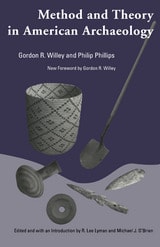
Method and Theory in American Archaeology
Gordon R. Willey
University of Alabama Press, 2001
A Dan Josselyn Memorial Publication
This invaluable classic provides the framework for the development of American archaeology during the last half of the 20th century.
In 1958 Gordon R. Willey and Philip Phillips first published Method and Theory in American Archaeology—a volume that went through five printings, the last in 1967 at the height of what became known as the new, or processual, archaeology. The advent of processual archaeology, according to Willey and Phillips, represented a "theoretical debate . . . a question of whether archaeology should be the study of cultural history or the study of cultural process."
Willey and Phillips suggested that little interpretation had taken place in American archaeology, and their book offered an analytical perspective; the methods they described and the structural framework they used for synthesizing American prehistory were all geared toward interpretation. Method and Theory served as the catalyst and primary reader on the topic for over a decade.
This facsimile reprint edition of the original University of Chicago Press volume includes a new foreword by Gordon R. Willey, which outlines the state of American archaeology at the time of the original publication, and a new introduction by the editors to place the book in historical context. The bibliography is exhaustive. Academic libraries, students, professionals, and knowledgeable amateurs will welcome this new edition of a standard-maker among texts on American archaeology.
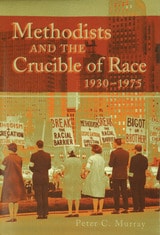
Methodists and the Crucible of Race, 1930-1975
Peter C. Murray
University of Missouri Press, 2004
During the Civil Rights movement, American churches confronted issues of racism that they had previously ignored. No church experienced this confrontation more sharply than the Methodist Church. When Methodists reunited their northern and southern halves in 1939, their new church constitution created a segregated church structure that posed significant issues for Methodists during the Civil Rights movement.
Of the six jurisdictional conferences that made up the Methodist Church, only one was not based on a geographic region: the Central Jurisdiction, a separate conference for “all Negro annual conferences.” This Jim Crow arrangement humiliated African American Methodists and embarrassed their liberal white allies within the church. The Supreme Court’s Brown v. Board of Education decision awakened many white Methodists from their complacent belief that the church could conform to the norms of the South without consequences among its national membership.
Murray places the struggle of the Methodist Church within the broader context of the history of race relations in the United States. He shows how the effort to destroy the barriers in the church were mirrored in the work being done by society to end segregation. Immensely readable and free of jargon, Methodists and the Crucible of Race, 1930–1975, will be of interest to a broad audience, including those interested in the Civil Rights movement and American church history.
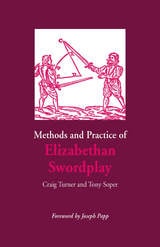
Methods and Practice of Elizabethan Swordplay
Craig Turner and Tony Soper. Foreword by Joseph Papp
Southern Illinois University Press, 1990
Featuring period drawings and prints of swordplay, this book examines and compares three Elizabethan fencing manuals written in English before 1600: Giacomo Di Grassi’s His True Arte of Defense (1594), Vincentio Saviolo’s His Practice in Two Bookes (1595), and George Silver’s Paradoxes of Defence and Bref Instructions upon My Paradoxes of Defence (1599).
More than a technical manual on swordplay, this book explores the influence of a new form of violence introduced into Elizabethan culture by the invention of the rapier. The authors examine the rapier’s influence on the various social classes, the clash between the traditional English fencing masters and those embracing the new style, the growing concern with unregulated dueling, and the frequent references to rapier play in the works of Shakespeare and his contemporaries.
As producer Joseph Papp notes in his foreword, this is a book that "makes a difference in performance."
Metro Dailies in the Age of Multimedia Journalism
Mary Lou Nemanic
Temple University Press, 2020
The death of the daily newspaper in the internet age has been predicted for decades. While print newspapers are struggling from drops in advertising and circulation, their survival has been based on original reporting. Instead of a death knell, metro dailies are experiencing an identity crisis—a clash between traditional print journalism’s formality and detail and digital journalism’s informality and brevity.
In Metro Dailies in the Age of Multimedia Journalism, Mary Lou Nemanic provides in-depth case studies of five mid-size city newspapers to show how these publications are adapting to the transition from print-only to multiplatform content delivery—and how newsroom practices are evolving to address this change. She considers the successes when owners allow journalists to manage their newspapers—to ensure production of quality journalism under the protection of newspaper guilds—as well as how layoffs and resource cutbacks have jeopardized quality standards.
Arguing for an integrated approach in which print and online reporting are considered complementary and visual journalism is emphasized across platforms, Nemanic suggests that there is a future for the endangered daily metro newspaper.
Metro Movies
Cinematic Urbanism in Post-Mao ChinaHarry H. Kuoshu
Southern Illinois University Press, 2010
Metro Movies: Cinematic Urbanism in Post-Mao China takes readers on a comprehensive tour of the urbanization of Chinese cinema. Focusing primarily on movies from the end of the twentieth century, it is the first single-authored work to explore the relationship between the changes in Chinese society—caused in part by the advent of postsocialism, the growth of cities, and globalization—and the transformation of Chinese cinema. Author Harry H. Kuoshu examines such themes as displacement, cinematic representation, youth subculture, the private emotional lives of emerging urbanites, raw urban realism, and the allegorical contrast of the city and the countryside to illustrate the artistic richness and cultural diversity of this cinematic genre.
Kuoshu discusses the work of director Huang Jianxin, whose films follow and critique China’s changing urban political culture. He dedicates a chapter to filmmakers who followed Huang and attempted to redefine the concept of art films to regain the local audience. These directors address Chinese moviegoers’ disappointment with the international adoption of Chinese art films, their lack of interest in conventional Chinese films, and their fascination with emerging audio-video media. A considerable amount of attention is given to films of the 1990s, which focus on the social changes surfacing in China, from the trend of hooliganism and the Beijing rock scene to the arrival of an urban pop culture lifestyle driven by expansionist commerce and materialism. Kuoshu also explores recent films that confront the seedier aspects of city life, as well as films that demonstrate how urbanization has touched every fiber of Chinese living.
Metro Movies illustrates how cinematic urbanism is no longer a genre indicator but is instead an era indicator, revealing the dominance of metropolitan living on modern Chinese culture. It gives new insight into contemporary Chinese politics and culture and provides readers with a better understanding of China’s urban cinema. This book will be an excellent addition to college film courses and will fascinate any reader with an interest in film studies or Chinese culture.
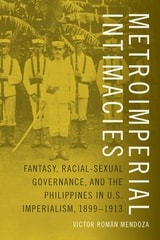
Metroimperial Intimacies
Fantasy, Racial-Sexual Governance, and the Philippines in U.S. Imperialism, 1899-1913Victor Román Mendoza
Duke University Press, 2015
Metropolis 1890-1940
Edited by Anthony Sutcliffe
University of Chicago Press, 1984

Metropolitan America
Fox, Kenneth
Rutgers University Press, 1990
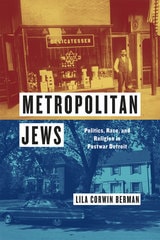
Metropolitan Jews
Politics, Race, and Religion in Postwar DetroitLila Corwin Berman
University of Chicago Press, 2015
Complex and subtle, Metropolitan Jews pushes urban scholarship beyond the tenacious black/white, urban/suburban dichotomy. It demands a more nuanced understanding of the process and politics of suburbanization and will reframe how we think about the American urban experiment and modern Jewish history.
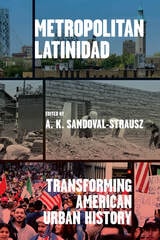
Metropolitan Latinidad
Transforming American Urban HistoryEdited by A. K. Sandoval-Strausz
University of Chicago Press, 2025
Latino urban history has been underappreciated not only in its own right but for the centrality of its narratives to urban history as a field. A scholarly discipline that has long scrutinized economics, politics, and the built environment has too often framed race as literally Black and white. This has resulted in a fundamental misunderstanding of the full social canvas of American cities since at least the early twentieth century.
Traversing metropolitan areas like Atlanta, Chicago, El Paso, Fort Worth, Los Angeles, Miami, and New York, this collection of essays brings together both established and emerging scholars, including long-time urbanists and academics working in the fields of Latino, borderlands, political, landscape, and religious history. Organized at different scales—including city, suburb, neighborhood, and hemisphere—this impressive body of work challenges long-standing narratives about metropolitan America. The contributors—Llana Barber, Mauricio Castro, Eduardo Contreras, Sandra I. Enríquez, Monika Gosin, Cecilia Sánchez Hill, Felipe Hinojosa, Michael Innis-Jiménez, Max Krochmal, Becky M. Nicolaides, Pedro A. Regalado, Iliana Yamileth Rodriguez, and Thomas J. Sugrue—engage a diverse range of subjects, such as urban rebellions, the suburbanization of Latinos, affordable housing, labor, the built environment, transnationalism, place-making, and religious life. The scholars also explore race within Latino communities, as well as the role that political and economic dynamics have played in creating Latino urban spaces. After reading this book, you will never see American cities the same way again.
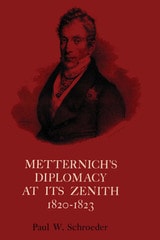
Metternich's Diplomacy at its Zenith, 1820-1823
Austria and the Congresses of Troppau, Laibach, and VeronaBy Paul W. Schroeder
University of Texas Press, 1962
What Metiernich wanted at the peak of his career, why he wanted it, and the methods by which he achieved his goals are questions brilliantly answered in this survey and analysis of the Austrian chancellor's diplomacy during the period when he was the pre-eminent figure in European politics.
Metternich's single-minded objective during 1820–1823 was to preserve the Austrian hegemony he had gained in Central Europe after long wars, enormous effort, and great sacrifice. If the internal security and international-power position secured by Austria at the Congress of Vienna were to be defended against the impact of widespread revolution in Europe, it was imperative that peace in Europe and the status quo be maintained. This required an unyielding opposition to all political movements that might disturb the equilibrium, especially French chauvinism and the spread of French constitutional ideas.
A one-man distillate of the doctrine of absolute monarchy, Metternich was the relentless foe of any cause, just or unjust, that threatened European repose. Hence, when the revolution in Naples seriously menaced Austrian hegemony in Italy, Metternich determined that the constitutional regime in Naples must be overthrown by an Austrian armed force, an absolute monarchy restored, and an Austrian army of occupation kept there. Nor did he scruple to use duplicity, secret negotiation, trickery, or deceit against ally and adversary alike in his effort to enlist them in the common cause of all thrones. At the Congress of Troppau, Metternich succeeded not only in defeating Russian ideas for peaceful intervention and a moderate constitution at Naples, but also in converting Tsar Alexander to thoroughly conservative views, thereby making Russia a powerful supporter of Austrian policies and knowingly alienating England, formerly Austria's closest ally.
Paul W. Schroeder brings to this bookexceptional scholarship and an objectivity hard to attain when dealing with a personality. Although Metternich, as Schroeder sees him, doubtless helped to maintain European peace and order, his real greatness consisted not in his European principles, but in his ability to defend Austrian interests under the guise of European principles. The evidence, gathered from documentary material in the Haus Hof- und Staatsarchiv in Vienna, has forced the author to the conclusion that Metternich was no real statesman. The very qualities that distinguished him as a brilliant diplomat—keen vision, cogent analysis, fertility of expedients, farsightedness, flexibility, and firmness of purpose—were converted into those of blindness to reality, superficial analysis, sterility of expedients, dogmatism, and failure of will when confronted with fundamental problems of state and society.

Meuse-Argonne Diary
A Division Commander in World War IWilliam M. Wright & Edited & Intro by Robert H. Ferrell
University of Missouri Press, 2004
September 13, 1918
Got no sleep at all last night.
About two o'clock in the morning Col. Heintzelman, chief of staff of the corps, came out and he was much pleased with what the division had accomplished and with the way they had gone through. It was the division's first battle and it played a very important and creditable part. Certain things fell down. . . . The truth of the matter is the troops got away from the wire and it was impossible to keep the wire up through the tangle of barbed wire and woods. We captured 3,000 prisoners on our front alone and have lost 521.
November 1, 1918 Considerable heavy artillery fire all night. The preparation fire went down promptly at 3:30, it was very heavy. . . . The barrage went down promptly at 5:30. Troops jumped off. At 7:30 thirty prisoners reported from Le Dhuy Fme., taken by the 353rd and 354th infantries. I don't understand what the 353rd Infantry is doing in there, as it is out of the sector. At 7:00 a.m. there was a distinct lull in the artillery fire. . . . I told Hanson at 8:05 to move his troops forward to parallel 86 immediately. He stated that he would get them going about 8:30, but actually did not get them started until about eleven o'clock. I sent for him on arrival and told him to hurry his men up. Before Lee left I had ordered the divisional reserve to move forward with its advance element on the first objective to maintain their echelonment in depth. Smyser came in at one o'clock and I ordered the divisional machine guns to the front to take position about one-half kilometer east of Dhuy Fme. At the time the reserves were ordered forward. I ordered Hanson to take his P.C. to Dhuy Fme. . . . Hanson has just arrived. I do not understand why he is always so slow. He seems to be inordinately stupid.
Mex-Ciné
Mexican Filmmaking, Production, and Consumption in the Twenty-first CenturyFrederick Luis Aldama
University of Michigan Press, 2013
Mexican American Civil Rights in Texas
Robert Brischetto
Michigan State University Press, 2022
Mexican American Mojo
Popular Music, Dance, and Urban Culture in Los Angeles, 1935–1968Anthony Macías
Duke University Press, 2008
Macías conducted numerous interviews for Mexican American Mojo, and the voices of little-known artists and fans fill its pages. In addition, more famous musicians such as Ritchie Valens and Lalo Guerrero are considered anew in relation to their contemporaries and the city. Macías examines language, fashion, and subcultures to trace the history of hip and cool in Los Angeles as well as the Chicano influence on urban culture. He argues that a grass-roots “multicultural urban civility” that challenged the attempted containment of Mexican Americans and African Americans emerged in the neighborhoods, schools, nightclubs, dance halls, and auditoriums of mid-twentieth-century Los Angeles. So take a little trip with Macías, via streetcar or freeway, to a time when Los Angeles had advanced public high school music programs, segregated musicians’ union locals, a highbrow municipal Bureau of Music, independent R & B labels, and robust rock and roll and Latin music scenes.
Mexican Americans and Education
El saber es poderEstela Godinez Ballón
University of Arizona Press, 2015
Mexican Americans and Education begins with a brief overview of historical educational conditions that have impacted the experiences and opportunities of Mexican American students, and moves into an examination of major contemporary institutional barriers to academic success, including segregation, high-stakes testing, and curriculum tracking. Ballón also explores the status of Mexican American students in higher education and introduces theories and pedagogies that aim to understand and improve school conditions. Through her extensive examination of the major issues impacting Mexican American students, Ballón provides a broad introduction to an increasingly relevant topic.
Ballón uses understandable and accessible language to examine institutional and ideological factors that have negatively impacted Mexican Americans’ public school experiences, while also focusing on their strengths and possibilities for future action. This unique overview serves as a foundation for both education and Chicana/o studies courses, as well as in teacher and professional development.

Mexican Americans and Health
¡Sana! ¡Sana!Adela de la Torre and Antonia Estrada
University of Arizona Press, 2001
- how values such as machismo, familismo, and marianismo influence care-seeking decisions and treatment of illness;
- how factors such as cultural values, socioeconomic status, peer pressure, and family concerns can contribute to substance abuse;
- how cultural attitudes toward sex can heighten the risk of AIDS—and how approaches to AIDS prevention and education need to reflect core cultural values such as familismo, respeto, and confianza. The book also addresses concerns of Mexican Americans regarding the health care system. These include not only access to care and to health insurance but also the shortage of bilingual and bicultural health care professionals. This coverage stresses not only the importance of linguistic competency but also the need to understand folklore illnesses, herbal remedies, and spiritual practices that can delay the treatment of illness and either complement or compromise treatment. Of all the issues that face the contemporary Mexican American community, none is as important to its very survival as health and health care. This timely book gives readers a broad understanding of these complex issues and points the way toward a healthier future for all people of Mexican origin. Mexican Americans and Health and Chicano Popular Culture are the first volumes in the series The Mexican American Experience, a cluster of modular texts designed to provide greater flexibility in undergraduate education. Each book deals with a single topic concerning the Mexican American population. Instructors can create a semester-length course from any combination of volumes, or may choose to use one or two volumes to complement other texts.
Mexican Anarchism after the Revolution
By Donald C. Hodges
University of Texas Press, 1995
Formal anarchist organizations disappeared in Mexico after the 1910 Revolution, but anarchist principles survive in the popular resistance movements against the post-revolutionary governments. In this book, Donald Hodges offers the first comprehensive treatment of the intellectual foundations, history, politics, and strategy of Mexican anarchism since the Revolution.
Hodges interviewed leading Mexican anarchists, including Mónico Rodríguez Gómez, and gained access to documents of numerous guerrilla organizations, such as the previously missing "Plan de Cerro Prieto." Using both original and published sources, he shows how the political heirs of Ricardo Flores Magón, Mexico's foremost anarchist, agitated for workers' self-management and agrarian reform under the cover of the Mexican Communist party, how they played an important role in the student rebellion, and how, in the face of a labor movement that has come under government control, anarchism is currently experiencing a rebirth under another name.
Mexican Chicago
Race, identity and Nation, 1916-39Gabriela F. Arredondo
University of Illinois Press, 2007
Mexican Chicago builds on previous studies of Mexicans in the United States while challenging static definitions of “American” and underlying assumptions of assimilation. Gabriela F. Arredondo contends that because of the revolutionary context from which they came, Mexicans in Chicago between 1916 and 1939 were not just another ethnic group working to be assimilated into a city that has a long history of incorporating newcomers. Suggesting a new understanding of identity formation, she argues that Mexicans wielded tools of identification forged in revolutionary Mexico to collectively battle the prejudices of ethnic groups that included Poles, Italians, and the Irish, as well as African Americans. By turning inward, however, Mexicans also highlighted tremendous differences among themselves, such as gender and class. In discussing this distinctive process of becoming “Mexican” in Chicago during the early twentieth century, Arredondo not only explores how that identity was constructed but also provides telling insight into the repercussions of that identity formation process.
Mexican Cinema/Mexican Woman, 1940-1950
Joanne Hershfield
University of Arizona Press, 1996
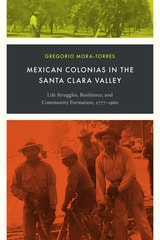
Mexican Colonias in the Santa Clara Valley
Life Struggles, Resilience, and Community Formation, 1777–1960Gregorio Mora-Torres
University of Nevada Press, 2027
Today, ethnic Mexicans and other Latinos make up the largest population group in California, and in the Santa Clara Valley they represent roughly 30 percent of residents, a proportion that has remained steady for nearly two centuries. Despite this population’s long presence as some of the earliest non-Indigenous settlers in the region and their major contributions to its economy, culture, and development, the history of ethnic Mexicans and other Latinos in the valley has been left untold. Much historical writing by local scholars has focused on ethnic Mexicans before 1846, often implying that their meaningful presence declined after the U.S. gained control of California. As a result, few scholarly works address ethnic Mexican history in the Santa Clara Valley after statehood.
Mexican Colonias in the Santa Clara Valley examines the formation and growth of ethnic Mexican neighborhoods from the late nineteenth century through the mid-twentieth century. Author Gregorio Mora-Torres traces continuity from Californios in the San José Pueblo to later arrivals of ethnic Mexicans from Mexico and the U.S. Southwest, highlighting their efforts to build community while working in agriculture and other manual labor. Despite economic hardship, these communities developed rich cultural and social traditions, including celebrations, entertainment, sports, and civic life. The book also explores midcentury transformation, including tensions between assimilation and cultural retention and the rise of political activism in the early 1960s.
Drawing on Anglo-American newspaper accounts and Mexican, Mexican American, and other Latino perspectives from El Excentrico (1949–1981), the study reconstructs narratives of identity, visibility, and change in the Santa Clara Valley over time.
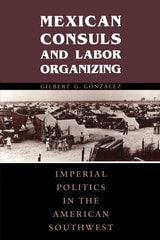
Mexican Consuls and Labor Organizing
Imperial Politics in the American SouthwestBy Gilbert G. González
University of Texas Press, 1999
Chicano history, from the early decades of the twentieth century up to the present, cannot be explained without reference to the determined interventions of the Mexican government, asserts Gilbert G. González. In this pathfinding study, he offers convincing evidence that Mexico aimed at nothing less than developing a loyal and politically dependent emigrant community among Mexican Americans, which would serve and replicate Mexico's political and economic subordination to the United States.
González centers his study around four major agricultural workers' strikes in Depression-era California. Drawing on a wide variety of sources, he documents how Mexican consuls worked with U.S. growers to break the strikes, undermining militants within union ranks and, in one case, successfully setting up a grower-approved union. Moreover, González demonstrates that the Mexican government's intervention in the Chicano community did not end after the New Deal; rather, it continued as the Bracero Program of the 1940s and 1950s, as a patron of Chicano civil rights causes in the 1960s and 1970s, and as a prominent voice in the debates over NAFTA in the late 1980s and early 1990s.