Results by title
22279 books match the query 'Social Science' and 1258 start with m

Minimum Wages in Central and Eastern Europe
From Protection to DestitutionGuy Standing
Central European University Press, 1995
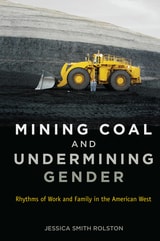
Mining Coal and Undermining Gender
Rhythms of Work and Family in the American WestJessica Smith Rolston
Rutgers University Press, 2014
Though mining is an infamously masculine industry, women make up 20 percent of all production crews in Wyoming’s Powder River Basin—the largest coal-producing region in the United States. How do these women fit into a working culture supposedly hostile to females? This is what anthropologist Jessica Smith Rolston, herself a onetime mine worker and the daughter of a miner, set out to discover. Her answers, based on years of participant-observation in four mines and extensive interviews with miners, managers, engineers, and the families of mine employees, offer a rich and surprising view of the working “families” that miners construct. In this picture, gender roles are not nearly as straightforward—or as straitened—as stereotypes suggest.
Gender is far from the primary concern of coworkers in crews. Far more important, Rolston finds, is protecting the safety of the entire crew and finding a way to treat each other well despite the stresses of their jobs. These miners share the burden of rotating shift work—continually switching between twelve-hour day and night shifts—which deprives them of the daily rhythms of a typical home, from morning breakfasts to bedtime stories. Rolston identifies the mine workers’ response to these shared challenges as a new sort of constructed kinship that both challenges and reproduces gender roles in their everyday working and family lives.
Crews’ expectations for coworkers to treat one another like family and to adopt an “agricultural” work ethic tend to minimize gender differences. And yet, these differences remain tenacious in the equation of masculinity with technical expertise, and of femininity with household responsibilities. For Rolston, such lingering areas of inequality highlight the importance of structural constraints that flout a common impulse among men and women to neutralize the significance of gender, at home and in the workplace.
At a time when the Appalachian region continues to dominate discussion of mining culture, this book provides a very different and unexpected view—of how miners live and work together, and of how their lives and work reconfigure ideas of gender and kinship.
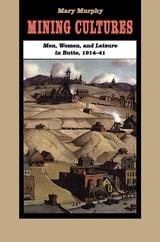
Mining Cultures
Men, Women, and Leisure in Butte, 1914-41Mary Murphy
University of Illinois Press, 1997
Butte, Montana, long deserved its reputation as a wide-open town. Mining Cultures shows how the fabled Montana city evolved from a male-dominated mining enclave to a community in which men and women participated on a more equal basis as leisure patterns changed and consumer culture grew. Mary Murphy looks at how women worked and spent their leisure time in a city dominated by the quintessential example of "men's work": mining. Bringing Butte to life, she adds in-depth research on church weeklies, high school yearbooks, holiday rituals, movie plots, and news of local fashion to archival material and interviews.
A richly illustrated jaunt through western history, Mining Cultures is the never-told chronicle of how women transformed the richest hill on earth.

Mining Encounters
Extractive Industries in an Overheated WorldEdited by Thomas Hylland Eriksen and Robert J. Pijpers
Pluto Press, 2018
Mining Encounters paints a broad picture, looking at resource extraction in numerous locations at different stages of development—covering coal, natural gas, gold, and cement mining in North, West, and South Africa, as well as in India, Kazakhstan, and Australia. The chapters answer key questions: How does mining transform the physical landscape? What are the value systems underlying the world’s mining industries? And how does the process of extracting resources determine which stakeholders become dominant and which marginalized?
Uncovering the tensions, negotiations, and disparities among different actors in the extractive industries, Mining Encounters will make a vital contribution to policy debates moving forward.
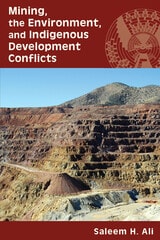
Mining, the Environment, and Indigenous Development Conflicts
Saleem H. Ali
University of Arizona Press, 2003
This book gets to the heart of resource conflicts and environmental impact assessment by asking why indigenous communities support environmental causes in some cases of mining development but not in others. Saleem Ali examines environmental conflicts between mining companies and indigenous communities and with rare objectivity offers a comparative study of the factors leading to those conflicts.
Mining, the Environment, and Indigenous Development Conflicts presents four cases from the United States and Canada: the Navajos and Hopis with Peabody Coal in Arizona; the Chippewas with the Crandon Mine proposal in Wisconsin; the Chipewyan Inuits, Déné and Cree with Cameco in Saskatchewan; and the Innu and Inuits with Inco in Labrador. These cases exemplify different historical relationships with government and industry and provide an instance of high and low levels of Native resistance in each country. Through these cases, Ali analyzes why and under what circumstances tribes agree to negotiated mining agreements on their lands, and why some negotiations are successful and others not.
Ali challenges conventional theories of conflict based on economic or environmental cost-benefit analysis, which do not fully capture the dynamics of resistance. He proposes that the underlying issue has less to do with environmental concerns than with sovereignty, which often complicates relationships between tribes and environmental organizations. Activist groups, he observes, fail to understand such tribal concerns and often have problems working with tribes on issues where they may presume a common environmental interest.
This book goes beyond popular perceptions of environmentalism to provide a detailed picture of how and when the concerns of industry, society, and tribal governments may converge and when they conflict. As demands for domestic energy exploration increase, it offers clear guidance for such endeavors when native lands are involved.
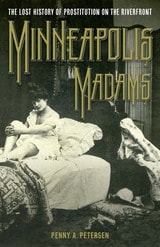
Minneapolis Madams
The Lost History of Prostitution on the RiverfrontPenny A. Petersen
University of Minnesota Press, 2013
Sex, money, and politics—no, it’s not a thriller novel. Minneapolis Madams is the surprising and riveting account of the Minneapolis red-light district and the powerful madams who ran it. Penny Petersen brings to life this nearly forgotten chapter of Minneapolis history, tracing the story of how these “houses of ill fame” rose to prominence in the late nineteenth century and then were finally shut down in the early twentieth century.
In their heyday Minneapolis brothels were not only open for business but constituted a substantial economic and political force in the city. Women of independent means, madams built custom bordellos to suit their tastes and exerted influence over leading figures and politicians. Petersen digs deep into city archives, period newspapers, and other primary sources to illuminate the Minneapolis sex trade and its opponents, bringing into focus the ideologies and economic concerns that shaped the lives of prostitutes, the men who used their services, and the social-purity reformers who sought to eradicate their trade altogether. Usually written off as deviants, madams were actually crucial components of a larger system of social control and regulation. These entrepreneurial women bought real estate, hired well-known architects and interior decorators to design their bordellos, and played an important part in the politics of the developing city.
Petersen argues that we cannot understand Minneapolis unless we can grasp the scope and significance of its sex trade. She also provides intriguing glimpses into racial interactions within the vice economy, investigating an African American madam who possibly married into one of the city’s most prestigious families. Fascinating and rigorously researched, Minneapolis Madams is a true detective story and a key resource for anyone interested in the history of women, sexuality, and urban life in Minneapolis.

Minnesota Green
The Highs and Lows of Cannabis in the North CountryTanner Berris
University of Minnesota Press, 2027
The socially fraught and surprisingly colorful history of cannabis in Minnesota
In a sweeping narrative, Minnesota Green presents the previously untold story of cannabis and its long and complex history of criminalization, activism, and legislative contention. Seamlessly blending historical research, political analysis, and lived experience, activist and industry insider Tanner Berris traces the highs and lows of the plant’s presence in a state often held up as a beacon of progressive policymaking. Trekking across this fraught history, Berris documents how nineteenth-century hemp cultivation coincided with the federal dispossession of Indigenous lands, how, by the 1930s, moral panic turned cannabis from a common crop into a criminal threat, and how the “Hemp for Victory” campaign during World War II temporarily lifted a federal ban before the postwar decades gave way to renewed policing and punishment.
Paying close attention to school-based antidrug curricula, racialized rhetoric, patient testimonies, eradication campaigns, and widespread propaganda, Berris uncovers the prohibitionist roots of the “marijuana menace” and how reformers worked to reclaim the plant’s maligned reputation throughout the twentieth century. The fight for medical cannabis during the AIDS crisis, the revival of industrial hemp, and Minnesota’s embrace of low-dose hemp-derived products—all are pivotal points in the state’s reshaping of both public opinion and regulatory imagination.
At its core, this story is about Minnesotans: farmers experimenting with commercial hemp, activists staging legalization protests, policymakers wrestling with public caution, entrepreneurs and tribal leaders navigating a complex regulatory landscape, and local communities confronting the unjust racial and social consequences of punitive—and often violently policed—prohibition. At once a regional history and civic memoir, Minnesota Green vividly documents how a once-criminalized plant reemerged as a symbol of renewal and self-determination in Minnesota.
Retail e-book files for this title are screen-reader friendly with images accompanied by short alt text and/or extended descriptions.
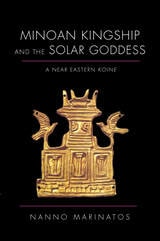
Minoan Kingship and the Solar Goddess
A Near Eastern KoineNanno Marinatos
University of Illinois Press, 2010
Ancient Minoan culture has been typically viewed as an ancestor of classical Greek civilization, but this book shows that Minoan Crete was on the periphery of a powerfully dynamic cultural interchange with its neighbors. Rather than viewing Crete as the autochthonous ancestor of Greece's glory, Nanno Marinatos considers ancient Crete in the context of its powerful competitors to the east and south.
Analyzing the symbols of the Minoan theocratic system and their similarities to those of Syria, Anatolia, and Egypt, Marinatos unlocks many Minoan visual riddles and establishes what she calls a "cultural koine," or standard set of cultural assumptions, that circulated throughout the Near East and the eastern Mediterranean at the time Minoan civilization reached its peak. With more than one hundred and fifty illustrations, Minoan Kingship and the Solar Goddess delivers a comprehensive reading of Minoan art as a system of thought.
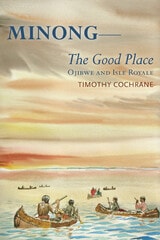
Minong
The Good Place Ojibwe and Isle RoyaleTimothy Cochrane
Michigan State University Press, 2009
Minong (the Ojibwe name for Isle Royale) is the search for the history of the Ojibwe people's relationship with this unique island in the midst of Lake Superior. Cochrane uses a variety of sources: Ojibwe oral narratives, recently rediscovered Jesuit records and diaries, reports of the Hudson's Bay post at Fort William, newspaper accounts, and numerous records from archives in the United States and Canada, to understand this relationship to a place. What emerges is a richly detailed account of Ojibwe activities on Minong—and their slow waning in the latter third of the nineteenth century.
Piece by piece, Cochrane has assembled a narrative of a people, an island, and a way of life that transcends borders, governments, documentation, and tidy categories. His account reveals an authentic 'history': the missing details, contradictions, deviations from the conventions of historical narrative—the living entity at the intersection of documentation by those long dead and the narratives of those still living in the area. Significantly, it also documents how non-natives symbolically and legally appropriated Isle Royale by presenting it to fellow non-natives as an island that was uninhabited and unused.
Minor Transnationalism
Françoise Lionnet and Shu-mei Shih, eds.
Duke University Press, 2005
Based in a broad range of fields—including literature, history, African studies, Asian American studies, Asian studies, French and francophone studies, and Latin American studies—the contributors complicate ideas of minority cultural formations and challenge the notion that transnationalism is necessarily a homogenizing force. They cover topics as diverse as competing versions of Chinese womanhood; American rockabilly music in Japan; the trope of mestizaje in Chicano art and culture; dub poetry radio broadcasts in Jamaica; creole theater in Mauritius; and race relations in Salvador, Brazil. Together, they point toward a new theoretical vocabulary, one capacious enough to capture the almost infinitely complex experiences of minority groups and positions in a transnational world.
Contributors. Moradewun Adejunmobi, Ali Behdad, Michael Bourdaghs, Suzanne Gearhart, Susan Koshy, Françoise Lionnet, Seiji M. Lippit, Elizabeth Marchant, Kathleen McHugh, David Palumbo-Liu, Rafael Pérez-Torres, Jenny Sharpe, Shu-mei Shih , Tyler Stovall
Minor Troubles
Racial Figurations of Youth Sexuality and Childhood's QueernessErin J. Rand
The Ohio State University Press, 2025
In Minor Troubles, Erin J. Rand investigates a series of controversies about youth sexuality and queerness from the early twenty-first century: adult concerns about teen sexting, the bullying and suicides of queer kids, trans youths’ access to gender-segregated bathrooms at school, and sex education. In the public deliberation and mediation of each of these controversies, the imagined qualities of childhood—innocence, vulnerability, nonsexuality, and, crucially, whiteness—are deployed by adults to justify the protection of children. However, these rhetorical figurations of childhood often produce material precarities for actual young people, especially youth of color and queer, trans, and gender-nonconforming youth.
Rand foregrounds the fundamental role of racialization in forming ideas about childhood, arguing that the image of innocent white childhood depends upon the dehumanization of racialized youth. Moreover, the rhetorical process of figuration produces vulnerability and constrains agency for real young people and creates cultural ideas about childhood that come to justify policies, discipline behaviors, regulate identities, control knowledges, and determine interventions that shape children’s lives, bodies, and experiences.

Minoritarian Liberalism
A Travesti Life in a Brazilian FavelaMoisés Lino e Silva
University of Chicago Press, 2022
Normative liberalism has promoted the freedom of privileged subjects, those entitled to rights—usually white, adult, heteronormative, and bourgeois—at the expense of marginalized groups, such as Black people, children, LGBTQ people, and slum dwellers. In this visceral ethnography of Rocinha, the largest favela in Rio de Janeiro, Brazil, Moisés Lino e Silva explores what happens when liberalism is challenged by people whose lives are impaired by normative understandings of liberty. He calls such marginalized visions of freedom “minoritarian liberalism,” a concept that stands in for overlapping, alternative modes of freedom—be they queer, favela, or peasant.
Lino e Silva introduces readers to a broad collective of favela residents, most intimately accompanying Natasha Kellem, a charismatic self-declared travesti (a term used in Latin America to indicate a specific form of female gender construction opposite to the sex assigned at birth). While many of those the author meets consider themselves “queer,” others are treated as “abnormal” simply because they live in favelas. Through these interconnected experiences, Lino e Silva not only pushes at the boundaries of anthropological inquiry, but also offers ethnographic evidence of non-normative routes to freedom for those seeking liberties against the backdrop of capitalist exploitation, transphobia, racism, and other patterns of domination.
Minority Report
Evaluating Political Equality in AmericaJohn D. Griffin and Brian Newman
University of Chicago Press, 2008
Minority Rules
The Miao and the Feminine in China's Cultural PoliticsLouisa Schein
Duke University Press, 2000
Posing questions about gender, cultural politics, and identity, Schein examines how non-Miao people help to create Miao ethnicity by depicting them as both feminized keepers of Chinese tradition and as exotic others against which dominant groups can assert their own modernity. In representing and consuming aspects of their own culture, Miao distance themselves from the idea that they are less than modern. Thus, Schein explains, everyday practices, village rituals, journalistic encounters, and tourism events are not just moments of cultural production but also performances of modernity through which others are made primitive. Schein finds that these moments frequently highlight internal differences among the Miao and demonstrates how not only minorities but more generally peasants and women offer a valuable key to understanding China as it renegotiates its place in the global order.

Minotaur, Parrot, and the SS Man
Essays on Jorge de SenaGeorge Monteiro
Tagus Press, 2021
Miracle Road
The Story of Research Triangle ParkAllen Paul and Mack Paul
Duke University Press, 2026
Research Triangle Park in North Carolina (RTP) emerged under the unique circumstances of a poor Southern state that needed to find a way to offset the declining industries of tobacco, furniture, and textiles in the 1950s. Through the sustained commitment of nearby universities, business leaders, and local and state officials, state leaders established the largest science and research park in the United States in an area that was nothing but “possums and pines.” Miracle Road tells this story through the eyes of those at the center of it, like the local black leaders who convinced white officials to desegregate public schools with the justification that it would make the area more appealing to tech companies, or how a chance meeting between the governor and a Danish executive led to North Carolina becoming an epicenter for weight loss drugmakers decades later. Allen Paul and Mack Paul organize the story around major periods in RTP’s growth, showing how RTP came to define the region and the state by the 1990s as well as the major setbacks it encountered in the early 2000s. Breaking down the strategies that led to RTP’s success, like creating new institutions in targeted tech areas to spur activity and factoring quality of life into the regional planning of the area, Miracle Road demonstrates how the story of Research Triangle Park is a fascinating and important case study of urban development in the twenty-first century.

Miracles on the Border
Retablos of Mexican Migrants to the United StatesJorge Durand and Douglas S. Massey
University of Arizona Press, 1995

Miraculous Corpse
Tragedy and the Underworlds of AnticolonialismAnjuli I. Gunaratne
Duke University Press, 2027

Miranda's Waning Protections
Police Interrogation Practices after DickersonWelsh S. White
University of Michigan Press, 2003
Welsh S. White looks at both sides of the issue, emphasizing that Miranda represents just one stage in the Court's ongoing struggle to accommodate a fundamental conflict between law enforcement and civil liberties, and assessing whether the Court's present decisions (including Miranda) strike an appropriate balance between promoting law enforcement's interest in obtaining reliable evidence and the individual's interest in being protected from overreaching police practices.
Welsh S. White is Professor of Law, University of Pittsburgh School of Law. He is best known for his work on capital punishment and has published and lectured on the death penalty for the past twenty years.

Mirror, Mirror
Reflections on Philly Style, Finding My Voice, and Social JusticeElizabeth Wellington
Temple University Press, 2027
For award-winning fashion writer Elizabeth Wellington, style was initially less about labels and more about how she styled her looks. She knew what looked good and that what she wore was an essential form of self-expression. Mirror, Mirror collects thirty-six of Wellington’s columns for the Philadelphia Inquirer, where she has written about fashion, politics, and pop culture since 2002. Each chapter includes an opening essay defining the era and how Wellington fit into it along with a “Fashion Fast Forward” that reflects how both she and society have evolved.
Wellington started covering fashion when the industry was on the cusp of social and sartorial change. As trends evolved, so too did Wellington, who found her place as she defined Philadelphia’s style scene. She profiles local doyennes Joan Shepp and Toby Lerner and writes about finding the perfect jeans. Wellington also intertwines optics and social justice in columns about First Lady style, the power of the hoodie, and the impact of the CROWN Act, which protects against discrimination based on hair.
Writing thoughtfully about fashion with nostalgia and passion, Wellington covers retail, Fashion Week runways, and the changing political landscape. Mirror, Mirror showcases Wellington’s flair in her work as she writes about style and herself.
Mis(s) Communication
Stigma and the Miss America OrganizationRebecca J. Meisenbach
Rutgers University Press, 2026
Mis(s) Communication: Stigma and the Miss America Organization explores the one-hundred-year history of the Miss America Organization (MAO) as a site of stigma management. Through five years of ethnographic, archival, and interview-based research, Rebecca J. Meisenbach shows how pageant participation is both valorized and stigmatized—making MAO a key lens for studying stigma as a dynamic, power-laden communication process. The book examines stigma across individual, organizational, and societal levels, focusing on moments like Rule Seven, which once barred nonwhite participants, and the 1968 protest by the New York Radical Women alongside the first Miss Black America pageant. Meisenbach also investigates how contestants navigate stigma tied to intelligence, body image, and the sexualization of women. She analyzes MAO’s 2018 elimination of the swimsuit competition as a stigma management move and its recent shift to a for-profit model under Miss America Opportunity. The book ultimately argues for understanding stigma as communicative and deeply intersectional.
Misbehaving Science
Controversy and the Development of Behavior GeneticsAaron Panofsky
University of Chicago Press, 2014
In Misbehaving Science, Aaron Panofsky traces the field of behavior genetics back to its origins in the 1950s, telling the story through close looks at five major controversies. In the process, Panofsky argues that persistent, ungovernable controversy in behavior genetics is due to the broken hierarchies within the field. All authority and scientific norms are questioned, while the absence of unanimously accepted methods and theories leaves a foundationless field, where disorder is ongoing. Critics charge behavior geneticists with political motivations; champions say they merely follow the data where they lead. But Panofsky shows how pragmatic coping with repeated controversies drives their scientific actions. Ironically, behavior geneticists’ struggles for scientific authority and efforts to deal with the threats to their legitimacy and autonomy have made controversy inevitable—and in some ways essential—to the study of behavior genetics.
Miscellaneous Studies in Mexican Prehistory
Michael W. Spence, Jeffrey R. Parsons, and Mary H. Parsons
University of Michigan Press, 1972
Miscellaneous Studies in Typology and Classification
Anta M. White, Lewis R. Binford and Mark L. Papworth
University of Michigan Press, 1963
Misconceiving Merit
Paradoxes of Excellence and Devotion in Academic Science and EngineeringMary Blair-Loy and Erin A. Cech
University of Chicago Press, 2022
In Misconceiving Merit, sociologists Mary Blair-Loy and Erin A. Cech uncover the cultural foundations of a paradox. On one hand, academic science, engineering, and math revere meritocracy, a system that recognizes and rewards those with the greatest talent and dedication. At the same time, women and some racial and sexual minorities remain underrepresented and often feel unwelcome and devalued in STEM. How can academic science, which so highly values meritocracy and objectivity, produce these unequal outcomes?
Blair-Loy and Cech studied more than five hundred STEM professors at a top research university to reveal how unequal and unfair outcomes can emerge alongside commitments to objectivity and excellence. The authors find that academic STEM harbors dominant cultural beliefs that not only perpetuate the mistreatment of scientists from underrepresented groups but hinder innovation. Underrepresented groups are often seen as less fully embodying merit compared to equally productive white and Asian heterosexual men, and the negative consequences of this misjudgment persist regardless of professors’ actual academic productivity. Misconceiving Merit is filled with insights for higher education administrators working toward greater equity as well as for scientists and engineers striving to change entrenched patterns of inequality in STEM.
Misconceiving Mothers
Legislators, Prosecutors, and the Politics of Prenatal Drug ExposureLaura Gomez
Temple University Press, 1997
Misconceiving Mothers is a case study of how public policy about reproduction and crime is made. Laura E. Gomez uses secondary research and first-hand interviews with legislators and prosecutors to examine attitudes toward the criminalization and/or medicalization of drug use during pregnancy by the legislature and criminal justice systems in California. She traces how an initial tendency toward criminalization gave way to a trend toward seeing the problem of "crack babies" as an issue of social welfare and public health.
It is no surprise that in an atmosphere of mother-blaming, particularly targeted at poor women and women of color, "crack babies" so easily captured the American popular imagination in the late 1980s. What is surprising is the was prenatal drug exposure came to be institutionalized in the state apparatus. Gomez attributes this circumstance to four interrelated cause: the gendered nature of the social problem; the recasting of the problem as fundamentally "medical" rather than "criminal"; the dynamic nature of t he process of institutionalization; and the specific feature of the legal institutions -- that is, the legislature and prosecutors' offices -- the became prominent in the case.
At one level Misconceiving Mothers tells the story of a particular problem at a particular time and place -- how the California legislature and district attorneys grappled with pregnant women's drug use in the late 1980s and early 1990s. At another level, the book tells a more general story about the political nature of contemporary social problems. The story it tells is political not just because it deals with the character of political institutions but because the process itself and the nature of the claims-making concern the power to control the allocation of state resources.
A number of studies have looked at how the initial criminalization of social problems takes place. Misconceiving Mothers looks at the process by which a criminalized social problem is institutionalized through the attitudes and policies of elite decision-makers.
Misconception
Social Class and Infertility in AmericaBell, Ann V.
Rutgers University Press, 2014
Misers, Shrews, and Polygamists
Sexuality and Male-Female Relations in Eighteenth-Century Chinese FictionKeith McMahon
Duke University Press, 1995
In many examples of rare erotic fiction, and in other works as well-known as Dream of the Red Chamber, Keith McMahon identifies a sexual economy defined by the figures of the "miser" and the "shrew"—caricatures of the retentive, self-containing man and the overflowing, male-enervating woman. Among these and other characters, the author explores the issues surrounding the practice of polygamy, the logic of its overvaluation of masculinity, and the nature of sexuality generally in Chinese society. How does the man with many wives manage and justify his sexual authority? Why and how might he escape or limit this presumed authority, sometimes to the point of portraying himself as abject before the shrewish woman? How do women accommodate or coddle the man, or else oppose, undermine, or remold him? And in what sense does the man place himself lower than the spiritually and morally superior woman?
The most extensive English-language study of Chinese literature from the eighteenth century, this examination of polygamy will interest not only students of Chinese history, culture, and literature but also all those concerned with histories of gender and sexuality.
Misery and Company
Sympathy in Everyday LifeCandace Clark
University of Chicago Press, 1997
"Clark's . . . research methods [are] inventive and her glimpses of U.S. life revealing. . . . And you have to love a social scientist so respectful of Miss Manners."—Clifford Orwin, Toronto Globe and Mail
"Clark offers a thought-provoking and quite interesting etiquette of sympathy according to which we ought to act in order to preserve the sympathy credits we can call on in time of need."—Virginia Quarterly Review
Misframing Men
The Politics of Contemporary MasculinitiesKimmel, Michael
Rutgers University Press, 2010
This past decade has witnessed an extraordinary transformation in men's lives. For years, wave after wave of the women's movement, a movement that reshaped every aspect of American life, produced nary a ripple among men. But suddenly men are in the spotlight.
Yet, the public discussions often seem strained, silly, and sometimes flat-out wrong. The spotlight itself seems to obscure as much as it illuminates. Old tired clichTs about men's resistance to romantic commitment or reluctance to be led to the marriage altar seem perennially recyclable in advice books and on TV talk shows, but these days the laughter feels more forced, the defensiveness more pronounced. Pop biologists avoid careful confrontation with serious scientific research in their quest to find anatomical or evolutionary bases for promiscuity or porn addiction, hoping that by fiat, one can pronounce that "boys will be boys" and render it more than a flaccid tautology. And political pundits wring their hands about the feminization of American manhood, as if gender equality has neutered these formerly proud studs. Misframing Men, a collection of Michael Kimmel's commentaries on contemporary debates about masculinity, argues that the media have largely misframed this debate.
Kimmel, among the world's best-known scholars in gender studies, discusses political moments such as the Virginia Military Institute and Citadel cases that reached the Supreme Court (he participated as expert witness for the Justice Department) along with Promise Keepers rallies, mythopoetic gatherings, and white supremacists. He takes on antifeminists as the real male bashers, questions the unsubstantiated assertions that men suffer from domestic violence to the same degree as women, and examines the claims made by those who want to rescue boys from the "misandrous" reforms initiated by feminism.
In writings both solidly grounded and forcefully argued, Kimmel pushes the boundaries of today's modern conversation about men and masculinity.
Mishearing Home
A Sinophone Poetics of SoundYun Emily Wang
Duke University Press, 2027
Misinformation Policy in Sub-Saharan Africa
From Laws and Regulations to Media LiteracyPeter Cunliffe-Jones, Assane Diagne, Alan Finlay, Sahite Gaye, Wallace Gichunge, Chido Onumah, Cornia Pretorius and Anya Schiffrin
University of Westminster Press, 2021
Misinformation Policy in Sub-Saharan Africa is a single volume containing two research reports by eight authors examining policy towards misinformation in Sub-Saharan Africa.
The volume first examines the teaching of ‘media literacy’ in state-run schools in seven Sub-Saharan African countries as of mid-2020, as relates to misinformation. It explains the limited elements of media and information literacy (MIL) that are included in the curricula in the seven countries studied and the elements of media literacy related to misinformation taught in schools in one province of South Africa since January 2020. The authors propose six fields of knowledge and skills specific to misinformation that are required in order to reduce students’ susceptibility to false and misleading claims. Identifying obstacles to the introduction and effective teaching of misinformation literacy, the authors make five recommendations for the promotion of misinformation literacy in schools, to reduce the harm misinformation causes.
The second report in the volume examines changes made to laws and regulations related to ‘false information’ in eleven countries across Sub-Saharan Africa 2016-2020 from Ethiopia to South Africa. By examining the terms of such laws against what is known of misinformation types, drivers and effects, it assesses the likely effects of punitive policies and those of more positive approaches that provide accountability in political debate by promoting access to accurate information and corrective speech. In contrast to the effects described for most recent regulations relating to misinformation, the report identifies ways in which legal and regulatory frameworks can be used to promote a healthier information environment.
Misinformation and Mass Audiences
Edited by Brian G. Southwell, Emily A. Thorson, and Laura Sheble
University of Texas Press, 2018
Lies and inaccurate information are as old as humanity, but never before have they been so easy to spread. Each moment of every day, the Internet and broadcast media purvey misinformation, either deliberately or accidentally, to a mass audience on subjects ranging from politics to consumer goods to science and medicine, among many others. Because misinformation now has the potential to affect behavior on a massive scale, it is urgently important to understand how it works and what can be done to mitigate its harmful effects.
Misinformation and Mass Audiences brings together evidence and ideas from communication research, public health, psychology, political science, environmental studies, and information science to investigate what constitutes misinformation, how it spreads, and how best to counter it. The expert contributors cover such topics as whether and to what extent audiences consciously notice misinformation, the possibilities for audience deception, the ethics of satire in journalism and public affairs programming, the diffusion of rumors, the role of Internet search behavior, and the evolving efforts to counteract misinformation, such as fact-checking programs. The first comprehensive social science volume exploring the prevalence and consequences of, and remedies for, misinformation as a mass communication phenomenon, Misinformation and Mass Audiences will be a crucial resource for students and faculty researching misinformation, policymakers grappling with questions of regulation and prevention, and anyone concerned about this troubling, yet perhaps unavoidable, dimension of current media systems.
Misplacing Ogden, Utah
Race, Class, Immigration, and the Construction of Urban ReputationsPepper Glass
University of Utah Press, 2020
Ogden, a working-class city with a history of racial and immigrant diversity, has long held a reputation among Utahns as a “sin city” in the middle of an entrenched religious culture. Glass blends ethnographic research with historical accounts, census reports, and other secondary sources to provide insight into Ogden’s reputation, past and present. Capturing residents’ perceptions of an entire city, as opposed to only some of its neighborhoods, and exploring the regional contexts shaping these views, is rare among urban researchers. Glass’s unique approach suggests we can better confront urban problems by rethinking assumptions about place and promoting interventions that break down boundaries.
Miss Cutler and the Case of the Resurrected Horse
Social Work and the Story of Poverty in America, Australia, and BritainMark Peel
University of Chicago Press, 2011
Social workers produced thousands of case files about the poor during the interwar years. Analyzing almost two thousand such case files and traveling from Boston, Minneapolis, and Portland to London and Melbourne, Miss Cutler and the Case of the Resurrected Horse is a pioneering comparative study that examines how these stories of poverty were narrated and reshaped by ethnic diversity, economic crisis, and war.
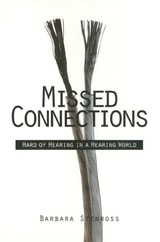
Missed Connections
Barbara Stenross
Temple University Press, 1999
Based on seven years of research, Stenross's book tells of how -- as she sought information and solutions to help her hard-of-hearing father -- she came to join a community group called Village Self Help for Hard of Hearing People. Taking us along to group meetings and into the homes of members, Stenross shows us -- through the personal accounts of these individuals -- the exhaustion that comes from constantly straining to listen, the frustration of missing critical comments or the or the punchlines of jokes, and the pain that hard-of-hearing family members experience when loved ones accuse them of hearing "when they want to." Full of scenes, dialogues, and conversations, Missed Connections also discusses such practical issues as how people with impaired hearing can continues to use the phone, how assistive technologies can help in public and private, why hearing aids can't always do enough, and how bluffing and silence can hurt more than help. Understanding that when one family member is hard of hearing, the whole family can suffer from "missed connections," Stenross offers in this book a useful family resource with a broad range of practical guidance.
With chapters on belonging and acceptance, do's and don'ts in public, lip-reading, hearing aids, and television, Missed Connections will interest a range of readers including deaf and hard-of-hearing people -- as well as their families, teachers, friends, employers, and counselors -- healthcare professionals, scholars, and others interested in the experience of and solutions for disability and hearing loss.
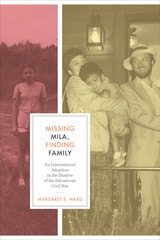
Missing Mila, Finding Family
An International Adoption in the Shadow of the Salvadoran Civil WarBy Margaret E. Ward
University of Texas Press, 2011
In the spring of 1983, a North American couple who were hoping to adopt a child internationally received word that if they acted quickly, they could become the parents of a boy in an orphanage in Honduras. Layers of red tape dissolved as the American Embassy there smoothed the way for the adoption. Within a few weeks, Margaret Ward and Thomas de Witt were the parents of a toddler they named Nelson—an adorable boy whose prior life seemed as mysterious as the fact that government officials in two countries had inexplicably expedited his adoption.
In Missing Mila, Finding Family, Margaret Ward tells the poignant and compelling story of this international adoption and the astonishing revelations that emerged when Nelson's birth family finally relocated him in 1997. After recounting their early years together, during which she and Tom welcomed the birth of a second son, Derek, and created a family with both boys, Ward vividly recalls the upheaval that occurred when members of Nelson's birth family contacted them and sought a reunion with the boy they knew as Roberto. She describes how their sense of family expanded to include Nelson's Central American relatives, who helped her piece together the lives of her son's birth parents and their clandestine activities as guerrillas in El Salvador's civil war. In particular, Ward develops an internal dialogue with Nelson's deceased mother Mila, an elusive figure whose life and motivations she tries to understand.
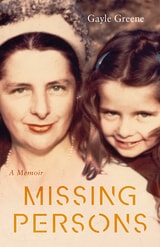
Missing Persons
A MemoirGayle Greene
University of Nevada Press, 2017
The memoir is structured as an account of her mother's and aunt’s final days and the year that follows, a year in which she reconstructs her life. This is a powerful story about family, what it means to have one, to lose one, never to have made one, and what, if anything, might take its place. It’s the story of a vexed mother-daughter relationship that mellows with age. It is also a search for home, as the very landscape shifts around her and the vast orchards are dug up and paved over for tract housing, strip malls, freeways, and the Santa Clara Valley, once known as the Valley of Heart’s Delight, is transformed to “Silicon.”
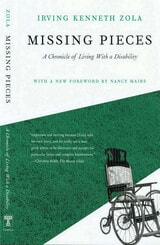
Missing Pieces
A Chronicle Of Living With A DisabilityKenneth Zola
Temple University Press, 2003

Missing Stories
Leslie Kelen
Utah State University Press, 2000
Utah's ethnic diversity is often overlooked. In a society sometimes presumed to be homogeneous, there is a danger that the varied experiences of its members will be lost to history. Missing Stories, available here for the first time in paperback, effectively counters such misconceptions and explores the rich history of ethnic and minority groups in the state. Several representatives from each of eight such groups tell in their own voices stories of themselves, their families, and their communities. The groups represented are Utes, African-Americans, Jews, Chinese, Italians, Japanese, Greeks, and Hispanics. In a preface to each section of oral history interviews, a respected historian of the community introduces background and heritage, setting the context for the personal recollections that follow. Also included are striking photographs by Kent Miles and George Janecek that capture much of the personality and character of the interviewees.
These oral histories recount migrations to new homes in Utah or adjustment to white settlement of traditional homelands in the state. They bring to light the struggles of individuals and families to survive and the formation and maintenance of communities in frequently adverse conditions, whether on reservations or farms, in small towns or large cities. The histories are enriched by accounts of challenges met and overcome and enlivened by stories of events and persons who sometimes achieved legendary status within and outside the groups. Missing Stories reveals the many ways that ethnic and minority groups have contributed to Utah's history and fills in missing pieces necessary to a complete portrayal of the state's society and culture.
Missing
Youth, Citizenship, and Empire after 9/11Sunaina Marr Maira
Duke University Press, 2009
Bringing grounded ethnographic analysis to the critique of U.S. empire, Maira teases out the ways that imperial power affects the everyday lives of young immigrants in the United States. She illuminates the paradoxes of national belonging, exclusion, alienation, and political expression facing a generation of Muslim youth coming of age at this particular moment. She also sheds new light on larger questions about civil rights, globalization, and U.S. foreign policy. Maira demonstrates that a particular subjectivity, the “imperial feeling” of the present historical moment, is linked not just to issues of war and terrorism but also to migration and work, popular culture and global media, family and belonging.
Mission Improbable
Using Fantasy Documents to Tame DisasterLee Clarke
University of Chicago Press, 1999
For example, Clarke studies corporations' plans for cleaning up oil spills in Prince William Sound prior to the Exxon Valdez debacle, and he finds that the accepted strategies were not just unrealistic but completely untenable. Although different organizations were required to have a cleanup plan for huge spills in the sound, a really massive spill was unprecedented, and the accepted policy was little more than a patchwork of guesses based on (mostly unsuccessful) cleanups after smaller accidents.
While we are increasingly skeptical of big organizations, we still have no choice but to depend on them for protection from large-scale disasters. We expect their specialists to tell the truth, and yet, as Clarke points out, reassuring rhetoric (under the guise of expert prediction) may have no basis in fact or truth because no such basis is attainable.
In uncovering the dangers of planning when implementation is a fantasy, Clarke concludes that society would be safer, smarter, and fairer if organizations could admit their limitations.
"An incursion into new territory written with insight and flair, Clarke's book achieves a revolution in understanding plans as an organizational activity-how they come about, why they go awry, and the often-disastrous disconnect between plans and an organization's ability to carry them out. A book that will fascinate general readers, administrators, organization theorists, and disaster buffs, Mission Improbable stands as a valuable companion volume to Pressman and Wildavsky's Implementation."—Diane Vaughan, author of The Challenger Launch Decision

Mission Underway
The History of the Popular Culture Association/American Culture Association and the Popular Culture Movement 1967–2001Edited, Revised, and Updated by Ray B. Browne
University of Wisconsin Press, 2002

Mission of Change in Southwest Alaska
Conversations with Father René Astruc and Paul Dixon on Their Work with Yup’ik PeopleEdited by Ann Fienup-Riordan
University of Alaska Press, 2012
Mission of Change is an oral history describing various types of change—political, social, cultural, and religious—as seen through the eyes of Father Astruc and Paul Dixon, non-Natives who dedicated their lives to working with the Yup’ik people. Their stories are framed by the an analytic history of regional changes, together with current anthropological theory on the nature of cultural change and the formation of cultural identity. The book presents a subtle and emotionally moving account of the region and the roles of two men, both of whom view issues from a Catholic perspective yet are closely attuned to and involved with changes in the Yup’ik community.
Missions for Science
U.S. Technology and Medicine in America's African WorldMcBride, David
Rutgers University Press, 2002
--What specific technologies and medical resources were transferred by U.S. institutions to black populations centers and why?
--How did the professed aims of U.S. technical projects, public health, and military activities differ from their actual effects and consequences?
--Did the U.S. technical transfer amount to a form of political hegemony?
--What lessons can we learn from the history of technology and medicine in these key geographic regions?
Missions for Science is the first book to explain how modern industrial and scientific advances shaped black Atlantic population centers. McBride is the first to provide a historical analysis of how shifting environmental factors and disease-control aid from the United States affected the collective development of these populations. He also discusses how independent black Atlantic republics with close historical links to the United States independently envisioned and attempted to use science and technology to build their nations.
Mississippian Polity and Politics on the Gulf Coastal Plain
A View from the Pearl River, MississippiPatrick Livingood
University of Alabama Press, 2011
The definition of the regional limits of chiefly influence during the Mississippian period in the southeastern United States remains unresolved. In the Gulf Coastal Plain between the Mississippi and Black Warrior rivers, some studies have explored the role that interpolity interactions played in influencing a polity’s social and political complexity through time. It has been argued that the larger, more complex polities were able to preempt the development of more complex political structures among the smaller polities.
Using research at the Pevey (22Lw510) and Lowe-Steen (22Lw511) mound sites on the Pearl River in Lawrence County, Mississippi, this book explores the social and political mechanisms by which these polities may have interacted with each other and the geographic limit to the effects of inter-polity competition. The Pevey site is a nine-mound Mississippian site and Lowe-Steen is a two-mound site located 18 kilometers to the north of Pevey. These sites provide a “missing link” of sorts to explore questions about inter-polity interactions because of their centrality to the study region and their unusual size. By filling a void in the regional dataset, this study allows us to better understand the capacity of the largest polities to negatively effect the political development of their smaller neighbors.
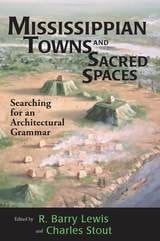
Mississippian Towns and Sacred Spaces
Searching for an Architectural GrammarEdited by R. Barry Lewis and Charles Stout
University of Alabama Press, 1998
Archaeologists and architects draw upon theoretical perspectives from their fields to provide valuable insights into the structure, development, and meaning of prehistoric communities.
Architecture is the most visible physical manifestation of human culture. The built environment envelops our lives and projects our distinctive regional and ethnic identities to the world around us. Archaeology and architecture find common theoretical ground in their perspectives of the homes, spaces, and communities that people create for themselves. Although archaeologists and architects may ask different questions and apply different methods, the results are the same—a deeper understanding of what it means to be human.
In this volume, prominent archaeologists examine the architectural design spaces of Mississippian towns and mound centers of the eastern United States. The diverse Mississippian societies, which existed between A.D. 900 and 1700, created some of the largest and most complex Native American archaeological sites in the United States. The dominant architectural feature shared by these communities was one or more large plazas, each of which was often flanked by buildings set on platform mounds. The authors describe the major dimensions of an architectural grammar, centered on the design of the plaza and mound complex that was shared by different societies across the Mississippian world. They then explore these shared architectural features as physical representations or metaphors for Mississippian world views and culture.
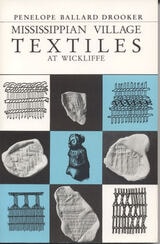
Mississippian Village Textiles at Wickliffe
Penelope Ballard Drooker
University of Alabama Press, 1992
Because textiles rarely are preserved in the archaeological record outside of deserts and permafrost areas, in many regions of the world very little is known about their characteristics, functions, production technology, or socioeconomic importance. While this fact is also true of organic fabrics produced during the Mississippian period in southeastern North Anerica, a wide variety of Mississippian textiles has been preserved in the form of impressions on large pottery vessels. From attribute analysis of 1,574 fabrics impressed on Wickliffe pottery sherds and comparison of the impressions with extant Mississippian textile artifacts, Drooker presents the first comparative analysis of these materials and the most inclusive available summary of information on Mississippian textiles.
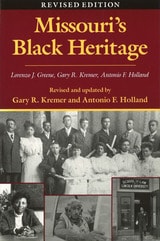
Missouri's Black Heritage, Revised Edition
Gary R. Kremer & Antonio F. Holland & With a Personal Reminiscence by Lorenzo J. Greene
University of Missouri Press, 1993
Originally written in 1980 by the late Lorenzo J. Greene, Gary R. Kremer, and Antonio F. Holland, Missouri's Black Heritage remains the only book-length account of the rich and inspiring history of the state's African American population. It has now been revised and updated by Kremer and Holland, incorporating the latest scholarship into its pages. This edition describes in detail the struggles faced by many courageous African Americans in their efforts to achieve full civil and political rights against the greatest of odds.
Documenting the African American experience from the horrors of slavery through present-day victories, the book touches on the lives of people such as John Berry Meachum, a St. Louis slave who purchased his own freedom and then helped countless other slaves gain emancipation; Hiram Young, a Jackson County free black whose manufacturing of wagons for Sante Fe Trail travelers made him a legendary figure; James Milton Turner, who, after rising from slavery to become one of the best-educated blacks in Missouri, worked with the Freedmen's Bureau and the State Department of Education to establish schools for blacks all over the state after the Civil War; and Annie Turnbo Malone, a St. Louis entrepreneur whose business skills made her one of the state's wealthiest African Americans in the early twentieth century.
A personal reminiscence by the late Lorenzo J. Greene, a distinguished African American historian whom many regard as one of the fathers of black history, offers a unique view of Missouri's racial history and heritage.
Missouri’s War
The Civil War in DocumentsSilvana R. Siddali
Ohio University Press, 2009
Winner of a 2011 “Distinguished Achievement in Literature” award, Missouri Humanities Council
Civil War Missouri stood at the crossroads of America. As the most Southern-leaning state in the Middle West, Missouri faced a unique dilemma. The state formed the gateway between east and west, as well as one of the borders between the two contending armies. Moreover, because Missouri was the only slave state in the Great Interior, the conflicts that were tearing the nation apart were also starkly evident within the state. Deep divisions between Southern and Union supporters, as well as guerrilla violence on the western border, created a terrible situation for civilians who lived through the attacks of bushwhackers and Jayhawkers.
The documents collected in Missouri's War reveal what factors motivated Missourians to remain loyal to the Union or to fight for the Confederacy, how they coped with their internal divisions and conflicts, and how they experienced the end of slavery in the state. Private letters, diary entries, song lyrics, official Union and Confederate army reports, newspaper editorials, and sermons illuminate the war within and across Missouri's borders.
Missouri's War also highlights the experience of free and enslaved African Americans before the war, as enlisted Union soldiers, and in their effort to gain rights after the end of the war. Although the collection focuses primarily on the war years, several documents highlight both the national sectional conflict that led to the outbreak of violence and the effort to reunite the conflicting forces in Missouri after the war.