Results by title
22279 books match the query 'Social Science' and 1258 start with m
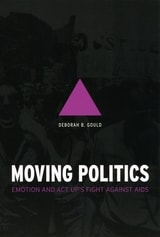
Moving Politics
Emotion and ACT UP's Fight against AIDSDeborah B. Gould
University of Chicago Press, 2009
In the late 1980s, after a decade spent engaged in more routine interest-group politics, thousands of lesbians and gay men responded to the AIDS crisis by defiantly and dramatically taking to the streets. But by the early 1990s, the organization they founded, ACT UP, was no more—even as the AIDS epidemic raged on. Weaving together interviews with activists, extensive research, and reflections on the author’s time as a member of the organization, Moving Politics is the first book to chronicle the rise and fall of ACT UP, highlighting a key factor in its trajectory: emotion.
Surprisingly overlooked by many scholars of social movements, emotion, Gould argues, plays a fundamental role in political activism. From anger to hope, pride to shame, and solidarity to despair, feelings played a significant part in ACT UP’s provocative style of protest, which included raucous demonstrations, die-ins, and other kinds of street theater. Detailing the movement’s public triumphs and private setbacks, Moving Politics is the definitive account of ACT UP’s origin, development, and decline as well as a searching look at the role of emotion in contentious politics.
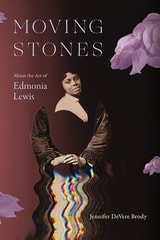
Moving Stones
About the Art of Edmonia LewisJennifer DeVere Brody
Duke University Press, 2026
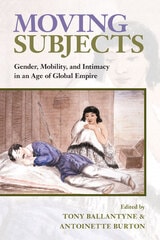
Moving Subjects
Gender, Mobility, and Intimacy in an Age of Global EmpireEdited by Tony Ballantyne and Antoinette Burton
University of Illinois Press, 2008
Moving Subjects is the first of its kind to make a case not simply for the necessity of a spatial analysis of imperial formations, but for the indispensability of an investigative approach that links space and movement with the domain of the intimate. Through careful archival research and a commitment to excavating the variety of "mobile intimacies" at the heart of imperial power, its agents, and its interlocutors, contributors offer new evidence and approaches for scholars engaged in capturing the historical nuances of imperial domination.
Contributors are Tony Ballantyne, Antoinette Burton, Adrian Carton, David Haines, Katherine Ellinghaus, Charlotte Macdonald, Michael A. McDonnell, Kirsten McKenzie, Michelle Moran, Fiona Paisley, Adele Perry, Dana Rabin, Christine M. Skwiot, Rachel Standfield, Frances Steel, Elizabeth Vibert, and Kerry Wynn.
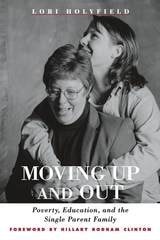
Moving Up And Out
Poverty, Education & Single Parent FamilyLori Holyfield, foreword by Hillary Rodham Clinton
Temple University Press, 2001
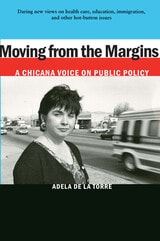
Moving from the Margins
A Chicana Voice on Public PolicyAdela de la Torre
University of Arizona Press, 2002
Addressing immigration, education, health care, and economic and political concerns, Adela de la Torre provides a distinctly Chicana perspective that often differs from that of mainstream readers and voters. Drawn from the author's syndicated column in the Los Angeles Times along with writings from other publications, Moving from the Margins includes incisive and often provocative commentaries that provide insights into the roots of ethnic tensions in the Golden State.
The book also includes readers' reactions to the articles, creating a dialogue of ideas while confronting fears of what many Americans view as an alien culture. Whether addressing entitlements granted to noncitizens, the future of public schools, or access to health care, de la Torre challenges readers to move beyond their own frame of reference and consider new points of view. The issues she faces have shaped today's California—and they also lie at the heart of urban public policy in America for the twenty-first century.

Moving the Mountain
The Women's Movement in America since 1960Flora Davis
University of Illinois Press, 1999
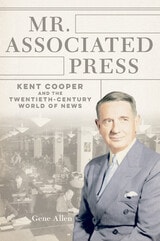
Mr. Associated Press
Kent Cooper and the Twentieth-Century World of NewsGene Allen
University of Illinois Press, 2023
- Finalist for the AEJMC Tankard Book Award
Allen critically assesses the many new approaches and causes that Cooper championed: introducing celebrity news and colorful features to a service previously known for stodgy reliability, pushing through disruptive technological innovations like the instantaneous transmission of news photos, and leading a crusade to bring American-style press freedom--inseparable from private ownership, in Cooper’s view--to every country. His insistence on truthfulness and impartiality presents a sharp contrast to much of today’s fractured journalistic landscape.
Deeply researched and engagingly written, Mr. Associated Press traces Cooper’s career as he built a new foundation for the modern AP and shaped the twentieth-century world of news.

Mrs. Shaw
A NovelMukoma Wa Ngugi
Ohio University Press, 2015

Mrs. Sigourney of Hartford
Poems and Prose on the Early American Deaf CommunityEdna Edith Sayers
Gallaudet University Press, 2013
Lydia Huntley was born in 1791 in Norwich, CT, the only child of a poor Revolutionary war veteran. But her father’s employer, a wealthy widow, gave young Lydia the run of her library and later sent her for visits to Hartford, CT. After teaching at her own school for several years in Norwich, Lydia returned to Hartford to head a class of 15 girls from the best families. Among her students was Alice Cogswell, a deaf girl soon to be famous as a student of Thomas Hopkins Gallaudet and Laurent Clerc.
Lydia’s inspiration came from a deep commitment to the education of girls and also for African American, American Indian, and deaf children. She left teaching to marry Charles Sigourney, then turned to writing to support her family, publishing 56 books, 2,000 magazine articles, and popular poetry. Lydia Sigourney never abandoned her passion for deaf education, remaining a supporter of Gallaudet’s school for the deaf until her death. Yet, her contributions to deaf education and her writing have been forgotten until now.
All of Lydia Sigourney’s of Lydia Sigourney’s work on the nascent Deaf community is presented in this new volume. Her writing intertwines her mastery of the sentimentalism form popular in her day with her sharp insights on the best ways to educate deaf children. In the process, Mrs. Sigourney of Hartford reestablishes her rightful place in history.
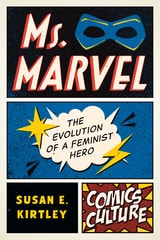
Ms. Marvel
The Evolution of a Feminist HeroSusan E. Kirtley
Rutgers University Press, 2027
Since her first appearance as a superhero in 1977, Ms. Marvel’s most frequent foe has, unfortunately, been herself. In the character’s earliest years, Carol Danvers struggled with two personalities that could not coexist. Later, Sharon Ventura wrestled with choosing between two bodies, one her preferred form and one deemed acceptable by society. Then Carol Danvers returned to the title and fought with a bevy of alternative versions of herself from various dimensions before battling the Dark Avenger version of Ms. Marvel, Karla Sofen. Upon assuming the title after Danvers took on the mantle of Captain Marvel, Kamala Khan inherited this seemingly endless ordeal: clashing with alternate versions of herself, as well as the doppelgänger Stormranger, and even with her own reanimated corpse.
In every iteration, the iconic hero associated with the honorific of women’s liberation continues to act as her own archnemesis, and the self remains the ultimate foe, suggesting that in every universe, women are their own worst enemy.

Mu, 49 Marks of Abolition
Sora Y. Han
Duke University Press, 2024
Much Ado about Culture
North American Trade DisputesKeith Acheson and Christopher Maule
University of Michigan Press, 2001
Much Matter in a Penny Paper
Early Yoruba Print Culture in Lagos, 1910–1930Karin Barber
Ohio University Press, 2026
A groundbreaking study of Yoruba-language print culture in colonial Lagos
Much Matter in a Penny Paper offers the first in-depth exploration of the emergence of an African-language print culture in early twentieth-century Lagos, Nigeria. Focusing on the 1910s and 1920s—a period of rapid experimentation and innovation—Karin Barber examines the rise of Yoruba-language newspapers and the vibrant civic sphere they helped create.
The 1910s was notable for an upsurge of local Yoruba-language history books, and during the 1920s entrepreneurial editors and writers launched five Yoruba-language weeklies in quick succession. These publications drew in readers beyond the educated elite, expanding public discourse and experimenting with new genres of writing. From moralizing pamphlets and dramatic sketches to serialized narratives voiced by women, Yoruba print producers reimagined oral and written traditions, blending popular songs, anecdotes, and poetic forms into a dynamic new medium.
This book is about not only what was printed but also how and why. It investigates the material practices of print production, the motivations of its creators, and the expectations of its audiences. Drawing on editorials, reader correspondence, and other paratextual commentary, it reveals how Yoruba writers and readers understood the role of print in capturing the present, preserving the past, projecting the wisdom of the day forward for the benefit of future generations, and generating deep Yoruba texts rich in poetic energy.
Through detailed portraits of key figures—editors, pamphleteers, and a mysterious oral historian—Barber traces the interconnections between publications and genres, showing how they formed an active bilingual sphere of communication. The interplay between Yoruba- and English-language media, as well as the creative exploitation of both languages, emerges as a defining feature of this period’s print culture. By treating the Yoruba print archive as a “transcript of emergence,” this study offers new insights into how cultural innovations take shape. It is essential reading for scholars of African history, media studies, sociolinguistics, and print culture.
Muchachas No More
Household Workers in Latin America and the CaribbeanElsa Chaney
Temple University Press, 1991
Muddied Waters
Race, Region, and Local History in Colombia, 1846–1948Nancy P. Appelbaum
Duke University Press, 2003
Nineteenth- and twentieth-century Colombian elite intellectuals, Appelbaum contends, mapped race onto their mountainous topography by defining regions in racial terms. They privileged certain places and inhabitants as white and modern and denigrated others as racially inferior and backward. Inhabitants of Riosucio, however, elaborated local narratives about their mestizo and indigenous identities that contested the white mystique of the Coffee Region. Ongoing violent conflicts over land and politics, Appelbaum finds, continue to shape local debates over history and identity. Drawing on archival and published sources complemented by oral history, Muddied Waters vividly illustrates the relationship of mythmaking and racial inequality to regionalism and frontier colonization in postcolonial Latin America.
Muddying the Waters
Coauthoring Feminisms across Scholarship and ActivismRicha Nagar
University of Illinois Press, 2014
With stories, encounters, and anecdotes as well as methodological reflections, Nagar grapples with the complexity of working through solidarities, responsibility, and ethics while involved in politically engaged scholarship. Experiences that range from the streets of Dar es Salaam to farms and development offices in North India inform discussion of the labor and politics of coauthorship, translation, and genre blending in research and writing that cross multiple--and often difficult--borders. The author links the implicit assumptions, issues, and questions involved with scholarship and political action, and explores the epistemological risks and possibilities of creative research that bring these into intimate dialogue
Daringly self-conscious, Muddying the Waters reveals a politically engaged researcher and writer working to become ""radically vulnerable,"" and the ways in which such radical vulnerability can allow a re-imagining of collaboration that opens up new avenues to collective dreaming and laboring across sociopolitical, geographical, linguistic, and institutional borders.

Mugwumps, Morals and Politics 1884-1920
Gerald W. McFarland
University of Massachusetts Press, 1975
The conventional approach has been to concentrate on only a dozen or so of the best known Mugwumps and to trace their careers no further than 1900. In contrast, McFarland greatly extends the number of individuals whose activities must be considered reflections of the movement, discussing a sample of hundreds of active Mugwumps, and traces their careers well into the twentieth century.
Mugwump orthodoxy is demonstrated by an examination of their largely negative goals in the anti-Blaine bolt of 1884, their narrow political program during the late 1880s, and their politically disastrous loyalty to Grover Cleveland. But their innovative side is also highlighted by a searching analysis of their successes, including their participation in the movement to professionalize such occupations as law, medicine, and higher education, and their contributions to urban, political, and social reform.
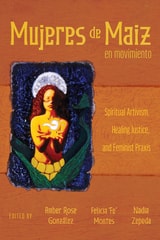
Mujeres de Maiz en Movimiento
Spiritual Artivism, Healing Justice, and Feminist PraxisEdited by Amber Rose González, Felicia ‘Fe’ Montes, and Nadia Zepeda
University of Arizona Press, 2024
MdM’s political-ethical-spiritual commitments, cultural production, and everyday practices are informed by Indigenous and transnational feminist of color artistic, ceremonial, activist, and intellectual legacies. Contributors fuse stories of celebration, love, and spirit-work with an incisive critique of interlocking oppressions, both intimate and structural, encouraging movement toward “a world where many worlds fit.”
The multidisciplinary, intergenerational, and critical-creative nature of the project coupled with the unique subject matter makes the book a must-have for high school and college students, activist-scholars, artists, community organizers, and others invested in social justice and liberation.

Mule South to Tractor South
Mules, Machines, and the Transformation of the Cotton SouthGeorge B. Ellenberg
University of Alabama Press, 2013
The adoption of the mule as the major agricultural resource in the American South and its later displacement by the mechanical tractor.
The author describes the adoption of the mule as the major agricultural resource in the American South and its later displacement by the mechanical tractor. After describing the surprising slowness of southern farmers to realize the superiority of the mule over the horse for agricultural labor, Ellenberg strives to capture the symbiosis that emerged between animal and man to illuminate why and how the mule became a standard feature in Southern folk culture.
Having been slow to adopt the mule, southern farmers were then reluctant to set it aside in favor of the tractor. Ellenberg describes the transformation as the tractor gradually displaced the mule and the role of the U.S. Department of Agriculture in this process.
The work not only becomes a survey of the development of southern agriculture as revealed through an examination of this premier work animal but also follows the emergence of the animal as a cultural icon, as it figures in southern literature, folklore, and music.
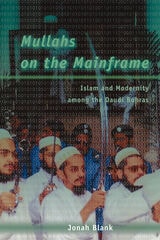
Mullahs on the Mainframe
Islam and Modernity among the Daudi BohrasJonah Blank
University of Chicago Press, 2001
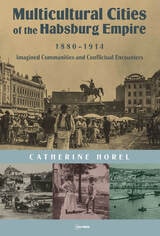
Multicultural Cities of the Habsburg Empire, 1880–1914
Imagined Communities and Conflictual EncountersCatherine Horel
Central European University Press, 2023
Catherine Horel has undertaken a comparative analysis of the societal, ethnic, and cultural diversity in the last decades of the Habsburg Monarchy as represented in twelve cities: Arad, Bratislava, Brno, Chernivtsi, Lviv, Oradea, Rijeka, Sarajevo, Subotica, Timișoara, Trieste, and Zagreb. By purposely selecting these cities, the author aims to counter the disproportionate attention that the largest cities in the empire receive.
With a focus on the aspects of everyday life faced by the city inhabitants (associations, schools, economy, and municipal politics) the book avoids any idealization of the monarchy as a paradise of peaceful multiculturalism, and also avoids exaggerating conflicts. The author claims that the world of the Habsburg cities was a dynamic space where many models coexisted and created vitality, emulation, and conflict. Modernization brought about the dissolution of old structures, but also mobility, the progress of education, the explosion of associative life, and constantly growing cultural offerings.

Multicultural Comics
From Zap to Blue BeetleEdited by Frederick Luis Aldama
University of Texas Press, 2010
Multicultural Comics: From Zap to Blue Beetle is the first comprehensive look at comic books by and about race and ethnicity. The thirteen essays tease out for the general reader the nuances of how such multicultural comics skillfully combine visual and verbal elements to tell richly compelling stories that gravitate around issues of race, ethnicity, gender, and sexuality within and outside the U.S. comic book industry. Among the explorations of mainstream and independent comic books are discussions of the work of Adrian Tomine, Grant Morrison, and Jessica Abel as well as Marv Wolfman and Gene Colan's The Tomb of Dracula; Native American Anishinaabe-related comics; mixed-media forms such as Kerry James Marshall's comic-book/community performance; DJ Spooky's visual remix of classic film; the role of comics in India; and race in the early Underground Comix movement. The collection includes a "one-stop shop" for multicultural comic book resources, such as archives, websites, and scholarly books. Each of the essays shows in a systematic, clear, and precise way how multicultural comic books work in and of themselves and also how they are interconnected with a worldwide tradition of comic-book storytelling.
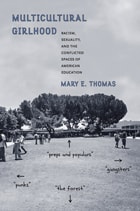
Multicultural Girlhood
Racism, Sexuality, and the Conflicted Spaces of American EducationMary E. Thomas
Temple University Press, 2011
High school turf wars are often a teenage rite of passage, but there are extremes—as when a race riot at a Los Angeles campus in the spring of 2005 resulted in a police lockdown. In her fascinating book,Multicultural Girlhood, Mary Thomas interviewed 26 Latina, Armenian, Filipina, African-American, and Anglo girls at this high school to gauge their responses to the campus violence. They all denounced the outbreak, calling for multicultural understanding and peaceful coexistence.
However, as much as the girls want everyone to just “get along,” they also exhibit strong racist beliefs and validate segregated social spaces on campus and beyond. How can teenagers and “girl power” work together to empower instead of alienate multicultural groups? In her perceptive book, Thomas foregrounds the spaces of teen girlhood and the role that space plays in girls' practices that perpetuate social difference, and she explains the ways we navigate the intellectual terrain between scholarship and school yard.
Multicultural Politics
Racism, Ethnicity, and Muslims in BritainTariq Modood
University of Minnesota Press, 2005
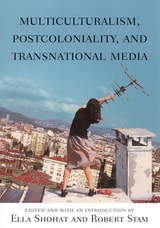
Multiculturalism, Postcoloniality, and Transnational Media
Edited by Ella Shohat and Robert Stam
Rutgers University Press, 2003
To explore this complexity, the editors have forged links between usually compartmentalized fields (especially media studies, literary theory, visual culture, and critical anthropology) and areas of inquiry-particularly postcolonial and diasporic studies and a diverse set of ethnic and area studies. This book, which links all these issues in suggestive ways, provides an indispensable guide for students and scholars in a wide variety of disciplines. Essays in this groundbreaking volume include Julianne Burton-Carvajal on ethnic identity in Lone Star; Manthia Diawara on diasporic documentary; Hamid Naficy on independent transnational film genres; Robyn Wiegman on whiteness studies; Faye Ginsburg on indigenous media; and Jennifer Gonzßles on race in cyberspace; Ana M. Lopez on modernity and Latin American cinema; and Inderpal Grewal and Caren Kaplan on Warrior Marks and multiculturalism and globalization.
Multidisciplinary Research at Grasshopper Pueblo, Arizona
Edited by William A. Longacre, Sally J. Holbrook, and Michael W. Graves
University of Arizona Press, 1982
Contributors:
Larry D. Agenbroad
Eric J. Arnould
Walter H. Birkby
Vorsila L. Bohrer
Jeffrey S. Dean
Michael W. Graves
Sally J. Holbrook
Gerald K. Kelso
William A. Longacre
Charmion R. McKusick
J. Jefferson Reid
John W. Olsen
Stanley J. Olsen
William Reynolds
William J. Robinson
Izumi Shimada
Stephanie M. Whittlesey
David R. Wilcox
Multilingualism and Sign Languages
From the Great Plains to AustraliaCeil Lucas
Gallaudet University Press, 2006
The 12th Volume in the Sociolinguistics in Deaf Communities Series
The latest entry in the Sociolinguistics in Deaf Communities series continues to mine the rich resources found in signing communities throughout the world. Divided into four parts, this collection features 16 internationally renowned linguistics experts whose absorbing studies reflect an astonishing range of linguistic diversity.
The sole essay in Part One: Multilingualism describes historic and contemporary uses of North American Indian Sign Language. Part Two: Language Contact examines language-contact phenomena between Auslan/English interpreters and Deaf people in Australia, and the features of bimodal bilingualism in hearing, Italian, native signers. Part Three: Variation reports the results of a study on location variation in Australian Sign Language.
Part Four: Discourse Analysis begins with an analysis of how deaf parents and their hearing toddlers establish and maintain sight triangles when conducting signed conversations. The ensuing chapter explores the use of evaluation within an informal narrative in Langue des Signes Québécoise. The final chapter explicates how a signer depersonalizes the concept of “self” in an American Sign Language narrative through the use of signs for “he” and “I.”
Multiple InJustices
Indigenous Women, Law, and Political Struggle in Latin AmericaR. Aída Hernández Castillo
University of Arizona Press, 2016
Multiple InJustices synthesizes R. Aída Hernández Castillo’s twenty-four years of activism and research among indigenous women’s organizations in Latin America. As both feminist and critical anthropologist, Hernández Castillo analyzes the context of legal pluralism wherein the indigenous women of Mexico, Guatemala, and Colombia struggle for justice. Through ethnographical research in community, state, and international justice, she reflects on the possibilities and limitations of customary, national, and international law for indigenous women.
Colonialism, racism, and patriarchal violence have been fundamental elements for the reproduction of capitalism, Hernández Castillo asserts. Only a social policy that offers economic alternatives based on distribution of wealth and a real recognition of cultural and political rights of indigenous peoples can counter the damage of outside forces such as drug cartels on indigenous lands.
She concludes that the theories of indigenous women on culture, tradition, and gender equity—as expressed in political documents, event reports, public discourse, and their intellectual writings—are key factors in the decolonization of Latin American feminisms and social justice for all.

Multiple Meanings of Gender Equality
A critical frame analysis of gender policies in EuropeMieke Verloo
Central European University Press, 2007
Multiple Modernities
Cinemas & Popular Media In Transcultural East AsiaJenny Lau
Temple University Press, 2002

Multiple Paths of Midlife Development
Edited by Margie E. Lachman and Jacquelyn Boone James
University of Chicago Press, 1997
Much of the past work on midlife has been limited by its use of cross-sectional data, its focus on clinical populations, and the analysis of only one target group. Using a diverse set of longitudinal data, this volume provides a broader perspective by examining the similarities and differences in the midlife experience as a function of gender, social class, and birth cohort.
Of interest to scholars as well as to those interested in the midlife period for clinical or personal reasons, this volume informs us of the enormous potential and promise amid the gains and losses of the middle years.

Multiracial Mandarin
Asian Americans and Impossible LanguageDavid Shuang Song
University of Minnesota Press, 2026
Understanding the entanglement of language education with ethnicity and racialization
Who has the “right” to learn Mandarin Chinese? In Multiracial Mandarin, author David Shuang Song examines how matters of race and privilege shape US Mandarin language education and who has access to it. Through a two-year ethnographic study of two Bay Area high schools where diasporic and heritage speakers learn Mandarin alongside Black and Latinx students, Song advances a sociological and educational–linguistic inquiry into how language interacts with our understanding of identity and equity.
Comparing classroom activities in two public schools, Song investigates teachers who seek to make Mandarin accessible while detaching it from its cultural roots. As he explores the difficulties of limited resources, racial inequality, and pedagogical practices inherent in multiracial Mandarin instruction, Song shows how language education complicates how educators understand Asian American students and troubles conventional conversations around race and racial equity in schools.
Arguing that language practice and instruction must always be considered in relation to diaspora, ethnicity, and racialization, Multiracial Mandarin offers a frank analysis of the risks and benefits of teaching a diasporic language and asks if this practice ought to be replicated in more schools. As he applies innovative conceptual frameworks for talking about language among Asian Americans, Song’s timely and theoretically sophisticated analysis has wide-ranging implications for how students, teachers, and administrators approach essential questions around education, privilege, and language survival.
Retail e-book files for this title are screen-reader friendly.
Multisituated
Ethnography as Diasporic PraxisKaushik Sunder Rajan
Duke University Press, 2021

Multispecies Studies
Thom van Dooren, Ursula Münster, Eben Kirksey, Deborah Bird Rose, Matthew Chrulew, and Anna Tsing, special issue editors
Duke University Press, 2016
The emerging field of multispecies studies, grounded in passionate immersion in the lives of fungi, microorganisms, animals, plants, and others, is opening up novel ways of engaging with worlds around us. This issue brings together some of the leading scholars in this field to explore what is at stake—epistemologically, politically, ethically—for different forms of life caught up in diverse relationships of knowing and living together. The collection takes us into the worlds of sheep and shepherds; of stones, worms, salmon, and forest-devouring beetles; of viruses and their elephants; of seals, crows, and lava flows in Hawaii; and finally of frogs-as-pregnancy-tests and possible agents of pathogenic fungal spread. Each of the contributors explores what difference curious and careful attention to others might make in our efforts to inhabit and coconstitute flourishing worlds in these difficult times.
This issue is freely available online at environmentalhumanities.org; a print version is available for purchase.
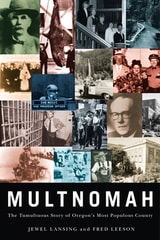
Multnomah
The Tumultuous Story of Oregon's Most Populous CountyJewel Lansing and Fred Leeson
Oregon State University Press, 2012
Covering people and events from 1854 to the present day, this definitive history of Multnomah County provides compelling details about public works triumphs and political scandals.
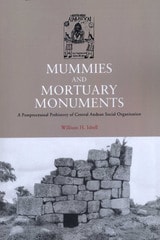
Mummies and Mortuary Monuments
A Postprocessual Prehistory of Central Andean Social OrganizationBy William H. Isbell
University of Texas Press, 1997
Since prehistoric times, Andean societies have been organized around the ayllu, a grouping of real or ceremonial kinspeople who share labor, resources, and ritual obligations. Many Andean scholars believe that the ayllu is as ancient as Andean culture itself, possibly dating back as far as 6000 B.C., and that it arose to alleviate the hardships of farming in the mountainous Andean environment.
In this boldly revisionist book, however, William Isbell persuasively argues that the ayllu developed during the latter half of the Early Intermediate Period (around A.D. 200) as a means of resistance to the process of state formation. Drawing on archaeological evidence, as well as records of Inca life taken from the chroniclers, Isbell asserts that prehistoric ayllus were organized around the veneration of deceased ancestors, whose mummified bodies were housed in open sepulchers, or challups, where they could be visited by descendants seeking approval and favors. By charting the temporal and spatial distribution of chullpa ruins, Isbell offers a convincing new explanation of where, when, and why the ayllu developed.
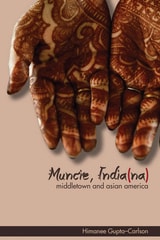
Muncie, India(na)
Middletown and Asian AmericaHimanee Gupta-Carlson
University of Illinois Press, 2018

Murder She Wrote
A Study of Agatha Christie's Detective FictionPatricia D. Maida
University of Wisconsin Press, 1982
This book explores the inter-relationships between Agatha Christie and her works to seek the wholeness in the Christie experience. The authors perceive an integration in personal experience and moral and aesthetic values between the woman and her art.

Murder Town, USA
Homicide, Structural Violence, and Activism in WilmingtonYasser Arafat Payne
Rutgers University Press, 2023
Far too many poor Black communities struggle with gun violence and homicide. The result has been the unnatural contortion of Black families and the inter-generational perpetuation of social chaos and untimely death. Young people are repeatedly ripped away from life by violence, while many men are locked away in prisons. In neighborhoods like those of Wilmington, Delaware, residents routinely face the pressures of violence, death, and incarceration. Murder Town, USA is thus a timely ethnography with an innovative structure: the authors helped organize fifteen residents formerly involved with the streets and/or the criminal justice system to document the relationship between structural opportunity and experiences with violence in Wilmington's Eastside and Southbridge neighborhoods.
Earlier scholars offered rich cultural analysis of violence in low-income Black communities, and yet this literature has mostly conceptualized violence through frameworks of personal responsibility or individual accountability. And even if acknowledging the pressure of structural inequality, most earlier researchers describe violence as the ultimate result of some moral failing, a propensity for crime, and the notion of helplessness. Instead, in Murder Town USA, Payne, Hitchens, and Chamber, along with their collaborative team of street ethnographers, instead offer a radical re-conceptualization of violence in low-income Black communities by describing the penchant for violence and involvement in crime overall to be a logical, "resilient" response to the perverse context of structural inequality.

Murder and the Death Penalty in Massachusetts
Alan Rogers
University of Massachusetts Press, 2008
For more than 300 years Massachusetts executed men and women convicted of murder, but with a sharp eye on “due proceeding” and against the backdrop of popular ambivalence about the death penalty's morality, cruelty, efficacy, and constitutionality. In this authoritative book, Alan Rogers offers a comprehensive account of how the efforts of reformers and abolitionists and the Supreme Judicial Court's commitment to the rule of law ultimately converged to end the death penalty in Massachusetts.
In the seventeenth century, Governor John Winthrop and the Massachusetts General Court understood murder to be a sin and a threat to the colony's well-being, but the Puritans also drastically reduced the crimes for which death was the prescribed penalty and expanded a capital defendant's rights. Following the Revolution, Americans denounced the death penalty as “British and brutish” and the state's Supreme Judicial Court embraced its role as protector of the rights extended to all men by the Massachusetts Constitution. In the 1830s popular opposition nearly stopped the machinery of death and a vote in the Massachusetts House fell just short of abolishing capital punishment.
A post–Civil War effort extending civil rights to all men also stimulated significant changes in criminal procedure. A “monster petition” begging the governor to spare the life of a murderer convicted on slight circumstantial evidence and the grim prospect of executing nine Chinese men found guilty of murder fueled a passionate debate about the death penalty in the decade before World War I.
The trials and executions of Sacco and Vanzetti focused unwanted international and national attention on Massachusetts. This was a turning point. Sara Ehrmann took charge of the newly formed Massachusetts Council Against the Death Penalty, relentlessly lobbied the legislature, and convinced a string of governors not to sign death warrants. In the 1970s the focus shifted to the courts, and eventually, in 1980, the Supreme Judicial Court abolished the death penalty on the grounds that it violated the Massachusetts Constitution.
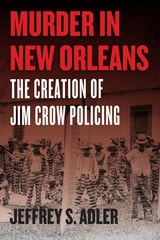
Murder in New Orleans
The Creation of Jim Crow PolicingJeffrey S. Adler
University of Chicago Press, 2019
New Orleans in the 1920s and 1930s was a deadly place. In 1925, the city’s homicide rate was six times that of New York City and twelve times that of Boston. Jeffrey S. Adler has explored every homicide recorded in New Orleans between 1925 and 1940—over two thousand in all—scouring police and autopsy reports, old interviews, and crumbling newspapers. More than simply quantifying these cases, Adler places them in larger contexts—legal, political, cultural, and demographic—and emerges with a tale of racism, urban violence, and vicious policing that has startling relevance for today.
Murder in New Orleans shows that whites were convicted of homicide at far higher rates than blacks leading up to the mid-1920s. But by the end of the following decade, this pattern had reversed completely, despite an overall drop in municipal crime rates. The injustice of this sharp rise in arrests was compounded by increasingly brutal treatment of black subjects by the New Orleans police department. Adler explores other counterintuitive trends in violence, particularly how murder soared during the flush times of the Roaring Twenties, how it plummeted during the Great Depression, and how the vicious response to African American crime occurred even as such violence plunged in frequency—revealing that the city’s cycle of racial policing and punishment was connected less to actual patterns of wrongdoing than to the national enshrinement of Jim Crow. Rather than some hyperviolent outlier, this Louisiana city was a harbinger of the endemic racism at the center of today’s criminal justice state. Murder in New Orleans lays bare how decades-old crimes, and the racially motivated cruelty of the official response, have baleful resonance in the age of Black Lives Matter.
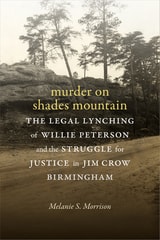
Murder on Shades Mountain
The Legal Lynching of Willie Peterson and the Struggle for Justice in Jim Crow BirminghamMelanie S. Morrison
Duke University Press, 2018
In Murder on Shades Mountain Melanie S. Morrison tells the gripping and tragic story of the attack and its aftermath—events that shook Birmingham to its core. Having first heard the story from her father—who dated Nell's youngest sister when he was a teenager—Morrison scoured the historical archives and documented the black-led campaigns that sought to overturn Peterson's unjust conviction, spearheaded by the NAACP and the Communist Party. The travesty of justice suffered by Peterson reveals how the judicial system could function as a lynch mob in the Jim Crow South. Murder on Shades Mountain also sheds new light on the struggle for justice in Depression-era Birmingham. This riveting narrative is a testament to the courageous predecessors of present-day movements that demand an end to racial profiling, police brutality, and the criminalization of black men.

Murder
A Tale of Modern American LifeSara L. Knox
Duke University Press, 1998
In her approach to the telling of this cultural phenomenon, Knox draws on historical analysis and original research. She discusses such subjects as the continuing existence of capital punishment, the “sensational” American murderers Martha Beck and Ray Fernandez (aka the Honeymoon Killers), the connection between true crime books and romance narratives, and pulp murder novels of the 1930s and 1940s. Analyzing widespread interest in forensic psychiatry, sexuality, mortality, and the relation of gender to society’s reactions to murder, Knox refers to the early work of David Brion Davis, Bill Ellis, and Joel Black. While demonstrating how society’s focus has shifted from the act itself to the psychology of the murderer to the broader social forces at work, she discusses the writings of Willard Motley, William March, Curtis Bok, James Baldwin, and Kate Millett, among others.
Full of anecdotes and insights, Murder is a lively meditation on American culture that includes not only close critical readings of individual texts but also everyday matters of murder’s meaning. It will interest those involved with American studies, cultural studies, and true crime accounts.

Murdered by His Wife
Deborah Navas
University of Massachusetts Press, 1999
In March 1778, Joshua Spooner, a wealthy gentleman farmer in Brookfield, Massachusetts, was beaten to death and his body stuffed down a well. Four people were hanged for the crime: two British soldiers, a young Continental soldier, and Spooner's wife, Bathsheba, who was charged with instigating the murder. She was thirty-two years old and five months pregnant when executed. Newspapers described the case as “the most extraordinary crime ever perpetrated in New England.”
Murdered by His Wife provides a vivid reconstruction of this dramatic but little-known episode. Beautiful, intelligent, high-spirited, and witty, Bathsheba was the mother of three young children and in her own words felt “an utter aversion” for her husband, who was known to be an abusive drunk.
A year before the murder, she took in and nursed a sixteen-year-old Continental soldier who was returning from a year's enlistment under George Washington. The two became lovers and conceived a child. Divorces were all but impossible for women at that time and adulteresses were stripped to the waist and publicly whipped. Bathsheba's pregnancy occasioned a series of desperate plots to murder her husband, finally brought to fruition with the aid of two British deserters from General Burgoyne's defeated army.
The plots, the crime, the trial, and the aftermath are presented against a backdrop of revolutionary turmoil in Massachusetts. As the daughter of the state's most prominent and despised Loyalist, Bathsheba bore the brunt of the political, cultural, and gender prejudices of her day. When she sought a stay of execution to deliver her baby, the Massachusetts Council rejected her petition and she was promptly hanged before a crowd of 5,000 spectators.
Murdered in Jersey
Expanded EditionGerald Tomlinson
Rutgers University Press, 1994

Murray Springs
A Clovis Site with Multiple Activity Areas in the San Pedro Valley, ArizonaEdited by C. Vance Haynes, Jr., and Bruce B. Huckell
University of Arizona Press, 2007

Musashino in Tuscany
Japanese Overseas Travel Literature, 1860–1912Susanna Fessler
University of Michigan Press, 2004
Muscle Works
Physical Culture and the Performance of MasculinityBroderick D. V. Chow
Northwestern University Press, 2024
This book recounts the story of fitness culture from its beginnings as spectacles of strongmen, weightlifters, acrobats, and wrestlers to its legitimization in the twentieth-century in the form of competitive sports and health and wellness practices. Broderick D. V. Chow shows how these modes of display contribute to the construction and deconstruction of definitions of masculinity.
Attending to its theatrical origins, Chow argues for a more nuanced understanding of fitness culture, one informed by the legacies of self-described Strongest Man in the World Eugen Sandow and the history of fakery in strongman performance; the philosophy of weightlifter George Hackenschmidt and the performances of martial artist Bruce Lee; and the intersections of fatigue, resistance training, and whiteness. Muscle Works: Physical Culture and the Performance of Masculinity moves beyond the gym and across the archive, working out techniques, poses, and performances to consider how, as gendered subjects, we inhabit and make worlds through our bodies.
Museum Frictions
Public Cultures/Global TransformationsIvan Karp, Corinne A. Kratz, Lynn Szwaja, and Tomás Ybarra-Frausto With Gustavo Buntinx, Barbara Kirshenblatt-Gimblett, and Ciraj Rassool, eds.
Duke University Press, 2006
Whether contrasting the transformation of Africa’s oldest museum, the South Africa Museum, with one of its newest, the Lwandle Migrant Labor Museum; offering an interpretation of the audio guide at the Guggenheim Bilbao; reflecting on the relative paucity of art museums in Peru and Cambodia; considering representations of slavery in the United States and Ghana; or meditating on the ramifications of an exhibition of Australian aboriginal art at the Asia Society in New York City, the contributors highlight the frictions, contradictions, and collaborations emerging in museums and heritage sites around the world. The volume opens with an extensive introductory essay by Ivan Karp and Corinne A. Kratz, leading scholars in museum and heritage studies.
Contributors. Tony Bennett, David Bunn, Gustavo Buntinx, Cuauhtémoc Camarena, Andrea Fraser, Martin Hall, Ivan Karp, Barbara Kirshenblatt-Gimblett, Corinne A. Kratz, Christine Mullen Kreamer, Joseph Masco, Teresa Morales, Howard Morphy, Ingrid Muan, Fred Myers, Ciraj Rassool, Vicente Razo, Fath Davis Ruffins, Lynn Szwaja, Krista A. Thompson, Leslie Witz, Tomás Ybarra-Frausto
Museum Matters
Making and Unmaking Mexico’s National CollectionsEdited by Miruna Achim, Susan Deans-Smith, Sandra Rozental
University of Arizona Press, 2021
Museum Matters traces the emergence, consolidation, and dispersal of this national museum complex by telling the stories of its objects. Objects that have been separated over time are brought back together in this book in order to shed light on the interactions and processes that have forged things into symbols of science, aesthetics, and politics. The contributors to this volume illuminate how collections came into being or ceased to exist over time, or how objects moved in and out of collections and museum spaces. They explore what it means to move things physically and spatially, as well as conceptually and symbolically.
Museum Matters unravels the concept of the national museum. By unmaking the spaces, frameworks, and structures that form the complicated landscape of national museums, this volume brings a new way to understand the storage, displays, and claims about the Mexican nation’s collections today.
Contributors
Miruna Achim, Christina Bueno, Laura Cházaro, Susan Deans-Smith, Frida Gorbach, Haydeé López Hernández, Carlos Mondragón, Bertina Olmedo Vera, Sandra Rozental, Mario Rufer