Results by title
8113 books match the query 'Literary Criticism' and 191 start with n
North American Monsters
A Contemporary Legend CasebookDavid J. Puglia
Utah State University Press, 2021
A diverse cast of scholars contemplate these alluring creatures, feared and beloved by the communities that host them—the Jersey Devil gliding over the Pine Barrens, Lieby wriggling through Lake Lieberman, Char-Man stalking the Ojai Valley, and many, many more. Embracing local stories, beliefs, and traditions while neither promoting nor debunking, North American Monsters aspires to revive scholarly interest in local legendary monsters and creatures and to encourage folkloristic monster legend sleuthing.
North Sea Crossings
The Literary Heritage of Anglo-Dutch Relations 1066–1688Sjoerd Levelt and Ad Putter
Bodleian Library Publishing, 2022
This richly illustrated book tells the story of cultural exchange between the people of the Low Countries and England in the Middle Ages and the Early Modern period, revealing how Anglo-Dutch connections changed the literary landscape on both sides of the North Sea.
Ranging from the Norman Conquest of 1066 to the “Glorious Revolution” of 1688, North Sea Crossings uncovers the lasting impact of contacts and collaborations between Dutch and English speakers on historical writing, map-making, manuscript production, and early printing. The literary heritage of Anglo-Dutch relations is explored and lavishly illustrated through a unique collection of manuscripts, early prints, maps, and other treasures from the Bodleian Library.
Northeastern Indian Lives, 1632-1816
Robert S. Grumet
University of Massachusetts Press, 1996
Few works have directed attention toward such lesser-known figures as Shickellamy, an Oneida diplomat; the Mohawk sachem Theyanoguin; Awashunkes, a Saconett sunksquaw; or Molly Ockett, a Pigwacket doctor. These individuals operated at the often dangerous and always uncertain interstices separating their world from that of the European settlers, as they worked for the security and survival of their peoples during the first centuries of contact. Their efforts helped shape events that determined the course of history in the colonial Northeast.
Northern Hospitality
Cooking by the Book in New EnglandKeith Stavely
University of Massachusetts Press, 2011
Beginning with four chapters placing the region's best-known cookbook authors and their works in nuanced historical context, Keith Stavely and Kathleen Fitzgerald then proceed to offer a ten-chapter cornucopia of culinary temptation. Readers can sample regional offerings grouped into the categories of the liquid one-pot meal, fish, fowl, meat and game, pie, pudding, bread, and cake. Recipes are presented in their original textual forms and are accompanied by commentaries designed to make them more accessible to the modern reader. Each chapter, and each section within each chapter, is also prefaced by a brief introductory essay. From pottage to pie crust, from caudle to calf's head, historic methods and obscure meanings are thoroughly—sometimes humorously—explained.
Going beyond reprints of single cookbooks and bland adaptations of historic recipes, this richly contextualized critical anthology puts the New England cooking tradition on display in all its unexpected--and delicious--complexity. Northern Hospitality will equip readers with all the tools they need for both historical understanding and kitchen adventure.
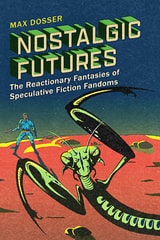
Nostalgic Futures
The Reactionary Fantasies of Speculative Fiction FandomsMax Dosser
Rutgers University Press, 2026
Speculative fiction imagines impossible futures and alternative pasts, alien species and angelic monsters, technological marvels and magical solutions. In recent years, however, many in its fandoms have protested the inclusion of nonwhite, nonmale, and nonheterosexual characters as betrayals of their beloved media for the sake of “wokeness.” Nostalgic Futures: The Reactionary Fantasies of Speculative Fiction Fandoms examines how contemporary fan controversies— particularly those surrounding gender, race, and sexuality in speculative fiction media—intersect with reactionary movements within and beyond fandom. This book explores how the nostalgic fantasies of fans and far-right movements contribute to broader reactionary discourses, shaping not only the past they long for but the future they fear. From the Hugo Awards and PuppyGate to Star Wars’ #NotMyJedi to Mass Effect and The Last of Us boycotts, Nostalgic Futures reveals how speculative fiction fandom has become a site of contestation over our visions of the past, present, and future.
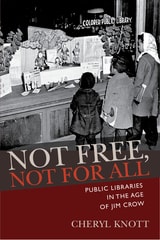
Not Free, Not for All
Public Libraries in the Age of Jim CrowCheryl Knott
University of Massachusetts Press, 2015
Winner of the 2016 Eliza Atkins Gleason Book Award and the 2016 Lillian Smith Book Award
Americans tend to imagine their public libraries as time-honored advocates of equitable access to information for all. Through much of the twentieth century, however, many black Americans were denied access to public libraries or allowed admittance only to separate and smaller buildings and collections. While scholars have examined and continue to uncover the history of school segregation, there has been much less research published on the segregation of public libraries in the Jim Crow South. In fact, much of the writing on public library history has failed to note these racial exclusions.
In Not Free, Not for All, Cheryl Knott traces the establishment, growth, and eventual demise of separate public libraries for African Americans in the South, disrupting the popular image of the American public library as historically welcoming readers from all walks of life. Using institutional records, contemporaneous newspaper and magazine articles, and other primary sources together with scholarly work in the fields of print culture and civil rights history, Knott reconstructs a complex story involving both animosity and cooperation among whites and blacks who valued what libraries had to offer. African American library advocates, staff, and users emerge as the creators of their own separate collections and services with both symbolic and material importance, even as they worked toward dismantling those very institutions during the era of desegregation.
Not Out of Hate
A Novel of BurmaMa Ma Lay
Ohio University Press, 1991
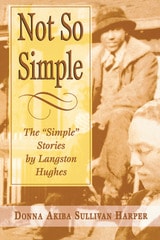
Not So Simple
The "Simple" Stories by Langston HughesDonna Akiba Sullivan Harper
University of Missouri Press, 1995
The "Simple" stories, Langston Hughes's satirical pieces featuring Harlem's Jesse B. Semple, have been lauded as Hughes's greatest contribution to American fiction. In Not So Simple, Donna Akiba Sullivan Harper provides the first full historical analysis of the Simple stories.
Harper traces the evolution and development of Simple from his 1943 appearance in Hughes's weekly Chicago Defender column through his 1965 farewell in the New York Post. Drawing on correspondence and manuscripts of the stories, Harper explores the development of the Simple collections, from Simple Speaks His Mind (1950) to Simple's Uncle Sam (1965), providing fresh and provocative perspectives on both Hughes and the characters who populate his stories.
Harper discusses the nature of Simple, Harlem's "everyman", and the way in which Hughes used his character both to teach fellow Harlem residents about their connection to world events and to give black literature a hero whose "day-after-day heroism" would exemplify greatness. She explores the psychological, sociological, and literary meanings behind the Simple stories, and suggests ways in which the stories illustrate lessons of American history and political science. She also examines the roles played by women in these humorously ironic fictions. Ultimately, Hughes's attitudes as an author are measured against the views of other prominent African American writers.
Demonstrating the richness and complexity of this Langston Hughes character and the Harlem he inhabited. Not So Simple makes an important contribution to the study of American literature.
Not Yet a Placeless Land
Tracking an Evolving American GeographyWilbur Zelinsky
University of Massachusetts Press, 2011
In this book, cultural geographer Wilbur Zelinsky challenges that nearly universal view and reaches a paradoxical conclusion: that American land and society are becoming more uniform and more diverse at the same time. After recounting the many ways in which modern technologies, an advanced capitalist market system, and a potent central political establishment have standardized the built landscape of the country's vast territory and its burgeoning population over the past two hundred and fifty years, he also considers the vigor of countervailing forces. In a carefully balanced assessment, he documents steady increases in the role of the unpredictable, in the number and variety of arbitrarily located places and activities, and the persistence of basic cultural diversities. Contrary to popular perceptions, place-to-place differences in spoken language, religion, and political behavior have not diminished or disappeared. In fact, Zelinsky shows, novel cultural regions and specialized cities have been emerging even as a latter-day version of regionalism and examples of neo-localism are taking root in many parts of the United States.
Not Your Mother's Mammy
The Black Domestic Worker in Transatlantic Women’s MediaTracey L Walters
Rutgers University Press, 2021
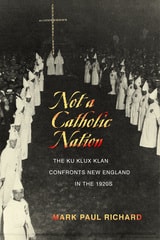
Not a Catholic Nation
The Ku Klux Klan Confronts New England in the 1920sMark Paul Richard
University of Massachusetts Press, 2015
Drawing on a wide range of previously untapped sources—French-language newspapers in the New England–Canadian borderlands; KKK documents scattered in local, university, and Catholic repositories; and previously undiscovered copies of the Maine Klansmen—Richard demonstrates that the Klan was far more active in the Northeast than previously thought. He also challenges the increasingly prevalent view that the Ku Klux Klan became a mass movement during this period largely because it functioned as a social, fraternal, or civic organization for many Protestants. While Richard concedes that some Protestants in New England may have joined the KKK for those reasons, he shows that the politics of ethnicity and labor played a more significant role in the Klan's growth in the region.
The most comprehensive analysis of the Ku Klux Klan's antagonism toward Catholics in the 1920s, this book is also distinctive in its consideration of the history of the Canada–U.S. borderlands, particularly the role of Canadian immigrants as both proponents and victims of the Klan movement in the United States.
Notations Of The Wild
Ecology Poetry Wallace StevensGyorgyi Voros
University of Iowa Press, 1997
Gyorgyi Voros focuses on three governing metaphors in Stevens' poems—Nature as house, Nature as body, and Nature as self. She argues that Stevens' youthful wilderness experience yielded his primary subject—the relationship between human beings and nonhuman nature—and that it spurred his shift from a romantic to a phenomenological understanding of nature. Most important, it prompted him to reject his culture's narrow humanism in favor of a singular vision that in today's terms would he deemed ecological.
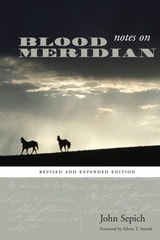
Notes on Blood Meridian
Revised and Expanded EditionBy John Sepich
University of Texas Press, 2008
Notes on Nowhere
Feminism, Utopian Logic, and Social TransformationJennifer Burwell
University of Minnesota Press, 1997
Notes on Nowhere was first published in 1997. Minnesota Archive Editions uses digital technology to make long-unavailable books once again accessible, and are published unaltered from the original University of Minnesota Press editions.
The term utopia implies both "good place" and "nowhere." Since Sir Thomas More wrote Utopia in 1516, debates about utopian models of society have sought to understand the implications of these somewhat contradictory definitions. In Notes on Nowhere, author Jennifer Burwell uses a cross section of contemporary feminist science fiction to examine the political and literary meaning of utopian writing and utopian thought.
Burwell provides close readings of the science fiction novels of five feminist writers-Marge Piercy, Sally Gearhart, Joanna Russ, Octavia Butler, and Monique Wittig-and poses questions central to utopian writing: Do these texts promote a tradition in which narratives of the ideal society have been used to hide rather than reveal violence, oppression, and social divisions? Can a feminist critical utopia offer a departure from this tradition by using utopian narratives to expose contradiction and struggle as central aspects of the utopian impulse? What implications do these questions have for those who wish to retain the utopian impulse for emancipatory political uses?
As one way of answering these questions, Burwell compares two "figures" that inform utopian writing and social theory. The first is the traditional abstract "revolutionary" subject who contradicts existing conditions and who points us to the ideal body politic. The second, "resistant," subject is partial, concrete, and produced by conditions rather than operating outside of them. In analyzing contemporary changes in the subject's relationship to social space, Burwell draws from and revises "standpoint approaches" that tie visions of social transformation to a group's position within existing conditions.
By exploring the dilemmas, antagonisms, and resolutions within the critical literary feminist utopia, Burwell creates connections to a similar set of problems and resolutions characterizing "nonliterary" discourses of social transformation such as feminism, gay and lesbian studies, and Marxism. Notes on Nowhere makes an original, significant, and persuasive contribution to our understanding of the political and literary dimensions of the utopian impulse in literature and social theory.
Jennifer Burwell teaches in the Department of English at Wesleyan University in Connecticut.
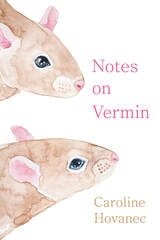
Notes on Vermin
Caroline Hovanec
University of Michigan Press, 2025
Notes on Vermin is an atlas of the literary vermin that appear in modern and contemporary literature, from Franz Kafka’s gigantic insect to Richard Wright’s city rats to Namwali Serpell’s storytelling mosquitoes. As parasites, trespassers, and collectives, vermin animals prove useful to writers who seek to represent life in the margins of power. Drawing on psychoanalysis, cultural studies, eco-Marxism, and biopolitics, this book explores four uses for literary vermin: as figures for the repressed thought, the uncommitted fugitive, the freeloading parasite, and the surplus life. In a series of short, accessible, interlinked essays, Notes on Vermin explores what animal pests can show us about our cultures, our environments, and ourselves.
Nothing Abstract
Investigations in the American Literary ImaginationTom Quirk
University of Missouri Press, 2001
Written by one of the leading scholars in the field, Nothing Abstract is a collection of essays gathered over the past twenty years--all of which, in some fashion, have to do with a genetic approach to literary study. In previous books, the author has traced the compositional histories of certain literary works, the course of individual careers, and the genesis of literary movements. In this book, Tom Quirk resists the direction taken by contemporary theory in favor of an approach to literature through source and influence study, the evolution of a writer's achievement, the establishment of biographical or other contexts, and the transition from one literary era to another.
All of the essays that Quirk has chosen for this collection illustrate a scholarly method. The first two essays, somewhat general in their concerns, constitute a defense for the genetic method, and subsequent essays serve as evidence for the usefulness of genetic inquiry. The entire volume challenges poststructuralist theory not through active confrontation, but merely by being what it is and doing what it does. More important though is that all of the chosen essays are intrinsically interesting. They tell fascinating stories—stories about literary genesis, biographical circumstances, and artistic ambitions and achievement.
Authors discussed at length are Edgar Allan Poe, Tony Hillerman, Nathaniel Hawthorne, Herman Melville, Mark Twain, Ambrose Bierce, Wallace Stevens, Willa Cather, F. Scott Fitzgerald, and Joyce Carol Oates. Quirk also touches on Flannery O'Connor, Richard Wright, Robert Frost, Jack London, Stephen Crane, William Faulkner, and others. Nothing Abstract makes a great contribution to the study of important American writers and will be welcomed by all students and scholars of American studies and American literature.
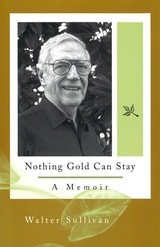
Nothing Gold Can Stay
A MemoirWalter Sullivan
University of Missouri Press, 2006
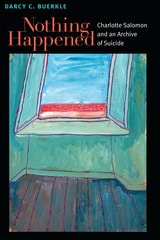
Nothing Happened
Charlotte Salomon and an Archive of SuicideDarcy C. Buerkle
University of Michigan Press, 2013
Charlotte Salomon's (1917-43) fantastical autobiography, Life? or Theater?, consists of 769 sequenced gouache paintings, through which the artist imagined the circumstances of the eight suicides in her family, all but one of them women. But Salomon's focus on suicide was not merely a familial idiosyncrasy. Nothing Happened argues that the social history of early-twentieth-century Germany has elided an important cultural and social phenomenon by not including the story of German Jewish women and suicide. This absence in social history mirrors an even larger gap in the intellectual history of deeply gendered suicide studies that have reproduced the notion of women's suicide as a rarity in history. Nothing Happened is a historiographic intervention that operates in conversation and in tension with contemporary theory about trauma and the reconstruction of emotion in history.
Nothing
Three Inquiries in BuddhismMarcus Boon, Eric Cazdyn, and Timothy Morton
University of Chicago Press, 2015
Nothingism
Poetry at the End of Print CultureJason Schneiderman
University of Michigan Press, 2025
In this collection, the essays range from blistering manifesto to deep historical dives to gentle classroom guidance to considerations of the poems of James Merrill and Agha Shahid Ali, moving between the theoretical and the practical. Nothingism is both deeply personal and highly erudite, providing an engaging and scholarly account of reading, writing, and teaching poetry as our world continues its unsupervised lurch toward digital culture.
Notorious Facts
Publicity in Romantic England, 1780–1830James Mulvihill
University of Delaware Press, 2012
Notorious Facts examines the sensationalistic confounding of persons and principles in the public life of Romantic England (1780–1830). Its purview is limited to five decades straddling the late eighteenth and early nineteenth centuries, but its trajectory, moving from a politics rendered in personal terms to a politics of personality, describes a shift still in process today. The study’s chapters draw on a motley body of literature (pamphlets, secret histories, and the like) that at first glance seems uncharacteristic of what literary historians call the English Romantic period. Viewed in the context of something called late Georgian England, these texts seem more indigenous, but if the canonical revisionism of the last few decades should teach us anything, it is that a Romanticism encompassing all romanticisms ideally excludes nothing.
In its heroic Enlightenment sense, publicity is concerned with exposing the workings of power for all to see. A good deal may be inferred about publicity in Romantic England from primary texts in which this salutary function is at once espoused and subverted. These texts—the mostly nameless or pseudonymous authors of the age’s pamphlet literature are the heroes and villains of the piece—almost invariably claim to speak from a disinterested conception of publicity while putting its methods of critical exposure to wholly self-interested purposes. This study examines well-known authors of the period like Jeremy Bentham, Samuel Taylor Coleridge, and William Hazlitt, as well as pamphleteers like John Horne Tooke, Philip Withers, and Nathaniel Jefferys. Other figures include authors of secret history like Thomas Ashe, Mary Anne Clarke, Lewis Goldsmith, and Joseph Haslewood in addition to notorious figures in their own right such as the Prince and Princess of Wales, Mrs. Fitzherbert, and the Reverend Edward Irving. Among the topics treated are treasonous libel, royal scandal, secret history, and celebrity.
Published by University of Delaware Press. Distributed worldwide by Rutgers University Press.

Novalis, Spinoza, and the Limits of Romantic Materialism
Siarhei Biareishyk
Northwestern University Press, 2026
Offering an innovative and illuminating new reading of Spinoza and Novalis
This rigorously researched study reframes our understanding of the intellectual currents in Germany around 1800 through a careful reinterpretation of its key thinker, Novalis, in conversation with Spinoza’s philosophy. Siarhei Biareishyk presents an alternative to the standard narrative that resolutely links emergent modernity and secularization to philosophical “idealism” by showing how Spinozan materialism informs the scientific experiments, metaphysical inquiries, and political debates of Novalis and his contemporaries. Shifting our focus away from the historical interpretation of Novalis as a mystic and theorist of subjectivity, Biareishyk elaborates on the Spinozan materialist strain in Novalis in three key domains: ontology and the conception of nature, theories of singularity and individuation, and the concept of the political. He brings current romanticist scholarship into conversation with contemporary discussions of Spinoza in continental philosophy, in the Marxist tradition particularly, demonstrating that the Spinoza–Novalis encounter provides a viable alternative—in its articulation of causality, dialectics, and the political—to the dominant conceptual apparatuses of both Kant and Hegel.
Novas
Selected WritingsHaroldo de Campos
Northwestern University Press, 2007
A generous introduction to one of the key literary figures to emerge from Brazil in the second half of the twentieth century, this book offers English-speaking readers an ample selection of this prodigious writer's celebrated poetry and widely influential critical work. As a poet and as a cofounder of the renowned group Noigandres, Haroldo de Campos has made a unique and substantial contribution to the theory and practice of experimental writing, particularly the form known as concrete poetry, and to the Latin American avant-garde as a whole. These contributions, acclaimed worldwide by figures such as Umberto Eco, Jacques Derrida, Octavio Paz, and Guillermo Cabrera Infante, can be observed unfolding here, first in poetry selections ranging from de Campos' early work before concretism through his most recent production; then in theoretical texts that trace his evolution as a critic from an early interest in baroque and modernist writers to his development of an innovative model for reading, translating, and writing. This second, critical section of the book includes de Campos' encounters with the tasks of translating and reading some of the most important texts of Eastern and Western culture-from Ecclesiastes to the No play Hagoromo, from Dante to Paz-thus charting a genealogy of modern literature.
Together, these poems and critical writings afford English-speaking readers their first sustained exposure to a unique personality within the international avant-garde, a writer described by Brazilian poet João Cabral de Melo Neto as "that wonderful thing: / a poet and a translator who came to literature armed with an enviable / knowledge of the literary phenomenon."
Novel Bodies
Disability and Sexuality in Eighteenth-Century British LiteratureJason S. Farr
Bucknell University Press, 2019
Published by Bucknell University Press. Distributed worldwide by Rutgers University Press.
Novel Bondage
Slavery, Marriage, and Freedom in Nineteenth-Century AmericaTess Chakkalakal
University of Illinois Press, 2013
Novel Competition
American Fiction and the Cultural Economy, 1965-1999Evan Brier
University of Iowa Press, 2024
Novel Ecologies
Nature Remade and the Illusions of TechAllison Carruth
University of Chicago Press, 2025
Allison Carruth’s Novel Ecologies shows how the tech industry has taken up the wilderness mythologies that shaped one strain of American environmentalism over the last century. Calling this twenty-first-century environmental imagination Nature Remade, Carruth describes a distinctly West Coast framework that is at once nostalgic and futuristic. Through three case studies (synthetic wildlife, the digital cloud, and space colonization), the book shows Nature Remade to be a quasi-religious belief in venture capitalism and big tech. This paradigm thus imagines a future in which species, ecosystems, and entire planets are re-generated and re-created through engineering.
Novel Ecologies challenges the conviction that climate change and other environmental crises must be met with ever larger-scale forms of technological intervention. Against the new worlds conjured by Google, Meta, Open AI, Amazon, SpaceX, and a host of lesser-known start-ups, Carruth marshals writers and artists who imagine provisionally hopeful environmental futures while refusing to forget the histories that have made the world what it is. On this track of the book, Carruth discusses the works of Octavia Butler, Becky Chambers, Jennifer Egan, Ruth Ozeki, Craig Santos Perez, Tracy K. Smith, Jeff VanderMeer, Saya Woolfalk, and many more. Their novels, poems, installation artworks, and expressive media offer a speculative world built on livable communities rather than engineered lifeforms.
Novel Gazing
Queer Readings in FictionEve Kosofsky Sedgwick, ed.
Duke University Press, 1997
Through discussions of a diverse array of British, French, and American novels—including major canonical novels, best-sellers, children’s fiction, and science fiction—these essays explore queer worlds of taste, texture, joy, and ennui, focusing on such subjects as flogging, wizardry, exorcism, dance, Zionist desire, and Internet sexuality. Interpreting the works of authors as diverse as Benjamin Constant, Toni Morrison, T. H. White, and William Gibson, along with canonical queer modernists such as James, Proust, Woolf, and Cather, contributors reveal the wealth of ways in which selves and communities succeed in extracting sustenance from the objects of a culture whose avowed desire has often been not to sustain them. The dramatic reframing that these essays perform will make the significance of Novel Gazing extend beyond the scope of queer studies to literary criticism in general.
Contributors. Stephen Barber, Renu Bora, Anne Chandler, James Creech, Tyler Curtain, Jonathan Goldberg, Joseph Litvak, Michael Lucey, Jeff Nunokawa, Cindy Patton, Jacob Press, Robert F. Reid-Pharr, Eve Kosofsky Sedgwick, Melissa Solomon, Kathryn Bond Stockton, John Vincent, Maurice Wallace, Barry Weller
Novel Houses
Twenty Famous Fictional DwellingsChristina Hardyment
Bodleian Library Publishing, 2019
Novel Nostalgias
The Aesthetics of Antagonism in Nineteenth Century U.S. LiteratureJohn Funchion
The Ohio State University Press, 2015
In contrast with studies that characterized the nineteenth-century U.S. novel as a consensus-generating form complicit with disciplinary culture, Funchion shows how novels shaped a series of culture wars by advancing antagonistic nostalgias. Southern slave owners and their slaves or industrial magnates and their union opponents alike enlisted the power of nostalgia to validate their rival visions of the nation as lost moments awaiting recovery. Antagonistic nostalgias legitimated the political claims of movements as diverse as abolitionism, sectionalism, populism, socialism, anarchism, and cosmopolitanism. Novel Nostalgias provides a deep cultural historical understanding of the nineteenth-century United States, but ultimately, it also allows for a better understanding of how twenty-first-century movements function.
Novel Science
Fiction and the Invention of Nineteenth-Century GeologyAdelene Buckland
University of Chicago Press, 2013
Novel Subjects
Authorship as Radical Self-Care in Multiethnic American NarrativesLeah A. Milne
University of Iowa Press, 2021
In Novel Subjects, Leah Milne offers a new way to look at multicultural literature by focusing on scenes of writing in contemporary works by authors with marginalized identities. These scenes, she argues, establish authorship as a form of radical self-care—a term we owe to Audre Lorde, who defines self-care as self-preservation and “an act of political warfare.”
In engaging in this battle, the works discussed in this study confront limitations on ethnicity and nationality wrought by the institutionalization of multiculturalism. They also focus on identities whose mere presence on the cultural landscape is often perceived as vindictive or willful. Analyzing recent texts by Carmen Maria Machado, Louise Erdrich, Ruth Ozeki, Toni Morrison, and more, Milne connects works across cultures and nationalities in search of reasons for this recent trend of depicting writers as characters in multicultural texts. Her exploration uncovers fiction that embrace unacceptable or marginalized modes of storytelling—such as plagiarism, historical revisions, jokes, and lies—as well as inauthentic, invisible, and unexceptional subjects. These works ultimately reveal a shared goal of expanding the borders of belonging in ethnic and cultural groups, and thus add to the ever-evolving conversations surrounding both multicultural literature and self-care.
Novel Violence
A Narratography of Victorian FictionGarrett Stewart
University of Chicago Press, 2009
Victorian novels, Garrett Stewart argues, hurtle forward in prose as violent as the brutal human existence they chronicle. In Novel Violence, he explains how such language assaults the norms of written expression and how, in doing so, it counteracts the narratives it simultaneously propels.
Immersing himself in the troubling plots of Charles Dickens, Anne Brontë, George Eliot, and Thomas Hardy, Stewart uses his brilliant new method of narratography to trace the microplots of language as they unfold syllable by syllable. By pinpointing where these linguistic narratives collide with the stories that give them context, he makes a powerful case for the centrality of verbal conflict to the experience of reading Victorian novels. He also maps his finely wrought argument on the spectrum of influential theories of the novel—including those of Georg Lukács and Ian Watt—and tests it against Edgar Allan Poe’s antinovelistic techniques. In the process, Stewart shifts critical focus toward the grain of narrative and away from more abstract analyses of structure or cultural context, revealing how novels achieve their semantic and psychic effects and unearthing, in prose, something akin to poetry.
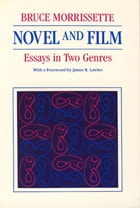
Novel and Film
Essays in Two GenresBruce Morrissette
University of Chicago Press, 1985
The influential essays collected in Novel and Film display a wide range of critical and analytic approaches to the narrative aspects of the two genres. For all the variety of their subjects, from constructional forms such as interior duplication and game play to intertextual parallels with mathematics and topology, these essays together define a unified critical perspective, one that has brought fresh precision to the analysis of narrative techniques and that continues to raise questions of prime importance to contemporary fiction. Included is a complete bibliography of Morrissette's scholarly works.
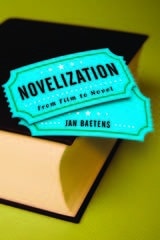
Novelization
From Film to NovelJan Baetens
The Ohio State University Press, 2018
Novelization offers a historical overview of the genre, focusing on the various formats that have been adopted since the first decades of the twentieth century until today: daily and weekly novelizations, cheap brochures, pocket books, and trade editions. It studies the specific features of the genre from various points of view: narrative style, illustrations, authorship, and marketing. By studying novelization from a broad historical perspective, Baetens reframes our understanding of adaptation and the relationship between cinema and literature. Rather than assume that cinematic adaptations either cannibalize or rejuvenate literature, Novelization ultimately offers the opportunity to rethink the adaptation paradigm of film and literary studies.

Novels and Arguments
Inventing Rhetorical CriticismZahava K. McKeon
University of Chicago Press, 1982
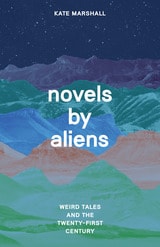
Novels by Aliens
Weird Tales and the Twenty-First CenturyKate Marshall
University of Chicago Press, 2023
Twenty-first-century fiction and theory have taken a decidedly weird turn. They both show a marked interest in the nonhuman and in the preternatural moods that the nonhuman often evokes. Writers of fiction and criticism are avidly experimenting with strange, even alien perspectives and protagonists. Kate Marshall’s Novels by Aliens explores this development broadly while focusing on problems of genre fiction. She identifies three key generic hybrids that harness a longing for the nonhuman: the old weird, an alternative tradition within naturalism and modernism for the twenty-first century’s cowboys and aliens; cosmic realism, the reach for words legible only from space in otherwise terrestrial narratives; and pseudoscience fiction, which imagines speculative futures beyond human life on earth. Offering sharp and surprising insights about a breathtaking range of authors, from Edgar Rice Burroughs to Kazuo Ishiguro, Willa Cather to Maggie Nelson, Novels by Aliens tells the story of how genre became mood in the twenty-first century.
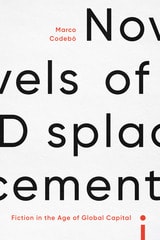
Novels of Displacement
Fiction in the Age of Global CapitalMarco Codebò
The Ohio State University Press, 2020
Using four works as case studies—Bernardo Carvalho’s Nove noites, Daniel Sada’s Porque parece mentira la verdad nunca se sabe, Zadie Smith’s White Teeth, and Mathias Énard’s Zone—Codebò investigates how globalization, displacement, and technology inform our understanding of subjectivity and one’s place in the world. Coming from different literary traditions––Brazilian-Portuguese, Spanish, English, and French–– Novels of Displacement traces the development of displacement caused by organized crime, migration, and war. Ultimately what emerges from this study is evidence of how cultures of untruth damage but do not destroy human agency.
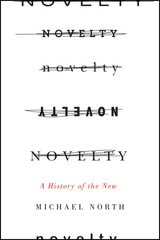
Novelty
A History of the NewMichael North
University of Chicago Press, 2013
In Novelty, Michael North takes us on a dazzling tour of more than two millennia of thinking about the problem of the new, from the puzzles of the pre-Socratics all the way up to the art world of the 1960s and ’70s. The terms of the debate, North shows, were established before Plato, and have changed very little since: novelty, philosophers argued, could only arise from either recurrence or recombination. The former, found in nature’s cycles of renewal, and the latter, seen most clearly in the workings of language, between them have accounted for nearly all the ways in which novelty has been conceived in Western history, taking in reformation, renaissance, invention, revolution, and even evolution. As he pursues this idea through centuries and across disciplines, North exhibits astonishing range, drawing on figures as diverse as Charles Darwin and Robert Smithson, Thomas Kuhn and Ezra Pound, Norbert Wiener and Andy Warhol, all of whom offer different ways of grappling with the idea of originality.
Novelty, North demonstrates, remains a central problem of contemporary science and literature—an ever-receding target that, in its complexity and evasiveness, continues to inspire and propel the modern. A heady, ambitious intellectual feast, Novelty is rich with insight, a masterpiece of perceptive synthesis.
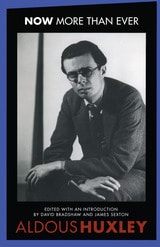
Now More Than Ever
By Aldous Huxley
University of Texas Press, 2000
Over the course of his career, British writer Aldous Huxley (1894-1963) shifted away from elitist social satires and an atheistic outlook toward greater concern for the masses and the use of religious terms and imagery. This change in Huxley's thinking underlies the previously unpublished play Now More Than Ever.
Written in 1932-1933 just after Brave New World, Now More Than Ever is a response to the social, economic, and political upheavals of its time. Huxley's protagonist is an idealistic financier whose grandiose schemes for controlling the means of production drive him to swindling and finally to suicide. His fate allows Huxley to expose the evils he perceives in free-market capitalism while pleading the case for national economic planning and the rationalization of Britain's industrial base.
This volume contains the full text of Now More Than Ever, which was believed to be lost until 1976, when a copy was found at the Harry Ransom Humanities Research Center of the University of Texas at Austin. A "thinker's play" that has never been produced on stage, it is the last previously unpublished piece of Huxley's major writings and immensely important to understanding his development as a writer. The editors of this volume have annotated the play for contemporary readers. Their introduction sets the play in the context of Huxley's intellectual life.

Now through a Glass Darkly
Specular Images of Being and Knowing from Virgil to ChaucerEdward Peter Nolan
University of Michigan Press, 1991
Now through a Glass Darkly brings both traditional medievalist and postmodernist approaches to bear in its attempt to understand both the powers and the limits of verbal art. Nolan explores the ways medieval writers and their Roman predecessors used formal and thematic mirrors to examine the implications of alterity in the face of similarity, arguing that these preoccupations were as central to the medieval sensibility as they are to our own. Now through a Glass Darkly frames several of the key issues in the current debate over the continued viability (or not) of the inherited canon of Western culture, such as the question whether there is any meaning at all to be rescued from such notions as “coherence” or “tradition” in Western literature.
Now through a Glass Darkly will appeal to the educated generalist interested in the relationships between literature and its surrounding intellectual and cultural contexts as well as to those more specifically interested in medieval poetry and poetics. For medievalists and those who work at the intersection of critical theory and medieval literature, Now through a Glass Darkly will be of critical importance.