Results by title
22279 books match the query 'Social Science' and 455 start with o
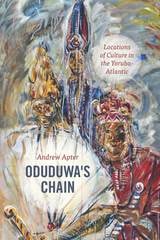
Oduduwa's Chain
Locations of Culture in the Yoruba-AtlanticAndrew Apter
University of Chicago Press, 2017
Focusing on Yoruba history and culture in Nigeria, Apter applies a generative model of cultural revision that allows him to identify formative Yoruba influences without resorting to the idea that culture and tradition are fixed. For example, Apter shows how the association of African gods with Catholic saints can be seen as a strategy of empowerment, explores historical locations of Yoruba gender ideologies and their variations in the Atlantic world, and much more. He concludes with a rousing call for a return to Africa in studies of the Black Atlantic, resurrecting a critical notion of culture that allows us to transcend Western inventions of African while taking them into account.
Oedipus
A Folklore CasebookEdited by Lowell Edmunds and Alan Dundes
University of Wisconsin Press, 1995
Classicist Lowell Edmunds and folklorist Alan Dundes both note that “the Oedipus tale is not likely to ever fade from view in Western civilization, [as] the tale continues to pack a critical family drama into a timeless form.” Looking beyond the story related in Sophocles’ drama—the ancient Theban myth of the son who unknowingly kills his father and marries his mother—Oedipus: A Folklore Casebook examines variations of the tale from Africa and South America to Eastern Europe and the Pacific. Taking sociological, psychological, anthropological, and structuralist perspectives, the nineteen essays reveal the complexities and multiple meanings of this centuries-old tale.
In addition to the well-known interpretations of the Oedipus myth by Sigmund Freud and James Frazer, this casebook includes insightful selections by an international group of scholars. Essays on a Serbian Oedipus legend by Friedrich Krauss and on a Gypsy version by Mirella Karpati, for example, stress the psychological stages of atonement after the Oedipus figure learns the truth about his actions. Anthropologist Melford E. Spiro investigates the myth’s appearance in Burma and the significance of the mother’s identification with the dragon (the sphinx figure). Vladimir Propp’s essay, translated into English for the first time, and Lowell Edmunds’s theoretical review discuss the relation of the Oedipus story to the larger study of folklore. The result is a comprehensive and fascinating casebook for students of folklore, classical mythology, anthropology, and sociology.
Oedipus; or, The Legend of a Conqueror
Marie Delcourt
Michigan State University Press, 2020
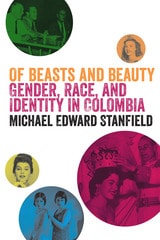
Of Beasts and Beauty
Gender, Race, and Identity in ColombiaBy Michael Edward Stanfield
University of Texas Press, 2013
All societies around the world and through time value beauty highly. Tracing the evolutions of the Colombian standards of beauty since 1845, Michael Edward Stanfield explores their significance to and symbiotic relationship with violence and inequality in the country. Arguing that beauty holds not only social power but also economic and political power, he positions it as a pacific and inclusive influence in a country “ripped apart by violence, private armies, seizures of land, and abuse of governmental authority, one hoping that female beauty could save it from the ravages of the male beast.” One specific means of obscuring those harsh realities is the beauty pageant, of which Colombia has over 300 per year. Stanfield investigates the ways in which these pageants reveal the effects of European modernity and notions of ethnicity on Colombian women, and how beauty for Colombians has become an external representation of order and morality that can counter the pathological effects of violence, inequality, and exclusion in their country.
Of Beggars and Buddhas
The Politics of Humor in the Vessantara Jataka in ThailandKatherine A. Bowie
University of Wisconsin Press, 2020
The Vessantara Jataka has served both monastic and royal interests, encouraging parents to give their sons to religious orders and intimating that kings are future Buddhas. But, as Bowie shows, characterizations of the beggar Jujaka in various regions and eras have also brought ribald humor and sly antiroyalist themes to the story. Historically, these subversive performances appealed to popular audiences even as they worried the conservative Bangkok court. The monarchy sporadically sought to suppress the comedic recitations. As Thailand has changed from a feudal to a capitalist society, this famous story about giving away possessions is paradoxically being employed to promote tourism and wealth.
Of Body and Brush
Grand Sacrifice as Text/Performance in Eighteenth-Century ChinaAngela Zito
University of Chicago Press, 1997
Forging a critical cultural historical method that challenges traditional categories of Chinese studies, Zito shows for the first time that in their performance, the ritual texts embodied, literally, the metaphysics upon which imperial power rested. By combining rule through the brush (the production of ritual texts) with rule through the body (mandated performance), the throne both exhibited its power and attempted to control resistance to it. Bridging Chinese history, anthropology, religion, and performance and cultural studies, Zito brings an important new perspective to the human sciences in general.
Of Cartography
PoemsEsther G. Belin
University of Arizona Press, 2017
In this long-anticipated collection, Belin daringly maps the poetics of womanhood, the body, institution, family, and love. Depicting the personal and the political, Of Cartography is an exploration of identity through language. With poems ranging from prose to typographic and linguistic illustrations, this distinctive collection pushes the boundaries of traditional poetic form.
Marking territory and position according to the Diné cardinal points, Of Cartography demands much from the reader, gives meaning to abstraction, and demonstrates the challenges of identity politics.
Of Caves and Shell Mounds
Edited by Kenneth C. Carstens and Patty Jo Watson
University of Alabama Press, 1996
Ancient human groups in the Eastern Woodlands of North America were long viewed as homogeneous and stable hunter-gatherers, changing little until the late prehistoric period when Mesoamerican influences were thought to have stimulated important economic and social developments. The authors in this volume offer new, contrary evidence to dispute this earlier assumption, and their studies demonstrate the vigor and complexity of prehistoric peoples in the North American Midwest and Midsouth. These peoples gathered at favored places along midcontinental streams to harvest mussels and other wild foods and to inter their dead in the shell mounds that had resulted from their riverside activities. They created a highly successful, pre-maize agricultural system beginning more than 4,000 years ago, established far-flung trade networks, and explored and mined the world's longest cave—the Mammoth Cave System in Kentucky.
Contributors include:
Kenneth C. Carstens, Cheryl Ann Munson, Guy Prentice, Kenneth B. Tankersley, Philip J. DiBlasi, Mary C. Kennedy, Jan Marie Hemberger, Gail E. Wagner, Christine K. Hensley, Valerie A. Haskins, Nicholas P. Herrmann, Mary Lucas Powell, Cheryl Claassen, David H. Dye, and Patty Jo Watson

Of Corpse
Death and Humor in Folklore and Popular CulturePeter Narvaez
Utah State University Press, 2003
Laughter, contemporary theory suggests, is often aggressive in some manner and may be prompted by a sudden perception of incongruity combined with memories of past emotional experience. Given this importance of the past to our recognition of the comic, it follows that some "traditions" dispose us to ludic responses. The studies in Of Corpse: Death and Humor in Folklore and Popular Culture examine specific interactions of text (jokes, poetry, epitaphs, iconography, film drama) and social context (wakes, festivals, disasters) that shape and generate laughter. Uniquely, however, the essays here peruse a remarkable paradox---the convergence of death and humor.
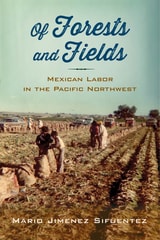
Of Forests and Fields
Mexican Labor in the Pacific NorthwestMario Jimenez Sifuentez
Rutgers University Press, 2016
Just looking at the Pacific Northwest’s many verdant forests and fields, it may be hard to imagine the intense work it took to transform the region into the agricultural powerhouse it is today. Much of this labor was provided by Mexican guest workers, Tejano migrants, and undocumented immigrants, who converged on the region beginning in the mid-1940s. Of Forests and Fields tells the story of these workers, who toiled in the fields, canneries, packing sheds, and forests, turning the Pacific Northwest into one of the most productive agricultural regions in the country.
Of Giants
Sex, Monsters, And The Middle AgesJeffrey Jerome Cohen
University of Minnesota Press, 1999
Considers what monsters tell us about identity in the medieval period.
A monster lurks at the heart of medieval identity, and this book seeks him out. Reading a set of medieval texts in which giants and dismemberment figure prominently, Jeffrey Jerome Cohen brings a critical psychoanalytic perspective to bear on the question of identity formation-particularly masculine identity-in narrative representation. The giant emerges here as an intimate stranger, a monster who stands at the limits of selfhood.
Arguing that in the romance tradition of late fourteenth-century England, identity is inscribed on sexed bodies only through the agency of a monster, Cohen looks at the giant as the masculine body writ large. In the giant he sees an uncanny figure, absolutely other and curiously familiar, that serves to define the boundaries of masculine embodiment. Philosophically compelling, the book is also a philologically rigorous inquiry into the phenomenon of giants and giant-slaying in various texts from the Anglo-Saxon period to late Middle English, including Beowulf, Chrétien de Troyes’s The Knight and the Lion, Geoffrey of Monmouth’s History of the Kings of Britain, several works by Chaucer, Sir Gowther, Sir Gawain and the Green Knight, and more.A significant contribution to our understanding of medieval culture, Of Giants also provides surprising insights into questions about the psychosocial work of representation in its key location for the individual: the construction of gender and the social formation of the boundaries of gender identification. It will engage students of the Middle Ages as well as those interested in discourses of the body, social identity, and the grotesque. ISBN 0-8166-3216-2 Cloth £00.00 $47.95xxISBN 0-8166-3217-0 Paper £00.00 $18.95x240 Pages 5 black-and-white photos 5 7/8 x 9 MayMedieval Cultures Series, volume 17Translation inquiries: University of Minnesota Press
Of Humans, Pigs, and Souls
An Essay on the Yagwoia "Womba" ComplexJadran Mimica
HAU, 2020
Of Marshes and Maize
Preceramic Agricultural Settlement in the Cienega Valley, Southeastern ArizonaBruce B. Huckell
University of Arizona Press, 1995
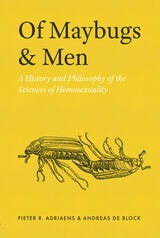
Of Maybugs and Men
A History and Philosophy of the Sciences of HomosexualityPieter R. Adriaens and Andreas De Block
University of Chicago Press, 2022
Questions about the naturalness or unnaturalness of homosexuality are as old as the hills, and the answers have often been used to condemn homosexuals, their behaviors, and their relationships. In the past two centuries, a number of sciences have involved themselves in this debate, introducing new vocabularies, theories, arguments, and data, many of which have gradually helped tip the balance toward tolerance and even acceptance. In this book, philosophers Pieter R. Adriaens and Andreas De Block explore the history and philosophy of the gay sciences, revealing how individual and societal values have colored how we think about homosexuality.
The authors unpack the entanglement of facts and values in studies of male homosexuality across the natural and human sciences and consider the extent to which science has mitigated or reinforced homonegative mores. The focus of the book is on homosexuality’s assumed naturalness. Geneticists rephrased naturalness as innateness, claiming that homosexuality is innate—colloquially, that homosexuals are born gay. Zoologists thought it a natural affair, documenting its existence in myriad animal species, from maybugs to men. Evolutionists presented homosexuality as the product of natural selection and speculated about its adaptive value. Finally, psychiatrists, who initially pathologized homosexuality, eventually appealed to its naturalness or innateness to normalize it.
Discussing findings from an array of sciences—comparative zoology, psychiatry, anthropology, evolutionary biology, social psychology, developmental biology, and machine learning—this book is essential reading for anyone interested in what science has to say about homosexuality.
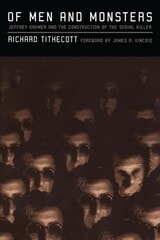
Of Men and Monsters
Jeffrey Dahmer and the Construction of the Serial KillerRichard Tithecott
University of Wisconsin Press, 1998
Of Men and Monsters examines the serial killer as an American cultural icon, one that both attracts and repels. Richard Tithecott suggests that the stories we tell and the images we conjure of serial killers—real and fictional—reveal as much about mainstream culture and its values, desires, and anxieties as they do about the killers themselves.
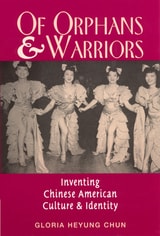
Of Orphans and Warriors
Inventing Chinese American Culture and IdentityChun, Gloria Heyung
Rutgers University Press, 1999
"We were as American as can be," states Jadin Wong in recalling the days when she used to dance at a San Francisco nightclub during the 1940s. Wong belonged to an all-Chinese chorus line at a time when all East Asians were called "Orientals." In this context, then, what did it mean for Wong, an American-born Chinese, to say that she thought of herself as an "American"? Of Orphans and Warriors explores the social and cultural history of largely urban, American-born Chinese from the 1930s through the 1990s, focusing primarily on those living in California. Chun thus opens a window onto the ways in which these Americans born of Chinese ancestry negotiated their identity over a half century.
Past scholarship has portrayed these individuals as desiring to assimilate into mainstream American culture, but being prevented from doing so by the immigrant parent generation. Taking a new approach, Chun uses memoirs, autobiographies, and fictional writings to unravel complex issues of ethnic identity as both culturally defined and individually negotiated. She concludes that, while indeed many Chinese Americans were caught between the lures of mainstream American culture and their parents' old-world values, this liminal position offered them unprecedented opportunities to carve out new identities for themselves from a position of strength.

Of Others Inside
Insanity, Addiction And Belonging in AmericaDarin Weinberg, foreword by Bryan S. Turner
Temple University Press, 2005
Seeking to offer a new sociological understanding of the relationship between social exclusion and mental disability, Of Others Inside considers the general social conditions of homelessness, poverty, and social marginality in the U.S. Weinberg also explores questions about American perceptions of these conditions, and examines in great detail the social reality of mental disability and drug addiction without reducing people's suffering to simple notions of biological fate or social disorder.
Of Revelation and Revolution, Volume 1
Christianity, Colonialism, and Consciousness in South AfricaJean Comaroff and John L. Comaroff
University of Chicago Press, 1991
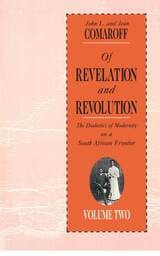
Of Revelation and Revolution, Volume 2
The Dialectics of Modernity on a South African FrontierJohn L. Comaroff and Jean Comaroff
University of Chicago Press, 1997
The Comaroffs trace many of the major themes of twentieth-century South African history back to these formative encounters. The relationship between the British evangelists and the Southern Tswana engendered complex exchanges of goods, signs, and cultural markers that shaped not only African existence but also bourgeois modernity "back home" in England. We see, in this volume, how the colonial attempt to "civilize" Africa set in motion a dialectical process that refashioned the everyday lives of all those drawn into its purview, creating hybrid cultural forms and potent global forces which persist in the postcolonial age.
This fascinating study shows how the initiatives of the colonial missions collided with local traditions, giving rise to new cultural practices, new patterns of production and consumption, new senses of style and beauty, and new forms of class distinction and ethnicity. As noted by reviewers of the first volume, the Comaroffs have succeeded in providing a model for the study of colonial encounters. By insisting on its dialectical nature, they demonstrate that colonialism can no longer be seen as a one-sided relationship between the conquering and the conquered. It is, rather, a complex system of reciprocal determinations, one whose legacy is very much with us today.
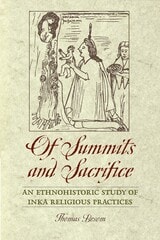
Of Summits and Sacrifice
An Ethnohistoric Study of Inka Religious PracticesBy Thomas Besom
University of Texas Press, 2009
In perhaps as few as one hundred years, the Inka Empire became the largest state ever formed by a native people anywhere in the Americas, dominating the western coast of South America by the early sixteenth century. Because the Inkas had no system of writing, it was left to Spanish and semi-indigenous authors to record the details of the religious rituals that the Inkas believed were vital for consolidating their conquests. Synthesizing these arresting accounts that span three centuries, Thomas Besom presents a wealth of descriptive data on the Inka practices of human sacrifice and mountain worship, supplemented by archaeological evidence.
Of Summits and Sacrifice offers insight into the symbolic connections between landscape and life that underlay Inka religious beliefs. In vivid prose, Besom links significant details, ranging from the reasons for cyclical sacrificial rites to the varieties of mountain deities, producing a uniquely powerful cultural history.

Of Two Minds
Hypertext Pedagogy and PoeticsMichael Joyce
University of Michigan Press, 1996
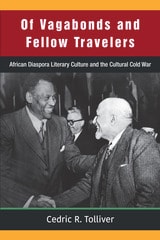
Of Vagabonds and Fellow Travelers
African Diaspora Literary Culture and the Cultural Cold WarCedric R. Tolliver
University of Michigan Press, 2019
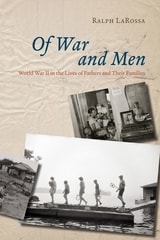
Of War and Men
World War II in the Lives of Fathers and Their FamiliesRalph LaRossa
University of Chicago Press, 2011
Fathers in the fifties tend to be portrayed as wise and genial pipe-smokers or distant, emotionless patriarchs. This common but limited stereotype obscures the remarkable diversity of their experiences and those of their children. To uncover the real story of fatherhood during this transformative era, Ralph LaRossa takes the long view—from the attack on Pearl Harbor up to the election of John F. Kennedy—revealing the myriad ways that World War II and its aftermath shaped men.
Offering compelling accounts of people both ordinary and extraordinary, Of War and Men digs deep into the terrain of fatherhood. LaRossa explores the nature and aftereffects of combat, the culture of fear during the Cold War, the ways that fear altered the lives of racial and sexual minorities, and how the civil rights movement affected families both black and white. Overturning some calcified myths, LaRossa also analyzes the impact of suburbanization on fathers and their kids, discovering that living in the suburbs often strengthened their bond. And finally, looking beyond the idealized dad enshrined in TV sitcoms, Of War and Men explores the brutal side of family life in the postwar years. LaRossa’s richly researched book dismantles stereotypes while offering up a fascinating and incisive chronicle of fatherhood in all its complexity.
Of Wonders and Wise Men
Religion and Popular Cultures in Southeast Mexico, 1800-1876By Terry Rugeley
University of Texas Press, 2001
2004 – Harvey L. Johnson Award – Southwest Council of Latin American Studies
In the tumultuous decades following Mexico's independence from Spain, religion provided a unifying force among the Mexican people, who otherwise varied greatly in ethnicity and socioeconomic status. Accordingly, religion and the popular cultures surrounding it form the lens through which Terry Rugeley focuses this cultural history of southeast Mexico from independence (1821) to the rise of the dictator Porfirio Díaz in 1876.
Drawing on a wealth of previously unused archival material, Rugeley vividly reconstructs the folklore, beliefs, attitudes, and cultural practices of the Maya and Hispanic peoples of the Yucatán. In engagingly written chapters, he explores folklore and folk wisdom, urban piety, iconography, and anticlericalism. Interspersed among the chapters are detailed portraits of individual people, places, and institutions, that, with the archival evidence, offer a full and fascinating history of the outlooks, entertainments, and daily lives of the inhabitants of southeast Mexico in the nineteenth century. Rugeley also links this rich local history with larger events to show how macro changes in Mexico affected ordinary people.
Off Limits
New Writings on Fear and SinNawal El Saadawi
Gingko, 2018
Off Limits presents a selection of El Saadawi’s most recent recollections and reflections in which she considers the role of women in Egyptian and wider Islamic society, the inextricability of imperialism from patriarchy, and the meeting points of East and West. These thoughtful and wide-reaching pieces leave no stone unturned and no view unchallenged, and the essays collected here offer further insight into this profound author’s ideas about women, society, religion, and national identity.
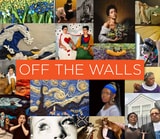
Off the Walls
Inspired Re-Creations of Iconic ArtworksSarah Waldorf
J. Paul Getty Trust, The, 2020
Van Gogh’s Starry Night made out of spaghetti? Cat with a Pearl Earring? Frida Kahlo self-portraits with pets and toilet paper? While the world reeled from the rapid spread of the novel coronavirus (COVID-19), thousands of people around the globe, inspired by challenges from Getty and other museums, raided toy chests, repurposed pantry items, and enlisted family, roommates, and animals to re-create famous works of art at home. Astonishing in their creativity, wit, and ingenuity, these creations remind us of the power of art to unite us and bring joy during troubled times. Off the Walls: Inspired Re-Creations of Iconic Artworks celebrates these imaginative re-creations, bringing highlights from this challenge together in one whimsical, irresistible volume. Getty Publications will donate all profits from the sale of this book to a charity supporting art and artists.
Offensive Films
Mikita Brottman
Vanderbilt University Press, 2005
While most critics have been quick to dismiss such films as mere shock-fests (if they even bother to talk about them at all), Brottman argues that these movies tell us quite a bit about who we are as a society, what makes us anxious, and what taboos we truly believe cannot be crossed. Part anthropology, part psychoanalysis, Offensive Films vivisects these movies in order to figure out just what about them is so offensive, obscene, or bizarre. In the end, Brottman proves that these films, shunned from the cinematic canon, work on us in sophisticated ways we often choose to remain unaware of.

Offers That Cannot Be Refused
An anthropology of extortionLucia Michelutti and EXTORT Research Group
University College London, 2026
A work of collaborative ethnography that investigates extortive practices across the globe.
What makes an offer impossible to refuse? Combining original ethnography with compelling storytelling, this book traces the social life of extortion across Bangladesh, Bolivia, Brazil, China, Ecuador, Guatemala, India, Italy, Nigeria, Pakistan, South Africa, Sri Lanka, and the United Kingdom. The research is grounded in collaborative and comparative ethnography conducted by a team of anthropologists, bringing together fieldwork from across the world to reveal how extortive logics shape different domains of life and following the circulation of threats and the distribution of intimidation across society.
The result is a gripping read about the ordinariness of extortion beyond conventional organized crime and mafia spheres. The chapters document how the strength of extortion lies in the gradual and complicit inclusion of individuals and populations within relationships that are simultaneously attractive and violent—capturing the overlapping dimensions of compulsion and choice that define so many of today's livelihoods. In doing so, this book illustrates the dynamics of coercion, force, and consent, and offers a fresh perspective on economic violence that moves away from exclusive legalistic definitions of extortion.
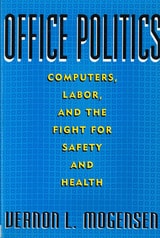
Office Politics
Computers, Labor, and the Fight for Safety and HealthMogensen, Vernon L
Rutgers University Press, 1996
The desktop computer has transformed office work. Business and social forecasters claimed that the use of video display terminals (VDTs) in the “Office of the Future” would free workers from routine tasks, giving them more time for creative work and chances for career advancement. Office Politics argues that, for many VDT workers––most of whom are nonunionized women in low-paying, dead-end jobs––exactly the opposite has been true. VDTs have been used to routinize office tasks; export work via satellite to low-wage, nonunion offshore offices; to de-skill workers and monitor their productivity. And the nature of the work has led to widespread health and safety problems, including vision, musculoskeletal (repetitive motion), and stress-related illnesses. Many have also charged that the electromagnetic fields (EMFs) emitted by computer terminals are responsible for miscarriages, for birth defects, and for promoting cancer.
As office workers sought to protect themselves against these new occupational health and safety problems, they found little help from organized labor, business, or the government. Office Politics is the first book to explain why. It shows how corporate interests successfully redefined the VDT health and safety crisis as a “comfort” problem, how the government refused to collect data on the true scope of VDT-related illnesses or to regulate Information Age industries, and how labor unions ignored women workers.
Office Politics is key reading for everyone who works at a computer. It will be of special interest to students, academics, and professionals in political science, sociology, occupational and environmental health, business, labor and management issues, women’s studies, computing, and public policy.
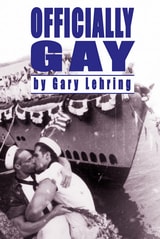
Officially Gay
The Political Construction Of SexualityGary L. Lehring
Temple University Press, 2003
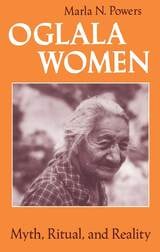
Oglala Women
Myth, Ritual, and RealityMarla N. Powers
University of Chicago Press, 1986
"It is a happy event when a fine scholarly work is rendered accessible to the general reader, especially so when none of the complexity of the subject matter is sacrificed. Oglala Women is a long overdue revisionary ethnography of Native American culture."—Penny Skillman, San Francisco Chronicle Review
"Marla N. Powers's fine study introduced me to Oglala women 'portrayed from the perspectives of Indians,' to women who did not pity themselves and want no pity from others. . . . A brave, thorough, and stimulating book."—Melody Graulich, Women's Review of Books
"Powers's new book is an intricate weaving . . . and her synthesis brings all of these pieces into a well-integrated and insightful whole, one which sheds new light on the importance of women and how they have adapted to the circumstances of the last century."—Elizabeth S. Grobsmith, Nebraska History
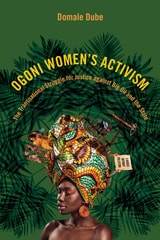
Ogoni Women's Activism
The Transnational Struggle for Justice against Big Oil and the StateDomale Dube
University of Illinois Press, 2025
Dube’s account examines and documents the issues that drew women into the movement, from concerns for themselves and their communities to grander visions for the Ogoni. As she shows, these issues not only influenced organizing in Nigeria but also the diaspora in general and the United States in particular. Ogoni women relied upon nonviolent protest to realize their aims. Dube looks at their campaigns and how their actions reflected their concerns, values, interests, and priorities. The result is a rare account of Black women and transnational organizing for women’s, climate, and environmental justice that merges a history of their involvement with an in-depth analysis of the racial, gender, and ethnic dimensions of the Ogoni Struggle.
Ohio Hopewell Ceramics
An Analysis of the Extant CollectionsOlaf H. Prufer
University of Michigan Press, 1968
Ohio under COVID
Lessons from America's Heartland in CrisisKatherine Sorrels, Vanessa Carbonell, Danielle Bessett, Lora Arduser, Edward Wallace, and Michelle L. McGowan, Editors
University of Michigan Press, 2023
In early March of 2020, Americans watched with uncertain terror as the novel coronavirus pandemic unfolded. One week later, Ohio announced its first confirmed cases. Just one year later, the state had over a million cases and 18,000 Ohioans had died. What happened in that first pandemic year is not only a story of a public health disaster, but also a story of social disparities and moral dilemmas, of lives and livelihoods turned upside down, and of institutions and safety nets stretched to their limits.
Ohio under COVID tells the human story of COVID in Ohio, America’s bellwether state. Scholars and practitioners examine the pandemic response from multiple angles, and contributors from numerous walks of life offer moving first-person reflections. Two themes emerge again and again: how the pandemic revealed a deep tension between individual autonomy and the collective good, and how it exacerbated social inequalities in a state divided along social, economic, and political lines. Chapters address topics such as mask mandates, ableism, prisons, food insecurity, access to reproductive health care, and the need for more Black doctors. The book concludes with an interview with Dr. Amy Acton, the state’s top public health official at the time COVID hit Ohio. Ohio under COVID captures the devastating impact of the pandemic, both in the public discord it has unearthed and in the unfair burdens it has placed on the groups least equipped to bear them.
Ohio’s First Peoples
James H. O'Donnell
Ohio University Press, 2004
Although founders of the state like Rufus Putnam pointed to the remaining prehistoric earthworks at Marietta as evidence that the architects were a people of “ingenuity, industry, and elegance,” their words did not prevent a rivalry with the area’s Indian inhabitants that was settled only through decades of warfare and treaty-making.
Native American armies managed to win battles with Josiah Harmar and Arthur St. Clair, but not the war with Anthony Wayne. By the early nineteenth century only a few native peoples remained, still hoping to retain their homes. Pressures from federal and state governments as well as the settlers‘ desire for land, however, left the earlier inhabitants no refuge. By the mid-1840s they were gone, leaving behind relatively few markers on the land.
Ohio’s First Peoples depicts the Native Americans of the Buckeye State from the time of the well-known Hopewell peoples to the forced removal of the Wyandots in the 1840s.
Professor James O’Donnell presents the stories of the early Ohioans based on the archaeological record. In an accessible narrative style, he provides a detailed overview of the movements of Fort Ancient peoples driven out by economic and political forces in the seventeenth century. Ohio’s plentiful game and fertile farmlands soon lured tribes such as the Wyandots, Shawnees, and Delawares, which are familiar to observers of the historic period.
In celebrating the bicentennial of Ohio, we need to remember its earliest residents. Ohio’s First Peoples recounts their story and documents their contribution to Ohio’s full heritage.
Ohiyesa
Charles Eastman, Santee SiouxRaymond Wilson
University of Illinois Press, 1983
Charles Eastman, called Ohiyesa in Santee, came of age amidst increasing tensions and violence between Native and European colonizers. Though raised to be a hunter-warrior, Eastman was persuaded by his Christian father to enter white society. Eastman graduated from Dartmouth and the Boston University School of Medicine. His career included service as the government physician at the Pine Ridge Agency, where he tended casualties at Wounded Knee; as an Inspector for the Bureau of Indian Affairs; as Indian secretary for the YMCA; and as one of the cofounders of the Boy Scouts of America.
Raymond Wilson examines these accomplishments while also delving into the writings that expressed Eastman’s determination to hold onto his Santee roots. Popular works like Indian Boyhood, The Soul of the Indian, and Indian Heroes and Chieftains reconfirmed his heritage and aimed at making white society aware of Indigenous peoples’ contribution to American civilization.
Oil Culture
Ross Barrett
University of Minnesota Press, 2014
In the 150 years since the birth of the petroleum industry oil has saturated our culture, fueling our cars and wars, our economy and policies. But just as thoroughly, culture saturates oil. So what exactly is “oil culture”? This book pursues an answer through petrocapitalism’s history in literature, film, fine art, wartime propaganda, and museum displays. Investigating cultural discourses that have taken shape around oil, these essays compose the first sustained attempt to understand how petroleum has suffused the Western imagination.
The contributors to this volume examine the oil culture nexus, beginning with the whale oil culture it replaced and analyzing literature and films such as Giant, Sundown, Bernardo Bertolucci’s La Via del Petrolio, and Ben Okri’s “What the Tapster Saw”; corporate art, museum installations, and contemporary photography; and in apocalyptic visions of environmental disaster and science fiction. By considering oil as both a natural resource and a trope, the authors show how oil’s dominance is part of culture rather than an economic or physical necessity. Oil Culture sees beyond oil capitalism to alternative modes of energy production and consumption.
Contributors: Georgiana Banita, U of Bamberg; Frederick Buell, Queens College; Gerry Canavan, Marquette U; Melanie Doherty, Wesleyan College; Sarah Frohardt-Lane, Ripon College, Matthew T. Huber, Syracuse U; Dolly Jørgensen, Umeå U; Stephanie LeMenager, U of Oregon; Hanna Musiol, Northeastern U; Chad H. Parker, U of Louisiana at Lafayette; Ruth Salvaggio, U of North Carolina, Chapel Hill; Heidi Scott, Florida International U; Imre Szeman, U of Alberta; Michael Watts, U of California, Berkeley; Jennifer Wenzel, Columbia University; Sheena Wilson, U of Alberta; Rochelle Raineri Zuck, U of Minnesota Duluth; Catherine Zuromskis, U of New Mexico.
Oil and Nation
A History of Bolivia's Petroleum SectorStephen C. Cote
West Virginia University Press, 2016
The book advances chronologically from Bolivia’s earliest petroleum pioneers in the nineteenth century until the present, inserting oil into historical debates about Bolivian ethnic, racial, and environmental issues, and within development strategies by different administrations. While Bolivia is best known for its tin mining, Oil and Nation makes the case that nationalist reformers viewed hydrocarbons and the state oil company as a way to modernize the country away from the tin monoculture and its powerful backers and toward an oil-powered future.
Oil and Urbanization on the Pacific Coast
Ralph Bramel Lloyd and the Shaping of the Urban WestMichael R. Adamson
West Virginia University Press, 2018
Oil and Urbanization on the Pacific Coast tells the story of oilman Ralph Bramel Lloyd, a small business owner who drove the development of one of America’s largest oil fields. Lloyd invested his petroleum earnings in commercial real estate—much of it centered around automobiles and the fuel they require—in several western cities, notably Portland, Oregon. Putting the history of extractive industry in dialogue with the history of urban development, Michael R. Adamson shows how energy is woven into the fabric of modern life, and how the “energy capital” of Los Angeles exerted far-flung influence in the US West.
A contribution to the relatively understudied history of small businesses in the United States, Oil and Urbanization on the Pacific Coast explores issues of interest to multiple audiences, such as the competition for influence over urban development waged among local growth machines and outside corporate interests; the urban rivalries of a region; the importance of public capital in mobilizing the commercial real estate sector during the Great Depression and World War II; and the relationships among owners, architects, and contractors in the execution of commercial building projects.
Oil and Water
Being Han in XinjiangTom Cliff
University of Chicago Press, 2016
With Oil and Water, anthropologist Tom Cliff offers the first ethnographic study of Han in Xinjiang, using in-depth vignettes, oral histories, and more than fifty original photographs to explore how and why they became the people they are now. By shifting focus to the lived experience of ordinary Han settlers, Oil and Water provides an entirely new perspective on Chinese nation building in the twenty-first century and demonstrates the vital role that Xinjiang Han play in national politics—not simply as Beijing’s pawns, but as individuals pursuing their own survival and dreams on the frontier.

Ojo en Celo / Eye in Heat
PoemsMargarita Pintado Burgos; Translated by Alejandra Quintana Arocho
University of Arizona Press, 2024
Aflame with desire, the eye conjures, dreams, invents itself, sees what it wants. The eye sees what it is able to see.
Ojo en celo / Eye in Heat brings into sharp relief the limits of our gaze. It shows us what it is to escape the mirror and move beyond mirages. Margarita Pintado Burgos invites us to ponder the impasse while showing us ways to see better, to break the habit of lying, and to confront images along with language.
With devastating clarity, Pintado Burgos’s poems, presented in both Spanish and English, give voice to the world within and beyond sight: the plants, the trees, the birds, the ocean waves, the fruit forgotten in the kitchen, the house’s furniture. Light takes on new dimensions to expose, manipulate, destroy, and nourish. Alejandra Quintana Arocho’s sensitive English translation renders the stark force of these poems without smoothing over the language of the original.
This collection is for anyone who has felt the weight of beauty that remains hidden. It is for those who have left behind a mother, a father, a country. It is for those who know that there is no way out of the poem, for those who have had to live off a house of words and need that house to be as real as possible. Pintado Burgos writes as a woman, exile, daughter, sister, lover, and artist empowered by the restorative potential of the creative phenomenon.
Oktoberfest in Brazil
Domestic Tourism, Sensescapes, and German Brazilian IdentityAudrey Ricke
University of Alabama Press, 2023
An immersive ethnography uncovering how sensory experience, tourism, and heritage performance shape German Brazilian identity across local, national, and transnational landscapes.
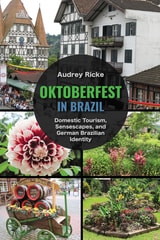
Oktoberfest in Brazil: Domestic Tourism, Sensescapes, and German Brazilian Identity is one of the first ethnographies to analyze the tourism industry based on German cultural heritage in southern Brazil. Southern Brazil’s booming domestic tourism industry draws more than 500,000 people to events such as the Oktoberfest in Blumenau. Ricke investigates domestic tourism as sensescapes, focusing on the multiple and layered meanings associated with tourism’s sensory experiences and interactions. The author also introduces the “economy of aesthetics” as a new framework to capture how the sensescapes associated with domestic tourism are intertwined in the negotiation of ethnic, national, and transnational identities. These sensescapes also intersect with discourses on class and race, which are examined as well.
Oktoberfest in Brazil leads readers on a tour through German Brazilian home gardens, folk dance performances, and the largest Oktoberfest in Brazil. These sensory-rich spaces of interaction provide access to different perspectives and types of identity negotiation at multiple levels from the local to the transnational. Ricke illustrates how the emotions and sensory experiences of these sensescapes associated with German cultural heritage function as a means for German Brazilians to negotiate senses of belonging as Brazilians as well as their ethnic and transnational identities.
This book also provides historical and contemporary insights into the politics of citizenship associated with cultural heritage. As politics become more polarized, the need to analyze different ways of communicating through sensory experiences increases. The unique contribution of the economy of aesthetics framework is its ability to capture the influential power of sensory experience in the negotiation of identity and senses of belonging and citizenship more broadly. It provides new insights into how and why some sensory experiences within domestic tourism foster belonging and identity while other experiences reinforce social distinctions and national divisions.

Old Age in a New Age
The Promise of Transformative Nursing HomesBeth Baker
Vanderbilt University Press, 2007
In Old Age in a New Age, Baker tell the story of a better way to live in old age. Although each home is different, they share common values: respecting individual choices; empowering staff; fostering a strong community of elders, staff, family members, and volunteers; redesigning buildings from a hospital model to a home (where pets and children are part of everyday life); and honoring people when they die. Her visits to more than two dozen facilities include those associated with the Eden Alternative, Green House, Kendal, and the Pioneer Network. Whether these transformational homes become the norm or the domain of a lucky few is the question that faces the next generation of elders, the baby boomers.
Old Birch Island Cemetery and the Early Historic Trade Route
Georgian Bay, OntarioEmerson F. Greenman
University of Michigan Press, 1951
Old China Through the Eyes of a Storyteller
Julie Moss Herrera
Parkhurst Brothers, Inc., 2012
“Having traveled on the same People to People Ambassador journey to China with Julie, I have seen Julie's anthology from inception to fruition. It is a masterful, engaging, informative and scholarly addition to our understanding and appreciation of Chinese culture, particularly storytelling and folk traditions, from ancient days to today. Practicing storytellers will especially appreciate her tips for telling and context clues at the end of each story.”
--Judith Heineman, storyteller, producer and Illinois Humanities Road Scholar
Old Heart Of Nevada
Ghost Towns And Mining Camps Of Elko CountyShawn Hall
University of Nevada Press, 1998
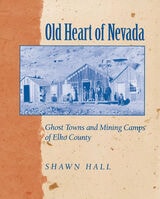
Elko County, in the old heart of Nevada, is rich in historic sites, many of them hitherto uncharted and some verging on disappearing. For the first time, historian Shawn Hall identifies and locates the ghost towns and old mining camps of Elko County and recounts their colorful histories. Following a guidebook format, Hall divides the county into five easily accessible regions, then lists the historic sites within each region and provides directions to reach them. He offers a brief history of each site as well as a description of its extant structures and their present condition. The result is a lively compilation of local history and mining and ranching lore that records the dramatic past of Nevada’s northeast corner, its pioneers and prospectors, its towns and mines, its outlaws, ranchers, merchants, mining concerns, and civic leaders. The book offers never-before available information about the old heart of Nevada and the people who settled there. It will be of enduring value to tourists and weekend explorers, historic preservationists, and all those interested in the history and artifacts of this region.
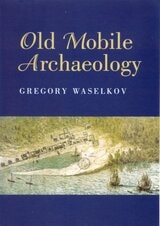
Old Mobile Archaeology
Gregory A. Waselkov
University of Alabama Press, 2005
An archaeological guide to the earliest French settlement on the northern Gulf Coast. Archaeological excavations since 1989 have uncovered exciting evidence of the original townsite of Mobile, first capital of the Louisiana colony, and remnants of the colony's port on Dauphin Island.
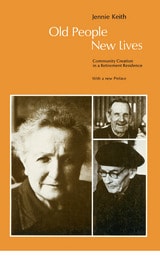
Old People, New Lives
Community Creation in a Retirement ResidenceJennie Keith
University of Chicago Press, 1982
Old Town Road
A Song by Lil Nas X with Billy Ray CyrusChris Molanphy
Duke University Press, 2023
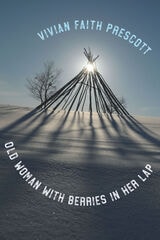
Old Woman with Berries in Her Lap
Vivian Faith Prescott
University of Alaska Press, 2022
Vivian Faith Prescott’s use of language is both a celebration of the richness of the Sámi languages and a mourning of the loss of language that occurs when a population is displaced and forced to exist in a totally foreign language space. According to Sámilinguist, professor, and politician Ole Henrik Magga, the Sámi languages have “very easily . . . one thousand lexemes with connections to snow, ice, freezing, and melting.” These lexemes frame many of Prescott’s poems, introducing ideas and feelings around the loss of language and culture.
A compelling insight into the Sámi culture from a contemporary poet’s eye, Old Woman with Berries in Her Lap juxtaposes past and present in an act of reclamation.