Results by title
122 books match the query 'English poetry' and 10 start with p
Perspectives
Modes of Viewing and Knowing in Nineteenth-Century EnglandLinda M. Shires
The Ohio State University Press, 2009
Poetic License
Essays on Modernist and Postmodernist LyricMarjorie Perloff
Northwestern University Press, 1990
Poetics & Polemics
1980-2005Jerome Rothenberg
University of Alabama Press, 2008
Poetics & Polemics, 1980-2005 brings together in one volume a wide-ranging selection of essays and commentaries by one of the most significant poets, critics, and translators working with American and international poetry today.
Jerome Rothenberg’s work spans a period of over forty years and nearly one hundred books, and though perhaps best known as a poet, his critical and theoretical contributions to the fields of innovative, experimental poetry have become equally important facets of his work. Rothenberg’s earliest critical writings concerned themselves with ethnopoetics and the poetics of performance. In the last twenty years his critical thinking has evolved to encompass more explicitly issues of modernism, postmodernism, and the avant-garde, as well as meditations on the nature of the book and writing. This volume extends and elaborates all of those interests, allowing for the first time a comprehensive glimpse of the full trajectory of his thinking.
In the first section, “Poetics and Polemics,” Rothenberg’s essays address a range of issues with which he’s become closely associated, among them the anthology as a critical and polemical tool; the intersection of poetry with art, performance, and politics, in both contemporary and traditional practice; the poetics of Jewish mysticism as a traditional form of conceptual and language poetry; and the universality of poetic discourse, particularly as seen in tribal poetry or in poetic traditions long separated from the Western literary mainstream. In “A Gallery of Poets” is Rothenberg’s lively explorations of the work of other poets, as they relate to his own work, to avant-garde poetry in general, and to the poetic traditions that concern him the most. Finally, in “Dialogues and Interviews” are Rothenberg’s unbridled meditations and musings on what he calls “the life of poetry” outside the bounds of book and binding, class and category, a dynamic force at the center of all that we call human.
Poetry of Mourning
The Modern Elegy from Hardy to HeaneyJahan Ramazani
University of Chicago Press, 1994
Through subtle readings of elegies, self-elegies, war poems, and the blues, Ramazani greatly enriches our critical understanding of a wide range of poets, including Thomas Hardy, Wilfred Owen, Wallace Stevens, Langston Hughes, W. H. Auden, Sylvia Plath, and Seamus Heaney. He also interprets the signal contributions to the American family elegy of Robert Lowell, Allen Ginsberg, Anne Sexton, John Berryman, Adrienne Rich, Michael Harper, and Amy Clampitt. Finally, he suggests analogies between the elegy and other kinds of contemporary mourning art—in particular, the AIDS Memorial Quilt and the Vietnam Veterans Memorial.
Grounded in genre theory and in the psychoanalysis of mourning, Ramazani's readings also draw on various historical, formal, and feminist critical approaches. This book will be of interest to anyone concerned with the psychology of mourning or the history of modern poetry.
"Consists of full, intelligent and lucid exposition and close reading. . . . Poetry of Mourning is itself a welcome contribution to modern poetry's search for a 'resonant yet credible vocabulary of grief in our time."—Times Literary Supplement
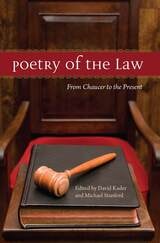
Poetry of the Law
From Chaucer to the PresentDavid Kader
University of Iowa Press, 2010
Since the time of Blackstone's "Farewell," poetry has been seen as celestial, pastoral, solitary, and mellifluous; law as venerable, social, urban, and cacophonous. This perception has persisted even to the present, with the bourgeoning field of law and literature focusing almost exclusively on fiction and drama. Poetry of the Law, however, reveals the richness of poetry about the law.
Poetry of the Law is the first serious anthology of law-related poetry ever published in the United States. As the editors make clear, though, serious need not imply solemn. Instead, David Kader and Michael Stanford have assembled a surprisingly capacious collection of 100 poems from the 1300s to the present.
Set in courtrooms, lawyers’ offices, law-school classrooms, and judges’ chambers; peopled with attorneys, the imprisoned (both innocent and guilty), judges, jurors, witnesses, and law-enforcement officers; based on real events (think “Scottsboro”) or exploring the complexity of abstract legal ideas; the poems celebrate justice or decry the lack of it, ranging in tone from witty to wry, sad to celebratory, funny to infuriating. Poetry of the Law is destined to become an authoritative source for years to come.
Contributors Include:
W. H. Auden
Robert Burns
Lewis Carroll
John Ciardi
Daniel Defoe
Emily Dickinson
John Donne
Rita Dove
Ralph Waldo Emerson
Martín Espada
Thomas Hardy
Seamus Heaney
A. E. Housman
Langston Hughes
Ben Jonson
X. J. Kennedy
Yusef Komunyakaa
Ted Kooser
D. H. Lawrence
Edgar Lee Masters
W. S. Merwin
Edna St. Vincent Millay
Sir Walter Raleigh
Muriel Rukeyser
Carl Sandburg
William Shakespeare
Jonathan Swift
Mona Van Duyn
Oscar Wilde
William Carlos Williams
from “The Hanging Judge” by Eavan Boland
Come to the country where justice is seen to be done,
Done daily. Come to the country where
Sentence is passed by word of mouth and raw
Boys split like infinitives. Look, here
We hanged our son, our only son
And hang him still and still we call it law.
Poetry of the Possible
Spontaneity, Modernism, and the MultitudeJoel Nickels
University of Minnesota Press, 2012
The Poetry of the Possible challenges the conventional image of modernism as a socially phobic formation, arguing that modernism’s abstractions and difficulties are ways of imagining unrealized powers of collective self-organization. Establishing a conceptual continuum between modernism and contemporary theorists such as Paulo Virno, Michael Hardt, Antonio Negri, and Alain Badiou, Joel Nickels rediscovers modernism’s attempts to document the creative potenza of the multitude.
By examining scenes of collective life in works by William Carlos Williams, Wyndham Lewis, Laura Riding, and Wallace Stevens, Nickels resurrects modernism’s obsession with constituent power: the raw, indeterminate capacity for reciprocal counsel that continually constitutes and reconstitutes established political regimes. In doing so, he reminds us that our own attempts to imagine leaderless networks of collective initiative are not so much breaks with modernist forms of knowledge as restagings of some of modernism’s most radical moments of political speculation.
Setting modernism’s individual and collective models of spontaneity in dialogue with theorists of political spontaneity such as Antonio Gramsci, Herbert Marcuse, and Theodor Adorno, Nickels retells the story of modernism as the struggle to represent powers of collective self-organization that lie outside established regimes of political representation.
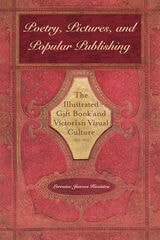
Poetry, Pictures, and Popular Publishing
The Illustrated Gift Book and Victorian Visual Culture, 1855–1875Lorraine Janzen Kooistra
Ohio University Press, 2011
In Poetry, Pictures, and Popular Publishing eminent Rossetti scholar Lorraine Janzen Kooistra demonstrates the cultural centrality of a neglected artifact: the Victorian illustrated gift book. Turning a critical lens on “drawing-room books” as both material objects and historical events, Kooistra reveals how the gift book’s visual/verbal form mediated “high” and popular art as well as book and periodical publication.
A composite text produced by many makers, the poetic gift book was designed for domestic space and a female audience; its mode of publication marks a significant moment in the history of authorship, reading, and publishing. With rigorous attention to the gift book’s aesthetic and ideological features, Kooistra analyzes the contributions of poets, artists, engravers, publishers, and readers and shows how its material form moved poetry into popular culture. Drawing on archival and periodical research, she offers new readings of Eliza Cook, Adelaide Procter, and Jean Ingelow and shows the transatlantic reach of their verses. Boldly resituating Tennyson’s works within the gift-book economy he dominated, Kooistra demonstrates how the conditions of corporate authorship shaped the production and receptionof the laureate’s verses at the peak of his popularity.
Poetry, Pictures, and Popular Publishing changes the map of poetry’s place—in all its senses—in Victorian everyday life and consumer culture.
Post-Personal Romanticism
Democratic Terror, Prosthetic Poetics, and the Comedy of Modern Ethical LifeBo Earle
The Ohio State University Press, 2017
Tracing this insight to Hegel’s suggestion that modern subjectivity is in some sense post-individual or even posthumous, Earle argues that signature Romantic lyrics offer a way forward that avoids postmodernism’s wholesale rejection of autonomous selfhood. With chapters on Wordsworth, Blake, Byron, Shelley, and Keats, Earle traces how Romantic lyrics mine this interminability to recover figurative emblems or masks of selfhood from experiences of its inevitable normative failure. This model is of particularly urgent value today when the costs of modern narcissism, economic exploitation, and political imperialism have come to include the normalization of torture, signature drone strikes, and climate change.
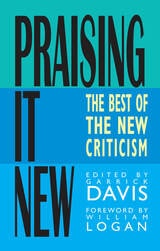
Praising It New
The Best of the New CriticismGarrick Davis
Ohio University Press, 2008
Praising It New is the first anthology of New Criticism to be printed in fifty years. It includes important essays by such influential poets and critics as T. S. Eliot, Ezra Pound, John Crowe Ransom, Allen Tate, Yvor Winters, Cleanth Brooks, R. P. Blackmur, W. K. Wimsatt, and Robert Penn Warren. Together, these authors ushered in the modernist age of poetry and criticism and transformed the teaching of literature in the schools. As the American poet and critic Randall Jarrell once noted: “I do not believe there has been another age in which so much extraordinarily good criticism of poetry has been written.”
This anthology now makes much of the best American poetry criticism available again, and includes short biographies and selected bibliographies of its chief figures. Praising It New is the perfect introduction for students to the best American poetry criticism of the twentieth century.
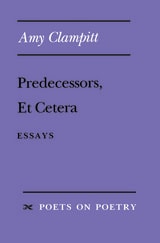
Predecessors, Et Cetera
EssaysAmy Clampitt
University of Michigan Press, 1991