Results by title
117 books match the query 'Philippines' and 8 start with p
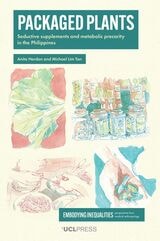
Packaged Plants
Seductive Supplements and Metabolic Precarity in the PhilippinesAnita Hardon and Michael Lim Tan
University College London, 2024
Through meticulous research and insightful analysis, Packaged Plants explores the intersectionality between health, economics, and environment in the Philippines, offering an absorbing ethnography and cultural history of how the production and consumption of plants for food and medicine have changed as well as how ultra-processed foods have become linked to health concerns, including cardiovascular disease, diabetes, and obesity.
Part one of the book presents a comprehensive analysis scrutinizing the colonial influences, urbanization, nutritional policies, research programs, and neoliberal marketing strategies in the Philippines that have proliferated packaged plant-based products as food and medicines. Part two interweaves contemporary urban political ecology frameworks with medical anthropological perspectives within Puerto Princesa and elucidates the precarious circumstances compelling individuals to invest in supplements.
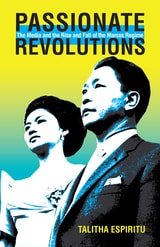
Passionate Revolutions
The Media and the Rise and Fall of the Marcos RegimeTalitha Espiritu
Ohio University Press, 2017
In the last three decades, the dictatorship of Ferdinand Marcos has commanded the close scrutiny of scholars. These studies have focused on the political repression, human rights abuses, debt-driven growth model, and crony capitalism that defined Marcos’ so-called Democratic Revolution in the Philippines. But the relationship between the media and the regime’s public culture remains underexplored.
In Passionate Revolutions, Talitha Espiritu evaluates the role of political emotions in the rise and fall of the Marcos government. Focusing on the sentimental narratives and melodramatic cultural politics of the press and the cinema from 1965 to 1986, she examines how aesthetics and messaging based on heightened feeling helped secure the dictator’s control while also galvanizing the popular struggles that culminated in “people power” and government overthrow in 1986.
In analyzing news articles, feature films, cultural policy documents, and propaganda films as national allegories imbued with revolutionary power, Espiritu expands the critical discussion of dictatorships in general and Marcos’s in particular by placing Filipino popular media and the regime’s public culture in dialogue. Espiritu’s interdisciplinary approach in this illuminating case study of how melodrama and sentimentality shape political action breaks new ground in media studies, affect studies, and Southeast Asian studies.
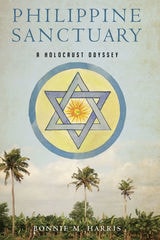
Philippine Sanctuary
A Holocaust OdysseyBonnie M. Harris
University of Wisconsin Press, 2022
This untold history is brought to life by focusing on the incredible journey of synagogue cantor Joseph Cysner. Drawing from oral histories, memoirs, and personal papers, Harris documents Cysner's harrowing escape from the Nazis and his heroic rescue by the American-led Jewish community of the Philippines in 1939. Moving and rich in historical detail, Philippine Sanctuary reveals new insights for an overlooked period in our recent history, and emphasizes the continued importance of humanitarian efforts to aid those being persecuted.
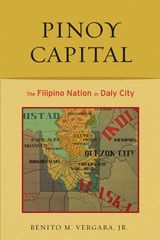
Pinoy Capital
The Filipino Nation in Daly CityBenito M. Vergara, Jr.
Temple University Press, 2009
Home to 33,000 Filipino American residents, Daly City, California, located just outside of San Francisco, has been dubbed “the Pinoy Capital of the United States.” In this fascinating ethnographic study of the lives of Daly City residents, Benito Vergara shows how Daly City has become a magnet for the growing Filipino American community.
Vergara challenges rooted notions of colonialism here, addressing the immigrants’ identities, connections and loyalties. Using the lens of transnationalism, he looks at the “double lives” of both recent and established Filipino Americans. Vergara explores how first-generation Pinoys experience homesickness precisely because Daly City is filled with reminders of their homeland’s culture, like newspapers, shops and festivals. Vergara probes into the complicated, ambivalent feelings these immigrants have—toward the Philippines and the United States—and the conflicting obligations they have presented by belonging to a thriving community and yet possessing nostalgia for the homeland and people they left behind.
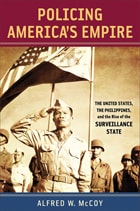
Policing America’s Empire
The United States, the Philippines, and the Rise of the Surveillance StateAlfred W. McCoy
University of Wisconsin Press, 2009
But security techniques bred in the tropical hothouse of colonial rule were not contained, McCoy shows, at this remote periphery of American power. Migrating homeward through both personnel and policies, these innovations helped shape a new federal security apparatus during World War I. Once established under the pressures of wartime mobilization, this distinctively American system of public-private surveillance persisted in various forms for the next fifty years, as an omnipresent, sub rosa matrix that honeycombed U.S. society with active informers, secretive civilian organizations, and government counterintelligence agencies. In each succeeding global crisis, this covert nexus expanded its domestic operations, producing new contraventions of civil liberties—from the harassment of labor activists and ethnic communities during World War I, to the mass incarceration of Japanese Americans during World War II, all the way to the secret blacklisting of suspected communists during the Cold War.
“With a breathtaking sweep of archival research, McCoy shows how repressive techniques developed in the colonial Philippines migrated back to the United States for use against people of color, aliens, and really any heterodox challenge to American power. This book proves Mark Twain’s adage that you cannot have an empire abroad and a republic at home.”—Bruce Cumings, University of Chicago
“This book lays the Philippine body politic on the examination table to reveal the disease that lies within—crime, clandestine policing, and political scandal. But McCoy also draws the line from Manila to Baghdad, arguing that the seeds of controversial counterinsurgency tactics used in Iraq were sown in the anti-guerrilla operations in the Philippines. His arguments are forceful.”—Sheila S. Coronel, Columbia University
Positively No Filipinos Allowed
Building Communities and Discourseedited by Antonio T. Tiongson, Jr., Edgardo V. Gutierrez and Ricardo V. Gutierrez, foreword by Lisa Lowe
Temple University Press, 2006
Postcolonial Configurations
Dictatorship, the Racial Cold War, and Filipino AmericaJosen Masangkay Diaz
Duke University Press, 2023
Profiles in Survival
The Experiences of American POWs in the Philippines during World War IIJohn C. Shively
Indiana Historical Society Press, 2012