Results by title
1066 books match the query 'Political' and 76 start with p
Palomino
Clinton Jencks and Mexican-American Unionism in the American SouthwestJames J. Lorence
University of Illinois Press, 2013
Parakratos
Narratives of Political and Military Conspiracies in Modern Greek HistoriographyNikola Tohma
Karolinum Press, 2025
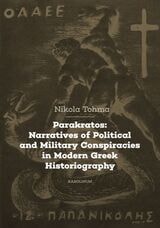
This book analyzes the conspiratorial concept of parakratos (translated as “deep state” or “parastate”) as a Cold War parallel power mechanism that exerted a profound influence on the political landscape in post-civil war Greece (1949–1967). A well-known phenomenon to the Greek domestic public, the far right parakratos became the usual suspect for political murders, election rigging, and terrorism during this period. Despite its notoriety for numerous outrageous incidents, including the assassination of the left-wing politician Grigoris Lambrakis in Thessaloniki in 1963, the structure of the parakratos has eluded a comprehensive understanding, primarily due to the paucity of reliable sources and the absence of a scholarly consensus regarding its nature. Parakratos endeavors to problematize the current conception of parakratos by underscoring the capacity of the concept to not only represent but also define and transform the Greek domestic Cold War politics and our perception of it. Rather than seeking to explain the presumed conspiracies typically ascribed to the groups and members, the book aims to demonstrate how these events influenced the domestic and international politics of the era and thereby contributed to the establishment of a legacy of conspiracy theories as a means of political struggle. Moreover, it connects the Greek parakratos to the broader debate on parapolitics as well as the concepts of the dual state, the security state, and the deep state in various national contexts.
Patrick J. Lucey
A Lasting LegacyDennis L. Dresang
Wisconsin Historical Society Press, 2020
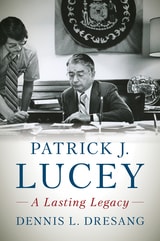
Preceding his service as governor, Lucey played a key role in rebuilding the Democratic Party in Wisconsin, returning a state that had been dominated by Republicans to a more moderate two-party system. As party chairman, he built coalitions between World War II veterans, remnants of the defunct Progressive Party, urban socialists, and activists in rural communities throughout the state.
Through exclusive interviews and unprecedented access to archival materials, Dennis L. Dresang shares the story of this pivotal figure in Wisconsin history, from his small-town rural roots to his wide-ranging influence.

Patterns of Persistence
Utah Women Legislators, 1993–2026Tiffany Greene and Marie Cornwall
University of Utah Press, 2027
Paul Powell of Illinois
A Lifelong DemocratRobert E. Hartley
Southern Illinois University Press, 1999
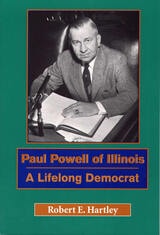
Paul Powell emerged from the hill country of southern Illinois to serve in state government from 1935 until his death in 1970. His political tenure included three terms as Speaker of the Illinois House, four terms as minority leader, and two terms as secretary of state. The sponsor of hundreds of bills, he worked tirelessly for his constituents in southern Illinois. He also worked tirelessly to promote his own interests.
In this first political biography of Powell, Robert E. Hartley follows the money. He tells how this man of humble origins and meager means amassed a world-class political and financial base. Part of that story is the disclosure of a personal fortune that boggled minds, including the unbelievable yarn of the $800,000 cash found in the hotel room following Powell's death.
Powell never earned a state salary of more than $30,000 per year, yet in the last year of his life, his federal income tax return showed an income of more than $200,000. At his death his estate totaled $3.2 million, and, when settled in 1978, was worth $4.6 million, including nearly $1 million in racetrack stock.
Following Powell's story, Hartley takes us deep into the Illinois political world of the 1940s, 1950s, and 1960s, a time when politicians were on an "honor system" regarding their financial holdings. This was before disclosure of political contributions, before computer records, and before public meetings laws.
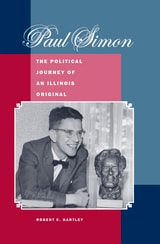
Paul Simon
The Political Journey of an Illinois OriginalRobert E. Hartley
Southern Illinois University Press, 2009
With Paul Simon: The Political Journey of an Illinois Original, author Robert E. Hartley presents the first thorough, objective volume on the journalistic and political career of one of Illinois’s most respected public figures. Hartley’s detailed account offers a fully rounded portrait of a man whose ideals and tenacity not only spurred reform on both state and national levels during his celebrated forty-year career but also established the lasting legacy of a political legend.
Simon first became a public figure at the age of nineteen, when he assumed the post of editor and publisher of a weekly newspaper in Troy, Illinois. From there, he used his paper to launch a fierce crusade against the crime and corruption plaguing Madison County. This battle sparked his entry into politics, helping to land him a seat in the state legislature in 1954. While serving, he campaigned tirelessly according to his principles, earning him the mass voter approval that would usher him into the seat of lieutenant governor in 1968—the first person elected to that position who did not share party affiliation with the governor.
As lieutenant governor, Simon initiated many changes to the position, remaking it to better serve the citizens of the state of Illinois. The cornerstone of his reform plan was an ombudsman program designed to allow the people of the state to voice problems they had with government and state agencies. The program, extremely popular with the public and the press, solved problems and helped to make Simon a household name throughout Illinois. Although he faced challenges along the way, including racial upheaval in Cairo and the student and police riots on the Carbondale campus of Southern Illinois University, Simon’s outspoken honesty and strong support of his constituents earned him the utmost esteem and popularity.
While his 1972 bid for governor of Illinois ultimately failed, this did not deter Simon from his dedication to social progress. In 1974 he began his remarkable twenty-two-year career in the U.S. House of Representatives and Senate, where he earned the admiration of the country for his political integrity. Despite the praise and support Simon had earned during his time in Washington, he was unable to win the Democratic presidential nomination in 1988 and returned to the Senate, winning a second term in 1990. Simon committed time and energy to the myriad issues of interest to him, especially in the field of education, with one of his biggest successes coming with the passage of the National Literacy Act, which he sponsored. He continued to foster his ties to journalism throughout his lengthy political career, authoring numerous books, articles, and columns, all of which he used to relentlessly promote open government and social programs.
This vivid account of the public life of Paul Simon reveals a man whose personal honor and dedication were unshakeable throughout nearly half a century in the political arena. Robert E. Hartley provides a candid perspective on Simon’s accomplishments and victories, as well as his mistakes and losses, revealing new insights into the life of this dynamic and widely respected public figure.
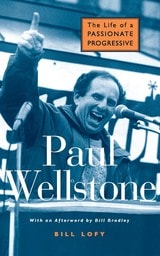
Paul Wellstone
The Life of a Passionate ProgressiveBill Lofy
University of Michigan Press, 2005
---Arianna Huffington, columnist and editor of HuffingtonPost.com
"This book captures the vibrant spirit of my friend Paul Wellstone---the fierce commitment to justice that defined his life, and that shapes his enduring legacy."
---U.S. Senator Russ Feingold
"Paul Wellstone was a great leader because he fused progressive idealism with a stubbornly pragmatic politics. Bill Lofy's book captures that dual commitment in his story of Wellstone's life, and also shows us the extraordinary human appeal that Wellstone emanated in his relationships with people in all walks of life. This book is an engaging read that also tells us a lot about the political practice to which we should aspire."
---Frances Fox Piven, author of The War at Home
"This vividly written book captures the life and personal qualities of the late Senator Paul Wellstone. In so doing it provides an illuminating gloss on Max Weber's seminal exposition of the political vocation. It is a jewel of a book."
-Fred Greenstein, Princeton University
Bill Lofy's fast-paced and readable biography tells the inspirational story of one of the most compelling figures in the history of American politics---Senator Paul Wellstone.
Yet Lofy's book is more than just the chronicle of Wellstone's life and political career; it's also an indispensable guide to what ails political life today. Readers politically inclined or not will find in its pages a handbook to the uncertain and often treacherous business of politics and a stirring example for living a courageous and honest life---whether as public servant or private individual.
Peltse and Pentameron
Volodymyr Dibrova
Northwestern University Press, 1996
Peltse portrays the formation of an average apparatchik. Both funny and alarming, it provides a psychological portrait of an individual trapped in a system he simultaneously dislikes and depends upon for survival. Pentameron tells the story of one day in the life of five colleagues at a Soviet research institute. Each is dissatisfied, yet all are trapped in and by a system that has taken away their ability to act decisively.

Performing Maternities
Political, Social and Feminist EnquiryEdited by Kate Aughterson and Jess Moriarty
Intellect Books, 2027
This volume brings together research and artistic practices that challenge dominant narratives around motherhood.
Performing Maternities is a collection of essays, creative work, images, and scripts that emerged out of an online international symposium held at Brighton University in November 2020. Together, the contributors challenge, celebrate, and share the normative, the queer, the transgressive, the joy, and the pain of performing maternity. The book asks key questions about the construction of maternal identities and mythologies in the contemporary world; the ways these affect individuals in different social, economic, and sexual identities; and how—as mothers, writers, artists, parents, and grandparents—we can address and challenge those identities.
Perjury and Pardon, Volume II
Jacques Derrida
University of Chicago Press, 2023
Perjury and Pardon is a two-year seminar series given by Jacques Derrida at the École des hautes études en sciences sociales in Paris during the late 1990s. In these sessions, Derrida focuses on the philosophical, ethical, juridical, and political stakes of the concept of responsibility. His primary goal is to develop what he calls a “problematic of lying” by studying diverse forms of betrayal: infidelity, denial, false testimony, perjury, unkept promises, desecration, sacrilege, and blasphemy.
This volume covers the seminar’s second year when Derrida explores the political dimensions of forgiveness and repentance. Over eight sessions, he discusses Hegel, Augustine, Levinas, Arendt, and Benjamin as well as Bill Clinton’s impeachment and Nelson Mandela and Desmond Tutu’s testimonies before the Truth and Reconciliation Commission. The seminars conclude with an extended reading of Henri Thomas’s 1964 novel Le Parjure.
Persecution and the Art of Writing
Leo Strauss
University of Chicago Press, 1988
Peter and Caesar
Political Authority and the Catholic ChurchEdward A. Goerner
St. Augustine's Press, 2020
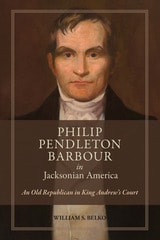
Philip Pendleton Barbour in Jacksonian America
An Old Republican in King Andrew’s CourtWilliam S. Belko
University of Alabama Press, 2016
Barbour, a Virginia lawyer, participated in America’s transition from a mostly republican government to a truer majority democracy, notably while serving as the twelfth Speaker of the United States House of Representatives and later as an associate justice of the United States Supreme Court. After being elected to the US Congress during the War of 1812, Barbour also emerged as one of the foremost champions of states’ rights, consistently and energetically fighting against expansions of federal powers. He, along with other Jeffersonian Old Republicans, opposed federal plans for a national tariff and internal improvements. Later, Barbour became one of the first Jeffersonian politicians to join the Jacksonian Democrats in Jackson’s war against a national bank.
Barbour continued to make crucial strides in support of states’ rights after taking his seat on the United States Supreme Court in 1836 under Chief Justice Roger Taney. He contributed to the Charles River Bridge v. Warren Bridge and Briscoe v. Bank of Kentucky decisions, which bolstered states’ rights. He also delivered the opinion of the court in New York v. Miln, which provided the basis for the State Police Powers Doctrine.
Expertly interweaving biography, history, political science, and jurisprudence, Philip Pendleton Barbour in Jacksonian America remembers the man whose personal life and career were emblematic of the decades in which the United States moved from the Age of Jefferson to the Age of Jackson, contributing to developments that continue to animate American politics today.

Philippe Aries and the Politics of French Cultural History
Patrick H. Hutton
University of Massachusetts Press, 2004
The author of Centuries of Childhood and other landmark historical works, Philippe Ariès (1914–1984) was a singular figure in French intellectual life. He was both a political reactionary and a path-breaking scholar, a sectarian royalist who supported the Vichy regime and a founder of the new cultural history—popularly known as l'histoire des mentalités—that developed in the decades following World War II. In this book, Patrick H. Hutton explores the relationship between Ariès's life and thought and evaluates his contribution to modern historiography, in France and abroad.
According to Hutton, the originality of Ariès's work and the power of his appeal derived from the way he drew together the two strands of his own intellectual life: his enduring ties to the old cultural order valued by the right-wing Action Française, and a newfound appreciation for the methodology of the leftist Annales school of historians. A demographer by training, he pioneered a new route into the history of private life that eventually won him a wide readership and in late life an appointment to the faculty of the prestigious École des Hautes Études en Sciences Sociales. At the same time, he fashioned himself as a man of letters in the intellectual tradition of the Action Française and became a perspicacious journalist as well as a stimulating writer of autobiographical memoirs. In Hutton's view, this helps explain why, more than any other historian, Philippe Ariès left his personal signature on his scholarship.

Philosophizing the Everyday
Revolutionary Praxis and the Fate of Cultural TheoryJohn Roberts
Pluto Press, 2006
John Roberts argues that this understanding of the everyday downgrades its revolutionary meaning and philosophical implications. Bringing radical political theory back to the centre of the discussion, he shows how notions of cultural democratization have been oversimplified. Asserting that the everyday should not be narrowly identified with the popular, Roberts critiques the way in which the concept is now overly associated with consumption and 'ordinariness'.
Engaging with the work of key thinkers including, Lukács, Arvatov, Benjamin, Lefebvre, Gramsci, Barthes, Vaneigem, and de Certeau, Roberts shows how the concept of the everyday continues to be central to debates on ideology, revolution and praxis. He offers a lucid account of different approaches that developed over the course of the twentieth century, making this an ideal book for anyone looking for a politicised approach to cultural theory.
John Roberts is a Senior Research Fellow in Fine Art at the University of Wolverhampton. He is the author of The Art of Interruption: Realism, Photography and the Everyday (Manchester University Press, 1997) and The Philistine Controversy (Verso, with Dave Beech, 2002), plus other books and numerous articles, in Radical Philosophy and elsewhere.
Philosophy Between the Lines
The Lost History of Esoteric WritingArthur M. Melzer
University of Chicago Press, 2014
Arthur M. Melzer serves as our deeply knowledgeable guide in this capacious and engaging history of philosophical esotericism. Walking readers through both an ancient (Plato) and a modern (Machiavelli) esoteric work, he explains what esotericism is—and is not. It relies not on secret codes, but simply on a more intensive use of familiar rhetorical techniques like metaphor, irony, and insinuation. Melzer explores the various motives that led thinkers in different times and places to engage in this strange practice, while also exploring the motives that lead more recent thinkers not only to dislike and avoid this practice but to deny its very existence. In the book’s final section, “A Beginner’s Guide to Esoteric Reading,” Melzer turns to how we might once again cultivate the long-forgotten art of reading esoteric works.
Philosophy Between the Lines is the first comprehensive, book-length study of the history and theoretical basis of philosophical esotericism, and it provides a crucial guide to how many major writings—philosophical, but also theological, political, and literary—were composed prior to the nineteenth century.

Philosophy, Literature, and Politics
Essays Honoring Ellis SandozEdited by Charles R. Embry & Barry Cooper
University of Missouri Press, 2005
Plastic Materialities
Politics, Legality, and Metamorphosis in the Work of Catherine MalabouBrenna Bhandar and Jonathan Goldberg-Hiller, editors
Duke University Press, 2015
Contributors. Brenna Bhandar, Silvana Carotenuto, Jonathan Goldberg-Hiller, Jairus Victor Grove, Catherine Kellogg, Catherine Malabou, Renisa Mawani, Fred Moten, Alain Pottage, Michael J. Shapiro, Alberto Toscano

Plato through Homer
Poetry and Philosophy in the Cosmological DialoguesZdravko Planinc
University of Missouri Press, 2003
Plato's Critique of Impure Reason
On Goodness and Truth in the RepublicD. C. Schindler
Catholic University of America Press, 2008
Plato's Philosophers
The Coherence of the DialoguesCatherine H. Zuckert
University of Chicago Press, 2009
Faced with the difficult task of discerning Plato’s true ideas from the contradictory voices he used to express them, scholars have never fully made sense of the many incompatibilities within and between the dialogues. In the magisterial Plato’s Philosophers, Catherine Zuckert explains for the first time how these prose dramas cohere to reveal a comprehensive Platonic understanding of philosophy.
To expose this coherence, Zuckert examines the dialogues not in their supposed order of composition but according to the dramatic order in which Plato indicates they took place. This unconventional arrangement lays bare a narrative of the rise, development, and limitations of Socratic philosophy. In the drama’s earliest dialogues, for example, non-Socratic philosophers introduce the political and philosophical problems to which Socrates tries to respond. A second dramatic group shows how Socrates develops his distinctive philosophical style. And, finally, the later dialogues feature interlocutors who reveal his philosophy’s limitations. Despite these limitations, Zuckert concludes, Plato made Socrates the dialogues’ central figure because Socrates raises the fundamental human question: what is the best way to live?
Plato’s dramatization of Socratic imperfections suggests, moreover, that he recognized the apparently unbridgeable gap between our understandings of human life and the nonhuman world. At a time when this gap continues to raise questions—about the division between sciences and the humanities and the potentially dehumanizing effects of scientific progress—Zuckert’s brilliant interpretation of the entire Platonic corpus offers genuinely new insights into worlds past and present.
Plato's Statesman
Part III of The Being of the BeautifulPlato
University of Chicago Press, 1986
Theaetetus is the first of a trilogy of Platonic dialogues that show Socrates formulating his conception of philosophy as he prepares the defense for his trial. This translation is particularly faithful to the original Greek, and it is accompanied by an introduction, extensive notes, and comprehensive commentary that puts the dialogue in context with Plato's thought and its influence over the centuries.
Seth Benardete (1930-2001) was professor of classics at New York University.
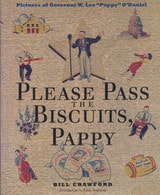
Please Pass the Biscuits, Pappy
Pictures of Governor W. Lee "Pappy" O'DanielBy Bill Crawford
University of Texas Press, 2004
Long before movie stars Ronald Reagan and Arnold Schwarzenegger became governors of California, a popular radio personality with no previous political experience—who wasn't even registered to vote—swept into the governor's office of Texas. W. Lee "Pappy" O'Daniel was a 1930s businessman who discovered the power of radio to sell flour. His musical shows with the Light Crust Doughboys (which launched the career of Bob Wills) and his radio homilies extolling family and Christian values found a vast, enthusiastic audience in Depression-era Texas. When Pappy decided to run for governor in 1938 as a way to sell more flour—a fact he proudly proclaimed throughout the campaign—the people of Texas voted for him in record numbers. And despite the ineptitude for politics he displayed once in office, Texans returned him to the governorship in 1940 and then elected him to the U.S. Senate in 1941 in a special election in which he defeated Lyndon Johnson, as well as to a full term as senator in 1942.
While the hit film O Brother, Where Art Thou? celebrated a fictional "Please Pass the Biscuits, Pappy" O'Daniel, this book captures the essence of the real man through photographs taken by employees of the Texas Department of Public Safety, most of which are previously unpublished. Reminiscent of the work of WPA photographers such as Russell Lee and Dorothea Lange, these photos record the last unscripted era of politics when a charismatic candidate could still address a crowd from an unpainted front porch or a mobile bandstand in the back of a truck. They strikingly confirm that Pappy O'Daniel's ability to connect with people was as great in person as on the radio.
To set the photos in context, Bill Crawford has written an entertaining text that discusses the political landscape in Texas and the United States in the 1930s, as well as the rise of radio as mass medium for advertising and entertainment. He also provides extensive captions for each picture. John Anderson, Photo Archivist of the Texas State Archives, discusses the work of Joel Tisdale and the other DPS photographers who left this extraordinary record of the greatest vote-getter in Texas history, who became one of America's first celebrities to cross the line from entertainment to political office.
Pluralism
William E. Connolly
Duke University Press, 2005
Connolly looks at pluralism not only in light of faith but also in relation to evil, ethics, relativism, globalization, and sovereignty. In the process, he engages many writers and theorists—among them, Spinoza, William James, Henri Bergson, Marcel Proust, Gilles Deleuze, Giorgio Agamben, Talal Asad, Michael Hardt, and Antonio Negri. Pluralism is the first book in which Connolly explains the relationship between pluralism and the experience of time, and he offers readings of several films that address how time is understood, including Time Code, Far from Heaven, Waking Life, and The Maltese Falcon. In this necessary book Connolly brings a compelling, accessible philosophical critique together with his personal commitment to an inclusive political agenda to suggest how we might—and why we must—cultivate pluralism within both society and ourselves.

Poetic Justice
Rereading Plato's "Republic"Jill Frank
University of Chicago Press, 2018
With Poetic Justice, Jill Frank overturns the conventional view that the Republic endorses a hierarchical ascent to knowledge and the authoritarian politics associated with that philosophy. When learning to read is understood as the passive absorption of a teacher’s beliefs, this reflects the account of Platonic philosophy as authoritative knowledge wielded by philosopher kings who ruled the ideal city. When we learn to read by way of the method Socrates introduces in the Republic, Frank argues, we are offered an education in ethical and political self-governance, one that prompts citizens to challenge all claims to authority, including those of philosophy.

Poindexter of Washington
A Study in Progressive PoliticsHoward W Allen
Southern Illinois University Press, 1981
In this study of Miles Poindexter, Insurgent Republican turned conservative, Howard W. Allen reaches beyond the traditional bounds of biography to present a history of the United States Congress during the Progressive era and the early years after World War I.
A congressman (1909–13)and a senator (1913–23), Miles Poindexter of Washington State was an outspoken, progressive reformer before World War I. He struggled to protect “the people” from “special interests,” particularly defending the interest of his section against eastern “colonialism.” A man with a penchant for absolute positions, Poindexter became caught up in the emotionalism of the Insurgent Republican revolt. At one time or another he championed Socialists, the IWW, the striking textile workers in Lawrence, Massachusetts—all unlikely causes for a middle-class lawyer from Spokane.
Regarding foreign policy, Poindexter was an uncompromising nationalist who, with Theodore Roosevelt, declared himself a member of the Progressive party in 1912.
After 1917 Poindexter actively tried to suppress opponents of the war. Following the war his targets were “Bolshevists” and other radicals. He also developed intense hostility toward Socialists, the IWW, and organized labor, fearing radicalism and labor. Reversing his former position, he allied himself with the eastern businessmen and regular Republicans in the Senate. Campaigning for the presidency in 1920, he appealed without success to the most conservative members of the party. He was defeated b a progressive Democrat in his 1922 bid for reelection to the Senate.
Allen examines the traditional sources—archival collections, newspaper files, and congressional reports. When he combines this material with a quantitative analysis of roll-call votes throughout Senator Poindexter’s years in Congress, he creates a remarkably useful method never before attempted in political biography.
Polish Liberal Thought Before 1918
Maciej Janowski
Central European University Press, 2004
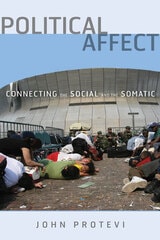
Political Affect
Connecting the Social and the SomaticJohn Protevi
University of Minnesota Press, 2010
For many philosophers, the rational cognitive (Cartesian) subject defines the human, or at least defines what humans should be. Yet some recent cognitive science, as well as the philosophy of Deleuze and Guattari, has called into question such individuality and rationality and emphasized social and emotional subjectivity. Understanding such embodied and embedded subjectivity, John Protevi argues, demands the notion of bodies politic.
In Political Affect, Protevi investigates the relationship between the social and the somatic: how our bodies, minds, and social settings are intricately and intimately linked. Bringing together concepts from science, philosophy, and politics, he develops a perspective he calls political physiology to indicate that subjectivity is socially conditioned and sometimes bypassed in favor of a direct connection of the social and the somatic, as with the politically triggered basic emotions of rage and panic. Protevi's treatment of affective cognition in social context breaks new theoretical ground, insisting that subjectivity be studied both in its embodied expression and in terms of the distribution of affective cognitive responses in a population.
Moving beyond the theoretical, Protevi applies his concept of political affect to show how unconscious emotional valuing shaped three recent, emotionally charged events: the cold rage of the Columbine High School slayings, the racialized panic that delayed rescue efforts in Hurricane Katrina, and the twists and turns of empathy occasioned by the Terry Schiavo case. These powerful individual and collective political events require new philosophical understanding.
Political Anthropology
Helmuth Plessner, Translated from the German by Nils F. Schott, Edited and with an introduction by Heike Delitz and Robert Seyfert and an epilogue by Joachim Fischer
Northwestern University Press, 2018
In Political Anthropology (originally published in 1931 as Macht und menschliche Natur), Helmuth Plessner considers whether politics—conceived as the struggle for power between groups, nations, and states—belongs to the essence of the human. Building on and complementing ideas from his Levels of the Organic and the Human (1928), Plessner proposes a genealogy of political life and outlines an anthropological foundation of the political. In critical dialogue with thinkers such as Carl Schmitt, Eric Voegelin, and Martin Heidegger, Plessner argues that the political relationships cultures entertain with one other, their struggle for acknowledgement and assertion, are expressions of certain possibilities of the openness and unfathomability of the human.
Translated into English for the first time, and accompanied by an introduction and an epilogue that situate Plessner's thinking both within the context of Weimar-era German political and social thought and within current debates, this succinct book should be of great interest to philosophers, political theorists, and sociologists interested in questions of power and the foundations of the political.
Political Peoplehood
The Roles of Values, Interests, and IdentitiesRogers M. Smith
University of Chicago Press, 2015
This book gathers Smith’s most important writings on peoplehood to build a coherent theoretical and historical account of what peoplehood has meant in American political life, informed by frequent comparisons to other political societies. From the revolutionary-era adoption of individual rights rhetoric to today’s battles over the place of immigrants in a rapidly diversifying American society, Smith shows how modern America’s growing embrace of overlapping identities is in tension with the providentialism and exceptionalism that continue to make up so much of what many believe it means to be an American.
A major work that brings a lifetime of thought to bear on questions that are as urgent now as they have ever been, Political Peoplehood will be essential reading for social scientists, political philosophers, policy analysts, and historians alike.
Political Philosophy and the Challenge of Revealed Religion
Heinrich Meier
University of Chicago Press, 2017
In the first of three chapters, Meier determines four intertwined moments constituting the concept of political philosophy as an articulated and internally dynamic whole. The following two chapters develop the concept through the interpretation of two masterpieces of political philosophy that have occupied Meier’s attention for more than thirty years: Leo Strauss’s Thoughts on Machiavelli and Jean-Jacques Rousseau’s Social Contract. Meier provides a detailed investigation of Thoughts on Machiavelli, with an appendix containing Strauss’s original manuscript headings for each of his paragraphs. Linking the problem of Socrates (the origin of political philosophy) with the problem of Machiavelli (the beginning of modern political philosophy), while placing between them the political and theological claims opposed to philosophy, Strauss’s most complex and controversial book proves to be, as Meier shows, the most astonishing treatise on the challenge of revealed religion. The final chapter, which offers a new interpretation of the Social Contract, demonstrates that Rousseau’s most famous work can be adequately understood only as a coherent political-philosophic response to theocracy in all its forms.
Political Philosophy
From Plato to MaoMartin Cohen
Pluto Press, 2008
Guiding the reader through the key arguments of the classic figures of Western political philosophy, from Plato through to the modern era, this revised edition includes new essays on Aristotle's 'Politics', Confucianism, Islamic social philosophy and Nazism, as well as additional material on 'Roman Law', Anarchism and 'anti-capitalism'.
Cohen moves chronologically through the development of political philosophy. He presents key texts in their own terms, before offering short, precise analyses of their strengths, weaknesses and influence. The book finishes with a discussion of modern liberalism and conservatism.
Providing both a broad overview and precise summaries of key ideas, this is an invaluable guide for all students of political thought.
Political Reasoning and Cognition
A Piagetian ViewShawn Rosenberg, Dana Ward, and Stephen Chilton
Duke University Press, 1989
Political Theology
Four Chapters on the Concept of SovereigntyCarl Schmitt
University of Chicago Press, 2005
Focusing on the relationships among political leadership, the norms of the legal order, and the state of political emergency, Schmitt argues in Political Theology that legal order ultimately rests upon the decisions of the sovereign. According to Schmitt, only the sovereign can meet the needs of an "exceptional" time and transcend legal order so that order can then be reestablished. Convinced that the state is governed by the ever-present possibility of conflict, Schmitt theorizes that the state exists only to maintain its integrity in order to ensure order and stability. Suggesting that all concepts of modern political thought are secularized theological concepts, Schmitt concludes Political Theology with a critique of liberalism and its attempt to depoliticize political thought by avoiding fundamental political decisions.

Political Theory and Praxis
New PerspectivesTerence Ball, Editor
University of Minnesota Press, 1977
Political Theory and Praxis was first published in 1977. Minnesota Archive Editions uses digital technology to make long-unavailable books once again accessible, and are published unaltered from the original University of Minnesota Press editions.
Nine distinguished contributors—philosophers and political scientists at universities and colleges in the United States, Europe, Canada, and Australia—write essays for this volume in political philosophy. The book is dedicated to the memory of Hannah Arendt, the writer and philosopher who died in 1975. The contributors discuss various aspects of the concepts of theory and practice and their interrelationship. All of the essays were written expressly for this volume. In an introduction, Professor Ball, the volume editor, notes that the essays reflect the diversity of conceptions of theory, of practice, and of their conceptual and practical interrelations, and that the contributors explore various ways and byways of approaching the age-old questions of theory and its relation to practice.
Part I: Origins
"On the History of 'Theory' and 'Praxis'," Nicholas Lobkowicz; "Creatures of a Day: Thought and Action in Thucydides,"J. Peter Euben; " Plato and Aristotle: The Unity Versus the Autonomy of Theory and Practice." Terence Ball.Part II: Developments
"Kant on Theory and Practice," Carl Raschke; "Theory and Practice in Hegel and Marx: An Unfinished Dialogue,"Peter Fuss; "The Unity of Theory and Practice: The Science of Marx and Nietzsche," Edward Andrew.Part II: Dilemmas and New Directions
"Hannah Arendt: The Ambiguities of Theory and Practice," Richard J. Bernstein; "Rebels, Beginners, and Buffoons: Politics as Action," Raymond L. Nichols; "How People Change Themselves: The Relationship between Critical Theory and Its Audience," Brian Fay
Political Visions of Ukraine
Models of a Common FutureBogdan Kolesnyk
Central European University Press, 2026
Drawing on intellectual discourses from 2013 onwards, this book maps those collisions, reconstructing Ukraine’s “noumenal parliament” — the constellation of voices that have vied to define the nation’s future. Bogdan Kolesnyk explains why Ukraine’s is not a single story but a composite of many, why neither liberal consolidation nor national stories alone provide a sufficient answer, and suggests how justice, reason and republican institutions might be the anchors for plural polity to endure.
In attempting to understand Ukrainian socio-political reality on its own terms from beyond its borders, this book urgently enquires what kind of future is worth fighting for?
Political Vocabularies
FDR, the Clergy Letters, and the Elements of Political ArgumentMary E. Stuckey
Michigan State University Press, 2018
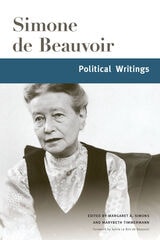
Political Writings
Simone de Beauvoir; Edited by Margaret A. Simons and Marybeth Timmermann; Foreword by Sylvie Le Bon de Beauvoir
University of Illinois Press, 2021
The writings in this volume range from Beauvoir's surprising 1952 defense of the misogynistic eighteenth-century pornographer, the Marquis de Sade, to a co-written 1974 documentary film, transcribed here for the first time, which draws on Beauvoir's analysis of how socioeconomic privilege shapes the biological reality of aging. The volume traces nearly three decades of Beauvoir's leftist political engagement, from exposés of conditions in fascist Spain and Portugal in 1945 and hard-hitting attacks on right-wing French intellectuals in the 1950s, to the 1962 defense of an Algerian freedom fighter, Djamila Boupacha, and a 1975 article arguing for what is now called the "two-state solution" in Israel.
Together these texts prefigure Beauvoir's later feminist activism and provide a new interpretive context for reading her multi-volume autobiography, while also shedding new light on French intellectual history during the turbulent era of decolonization.
Political and Social Writings
Volume 1, 1946-1955Cornelius CastoriadisDavid Ames Curtis, EditorTranslated by David Ames Curtis
University of Minnesota Press, 1988
Political and Social Writings: Volume 1, 1946–1955 was first published in 1988. Minnesota Archive Editions uses digital technology to make long-unavailable books once again accessible, and are published unaltered from the original University of Minnesota Press editions.
A series of writings by the man who inspired the students of the Workers' Rebellion in May of 1968.
"Given the rapid pace of change in the Soviet Union and Eastern Europe, and the radical nature of these transformations, the work of Cornelius Castoriadis, a consistent and radical critic of Soviet Marxism, gains renewed significance. . . . these volumes are instructive because they enable us to trace his rigorous engagement with the project of socialist construction from his break with Trotskyism to his final breach with Marxism . . . and would be read with profit by all those seeking to comprehend the historical originality of events in the USSR and Eastern Europe." –Contemporary Sociology
Political and Social Writings
Volume 2, 1955-1960Cornelius CastoriadisDavid Ames Curtis, EditorTranslated by David Ames Curtis
University of Minnesota Press, 1988
Political and Social Writings:Volume 2, 1955–1960 was first published in 1988. Minnesota Archive Editions uses digital technology to make long-unavailable books once again accessible, and are published unaltered from the original University of Minnesota Press editions.
A series of writings by the man who inspired the students of the Workers' Rebellion in May of 1968.
"Given the rapid pace of change in the Soviet Union and Eastern Europe, and the radical nature of these transformations, the work of Cornelius Castoriadis, a consistent and radical critic of Soviet Marxism, gains renewed significance....these volumes are instructive because they enable us to trace his rigorous engagement with the project of socialist construction from his break with Trotskyism to his final breach with Marxism. . . and would be read with profit by all those seeking to comprehend the historical originality of events in the USSR and Eastern Europe." –Contemporary Sociology
Political and Social Writings
Volume 3, 1961-1979Cornelius CastoriadisDavid Ames Curtis, EditorTranslated by David Ames Curtis
University of Minnesota Press, 1992
Political and Social Writings: Volume 3, 1961–1979 was first published in 1992. Minnesota Archive Editions uses digital technology to make long-unavailable books once again accessible, and are published unaltered from the original University of Minnesota Press editions.
This work offers an extraordinary wealth and variety of writings from the crucial years that followed the publication of Castoriadis's landmark text, Modern Capitalism and Revolution. The "new orientation" he proposed for the Socialisme ou Barbarie group centered on the emerging roles of women, youth, and minorities in the growing challenge to established society in the early sixties. Resistance within the group to this new orientation led Castoriadis to criticize the "neopaleo- Marxism" of Jean-François Lyotard and others who ultimately left Socialisme ou Barbarie. A heightened concern for ethnological issues culminated in what might be called, to the embarrassment of today's "poststructuralists," Castoriadis's "premature antistructuralism."
Additional texts examine the dissolution of the group itself and analyze the May 1968 rebellion of workers and students - who, according to their own testimony, were inspired by ideas developed in the group's journal. Also included were many of Castoriadis's still-relevant political writings from the seventies, which were developed in tandem with the more explicitly philosophical work now found in The Imaginary Institution of Society and Crossroads in the Labyrinth.
Political and Social Writings: Volume 3 provides key elements for a radical renewal of emancipatory thought and action while offering an irreplaceable and hitherto missing perspective on postwar French thought.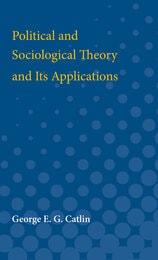
Political and Sociological Theory and Its Applications
George E.G. Catlin
University of Michigan Press, 1964
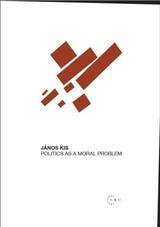
Politics as a Moral Problem
János Kis
Central European University Press, 2008
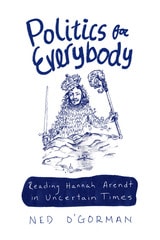
Politics for Everybody
Reading Hannah Arendt in Uncertain TimesNed O'Gorman
University of Chicago Press, 2020
Politics for Everybody
Reading Hannah Arendt in Uncertain TimesNed O'Gorman
University of Chicago Press, 2020
This is an auto-narrated audiobook edition of this book.
In this age of nearly unprecedented partisan rancor, you’d be forgiven for thinking we could all do with a smaller daily dose of politics. In his provocative and sharp book, however, Ned O’Gorman argues just the opposite: Politics for Everybody contends that what we really need to do is engage more deeply with politics, rather than chuck the whole thing out the window. In calling for a purer, more humanistic relationship with politics—one that does justice to the virtues of open, honest exchange—O’Gorman draws on the work of Hannah Arendt (1906–75). As a German-born Jewish thinker who fled the Nazis for the United States, Arendt set out to defend politics from its many detractors along several key lines: the challenge of separating genuine politics from distorted forms; the difficulty of appreciating politics for what it is; the problems of truth and judgment in politics; and the role of persuasion in politics. O’Gorman’s book offers an insightful introduction to Arendt’s ideas for anyone who wants to think more carefully
Politics of James Connolly
Kieran Allen
Pluto Press, 1990
Kieran Allen breaks this mould, assessing the founder of the Irish Marxist movement ideas from a revolutionary socialist perspective. Allen considers the strengths and weaknesses of Connolly’s revolutionary strategy, the effect of his commitment to international socialism on his nationalist loyalties and arguing that, ultimately, Connolly's enduring relevance derives from his anti-imperialism. Any socialist movement today ignores this book at its peril.
Politics of Touch
Sense, Movement, SovereigntyErin Manning
University of Minnesota Press, 2006
In Politics of Touch, Manning develops a new way to conceive the role of the senses, and of touch in particular. Exploring concepts of violence, gender, sexuality, security, democracy, and identity, she traces the ways in which touch informs and reforms the body. Specifically considering tango-a tactile, rhythmic, and improvisational dance- she foregrounds movement as the sensing body's intervention into the political. With a fresh vision and an original theoretical basis, Manning shows the ontogenetic potential of the body, and in doing so, redefines our understanding of the sense of touch in philosophical and political terms.
Erin Manning is assistant professor of fine arts at Concordia University and the author of Ephemeral Territories (Minnesota, 2003).
Politics with Beauvoir
Freedom in the EncounterLori Jo Marso
Duke University Press, 2017
Politics without Vision
Thinking without a Banister in the Twentieth CenturyTracy B. Strong
University of Chicago Press, 2012
From Plato through the nineteenth century, the West could draw on comprehensive political visions to guide government and society. Now, for the first time in more than two thousand years, Tracy B. Strong contends, we have lost our foundational supports. In the words of Hannah Arendt, the state of political thought in the twentieth and twenty-first centuries has left us effectively “thinking without a banister.”
Politics, Metaphysics, and Death
Essays on Giorgio Agamben's Homo SaceAndrew Norris, ed.
Duke University Press, 2005
The contributors analyze Agamben’s thought from the perspectives of political theory, philosophy, jurisprudence, and the history of law. They consider his work not only in relation to that of his major interlocutors—Hannah Arendt, Michel Foucault, Carl Schmitt, Walter Benjamin, and Martin Heidegger—but also in relation to the thought of Plato, Pindar, Heraclitus, Descartes, Kafka, Bataille, and Derrida. The essayists’ approaches are varied, as are their ultimate evaluations of the cogency and accuracy of Agamben’s arguments. This volume also includes an original essay by Agamben in which he considers the relation of Benjamin’s “Critique of Violence” to Schmitt’s Political Theology. Politics, Metaphysics, and Death is a necessary, multifaceted exposition and evaluation of the thought of one of today’s most important political theorists.
Contributors: Giorgio Agamben, Andrew Benjamin, Peter Fitzpatrick, Anselm Haverkamp, Paul Hegarty, Andreas Kalyvas, Rainer Maria Kiesow , Catherine Mills, Andrew Norris, Adam Thurschwell, Erik Vogt, Thomas Carl Wall