Results by title
1917 books match the query 'Law' and 83 start with p
Poverty, Law, and Divine Justice in Persian and Hellenistic Judah
Johannes Unsok Ro
SBL Press, 2018
A view of Persian and Hellenistic Judean communities through theological and socioeconomic lenses
Johannes Unsok Ro employs philological, historical, and sociological approaches to investigate the close connections between socioeconomic structures, social inequality, and theological developments in the Judean communities in Persian- and Hellenistic-era Palestine. Ro contends that competing points of view from communities of lay returnees, priestly returnees, and communities of resident Judeans and Samaritans were juxtaposed within the Hebrew Bible, which took shape during the postexilic period. By exploring issues such as the relationship between the shaping of the canon and literacy in the Judean community, the term strangers in the biblical law codes, the socioeconomic structures of Judean communities reflected in the biblical law codes, the development of the theological concept of divine punitive justice, the piety of the poor in certain psalms, and the concept of poverty in the Dead Sea Scrolls, Ro illustrates that the communities behind each text and its redactions can be ascertained through sociological and theological lenses.
Features
- Demonstration that a theology of the poor materialized orally among the poor but found written expression among Levites
- Insight into the socioeconomic and theological concerns of the authorial groups behind various biblical law codes
- A case that biblical “poverty” sometimes refers to humility and a theologically reflected consciousness of lowliness toward God
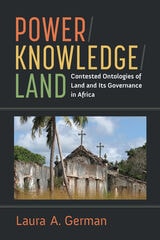
Power / Knowledge / Land
Contested Ontologies of Land and Its Governance in AfricaLaura A. German
University of Michigan Press, 2022
The 2008 outcry over the “global land grab” made headlines around the world, leading to a sustained interest in the dynamics and fate of customary land among both academics and development practitioners. In Power/Knowledge/Land, author Laura German profiles the consolidation of a global knowledge regime surrounding land and its governance within international development circles in the decade following this outcry, and the growing enrollment of previously antagonistic actors within it. Drawing theoretical insights on the inseparability of power and knowledge, German reveals the dynamics of knowledge practices that have enabled the longstanding project of commodifying customary land – and the more contemporary interests in acquiring and financializing it – to be advanced and legitimated by capturing the energies of socially progressive forces. By bringing theories of change from the emergent land governance orthodoxy into dialogue with the ethnographic evidence from across the African continent and beyond, concepts masquerading as universal and self-evident truths are provincialized, and their role in commodifying customary land and entrenching colonial futurities put on display. In doing so, the volume brings wider academic debates surrounding productive forms of power into the heart of the land grab debate, while enhancing their accessibility to a wider audience.
Power/Knowledge/Land takes current scholarly debates surrounding land grabs beyond their theoretical moorings in critical agrarian studies, political economy and globalization into contemporary debates surrounding the politics of knowledge—from theories of coloniality to ontological anthropology, thereby enabling new dynamics of the phenomenon to be revealed. The book deploys a pioneering epistemology integrating deconstructionist approaches (to reveal the tactics, truth claims and ontological assumptions of global knowledge brokers), with systematic qualitative reviews and comparative study (to contrast these dominant constructs with the evidence and reveal alternative ways of knowing “land” and practicing “security” from the ethnographic literature). This helps to reveal the Western and modernist biases in the narratives that have been advanced about women, custom, and security, revealing how the coloniality of knowledge works to grease the wheels of land takings by advancing highly provincialized constructs aligned with western interests as universal truths.
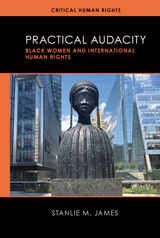
Practical Audacity
Black Women and International Human RightsStanlie James
University of Wisconsin Press, 2022
Stanlie M. James weaves narratives by and about these women throughout the history of the field, illustrating how they conceptualize, develop, and implement human rights. By centering the courage and innovative interventions of capable and visionary Black women, she places them rightfully alongside such figures as Thurgood Marshall and Charles Hamilton Houston. This volume fundamentally shifts the frame through which human rights struggles are understood, illuminating how those who witness and experience oppression have made some of the biggest contributions to building a better world.
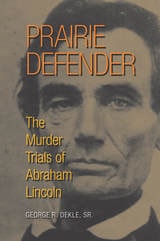
Prairie Defender
The Murder Trials of Abraham LincolnGeorge R. Dekle, Sr.
Southern Illinois University Press, 2017
2018 ISHS Annual Award Winner for a Scholarly Publication
According to conventional wisdom, Abraham Lincoln spent most of his law career collecting debt and representing railroads, and this focus made him inept at defending clients in homicide cases. In this unprecedented study of Lincoln’s criminal cases, George Dekle disproves these popular notions, showing that Lincoln was first and foremost a trial lawyer. Through careful examination of Lincoln’s homicide cases and evaluation of his legal skills, Dekle demonstrates that criminal law was an important part of Lincoln's practice, and that he was quite capable of defending people accused of murder, trying approximately one such case per year.
Dekle begins by presenting the viewpoints of not only those who see Lincoln as a perfect lawyer whose only flaw was his inability to represent the wrong side of a case but also those who believe Lincoln was a less-than-honest legal hack. The author invites readers to compare these wildly different stereotypes with the flesh-and-blood Lincoln revealed in each case described in the book, including an axe murder suit in which Lincoln assisted the prosecution, a poisoning case he refused to prosecute for $200 but defended for $75, and a case he won by proving that a supposed murder victim was actually still alive.
For each case Dekle covers, he first tells the stories of the feuds, arguments, and insults that led to murder and other criminal activity, giving a gripping view of the seamy side of life in nineteenth-century Illinois. Then he traces the course of the pretrial litigation, describes the trials and the various tactics employed in the prosecution and defense, and critiques the performance of both Lincoln and his adversaries.
Dekle concludes that Lincoln was a competent, diligent criminal trial lawyer who knew the law, could argue it effectively to both judge and jury, and would use all lawful means to defend clients whether he believed them to be innocent or guilty. His trial record shows Lincoln to have been a formidable defense lawyer who won many seemingly hopeless cases through his skill as a courtroom tactician, cross-examiner, and orator. Criminal defendants who could retain Lincoln as a defense attorney were well represented, and criminal defense attorneys who sought him as co-counsel were well served. Providing insight into both Lincoln’s legal career and the culture in which he practiced law, Prairie Defender resolves a major misconception concerning one of our most important historical figures.
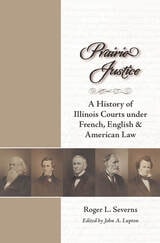
Prairie Justice
A History of Illinois Courts under French, English, and American LawRoger L. Severns. Edited by John A. Lupton
Southern Illinois University Press, 2015
Winner, ISHS Superior Achievement Award for a Scholarly Publication, 2016
A concise legal history of Illinois through the end of the nineteenth century, Prairie Justice covers the region’s progression from French to British to early American legal systems, which culminated in a unique body of Illinois law that has influenced other jurisdictions. Written by Roger L. Severns in the 1950s and published in serial form in the 1960s, Prairie Justice is available now for the first time as a book, thanks to the work of editor John A. Lupton, an Illinois and legal historian who also contributed an introduction.
Illinois’ legal development demonstrates the tension between two completely different European legal systems, between river communities and prairie towns, and between agrarian and urban interests. Severns uses several rulings—including a reconstitution of the Supreme Court in 1824, slavery-related cases, and the impeachment of a Supreme Court justice—to examine political movements in Illinois and their impact on the local judiciary. Through legal decisions, the Illinois judiciary became an independent, co-equal branch of state government. By the mid-nineteenth century, Illinois had established itself as a leading judicial authority, influencing not only the growing western frontier but also the industrialized and farming regions of the country. With a close eye for detail, Severns reviews the status of the legal profession during the 1850s by looking new members of the Court, the nostalgia of circuit riding, and how a young lawyer named Abraham Lincoln rose to prominence.
Illinois has a rich judicial history, but that history has not been adequately documented until now. With the publication of Prairie Justice, those interested in Illinois legal history finally have a book that covers the development of the state’s judiciary in its formative years.
Prejudicial Appearances
The Logic of American Antidiscrimination LawRobert C. Post, with K. Anthony Appiah, Judith Butler, Thomas C. Grey, and Reva B. Siegel
Duke University Press, 2001
Four distinguished commentators respond to Post’s provocative essay. Each adopts a distinctive perspective. K. Anthony Appiah investigates the philosophical logic of stereotyping and of equality. Questioning whether the law ought to endorse any social practices that define persons, Judith Butler explores the tension between sociological and postmodern approaches to antidiscrimination law. Thomas C. Grey examines whether Post’s proposal can be reconciled with the values of the rule of law. And Reva B. Siegel applies critical race theory to query whether antidiscrimination law’s reshaping of race and gender should best be understood in terms of practices of subordination and stratification.
By illuminating the consequential rhetorical maneuvers at the heart of contemporary U.S. antidiscrimination law, Prejudical Appearances forces readers to reappraise the relationship between courts of law and social behavior. As such, it will enrich scholars interested in the relationships between law, rhetoric, postmodernism, race, and gender.
Pressing the Police and Policing the Press
The History and Law of the U.S. Press-Police RelationshipScott Memmel
University of Missouri Press, 2024
What transpired during this troubled time cast a bright light on the contemporary relationship between the press and police in the United States. The relationship between these two fundamental institutions is, however, a long and complicated one, dating back to colonial British North America. In the mid-19th century, (1830s–1850s) both the press and the police began to take their modern forms, and since then have continued to develop, routinely interacting with each other as journalists and police officers often found themselves responding to the same crimes and events. At times, members of both institutions managed to co-exist or even cooperate and made efforts to help one another, while at other times they butted heads to the point of conflict, the professional boundaries between journalists and police officers seemingly blurred.
As both the press and the police have fallen under deep scrutiny in more modern times, the present moment marks what is, perhaps, an opportune time to focus on the political, economic, social, and technological problems they face. In “Pressing the Police and Policing the Press,” Scott Memmel offers the first book-length study of the history and legal landscape of the press-police relationship. Each chapter focuses on interactions between the press and the police during a particular era, introducing relevant societal context and how both institutions evolved and responded to that context. Memmel concludes his study with recommendations on how, going forward, the press and the police might work together to tackle some of the similar issues they face and better serve the public.
Presumed Incompetent
The Intersections of Race and Class for Women in Academiaedited by Gabriella Gutiérrez y Muhs, Yolanda Flores Niemann, Carmen G. González, and Angela P. Harris
Utah State University Press, 2012
Presumed Incompetent is a pathbreaking account of the intersecting roles of race, gender, and class in the working lives of women faculty of color. Through personal narratives and qualitative empirical studies, more than 40 authors expose the daunting challenges faced by academic women of color as they navigate the often hostile terrain of higher education, including hiring, promotion, tenure, and relations with students, colleagues, and administrators. The narratives are filled with wit, wisdom, and concrete recommendations, and provide a window into the struggles of professional women in a racially stratified but increasingly multicultural America.
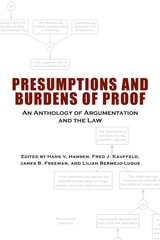
Presumptions and Burdens of Proof
An Anthology of Argumentation and the LawEdited by Hans V. Hansen, Fred J. Kauffeld, James B. Freeman, and Lilian Bermejo-Luque
University of Alabama Press, 2019
An anthology of the most important historical sources, classical and modern, on the subjects of presumptions and burdens of proof
In the last fifty years, the study of argumentation has become one of the most exciting intellectual crossroads in the modern academy. Two of the most central concepts of argumentation theory are presumptions and burdens of proof. Their functions have been explicitly recognized in legal theory since the middle ages, but their pervasive presence in all forms of argumentation and in inquiries beyond the law—including politics, science, religion, philosophy, and interpersonal communication—have been the object of study since the nineteenth century.
However, the documents and essays central to any discussion of presumptions and burdens of proof as devices of argumentation are scattered across a variety of remote sources in rhetoric, law, and philosophy. Presumptions and Burdens of Proof: An Anthology of Argumentation and the Law brings together for the first time key texts relating to the history of the theory of presumptions along with contemporary studies that identify and give insight into the issues facing students and scholars today.
The collection’s first half contains historical sources and begins with excerpts from Aristotle’s Topics and goes on to include the locus classicus chapter from Bishop Whately’s crucial Elements of Rhetoric as well as later reactions to Whately’s views. The second half of the collection contains contemporary essays by contributors from the fields of law, philosophy, rhetoric, and argumentation and communication theory. These essays explore contemporary understandings of presumptions and burdens of proof and their role in numerous contexts today. This anthology is the definitive resource on the subject of these crucial rhetorical modes and will be a vital resource to all scholars of communication and rhetoric, as well as legal scholars and practicing jurists.
Pretrial Discovery and the Adversary System
William A. Glaser
Russell Sage Foundation, 1968
Privacy and the Past
Research, Law, Archives, EthicsLawrence, Susan C
Rutgers University Press, 2016
Privacy at Risk
The New Government Surveillance and the Fourth AmendmentChristopher Slobogin
University of Chicago Press, 2007
Applying the Fourth Amendment’s prohibition on unreasonable searches and seizures, Slobogin argues that courts should prod legislatures into enacting more meaningful protection against government overreaching. In setting forth a comprehensive framework meant to preserve rights guaranteed by the Constitution without compromising the government’s ability to investigate criminal acts, Slobogin offers a balanced regulatory regime that should intrigue everyone concerned about privacy rights in the digital age.
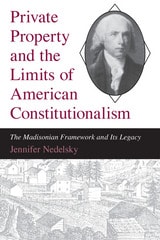
Private Property and the Limits of American Constitutionalism
The Madisonian Framework and Its LegacyJennifer Nedelsky
University of Chicago Press, 1990
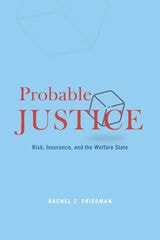
Probable Justice
Risk, Insurance, and the Welfare StateRachel Z. Friedman
University of Chicago Press, 2020
Probable Justice traces a history of social insurance from the eighteenth century to today, from the earliest ideas of social accountability through the advanced welfare state of collective responsibility and risk. At the heart of Rachel Z. Friedman’s investigation is a study of how probability theory allows social insurance systems to flexibly measure risk and distribute coverage. The political genius of social insurance, Friedman shows, is that it allows for various accommodations of needs, risks, financing, and political aims—and thereby promotes security and fairness for citizens of liberal democracies.
Products Liability in the Automobile Industry
A Study in Strict Liability and Social ControlCornelius Gillam
University of Minnesota Press, 1960
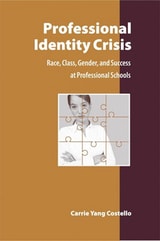
Professional Identity Crisis
Race, Class, Gender, and Success at Professional SchoolsCarrie Yang Costello
Vanderbilt University Press, 2006
The author spent over 400 hours observing how first-year students are socialized in two very different environments, Boalt School of Law and the School of Social Welfare at UC Berkeley, watching how they adapted to different expectations of how to speak, dress, and behave in the classroom.
Costello found that students who were female, of color, disabled, or poor were not underqualified compared with their privileged peers. Nor did the research uncover intentional bigotry. Instead, the disproportionate success of white men can be explained by the fact that they are more likely to acquire appropriate professional identities swiftly, with little inner conflict. Students from less privileged backgrounds, however, suffered from "identity dissonance." For example, Jasmine, a Filipino student from Los Angeles, explained, "In the legal culture you have to adopt a different way of being, a different vocabulary and way to carry yourself . . . That's how I got this far. And when I go home, if I act the way I do here, they won't get it. My cousins and my friends say, 'You're kind of whitewashed.' And when I come back here I have to get back my law style."
Profiles in Judicial Excellence
Territorial and Supreme Court Justices of NevadaDavid A. Hardy
University of Nevada Press, 2025
Until the publication of Judge David A. Hardy’s Profiles in Judicial Excellence: Territorial and Supreme Court Justices of Nevada, there has been no single source containing biographies of these influential figures from the state’s history from 1861 to 1997. Hardy curates various sources and presents profiles of these judges in sequential order of their service. He also examines the influence of territorial judges in the 1864 vote for statehood. The Nevada judiciary has played an integral, but often unrecognized, role in shaping the unique character of the Silver State.

Progressive Constitutionalism
Reconstructing the Fourteenth AmemdmentRobin L. West
Duke University Press, 1994
West shows how the "equal protection" clause, far from insulating the private spheres of culture, market, and home life, as is commonly held, directly targets abuses of power within those spheres. She develops a number of arguments for the modern relevance of this understanding, from the failure of the state to provide equal protection against private domestic violence, permitting a "private sovereignty" of patriarchal power within the home, to the the state’s failure to provide equal protection against material deprivation, allowing "private sovereignty" between economically privileged and desperate people in private markets.
West’s argument extends to the "liberty" prong of the due process clause, seen here as a protection of the positive, not negative, liberty of citizens, covering rights in such typically controversial areas as welfare, education, and domestic safety. This interpretation recasts a number of contemporary constitutional issues, such as affirmative action and hate speech, and points to very different problems—notably private, unchecked criminal violence and extreme economic deprivation—as the central constitutional dilemmas of our day.
Progressive Constitutionalism urges a substantive, institutional, and jurisprudential reorientation of our understanding of the Fourteenth Amendment, one that would necessarily be pursued through Congressional rather than judicial channels. In doing so, with attention to history and both feminist and critical race scholarship, it should reinvigorate our politics and our constitutional conversations—and, perhaps, point us toward a more just society.
Prohibition, the Constitution, and States' Rights
Sean Beienburg
University of Chicago Press, 2019
Sean Beienburg recovers a largely forgotten constitutional debate, revealing how Prohibition became a battlefield on which skirmishes of American political development, including the debate over federalism and states’ rights, were fought. Beienburg focuses on the massive extension of federal authority involved in Prohibition and the passage of the Eighteenth Amendment, describing the roles and reactions of not just Congress, the presidents, and the Supreme Court but political actors throughout the states, who jockeyed with one another to claim fidelity to the Tenth Amendment while reviling nationalism and nullification alike. The most comprehensive treatment of the constitutional debate over Prohibition to date, the book concludes with a discussion of the parallels and differences between Prohibition in the 1920s and debates about the legalization of marijuana today.
Prometheus Reimagined
Technology, Environment, and Law in the Twenty-first CenturyAlbert C. Lin
University of Michigan Press, 2013
Technologies such as synthetic biology, nanotechnology, artificial intelligence, and geoengineering promise to address many of our most serious problems, yet they also bring environmental and health-related risks and uncertainties. Moreover, they can come to dominate global production systems and markets with very little public input or awareness. Existing governance institutions and processes do not adequately address the risks of new technologies, nor do they give much consideration to the concerns of persons affected by them.
Instead of treating technology, health, and the environment as discrete issues, Albert C. Lin argues that laws must acknowledge their fundamental relationship, anticipating both future technological developments and their potential adverse effects. Laws should encourage international cooperation and the development of common global standards, while allowing for flexibility and reassessment.
Promise of Justice
Essays on Brown v. Board of EducationMac A. Stewart
The Ohio State University Press, 2008
Psychiatric Malpractice
Stories of Patients, Psychiatrists, and the LawKelley, James L
Rutgers University Press, 1996
• Two weeks after Johnny Moore was discharged from a psychiatric hospital, the deeply troubled teenager took a lethal overdose of the antidepressant prescribed by his psychiatrist.
• Dennis Gould suffered from paranoid schizophrenia. He let a streetcar cut off his right arm rather than carry out his divine mission to kill his ex-girlfriend, Shelley Rotman; three years later––while under psychiatric care and after several hospitalizations––Gould stabbed the young woman to death with his left arm.
• After seven months of psychotherapy as his only treatment in a private psychiatric hospital, Raphael Osheroff’s symptoms of the agitated depression that had destroyed his medical practice and personal life were more severe than ever. At a second hospital, Osheroff was given the antidepressant drugs he had been asking for––and he rapidly improved.
• Joan Barkley went to Dr. Jonathan Fox for help in overcoming her addiction to Darvon. After a year of therapy, the twice-weekly sessions turned into intense sexual encounters, which continued for two years.
James Kelley tells the true stories of people who sought help from psychiatrists and ended up suing them for malpractice. These tales are compelling, tragic, and sometimes bizarre. They offer a unique view into a relationship that is normally confidential and caring––but can be catastrophic when it goes wrong. Kelley discusses several cases that received national attention: former Reagan administration press secretary James Brady's suit against the psychiatrist who had been treating John Hinckley; the Tarasoff decision that established the psychiatrist’s duty to warn potential victims of a patient’s threats; and the disciplinary proceedings against Dr. Margaret Bean-Bayog for her unusual “mothering” treatment of Paul Lozano.
Kelley accompanies detailed accounts of courtroom clashes––based on court records––with clear, even-handed treatments of four kinds of psychiatric malpractice cases: a patient’s suicide, a patient’s violence against other people, a psychotherapist's sexual misconduct, and the use of unconventional treatments. With a wealth of examples, he explains the role of psychiatrists as expert witnesses against each other, the difficulties of predicting the outcomes of these suits, and the balances psychiatrists and judges have to strike between the duties owed to patients, on the one hand, and to society on the other.
Whether you identify with the patients or the psychiatrists, you will find these tales unforgettable. Kelley writes in nontechnical language for the general reader, stressing the human elements. His lucid analyses of key, current issues make his book essential reading for professionals in mental health or law––and for anyone contemplating a malpractice suit.

Public Documents from Sinnar
Jay Spaulding
Michigan State University Press, 1989
This selection of Arabic and English translations illuminates the changes of eighteenth-century government in the northern Nile Valley of Sudan, and provides reliable chronological points of reference for the history of the region.
The documents offered in this volume, including charter grants of land and privilege, administrative letters, judicial rulings, and other official government records, date form 1702 to 1820. This period marks the apogee of the wealth, power, and geographical extent of the realm of the Funji kings of Sinnar who reigned over much of the Sudan from about 1500 until the Turkish colonial conquest of 1821.
These records document with concrete precision and eloquence the dissolution of the agrarian social order of an old African kingdom under the corroding influence of intrusive Mediterranean commercial practices and culture. They reveal the Sudan's legacy of a traditionally weak government vulnerable to manipulation or conquest by foreign powers and a divided and impoverished society dominated by a minority of urban interests.
Public Subsidy, Private Accumulation
The Political Economy of Singapore's Public HousingBeng Huat Chua
National University of Singapore Press, 2024
The achievement of Singapore’s national public housing program is impressive by any standard. Within a year of its first election victory in 1959, the People's Action Party began to deliver on its promises. By the 1980s, 85% of the population had been rehoused in modern flats. Now, decades later, the provision of public housing shapes Singapore's environment. The standard accounts of this remarkable transformation leave many questions unanswered, from the historical to urgent matters of current policy. Why was housing such a priority in the 1960s? How did the provision of social welfare via public housing shape Singapore's industrialization and development over the last 50 years? Looking forward, can the HDB continue to be both a source of affordable housing for young families and a mechanism for retirement savings? What will happen when 99-year leases expire?
Public Subsidy, Private Accumulation is a culmination of Chua Beng Huat's study of Singapore's public housing system, its dynamics, and the ways it functions in Singapore's politics. The book will be of interest to citizens and to scholars of the political economy of Asian development, social welfare provision, and Singapore.
Pulled Over
How Police Stops Define Race and CitizenshipCharles R. Epp, Steven Maynard-Moody, and Donald P. Haider-Markel
University of Chicago Press, 2014
Pulled Over deftly traces the strange history of the investigatory police stop, from its discredited beginning as “aggressive patrolling” to its current status as accepted institutional practice. Drawing on the richest study of police stops to date, the authors show that who is stopped and how they are treated convey powerful messages about citizenship and racial disparity in the United States. For African Americans, for instance, the experience of investigatory stops erodes the perceived legitimacy of police stops and of the police generally, leading to decreased trust in the police and less willingness to solicit police assistance or to self-censor in terms of clothing or where they drive. This holds true even when police are courteous and respectful throughout the encounters and follow seemingly colorblind institutional protocols. With a growing push in recent years to use local police in immigration efforts, Hispanics stand poised to share African Americans’ long experience of investigative stops.
Punctuation and Persuasion
Patrick Barry
Michigan Publishing Services, 2022
With a little knowledge and a lot of practice, you can do more than just sound more professional when you skillfully use commas, semicolons, and other forms of punctuation. You can, importantly, become more persuasive.
That’s what students who have taken Professor Patrick Barry’s classes at the University of Michigan Law School, the University of Chicago Law School, and the UCLA School of Law have learned, as have the over 100,000 people who have enrolled in his online course “Good with Words: Writing and Editing” on the educational platforms Coursera and FutureLearn.
Now, thanks to this book, you can undergo that same rhetorical transformation. Punctuation doesn’t have to be a pain point. When properly mastered, it can be a powerful tool for all kinds of advocates.
Punishment and Culture
Philip Smith
University of Chicago Press, 2008
Punishment and Culture traces three centuries of the history of punishment, looking in detail at issues ranging from public executions and the development of the prison to Jeremy Bentham’s notorious panopticon and the invention of the guillotine. Smith contends that each of these attempts to achieve sterile bureaucratic control was thwarted as uncontrollable cultural forces generated alternative visions of heroic villains, darkly gothic technologies, and sacred awe. Moving from Andy Warhol to eighteenth-century highwaymen to Orwell’s 1984, Smith puts forward a dazzling account of the cultural landscape of punishment. His findings will fascinate students of sociology, history, criminology, law, and cultural studies.
Punishment and Inequality in America
Bruce Western
Russell Sage Foundation, 2006
Punishment and Modern Society
A Study in Social TheoryDavid Garland
University of Chicago Press, 1990
"Punishment and Modern Society is an outstanding delineation of the sociology of punishment. At last the process that is surely the heart and soul of criminology, and perhaps of sociology as well—punishment—has been rescued from the fringes of these 'disciplines'. . . . This book is a first-class piece of scholarship."—Graeme Newman, Contemporary Sociology
"Garland's treatment of the theorists he draws upon is erudite, faithful and constructive. . . . Punishment and Modern Society is a magnificent example of working social theory."—John R. Sutton, American Journal of Sociology
"Punishment and Modern Society lifts contemporary penal issues from the mundane and narrow contours within which they are so often discussed and relocates them at the forefront of public policy. . . . This book will become a landmark study."—Andrew Rutherford, Legal Studies
"This is a superbly intelligent study. Its comprehensive coverage makes it a genuine review of the field. Its scholarship and incisiveness of judgment will make it a constant reference work for the initiated, and its concluding theoretical synthesis will make it a challenge and inspiration for those undertaking research and writing on the subject. As a state-of-the-art account it is unlikely to be bettered for many a year."—Rod Morgan, British Journal of Criminology
Winner of both the Outstanding Scholarship Award of the Crime and Delinquency Division of the Society for the Study of Social Problems and the Distinguished Scholar Award from the American Sociological Association's Crime, Law, and Deviance Section
Punishment and Political Order
Keally McBride
University of Michigan Press, 2007
Most of us think of punishment as an ugly display of power. But punishment also tells us something about the ideals and aspirations of a people and their government. How a state punishes reveals whether or not it is confident in its own legitimacy and sovereignty. Punishment and Political Order examines the questions raised by the state’s exercise of punitive power—from what it is about human psychology that desires sanction and order to how the state can administer pain while calling for justice. Keally McBride's book demonstrates punishment's place at the core of political administration and the stated ideals of the polity.
"From start to finish this is a terrific, engaging book. McBride offers a fascinating perspective on punishment, calling attention to its utility in understanding political regimes and their ideals. She succeeds in reminding us of the centrality of punishment in political theory and, at the same time, in providing a framework for understanding contemporary events. I know of no other book that does as much to make the subject of punishment so compelling."
—Austin Sarat, Amherst College
"Punishment and Political Order will be welcome reading for anyone interested in understanding law in society, punishment and political spectacle, or governing through crime control. This is a clear, accessible, and persuasive examination of punishment—as rhetoric and reality. Arguing that punishment is a complex product of the social contract, this book demonstrates the ways in which understanding the symbolic power and violence of the law provides analytical tools for examining the ideological function of prison labor today, as well as the crosscutting and contingent connections between language and identity, legitimation and violence, sovereignty and agency more generally."
—Bill Lyons, Director, Center for Conflict Management, University of Akron
"Philosophical explorations of punishment have often stopped with a theory of responsibility. McBride's book moves well beyond this. It shows that the problem of punishment is a central issue for any coherent theory of the state, and thus that punishment is at the heart of political theory. This is a stunning achievement."
—Malcolm M. Feeley, University of California at Berkeley
Keally McBride is Assistant Professor of Politics at the University of San Francisco.
Punitive Damages
How Juries DecideCass R. Sunstein, Reid Hastie, John W. Payne, David A. Schkade, and W. Kip Viscu
University of Chicago Press, 2002
But how do juries actually make decisions about punitive damages? To find out, the authors-experts in psychology, economics, and the law-present the results of controlled experiments with more than 600 mock juries involving the responses of more than 8,000 jury-eligible citizens. Although juries tended to agree in their moral judgments about the defendant's conduct, they rendered erratic and unpredictable dollar awards. The experiments also showed that instead of moderating juror verdicts, the process of jury deliberation produced a striking "severity shift" toward ever-higher awards. Jurors also tended to ignore instructions from the judges; were influenced by whatever amount the plaintiff happened to request; showed "hindsight bias," believing that what happened should have been foreseen; and penalized corporations that had based their decisions on careful cost-benefit analyses. While judges made many of the same errors, they performed better in some areas, suggesting that judges (or other specialists) may be better equipped than juries to decide punitive damages.
Using a wealth of new experimental data, and offering a host of provocative findings, this book documents a wide range of systematic biases in jury behavior. It will be indispensable for anyone interested not only in punitive damages, but also jury behavior, psychology, and how people think about punishment.
Pursuit of Justices
Presidential Politics and the Selection of Supreme Court NomineesDavid Alistair Yalof
University of Chicago Press, 1999
Yalof draws on the papers of seven modern presidents, from Truman to Reagan, and firsthand interviews with key figures, such as Ramsey Clark, Edwin Meese, and President Gerald Ford. He documents and analyzes the selection criteria these presidents used, the pool of candidates from which they chose, their strategies, and the political pressures affecting their decisions, both successes and failures. Yalof also disputes much conventional wisdom about the selection process, including the widely held view that presidents choose nominees primarily to influence future decisions of the high court. In a substantial epilogue, Yalof offers insightful observations about the selections of Presidents George Bush and Bill Clinton.
By focusing on a neglected area of presidential politics, Yalof offers a fascinating and unprecedented glimpse into the intricate world of executive branch decisionmaking and the Supreme Court appointment process as a whole.
Winner of the 2000 Richard E. Neustadt Award for Best Book on the American Presidency
Putting Inequality in Context
Class, Public Opinion, and Representation in the United StatesChristopher Ellis
University of Michigan Press, 2017
Christopher Ellis argues citizens’—and legislators’—views of class politics are driven by lived experience in particular communities. While some experience is formally political, on an informal basis citizens learn a great deal about their position in the broader socioeconomic spectrum and the social norms governing how class intersects with day-to-day life. These factors are important for policymakers, since most legislators do not represent “the public” at large, but specific constituencies.
Focusing on U.S. congressional districts as the contextual unit of interest, Ellis argues individuals’ political behavior cannot be separated from their environment, and shows how income’s role in political processes is affected by the contexts in which citizens and legislators interact. Political inequality exists in the aggregate, but it does not exist everywhere. It is, rather, a function of specific arrangements that depress the political influence of the poor. Identifying and understanding these factors is a crucial step in thinking about what reforms might be especially helpful in enhancing equality of political voice.