Results by title
5448 books match the query 'History and criticism' and 305 start with p

Pilgrims To The Wild
John P O'Grady
University of Utah Press, 1993
Pilgrims to the Wild is a survey of American writers who have responded to their encounters with the natural world. Ranging in its treatment from Thoreau’s important but neglected essay, 'Walking,' to the exuberant letters of the young artist Everett Ruess (who disappeared in the Escalante canyonlands), this is a broadly based exploration that brings to bear Eastern and Western classical philosophy, as well as contemporary critical theory, on a distinctive tradition of American Writing—those works concerned with the human relationship to the nonhuman world.
In addition to offering a fresh interpretation of classic authors such a Thoreau and Muir, this book introduces readers to the less widely known but equally fascinating writers Clarence King and Mary Austin.
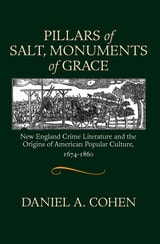
Pillars of Salt, Monuments of Grace
New England Crime Literature and the Origins of American Popular Culture, 1674-1860Daniel A. Cohen
University of Massachusetts Press, 2006
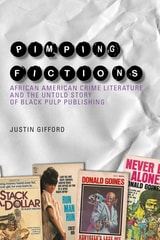
Pimping Fictions
African American Crime Literature and the Untold Story of Black Pulp PublishingJustin Gifford
Temple University Press, 2013
Gifford draws from an impressive array of archival materials to provide a first-of-its-kind literary and cultural history of this distinctive genre. He evaluates the artistic and symbolic representations of pimps, sex-workers, drug dealers, and political revolutionaries in African American crime literature-characters looking to escape the racial containment of prisons and the ghetto.
Gifford also explores the struggles of these black writers in the literary marketplace, from the era of white-owned publishing houses like Holloway House-that fed books and magazines like Players to eager black readers-to the contemporary crop of African American women writers reclaiming the genre as their own.
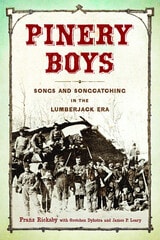
Pinery Boys
Songs and Songcatching in the Lumberjack EraEdited by Franz Rickaby with Gretchen Dykstra and James P. Leary
University of Wisconsin Press, 2017
Pinery Boys now incorporates, commemorates, contextualizes, and complements Rickaby's early work. It includes an introduction and annotations throughout by eminent folklore scholar James P. Leary and an engaging, impressively researched biography by Rickaby's granddaughter Gretchen Dykstra. Central to this edition are Rickaby's own introduction and the original fifty-one songs that he published—including "Jack Haggerty's Flat River Girl," "The Little Brown Bulls," "Ole from Norway," "The Red Iron Ore," and "Morrissey and the Russian Sailor"—plus fourteen additional songs selected to represent the varied collecting Rickaby did beyond the lumber camps.
Supplemented by historical photographs, Pinery Boys fully reveals Franz Rickaby as a visionary artist and scholar and provides glimpses into the past lives of woods poets and singers.
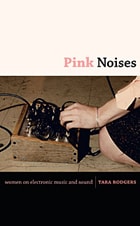
Pink Noises
Women on Electronic Music and SoundTara Rodgers
Duke University Press, 2010
Contemporary electronic music practices are illuminated through the stories of women artists of different generations and cultural backgrounds. They include the creators of ambient soundscapes, “performance novels,” sound sculptures, and custom software, as well as the developer of the Deep Listening philosophy and the founders of the Liquid Sound Lounge radio show and the monthly Basement Bhangra parties in New York. These and many other artists open up about topics such as their conflicted relationships to formal music training and mainstream media representations of women in electronic music. They discuss using sound to work creatively with structures of time and space, and voice and language; challenge distinctions of nature and culture; question norms of technological practice; and balance their needs for productive solitude with collaboration and community. Whether designing and building modular synthesizers with analog circuits or performing with a wearable apparatus that translates muscle movements into electronic sound, these artists expand notions of who and what counts in matters of invention, production, and noisemaking. Pink Noises is a powerful testimony to the presence and vitality of women in electronic music cultures, and to the relevance of sound to feminist concerns.
Interviewees: Maria Chavez, Beth Coleman (M. Singe), Antye Greie (AGF), Jeannie Hopper, Bevin Kelley (Blevin Blectum), Christina Kubisch, Le Tigre, Annea Lockwood, Giulia Loli (DJ Mutamassik), Rekha Malhotra (DJ Rekha), Riz Maslen (Neotropic), Kaffe Matthews, Susan Morabito, Ikue Mori, Pauline Oliveros, Pamela Z, Chantal Passamonte (Mira Calix), Maggi Payne, Eliane Radigue, Jessica Rylan, Carla Scaletti, Laetitia Sonami, Bev Stanton (Arthur Loves Plastic), Keiko Uenishi (o.blaat)
Pink Pirates
Contemporary American Women Writers and CopyrightCaren Irr
University of Iowa Press, 2010
Today, copyright is everywhere, surrounded by a thicket of no trespassing signs that mark creative work as private property. Caren Irr’s Pink Pirates asks how contemporary novelists—represented by Ursula Le Guin, Andrea Barrett, Kathy Acker, and Leslie Marmon Silko—have read those signs, arguing that for feminist writers in particular copyright often conjures up the persistent exclusion of women from ownership. Bringing together voices from law schools, courtrooms, and the writer's desk, Irr shows how some of the most inventive contemporary feminist novelists have reacted to this history.
Explaining the complex, three-century lineage of Anglo-American copyright law in clear, accessible terms and wrestling with some of copyright law's most deeply rooted assumptions, Irr sets the stage for a feminist reappraisal of the figure of the literary pirate in the late twentieth century—a figure outside the restrictive bounds of U.S. copyright statutes.
Going beyond her readings of contemporary women authors, Irr’s exhaustive history of how women have fared under intellectual property regimes speaks to broader political, social, and economic implications and engages digital-era excitement about the commons with the most utopian and materialist strains in feminist criticism.
Pioneers of the Blues Revival
Steve Cushing
University of Illinois Press, 2014
Opinionated and territorial, the American, British, and French interviewees provide fascinating first-hand accounts of the era and movement. Experts including Paul Oliver, Gayle Dean Wardlow, Sam Charters, Ray Flerledge, Paul Oliver, Richard K. Spottswood, and Pete Whelan chronicle in their own words their obsessive early efforts at cataloging blues recordings and retrace lifetimes spent loving, finding, collecting, reissuing, and producing records. They and nearly a dozen others recount relationships with blues musicians, including the discoveries of prewar bluesmen Mississippi John Hurt, Son House, Skip James, and Bukka White, and the reintroduction of these musicians and many others to new generations of listeners. The accounts describe fieldwork in the South, renew lively debates, and tell of rehearsals in Muddy Waters's basement and randomly finding Lightning Hopkins's guitar in a pawn shop.
Blues scholar Barry Lee Pearson provides a critical and historical framework for the interviews in an introduction.
Pioneers of the Blues Revival
Steve Cushing
University of Illinois Press, 2018
Pirate Novels
Fictions of Nation Building in Spanish AmericaNina Gerassi-Navarro
Duke University Press, 1999
Beginning with an overview of the history of piracy, Gerassi-Navarro traces the historical icon of the pirate through colonial-era chronicles before exploring a group of nineteenth-century Mexican, Colombian, and Argentine novels. She argues that the authors of these novels, in their reconstructions of the past, were less interested in accurate representations than in using their narratives to discuss the future of their own countries. In reading these pirate narratives as metaphors for the process of nation building in Spanish America, Gerassi-Navarro exposes the conflicting strains of a complex culture attempting to shape that future. She shows how these pirate stories reflect the on-going debates that marked the consolidation of nationhood, as well as the extent to which the narratives of national identity in Spanish America are structured in relation to European cultures, and the ways in which questions of race and gender were addressed.
Providing new readings of the cultural and political paradigms that marked the literary production of nineteenth-century Spanish America, Pirate Novels uniquely expands the range of texts usually examined in the study of nation-building. It will interest literary scholars generally as well as those engaged in Latin American, colonial, and postcolonial studies.

Pistol Packin' Mama
Aunt Molly Jackson and the Politics of FolksongShelly Romalis
University of Illinois Press, 1999
A coal miner's daughter, Jackson grew up in eastern Kentucky, married a miner, and became a midwife, labor activist, and songwriter. Fusing hard experience with the rich Appalachian musical tradition, her songs became weapons of struggle. In 1931, at age fifty, she was "discovered" and brought north. There, she was sponsored and befriended by an illustrious circle of left-wing intellectuals and musicians that included Theodore Dreiser, Alan Lomax, and Charles and Pete Seeger. Along with Sarah Ogan Gunning, Jim Garland (two of Aunt Molly's half-siblings), Woody Guthrie, Leadbelly, and other folk musicians, Jackson served as a cultural broker who linked the rural working poor to big-city, left-wing activism.
Shelly Romalis combines interviews with archival materials to construct an unforgettable portrait of an Appalachian woman who remained radical, raucous, proud, poetic, offensive, self-involved, and in spirit the "real" pistol packin' mama of the song.
Pitch of Poetry
Charles Bernstein
University of Chicago Press, 2016
Subjects range across Holocaust representation, Occupy Wall Street, and the figurative nature of abstract art. Detailed overviews of formally inventive work include essays on—or “pitches” for—a set of key poets, from Gertrude Stein and Robert Creeley to John Ashbery, Barbara Guest, Larry Eigner, and Leslie Scalapino. Bernstein also reveals the formative ideas behind the magazine L=A=N=G=U=A=G=E. The final section, published here for the first time, is a sweeping work on the poetics of stigma, perversity, and disability that is rooted in the thinking of Edgar Allan Poe, Emily Dickinson, Ralph Waldo Emerson, and William Blake.
Pitch of Poetry makes an exhilarating case for what Bernstein calls echopoetics: a poetry of call and response, reason and imagination, disfiguration and refiguration.
Pitfalls of Prestige
Black Women and Literary RecognitionLaura Elizabeth Vrana
The Ohio State University Press, 2024
Winner, 2025 College Language Association Book Award
From 1987, when Rita Dove won the Pulitzer Prize for Poetry, to 2021, when Amanda Gorman skyrocketed to celebrity status after performing during Biden’s inauguration and the Super Bowl, Black women have seemingly attained secure, stable positions at the forefront of American poetry. But this prominence comes at a price. As figures like Dove and Elizabeth Alexander have become well known, receiving endorsements and gaining visible platforms from major prizes, academic institutions, and publishing houses, the underlying terms of evaluation that greet Black women’s poetics often remain superficial, reflecting efforts to co-opt and contain rather than meaningfully consider new voices and styles. In Pitfalls of Prestige, Laura Elizabeth Vrana surveys how developments in American literary institutions since 1980 have shaped—and been shaped by—Black women poets. Grappling with the refulgent works of the most acclaimed contemporary figures alongside those of lesser-known poets, Vrana both elucidates how seeming gestures of inclusion can actually result in constraining Black women poets’ works and also celebrates how these writers draw on a rich lineage and forge alternative communities in order to craft continually innovative modes of transgressing such limits, on the page and in life.
Pivotal Voices, Era of Transition
Toward a 21st Century PoeticsRigoberto González
University of Michigan Press, 2017
This book fills a glaring gap in existing poetry scholarship by focusing exclusively on writers of color, and particularly on Latino poetry. González makes important observations about the relevance, urgency, and exquisite craft of the work coming from writers who represent marginalized communities. His insightful connections between the Latino, African American, Asian American, and Native American literatures persuasively position them as a collective movement critiquing, challenging, and reorienting the direction of American poetry with their nuanced and politicized verse. González’s inclusive vision covers a wide landscape of writers, opening literary doors for sexual and ethnic minorities.
Place Matters
Morgan, Susan
Rutgers University Press, 1996
"Morgan has written an important and original work that presents a well-substantiated challenge to many recent studies of 'colonial discourse'."--Nancy L. Paxton,
Susan Morgan's study of materials and regions, previously neglected in contemporary postcolonial studies, begins with the transforming premise that "place matters." Concepts derived from writings about one area of the world cannot simply be transposed to another area, in some sort of global theoretical move. Moreover, place in the discourse of Victorian imperialism is a matter of gendered as well as geographic terms. Taking up works by Anna Forbes and Marianne North on the Malay Archipelago, by Margaret Brooke and Harriette McDougall on Sarawak, by Isabella Bird and Emily Innes on British Malaya, by Anna Leonowens on Siam, Morgan also makes extensive use of theorists whose work on imperialism in Southeast Asia is unfamiliar to most American academics.
This vivid examination of a different region and different writings emphasizes that in Victorian literature there was no monolithic imperialist location, authorial or geographic. The very notion of a ‘colony’ or an ‘imperial presence’ in Southeast Asia is problematic. Morgan is concerned with marking the intersections of particular Victorian imperial histories and constructions of subjectivity. She argues that specific places in Southeast Asia have distinctive, and differing, masculine imperial rhetorics. It is within these specific rhetorical contexts that women’s writings, including their moments of critique, can be read.
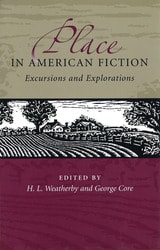
Place in American Fiction
Excursions and ExplorationsEdited by H.L. Weatherby & George Core
University of Missouri Press, 2004
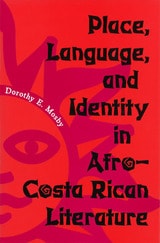
Place, Language, and Identity in Afro-Costa Rican Literature
Dorothy E. Mosby
University of Missouri Press, 2003
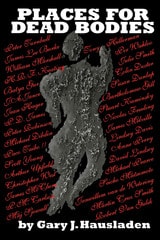
Places for Dead Bodies
By Gary J. Hausladen
University of Texas Press, 2000
From Tony Hillerman's Navajo Southwest to Martin Cruz Smith's Moscow, an exotic, vividly described locale is one of the great pleasures of many murder mysteries. Indeed, the sense of place, no less than the compelling character of the detective, is often what keeps authors writing and readers reading a particular series of mystery novels.
This book investigates how "police procedural" murder mysteries have been used to convey a sense of place. Gary Hausladen delves into the work of more than thirty authors, including Tony Hillerman, Martin Cruz Smith, James Lee Burke, David Lindsey, P. D. James, and many others. Arranging the authors by their region of choice, he discusses police procedurals set in America, the United Kingdom and Ireland, Europe, Moscow, Asia, and selected locales in other parts of the world, as well as in historical places ranging from the Roman Empire to turn-of-the-century Cairo.
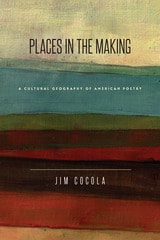
Places in the Making
A Cultural Geography of American PoetryJim Cocola
University of Iowa Press, 2016
Positing place as a pivotal axis of identification and heralding emplacement as a crucial model for cultural, intellectual, and political activity in a period marked and imperiled by a tendency toward dislocation, the critical vocabulary of this project centers upon the work of place-making. It attends to a poetics that extends beyond epic and lyric modes while relying simultaneously on auditory and visual effects and proceeding in the interests of environmental advocacy and social justice, often in contrast to the more orthodox concerns of literary modernism, global capitalism, and print culture. Focusing on poets of international reputation, such as Elizabeth Bishop, Pablo Neruda, Charles Olson, and William Carlos Williams, Places in the Making also considers work by more recent figures, including Kamau Brathwaite, Joy Harjo, Myung Mi Kim, and Craig Santos Perez. In its larger comparative, multiethnic, and transnational emphases, this book addresses questions of particular moment in American literary and cultural studies and aspires to serve as a catalyst for further interdisciplinary work connecting geography and the humanities.
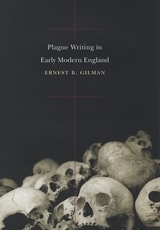
Plague Writing in Early Modern England
Ernest B. Gilman
University of Chicago Press, 2009
During the seventeenth century, England was beset by three epidemics of the bubonic plague, each outbreak claiming between a quarter and a third of the population of London and other urban centers. Surveying a wide range of responses to these epidemics—sermons, medical tracts, pious exhortations, satirical pamphlets, and political commentary—Plague Writing in Early Modern England brings to life the many and complex ways Londoners made sense of such unspeakable devastation.
Ernest B. Gilman argues that the plague writing of the period attempted unsuccessfully to rationalize the catastrophic and that its failure to account for the plague as an instrument of divine justice fundamentally threatened the core of Christian belief. Gilman also trains his critical eye on the works of Jonson, Donne, Pepys, and Defoe, which, he posits, can be more fully understood when put into the context of this century-long project to “write out” the plague. Ultimately, Plague Writing in Early Modern England is more than a compendium of artifacts of a bygone era; it holds up a distant mirror to reflect our own condition in the age of AIDS, super viruses, multidrug resistant tuberculosis, and the hovering threat of a global flu pandemic.
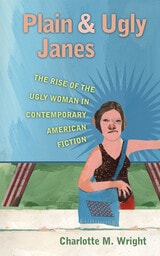
Plain and Ugly Janes
The Rise of the Ugly Woman in Contemporary American FictionWright, Charlotte M.
University of Iowa Press, 2000
“If beauty is truth, is ugliness falsehood and deception? If all art need concern itself with is beauty, what need have we to explore in our literature the nature and consequences of ugliness?” In Plain and Ugly Janes, originally published in hardcover in 2000 by Garland, Charlotte Wright defines and explores the ramifications of a new character type in twentieth-century American literature, the “ugly woman,” whose roots can be traced to the old maid/spinster character of the nineteenth century.
During the 1970s, stories began to appear in which the ugly woman is a figure of power—heroic not in the traditional old maid's way of quiet, passive acceptance but in a way more in keeping with the active, masculine definition of heroic behavior. Wright uses these stories to discuss the nature and definitions of ugliness and the effects of female ugliness on both male and female literary characters in the works of a range of American authors, including Sherwood Anderson, Russell Banks, Djuna Barnes, Peter S. Beagle, Sarah Bird, Ray Bradbury, Katherine Dunn, Louise Erdrich, William Faulkner, Tess Gallagher, Barry Hannah, Ernest Hemingway, Zora Neale Hurston, Alison Lurie, Lorrie Moore, Joyce Carol Oates, Flannery O'Connor, Katherine Anne Porter, Leon Rooke, Anne Tyler, Alice Walker, and Eudora Welty. Wright concludes that the ugly woman character allows American authors to explore the ironies and inequalities inherent in the beauty system.
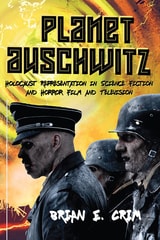
Planet Auschwitz
Holocaust Representation in Science Fiction and Horror Film and TelevisionBrian E. Crim
Rutgers University Press, 2020
Planet Auschwitz website (https://planetauschwitz.com)
Plato and Aristophanes
Comedy, Politics, and the Pursuit of a Just LifeMarina Marren
Northwestern University Press, 2022
Marren makes this case by delving into Plato’s Republic, a foundational work of political philosophy. While the Republic straightforwardly condemns the decadence and greed of a tyrant, Plato’s attack on political idealism is both solemn and comedic. In fact, Plato draws on the same comedic stock and tropes as do Aristophanes’s plays. Marren’s book strikes up an innovative conversation between three works by Aristophanes—Assembly Women, Knights, and Birds—and Plato’s philosophy, prompting important questions about individual convictions and one’s personal search for justice. These dialogic works offer critiques of tyranny that are by turns brilliant, scathing, and exuberant, making light of faults and ideals alike. Philosophical comedy exposes despotism in individuals as well as systems of government claiming to be just and good. This critique holds as much bite against contemporary injustices as it did at the time of Aristophanes and Plato.
An ingenious new work by an emerging scholar, Plato and Aristophanes shows that comedy—in tandem with philosophy and politics—is essential to self-examination. And without such examination, there is no hope for a just life.
Plato, Derrida, and Writing
Jasper Neel
Southern Illinois University Press, 1988
Winner, Mina P. Shaughnessy Prize
Achieving the remarkable feat of linking composition theory, deconstruction, and classical rhetoric, this book has been admirably summarized by the theorist G. Douglas Atkins, who writes: "This lively and engaging, informed and informative book constitutes an important contribution. Though its ‘field’ is most obviously composition, composition theory, and pedagogy, part of its importance derives from the way it transcends disciplinary boundaries to bear on writing in general. . . I know of no book that so fully and well discusses, and evaluates, the implications of deconstruction for composition and pedagogy. That [it] goes ‘beyond deconstruction,’ rather than merely ‘applying’ it, increases its importance and signals a clear contribution to the understanding of writing."
Jasper Neel analyzes the emerging field of composition studies within the epistemological and ontological debate over writing precipitated by Plato, who would have us abandon writing entirely, and continued by Derrida, who argues that all human beings are written. This book offers a three-part exploration of that debate. In the first part, a deconstructive reading of Plato’s Phaedrus, Neel shows the elaborate sleight-of-hand that Plato must employ as he uses writing to engage in a semblance of spoken dialogue.
The second part describes Derrida’s theory of writing and presents his famous argument that "the history of truth, of the truth of truth, has always been. . .the debasement of writing, and its repression outside full speech." A lexicon of nine Derridean terms, the key to his theory of writing, is also included. At the end of this section, Neel turns deconstruction against itself, demonstrating that Derridean analysis collapses of its own weight.
The concluding section of the book juxtaposes the implications of Platonic and Derridean views of writing, warning that Derrida’s approach may lock writing inside philosophy. The conclusion suggests that writing may be liberated from philosophical judgment by turning to Derrida’s predecessors, the sophists, particularly Protagoras and Gorgias. Drawing on Protagoras’s idea of strong discourse, Neel shows that sophistry is the foundation of democracy: "Strong discourse is public discourse, which, though based on probability and not truth, remains persuasive over a long period of time to a great number of people. This publicly tested discourse exists only among competitors, never alone, but its ability to remain persuasive even when surrounded by other discourses enables the ideas of democracy to emerge and then keeps democracy alive."
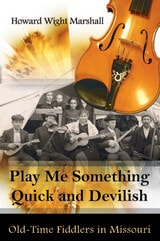
Play Me Something Quick and Devilish
Old-Time Fiddlers in MissouriHoward Wight Marshall
University of Missouri Press, 2012
Beginning with the French villages on the Mississippi River, Marshall leads us chronologically through the settlement of the state and how these communities established our cultural heritage. Other core populations include the “Old Stock Americans” (primarily Scotch-Irish from Kentucky, Tennessee, North Carolina, and Virginia), African Americans, German-speaking immigrants, people with American Indian ancestry (focusing on Cherokee families dating from the Trail of Tears in the 1830s), and Irish railroad workers in the post–Civil War period. These are the primary communities whose fiddle and dance traditions came together on the Missouri frontier to cultivate the bounty of old-time fiddling enjoyed today.
Marshall also examines regional styles in Missouri fiddling and comments on the future of this time-honored, and changing, tradition. Documentary in nature, this social history draws on various academic disciplines and oral histories recorded in Marshall’s forty-some years of research and field experience. Historians, music aficionados, and lay people interested in Missouri folk heritage—as well as fiddlers, of course—will find Play Me Something Quick and Devilish an entertaining and enlightening read.
With 39 tunes, the enclosed Voyager Records companion CD includes a historic sampler of Missouri fiddlers and styles from 1955 to 2012.
Played Out
The Race Man in Twenty-First-Century SatireBrandon J. Manning
Rutgers University Press, 2022
Playhouse to Powerhouse
Locating Black Power Women and their Movement in the Black TheatreKerry Goldmann
University of Arkansas Press, 2025
In Playhouse to Powerhouse, Kerry L. Goldmann explores the Black theatre movement through the lens of three significant women-led theatres that are still in operation today: Nora Vaughn’s Black Repertory Group in Berkeley, Barbara Ann Teer’s National Black Theatre in Harlem, and George Hawkins and Eileen Morris’s Ensemble Theatre in Houston. Goldmann concludes with a discussion of the current moment, examining contemporary obstacles such as gentrification, the co-opting of Black theatres, and the impact of COVID-19.
This remarkable work sheds light on the foundational role that Vaughn, Teer, and Morris played in the Black cultural revolution of the mid- to late twentieth century, securing theatre houses that thrived in multiple capacities as sites for revolution organizing, revenue generation for communal uplift, and unapologetic Black cultural representation.
Playing Dirty
Sexuality and Waste in Early Modern ComedyWill Stockton
University of Minnesota Press, 2010
Noting that psychoanalysis has traditionally operated in a paranoid framework that relentlessly produces evidence of the same “truths,” Stockton turns to a minority practice in psychoanalysis—associated with Jean Laplanche—to develop a more “playful” analytic for literary studies. This analytic brings together different discourses of sexuality and the body and allows individual writings to reform psychoanalytic wisdom about sexuality, waste, and comedy. Through original explorations of works by William Shakespeare, Ben Jonson, Sir John Harington, Thomas Nashe, and Geoffrey Chaucer, Stockton further encourages the reconciliation of psychoanalysis and queer historicism. He focuses in large part on the less-often-read texts of the early modern English canon, assessing the ways in which these books have been purged from the canon in the name of generic purity.
Playing Dirty builds on recent calls by Renaissance and medieval queer scholars for a method of literary analysis that is less constrained by the boundaries of periodicity and the supposed exigencies of historicism. To take Playing Dirty seriously is to accept its invitation to “play”—to queerly disrupt the modern divide in moving promiscuously between texts past and present.
Playing God
The Bible on the Broadway StageHenry Bial
University of Michigan Press, 2015
Playing House in the American West
Western Women's Life Narratives, 1839–1987Cathryn Halverson
University of Alabama Press, 2013
How domestic life shaped identity, gender, and power in the American West
The controlling metaphor Cathryn Halverson uses in her engrossing study is “playing house.” From Caroline Kirkland and Laura Ingalls Wilder to Willa Cather and Marilynne Robinson, from the mid-nineteenth to the late-twentieth centuries, western authors have persistently embraced wayward or eccentric housekeeping to prove a woman’s difference from western neighbors and eastern readers alike.
The readings in Playing House investigate the surprising textual ends to which westerners turn the familiar terrain of the home: evaluating community; arguing for different conceptions of race and class; and perhaps most especially, resisting traditional gender roles. Western women writers, Halverson argues, render the home as a stage for autonomy, resistance, and imagination rather than as a site of sacrifice and obligation.
The western women examined in Playing House in the American West are promoted and read as representatives of a region, as insiders offering views of distant and intriguing ways of life, even as they conceive of themselves as outsiders. By playing with domestic conventions, they recast the region they describe, portraying the West as a place that fosters female agency, individuality, and subjectivity.
Playing Smart
New York Women Writers and Modern Magazine CultureKeyser, Catherine
Rutgers University Press, 2010
Through humor writing, this "smart set" expressed both sides of the story-promoting their urbanity and wit while using irony and caricature to challenge feminine stereotypes. Their fiction raised questions about what it meant to be a woman in the public eye, how gender roles would change because men and women were working together, and how the growth of the magazine industry would affect women's relationships to their bodies and minds. Keyser provides a refreshing and informative chronicle, saluting the value of being "smart" as incisive and innovative humor showed off the wit and talent of women writers and satirized the fantasy world created by magazines.
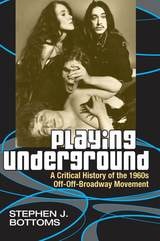
Playing Underground
A Critical History of the 1960s Off-Off-Broadway MovementStephen J. Bottoms
University of Michigan Press, 2004
-William Coco
"At last---a book documenting the beginnings of Off-Off Broadway theater. Playing Underground is an insightful, illuminating, and honest appraisal of this important period in American theater."
-Rosalyn Drexler, author of Art Does (Not!) Exist and Occupational Hazard
"An epic movie of an epic movement, Playing Underground is a book the world has waited for without knowing it. How precisely it captures the evolution of our revolution! I am amazed by the book's scope and scale, and I bless its author especially for giving two greats, Paul Foster and H. M. Koutoukas, their proper, polar places, and for memorializing such unjustly forgotten masterpieces as Irene Fornes's Molly's Dream and Jeff Weiss's A Funny Walk Home. Stephen Bottoms's vivid evocation of the grand adventure of Off-Off Broadway has woken and broken my heart. It is difficult to believe that he was not there alongside me to breathe the caffeine-nicotine-alkaloid-steeped air."
-Robert Patrick, author of Kennedy's Children and Temple Slave
Few books address the legendary age of 1960s off-off Broadway theater. Fortunately, Stephen Bottoms fills that gap with Playing Underground---the first comprehensive history of the roots of off-off Broadway.
This is a theater whose legacy is still felt today: it was the launching pad for many leading contemporary theater artists, including Sam Shepard, Maria Irene Fornes, and others, and it was a pivotal influence on improv comedy and shows like Saturday Night Live.
Off-off Broadway groups such as the Living Theatre, La Mama, and Caffe Cino captured the spirit of nontraditional theater with their edgy, unscripted, boundary-crossing subjects. Yet, as Bottoms discovers, there is no one set of truths about off-off Broadway to uncover; the entire scene was always more a matter of competing perceptions than a singular, concrete reality.
No other author has managed to illuminate this shifting tableau as Bottoms does. Through interviews with dozens of the era's leading playwrights, performers, directors, and critics, he unearths a countercultural theater movement that was both influential and transforming-yet ephemeral and quintessentially of its moment.
Playing Underground will be a definitive work on the subject, offering a complete picture of an important but little-studied period in American theater.
Playing at Narratology
Digital Media as Narrative TheoryDaniel Punday
The Ohio State University Press, 2019
Returning to terms such as narrator, setting, event, character, and world, Playing at Narratology reveals new ways of thinking about these basic narrative concepts—concepts that are not so basic when applied to games and web-based narratives. What are thought of as narrative innovations in these digital forms are a product of technological ability and tied to how we physically interact with a medium, creating new and complicated questions: Is the game designer the implied author or the narrator? Is the space on the screen simply the story’s setting? Playing at Narratology guides us through the evolution of narrative in new media without abandoning the field’s theoretical foundations.
Playing in the Shadows
Fictions of Race and Blackness in Postwar Japanese LiteratureWilliam Bridges
University of Michigan Press, 2020
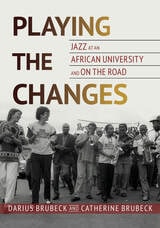
Playing the Changes
Jazz at an African University and on the RoadDarius Brubeck and Catherine Brubeck
University of Illinois Press, 2024
Catherine and Darius Brubeck’s 1983 move to South Africa launched them on a journey that helped transform jazz education. Blending biography with storytelling, the pair recount their time at the University of KwaZulu-Natal, where they built a pioneering academic program in jazz music and managed and organized bands, concerts, and tours around the world.
The Brubecks and the musicians faced innumerable obstacles, from the intensification of apartheid and a lack of resources to the hardscrabble lives that forced even the most talented artists to the margins. Building a program grounded in multi-culturalism, Catherine and Darius encouraged black and white musicians to explore and expand the landscape of South African jazz together Their story details the sometimes wily, sometimes hilarious problem-solving necessary to move the institution forward while offering insightful portraits of South African jazz players at work, on stage, and providing a soundtrack to the freedom struggle and its aftermath.
Frank and richly detailed, Playing the Changes provides insiders’ accounts of how jazz intertwined with struggle and both expressed and resisted the bitter unfairness of apartheid-era South Africa.
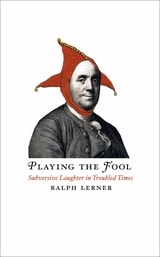
Playing the Fool
Subversive Laughter in Troubled TimesRalph Lerner
University of Chicago Press, 2009
The role of the fool is to provoke the powerful to question their convictions, preferably while avoiding a beating. Fools accomplish this not by hectoring their audience, but by broaching sensitive topics indirectly, often disguising their message in a joke or a tale. Writers and thinkers throughout history have adopted the fool’s approach, and here Ralph Lerner turns to six of them—Thomas More, Francis Bacon, Robert Burton, Pierre Bayle, Benjamin Franklin, and Edward Gibbon—to elucidate the strategies these men employed to persuade the heedless, the zealous, and the overly confident to pause and reconsider.
As Playing the Fool makes plain, all these men lived through periods marked by fanaticism, particularly with regard to religion and its relation to the state. In such a troubled context, advocating on behalf of skepticism and against tyranny could easily lead to censure, or even, as in More’s case, execution. And so, Lerner reveals, these serious thinkers relied on humor to move their readers toward a more reasoned understanding of the world and our place in it. At once erudite and entertaining, Playing the Fool is an eloquently thought-provoking look at the lives and writings of these masterly authors.
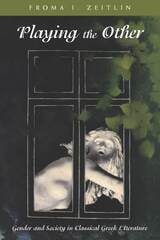
Playing the Other
Gender and Society in Classical Greek LiteratureFroma I. Zeitlin
University of Chicago Press, 1995
Zeitlin demonstrates the indispensable workings of gender as a major factor in Greek social, religious, and cultural practices and in more abstract ideas about nature and culture, public and private, citizen and outsider, self and other, and mortal and immortal. Focusing on the prominence of female figures in these male authored texts, she enlarges our perspective on critical components of political order and civic identity by including issues of sexuality, the body, modes of male and female maturation, and speculations about parentage, kinship, and reproductive strategies. Along with considerations of genre, poetics, and theatrical mimesis, she points to the powerful mythmaking capacities of Greek culture for creating memorable paradigms and dramatic scenarios that far exceed simple notions of male and female opposition and predictable enforcement of social norms. Consisting of both new and revised essays, Playing the Other is a wide-ranging account of a central category of Greek literature by a scholar who pioneered an approach to classics through the perspective of gender.
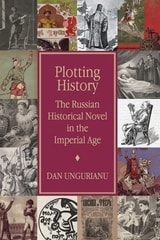
Plotting History
The Russian Historical Novel in the Imperial AgeDan Ungurianu
University of Wisconsin Press, 2007
Balanced precariously between fact and fiction, the historical novel is often viewed with suspicion. Some have attacked it as a mongrel form, a “bastard son” born of “history’s flagrant adultery with imagination.” Yet it includes some of the most celebrated achievements of Russian literature, with Alexander Pushkin, Nikolai Gogol, Leo Tolstoy, and scores of other writers contributing to this tradition.
Dan Ungurianu’s Plotting History traces the development of the Russian historical novel from its inception in the romantic era to the emergence of Modernism on the eve of the Revolution. Organized historically and thematically, the study is focused on the cultural paradigms that shaped the evolution of the genre and are reflected in masterpieces such as The Captain’s Daughter and War and Peace. Ungurianu examines the variety of approaches by which Russian writers combined fact with fiction and explores the range of subjects that inspired the Russian historical imagination.
Outstanding Academic Title, Choice Magazine
“Ungurianu has produced a most valuable work for literary scholars.”—Andrew M. Drozd, Slavic and East European Journal
“[Ungurianu’s] overwhelming knowledge, impeccable documentation, erudite notes, and valuable addenda make for a treasure house of information and keen analysis. . . . Essential.”—Choice
Poe Abroad
Influence Reputation AffinitiesLois Davis Vines
University of Iowa Press, 1999
In Poe Abroad, Lois Vines has brought together a collection of essays that document the American writer's influence on the diverse literatures—and writers—of the world. Over twenty scholars demonstrate how and why Poe has significantly influenced many of the major literary figures of the last 150 years.
Part One includes studies of Poe's popularity among general readers, his influence on literary movements, and his reputation as a poet, fiction writer, and literary critic. Part Two presents analyses of the role Poe played in the literary development of specific writers representing many different cultures.
Poe Abroad commemorates the 150th anniversary of Poe's death and celebrates his worldwide impact, beginning with the first literal translation of Poe into a foreign language, “The Gold-Bug”into French in 1845. Charles Baudelaire translated another Poe tale in 1848 and four years later wrote an essay that would make Poe a well-known author in Europe even before he achieved recognition in America.
Poe died knowing only that some of his stories had been translated into French. He probably never would have imagined that his work would be admired and imitated as far away as Japan, China, and India or would have a lasting influence on writers such as Baudelaire, August Strindberg, Franz Kafka, Jorge Luis Borges, Julio Cortázar, and Tanizaki Junichiro.
As we approach the sesquicentennial of his death, Poe Abroad brings together a timely one-volume assessment of Poe's influence throughout the world.
Poe's Critical Theory
THE MAJOR DOCUMENTSEdgar Allan Poe
University of Illinois Press, 2007
This edition shows that what is consistent in Poe is not any single theory. Rather, always present are wit, playfulness, concern for the strong effect, a bin of recyclable allusions, anecdotes and quotations, and a writer’s discipline. His writing on theory is of a piece with his fiction, poetry, and journalism. The Levines explain how these pieces also tie in tightly to the social, political, economic, and technological history of the world in which Poe lived.
Poe's Pym
Critical ExplorationsRichard Kopley, ed.
Duke University Press, 1992
The product of a decade of research and planning, Poe's "Pym" offers a factual basis for some of the most fantastic elements in the novel and uncovers surprising connections between Poe's text and exploration literature, nautical lore, Arthurian narrative, nineteenth-century journalism, Moby Dick, and other writings. Representing a rich cross-section of current modes of literary study—from source study to psychoanalytic criticism to new historicism—these sixteen essays probe issues such as literary influence, the limits of language, racism, the holocaust, prolonged mourning, and the structure of the human mind. Poe's "Pym" will be an invaluable resource for students of both contemporary criticism and nineteenth-century American culture.
Contributors. John Barth, Susan F. Beegel, J. Lasley Dameron, Grace Farrell, Alexander Hammond, David H. Hirsch, John T. Irwin, J. Gerald Kennedy, David Ketterer, Joan Tyler Mead, Joseph J. Moldenhauer, Carol Peirce, Burton R. Pollin, Alexander G. Rose III, John Carlos Rowe, G. R. Thompson, Bruce I. Weiner
Poe, Fuller, and the Mesmeric Arts
Transition States in the American RenaissanceBruce Mills
University of Missouri Press, 2005
Poems of the American Empire
The Lyric Form in the Long Twentieth CenturyJen Hedler Phillis
University of Iowa Press, 2019
Poems of the American Empire argues that careful attention to a particular strain of twentieth-century lyric poetry yields a counter-history of American global power. The period that Phillis covers—from Ezra Pound’s A Draft of XXX Cantos in 1930 to Cathy Park Hong’s Engine Empire in 2012—roughly matches what some consider the ascent and decline of the American empire. The diverse poems that appear in this book are united by their use of epic forms in the lyric poem, a combination that violates a fundamental framework of both genres’ relationship to time.
This book makes a groundbreaking intervention by insisting that lyric time is key to understanding the genre. These poems demonstrate the lyric form’s ability to represent the totality of history, making American imperial power visible in its fullness. Neither strictly an empty celebration of American exceptionalism nor a catalog of atrocities, Poems of the American Empire allows us to see both.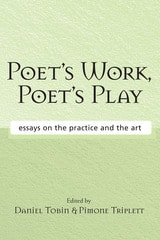
Poet's Work, Poet's Play
Essays on the Practice and the ArtEdited by Daniel Tobin and Pimone Triplett
University of Michigan Press, 2008
A follow-up to the highly praised Poets Teaching Poets, Daniel Tobin and Pimone Triplett's Poet's Work, Poet's Play gathers together essays by some of the most important voices in contemporary poetry: Carl Dennis, Stephen Dobyns, Tony Hoagland, Heather McHugh, Ellen Bryant Voigt, Eleanor Wilner, Dean Young, and the late Larry Levis and Agha Shahid Ali.
Lively, accessible, and erudite, the pieces range from discussions on syntax and the syllable to an exploration of the complexities of canon formation under the shadow of imperialism, race, and history. Exploring the work of John Donne, William Butler Yeats, Robert Frost, Philip Larkin, Charles Olsen, Ezra Pound, Anne Carson, Robert Herrick, Harryette Mullen, and many others, Poet's Work, Poet's Play---like its predecessor volume---will be an invaluable tool for teachers, students, and poets at every level.
"Much more than a set of essays on poetic craft or aesthetic understandings, this collection takes on two of the most prevalent anxieties about writing poetry in our time: the place of subjectivity in poetry, and how to make a significant shape in language while both affirming and interrogating the poetic I's authority. This is a book for anyone who wants to write better poems, who wants to read with greater passion, and who believes that poetry is an independent category of human consciousness that can be as capaciousness as the world, and as nuanced."
---Tom Sleigh, author of Space Walk and Far Side of the Earth
"Gathering together essays by unquestionably important poets, Poet's Work, Poet's Play has immense pedagogical value in the way it demonstrates how to discover in poetry resources of language and structure often overlooked in first, and ensuing, readings of complex texts."
---Laurence Goldstein, Professor of English, University of Michigan, and Editor, Michigan Quarterly Review
"A valuable document illuminating critical aspects of the contemporary American poetry scene."
---John Koethe, Distinguished Professor of Philosophy at the University of Wisconsin, Milwaukee, and author of Sally's Hair: Poems
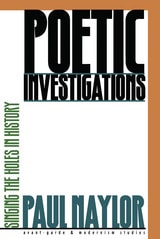
Poetic Investigations
Singing the Holes in HistoryPaul Naylor
Northwestern University Press, 1999
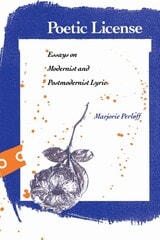
Poetic License
Essays on Modernist and Postmodernist LyricMarjorie Perloff
Northwestern University Press, 1990
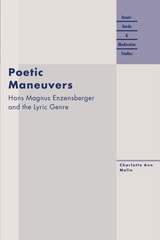
Poetic Maneuvers
Hans Magnus Enzensberger and the Lyric GenreCharlotte Melin
Northwestern University Press, 2004
From the first, Enzensberger resisted the marginalization of literature–particularly poetry—by connecting it with ethical imperatives of the post-Holocaust era. Charlotte Ann Melin shows how Enzensberger has accomplished this by challenging prevailing aesthetic and social values. Departing from existing studies that focus on Enzensberger's political views or controversial texts, her book situates his full poetic program within contemporary discussions staged by various German writers, translators, and theorists, including Jürgen Habermas and Theodor Adorno. Melin proposes a framework for reading poetry by Enzensberger and his contemporaries—one that connects the radical evolution of poetic style with how questions about representation, identity, and ethical values developed under historical conditions unique to the second half of the twentieth century. Her account of postwar literary trends explores the fluidity of national literary boundaries and tastes after 1945, and reveals the relationship of such American poets as William Carlos Williams and Carolyn Forché to German verse. Essential to an understanding Enzensberger as an important literary figure, Poetic Maneuvers also offers invaluable insight into the status of recent postwar German literature and American-European literary relations.
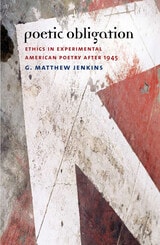
Poetic Obligation
Ethics in Experimental American Poetry after 1945Matthew G. Jenkins
University of Iowa Press, 2008
Since at least the time of Plato's Republic, the relationship between poetry and ethics has been troubled. Through the prism of what has been called the "new" ethical criticism, inspired by the work of Emmanuel Levinas, G. Matthew Jenkins considers the works of Objectivists, Black Mountain poets, and Language poets in light of their full potential to reshape this ancient relationship.
American experimental poetry is usually read in either political or moral terms. Poetic Obligation, by contrast, considers the poems of Louis Zukofsky, Charles Reznikoff, George Oppen, Edward Dorn, Robert Duncan, Susan Howe, and Lyn Hejinian in terms of the philosophical notion of ethical obligation to the Other in language. Jenkins's historical trajectory enables him to consider the full breadth of ethical topics that have driven theoretical debate since the end of World War II. This original approach establishes an ethical lineage in the works of twentieth-century experimental poets, creating a way to reconcile the breach between poetry and the issue of ethics in literature at large.
With implications for a host of social issues, including ethnicity and immigration, economic inequities, and human rights, Jenkins's imaginative reconciliation of poetry and ethics will provide stimulating reading for teachers and scholars of American literature as well as advocates and devotees of poetry in general. Poetic Obligation marshals ample evidence that poetry matters and continues to speak to the important issues of our day.
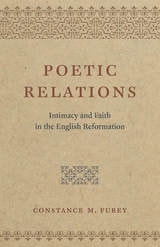
Poetic Relations
Intimacy and Faith in the English ReformationConstance M. Furey
University of Chicago Press, 2017
As Furey demonstrates, John Donne, George Herbert, Anne Bradstreet, and others describe inner lives that are surprisingly crowded, teeming with human as well as divine companions. The same early modern writers who bequeathed to us the modern distinction between self and society reveal here a different way of thinking about selfhood altogether. For them, she argues, the self is neither alone nor universally connected, but is forever interactive and dynamically constituted by specific relationships. By means of an analysis equally attentive to theological ideas, social conventions, and poetic form, Furey reveals how poets who understand introspection as a relational act, and poetry itself as a form ideally suited to crafting a relational self, offer us new ways of thinking about selfhood today—and a resource for reimagining both secular and religious ways of being in the world.
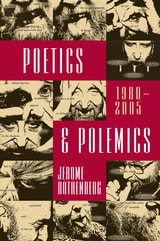
Poetics & Polemics
1980-2005Jerome Rothenberg
University of Alabama Press, 2008
Poetics & Polemics, 1980-2005 brings together in one volume a wide-ranging selection of essays and commentaries by one of the most significant poets, critics, and translators working with American and international poetry today.
Jerome Rothenberg’s work spans a period of over forty years and nearly one hundred books, and though perhaps best known as a poet, his critical and theoretical contributions to the fields of innovative, experimental poetry have become equally important facets of his work. Rothenberg’s earliest critical writings concerned themselves with ethnopoetics and the poetics of performance. In the last twenty years his critical thinking has evolved to encompass more explicitly issues of modernism, postmodernism, and the avant-garde, as well as meditations on the nature of the book and writing. This volume extends and elaborates all of those interests, allowing for the first time a comprehensive glimpse of the full trajectory of his thinking.
In the first section, “Poetics and Polemics,” Rothenberg’s essays address a range of issues with which he’s become closely associated, among them the anthology as a critical and polemical tool; the intersection of poetry with art, performance, and politics, in both contemporary and traditional practice; the poetics of Jewish mysticism as a traditional form of conceptual and language poetry; and the universality of poetic discourse, particularly as seen in tribal poetry or in poetic traditions long separated from the Western literary mainstream. In “A Gallery of Poets” is Rothenberg’s lively explorations of the work of other poets, as they relate to his own work, to avant-garde poetry in general, and to the poetic traditions that concern him the most. Finally, in “Dialogues and Interviews” are Rothenberg’s unbridled meditations and musings on what he calls “the life of poetry” outside the bounds of book and binding, class and category, a dynamic force at the center of all that we call human.
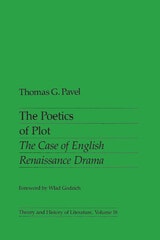
Poetics Of Plot
The Case of English Renaissance DramaThomas Pavel
University of Minnesota Press, 1985
Thomas Pavel has written extensively on poetics, linguistics, and narratology. In this book he proposes an original theory and methodology of plot analysis—a reading that draws upon the most fruitful aspects of literary structuralism and upon contemporary linguistic models (specifically generative grammar). Theorists have tended to use formal plot analysis to examine relatively simple literary artifacts, like folk tales and short stories; Pavel, however, applies his model to a group of English Renaissance tragedies and demonstrates that plot analysis can make a major contribution to the understanding of sophisticated literary texts.
Pavel leads the reader through step-by-step analyses of increasingly complex plot structures as he explicates Marlowe’s Tamburlaine I, the Jew of Malta, Doctor Faustus and Edward the Second; Kyd’s Spanish Tragedy; The Arden Feversham; and, finally, Shakespeare’s King Lear. He has chosen these plays for their chronological proximity, yet their diversity allows for contrasts and typological considerations. The inclusion of most of Marlowe’s tragedies enables Pavel to gain new insights into a single writer’s strategies of plot construction.The Poetics of Plot moves beyond the establishment and application of a new theory of plot to address broader issues in cultural studies: the role of linguistic models in literary studies, the nature and function of agency in plot advancement and history, the universal features of plot organization, and the relation of plot patterns to period styles and dominant modes of organized knowledge. In his foreword to The Poetics of Plot, Wlad Godzich sketches the historical context in which Pavel’s discussion of plot appears and makes explicit the way that the study of plot challenges both the presuppositions of linguistic analysis and the status of action in philosophical thought.