Results by title
5448 books match the query 'History and criticism' and 305 start with p
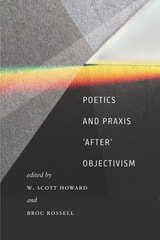
Poetics and Praxis 'After' Objectivism
W. Scott Howard and Broc Rossell
University of Iowa Press, 2018
Poetics and Praxis ‘After’ Objectivismexamines late twentieth-and early twenty-first-century poetics and praxis within and against the dynamic, disparate legacy of Objectivism and the Objectivists. This is the first volume in the field to investigate the continuing relevance of the Objectivist ethos to poetic praxis in our time. The book argues for a reconfiguration of Objectivism, adding contingency to its historical values of sincerity and objectification, within the context of the movement’s development and disjunctions from 1931 to the present.
Essays and conversations from emerging and established poets and scholars engage a network of communities in the U.S., Canada, and the U.K., shaped by contemporaneous oppositions as well as genealogical (albeit discontinuous) historicisms. This book articulates Objectivism as an inclusively local, international, and interdisciplinary ethos, and reclaims Objectivist poetics and praxis as modalities for contemporary writers concerned with radical integrations of aesthetics, lyric subjectivities, contingent disruption, historical materialism, and social activism. The chapter authors and roundtable contributors reexamine foundational notions about Objectivism—who the Objectivists were and are, what Objectivism has been, now is, and what it might become—delivering critiques of aesthetics and politics; of race, class, and gender; and of the literary and cultural history of the movement’s development and disjunctions from 1931 to the present.
Contributors: Rae Armantrout, Julie Carr, Amy De’Ath, Jeff Derksen, Rachel Blau DuPlessis, Graham Foust, Alan Golding, Jeanne Heuving, Ruth Jennison, David Lau, Steve McCaffery, Mark McMorris, Chris Nealon, Jenny Penberthy, Robert Sheppard
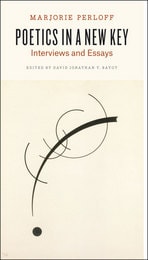
Poetics in a New Key
Interviews and EssaysMarjorie Perloff
University of Chicago Press, 2014
The fourteen interviews in Poetics in a New Key—conducted by scholars, poets, and critics from the United States, Denmark, Norway, France, and Poland, including Charles Bernstein, Hélène Aji, and Peter Nicholls—cover a broad spectrum of topics in the study of poetry: its nature as a literary genre, its current state, and its relationship to art, politics, language, theory, and technology. Also featured in the collection are three pieces by Perloff herself: an academic memoir, an exploration of poetry pedagogy, and an essay on twenty-first-century intellectuals. But across all the interviews and essays, Perloff’s distinctive personality and approach to reading and talking resound, making this new collection an inspiring resource for scholars both of poetry and writing.
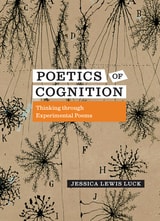
Poetics of Cognition
Thinking through Experimental PoemsJessica Lewis Luck
University of Iowa Press, 2023
The cognitive research Luck draws upon suggests that the strangeness of experimental poetry can reshape the activity of the reader’s mind, creating new forms of attention, perception, and cognition. This book closes by shifting from theory to praxis, extracting forms of teaching from the forms of thinking that experimental poems instill in order to better enable their transformative effects in readers and to bring poetry pedagogy into the twenty-first century.
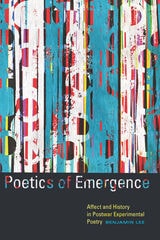
Poetics of Emergence
Affect and History in Postwar Experimental PoetryBenjamin Lee
University of Iowa Press, 2020
Experimental poetry responded to historical change in the decades after World War II, with an attitude of such casual and reckless originality that its insights have often been overlooked. However, as Benjamin Lee argues, to ignore the scenes of self and the historical occasions captured by experimental poets during the 1950s and 1960s is to overlook a rich and instructive resource for our own complicated transition into the twenty-first century.
Frank O’Hara and fellow experimental poets like Amiri Baraka, Diane di Prima, and Allen Ginsberg offer us a set of perceptive responses to Cold War culture, lyric meditations on consequential changes in U.S. social life and politics, including the decline of the Old Left, the rise of white-collar workers, and the emergence of vernacular practices like hipsterism and camp. At the same time, they offer us opportunities to anatomize our own desire for historical significance and belonging, a desire we may well see reflected and reconfigured in the work of these poets.
Poetics of Visibility in the Contemporary Arab American Novel
Mazen Naous
The Ohio State University Press, 2020
Naous’s book offers analyses of Diana Abu-Jaber’s Arabian Jazz and Crescent, Rabih Alameddine’s Koolaids: The Art of War, Laila Halaby’s Once in a Promised Land, and Mohja Kahf’s The Girl in the Tangerine Scarf as ways to answer this question. Naous explores how these novels negotiate queer desire, music, Western and Middle Eastern art, gender, and relationships between other minorities. These poetics enable readers to see the nuance and richness of Arab American experience. Naous ultimately argues that fiction creates crucial spaces for reimagining and redefining intercultural relationships.
Poetics of the First Punic War
Thomas Biggs
University of Michigan Press, 2020
Poetry FM
American Poetry and Radio CountercultureLisa Hollenbach
University of Iowa Press, 2023
Lisa Hollenbach traces the history of Pacifica Radio—founded in 1946, the nation’s first listener-supported public radio network—through the 1970s: from the radical pacifists and poets who founded Pacifica after the war; to the San Francisco Renaissance, Beat, and New York poets who helped define the countercultural sound of Pacifica stations KPFA and WBAI in the 1950s and 1960s; to the feminist poets and activists who seized Pacifica’s frequencies in the 1970s. In the poems and recorded broadcasts of writers like Kenneth Rexroth, Jack Spicer, Allen Ginsberg, Amiri Baraka, Audre Lorde, Pat Parker, Bernadette Mayer, and Susan Howe, one finds a recurring ambivalence about the technics and poetics of reception. Through tropes of static noise, censorship, and inaudibility as well as voice, sound, and signal, these radiopoetic works suggest new ways of listening to the sounds and silences of Cold War American culture.
Poetry Los Angeles
Reading the Essential Poems of the CityLaurence Goldstein
University of Michigan Press, 2014
One chapter is devoted to Charles Bukowski, the celebrity face of the city’s poetry. Other chapters discuss the ways that poets explore “Interiors” and “Exteriors” throughout the cityscape. Goldstein also provides ample connections to the novels, films, art, and politics of Southern California. In clear prose, Poetry Los Angeles examines the strategies by which poets make significant places meaningful and memorable to readers of every region of the U.S. and elsewhere.
Poetry Matters
Neoliberalism, Affect, and the Posthuman in Twenty-First Century North American Feminist PoeticsHeather Milne
University of Iowa Press, 2018
Poetry Matters explores poetry written by women from the United States and Canada, which documents the social and political turmoil of the early twenty-first century and places this poetry in dialogue with recent currents of feminist theory including new materialism, affect theory, posthumanism, and feminist engagements with neoliberalism and capitalism. Central to this project is the conviction that a poetics that explores the political dimensions of affect; demonstrates an understanding of subjectivity as posthuman and transcorporeal; critically reflects on the impact of capitalism on queer, racialized, and female bodies; and develops an ethical vocabulary for reimagining the nation state and critically engaging with issues of democracy and citizenship is now more urgent than ever before.
Milne focuses on poetry published after 2001 by writers who mostly began writing after the feminist writing movements of the 1980s, but who have inherited and built upon their political and aesthetic legacies. The poets discussed in this book—including Jennifer Scappettone, Margaret Christakos, Larissa Lai, Rita Wong, Nikki Reimer, Rachel Zolf, Yedda Morrison, Marcella Durand, Evelyn Reilly, Juliana Spahr, Claudia Rankine, Dionne Brand, Jena Osman, and Jen Benka—bring a sense of political agency to poetry. These voices seek new vocabularies and dissenting critical and aesthetic frameworks for thinking across issues of gender, materiality, capitalism, the toxic convergences of nationalism and racism, and the decline of democratic institutions. This is poetry that matters—both in its political urgency and in its attentiveness to the world as “matter”—as a material entity under siege. It could not be more timely or more relevant.
Poetry Of Resistance
Seamus HeaneySidney Burris
Ohio University Press, 1990
Poetry On and Off the Page
Essays for Emergent OccasionsMarjorie Perloff
Northwestern University Press, 1998
Poetry and Its Others
News, Prayer, Song, and the Dialogue of GenresJahan Ramazani
University of Chicago Press, 2013

Poetry and Prophecy
The Anthropology of InspirationJohn Leavitt, Editor
University of Michigan Press, 1997
Based on rich ethnographic work in Western and non-Western cultures, the essays represent distinct approaches to the topic, from one person's account of her interactions with a possessing spirit to another's world-spanning statement on prophetic poetics. Each contributor challenges easy assumptions that poetic texts are crafted works, products of skill rather than inspiration, while prophetic speech and writing are best understood as spontaneous performance rather than formal art.
As a whole the collection aims to reorient the anthropological study of possession and oracular experiences toward an awareness of the word, and to draw the attention of literary critics to "inspired" poetry. It will also appeal to readers in performance studies and comparative religion.
Contributors are Marjorie Mandelstam Balzer, James Fernandez, Paul Friedrich, John Leavitt, Dennis Tedlock, Margaret Trawick.
John Harold Leavitt is Professor of Anthropology, University of Montreal.
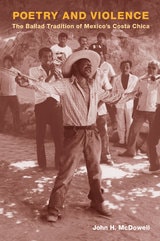
Poetry and Violence
The Ballad Tradition of Mexico's Costa ChicaJohn H. McDowell
University of Illinois Press, 1999
Detailed and rife with social and cultural implications, Poetry and Violence is a compelling commentary on violence as both human experience and communicative action.
Poetry and the Cult of the Martyrs
The Liber Peristephanon of PrudentiusMichael Roberts
University of Michigan Press, 1993
Poetry and the Fate of the Senses
Susan Stewart
University of Chicago Press, 2001
Herself an acclaimed poet, Stewart not only brings the intelligence of a critic to the question of poetry, but the insight of a practitioner as well. Her new study draws on reading from the ancient Greeks to the postmoderns to explain how poetry creates meanings between persons. Poetry and the Fate of the Senses includes close discussions of poems by Stevens, Hopkins, Keats, Hardy, Bishop, and Traherne, of the sense of vertigo in Baroque and Romantic works, and of the rich tradition of nocturnes in visual, musical, and verbal art. Ultimately, Stewart explores the pivotal role of poetry in contemporary culture. She argues that poetry can counter the denigration of the senses and can expand our imagination of the range of human expression.
Poetry and the Fate of the Senses won the 2004 Truman Capote Award for Literary Criticism in Memory of Newton Arvin, administered for the Truman Capote Estate by the University of Iowa Writers' Workshop. It also won the Phi Beta Kappa Society's 2002 Christian Gauss Award for Literary Criticism.
Poetry as Re-Reading
American Avant-Garde Poetry and the Poetics of Counter-MethodMing-Qian Ma
Northwestern University Press, 2008
Rereading and rewriting our understanding of the poetics of modernism and postmodernism, this truly revisionary work identifies a significant counter-tradition in twentieth-century poetry. Postmodernism, Ming-Qian Ma argues, does not so much follow from modernism as coexist with it, with postmodernists employing the anarchic poetics introduced by Gertrude Stein in countering the rationalist method of high modernists such as T. S. Eliot and Ezra Pound.
Grounded in a detailed and compelling account of the philosophy guiding such a project, Ma’s book traces a continuity of thought and practice through the very different poetic work of objectivists Louis Zukofsky, George Oppen, Carl Rakosi, and John Cage and language poets Susan Howe, Lyn Hejinian, Bruce Andrews, and Charles Bernstein. His deft individual readings provide an opening into this notoriously difficult work, even as his larger critique reveals a new and clarifying perspective on American modernist and post-modernist avant-garde poetics. Ma shows how we cannot understand these poets according to the usual way of reading but must see how they deliberately use redundancy, unpredictability, and irrationality to undermine the meaning-oriented foundations of American modernism--and to force a new and different kind of reading.
With its unusually clear explanation of the philosophy informing postmodern practice, and its unique insights into some of the more interesting and vexing poets of our time, this book points to a reading of an important strain of postmodern American poetry that is likely to develop well into the twenty-first century.
Poetry as a Way of Life
Aesthetics and Askesis in the German Eighteenth CenturyGabriel Trop
Northwestern University Press, 2014
What would it mean to make a work of art the focal point of one’s life practice? Poetry as a Way of Life goes back to the origins of aesthetics as a philosophical discipline in the early eighteenth century in order to uncover an understanding of the work of art as an exercise of the self. Engaging in close readings of works by both canonical and less well-known eighteenth-century German poets such as Friedrich Holderlin, Novalis, Friedrich von Hagedorn, and Johann Wilhelm Ludwig Gleim, Gabriel Trop illustrates the ways in which these authors tap into the potential of poetic form to redefine the limits of human perception and generate alternative ways of being in the world.
Poetry from Spaceship Earth
Empire and Ecology in Post-1945 American PoetrySamia Rahimtoola
University of Iowa Press, 2026
In the early decades of the postwar period, the planetary metaphor of “spaceship Earth” was everywhere in the West. It exerted its power on sites as various as Caribbean research stations, the shipping lanes of the U.S.-occupied Pacific, Palestinian refugee camps, and the internal colonies of segregated nations. At its heart was a new ideology and infrastructure of managing, administering, and rationalizing nature through which Western powers sought to maintain their grip on a decolonizing planet.
Poetry from Spaceship Earth retrieves a diverse array of postwar American poets—Robert Duncan, June Jordan, Joanne Kyger, Lorine Niedecker, and Charles Olson—who contested and cultivated alternatives to this emergent mode of environmentalism. By placing the major innovations of postwar poetry into conversation with environmental politics, Cold War science and technology studies, and postcolonial and Black studies, Samia Rahimtoola develops an original theoretical and historical account of the racial and colonial logics that underpin the supposedly neutral project of managing nature.
Poetry in a Global Age
Jahan Ramazani
University of Chicago Press, 2020
Poetry in a Global Age builds on Ramazani’s award-winning A Transnational Poetics, a book that had a catalytic effect on literary studies. Ramazani broadens his lens to discuss modern and contemporary poems not only in relation to world literature, war, and questions of orientalism but also in light of current debates over ecocriticism, translation studies, tourism, and cultural geography. He offers brilliant readings of postcolonial poets like Agha Shahid Ali, Lorna Goodison, and Daljit Nagra, as well as canonical modernists such as W. B. Yeats, Wallace Stevens, T. S. Eliot, and Marianne Moore. Ramazani shows that even when poetry seems locally rooted, its long memory of forms and words, its connections across centuries, continents, and languages, make it a powerful imaginative resource for a global age. This book makes a strong case for poetry in the future development of world literature and global studies.
Poetry in a World of Things
Aesthetics and Empiricism in Renaissance EkphrasisRachel Eisendrath
University of Chicago Press, 2018
In Poetry in a World of Things, Rachel Eisendrath explores how poetry responded to this new detachment by becoming a repository for a more complex experience of the world. The book focuses on ekphrasis, the elaborate literary description of a thing, as a mode of resistance to this new empirical objectivity. Poets like Petrarch, Spenser, Marlowe, and Shakespeare crafted highly artful descriptions that recovered the threatened subjective experience of the material world. In so doing, these poets reflected on the emergence of objectivity itself as a process that was often darker and more painful than otherwise acknowledged. This highly original book reclaims subjectivity as a decidedly poetic and human way of experiencing the material world and, at the same time, makes a case for understanding art objects as fundamentally unlike any other kind of objects.
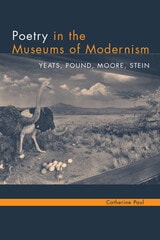
Poetry in the Museums of Modernism
Yeats, Pound, Moore, SteinCatherine Paul
University of Michigan Press, 2002
Although critics have attested to the importance of the visual arts to literary modernists and have begun to explore the relationships between literary production and social institutions, before now no one has examined the particular institutions in which modernist poets found the artworks, specimens, and other artifacts that inspired their literary innovations. Catherine Paul's book offers the reader a fresh encounter with modernism that will interest literary and art historians, literary theorists, critics, and scholars in cultural studies and museum studies.
Catherine Paul is Associate Professor of English, Clemson University.
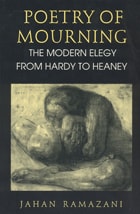
Poetry of Mourning
The Modern Elegy from Hardy to HeaneyJahan Ramazani
University of Chicago Press, 1994
Through subtle readings of elegies, self-elegies, war poems, and the blues, Ramazani greatly enriches our critical understanding of a wide range of poets, including Thomas Hardy, Wilfred Owen, Wallace Stevens, Langston Hughes, W. H. Auden, Sylvia Plath, and Seamus Heaney. He also interprets the signal contributions to the American family elegy of Robert Lowell, Allen Ginsberg, Anne Sexton, John Berryman, Adrienne Rich, Michael Harper, and Amy Clampitt. Finally, he suggests analogies between the elegy and other kinds of contemporary mourning art—in particular, the AIDS Memorial Quilt and the Vietnam Veterans Memorial.
Grounded in genre theory and in the psychoanalysis of mourning, Ramazani's readings also draw on various historical, formal, and feminist critical approaches. This book will be of interest to anyone concerned with the psychology of mourning or the history of modern poetry.
"Consists of full, intelligent and lucid exposition and close reading. . . . Poetry of Mourning is itself a welcome contribution to modern poetry's search for a 'resonant yet credible vocabulary of grief in our time."—Times Literary Supplement
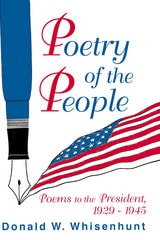
Poetry of the People
Poems to the President, 1929–1945Donald W. Whisenhunt
University of Wisconsin Press, 1996
The poets of the era voiced their opinions on virtually every subject. They wrote about New Deal agencies, they praised and condemned Hoover and Roosevelt. They expressed their views about the Supreme Court, the third term, and the approaching war in Europe. The resulting study, arranged topically rather than chronologically, provides a unique perspective on American popular culture and American politics.
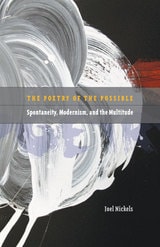
Poetry of the Possible
Spontaneity, Modernism, and the MultitudeJoel Nickels
University of Minnesota Press, 2012
The Poetry of the Possible challenges the conventional image of modernism as a socially phobic formation, arguing that modernism’s abstractions and difficulties are ways of imagining unrealized powers of collective self-organization. Establishing a conceptual continuum between modernism and contemporary theorists such as Paulo Virno, Michael Hardt, Antonio Negri, and Alain Badiou, Joel Nickels rediscovers modernism’s attempts to document the creative potenza of the multitude.
By examining scenes of collective life in works by William Carlos Williams, Wyndham Lewis, Laura Riding, and Wallace Stevens, Nickels resurrects modernism’s obsession with constituent power: the raw, indeterminate capacity for reciprocal counsel that continually constitutes and reconstitutes established political regimes. In doing so, he reminds us that our own attempts to imagine leaderless networks of collective initiative are not so much breaks with modernist forms of knowledge as restagings of some of modernism’s most radical moments of political speculation.
Setting modernism’s individual and collective models of spontaneity in dialogue with theorists of political spontaneity such as Antonio Gramsci, Herbert Marcuse, and Theodor Adorno, Nickels retells the story of modernism as the struggle to represent powers of collective self-organization that lie outside established regimes of political representation.
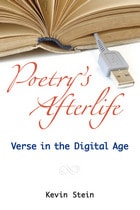
Poetry's Afterlife
Verse in the Digital AgeKevin Stein
University of Michigan Press, 2010
"The great pleasure of this book is the writing itself. Not only is it free of academic and ‘lit-crit' jargon, it is lively prose, often deliciously witty or humorous, and utterly contemporary. Poetry's Afterlife has terrific classroom potential, from elementary school teachers seeking to inspire creativity in their students, to graduate students in MFA programs, to working poets who struggle with the aesthetic dilemmas Stein elucidates, and to teachers of poetry on any level."
--- Beckian Fritz Goldberg, Arizona State University
"Kevin Stein is the most astute poet-critic of his generation, and this is a crucial book, confronting the most vexing issues which poetry faces in a new century."
---David Wojahn, Virginia Commonwealth University
At a time when most commentators fixate on American poetry's supposed "death," Kevin Stein's Poetry's Afterlife instead proposes the vitality of its aesthetic hereafter. The essays of Poetry's Afterlife blend memoir, scholarship, and personal essay to survey the current poetry scene, trace how we arrived here, and suggest where poetry is headed in our increasingly digital culture. The result is a book both fetchingly insightful and accessible. Poetry's spirited afterlife has come despite, or perhaps because of, two decades of commentary diagnosing American poetry as moribund if not already deceased. With his 2003 appointment as Illinois Poet Laureate and his forays into public libraries and schools, Stein has discovered that poetry has not given up its literary ghost. For a fated art supposedly pushing up aesthetic daisies, poetry these days is up and about in the streets, schools, and universities, and online in new and compelling digital forms. It flourishes among the people in a lively if curious underground existence largely overlooked by national media. It's this second life, or better, Poetry's Afterlife, that his book examines and celebrates.
Kevin Stein is Caterpillar Professor of English and Director of the Creative Writing Program at Bradley University and has served as Illinois Poet Laureate since 2003, having assumed the position formerly held by Gwendolyn Brooks and Carl Sandburg. He is the author of numerous books of poetry and criticism.
digitalculturebooksis an imprint of the University of Michigan Press and the Scholarly Publishing Office of the University of Michigan Library dedicated to publishing innovative and accessible work exploring new media and their impact on society, culture, and scholarly communication. Visit the website at www.digitalculture.org.
Poets Beyond the Barricade
Rhetoric, Citizenship, and Dissent after 1960Dale M. Smith
University of Alabama Press, 2012
Poets On Place
W. T. Pfefferle
Utah State University Press, 2005
Out to see America and satisfy his travel bug, W. T. Pfefferle resigned from his position as director of the writing program at Johns Hopkins University and hit the road to interview sixty-two poets about the significance of place in their work. The lively conversations that resulted may surprise with the potential meanings of a seemingly simple concept. This gathering of voices and ideas is illustrated with photo and word portraits from the road and represented with suitable poems.
The poets are James Harms, David Citino, Martha Collins, Linda Gregerson, Richard Tillinghast, Orlando Ricardo Menes, Mark Strand, Karen Volkman, Lisa Samuels, Marvin Bell, Michael Dennis Browne, David Allan Evans, David Romtvedt, Sandra Alcosser, Robert Wrigley, Nance Van Winckel, Christopher Howell, Mark Halperin, Jana Harris, Sam Hamill, Barbara Drake, Floyd Skloot, Ralph Angel, Carol Muske-Dukes, David St. John, Sharon Bryan, Donald Revell, Claudia Keelan, Alberto Rios, Richard Shelton, Jane Miller, William Wenthe, Naomi Shihab Nye, Peter Cooley, Miller Williams, Beth Ann Fennelly, Natasha Trethewey, Denise Duhamel, Campbell McGrath, Terrance Hayes, Alan Shapiro, Nikki Giovanni, Charles Wright, Rita Dove, Henry Taylor, Dave Smith, Nicole Cooley, David Lehman, Lucie Brock-Broido, Michael S. Harper, C. D. Wright, Mark Wunderlich, James Cummins, Frederick Smock, Mark Jarman, Carl Phillips, Scott Cairns, Elizabeth Dodd, Jonathan Holden, Bin Ramke, Kenneth Brewer, and Paisley Rekdal.
Poiesis and Modernity in the Old and New Worlds
Anthony J. Cascardi
Vanderbilt University Press, 2012
Points of Departure
Samuel Weber between Spectrality and ReadingEdited by Peter Fenves, Kevin McLaughlin, and Marc Redfield
Northwestern University Press, 2016
Poisonous Muse
The Female Poisoner and the Framing of Popular Authorship in Jacksonian AmericaSara L. Crosby
University of Iowa Press, 2016
This difference in outcome doesn’t mean that poisonous women didn’t preoccupy Americans. In the decades following Andrew Jackson’s first presidential bid, Americans buzzed over women who used poison to kill men. They produced and devoured reams of ephemeral newsprint, cheap trial transcripts, and sensational “true” pamphlets, as well as novels, plays, and poems. Female poisoners served as crucial elements in the literary manifestos of writers from Nathaniel Hawthorne and Edgar Allan Poe to George Lippard and the cheap pamphleteer E. E. Barclay, but these characters were given a strangely positive spin, appearing as innocent victims, avenging heroes, or engaging humbugs.
The reason for this poison predilection lies in the political logic of metaphor. Nineteenth-century Britain strove to rein in democratic and populist movements by labeling popular print “poison” and its providers “poisoners,” drawing on centuries of established metaphor that negatively associated poison, women, and popular speech or writing. Jacksonian America, by contrast, was ideologically committed to the popular—although what and who counted as such was up for serious debate. The literary gadfly John Neal called on his fellow Jacksonian writers to defy British critical standards, saying, “Let us have poison.” Poisonous Muse investigates how they answered, how they deployed the figure of the female poisoner to theorize popular authorship, to validate or undermine it, and to fight over its limits, particularly its political, gendered, and racial boundaries.
Poisonous Muse tracks the progress of this debate from approximately 1820 to 1845. Uncovering forgotten writers and restoring forgotten context to well-remembered authors, it seeks to understand Jacksonian print culture from the inside out, through its own poisonous language.
Polish Literature and the Holocaust
Eyewitness Testimonies, 1942–1947Rachel Feldhay Brenner
Northwestern University Press, 2019
Polish Literature and the Holocaust: Eyewitness Testimonies,1942–1947 is a particularly timely book in view of the continuing debate about the attitudes of Poles toward the Jews during the war. The literary voices from the past that Brenner examines posit questions that are as pertinent now as they were then. And so, while this book speaks to readers who are interested in literary responses to the Holocaust, it also illuminates the universal issue of the responsibility of witnesses toward the victims of any atrocity.
Political Aesthetics in the Era of Shakespeare
Edited by Christopher Pye
Northwestern University Press, 2020
Taking up this expansive conception of aesthetics, Political Aesthetics in the Era of Shakespeare suggests that the political stakes of the literary work—and Shakespeare’s work in particular—extend from the most intimate dimensions of affective response to the problem of the grounds of political society. The approaches to aesthetic thought included in this volume explore the intersections between the literary work and the full range of concerns animating the field today: political philosophy, affect theory, and ecocritical analysis of environs and habitus.
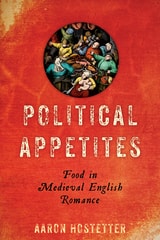
Political Appetites
Food in Medieval English RomanceAaron Hostetter
The Ohio State University Press, 2017
If humanity has attempted through its brief history to render the material world edible, then food and food practice not only influence our aspirations but also shift focus to the limits of human existence on this planet. In studying the foodways of the past as a fundamental economic activity, Political Appetites questions contemporary attitudes towards consumption as their proliferation and abuses create social inequities, menace ecosystems, and threaten to bring about the end of the Anthropocene Era.

Political Fiction, the Spirit of Age, and Allen Drury
Tom Kemme
University of Wisconsin Press, 1987

Politicizing Gender
Narrative Strategies in the Aftermath of the French RevolutionKadish, Doris Y
Rutgers University Press, 1991
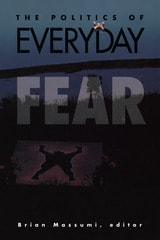
Politics Of Everyday Fear
Brian Massumi
University of Minnesota Press, 1993
The contemporary consumer is bombarded with fear-inducing images and information. This media shower of imagery is equaled only by the sheer quantity of fear-assuaging products offered for our consumption. The contributors address questions raised by the saturation of social space by capitalized fear.
Politics and History in William Golding
The World Turned Upside DownPaul Crawford
University of Missouri Press, 2002

Politics and Poetic Value
Edited by Robert von Hallberg
University of Chicago Press, 1987
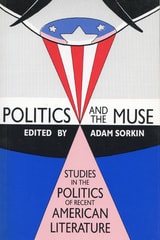
Politics and the Muse
Studies in the Politics of Recent American LiteratureAdam J. Sorkin
University of Wisconsin Press, 1989
Politics as Sound
The Washington, DC, Hardcore Scene, 1978-1983Shayna L. Maskell
University of Illinois Press, 2021
A fascinating analysis of a punk rock hotbed, Politics as Sound tells the story of how a generation created music that produced--and resisted--politics and power.
Politics, Desire, and the Hollywood Novel
Chip Rhodes
University of Iowa Press, 2008
Rhodes considers how novels about the film industry changed between the studio era of the 1930s and 1940s and the era of deregulated film making that has existed since the 1960s. He asserts that Americans are now driven by cultural, rather than class, differences and that our mainstream notion of love has gone from repressed desire to “abnormal desire” to, finally, strictly business.
Politics, Desire, and the Hollywood Novel pays close attention to six authors—Nathanael West, Raymond Chandler, Budd Schulberg, Joan Didion, Bruce Wagner, and Elmore Leonard—who have toiled in the film industry and written to tell about it. More specifically, Rhodes considers both screenplays and novels with an eye toward the different formulations of sexuality, art, and ultimately political action that exist in these two kinds of storytelling.

Politics, Gender, and the Mexican Novel, 1968-1988
Beyond the PyramidBy Cynthia Steele
University of Texas Press, 1992
The student massacre at Tlatelolco in Mexico City on October 2, 1968, marked the beginning of an era of rapid social change in Mexico. In this illuminating study, Cynthia Steele explores how the writers of the next two decades responded to the massacre and to the social crisis it signaled in terms of political change and gender identity.
Politics, Ideology, and Literary Discourse in Modern China
Theoretical Interventions and Cultural CritiqueKang Liu and Xiaobing Tang, eds.
Duke University Press, 1993
With chapters by writers, scholars, and critics from mainland China, Hong Kong, and the United States, this volume explores the complexity of representing modernity within the Chinese context. Addressing the problem of finding a proper language for articulating fundamental issues in the historical experience of twentieth-century China, the authors critically re-examine notions of realism, the self/subject, and modernity and draw on perspectives from feminist criticism, ideological analysis, and postmodern theory. Among the many topics explored are subjectivity in Chinese cultural theory, Chinese gender relations, the viability of a Lacanian approach to Chinese identity, the politics of subversion in Chinese reportage, and the ambivalent status of the icon of paternity since Mao.
At the same time this book offers a probing look into the transformation that Chinese culture as well as the study of that culture is currently undergoing, it also reconfirms private discourse as an ideal site for an investigation into a real and imaginary, private and collective encounter with history.
Contributors. Liu Kang, Xiaobing Tang, Liu Zaifu, Stephen Chan, Lydia H. Liu, Wendy Larson, Theodore Huters, David Wang, Tonglin Lu, Yingjin Zhang, Yuejin Wang, Li Tuo, Leo Ou-fan Lee

Politics, Writing, Mutilation
The Cases of Bataille, Blanchot, Roussel, Leiris, and PongeAllan Stoekl
University of Minnesota Press, 1985
Politics, Writing, Mutilation was first published in 1985. Minnesota Archive Editions uses digital technology to make long-unavailable books once again accessible, and are published unaltered from the original University of Minnesota Press editions.
Five twentieth-century French writers played, and continue to play, a pivotal role in the development of literary-philosophical thinking that has come to be known in the United States as post-structuralism. The work of Georges Bataille, Maurice Blanchot, Raymond Roussel, Michel Leiris, and Francis Ponge in the 1930s and 1940s amounts to a prehistory of today's theoretical debates; the writings of Foucault and Derrida in particular would have been unthinkable outside the context provided by these writers. In Politics, Writing, Mutilation,Allan Stoekl emphasizes their role as precursors, but he also makes clear that they created a distinctive body of work that must be read and evaluated on its own terms.
Stoekl's critical readings of their work—selected novels, poems, and autobiographical fragments—reveal them to be battlegrounds not only of disruptive language practices, but of conflicting political drives as well. These irreconcilable tendencies can be defined as progressive political revolution, on the one hand with its emphasis on utility, conservation, and labor; and, on the other hand, a notion of dangerous and sinister production that stresses orgiastic sexuality and delirious expenditure. Caught between these forces is the intellectual of Bataille's time (and indeed of ours), locked in impotence, self-betrayal, and automutilation.
Stoekl develops his critique through dual readings of each writer's central work—the first reading deconstructive, the second a search for the political meaning excluded by a deconstructive approach. Repeating this process on a larger scale, he shows how Derrida and Foucault are indebted to their precursors even while they have betrayed them by stripping their work of political conflict and historical specificity. And he acknowledges that one of the most painful questions faced in prewar and Occupied France—that of the unthinkable guilt and duplicity of the intellectual—may not be as remote from contemporary theoretical concerns as some would have us believe.
Poor Pearl, Poor Girl!
The Murdered-Girl Stereotype in Ballad and NewspaperBy Anne B. Cohen
University of Texas Press, 1973
The year was 1896, and nineteenth-century journalists called the murder of Pearl Bryan the "Crime of the Century." From the day Pearl's headless body was found to the execution of her murderers on the gallows, the details of the murder fascinated newspaper reporters and ballad composers alike.
Often glossing over the facts of the case, newspaper accounts presented the events according to stereotypes that were remarkably similar to those found in well-known murdered-girl ballads, such as "Pretty Polly," "Omie Wise," and "The Jealous Lover." Events, characters, motivations, and plot were presented through this framework: the simple country girl led astray by a clever degenerate. Nearly all variants of the Pearl Bryan ballad point the same moral:
Young ladies now take warning
Young men are so unjust,
It may be your best lover
But you know not whom to trust.
Representations of this formula appear in such diverse genres as the ballad "Poor Ellen Smith" and the novel An American Tragedy.
As Anne Cohen demonstrates, both newspaper accounts and ballads tell the Pearl Bryan story from the same moral stance, express the same interpretation of character, and are interested in the same details. Both distort facts to accommodate a shared pattern of storytelling. This pattern consists of a plot formula—the murdered-girl formula—that is accompanied by stereotyped scenes, actors, and phrases. The headless body—surely the most striking element in the Pearl Bryan case—is absent from those ballads that have survived. Anne Cohen contends that a decapitated heroine does not belong to the formula—a murdered heroine, yes, but not a decapitated one. Similarly, newspapers made much of Pearl's "innocence" and tended to downplay the second murderer. Only one murderer, the lover, belongs to the stereotype.
Poor Pearl, Poor Girl! is a ballad study conducted on historic- geographic lines; that is, it seeks to trace the history and interrelations of a series of ballad texts and to relate the ballads directly to their ideological and historical context in the American scene. It also compares the narrative techniques of ballad composition with the techniques of other forms of popular narrative, especially newspaper journalism.
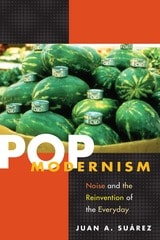
Pop Modernism
Noise and the Reinvention of the EverydayJuan A. Suarez
University of Illinois Press, 2007
Pop Music And The Press
Steve Jones
Temple University Press, 2002
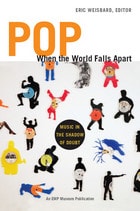
Pop When the World Falls Apart
Music in the Shadow of DoubtEric Weisbard, ed.
Duke University Press, 2012
Drawn from presentations at the annual Experience Music Project Pop Conference—hailed by Robert Christgau as “the best thing that’s ever happened to serious consideration of pop music”—the essays in this book include inquiries into the sonic dimension of war in Iraq; the cultural life of jazz in post-Katrina New Orleans; Isaac Hayes’s reappropriation of a country song, “By the Time I Get to Phoenix,” as a symbol of black nationalism; and punk rock pranks played on record execs looking for the next big thing in central Virginia. Offering a diverse range of voices, perspectives, and approaches, this volume mirrors the eclecticism of pop itself.
Contributors: Larry Blumenfeld , Austin Bunn, Nate Chinen, J. Martin Daughtry, Brian Goedde, Michelle Habell-Pallán, Jonathan Lethem, Eric Lott, Kembrew McLeod, Elena Passarello, Diane Pecknold, David Ritz, Carlo Rotella, Scott Seward, Tom Smucker, Greg Tate, Karen Tongson, Alexandra T. Vazquez, Oliver Wang, Eric Weisbard, Carl Wilson
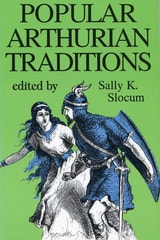
Popular Arthurian Traditions
Sally K. Slocum
University of Wisconsin Press, 1992