Results by title
3785 books match the query 'Poetry' and 203 start with p
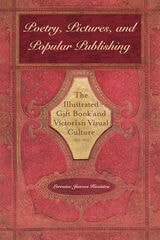
Poetry, Pictures, and Popular Publishing
The Illustrated Gift Book and Victorian Visual Culture, 1855–1875Lorraine Janzen Kooistra
Ohio University Press, 2011
In Poetry, Pictures, and Popular Publishing eminent Rossetti scholar Lorraine Janzen Kooistra demonstrates the cultural centrality of a neglected artifact: the Victorian illustrated gift book. Turning a critical lens on “drawing-room books” as both material objects and historical events, Kooistra reveals how the gift book’s visual/verbal form mediated “high” and popular art as well as book and periodical publication.
A composite text produced by many makers, the poetic gift book was designed for domestic space and a female audience; its mode of publication marks a significant moment in the history of authorship, reading, and publishing. With rigorous attention to the gift book’s aesthetic and ideological features, Kooistra analyzes the contributions of poets, artists, engravers, publishers, and readers and shows how its material form moved poetry into popular culture. Drawing on archival and periodical research, she offers new readings of Eliza Cook, Adelaide Procter, and Jean Ingelow and shows the transatlantic reach of their verses. Boldly resituating Tennyson’s works within the gift-book economy he dominated, Kooistra demonstrates how the conditions of corporate authorship shaped the production and receptionof the laureate’s verses at the peak of his popularity.
Poetry, Pictures, and Popular Publishing changes the map of poetry’s place—in all its senses—in Victorian everyday life and consumer culture.
Poets Beyond the Barricade
Rhetoric, Citizenship, and Dissent after 1960Dale M. Smith
University of Alabama Press, 2012
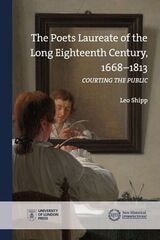
Poets Laureate in the Long Eighteenth Century, 1668-1813
Leo Shipp
University of London Press, 2022
The office of the poet laureate of Britain was a highly prominent, relevant, and respectable institution throughout the long eighteenth century. First instituted for John Dryden in 1668, the laureateship developed from an honorific into a functionary office with a settled position in court, and in 1813 was bestowed upon Robert Southey, whose tenure transformed the office. Taking an interdisciplinary approach, this book examines the office’s institutional changes and public reception, the mechanics of each laureate’s appointment, and the works produced by the laureates before and after their appointments. It argues that the laureateship played a key part in some of the most vital trends in eighteenth-century culture.
At the core of the book is a new research paradigm that Leo Shipp calls the conceptual geography of culture. It shows that Britons routinely used spatial concepts to understand culture throughout the period, which became increasingly abstract over time. As part of this, Shipp shows, the court evolved from a concrete space in London to an abstract space capable of hosting the entire British public. The laureateship was a dynamic office positioned at the interface of court and public, evolving in line with its audiences. An important intervention in eighteenth-century historiography, this book presents a nuanced understanding of eighteenth-century culture and society, in which the laureateship exemplified the enduring centrality of the court to the British conceptual geography of culture.
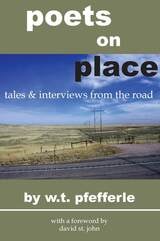
Poets On Place
W. T. Pfefferle
Utah State University Press, 2005
Out to see America and satisfy his travel bug, W. T. Pfefferle resigned from his position as director of the writing program at Johns Hopkins University and hit the road to interview sixty-two poets about the significance of place in their work. The lively conversations that resulted may surprise with the potential meanings of a seemingly simple concept. This gathering of voices and ideas is illustrated with photo and word portraits from the road and represented with suitable poems.
The poets are James Harms, David Citino, Martha Collins, Linda Gregerson, Richard Tillinghast, Orlando Ricardo Menes, Mark Strand, Karen Volkman, Lisa Samuels, Marvin Bell, Michael Dennis Browne, David Allan Evans, David Romtvedt, Sandra Alcosser, Robert Wrigley, Nance Van Winckel, Christopher Howell, Mark Halperin, Jana Harris, Sam Hamill, Barbara Drake, Floyd Skloot, Ralph Angel, Carol Muske-Dukes, David St. John, Sharon Bryan, Donald Revell, Claudia Keelan, Alberto Rios, Richard Shelton, Jane Miller, William Wenthe, Naomi Shihab Nye, Peter Cooley, Miller Williams, Beth Ann Fennelly, Natasha Trethewey, Denise Duhamel, Campbell McGrath, Terrance Hayes, Alan Shapiro, Nikki Giovanni, Charles Wright, Rita Dove, Henry Taylor, Dave Smith, Nicole Cooley, David Lehman, Lucie Brock-Broido, Michael S. Harper, C. D. Wright, Mark Wunderlich, James Cummins, Frederick Smock, Mark Jarman, Carl Phillips, Scott Cairns, Elizabeth Dodd, Jonathan Holden, Bin Ramke, Kenneth Brewer, and Paisley Rekdal.
Poets Teaching Poets
Self and the WorldGregory Orr and Ellen Bryant Voigt, Editors
University of Michigan Press, 1996
Poets as Public Scholars
Contemporary Poetics in an Age of Social MediaC. R. Grimmer
University of Michigan Press, 2026
Poets as Public Scholars is a multimedia project that interrogates how poet-scholars use digital platforms to expand access and visibility for underrepresented voices, but also to critique the commodification, extraction, and erasure practices embedded in neoliberal literary circulation. Framed by two core questions—how poets teach public scholarship through networked media, and how to support underrepresented poets without reinforcing market-driven erasure—the collection offers videos for student and public engagement, essays for scholarly audiences, and discussion questions for classroom use.
Structured around seven video dialogues and seven critical essays, the book features contributions from poet-scholars including Camea Davis, A.D. Carson, Tyrone Williams, Patrick Milian, Stevi Costa, Cameron Awkward-Rich, and Woogee Bae. Each chapter examines the material and affective economies that shape poetic production and reception, while proposing alternative, community-rooted infrastructures for literary and cultural labor. Designed for layered audiences, the video interviews model public-facing discourse, while the companion essays situate the work within critical conversations in literature, cultural theory, and media studies. With included discussion questions by Dr. Molly Ubbesen (University of Minnesota Rochester) and open access availability, Poets as Public Scholars functions as both a teaching tool and a theoretical intervention for scholars and educators seeking to integrate anti-racist, anti-capitalist approaches to literary and digital humanities pedagogy.
Poets on Teaching
A SourcebookJoshua Marie Wilkinson
University of Iowa Press, 2010
In response to a lack of source works for wide-ranging approaches to teaching poetry, award-winning poet Joshua Marie Wilkinson has gathered ninety-nine micro-essays for poets, critics, and scholars who teach and for students who wish to learn about the many ways poets think about how a poem comes alive from within—and beyond—a classroom. Not narrowly concerned with how to read poetry or how to write poetry, by virtue of their central concern with teaching poetry, the essays in this fresh and innovative volume address both reading and writing and give teachers and students useful tools for the classroom and beyond.
Divided into four sections—“Reflections / Poetics,” “Exercises / Praxis,” “New Approaches to Poetry Courses and Methodology,” and “Talks / Directives”—Poets on Teaching provides practical, intelligent advice. “Reflections / Poetics” encompasses the most expansive approaches to teaching poetry, where poets reflect variously on what teachers can cultivate in their classrooms. “Exercises / Praxis” consists of hands-on approaches to reading and, especially, writing poems. “New Approaches to Poetry Courses and Methodology” features essays on rethinking specific courses, offering new ideas for course design and pedagogy. “Talks / Directives” contains a series of more informal and conversational discussions geared toward becoming a stronger reader, writer, teacher, and student of poetry. Poets on Teaching will be required reading for new and experienced teachers alike.
Kazim Ali, Rae Armantrout, Hadara Bar-Nadav, Dan Beachy-Quick, Bruce Beasley, Claire Becker, Jaswinder Bolina, Jenny Boully, Joel Brouwer, Lily Brown, Laynie Browne, Stephen Burt, Julie Carr, Joshua Clover, Matthew Cooperman, Oliver de la Paz, Linh Dinh, Ben Doller, Sandra Doller, Julie Doxsee, Lisa Fishman, Graham Foust, John Gallaher, Forrest Gander, C. S. Giscombe, Peter Gizzi, Lara Glenum, Kenneth Goldsmith, Johannes Göransson, Noah Eli Gordon, Arielle Greenberg, Richard Greenfield, Sarah Gridley, Anthony Hawley, Terrance Hayes, Eric Hayot, Brian Henry, Brenda Hillman, Jen Hofer, Paul Hoover, Christine Hume, Brenda Iijima, Lisa Jarnot, Kent Johnson, Bhanu Kapil, Karla Kelsey, Aaron Kunin, Quraysh Ali Lansana, Dorothea Lasky, Sueyeun Juliette Lee, Ada Limón, Timothy Liu, Sabrina Orah Mark, Dawn Lundy Martin, Kristi Maxwell, Joyelle McSweeney, Christina Mengert, Albert Mobilio, K. Silem Mohammad, Fred Moten, Jennifer Moxley, Laura Mullen, Sawako Nakayasu, Aimee Nezhukumatathil, Hoa Nguyen, Jena Osman, D. A. Powell, Kristin Prevallet, Bin Ramke, Jed Rasula, Srikanth Reddy, Barbara Jane Reyes, Boyer Rickel, Elizabeth Robinson, Martha Ronk, Emily Rosko, Prageeta Sharma, Evie Shockley, Eleni Sikelianos, Richard Siken, Ron Silliman, Tracy K. Smith, Juliana Spahr, Sasha Steensen, Peter Streckfus, Cole Swensen, Michael Theune, Tony Trigilio, Spring Ulmer, Karen Volkman, Catherine Wagner, G. C. Waldrep, Mark Wallace, Tyrone Williams, Mark Yakich, Jake Adam York, Stephanie Young, Timothy Yu, Matthew Zapruder, Andrew Zawacki, and Rachel Zucker
Polish Poetry of the Last Two Decades of Communist Rule
Spoiling Cannibals FunStanislaw Baranczak and Clare Cavanagh
Northwestern University Press, 1991

Politics and Poetic Value
Edited by Robert von Hallberg
University of Chicago Press, 1987
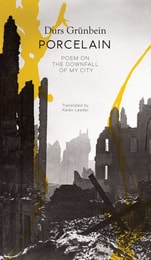
Porcelain
Poem on the Downfall of My CityDurs Grünbein
Seagull Books, 2020
Porcelain is a book-length cycle of forty-nine poems written over the course of more than a decade that together serve as a lament for Durs Grünbein’s hometown, Dresden, which was destroyed in the Allied firebombing of February 1945. The book is at once a history and “declaration of love” to the famed “Venice on the Elbe,” so catastrophically razed by British bombs; a musical fusion of eyewitness accounts, family memories, and stories, of monuments and relics; the story of the city’s destiny as seen through a prism of biographical enigmas, its intimate relation to the “white gold” porcelain that made its fortune and reflections on the power and limits of poetry. Musical, fractured, ironic, and elegiac, Porcelain is controversial, too, in setting itself against what Grünbein calls the “myth” of the Germans as innocent victims of a war crime. At the same time, it never loses sight of the horror deliberately visited on an unwitting civilian population, nor the devastation that looms so large in the German memory. Published for the first time in English, on the seventy-fifth year anniversary of the firebombing, this edition contains new images, notes, Grünbein’s own reflections, and an additional canto—an extraordinary act of poetic kintsugi for the fractured remains of Dresden’s memory.
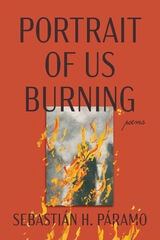
Portrait of Us Burning
PoemsSebastián H. Páramo
Northwestern University Press, 2024
Sebastián H. Páramo renders a semi-autobiographical collection, utilizing self-portraiture and memory to uncover how his Texan, working-class, Mexican American identity shapes his relationship to his half brother and to his family’s burning desire to become American.
Portrait of Us Burning begins with the humble picture of an immigrant American family. This picture starts to disintegrate—and, ultimately, burns—with the need to understand an inciting event that haunts the family throughout the second half of the collection. As the poems gather force and the picture dissolves further, Páramo asks us again and again: What does it mean to burn while becoming a part of a whole?
Portrait of Your Niece
And Other PoemsCarol Hall
University of Minnesota Press, 1959
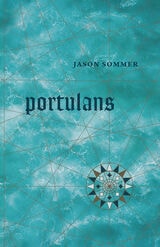
Portulans
Jason Sommer
University of Chicago Press, 2021
to say? Your eyes, though, scanning upward in their sockets,
do seem to search memory, but for what may be gone already,
gone to where it goes—wherever it came from—gone as can be imagined,
down into things, in past flesh and bark, marrow and pith, and down,
down into molecule, atom, particle, vanishing into theory.
Through this collection, Sommer takes us to the ocean floor, into the basement, out the front door, through multiverses, and in and out of dreams. Along the way, he considers whether art—the beauty of the map—can provide momentary meaning against a backdrop of oblivion. Drawing on history and myth, the voices in these poems consider what can and cannot be known of the self and the other, of our values, and of what we insist has permanence. These are poems of searching. Like ancient cartographers who lent lavish decoration to their maps, the poems in Portulans illuminate possibilities of beauty in each journey.
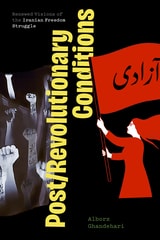
Post/Revolutionary Conditions
Renewed Visions of the Iranian Freedom StruggleAlborz Ghandehari
Northwestern University Press, 2025
An exploration of how the Iranian people have renewed their longtime struggle for freedom
The Woman, Life, Freedom uprising is only the latest manifestation of a century-long struggle for liberation in Iran. This ongoing movement for justice has encompassed two revolutions against domestic dictatorship and foreign imperialism, as well as a series of uprisings since the 1979 Iranian Revolution, which was followed by a new era of repression. Post/Revolutionary Conditions: Renewed Visions of the Iranian Freedom Struggle offers an intersectional analysis of how progressive and radical movement builders have reenvisioned liberation in the post-’79 era, despite new forms of oppression under the Islamic Republic and from US and other foreign imperial powers. Bringing together a diverse array of sources, including oral histories with Iranian labor, student, and gender justice organizers, as well as resistance literature and art, Alborz Ghandehari challenges narratives that treat working-class, feminist, queer, and oppressed ethnic minorities’ movements as separate from one another. Post/Revolutionary Conditions demonstrates how such potent reimaginings of collective liberation and a radically democratic future have been shaped by multiple generations of protest and kindred struggles globally.
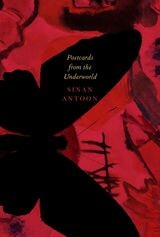
Postcards from the Underworld
PoemsSinan Antoon
Seagull Books, 2023
To confront time, pre-modern Arabic poems often began with the poet standing before the ruins, real and imagined, of a beloved’s home. In Postcards from the Underworld, Sinan Antoon works in that tradition, observing the detritus of his home city, Baghdad, where he survived two wars—the Iran-Iraq War of 1980 and the First Gulf War of 1991—and which, after he left, he watched from afar being attacked during the US invasion in 2003. Antoon’s poems confront violence and force us not to look away as he traces death’s haunting presence in the world. Nature offers consolation, and flowers and butterflies are the poet’s interlocutors, but they too cannot escape ruin. Composed in Arabic and translated into English by the poet himself, Postcards from the Underworld is a searing meditation on the destruction of humans, habitats, and homes.
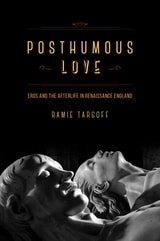
Posthumous Love
Eros and the Afterlife in Renaissance EnglandRamie Targoff
University of Chicago Press, 2014
Targoff shows that medieval notions of the somewhat flexible boundaries between love in this world and in the next were hardened by Protestant reformers, who envisioned a total break between the two. Tracing the narrative of this rupture, she focuses on central episodes in poetic history in which poets developed rich and compelling compensations for the lack of posthumous love—from Thomas Wyatt’s translations of Petrarch’s love sonnets and the Elizabethan sonnet series of Shakespeare and Spencer to the carpe diem poems of the seventeenth century. Targoff’s centerpiece is Romeo and Juliet, where she considers how Shakespeare’s reworking of the Italian story stripped away any expectation that the doomed teenagers would reunite in heaven. Casting new light on these familiar works of poetry and drama, this book ultimately demonstrates that the negation of posthumous love brought forth a new mode of poetics that derived its emotional and aesthetic power from its insistence upon love’s mortal limits.
Postliterary America
From Bagel Shop Jazz to MicropoetriesMaria Damon
University of Iowa Press, 2011
Potential Stranger
Killarney Clary
University of Chicago Press, 2003
Pound/Cummings
The Correspondence of Ezra Pound and E.E. CummingsBarry Ahearn, Editor
University of Michigan Press, 1996
Throughout the correspondence both poets reveal themselves and their beliefs to a remarkable degree. Pound entrusted to Cummings details of his political outlook in the 1930s and 1940s, including his opinions about Mussolini's Italy. The letters to Cummings also shed new light on the question of Pound's sanity after World War II. Although he was diagnosed as mentally unfit, the letters generally show no evidence of paranoia, only of his characteristic eccentricity.
Similarly, these letters should provoke a reevaluation of Cummings. Critics have treated Cummings's political views as either strictly private matters or merely incidental to his art. The letters, however, show that Cummings's radically conservative political opinions are wholly consistent with his poetics, and raise the question of the relation between Cummings's political principles and his enthusiasm for particular forms (and particular stars) of mass entertainment.
In addition to their political revelations, the letters are steeped in the literary climate--and literary gossip--of the times. Pound comments often and candidly on Cummings's poetry and prose; both Pound and Cummings send light verse to each other. And the poets exchange anecdotes about such figures as Henry James, Wyndham Lewis, T. S. Eliot, Edmund Grosse, Max Eastman, and Aldous Huxley, among other writers.
There is much here to interest and delight both fans and foes of Pound and Cummings. The book will be of primary importance to students and scholars of modern poetry, especially those who emphasize the intersection of literary works and political history.
Barry Ahearn is Associate Professor of English, Tulane University.

Poverty Creek Journal
Thomas Gardner
Tupelo Press, 2014

Power and Elusiveness in Shelley
Oscar W. Firkins
University of Minnesota Press, 1937
Power and Elusiveness in Shelley was first published in 1937. Minnesota Archive Editions uses digital technology to make long-unavailable books once again accessible, and are published unaltered from the original University of Minnesota Press editions.
This is a discussion in measured prose of the strange yet frequent union of various abstract elements in Shelley's poetry. The study contains an interesting analysis of the thesis that Shelley's "love of abstraction is only one form—probably the most obvious and the most significant form—of a larger and more general tendency." The object of this essay, in the author's words, "is to collect and combine the manifestations of this larger tendency."
The two great "abstractions" that Firkins selects as the touchstones in his study he generalizes as "power" and "elusiveness," and he shows how these seemingly antithetical qualities are united in both the structure and the style of all Shelley's chief poems.
Power and Possibility
Essays, Reviews, and InterviewsElizabeth Alexander
University of Michigan Press, 2007
A volume in the Poets on Poetry series, which collects critical works by contemporary poets, gathering together the articles, interviews, and book reviews by which they have articulated the poetics of a new generation.
Elizabeth Alexander is considered one of the country's most gifted contemporary poets, and the publication of her essays in The Black Interior in 2004 established her as an astute critic and cultural commentator as well. Arnold Rampersad has called Alexander "one of the brightest stars in our literary sky . . . a superb, invaluable commentator on the American scene." In this new collection of her essays, reviews, and interviews, Alexander again focuses on African American artistic production, particularly poetry, and the cultural contexts in which it is created and experienced.
The book's first section, "Black Arts 101," takes up the poetry of Paul Laurence Dunbar, Sterling Brown, Lucille Clifton, Gwendolyn Brooks, and Rita Dove (among others); artist Romare Bearden; dancer Bill T. Jones; and dramatist August Wilson. A second section, "Black Feminist Thinking," provides engaging meditations ranging from "My Grandmother's Hair" and "A Very Short History of Black Women and Food" to essays on the legacies of Toni Cade, Audre Lorde, and June Jordan. The collection's final section, "Talking," includes interviews, a commencement address---"Black Graduation"---and the essay "Africa and the World."
Elizabeth Alexander received a B.A. from Yale University, an M.A. from Boston University, and a Ph.D. in English from the University of Pennsylvania. She has published four books of poems: The Venus Hottentot (1990); Body of Life (1996); Antebellum Dream Book (2001); and, most recently, American Sublime (2005), which was one of three finalists for the Pulitzer Prize. Her play, Diva Studies, was produced at the Yale School of Drama. She is presently Professor of American and African American Studies at Yale University.
Practicing Literary Theory in the Middle Ages
Ethics and the Mixed Form in Chaucer, Gower, Usk, and HoccleveEleanor Johnson
University of Chicago Press, 2013
Praise Nothing
PoemsJoshua Robbins
University of Arkansas Press, 2013
Praising It New
The Best of the New CriticismGarrick Davis
Ohio University Press, 2008
Praising It New is the first anthology of New Criticism to be printed in fifty years. It includes important essays by such influential poets and critics as T. S. Eliot, Ezra Pound, John Crowe Ransom, Allen Tate, Yvor Winters, Cleanth Brooks, R. P. Blackmur, W. K. Wimsatt, and Robert Penn Warren. Together, these authors ushered in the modernist age of poetry and criticism and transformed the teaching of literature in the schools. As the American poet and critic Randall Jarrell once noted: “I do not believe there has been another age in which so much extraordinarily good criticism of poetry has been written.”
This anthology now makes much of the best American poetry criticism available again, and includes short biographies and selected bibliographies of its chief figures. Praising It New is the perfect introduction for students to the best American poetry criticism of the twentieth century.
Prayer and Power
George Herbert and Renaissance CourtshipMichael C. Schoenfeldt
University of Chicago Press, 1991
Before entering the priesthood, Herbert nourished contacts in court, was elected University Orator at Cambridge, and served in Parliament. In turning to God, Schoenfeldt argues, Herbert did not simply turn away from the secular world but also turned its language, particularly the language of courtesy, into the medium for his lyric worship of God. The confluence of courtesy and spirituality in Herbert's poetry provides a fascinating insight into a society searching for an appropriate discourse of reverence in a time of baffling change. The first five chapters investigate the manifold ways in which Herbert's life and works exemplify the interdependence of social and religious behavior in the English Renaissance. The sixth and final chapter extends this investigation into the nervous eroticism of Herbert's poems.
Considering The Temple as well as Herbert's letters, speeches, Latin poems, collections of foreign proverbs, translations, The Country Parson, and less familiar lyrics, Schoenfeldt offers a thorough and detailed reading of Herbert's rich and conflicted corpus. Prayer and Power is not only a bold redefinition of the accomplishment of one of the finest poets of the English Renaissance but also the first sustained study to advance a cultural poetics of the religious lyric.
Praying Naked
Katie Condon
The Ohio State University Press, 2020
Predecessors, Et Cetera
EssaysAmy Clampitt
University of Michigan Press, 1991
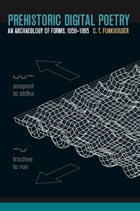
Prehistoric Digital Poetry
An Archaeology of Forms, 1959-1995C.T. Funkhouser, with a foreword by Sandy Baldwin
University of Alabama Press, 2007
Tracing the Origins of Digital Poetry Before the Web Revolution
For the last five decades, poets have had a vibrant relationship with computers and digital technology. This book is a documentary study and analytic history of digital poetry that highlights its major practitioners and the ways that they have used technology to foster a new aesthetic. Focusing primarily on programs and experiments produced before the emergence of the World Wide Web in the mid-1990s, C. T. Funkhouser analyzes numerous landmark works of digital poetry to illustrate that the foundations of today’s most advanced works are rooted in the rudimentary generative, visual, and interlinked productions of the genre’s prehistoric period.
Since 1959, computers have been used to produce several types of poetic output, including randomly generated writings, graphical works (static, animated, and video formats), and hypertext and hypermedia. Funkhouser demonstrates how hardware, programming, and software have been used to compose a range of new digital poetic forms. Several dozen historical examples, drawn from all of the predominant approaches to digital poetry, are discussed, highlighting the transformational and multi-faceted aspects of poetic composition now available to authors. This account includes many works, in English and other languages, which have never before been presented in an English-language publication.
In exploring pioneering works of digital poetry, Funkhouser demonstrates how technological constraints that would seemingly limit the aesthetics of poetry have instead extended and enriched poetic discourse. As a history of early digital poetry and a record of an era that has passed, this study aspires both to influence poets working today and to highlight what the future of digital poetry may hold.
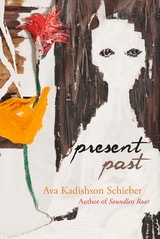
Present Past
Ava Kadishson Schieber
Northwestern University Press, 2016
The focus of Present Past is her life after the Shoah. Rejecting stereotypes of survivors as traumatized or broken, Schieber is stark yet exuberant, formidable yet nuanced. The woman who emerges in Schieber’s Present Past is a multifaceted, heterogeneous figure—poet, artist, and survivor. In it, she plays the passionate observer who dispassionately curates the kaleidoscopic memories of her tumultuous personal and professional life in Belgrade, Prague, Tel Aviv, New York, and Chicago.
Organized into thirteen chapters, each a blend of images, poems, and narrative, this moving new work offers myriad points of entry to readers of these genres, those fascinated in the relationship between the Holocaust and art, as well as readers interested in memory and survivorship.
Previously Owned
Nathan McClain
Four Way Books, 2022
Primary Care
More Poems by PhysiciansAngela Belli
University of Iowa Press, 2006
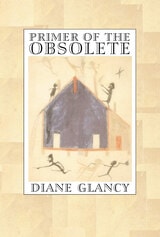
Primer of the Obsolete
Diane Glancy
University of Massachusetts Press, 2004
The poems have roots in history, religion, and illiteracy. They are inspired by folk artists who use materials and textures at hand—enamel and cornmeal on plywood, house paint on tar and tin, model airplane paint on corrugated scrap metal. The resulting lyrics walk the boundary between worlds, weaving remnants of the old way of viewing the world with pieces of the new world, such as a clapper that turns lights on and off. The experimental text revisits the gap between past and present. The past is just beneath a newly painted surface. The newly painted surface is not quite dry.
Printer's Fist
PoemsMelissa Range
Vanderbilt University Press, 2026
Melissa Range’s Printer’s Fist, awarded the 2025 Vanderbilt University Literary Prize, is a collection that tells the story of a political movement—its strides and setbacks, its unity and fractures—with a particular emphasis on print culture. Drawing upon more than a decade’s worth of archival research into nineteenth-century antislavery newspapers, pamphlets, broadsides, and more, Range highlights the expansiveness of the movement by focusing not on one, but a chorus of abolitionist voices. Her investment in celebrating Black and women’s histories, in particular, offers an inclusive account of American history, informed not only by thorough research but through a formal, poetic engagement with the past. In exploring how enslaved people’s self-emancipation was a form of resistance that preceded, operated alongside, and intertwined with organized networks of antislavery activists, Printer’s Fist will help facilitate discussions surrounding race, gender, and activism that are grounded in historical fact and emotional truth.
Proceed to Check Out
Alan Shapiro
University of Chicago Press, 2022
Alan Shapiro’s fourteenth collection of poetry, Proceed to Check Out, is a kind of summing up, or stock-taking, by an aging poet, of his precarious place in a world dominated by the ever-accelerating pace of technological innovation, political disruption, personal loss, and racial strife. These poems take on fundamental subjects—like the nature of time and consciousness and how or why we become who we are—but Shapiro presses them into becoming urgent and timely.
Employing idiomatic range and formal variety, Shapiro’s poems move through recurring dreams, the coercions of childhood, and the mysterious connections of mind and matter, pleasure and memory. They meet an abiding need to find empathy and understanding in even the most challenging places—amid disaffection, public discord, and estrangement. His grasp of contemporary life—in all its insidious violence and beauty—is distinct, comprehensive, and profound.
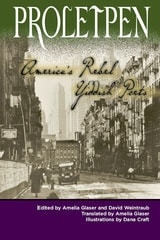
Proletpen
America’s Rebel Yiddish PoetsEdited by Amelia Glaser and David Weintraub
University of Wisconsin Press, 2005
This anthology presents a rich but little-known body of American Yiddish poetry from the 1920s to the early 1950s by thirty-nine poets who wrote from the perspective of the proletarian left. Presented on facing pages in Yiddish and English translation, these one hundred poems are organized thematically under such headings as Songs of the Shop, United in Struggle, Matters of the Heart, The Poet on Poetry, and Wars to End All Wars. One section is devoted to verse depicting the struggles of African Americans, including several poems prompted by the infamous Scottsboro trial of nine African American men falsely accused of rape. Home to many of the writers, New York City is the subject of a varied array of poems. The volume includes an extensive introduction by Dovid Katz, a biographical note about each poet, a bibliography, and a timeline of political, social, and literary events that provide context for the poetry.
Winner of the Fenia and Yaakov Leviant Memorial Prize in Yiddish Studies for Outstanding Translation
A Choice Outstanding Academic Title
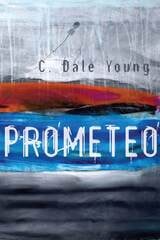
Prometeo
C. Dale Young
Four Way Books, 2021
“Some men find nothing, and others / find omens everywhere,” writes C. Dale Young in Prometeo, a collection whose speaker is a proverbial “child of fire.” In poems that thrive off of their distinct voice, the speaker confronts generational and lived trauma and their relationship to his multi-ethnicity. We are presented with the idea of the past’s burial in the body and its constellatory manifestations—both in the speaker and those around him—in disease and pain, but also in strength and a capacity for intimacy with others and nature. Grounded in precise language, Young’s examination of the past and its injuries turns into a celebration of the self. In stark, exuberant relief, the speaker proclaims “…I was splendidly blended, genetically engineered / for survival.” Resilient, Young’s poems find beauty in landscape, science, and meditation.
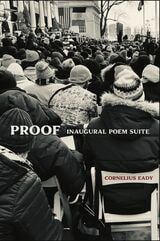
Proof
Inaugural Poem SuiteCornelius Eady
Tupelo Press, 2026
Cornelius Eady turns the inaugural poem into an instrument of reckoning.
First delivered to mark the historic inauguration of New York City’s mayor Zohran Mamdani on January 1, 2026, the title poem is not ceremony—it is summons. “You have to imagine it,” Eady insists, and from that insistence rises a chorus: those called too dark, too queer, too poor, too loud; those renamed invisible; those told “not now.” What if joy could wear down the rock of no? What if imagination were not escape, but evidence?
Moving from Robert Frost squinting into winter glare, to Elizabeth Alexander straightening her back before history, to Aretha Franklin beneath her church-crown hat, Eady braids civic pageantry with private memory. He summons the Colored Conventions of 1830, the 911 call that ricocheted through racial panic, the mock rifles on a Brooklyn rooftop, the “knife in sheep’s clothes.” Each poem widens the frame. Each poem refuses to look away.
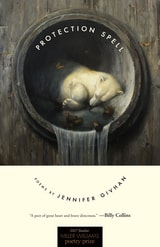
Protection Spell
PoemsJennifer Givhan
University of Arkansas Press, 2017
Finalist, 2017 Miller Williams Poetry Prize, edited by Billy Collins
“A poet of great heart and brave directness.”
—Billy Collins
In Protection Spell Jennifer Givhan explores the guilt, sadness, and freedom of relationships: the sticky love that keeps us hanging on for no reason other than love, the inky place that asks us to continue revising and reimagining, tying ourselves to this life and to each other despite the pain (or perhaps because of it). These poems reassemble safe spaces from the fissures cleaving the speaker’s own biracial home and act as witnesses speaking to the racial iniquity of our broader social landscape as well as to the precarious standpoint of a mother-woman of color whose body lies vulnerable to trauma and abuse. From insistent moments of bravery, a collection of poems arises that asks the impossible, like the childhood chant that palliates suffering by demanding nothing less than magical healing: sana sana colita de rana, si no sanas hoy, sanas mañana (the frog who loses his tail is commanded to grow another). In the end, Givhan’s verse offers a place where healing may begin.
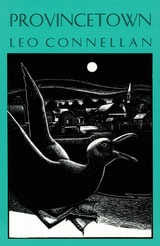
Provincetown and Other Poems
Leo Connellan
Northwestern University Press, 1995
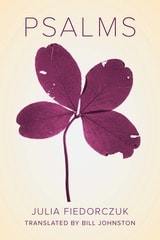
Psalms
Julia Fiedorczuk
University of Wisconsin Press, 2023
Fiedorczuk was inspired by her readings of the original Hebrew Psalms, as well as by the process of learning to sing. In her poems she captures the heartache and joy of the Biblical Psalms, but in the context of modern life. She addresses climate change, loss of biodiversity, the upheavals of migration, and, in her most recent poems, the return of war to Europe: “Even when bombs are falling you ought to write / perhaps even especially when people lost / in the woods are saying cold, she is so cold.”
Fiedorczuk writes of the natural world, the built environment, motherhood, brotherhood, and of vast and tiny passages of time. And as she does, she discovers a new voice, singing to soothe and inspire.
whose
flower made from a clod of pain will enfold
the milky way with its claws
of time, its pelt of stars?
—Excerpt from “Psalm XVII”
Psyche Running
Selected Poems, 2005–2022Durs Grünbein
Seagull Books, 2023
Born in Dresden in 1962, Durs Grünbein is the most significant and successful poet of his generation in Germany. Since 1988, when the then-twenty-five-year-old burst onto the scene with his poetry collection Grauzone morgens—a mordant reckoning with the East Germany he grew up in—Grünbein has published more than thirty books of poetry and prose, which have been translated into dozens of languages.
In 2005 the volume Ashes for Breakfast introduced Grünbein to English-language readers for the first time by sampling poetry from his first four collections. Psyche Running picks up where that volume left off and offers a selection of poems from his nine subsequent collections, which shows how Grünbein has developed from his ironic take on the classical into an elegiac exploration of history through dream fragments and poems with a haunting existential unease.
Published Poems
The Writings of Herman Melville Vol. 11Herman Melville
Northwestern University Press, 2009
Although he surprised the world in 1866 with his first published book of poetry, Battle-Pieces and Aspects of the War, Herman Melville had long been steeped in poetry. This new offering in the authoritative Northwestern-Newberry series, The Writings of Herman Melville, with a historical note by Hershel Parker, is testament to Melville the poet. Penultimate in the publication of the series, Published Poems follows the release of Melville’s verse epic, Clarel (1876), and with it, contains the entirety of the poems published during Melville’s lifetime: Battle-Pieces, as well as John Marr and Other Sailors, with Some Sea-Pieces (1888), and Timoleon Etc. (1891).
Battle-Pieces and Aspects of the War has long been recognized as a great contribution to the poetry of the Civil War, comparable only to Whitman’s Drum-Taps. Its idiosyncrasies, many of them grounded in British poetry, kept it from immediate popularity, but it was not the production of a novice. Melville had made himself over into a poet in the late 1850s and had tried to publish a previous collection of poetry—now lost—in 1860.
John Marr and Other Sailors is a retrospective nautical book. Its portraits of sailors were influenced by Melville’s own experience of aging as well as by his long acquaintance with wasted mariners at the Sailors’ Snug Harbor on Staten Island, where his brother was governor.
The book modulates into "Sea-Pieces," including the grisly "Maldive Shark" and "To Ned," a powerful reflection on how Melville’s personal adventures with the Typee islanders in 1842 had accrued rich historical significance over the decades.
Thematically less unified, Timoleon Etc. contains poems with many European and exotic settings from ancient to modern times. The most famous are "After the Pleasure Party" and "The Age of the Antonines." Published in the last year of Melville’s life, some of the poems were first written many years earlier; for example, Melville copied "The Age of the Antonines" out for his brother-in-law in 1877, describing it as something found in a bundle of old papers. One whole section seems to have been almost entirely salvaged from the unpublished 1860 volume of poetry. As with the other volumes in the Northwestern-Newberry series, the aim of this edition of Published Poems is to present a text as close to the author’s intention as surviving evidence permits. To that end, the editorial appendix includes a historical note by Hershel Parker, the dean of Melville scholars, which gives a compelling, in-depth account of how one of America’s greatest writers grew into the vocation of a poet; an essay by G. Thomas Tanselle on the printing and publishing history of the works in Published Poems; a textual record that identifies the copy-texts for the present edition and explains the editorial policy; and substantial scholarly notes on individual poems.
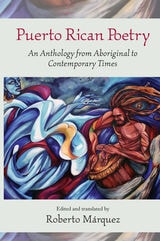
Puerto Rican Poetry
An Anthology from Aboriginal to Contemporary TimesRoberto Marquez
University of Massachusetts Press, 2007
This volume offers the most wide-ranging and comprehensive collection of Puerto Rican poetry available in English. It includes the work of sixty-four poets, as well as many previously inaccessible selections from Puerto Rico's tradition of popular verse forms—coplas, décimas, bombas—produced by anonymous writers. All are presented in English, contextualized and individually introduced by Roberto Márquez, a distinguished translator and literary scholar.
Book I, “Before Columbus and After, 1400–1820,” focuses on the foundational origins of Puerto Rican poetry and the clash of competing visions embodied in the rich and heterogeneous corpus of anonymous popular verse forms. Book II, “The Creole Matrix: Notions of Nation, 1821–1950s,” concentrates on the period in which a distinctively Puerto Rican consciousness emerged and the island's subsequent experience as a U. S. colony in the decades after the Spanish-Cuban-American War up to formal establishment of Commonwealth status. Books III and IV are devoted, respectively, to the era of insular “Critique, Revolt, and Renewal” in the mid-twentieth century, and to the “New Creoles, New Definitions” that developed in the late twentieth century, including the distinct and parallel growth of Puerto Rican poetry in the mainland United States.
In addition to a general introduction and concise biographical profiles of each poet, Márquez provides a detailed “Chronology” of the history of the island that has shaped the poets and informed their work. The resulting volume is a major contribution to our understanding and appreciation of Puerto Rican literature and the heterogeneous society in which it has been produced.
Pulp Sonnets
Tony Barnstone
Tupelo Press, 2015
Pure
Carol Frost
Northwestern University Press, 1994
Purple Passages
Pound, Eliot, Zukofsky, Olson, Creeley, and the Ends of Patriarchal PoetryRachel Blau DuPlessis
University of Iowa Press, 2012
Push
A Collection of PoemsRonald F. Smits
University of Scranton Press, 2009
In this sophisticated debut collection, Ronald F. Smits deftly weaves the comic with the tragic as he vividly recreates days past in rural Pennsylvania. With a boyish charm, the eighty poems in Push lyrically recall baseball games, campouts under the stars, and dusty treks along lonely back roads—bringing to life a vision of mid-century America that is by turns nostalgic and clear-eyed, humorous and heartfelt. A masterly evocation of a place and a time that feel quintessentially American, Push opens our eyes to the twinned power of literature and memory.
Pushkin, the Decembrists, and Civic Sentimentalism
Emily Wang
University of Wisconsin Press, 2023
Through careful readings of the literature of Pushkin and others active in the northern branch of the Decembrist movement, such as Kondraty Ryleev, Wilhelm Küchelbecker, and Fyodor Glinka, Wang traces the development of “emotional communities” among the members and adjacent writers. This book illuminates what Wang terms “civic sentimentalism”: the belief that cultivating noble sentiments on an individual level was the key to liberal progress for Russian society, a core part of Decembrist ideology that constituted a key difference from their thought and Pushkin’s. The emotional program for Decembrist community members was, in other ways, a civic program for Russia as a whole, one that they strove to enact by any means necessary.