Results by title
2916 books match the query 'Politics and government' and 195 start with p
Power, Culture and Place
Essays on New York CityJohn H. Mollenkopf
Russell Sage Foundation, 1988
Power, Money, and Media
Communication Patterns and Bureaucratic Control in Cultural ChinaChin-Chuan Lee
Northwestern University Press, 2000
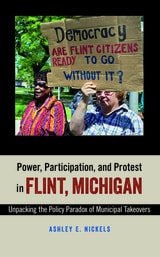
Power, Participation, and Protest in Flint, Michigan
Unpacking the Policy Paradox of Municipal TakeoversAshley E. Nickels
Temple University Press, 2019
When the 2011 municipal takeover in Flint, Michigan placed the city under state control, some supported the intervention while others saw it as an affront to democracy. Still others were ambivalent about what was supposed to be a temporary disruption. However, the city’s fiscal emergency soon became a public health emergency—the Flint Water Crisis—that captured international attention.
But how did Flint’s municipal takeovers, which suspended local representational government, alter the local political system? In Power, Participation, and Protest in Flint, Michigan, Ashley Nickels addresses the ways residents, groups, and organizations were able to participate politically—or not—during the city’s municipal takeovers in 2002 and 2011. She explains how new politics were created as organizations developed, new coalitions emerged and evolved, and people’s understanding of municipal takeovers changed.
Inwalking readers through the policy history of, implementation of, and reaction to Flint’s two municipal takeovers, Nickels highlights how the ostensibly apolitical policy is, in fact, highly political.
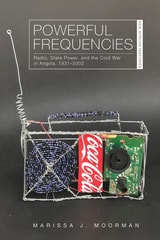
Powerful Frequencies
Radio, State Power, and the Cold War in Angola, 1931–2002Marissa J. Moorman
Ohio University Press, 2019
Powerful Frequencies details the central role that radio technology and broadcasting played in the formation of colonial Portuguese Southern Africa and the postcolonial nation-state, Angola. In Intonations, Marissa J. Moorman examined the crucial relationship between music and Angolan independence during the 1960s and ’70s. Now, Moorman turns to the history of Angolan radio as an instrument for Portuguese settlers, the colonial state, African nationalists, and the postcolonial state. They all used radio to project power, while the latter employed it to challenge empire.
From the 1930s introduction of radio by settlers, to the clandestine broadcasts of guerrilla groups, to radio’s use in the Portuguese counterinsurgency strategy during the Cold War era and in developing the independent state’s national and regional voice, Powerful Frequencies narrates a history of canny listeners, committed professionals, and dissenting political movements. All of these employed radio’s peculiarities—invisibility, ephemerality, and its material effects—to transgress social, political, “physical,” and intellectual borders. Powerful Frequencies follows radio’s traces in film, literature, and music to illustrate how the technology’s sonic power—even when it made some listeners anxious and frightened—created and transformed the late colonial and independent Angolan soundscape.
Precarious Democracy
Ethnographies of Hope, Despair, and Resistance in BrazilBenjamin Junge
Rutgers University Press, 2021
Preface to the Presidency
Selected Speeches of Bill Clinton 1974-1992Stephen Smith
University of Arkansas Press, 1996
Prelude to Genocide
Arusha, Rwanda, and the Failure of DiplomacyDavid Rawson
Ohio University Press, 2018
As the initial US observer, David Rawson participated in the 1993 Rwandan peace talks at Arusha, Tanzania. Later, he served as US ambassador to Rwanda during the last months of the doomed effort to make them hold. Despite the intervention of concerned states in establishing a peace process and the presence of an international mission, UNAMIR, the promise of the Arusha Peace Accords could not be realized. Instead, the downing of Rwandan president Habyarimana’s plane in April 1994 rekindled the civil war and opened the door to genocide.
In Prelude to Genocide, Rawson draws on declassified documents and his own experiences to seek out what went wrong. How did the course of political negotiations in Arusha and party wrangling in Kigali, Rwanda, bring to naught a concentrated international effort to establish peace? And what lessons are there for other international humanitarian interventions? The result is a commanding blend of diplomatic history and analysis that is a milestone read on the Rwandan crisis and on what happens when conflict resolution and diplomacy fall short.
Published in partnership with the ADST-DACOR Diplomats and Diplomacy Series.
President Johnson's War On Poverty
Rhetoric and HistoryDavid Zarefsky
University of Alabama Press, 1986
How words waged war—and shaped the fate of a nation’s boldest social crusade.
In January 1964, in his first State of the Union address, President Lyndon Johnson announced a declaration of “unconditional war” on poverty. By the end of the year the Economic Opportunity Act became law.
War on Poverty illustrates the interweaving of rhetorical and historical forces in shaping public policy. Zarefsky suggests that an important problem lay in its discourse. He assumes that language plays a central role in the formulation of social policy by shaping the context within which people view the social world. By terming the anti-poverty effort a war, President Johnson imparted significant symbolism to the effort: it called for total victory and gave confidence that the “war” was winnable. It influenced the definition of the enemy as an intergenerational cycle of poverty, rather than the shortcomings of the individual; and it led to the choice of community action, manpower programs, and prudent management as weapons and tactics. Each of these implications involves a choice of language and symbols, a decision about how to characterize and discuss the world. Zarefsky contends that each of these rhetorical choices was helpful to the Johnson administration in obtaining passage of the Economic Opportunity Ac of 1964, but that each choice invited redefinition or reinterpretation of a symbol in a way that threatened the program.
Presidential Leadership
From Woodrow Wilson to Harry S. TrumanRobert H. Ferrell
University of Missouri Press, 2005
Presidential Management of Science and Technology
The Johnson PresidencyBy W. Henry Lambright
University of Texas Press, 1985
How do science and technology issues become important to a particular presidency? Which issues gain priority? How? Why? What is the role of the presidency in the adoption of national policies affecting science and technology? In their implementation? How does the presidency try to curtail certain programs? Eliminate others? Or rescue programs Congress might seek to terminate? How does implementation vary between a president's own program and one that is inherited?
Such are the questions raised in this book, one of the first to address the relationship between scientists, few of whom have political backgrounds, and presidents, few of whom are knowledgeable in matters of science and technology. Drawing on extensive research performed at the Lyndon B. Johnson Library in Austin, Texas, and the National Archives in Washington, as well as on secondary sources and interviews, W. Henry Lambright describes, discusses, and analyzes this relationship and shows how one presidency set its agenda, adopted, implemented, and curtailed or eliminated science and technology programs.
Twenty-four case studies of specific decision processes occurring in the era of Lyndon Johnson anchor the book in the world of real events. Some programs adopted under Johnson are now all but forgotten, such as the Manned Orbiting Laboratory, nuclear desalting, and electronic barrier. The effects of many more, initiated, maintained, or enlarged under LBJ, lasted far beyond his administration. These include environmental pollution control, Project Apollo, and the application of Agent Orange in Vietnam. Finally, there are those that were redirected, placed on hold, or terminated under Johnson, such as the supersonic transport, antiballistic missile, and Project Mohole.
In this important book, Lambright has provided a framework for analyzing how the presidency as an institution deals with such issues, and he has established a strong foundation on which all future students of presidential policy management can build.
Presidential Mandates
How Elections Shape the National AgendaPatricia Heidotting Conley
University of Chicago Press, 2001
Presidents claim mandates, Conley shows, only when they can mobilize voters and members of Congress to make a major policy change: the margin of victory, the voting behavior of specific groups, and the composition of Congress all affect their decisions. Using data on elections since 1828 and case studies from Truman to Clinton, she demonstrates that it is possible to accurately predict which presidents will ask for major policy changes at the start of their term. Ultimately, she provides a new understanding of the concept of mandates by changing how we think about the relationship between elections and policy-making.
Presidents and Political Thought
David J. Siemers
University of Missouri Press, 2009
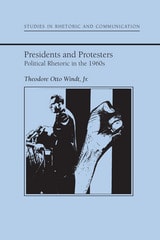
Presidents and Protestors
Political Rhetoric in the 1960sTheodore O. Windt
University of Alabama Press, 1990
The decade of the 1960s was a time of passionate politics and resounding rhetoric. The “resounding rhetoric,” from Kennedy’s celebrated inaugural address, to the outlandish antics of the Yippies, is the focus of this book. The importance of this volume is its consideration of both people in power (presidents) and people out of power (protesters), and its delineation of the different rhetorical bases that each had to work from in participating in the politics of the 1960s.
Presidents and Protesters places rhetorical acts within their specific political contexts, changing the direction of previous rhetorical studies from the sociological to the historical-political. Above all, this is an intellectual history of the 1960s as seen through the rhetoric of the participants, which ultimately shows that the major participants utilized every form of political discourse available and, consequently, exhausted not only themselves but the rhetorical forms as well.
Presidents, Populism, and the Crisis of Democracy
William G. Howell and Terry M. Moe
University of Chicago Press, 2020
The most visible cause is Donald Trump, who has used his presidency to attack the nation’s institutions and violate its democratic norms. Yet Trump is but a symptom of causes that run much deeper: social forces like globalization, automation, and immigration that for decades have generated economic harms and cultural anxieties that our government has been wholly ineffective at addressing. Millions of Americans have grown angry and disaffected, and populist appeals have found a receptive audience. These are the drivers of Trump’s dangerous presidency. And after he leaves office, they will still be there for other populists to weaponize.
What can be done to safeguard American democracy? The disruptive forces of modernity cannot be stopped. The solution lies, instead, in having a government that can deal with them—which calls for aggressive new policies, but also for institutional reforms that enhance its capacity for effective action.
The path to progress is filled with political obstacles, including an increasingly populist, anti-government Republican Party. It is hard to be optimistic. But if the challenge is to be met, we need reforms of the presidency itself—reforms that harness the promise of presidential power for effective government, but firmly protect against the fear that it may be put to anti-democratic ends.
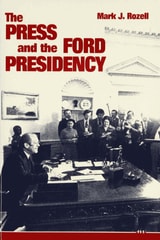
Press and the Ford Presidency
Mark J. Rozell
University of Michigan Press, 1992
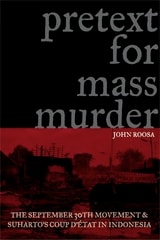
Pretext for Mass Murder
The September 30th Movement and Suharto's Coup d'Etat in IndonesiaJohn Roosa
University of Wisconsin Press, 2006
In the early morning hours of October 1, 1965, a group calling itself the September 30th Movement kidnapped and executed six generals of the Indonesian army, including its highest commander. The group claimed that it was attempting to preempt a coup, but it was quickly defeated as the senior surviving general, Haji Mohammad Suharto, drove the movement’s partisans out of Jakarta. Riding the crest of mass violence, Suharto blamed the Communist Party of Indonesia for masterminding the movement and used the emergency as a pretext for gradually eroding President Sukarno’s powers and installing himself as a ruler. Imprisoning and killing hundreds of thousands of alleged communists over the next year, Suharto remade the events of October 1, 1965 into the central event of modern Indonesian history and the cornerstone of his thirty-two-year dictatorship.
Despite its importance as a trigger for one of the twentieth century’s worst cases of mass violence, the September 30th Movement has remained shrouded in uncertainty. Who actually masterminded it? What did they hope to achieve? Why did they fail so miserably? And what was the movement’s connection to international Cold War politics? In Pretext for Mass Murder, John Roosa draws on a wealth of new primary source material to suggest a solution to the mystery behind the movement and the enabling myth of Suharto’s repressive regime. His book is a remarkable feat of historical investigation.
Finalist, Social Sciences Book Award, the International Convention of Asian Scholars

Primal Screams
How the Sexual Revolution Created Identity PoliticsEberstadt, Mary
Templeton Press, 2021
Who am I? The question today haunts every society in the Western world.
Legions of people—especially the young—have become unmoored from a firm sense of self. To compensate, they join the ranks of ideological tribes spawned by identity politics and react with frenzy against any perceived threat to their group.
As identitarians track and expose the ideologically impure, other citizens face the consequences of their rancor: a litany of “isms” run amok across all levels of cultural life, the free marketplace of ideas muted by agendas shouted through megaphones, and a spirit of general goodwill warped into a state of perpetual outrage.
How did we get here? Why have we divided against one another so bitterly? In Primal Screams, acclaimed cultural critic Mary Eberstadt presents the most provocative and original theory to come along in recent years. The rise of identity politics, she argues, is a direct result of the fallout of the sexual revolution, especially the collapse and shrinkage of the family.
As Eberstadt illustrates, humans have forged their identities within the kinship structure from time immemorial. The extended family, in a real sense, is the first tribe and teacher. But with its unprecedented decline across various measures, generations of people have been set adrift and can no longer answer the question Who am I? concerning primordial ties. Desperate for solidarity and connection, they claim membership in politicized groups whose displays of frantic irrationalism amount to primal screams for familial and communal loss.
Written in her impeccable style and with empathy rarely encountered in today’s divisive discourse, Eberstadt’s theory holds immense explanatory power that no serious citizen can afford to ignore. The book concludes with three incisive essays by Rod Dreher, Mark Lilla, and Peter Thiel, each sharing their perspective on the author’s formidable argument.
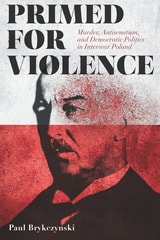
Primed for Violence
Murder, Antisemitism, and Democratic Politics in Interwar PolandPaul Brykczynski
University of Wisconsin Press, 2017
As Paul Brykczynski tells this gripping story, he explores the complex role of antisemitism, nationalism, and violence in Polish politics between the two World Wars. Though focusing on Poland, the book sheds light on the rise of the antisemitic right in Europe and beyond, and on the impact of violence on political culture and discourse.
Princes and Political Cultures
The New Tiberian Senatorial DecreesGreg Rowe
University of Michigan Press, 2002
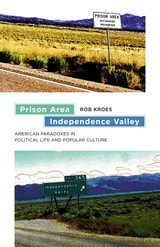
Prison Area, Independence Valley
American Paradoxes in Political Life and Popular CultureRob Kroes
Dartmouth College Press, 2015
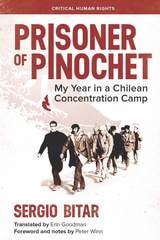
Prisoner of Pinochet
My Year in a Chilean Concentration CampSergio Bitar
University of Wisconsin Press, 2017
Prisoner of Pinochet is the gripping first-person chronicle of Bitar's year as a political prisoner before being expelled from Chile; a poignant narrative of men held captive together in a labor camp under harsh conditions, only able to guess at their eventual fate; and an insightful memoir of the momentous events of the early 1970s that led to seventeen years of bloody authoritarian rule in Chile. Available in English for the first time, this edition includes maps and photos from the 1970s and contextual notes by historian Peter Winn.
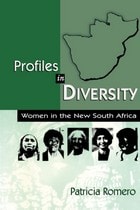
Profiles in Diversity
Women in the New South AfricaPatricia Romero
Michigan State University Press, 1998
A revealing oral history collection, Profiles in Diversity contains in-depth interviews of twenty-six women in South Africa from different racial, class, and age backgrounds. Conducted in Johannesburg, Pretoria, Bloemfontein, Vryburg, Cape Town, Port Elizabeth, Grahamstown, Durban, and a rural section of Kwa-Zulu Natal, these life histories encompass diverse experiences ranging from a squatter in a township outside Cape Town to an ANC activist in Port Elizabeth, who lost three sons to the struggle for democracy and who herself was imprisoned several times during what many in South Africa now refer to as the "civil war."
Nearly all of these women describe their formative years spent growing up in South Africa's segregated society. Three young black students discuss the hardships they experienced in an unequal educational system as well as aspects of segregation in their childhood. They are joined in their memories and hopes for the future by two mature women—one now a high court judge in Durban and the other a linguist at the University of South Africa in Pretoria—both of whom studied at Harvard in the United States. Nancy Charton, the first woman ordained as an Anglican priest in South Africa, speaks about her past and what led her, in her early seventies, to a vocation in the church.
Three Afrikaner women, including one in her late twenties, speak about growing up in South Africa and articulate their concerns for a future that, in some respects, differs from the predictions of their English-speaking or black sisters. Two now-deceased members of the South African Communist Party provide disparate accounts of what led them to lives of active opposition to the discrimination that marked the lives of people of color, long before apartheid became embedded in South Africa's legal system. Also included is an account by Dr. Goonam, an Indian woman who grew up in relative comfort in the then province of Natal, while Ray Alexander discusses how she witnessed the tyranny visited on the Jews of her native Latvia before immigrating to the Cape.
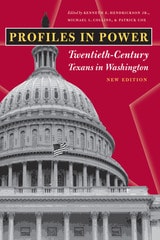
Profiles in Power
Twentieth-Century Texans in Washington, New EditionEdited by Kenneth E. Hendrickson, Jr., Michael L. Collins, and Patrick Cox
University of Texas Press, 2004
Profiles in Power offers concise biographies of fourteen twentieth-century Texans who wielded significant political power and influence in Washington, D.C. First published in 1993 by Harlan Davidson, it has been revised and updated with new chapters on John Nance Garner and Henry Gonzalez and expanded chapters on Lyndon Johnson, Barbara Jordan, Ralph Yarborough, Jim Wright, and John Tower. Demonstrating the validity of a biographical approach to history, the book as a whole covers all the major political issues of the twentieth century, as well as the pivotal role of Texans in defining the national agenda.
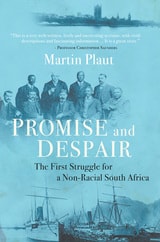
Promise and Despair
The First Struggle for a Non-Racial South AfricaMartin Plaut
Ohio University Press, 2016
The struggle for freedom in South Africa goes back a long way. In 1909, a remarkable interracial delegation of South Africans traveled to London to lobby for a non-racialized constitution and franchise for all. Among their allies was Mahatma Gandhi, who later encapsulated lessons from the experience in his most important book, Hind Swaraj. Though the mission failed, the London debates were critical to the formation of the African National Congress in 1912.
With impeccable storytelling and rich character depictions, Martin Plaut describes the early quest for black franchise and the seeds it planted for a new South Africa. While most people believe that black South Africans obtained the vote in 1994, men of all races voted in the Cape Colony for almost a century, sometimes deciding election outcomes. The London mission was part of a long history of nonwhite political agency.
Taking as its centerpiece the 1909 delegation, Promise and Despair covers the twelve years between the South African War and the First World War, during which the major forces that would shape twentieth-century South Africa were forged. Plaut reveals new details of the close collaboration between Gandhi and the ANC leadership during the Indian-South African community’s struggle for their rights, the influence of the American South on South African racial practices, and the workings of the Imperial system.
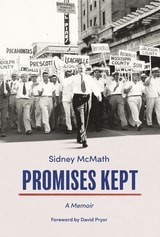
Promises Kept
A MemoirSidney S. McMath
University of Arkansas Press, 2003
Winner of the 2006 Booker Worthen Literary Prize and the 2004 Ragsdale Award
A dominating spirit of public service animated the life of Sidney Sanders McMath (1912–2003), the thirty-fourth governor of Arkansas. Promises Kept, completed and published when McMath was in his nineties, tells his story in his own words—from the piney hills of South Arkansas to the battlefields of World War II; through the human dramas of the courtroom to the marbled corridors of the State Capitol.
In Promises Kept, McMath recounts a rural upbringing that grounded him in the concerns of everyday Arkansans. He tells his life story through key milestones, including distinguished military service and a dramatic political rise to governor of Arkansas. During his four years in office, he pursued reform and modernization by expanding roads and electricity to rural areas, fighting the poll tax, building the state’s first medical center, opening Democratic primaries to Black voters, and standing with President Harry Truman in resisting the segregationist Dixiecrats. McMath’s political career ended amid unproven allegations tied to the highway program—charges he addresses directly here—and concludes with his return to the law, where landmark cases earned him honors.
Throughout, McMath reveals the excitement and the hard choices of real democracy, offering compelling human stories and a crucial perspective of a pivotal time in Arkansas history.
Promises of 1968
Crisis, Illusion and UtopiaVladimir Tismaneanu
Central European University Press, 2011
Propaganda and Aesthetics
The Literary Politics of Afro-American Magazines in the Twentieth CenturyAbby Arthur Johnson
University of Massachusetts Press, 1979
Little work has been done on individual Afro-American periodicals and nothing, up to this point, has been published on twentieth-century black journals as a group. Studies of magazines in general are relatively rare, with only The Little Magazine, by Frederick Hoffman, Charles Allen, and Carolyn P. Ulrich, attempting a survey of small journals in this century. This book fills a considerable gap in literary history by detailing the development of Afro-American magazines in this century.
Property Rules
Political Economy in Chicago, 1833-1872Robin L. Einhorn
University of Chicago Press, 1991
A Choice "Outstanding Academic Book"
"[A] masterful study of policy-making in Chicago."—Choice
"[A] major contribution to urban and political history. . . . [A]n excellent book."—Jeffrey S. Adler, American Historical Review
"[A]n enlightening trip. . . . Einhorn's foray helps make sense out of the transition from Jacksonian to Gilded Age politics on the local level. . . . [She] has staked out new ground that others would do well to explore."—Arnold R. Hirsch, American Journal of Legal History
"A well-documented and informative classic on urban politics."—Daniel W. Kwong, Law Books in Review
Protest In Belgrade
Winter of DiscontentMladen Lazic
Central European University Press, 1999
Protest in Belgrade addresses one of the most important social movements of this decade - the civil and student peace demonstrations which took place in Belgrade during the winter of 1996/97. The demonstrations, the largest ever in history, were in response to Milošević’s nullifying of the results of local elections in fourteen towns in Serbia which created global media attention and attracted worldwide sympathy.
This in-depth study of a society calling for democracy is based on interviews with over 1000 civilians and students. The book is unique because much of the research was carried out and completed while the demonstrations were still in progress and before the outcome of events was known. A chronology of events is also included.
The book provides an abundance of valuable information for analysts of post-socialist transformation, researchers of social movements and social change, and for all those concerned with the tragic events in Southeast Europe.
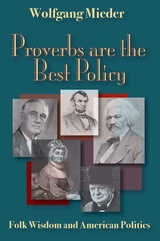
Proverbs Are The Best Policy
Folk Wisdom And American PoliticsWolfgang Mieder
Utah State University Press, 2005
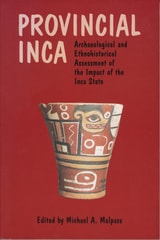
Provincial Inca
Archaeological and Ethnohistorical Assessment of the Impact of the Inca StateMichael A. Malpass
University of Iowa Press, 1993
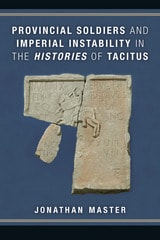
Provincial Soldiers and Imperial Instability in the Histories of Tacitus
Jonathan Master
University of Michigan Press, 2016
Master draws on scholarship in political theory, Latin historiography, Roman history, and ethnic identity to demonstrate how Tacitus presented to his contemporary audience in Trajanic Rome the dangerous consequences of the city’s failure to reward and incorporate its provincial subjects. Master argues that Tacitus’ presentation of the Vitellian and Flavian armies, and especially the Batavian auxiliary soldiers, reflects a central lesson of the Histories: the Empire’s exploitation of provincial manpower (increasingly the majority of all soldiers under Roman banners) while offering little in return, set the stage for civil wars and ultimately the separatist Batavian revolt.
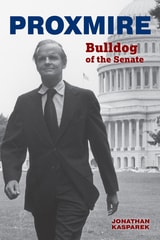
Proxmire
Bulldog of the SenateJonathan Kasparek
Wisconsin Historical Society Press, 2019
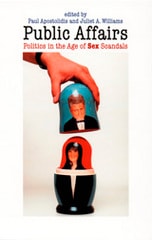
Public Affairs
Politics in the Age of Sex ScandalsPaul Apostolidis and Juliet A. Williams, eds.
Duke University Press, 2004
The essays in Public Affairs reflect on a number of sex scandals while emphasizing the Clinton/Lewinsky affair, certainly the most avidly followed and momentous sex scandal in American political history. Leading scholars situate contemporary public affairs in the context not only of earlier sex scandals in American politics (such as Thomas Jefferson’s and Sally Hemings’s affair), but also of more purely political scandals (including Teapot Dome and Watergate) and sex scandals centered around public figures other than politicians (such as the actor Hugh Grant and the minister Jimmy Swaggart). Some essays consider the Clinton affair in light of feminist and anti-racist politics, while others discuss the dynamics of scandals as major media events. By charting a critical path through the muck of scandal rather than around it, Public Affairs illuminates why sex scandals have become such a prominent feature of American public life.
Contributors. Paul Apostolidis, Jodi Dean, Joshua Gamson, Theodore J. Lowi, Joshua D. Rothman, George Shulman, Anna Marie Smith, Jeremy Varon, Juliet A. Williams

Public Libraries in Nazi Germany
Margaret F. Stieg
University of Alabama Press, 1992
"Margaret F. Stieg's thoroughly researched study, the first comprehensive examination of public libraries in Nazi Germany, reveals that library policy in the Third Reich was far more complex than we might assume, with the positive and the negative hopelessly entangled. . . . A solid and welcome contribution."
—American Historical Review
Public Office in Early Rome
Ritual Procedure and Political PracticeRoberta Stewart
University of Michigan Press, 2010
---Bryn Mawr Classical Review
Public Policy and Community
Activism and Governance in TexasEdited by Robert H. Wilson
University of Texas Press, 1997
The decentralization of public policy from the federal government to state and local governments offers increased opportunities for ordinary citizens to participate directly in public policymaking. Yet these opportunities may not be equally shared. Due to a variety of factors, low-income citizens have long been denied a meaningful role in the public life and governance of our country.
By contrast, the essays in this volume explore how low-income citizens have successfully affected public policy. The book is built around six case studies, all from Texas, that cover education finance and reform, local infrastructure provision, environmental protection, and indigent health care.
This research illuminates several issues of national importance, including how communities gain standing and recognition for themselves and their issues, how policy agendas are defined, how communities mobilize technical and institutional resources, and how they form coalitions and alliances to accomplish their goals.
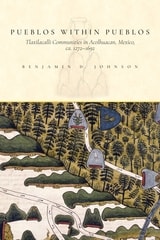
Pueblos within Pueblos
Tlaxilacalli Communities in Acolhuacan, Mexico, ca. 1272-1692Benjamin Johnson
University Press of Colorado, 2017
Focusing on the specific case of Acolhuacan in the eastern Basin of Mexico, Pueblos within Pueblos is the first book to systematically analyze tlaxilacalli history over nearly four centuries, beginning with their rise at the dawn of the Aztec empire through their transformation into the “pueblos” of mid-colonial New Spain. Even before the rise of the Aztecs, commoners in pre-Hispanic central Mexico set the groundwork for a new style of imperial expansion. Breaking free of earlier centralizing patterns of settlement, they spread out across onetime hinterlands and founded new and surprisingly autonomous local communities called, almost interchangeably, tlaxilacalli or calpolli.
Tlaxilacalli were commoner-administered communities that coevolved with the Acolhua empire and structured its articulation and basic functioning. They later formed the administrative backbone of both the Aztec and Spanish empires in northern Mesoamerica and often grew into full and functioning existence before their affiliated altepetl, or sovereign local polities. Tlaxilacalli resembled other central Mexican communities but expressed a local Acolhua administrative culture in their exacting patterns of hierarchy. As semiautonomous units, they could rearrange according to geopolitical shifts and even catalyze changes, as during the rapid additive growth of both the Aztec Triple Alliance and Hispanic New Spain. They were more successful than almost any other central Mexican institution in metabolizing external disruptions (new gods, new economies, demographic emergencies), and they fostered a surprising level of local allegiance, despite their structural inequality. Indeed, by 1692 they were declaring their local administrative independence from the once-sovereign altepetl. Administration through community, and community through administration—this was the primal two-step of the long-lived Acolhua tlaxilacalli, at once colonial and colonialist.
Pueblos within Pueblos examines a woefully neglected aspect of pre-Hispanic and early colonial Mexican historiography and is the first book to fully demonstrate the structuring role tlaxilacalli played in regional and imperial politics in central Mexico. It will be of interest to students and scholars of Latin American ethnohistory, history, and anthropology.
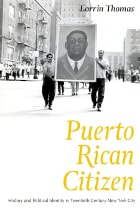
Puerto Rican Citizen
History and Political Identity in Twentieth-Century New York CityLorrin Thomas
University of Chicago Press, 2010
Building its incisive narrative from a wide range of archival sources, interviews, and first-person accounts of Puerto Rican life in New York, this book illuminates the rich history of a group that is still largely invisible to many scholars. At the center of Puerto Rican Citizen are Puerto Ricans’ own formulations about political identity, the responses of activists and ordinary migrants to the failed promises of American citizenship, and their expectations of how the American state should address those failures. Complicating our understanding of the discontents of modern liberalism, of race relations beyond black and white, and of the diverse conceptions of rights and identity in American life, Thomas’s book transforms the way we understand this community’s integral role in shaping our sense of citizenship in twentieth-century America.

Puerto Rican Jam
Rethinking Colonialism and NationalismNegron-Muntaner, Frances
University of Minnesota Press, 1997
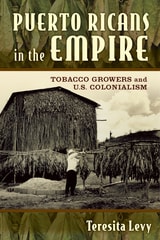
Puerto Ricans in the Empire
Tobacco Growers and U.S. ColonialismTeresita A. Levy
Rutgers University Press, 2015
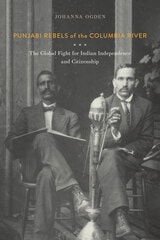
Punjabi Rebels of the Columbia River
The Global Fight for Indian Independence and CitizenshipJohanna Ogden
Oregon State University Press, 2024
Oregon is commonly perceived to have little, let alone notable, South Asian history. Yet in the early 1900s Oregon was at the center of two entwined quests for Indian independence and civic belonging that rocked the world.
Punjabi Rebels of the Columbia River traces the stories of the radical Indian independence organization known as Ghadar and Bhagat Singh Thind’s era-defining US Supreme Court citizenship case. Ghadar sought the overthrow of India’s British colonizers while Thind utilized sanctioned legal channels to do so. Despite widely differing strategies, both the movement and the man were targeted, often in coordination, by the highest levels of the US and British governments. The empires’ united message: India would not be an independent country and Indians could not be citizens. In the decades that followed, it was a verdict Indians refused to abide.
Johanna Ogden’s detailed history of migrants’ experience expands the time frame, geographic boundaries, and knowledge of the conditions and contributions of Indians in North America. It is the story of a people’s awakening amid a rich community of international workers in an age of nationalist uprisings. To understand why one of the smallest western Indian settlements became a resistance center, Punjabi Rebels mines the colonial underpinnings of labor, race, and place-making and their regional and global connections, rendering a history of whiteness and labor as much as of Indian-ness and migration. The first work to rejoin the lived experience of Thind and Ghadar activists, Punjabi Rebels complicates our understanding not just of the global fight for Indian political rights but of multi-racial democracy.
Punk and Revolution
Seven More Interpretations of Peruvian RealityShane Greene
Duke University Press, 2016
Putting Inequality in Context
Class, Public Opinion, and Representation in the United StatesChristopher Ellis
University of Michigan Press, 2017
Christopher Ellis argues citizens’—and legislators’—views of class politics are driven by lived experience in particular communities. While some experience is formally political, on an informal basis citizens learn a great deal about their position in the broader socioeconomic spectrum and the social norms governing how class intersects with day-to-day life. These factors are important for policymakers, since most legislators do not represent “the public” at large, but specific constituencies.
Focusing on U.S. congressional districts as the contextual unit of interest, Ellis argues individuals’ political behavior cannot be separated from their environment, and shows how income’s role in political processes is affected by the contexts in which citizens and legislators interact. Political inequality exists in the aggregate, but it does not exist everywhere. It is, rather, a function of specific arrangements that depress the political influence of the poor. Identifying and understanding these factors is a crucial step in thinking about what reforms might be especially helpful in enhancing equality of political voice.
Puyo Runa
Imagery and Power in Modern AmazoniaNorman E. Whitten Jr. and Dorothea Scott Whitten
University of Illinois Press, 2007
The Andean nation of Ecuador derives much of its revenue from petroleum that is extracted from its vast Upper Amazonian rain forest, which is home to ten indigenous nationalities. Norman E. Whitten Jr. and Dorothea Scott Whitten have lived among and studied one such people, the Canelos Quichua, for nearly forty years. In Puyo Runa, they present a trenchant ethnography of history, ecology, imagery, and cosmology to focus on shamans, ceramic artists, myth, ritual, and political engagements. Canelos Quichua are active participants in national politics, including large-scale movements for social justice for Andean and Amazonian people. Puyo Runa offers readers exceptional insight into this cultural world, revealing its intricacies and embedded humanisms.