Results by title
18284 books match the query 'United States' and 850 start with p
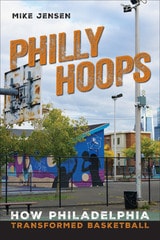
Philly Hoops
How Philadelphia Transformed BasketballMike Jensen
Temple University Press, 2027
Sportswriter Mike Jensen would argue that Philadelphia has earned a unique place in basketball history. In Philly Hoops, he makes an incontrovertible case that the city contributed to the sport on and off the court. Jensen, who spent decades covering the game for The Philadelphia Inquirer, charts the strategies, players, coaches, and even some referees from the pre-Wilt Chamberlain days to the post-Kobe Bryant era to show the region’s impact and influence on the sport worldwide.
Philadelphia didn’t merely play the game. It shaped it through ahead-of-their-time approaches, such as the value of pushing the pace. Jensen chronicles Hall-of-Fame game changers, including Earl Monroe and Paul Arizin, and coaches John Chaney, Jack Ramsay, Jay Wright, and Geno Auriemma. He recounts how the powerhouse teams at Immaculata and Cheyney University, along with Dawn Staley’s landmark playing and coaching achievements, helped make Philadelphia ground zero for women’s basketball. Philly Hoops also celebrates the influence of the Big 5 glory days, Jewish teams like The SPHAS, and icons Kyle Lowry, Tom Gola, and Rasheed Wallace.
Jensen knows how and why Philly loves basketball. His Philly Hoops is all about that love of and for the game.

Philly Sports
Teams, Games, and Athletes from Rocky's TownRyan Swanson
University of Arkansas Press, 2016
Philadelphia sports—anchored by the Eagles, Flyers, Phillies, and 76ers—have a long, and sometimes tortured, history. Philly fans have booed more than their share and have earned a reputation as some of the most hostile in the country. They’ve been known, so the tales go, to jeer Santa Claus and cheer at the injury of an opposing player.
Strangely though, much of America’s perception of Philadelphia sports has been shaped by a fictional figure: Rocky. The series of Hollywood films named after their title character has told and retold the Cinderella story of an underdog boxer rising up against long odds. One could plausibly make the argument that Rocky is Philadelphia’s most famous athlete.
Beyond the major sports franchises and Rocky, lesser-known athletic competition in Philadelphia offers much to the interested observer. The city’s boxing culture, influence on Negro Leagues baseball, role in establishing interscholastic sport, and leadership in the rise of cricket all deserve and receive close investigation in this new collection. Philly Sports combines primary research and personal experiences—playing in the Palestra, scouting out the tombstones of the city’s best athletes, enjoying the fervor of a Philadelphia night with a local team in pursuit of a championship title. The essence of Philadelphia sport, and to a certain extent the city itself, is distilled here.
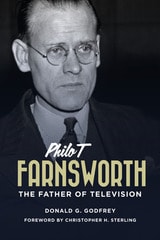
Philo T Farnsworth
Donald Godfrey
University of Utah Press, 2001
Philo T. Farnsworth (1906–1971) has been called the "forgotten father of television." He grew up in Utah and southern Idaho, and was described as a genius by those who knew and worked with him. With only a high school education, Farnsworth drew his first television schematic for his high school teacher in Rigby, Idaho. Subsequent claims and litigation notwithstanding, he was the first to transmit a television image.
Farnsworth filed ten patents between 1927 and 1929 for camera tubes (transmitting), circuitry, and the cathode ray tube (viewing). After his early years as an inventor in San Francisco, he worked as an engineer, doing battle with RCA in the 1930s over patent rights, formed the Farnsworth Television Company in the 1940s, and worked for IT&T after their purchase of the Farnsworth enterprises. Every television set sold utilized at least six of his basic patents.
Because of endless legal wrangling with RCA over patent rights, he received very little financial reward for his television patents. Donald Godfrey examines the genius and the failures in the life of Philo Farnsworth as he struggled to be both inventor and entrepreneur.
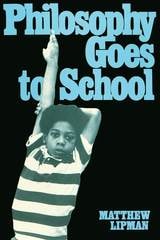
Philosophy Goes To School
Matthew Lipman
Temple University Press, 1988
Ten years ago Philosophy in the Classroom, by Lipman, Sharp, and Oscanyan, hailed the emergence of philosophy as a novel, although in some ways highly traditional, elementary school discipline. In this sequel, Matthew Lipman examines the impact that elementary school philosophy has had, and may yet have, upon the process of education. Going beyond his earlier work to describe the contribution that training in philosophy can make in the teaching of values, he shows the applications of ethics in civics education and the ways in which aesthetics can be incorporated into areas of the curriculum related to the development of creativity.
Making reference to the contemporary educational scene, Lipman compares the K-12 Philosophy for Children curriculum to the many unsatisfactory solutions being offered in our current drive for educational excellence. He addresses the relationship of elementary school philosophy to educational reform in the areas of science, language, social studies, and writing. And he shows how philosophy can be instrumental in the difficult task of teaching values to children while avoiding both ideological indoctrination and mindless relativism.

Philosophy for Spiders
On the Low Theory of Kathy AckerMcKenzie Wark
Duke University Press, 2021

Philosophy in a Time of Terror
Dialogues with Jurgen Habermas and Jacques DerridaGiovanna Borradori
University of Chicago Press, 2003
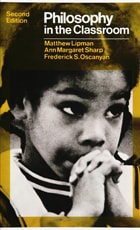
Philosophy in the Classroom
Matthew Lipman, Ann Margaret Sharp and Frederick S. Oscanyan
Temple University Press, 1980
This is a textbook for teachers that demonstrates how philosophical thinking can be used in teaching children. It begins with the assumption that what is taught in schools is not (and should not be) subject matter but rather ways of thinking. The main point is that the classroom should be converted into a community of inquiry, and that one can begin doing that with children. Based on the curriculum that Matt Lipman has developed at the Institute for the Advancement of Philosophy for Children, which he heads, this book describes the curriculum and explains its use. The text is self-contained, however.
This revision is thorough-going and incorporates new chapters, as well as new material in old chapters. Part One focuses on the need of educational change and the importance of philosophical inquiry in developing new approaches. Part Two discusses curriculum and teaching methodology, including teacher behavior conducive to helping children. Part Three deals with developing logic skills and moral judgment. It concludes with a chapter on the sorts of philosophical themes pertinent to ethical inquiry for children: the right and the fair, perfect and right, free will and determinism, change and growth, truth, caring, standards and rules, thinking and thinking for oneself. Education, in this sense, is not a matter of dispensing information; it is the process of assisting in the growth of the whole individual.
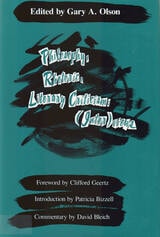
Philosophy, Rhetoric, Literary Criticism
(Inter)viewsGary A. Olson
Southern Illinois University Press, 1994
Susan Wells and Reed Way Dasenbrock provide distinctly divergent assessments of the application of Donald Davidson’ s language theory to rhetoric and composition, and especially to writing pedagogy. Patricia Bizzell and John Trimbur explore how Stanley Fish’ s neopragmatism might be useful both to composition theory and to literacy education. And Joyce Irene Middleton and Tom Fox discuss bell hooks’ s notions of how race and gender affect pedagogy. In two frank and sometimes angry responses, Patricia Harkin and Jasper Neel take J. Hillis Miller to task for seeming to support rhetoric and composition while continuing to maintain the political status quo. Similarly, Susan C. Jarratt and Elizabeth A. Flynn express skepticism about Jane Tompkins’ s vocal support of composition and of radical pedagogy particularly. And Arabella Lyon and C. Jan Swearingen analyze Stephen Toulmin’ s thoughts on argumentation and postmodernism.
Internationally respected anthropologist Clifford Geertz provides a foreword; literacy expert Patricia Bizzell contributes an introduction to the text; and noted reader-response critic David Bleich supplies critical commentary.
This book is a follow-up to the editor’ s (Inter)views: Cross-Disciplinary Perspectives on Rhetoric and Literacy, already a major work of scholarship in the field.
Phoenix Indian School
The Second Half-CenturyDorothy R. Parker
University of Arizona Press, 1996
This book provides a history of the school from 1930 until the graduation of its final class of nineteen students in 1990. Dorothy Parker tells how the Phoenix Indian School not only adapted to policy changes instituted by the federal government but also had to contend with events occurring in the world around it, such as the Great Depression, World War II, and the advent of the "red power" movement.
Although the Phoenix Indian School has closed its doors forever, the National Park Service has undertaken an archaeological analysis of the site and an architectural documentation of the school's buildings. This history of its final years further attests to the legacy of this institution.
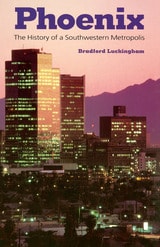
Phoenix
The History of a Southwestern MetropolisBradford Luckingham
University of Arizona Press, 1989
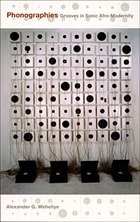
Phonographies
Grooves in Sonic Afro-ModernityAlexander G. Weheliye
Duke University Press, 2005
Weheliye surveys literature, film, and music to focus on engagements with recorded sound. He offers substantial new readings of canonical texts by W. E. B. Du Bois and Ralph Ellison, establishing dialogues between these writers and popular music and film ranging from Louis Armstrong’s voice to DJ mixing techniques to Darnell Martin’s 1994 movie I Like It Like That. Looking at how questions of diasporic belonging are articulated in contemporary black musical practices, Weheliye analyzes three contemporary Afro-diasporic musical acts: the Haitian and African American rap group the Fugees, the Afro- and Italian-German rap collective Advanced Chemistry, and black British artist Tricky and his partner Martina. Phonographies imagines the African diaspora as a virtual sounding space, one that is marked, in the twentieth century and twenty-first, by the circulation of culture via technological reproductions—records and tapes, dubbing and mixing, and more.

Phony Culture
Confidence and Malaise in Contemporary AmericaJames Combs
University of Wisconsin Press, 1994
As the United States nears the twenty-first century, many of its citizens are troubled by the sense that something is wrong. Even though it is argued that our national situation is good, there persists the widespread feeling that somehow we are on the wrong social and historical track. It is the contention of this book that much of this dis-ease stems from our construction of a phony culture, a culture dominated by the value of the confidence man and woman.
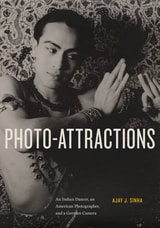
Photo-Attractions
An Indian Dancer, an American Photographer, and a German CameraAjay Sinha
Rutgers University Press, 2022
Art historian Ajay Sinha uses these hitherto unpublished photographs and archival research to raise provocative and important questions about photographic technology, colonial histories, race, sexuality and transcultural desires. Challenging the assumption that Gopal was merely objectified by Van Vechten’s Orientalist gaze, he explores the ways in which the Indian dancer co-authored the photos. In Sinha’s reading, Van Vechten’s New York studio becomes a promiscuous contact zone between world cultures, where a “photo-erotic” triangle is formed between the American photographer, Indian dancer, and German camera.
A groundbreaking study of global modernity, Photo-Attractions brings scholarship on American photography, literature, race and sexual economies into conversation with work on South Asian visual culture, dance, and gender. In these remarkable historical documents, it locates the pleasure taken in cultural difference that still resonates today.
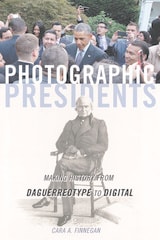
Photographic Presidents
Making History from Daguerreotype to DigitalCara A. Finnegan
University of Illinois Press, 2021
Lincoln’s somber portraits. Lyndon Johnson’s swearing in. George W. Bush’s reaction to learning about the 9/11 attacks. Photography plays an indelible role in how we remember and define American presidents. Throughout history, presidents have actively participated in all aspects of photography, not only by sitting for photos but by taking and consuming them. Cara A. Finnegan ventures from a newly-discovered daguerreotype of John Quincy Adams to Barack Obama’s selfies to tell the stories of how presidents have participated in the medium’s transformative moments. As she shows, technological developments not only changed photography, but introduced new visual values that influence how we judge an image. At the same time, presidential photographs—as representations of leaders who symbolized the nation—sparked public debate on these values and their implications.
An original journey through political history, Photographic Presidents reveals the intertwined evolution of an American institution and a medium that continues to define it.
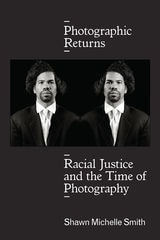
Photographic Returns
Racial Justice and the Time of PhotographyShawn Michelle Smith
Duke University Press, 2020
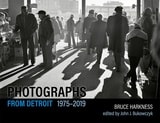
Photographs from Detroit, 1975–2019
Bruce Harkness
Ohio University Press, 2022
A retrospective survey of Bruce Harkness’s striking social documentary photographs and an invaluable historical record that bears witness to irrevocably lost swaths of Detroit’s social and urban fabric.
In 1980, the cities of Detroit and Hamtramck, Michigan, exercised eminent domain to develop nearly five hundred acres of land for a new industrial park and General Motors assembly plant. But the land was not vacant. Some thirty-five hundred people lived there in Poletown—some of them for their entire lives. They attended neighborhood schools and churches, worked for and patronized small businesses, walked the sidewalks, drove the streets, and tended to lawns and gardens. Harkness began photographing the area in February 1981. He recorded street scenes, intersections, panoramic views, homes, businesses, churches, and people. Ten months, ninety visits, and six hundred photographs later, it all disappeared forever.
The Poletown series established Harkness as a major Detroit documentarian. It came on the heels of late-1970s projects located in and around the city’s skid row: Cass Corridor. The images include gritty streetscapes, a portrait series depicting residents living in a crumbling apartment building, and the lively cultural milieu of a local gay and transgender bar. Most of this old portion of inner-city Detroit since has been supplanted by urban redevelopment and gentrification.
During the late 1980s, Harkness collaborated with urban historian John J. Bukowczyk on a major documentary project, Urban Interiors. While the Poletown project had documented the exteriors of buildings and streetscapes on Detroit’s East Side, Urban Interiors captured the insides of inner-city Detroit homes and businesses and included extended oral history interviews.
While Harkness has always found human dignity and resilience in his subjects, the tone of his work brightened in the 1990s alongside Detroit’s revival. Photographs from this era include blues musicians performing in clubs and at outdoor concerts and the distinctive, robust youth culture that flourished in Dearborn’s now-defunct Zone Coffee House.
Featuring images from these and other projects, Photographs from Detroit, 1975–2019 includes Harkness’s extensive notes, which describe and contextualize the encounters he shared with the people and places he photographed, and offer insight into his working methods and equipment. The volume and quality of Harkness’s work merits him recognition as one of Detroit’s most important documentary photographers during this pivotal, transitional era in the city’s history.
Harkness’s images depict the struggles and resilience of ordinary individuals and families in working-class communities who together have indelibly shaped the spirit of Detroit. This book is a must-have for Detroiters past and present as well as historians, anthropologists, social documentary advocates, and photobook collectors everywhere.
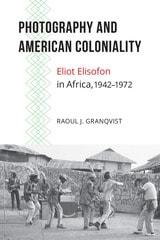
Photography and American Coloniality
Eliot Elisofon in Africa, 1942–1972Raoul J. Granqvist
Michigan State University Press, 2017
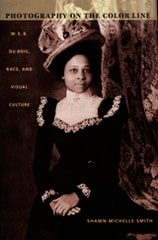
Photography on the Color Line
W. E. B. Du Bois, Race, and Visual CultureShawn Michelle Smith
Duke University Press, 2004
Smith reads Du Bois’s photographs in relation to other turn-of-the-century images such as scientific typologies, criminal mugshots, racist caricatures, and lynching photographs. By juxtaposing these images with reproductions from Du Bois’s exhibition archive, Smith shows how Du Bois deliberately challenged racist representations of African Americans. Emphasizing the importance of comparing multiple visual archives, Photography on the Color Line reinvigorates understandings of the stakes of representation and the fundamental connections between race and visual culture in the United States.
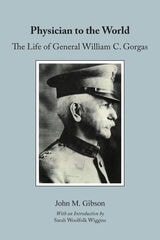
Physician to the World
The Life of General William C. GorgasJohn M. Gibson
University of Alabama Press, 1989
The remarkable story of the physician whose public health victories changed the world.
Physician to the World by John M. Gibson is a study of the career of William Crawford Gorgas, focusing primarily on the 22 years from the Spanish-American War until his death at the age of 65. The book details the medical community’s gradual acceptance of the mosquito theory as the cause for yellow fever epidemics and follows Gorgas as his initial skepticism gave way to belief while he participated in Walter Reed’s massive cleanup of Havana. From this success Gorgas moved to the Panama Canal Zone and a bureaucratic quagmire as he attempted to apply sanitary principles there to control yellow fever and malaria. As canal construction proceeded, assorted red-tape and critics repeatedly thwarted Gorgas’s efforts. His particular nemesis was the imperious engineer George Goethals, who ruled the construction project with an iron hand. Gorgas’s dogged persistence to make Panama healthy for both Americans and natives eventually succeeded, enabling the project to be completed with minimum loss of life. During World War I Gorgas became U.S. Surgeon General, and finally his reputation equaled his accomplishments. He traveled widely in Europe, South Africa, and South America on behalf of public health improvements and was about to begin another such journey when he died of complications from a stroke in London in 1920.

Physicians and Hospitals
The Great Partnership at the CrossroadsDuncan Yaggy and Patricia Hodgson, eds.
Duke University Press, 1985
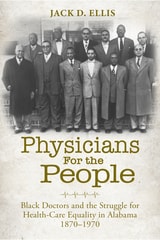
Physicians for the People
Black Doctors and the Struggle for Health-Care Equality in Alabama, 1870–1970Jack D. Ellis with a foreword by Alan I Marcus
University of Alabama Press, 2025
WINNER OF THE JAMES F. SULZBY AWARD
Healing against the odds—Black doctors, bold resistance, and the fight for medical justice in Alabama.
Physicians for the People chronicles the remarkable stories of 241 Black doctors who practiced medicine in Alabama during the Jim Crow era. Historian Jack D. Ellis reveals the ingenuity and resilience of these trailblazing doctors who defied segregation by establishing hospitals and clinics and providing vital healthcare to underserved Black communities.
This meticulously researched work draws on archival sources, oral histories, and an unparalleled database to dismantle the myth of a monolithic medical system in the Jim Crow South. Jack D. Ellis argues that the post–Civil War lives of Black physicians, dentists, pharmacists, nurses, and midwives hold special significance, illuminating both the causes of health care disparities among African Americans and the reasons for their continued underrepresentation in the medical professions.
Offering much of interest to students and scholars of Black history, medical history, and the civil rights movement, Physicians for the People exposes the deliberate exclusion faced by Black doctors within the white medical establishment and their ongoing fight for racial equality in medicine.

Physics Demonstrations
A Sourcebook for Teachers of PhysicsJulien Clinton Sprott
University of Wisconsin Press, 2015
Dr. Sprott shares demonstrations tested over many years in his popular public lectures on “The Wonders of Physics,” which appeal to general audiences and to students from grade school to graduate school. Science teachers at all levels will find a wealth of detail showing how to present these demonstrations to students with flair. Science professionals will find indispensable information for creating educational and entertaining public programs. Organized to teach the six major areas of classical physics—motion, heat, sound, electricity, magnetism, and light—Physics Demonstrations includes:
• a brief description of each demonstration
• materials lists, with sources for common materials
• preparation procedures
• discussions of the physics principles demonstrated
• potential safety hazards
• references for further information.
Picking Up the Tab
The Life and Movies of Martin RittCarlton Jackson
University of Wisconsin Press, 1994
Pickin’ Cotton on the Way to Church
The Life and Work of Father Boniface Hardin, OSBNancy Van Note Chism
Indiana Historical Society Press, 2019

Picture Books for Children
Fiction, Folktales, and PoetryMary Northrup
American Library Association, 2012
Picture Personalities
The Emergence of the Star System in AmericaRichard deCordova
University of Illinois Press, 1990
Conventional wisdom attributes the rise of the star system to the charisma of individual performers or to the public's desire to idolize an appealing star. In Picture Personalities, Richard deCordova argues that the fledgling movie industry and the press conspired to develop the star system, along with a system of discourse to support it.
How actors became stars and how they began to assume public identities distinct from their fictional roles was closely tied to the journalistic discourse of the period, produced by the trade press, newspapers, general periodicals, fan magazines, publicity stills, posters, and other material. DeCordova shows how the studios worked to fabricate moral images of the stars' marriages and personal lives and how a series of star scandals in the 1920s challenged those images and brought about changes in the conventions of representing stars. A new foreword by Corey K. Creekmur enhances this first paperback edition.
Pictures and Progress
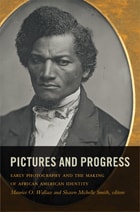
Early Photography and the Making of African American IdentityMaurice O. Wallace and Shawn Michelle Smith, eds.
Duke University Press, 2012
Contributors. Michael A. Chaney, Cheryl Finley, P. Gabrielle Foreman, Ginger Hill, Leigh Raiford, Augusta Rohrbach, Ray Sapirstein, Suzanne N. Schneider, Shawn Michelle Smith, Laura Wexler, Maurice O. Wallace
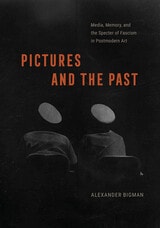
Pictures and the Past
Media, Memory, and the Specter of Fascism in Postmodern ArtAlexander Bigman
University of Chicago Press, 2024
A fresh take on the group of artists known as the Pictures Generation, reinterpreting their work as haunted by the history of fascism, the threat of its return, and the effects of its recurring representation in postwar American culture.
The artists of the Pictures Generation, converging on New York City in the late 1970s, indelibly changed the shape of American art. Rebelling against abstraction, they borrowed liberally from the aesthetics of mass media and sometimes the work of other artists. It has long been thought that the group’s main contribution was to upend received conceptions of authorial originality. In Pictures and the Past, however, art critic and historian Alexander Bigman shows that there is more to this moment than just the advent of appropriation art. He presents us with a bold new interpretation of the Pictures group’s most significant work, in particular its recurring evocations of fascist iconography.
In the wake of the original Pictures show, curated by Douglas Crimp in 1977, artists such as Sarah Charlesworth, Jack Goldstein, Troy Brauntuch, Robert Longo, and Gretchen Bender raised pressing questions about what it means to perceive the world historically in a society saturated by images. Bigman argues that their references to past cataclysms—to the violence wrought by authoritarianism and totalitarianism—represent not only a coded form of political commentary about the 1980s but also a piercing reflection on the nature of collective memory. Throughout, Bigman situates their work within a larger cultural context including parallel trends in music, fashion, cinema, and literature. Pictures and the Past probes the shifting relationships between art, popular culture, memory, and politics in the 1970s and ’80s, examining how the specter of fascism loomed for artists then—and the ways it still looms for us today.
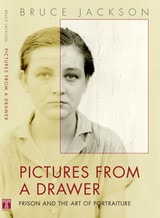
Pictures from a Drawer
Prison and the Art of PortraitureBruce Jackson
Temple University Press, 2009
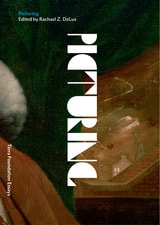
Picturing
Edited by Rachael Z. DeLue
Terra Foundation for American Art, 2016
The first volume in a new series on critical concerns in the history of American art, Picturing brings together essays by a distinguished international group of scholars who discuss the creation and consumption of images from the early modern period through the end of the twentieth century. Some of the contributions focus on art critical texts, like Gertrude Stein’s portrait of Cézanne, while others have as their point of departure particular artworks, from a portrait of Benjamin Franklin to Eadweard Muybridge’s nineteenth-century photographs of the California Coast. Works that addressed images and image making were not confined to the academy; they spilled out into poetry, literature, theater, and philosophy, and the essays’ considerations likewise range freely, from painting to natural history illustrations, travel narratives, and popular fiction. Together, the contributions demonstrate a rich deliberation that thoroughly debunks the notion that American art is merely derivative of a European tradition.
With a wealth of new research and full-color illustrations, Picturing significantly expands the terrain of scholarship on American art.
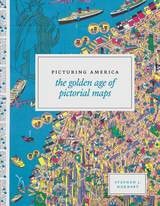
Picturing America
The Golden Age of Pictorial MapsStephen J. Hornsby
University of Chicago Press, 2017
Picturing America is the first book to showcase this vivid and popular genre of maps. Geographer Stephen J. Hornsby gathers together 158 delightful pictorial jewels, most drawn from the extensive collections of the Library of Congress. In his informative introduction, Hornsby outlines the development of the cartographic form, identifies several representative artists, describes the process of creating a pictorial map, and considers the significance of the form in the history of Western cartography. Organized into six thematic sections, Picturing America covers a vast swath of the pictorial map tradition during its golden age, ranging from “Maps to Amuse” to “Maps for War.” Hornsby has unearthed the most fascinating and visually striking maps the United States has to offer: Disney cartoon maps, college campus maps, kooky state tourism ads, World War II promotional posters, and many more. This remarkable, charming volume’s glorious full-color pictorial maps will be irresistible to any map lover or armchair traveler.
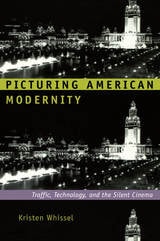
Picturing American Modernity
Traffic, Technology, and the Silent CinemaKristen Whissel
Duke University Press, 2008
Whissel shows that by portraying key events, achievements, and anxieties, the cinema invited American audiences to participate in the rapidly changing world around them. Moving pictures provided astonishing visual dispatches from military camps prior to the outbreak of fighting in the Spanish-American War. They allowed audiences to delight in images of the Pan-American Exposition, and also to mourn the assassination of President McKinley there. One early film genre, the reenactment, presented spectators with renditions of bloody battles fought overseas during the Philippine-American War. Early features offered sensational dramatizations of the scandalous “white slave trade,” which was often linked to immigration and new forms of urban work and leisure. By bringing these frequently distant events and anxieties “near” to audiences in cities and towns across the country, the cinema helped construct an American national identity for the machine age.
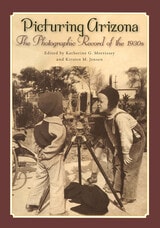
Picturing Arizona
The Photographic Record of the 1930sEdited by Katherine G. Morrissey and Kirsten Jensen
University of Arizona Press, 2005
This book places the work of local Arizonans alongside that of federal photographers both to illuminate the impact of the Depression on the state’s distinctive racial and natural landscapes and to show the influence of differing cultural agendas on the photographic record. The more than one hundred images—by well-known photographers such as Dorothea Lange and Laura Gilpin as well as by an array of less familiar photographers—represent a variety of purposes and perspectives, from public to personal, political to promotional. Six essays and three photo-essays bring together prominent authorities in history, the arts, and other fields who provide diverse perspectives on this period in Arizona and American history. Viewed together, the words and images capture a Depression-era Arizona bustling with activity as federally funded construction projects and seasonal agricultural jobs brought migrants and newcomers to the state. They convey the celebrations and the struggles of commercial photographers, archaeologists, city folks, farmers, tourists, native peoples and others in these hard times.
As the economic strains of the decade reverberated through the state, local photographers documented the lives of Arizona residents—including those frequently overlooked by historians. As this book persuasively shows, photographs can conceal as much as they reveal. A young Mexican American girl stands in front of a backdrop that hides the outhouse behind her, a deeply moving image for what it suggests about the efforts of her family to conceal their economic circumstances. Yet this image is a perfect metaphor for all the photographs in this book: stories remain hidden, but when viewers begin to question what they cannot see, pictures resonate more loudly than ever before.
This book is a history of Arizona written from the photographic record, offering a point of view that may differ from the written record. From the images and the insights of the authors, we can gain a new appreciation of how one state—and its indomitable people—weathered our nation’s toughest times.
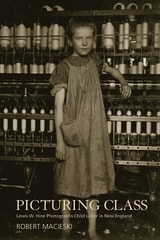
Picturing Class
Lewis W. Hine Photographs Child Labor in New EnglandRobert Macieski
University of Massachusetts Press, 2015
In this richly illustrated book, Robert Macieski examines Lewis W. Hine's art and advocacy on behalf of child laborers as part of the National Child Labor Committee (NCLC) between 1909 and 1917. A “social photographer”—as he called himself—Hine created images that documented children at work throughout New England, revealing their exploitation in the North as he had for rural working children in the South. Hine staged his images, highlighting particular types of labor in specific places: the “newsies” in Connecticut cities; sardine canners in Eastport, Maine; cranberry pickers in Cape Cod bogs; industrial homeworkers in Boston and Providence; and cotton textile workers throughout the region. His association with the NCLC connected him to a network of local and national reformers, social workers, and child welfare professionals, a broad coalition he supported in their fight to end this unethical labor practice. Macieski also chronicles Hine's efforts to mount major exhibitions that would help move public opinion against child labor.
In Picturing Class, Macieski explores the historical context of Hine's photographs and the social worlds of his subjects. He offers a detailed analysis of many of the images, unearthing the stories behind the creation of these photographs and the lives of their subjects. In telling the story of these photographs, their creation, and their reception, Macieski demonstrates how Hine worked to advance an unvarnished picture of a rapidly changing region and the young workers at the center of this important shift.
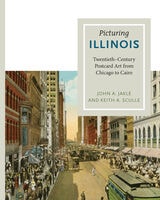
Picturing Illinois
Twentieth-Century Postcard Art from Chicago to CairoJohn A. Jakle and Keith A. Sculle
University of Illinois Press, 2012
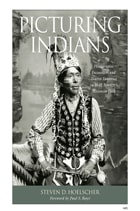
Picturing Indians
Photographic Encounters and Tourist Fantasies in H. H. Bennett's Wisconsin DellsSteven D. Hoelscher
University of Wisconsin Press, 2008
Winner, Book Award of Merit, Wisconsin Historical Society, Best Books for General Audiences, selected by the American Association of School Librarians, and Best Books for Regional Interests, selected by the Public Library Association
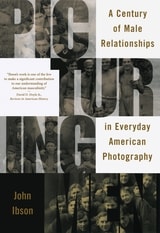
Picturing Men
A Century of Male Relationships in Everyday American PhotographyJohn Ibson
University of Chicago Press, 2006
Such is the time John Ibson evokes in Picturing Men, a striking visual record of changes in attitudes about relationships between gentlemen, soldiers, cowboys, students, lumberjacks, sailors, and practical jokers. Spanning from 1850 to 1950, the 142 everyday photographs that richly illustrate Picturing Men radiate playfulness, humor, and warmth. They portray a lost world for American men: a time when their relationships with each other were more intimate than they commonly are today, regardless of sexual orientation. Picturing Men starkly contrasts the calm affection displayed in earlier photographs with the absence of intimacy in photos from the mid-1950s on. In doing so, this lively, accessible book makes a significant contribution to American history and cultural studies, gender studies, and the history of photography.
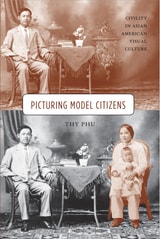
Picturing Model Citizens
Civility in Asian American Visual CultureThy Phu
Temple University Press, 2012
At the heart of the model minority myth—often associated with Asian Americans—is the concept of civility. In this groundbreaking book, Picturing Model Citizens, Thy Phu exposes the complex links between civility and citizenship, and argues that civility plays a crucial role in constructing Asian American citizenship.
Featuring works by Arnold Genthe, Carl Iwasaki, Toyo Miyatake, Nick Ut, and others, Picturing Model Citizens traces the trope of civility from the nineteenth to the twenty-first centuries. Through an examination of photographs of Chinese immigrants, Japanese internment camps, the Hiroshima Maidens project, napalm victims, and the SARS epidemic, Phu explores civility's unexpected appearance in images that draw on discourses of intimacy, cultivation, apology, and hygiene. She reveals how Asian American visual culture illustrates not only cultural ideas of civility, but also contests the contradictions of state-defined citizenship.
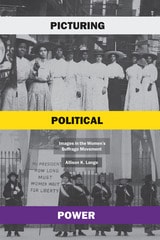
Picturing Political Power
Images in the Women’s Suffrage MovementAllison K. Lange
University of Chicago Press, 2020
For as long as women have battled for equitable political representation in America, those battles have been defined by images—whether illustrations, engravings, photographs, or colorful chromolithograph posters. Some of these pictures have been flattering, many have been condescending, and others downright incendiary. They have drawn upon prevailing cultural ideas of women’s perceived roles and abilities and often have been circulated with pointedly political objectives.
Picturing Political Power offers perhaps the most comprehensive analysis yet of the connection between images, gender, and power. In this examination of the fights that led to the ratification of the Nineteenth Amendment in 1920, Allison K. Lange explores how suffragists pioneered one of the first extensive visual campaigns in modern American history. She shows how pictures, from early engravings and photographs to colorful posters, proved central to suffragists’ efforts to change expectations for women, fighting back against the accepted norms of their times. In seeking to transform notions of womanhood and win the right to vote, white suffragists emphasized the compatibility of voting and motherhood, while Sojourner Truth and other leading suffragists of color employed pictures to secure respect and authority. Picturing Political Power demonstrates the centrality of visual politics to American women’s campaigns throughout the nineteenth and early twentieth centuries, revealing the power of images to change history.
Picturing Sabino
A Photographic History of a Southwestern CanyonDavid Wentworth Lazaroff
University of Arizona Press, 2023
The story is vividly told through numerous historical photographs, lively anecdotes, and an engaging text, informed by decades of research by David Wentworth Lazaroff. Along the way the reader makes the acquaintance of ordinary picnickers as well as influential citizens who helped to reshape the canyon, while witnessing the canyon’s evolving relationship with its growing urban neighbor. The book will fascinate readers who are already familiar with Sabino Canyon, as well as anyone with an interest in local or regional history, or in historical photography.
Picturing Texas Politics
A Photographic History from Sam Houston to Rick PerryBy Chuck Bailey; with historical text by Patrick Cox; introduction by John Anderson
University of Texas Press, 2015
With rare, previously unpublished photographs and iconic images of politicians from the state’s founders to Ann Richards, George W. Bush, and Rick Perry, here is the first-ever photographic album of Texas politicians and political campaigns.
The Republic of Texas was founded in 1839, around the time that photography was being invented. So while there were no photographers at the Alamo or San Jacinto, they arrived soon after to immortalize, on film, Sam Houston, David Burnett, Mirabeau Lamar, and many other founding fathers of the Lone Star State. Over the following nearly two centuries, Texas politics and politicians have provided reliable, often dramatic, and sometimes larger-than-life subjects for photographers to capture in the moment and add to the historical record.
Picturing Texas Politics presents the first photographic album of Texas politicians and political campaigns ever assembled. Chuck Bailey has searched archives, museums, libraries, and private collections to find photographs that have never been published, as well as iconic images, such as Russell Lee’s pictures of one of Ralph Yarborough’s campaigns. These photographs are arranged into four chronological sections, each one introduced by historian Patrick Cox, who also provides informative photo captions. The photographs display power and political savvy from the early Republic to Lyndon Johnson and Bob Bullock; unmatched dedication to Texas in the Hobby and Bush families; and the growing influence of women in politics, from Miriam “Ma” Ferguson to Barbara Jordan, Ann Richards, and Kay Bailey Hutchison. With Sam Houston’s jaguar vest, W. Lee “Pappy” O’Daniel’s hillbilly band, a famous governor with an ostrich, and prominent Texans eating watermelons, shooting guns, and riding horses, this is Texas politics at its liveliest and best.

Picturing Utopia
Bertha Shambaugh and the Amana PhotographersAbigail Foerstner
University of Iowa Press, 2005
Picturing the World
Informational Picture Books for ChildrenKathleen T. Isaacs
American Library Association, 2012
Piecemeal Protest
Animal Rights in the Age of NonprofitsCorey Lee Wrenn
University of Michigan Press, 2019
Given their tendency to splinter over tactics and goals, social movements are rarely unified. Following the modern Western animal rights movement over thirty years, Corey Lee Wrennapplies the sociological theory of Bourdieu, Goffman, Weber, and contemporary social movement researchers to examine structural conditions in the animal rights movement, facilitating factionalism in today’s era of professionalized advocacy.
Modern social movements are dominated by bureaucratically oriented nonprofits, a special arrangement that creates tension between activists and movement elites who compete for success in a corporate political arena. Piecemeal Protest examines the impact of nonprofitization on factionalism and a movement’s ability to mobilize, resonate, and succeed. Wrenn’sexhaustive analysis of archival movement literature and exclusive interviews with movement leaders illustrate how entities with greater symbolic capital are positioned to monopolize claims-making, disempower competitors, and replicate hegemonic power, eroding democratic access to dialogue and decision-making essential for movement health.
Piecemeal Protest examines social movement behavior shaped by capitalist ideologies and state interests. As power concentrates to the disadvantage of marginalized factions in the modern social movement arena, Piecemeal Protest shines light on processes of factionalism and considers how, in the age of nonprofits, intra-movement inequality could stifle social progress.
Piety and Dissent
Race, Gender, and Biblical Rhetoric in Early American AutobiographyEileen R. Elrod
University of Massachusetts Press, 2008
For pious converts to Christianity in late eighteenth- and early nineteenth-century New England, all reality was shaped by religious devotion and biblical text. It is therefore not surprising that earnest believers who found themselves marginalized by their race or sex relied on their faith to reconcile the tension between the spiritual experience of rebirth and the social ordeal of exclusion and injustice.
In Piety and Dissent, Eileen Razzari Elrod examines the religious autobiographies of six early Americans who represented various sorts of marginality: John Marrant, Olaudah Equiano, and Jarena Lee, all of African or African American heritage; Samson Occom (Mohegan) and William Apess (Pequot); and Abigail Abbott Bailey, a white woman who was subjected to extreme domestic violence. Through close readings of these personal narratives, Elrod uncovers the complex rhetorical strategies employed by pious outsiders to challenge the particular kinds of oppression each experienced. She identifies recurrent ideals and images drawn from Scripture and Protestant tradition—parables of liberation, rage, justice, and opposition to authority—that allowed them to see resistance as a religious act and, more than that, imbued them with a sense of agency.
What the life stories of these six individuals reveal, according to Elrod, is that conventional Christianity in early America was not the hegemonic force that church leaders at the time imagined, and that many people since have believed it to be. Nor was there a clear distinction between personal piety and religious, social, and political resistance. To understand fully the role of religion in the early period of American letters, we must rethink some of our most fundamental assumptions about the function of Christian faith in the context of individual lives.
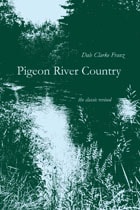
Pigeon River Country
A Michigan ForestDale Clarke Franz
University of Michigan Press, 2007
The long awaited new edition of a classic offers memories, myths, and meanings of the largest contiguous piece of wild land in Michigan's Lower Peninsula.
This updated edition explores more deeply why and how the outdoors moves and compels us. It’s a book about mice who sing, elk who wear collars, deer who kiss, and birds who could dictate their compositions to Mozart. It's about the human species interacting in generous and sometimes misguided ways with the rest of life. It's about men trying to ripen pinecones into pineapples and women taking better aim with a revolver than expected. It's about poetry—from Mary Oliver, Lao Tzu, and Theodore Roethke—and seeing hawks dive in a night sky or feeling oil geologists shake the earth below. It's about finding fish dead in the river by the thousands and crouching behind a stump to watch beaver build a dwelling. While this book considers life beyond the boundaries of Pigeon River Country, it is steeped in the specifics of a place that lives mostly on its own, instead of human, terms.
The Pigeon River Country is a remote northern forest, ecologically distinct from most of the United States. Laced with waterways, it has a storied past. Dale Clarke Franz has collected personal accounts from various people intrigued with the Pigeon River Country—including loggers, conservationists, mill workers, campers, even the young Ernest Hemingway, who said he loved the forest "better than anything in the world." There are comprehensive discussions of the area's flora and fauna, guides to trails and camping sites, and photos showcasing the changing face of this hidden national treasure.
Pigskin Nation
How the NFL Remade American PoliticsJesse Berrett
University of Illinois Press, 2018
Pikes Peak Partnership
The Penroses and the TuttsThomas J. Noel
University Press of Colorado, 2002

Pil 58,Center For Learning
Writing Centers & LibrariesJames Elmborg
Assoc of College & Research Libraries, 2011
Pilgrimage to Dollywood
A Country Music Road Trip through TennesseeHelen Morales
University of Chicago Press, 2014
In Pilgrimage to Dollywood, Morales sets out to discover Parton’s Tennessee. Her travels begin at the top celebrity pilgrimage site of Elvis Presley’s Graceland, then take her to Loretta Lynn’s ranch in Hurricane Mills; the Country Music Hall of Fame and the Grand Ole Opry in Nashville; to Sevierville, Gatlinburg, and the Great Smoky Mountains National Park; and finally to Pigeon Forge, home of the “Dolly Homecoming Parade,” featuring the star herself as grand marshall. Morales’s adventure allows her to compare the imaginary Tennessee of Parton’s lyrics with the real Tennessee where the singer grew up, looking at essential connections between country music, the land, and a way of life. It’s also a personal pilgrimage for Morales. Accompanied by her partner, Tony, and their nine-year-old daughter, Athena (who respectively prefer Mozart and Miley Cyrus), Morales, a recent transplant from England, seeks to understand America and American values through the celebrity sites and attractions of Tennessee.
This celebration of Dolly and Americana is for anyone with an old country soul who relies on music to help understand the world, and it is guaranteed to make a Dolly Parton fan of anyone who has not yet fallen for her music or charisma.