453 books match the query 'Economic policy' and 24 start with r
cover of Race, Liberalism, and Economics

Race, Liberalism, and Economics

David Colander, Robert E. Prasch, and Falguni A. Sheth, Editors

University of Michigan Press, 2009

Noneconomists often think that economists' approach to race is almost exclusively one of laissez-faire. Racism, Liberalism, and Economics argues that economists' ideas are more complicated. The book considers economists' support of markets in relation to the challenge of race and race relations and argues that their support of laissez-faire has traditionally been based upon a broader philosophical foundation of liberalism and history: what markets have and have not achieved in the past, and how that past relates to the future. The book discusses the concepts of liberalism and racism, the history and use of these terms, and how that history relates to policy issues. It argues that liberalism is consistent with a wide variety of policies and that the broader philosophical issues are central in choosing policies.

The contributors show how the evolution of racist ideas has been a subtle process that is woven into larger movements in the development of scientific thought; economic thinking is embedded in a larger social milieu. Previous discussions of policies toward race have been constrained by that social milieu, and, since World War II, have largely focused on ending legislated and state-sanctioned discrimination. In the past decade, the broader policy debate has moved on to questions about the existence and relative importance of intangible sources of inequality, including market structure, information asymmetries, cumulative processes, and cultural and/or social capital. This book is a product of, and a contribution to, this modern discussion. It is uniquely transdisciplinary, with contributions by and discussions among economists, philosophers, anthropologists, and literature scholars.

The volume first examines the early history of work on race by economists and social scientists more generally. It continues by surveying American economists on race and featuring contributions that embody more modern approaches to race within economics. Finally it explores several important policy issues that follow from the discussion.

". . . adds new insights that contribute significantly to the debate on racial economic inequality in the U.S. The differing opinions of the contributors provide the broad perspective needed to examine this extremely complex issue."
--James Peoples, University of Wisconsin-Milwaukee

"There is an immense economic literature on racial discrimination, employing a variety of models and decomposition methods. This volume makes a unique contribution by focusing on the philosophical assumptions at the root of this analysis and by presenting many sides of the very vigorous debate surrounding these controversial issues."
--Thomas Maloney, University of Utah

"By focusing upon the progress of analytical technique, historians of economic thought have grossly neglected the symbiotic relation of economics to public policy and ideology. This collection of essays offers a most welcome breach of disciplinary apartheid. Seizing upon recent research in the almost forgotten writings about race of Classical economists and their contemporaries, it relates nineteenth-century ideas to current debates about economic discrimination and other manifestations of racism. As the writing is both learned and lively, the book should appeal both to the generally educated reader and to teachers of courses in multiculturalism."
--Melvin Reder, Isidore Brown and Gladys J. Brown Professor Emeritus of Urban and Labor Economics, University of Chicago
[more]
cover of Race, Nation, and Market: Economic Culture in Porfirian Mexico

Race, Nation, and Market

Economic Culture in Porfirian Mexico

Richard Weiner

University of Arizona Press, 2004

Prior to the Revolution of 1910, economic ideals were a dominant mode of political and social discourse in Mexico. Scholars have focused considerable attention on the expansion of the market economy during this period—particularly its political, economic, and social importance. Richard Weiner now enhances our understanding of the emergence of modern Mexico by exploring the market's immense symbolic significance. Race, Nation, and Market traces the intellectual strands of economic thought during the late Porfiriato. Even in the face of Díaz's political reign, the market became the dominant theme in national discourse as contemporaries of all political persuasions underscored its social and cultural effects. This work documents the ways in which liberals, radicals, and conservatives employed market rhetoric to establish their political identities and map out their courses of action, and it shows how the market became an emblem linked to the identity of each group. Weiner explains how the dominant political interests—the científicos, the Mexican Liberal Party, and the social Catholics—each conceived economic issues, and he compares how they rhetorically used their conceptions of the market to promote their political objectives. Some worshiped it as a deity that created social peace, political harmony, and material abundance, while others demonized it as a source of social destruction. Weiner delineates their approaches and reveals how distinct notions of race, gender, community, and nationality informed economic culture and contradicted a laissez-faire conception of society and economy. By focusing on these rhetorical contests, Race, Nation, and Market offers a new perspective on social mobilization in late nineteenth-century Mexico as it also explores the related field of Porfirian economic culture and thought, about which little thus far has been written. In the face of today's controversy over globalization, it offers a unique historical perspective on the market's long-standing significance to political activism.
[more]
cover of Radicalism in the States: The Minnesota Farmer-Labor Party and the American Political Economy

Radicalism in the States

The Minnesota Farmer-Labor Party and the American Political Economy

Richard M. Valelly

University of Chicago Press, 1989

Concentrated in states outside the Northeast and the South, state-level third-party radical politics has been more widespread than many realize. In the 1920s and 1930s, American political organizations strong enough to mount state-wide campaigns, and often capable of electing governors and members of Congress, emerged not only in Minnesota but in Wisconsin and Washington, in Oklahoma and Idaho, and in several other states.

Richard M. Valelly treats in detail the political economy of the Minnesota Farmer-Labor Party (1918-1944), the most successful radical, state-level party in American history. With the aid of numerous interviews of surviving organizers and participants in the party's existence, Valelly recreates the party's rise to power and subsequent decline, seeking answers to some broad, developmental questions. Why did this type of politics arise, and why did it collapse when it did? What does the party's history tell us about national political change? The answers lie, Valelly argues, in America's transition from the political economy of the 1920s to the New Deal. Combining case study and comparative state politics, he reexamines America's political economy prior to the New Deal and the scope and ironies of the New Deal's reorganization of American politics. The results compellingly support his argument that the federal government's increasing intervention in the economy profoundly transformed state politics. The interplay between national economy policy-making and federalism eventually reshaped the dynamics of interest-group politics and closed off the future of "state-level radicalism." The strength of this argument is highlighted by Valelly's cross-national comparison with Canadian politics. In vivid contrast to the fate of American movements, "province level radicalism" thrived in the Canadian political environment.

In the course of analyzing one of the "supressed alternatives" of American politics, Valelly illuminates the influence of the national political economy on American political development. Radicalism in the States will interest students of economic protest, of national policy-making, of interest-group politics and party politics.
[more]
cover of Rainbow at Midnight: LABOR AND CULTURE IN THE 1940S

Rainbow at Midnight

LABOR AND CULTURE IN THE 1940S

George Lipsitz

University of Illinois Press, 1994
Rainbow at Midnight details the origins and evolution of working-class strategies for independence during and after World War II. Arguing that the 1940s may well have been the most revolutionary decade in U.S. history, George Lipsitz combines popular culture, politics, economics, and history to show how war mobilization transformed the working class and how that transformation brought issues of race, gender, and democracy to the forefront of American political culture. This book is a substantially revised and expanded work developed from the author's heralded 1981 Class and Culture in Cold War America.
 
[more]
cover of Raising the Floor: Federalism and the Politics of US Minimum Wage Policy

Raising the Floor

Federalism and the Politics of US Minimum Wage Policy

Shanna Rose

University of Chicago Press, 2026

A rich history of the development of American minimum wage policy with lessons for today.

Despite broad popular support for robust minimum wage policy, the federal minimum wage is now worth less—in real, inflation-adjusted terms—than at any time since 1949. While some state and local governments have stepped in to fill this void, others have declined to set any minimum wage standard at all. Traversing more than 100 years of history, Raising the Floor examines how interest groups have navigated the highly decentralized American political system to shape the development of federal, state, and local minimum wage laws.

In her analysis, Shanna Rose highlights the importance of American federalism. She argues that because federalism creates multiple arenas for policy change, interest groups have sought out the sites most conducive to their goals, shifting their lobbying efforts as new obstacles and opportunities emerge. Federalism has facilitated minimum wage policymaking by fostering policy experimentation, learning, and diffusion across states and by allowing state and local governments to overcome gridlock and status-quo biases at the national level. Yet, federalism has also been an instrument for containment, enabling those opposed to minimum wage increases to litigate and preempt local-level laws.

With rich historical chapters that illuminate different phases in the development of today’s patchwork of wage standards, Raising the Floor is a deep examination of the past, present, and future of American minimum wage law.

[more]
cover of Rational Expectations and Econometric Practice: Volume 1

Rational Expectations and Econometric Practice

Volume 1

Robert E. Lucas Jr. and Thomas J. Sargent, Editors

University of Minnesota Press, 1981

Rational Expectations and Econometric Practice was first published in 1981. Minnesota Archive Editions uses digital technology to make long-unavailable books once again accessible, and are published unaltered from the original University of Minnesota Press editions.

Assumptions about how people form expectations for the future shape the properties of any dynamic economic model. To make economic decisions in an uncertain environment people must forecast such variables as future rates of inflation, tax rates, government subsidy schemes and regulations. The doctrine of rational expectations uses standard economic methods to explain how those expectations are formed.

This work collects the papers that have made significant contributions to formulating the idea of rational expectations. Most of the papers deal with the connections between observed economic behavior and the evaluation of alternative economic policies.

Robert E. Lucas, Jr., is professor of economics at the University of Chicago. Thomas J. Sargent is professor of economics at the University of Minnesota and adviser to the Federal Reserve Bank of Minnesota.
[more]
cover of Rational Expectations and Economic Policy

Rational Expectations and Economic Policy

Edited by Stanley Fischer

University of Chicago Press, 1982

"Several areas in economics today have unprecedented significance and vitality. Most people would agree that stabilization policy ranks with the highest of these. Continuing inflation and periodic serious acceleration of inflation combined with high and secularly rising unemployment combine to give the area high priority. This book brings us up to date on an extremely lively discussion involving the role of expectations, and more particularly rational expectations, in the conduct of stabilization policy. . . . Anyone interested in the role of government in economics should read this important book."—C. Glyn Williams, The Wall Street Review of Books

"This is a most timely and valuable contribution. . . . The contributors and commentators are highly distinguished and the editor has usefully collated comments and the ensuing discussion. Unusually for a conference proceedings the book is well indexed and it is also replete with numerous and up-to-date references. . . . This is the first serious book to examine the rational expectations thesis in any depth, and it will prove invaluable to anyone involved with macroeconomic policy generally and with monetary economics in particular."—G. K. Shaw, The Economic Journal
[more]
cover of Re-Forming the State: The Politics of Privatization in Latin America and Europe

Re-Forming the State

The Politics of Privatization in Latin America and Europe

Hector E. Schamis

University of Michigan Press, 2002

With evidence drawn from Argentina, Chile, Mexico, Great Britain, and Hungary, Re-forming the State examines the processes leading to, and the political effects of, market reform experiments and focuses specifically on the patterns of collective action and coalition building that drive privatization. The author's argument calls into question established approaches in the discipline of economics and in the fields of comparative and international political economy.
The experience of privatization shows that the public and the private are neither contradictory nor mutually exclusive spheres, and that power relations between them are not necessarily zero-sum. To stress the point, the author borrows from the literature on state formation, which has extensively examined the historical processes of key private groups. The evidence presented shows why and how, by restructuring coalitional and institutional arenas, the state uses marketization to generate political order and to distribute political power. Thus, the author specifies the conditions under which political change is conceived in terms of and channeled through economic policy; in other words, how the state is "re-formed" through privatization. Re-forming the State thus highlights how privatization is simultaneously a movement from public to private, but also a movement from non-state to state, as the reduction of state assets leads to institutional changes that increase state capacities for defining and enforcing property rights, extracting revenue, and centralizing administrative and political resources.
Hector E. Schamis is Assistant Professor of Government, Cornell University.
[more]
cover of Reaching for a New Deal: Ambitious Governance, Economic Meltdown, and Polarized Politics in Obama's First Two Years

Reaching for a New Deal

Ambitious Governance, Economic Meltdown, and Polarized Politics in Obama's First Two Years

Theda Skocpol

Russell Sage Foundation, 2011
During his winning presidential campaign, Barack Obama promised to counter rising economic inequality and revitalize America's middle-class through a series of wide-ranging reforms. His transformational agenda sought to ensure affordable healthcare; reform the nation's schools and make college more affordable; promote clean and renewable energy; reform labor laws and immigration; and redistribute the tax burden from the middle class to wealthier citizens. The Wall Street crisis and economic downturn that erupted as Obama took office also put U.S. financial regulation on the agenda. By the middle of President Obama's first term in office, he had succeeded in advancing major reforms by legislative and administrative means. But a sluggish economic recovery from the deep recession of 2009, accompanied by polarized politics and governmental deadlock in Washington, DC, have raised questions about how far Obama's promised transformations can go. Reaching for a New Deal analyzes both the ambitious domestic policy of Obama's first two years and the consequent political backlash—up to and including the 2010 midterm elections. Reaching for a New Deal opens by assessing how the Obama administration overcame intense partisan struggles to achieve legislative victories in three areas—health care reform, federal higher education loans and grants, and financial regulation. Lawrence Jacobs and Theda Skocpol examine the landmark health care bill, signed into law in spring 2010, which extended affordable health benefits to millions of uninsured Americans after nearly 100 years of failed legislative attempts to do so. Suzanne Mettler explains how Obama succeeded in reorienting higher education policy by shifting loan administration from lenders to the federal government and extending generous tax tuition credits. Reaching for a New Deal also examines the domains in which Obama has used administrative action to further reforms in schools and labor law. The book concludes with examinations of three areas—energy, immigration, and taxes—where Obama's efforts at legislative compromises made little headway. Reaching for a New Deal combines probing analyses of Obama's domestic policy achievements with a big picture look at his change-oriented presidency. The book uses struggles over policy changes as a window into the larger dynamics of American politics and situates the current political era in relation to earlier pivotal junctures in U.S. government and public policy. It offers invaluable lessons about unfolding political transformations in the United States.
[more]
cover of Realizing Equality in Policy

Realizing Equality in Policy

Edited by Alexander Kaufman

University of Michigan Press, 2025

Economic and social inequality have become defining features of the world economy in the late twentieth and early twenty-first centuries. While increased inequality has been particularly pronounced in the United States, a similar phenomenon of increasing inequality of incomes and wealth has emerged in the economies of most major western European states. Realizing Equality in Policy brings together leading scholars to address current issues relating to rising inequality as it affects policy in the areas of education, health care, anti-poverty, employment, and economic policy. 

With contributions from scholars of both luck and relational egalitarianism, the essays reexamine a number of basic assumptions regarding social and economic policy from an egalitarian perspective. They explore gender-based discrimination, international justice, and the possibility for engagement between socialist and left-liberal thought. Rather than focusing on the subtle distinctions that divide egalitarian views, this volume shows that both views have the potential to offer important insights about how differences might be overcome and gaps might be closed. In offering new directions for solving wealth inequality through policy, Realizing Equality in Policy contributes to ongoing conversations in political theory, economic theory, and moral philosophy.
[more]
cover of Reconstructing the Commercial Republic: Constitutional Design after Madison

Reconstructing the Commercial Republic

Constitutional Design after Madison

Stephen L. Elkin

University of Chicago Press, 2006

James Madison is the thinker most responsible for laying the groundwork of the American commercial republic. But he did not anticipate that the propertied class on which he relied would become extraordinarily politically powerful at the same time as its interests narrowed. This and other flaws, argues Stephen L. Elkin, have undermined the delicately balanced system he constructed. In Reconstructing the Commercial Republic, Elkin critiques the Madisonian system, revealing which of its aspects have withstood the test of time and which have not. 

The deficiencies Elkin points out provide the starting point for his own constitutional theory of the republic—a theory that, unlike Madison’s, lays out a substantive conception of the public interest that emphasizes the power of institutions to shape our political, economic, and civic lives. Elkin argues that his theory should guide us toward building a commercial republic that is rooted in a politics of the public interest and the self-interest of the middle class. He then recommends specific reforms to create this kind of republic, asserting that Americans today can still have the lives a commercial republic is intended to promote: lives with real opportunities for economic prosperity, republican political self-government, and individual liberty.
[more]
cover of Reforming the Welfare State: Recovery and Beyond in Sweden

Reforming the Welfare State

Recovery and Beyond in Sweden

Edited by Richard B. Freeman, Birgitta Swedenborg, and Robert H. Topel

University of Chicago Press, 2010
Over the course of the twentieth century, Sweden carried out one of the most ambitious experiments by a capitalist market economy in developing a large and active welfare state. Sweden's generous social programs and the economic equality they fostered became an example for other countries to emulate. Of late, Sweden has also been much discussed as a model of how to deal with financial and economic crisis, due to the country's recovery from a banking crisis in the mid-1990s. At that time economists heatedly debated whether the welfare state caused Sweden's crisis and should be reformed—a debate with clear parallels to current concerns over capitalism. 
Bringing together leading economists, Reforming the Welfare State examines Sweden's policies in response to the mid-1990s crisis and the implications for the subsequent recovery. Among the issues investigated are the way changes in the labor market, tax and benefit policies, local government policy, industrial structure, and international trade affected Sweden's recovery. The way that Sweden addressed its economic challenges provides valuable insight into the viability of large welfare states, and more broadly, into the way modern economies deal with crisis.
[more]
cover of Regions That Work: How Cities and Suburbs Can Grow Together

Regions That Work

How Cities and Suburbs Can Grow Together

Manuel Pastor, Jr.

University of Minnesota Press, 2000

"A remarkable and timely book. . . . Must reading." William Julius Wilson

Offering a new vision of community-based regionalism, this book arrives just as "smart growth" measures and other attempts to link cities and suburbs are beginning to make their mark on the political and analytical scene. The authors make a powerful case for emphasizing equity, arguing that metropolitan areas must reduce poverty in order to grow and that low-income individuals must make regional connections in order to escape poverty.

A hard-hitting analysis of Los Angeles demonstrates that the roots of the unrest of 1992 lay in regional economic deterioration and that the recovery was slowed by insufficient attention to the poor. Regions That Work then provides a history and critique of community-development corporations, a statistical analysis of the poverty-growth relationship in seventy-four metro areas, a detailed study of three regions that have produced superior equity outcomes, and a provocative call for new policies and new politics.
[more]
cover of Regulating Finance: The Political Economy of Spanish Financial Policy from Franco to Democracy

Regulating Finance

The Political Economy of Spanish Financial Policy from Franco to Democracy

Arvid John Lukauskas

University of Michigan Press, 1997
In recent years many countries have liberalized their financial markets as a central element of their efforts to reform their economies and increase their economic growth rates. Financial deregulation leads to a fundamental restructuring of a country's economy and polity, as market forces, not state officials, begin to determine who obtains financial resources and at what cost. A critical question is whether countries can undertake a program of liberalization while undergoing democratic transformation. In this study, Arvid John Lukauskas explores why governments tightly regulate their country's financial system and why they choose to liberalize it. Using a rational choice approach, Lukauskas contends that public officials provide the dynamic behind the evolution of financial regulation as they seek to retain power and generate public revenue. Lukauskas argues that the nature of a country's political institutions shape the incentives facing politicians and influence whether they seek to regulate closely or liberalize financial markets in the pursuit of their goals. Lukauskas then tests his ideas in an in-depth case study of the evolution of financial policy in Spain, a country that transformed its financial system into a mostly market-based system after years of heavy state intervention, while undergoing a transformation from a dictatorship to a democracy. Contrary to the conventional wisdom that leaders will not undertake structural change during periods of democratization, he finds that leaders in Spain undertook financial liberalization despite opposition from powerful groups, because democratization gave Spanish leaders a strong incentive to improve economic performance through financial reform in order to compete for votes. Regulating Finance will be of interest to political scientists and economists interested in studying financial markets and the effects of regime change, including democratization, on economic reform.
[more]
cover of Regulation, Organizations, and Politics: Motor Freight Policy at the Interstate Commerce Commission

Regulation, Organizations, and Politics

Motor Freight Policy at the Interstate Commerce Commission

Lawrence S. Rothenberg

University of Michigan Press, 1994
Regulation, Organizations, and Politics examines the evolution of regulation at the Interstate Commerce Commission (ICC). The ICC has probably had the most profound impact on any federal agency on the way social scientists view politics. From a perspective based in modern political economy, the author develops an analysis that improves our understanding of the determinants of bureaucratic performance and clarifies the conditions under which organizations are likely to have a substantial influence.   Employing a variety of techniques, Regulation, Organizations, and Politics explains how motor carriers, particularly the larger truckers who controlled the American Trucking Association, were unable to control public policy once the chief executive decided to expand substantial political resources on reforming the motor carrier system. The author shows that this failure was rooted in the carriers' inability to offer the requisite rewards and sanctions required to influence those with power over the outcome. This work thus demonstrates that an integrated approach to the intersections of rational, if often incompletely informed, actors can help us to understand phenomena that seem puzzling at first consideration.
[more]
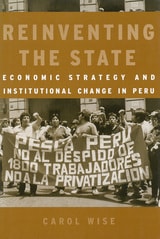
cover of Reinventing the State: Economic Strategy and Institutional Change in Peru

Reinventing the State

Economic Strategy and Institutional Change in Peru

Carol Wise

University of Michigan Press, 2003
The political economic history of Latin America in the post-World War II era has largely been one of underachievement and opportunities lost. This all changed with the wave of market reforms that were implemented in the 1990s. However, the precise role of these reforms as an agent of change is still hotly debated. This in-depth analysis of the Peruvian case argues for an explanation that treats institutional innovation and state reconstruction as necessary conditions for the apparent success of the market in Latin America.
Exploring how state intervention has been both the cause of Latin America's economic downfall in the 1980s and the solution to its recovery, Reinventing the State analyzes three main phases of state intervention: the developmentalism that lasted until 1982, the state in retreat of the 1980s, and the streamlined state of the 1990s. Through a comprehensive examination of the Peruvian experience, the book explains the country's impressive turnaround from the standpoint of institutional modernization and internal state reform.
Written for a broad academic audience, the public-policy community, and the private sector, this book is also meant as a quick primer for any journalist, consultant, or private-sector analyst in need of an overview of the region's market-reform effort and how it has played out in Peru.
Carol Wise is Associate Professor, School of International Relations, University of Southern California.
[more]
cover of Reluctant Partners: A History of Multilateral Trade Cooperation, 1850-2000

Reluctant Partners

A History of Multilateral Trade Cooperation, 1850-2000

Andrew G. Brown

University of Michigan Press, 2003

With globalization drawing countries closer together, greater international cooperation is essential for peace and stability. The collective arrangement made by governments to manage their trade relations is one of the few successes of globalization. This book assesses the progress of multilateral trade cooperation, exploring the interests at work and the issues raised in successive postwar rounds of negotiations. It traces how the narrow perception of reciprocity has gradually yielded to a broader evaluation of the benefits to the regime as a whole as the major trading nations have mutually reduced trade barriers. Andrew G. Brown demonstrates the increasing importance of rule making and shows the diversity of issues on which negotiations have focused, such as customs procedures, technical standards, subsidies, anti-dumping duties, intellectual property rights, and the treatment of foreign direct investment. Despite the progress, however, the regime has remained vulnerable. The book also analyzes the major sources of strain that have been evident.
This is a nontechnical book for those curious about the possibilities for cooperation among states and should be of interest to both the nonspecialist and the specialist. It draws on more than one discipline to interpret the events, lying in the triangle bounded by political science, economics, and history.
Andrew G. Brown is a former Director of the General Analysis and Policies Division for the United Nations, New York.
[more]
cover of Remaking New York: Primitive Globalization And The Politics Of Urban Community

Remaking New York

Primitive Globalization And The Politics Of Urban Community

William Sites

University of Minnesota Press, 2003

Uses New York City to discuss the ways that policy has mismanaged the effects of globalization

Inequality increases, instability grows, communities fragment: this is the fate of a city in the wake of globalization—but is globalization really the cause? Proposing a new perspective on politics, globalization, and the city, this provocative book argues that such urban problems result in part from U.S. policies that can be changed.

William Sites develops the concept of primitive globalization, identifying a pattern of reactive politics—ad hoc measures to subsidize business, displace the urban poor, and dismantle the welfare state—that uproots social actors (corporations, citizens, urban residents) and facilitates a damaging, short-term-oriented type of international integration. In light of this theory, Sites examines the transformation of New York City since the 1970s, focusing on the logic of political action at national, local, and neighborhood levels. In the process, the story of late twentieth-century New York and its Lower East Side community emerges as something different: not a tale of globalist transformation or of local resurgence but a distinctly American case, one in which urban politics and the state, in their own right, exacerbate inequality and community fragmentation within the city.
[more]
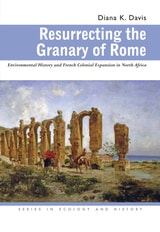
cover of Resurrecting the Granary of Rome: Environmental History and French Colonial Expansion in North Africa

Resurrecting the Granary of Rome

Environmental History and French Colonial Expansion in North Africa

Diana K. Davis

Ohio University Press, 2007

Tales of deforestation and desertification in North Africa have been told from the Roman period to the present. Such stories of environmental decline in the Maghreb are still recounted by experts and are widely accepted without question today. International organizations such as the United Nations frequently invoke these inaccurate stories to justify environmental conservation and development projects in the arid and semiarid lands in North Africa and around the Mediterranean basin. Recent research in arid lands ecology and new paleoecological evidence, however, do not support many claims of deforestation, overgrazing, and desertification in this region.

Diana K. Davis’s pioneering analysis reveals the critical influence of French scientists and administrators who established much of the purported scientific basis of these stories during the colonial period in Algeria, Morocco, and Tunisia, illustrating the key role of environmental narratives in imperial expansion. The processes set in place by the use of this narrative not only systematically disadvantaged the majority of North Africans but also led to profound changes in the landscape, some of which produced the land degradation that continues to plague the Maghreb today.

Resurrecting the Granary of Rome exposes many of the political, economic, and ideological goals of the French colonial project in these arid lands and the resulting definition of desertification that continues to inform global environmental and development projects. The first book on the environmental history of the Maghreb, this volume reframes much conventional thinking about the North African environment. Davis’s book is essential reading for those interested in global environmental history.
[more]
cover of Rethinking the Financial Crisis

Rethinking the Financial Crisis

Alan S. Blinder

Russell Sage Foundation, 2013
Some economic events are so major and unsettling that they “change everything.” Such is the case with the financial crisis that started in the summer of 2007 and is still a drag on the world economy. Yet enough time has now elapsed for economists to consider questions that run deeper than the usual focus on the immediate causes and consequences of the crisis. How have these stunning events changed our thinking about the role of the financial system in the economy, about the costs and benefits of financial innovation, about the efficiency of financial markets, and about the role the government should play in regulating finance? In Rethinking the Financial Crisis, some of the nation’s most renowned economists share their assessments of particular aspects of the crisis and reconsider the way we think about the financial system and its role in the economy. In its wide-ranging inquiry into the financial crash, Rethinking the Financial Crisis marshals an impressive collection of rigorous and yet empirically-relevant research that, in some respects, upsets the conventional wisdom about the crisis and also opens up new areas for exploration. Two separate chapters–by Burton G. Malkiel and by Hersh Shefrin and Meir Statman – debate whether the facts of the financial crisis upend the efficient market hypothesis and require a more behavioral account of financial market performance. To build a better bridge between the study of finance and the “real” economy of production and employment, Simon Gilchrist and Egan Zakrasjek take an innovative measure of financial stress and embed it in a model of the U.S. economy to assess how disruptions in financial markets affect economic activity—and how the Federal Reserve might do monetary policy better. The volume also examines the crucial role of financial innovation in the evolution of the pre-crash financial system. Thomas Philippon documents the huge increase in the size of the financial services industry relative to real GDP, and also the increasing cost per financial transaction. He suggests that the finance industry of 1900 was just as able to produce loans, bonds, and stocks as its modern counterpart—and it did so more cheaply. Robert Jarrow looks in detail at some of the major types of exotic securities developed by financial engineers, such as collateralized debt obligations and credit-default swaps, reaching judgments on which make the real economy more efficient and which do not. The volume’s final section turns explicitly to regulatory matters. Robert Litan discusses the political economy of financial regulation before and after the crisis. He reviews the provisions of the Dodd-Frank Wall Street Reform and Consumer Protection Act of 2010, which he considers an imperfect but useful response to a major breakdown in market and regulatory discipline. At a time when the financial sector continues to be a source of considerable controversy, Rethinking the Financial Crisis addresses important questions about the complex workings of American finance and shows how the study of economics needs to change to deepen our understanding of the indispensable but risky role that the financial system plays in modern economies.
[more]
cover of Ronald Reagan and the House Democrats: Gridlock, Partisanship, and the Fiscal Crisis

Ronald Reagan and the House Democrats

Gridlock, Partisanship, and the Fiscal Crisis

Karl Gerard Brandt

University of Missouri Press, 2009
When Democrats in the House of Representatives locked horns with President Ronald Reagan over the latter’s fiscal policies, the ensuing conflict reinforced the seismic shift in the political landscape that the 1980 election had brought. Karl Brandt now tells the story of how the New Deal Democratic coalition was able to sustain itself in the face of an unprecedented Republican assault—in a conflict whose reverberations are still being felt today.
            After a bipartisan conservative House coalition passed Reagan’s budget and tax cuts in 1981, conservative Democrats became worried about the increasingly large deficits produced by Reaganomics and questioned the administration’s spending priorities. In one of the few studies of congressional politics in the 1980s, Brandt describes the House Democratic leadership’s efforts to rebuild party unity while facing challenges from conservative Democrats, the Reagan administration, and the emerging fiscal crisis. He tells how Democrats worked hard to rein in party conservatives, to craft consensus-oriented policies palatable to all Democrats, and over the coming years to force the president and the Senate to compromise over fiscal policy.
            Drawing on primary source materials unavailable in the 1980s—including transcripts from closed-door meetings and internal House documents—Brandt chronicles the events that resulted in the deepening of the fiscal crisis, examines the growth of an intensely partisan political environment, and provides insight into the dynamics of creating a national budget. He cuts through conservative rhetoric to show how Reagan’s fiscal policies deepened federal deficits and reveals how the partisan struggles of the Reagan years redefined the Democrats along more centrist lines.
            When the dust had settled, the Democratic Party had become more unified in the face of budget conflict and had proved that it could practice fiscal conservatism and make tough budget choices when necessary. Carefully argued and thoroughly researched, Brandt’s work brings historical perspective to this important chapter in recent history as it explores conflicting visions of the economy, American society, and the very future of the nation.
[more]
cover of Royal Capitalism: Wealth, Class, and Monarchy in Thailand

Royal Capitalism

Wealth, Class, and Monarchy in Thailand

Puangchon Unchanam

University of Wisconsin Press, 2022

Thanks to its active role in national politics, the market economy, and popular culture, the Thai crown remains both the country's dominant institution and one of the world's wealthiest monarchies. Puangchon Unchanam examines the reign of Thailand's King Bhumibol Adulyadej or Rama IX (1946–2016) and how the crown thrived by transforming itself into a distinctly "bourgeois" monarchy that co-opted middle-class values of hard work, frugality, and self-sufficiency.
The kingdom positioned itself to connect business elites, patronize local industries, and form strategic partnerships with global corporations. Instead of restraining or regulating royal power, white-collar workers joined with the crown to form a dynamic, symbiotic force that has left the lower classes to struggle in their wake. Unchanam presents a surprising case study that kings and queens live long and large in cooperation with the bourgeoisie's interests and ideology.
[more]
cover of Rules and Restraint: Government Spending and the Design of Institutions

Rules and Restraint

Government Spending and the Design of Institutions

David M. Primo

University of Chicago Press, 2007

Government spending has increased dramatically in the United States since World War II despite the many rules intended to rein in the insatiable appetite for tax revenue most politicians seem to share. Drawing on examples from the federal and state governments, Rules and Restraint explains in lucid, nontechnical prose why these budget rules tend to fail, and proposes original alternatives for imposing much-needed fiscal discipline on our legislators.

One reason budget rules are ineffective, David Primo shows, is that politicians often create and preserve loopholes to protect programs that benefit their constituents. Another reason is that legislators must enforce their own provisions, an arrangement that is seriously compromised by their unwillingness to abide by rules that demand short-term sacrifices for the sake of long-term gain. Convinced that budget rules enacted through such a flawed legislative process are unlikely to work, Primo ultimately calls for a careful debate over the advantages and drawbacks of a constitutional convention initiated by the states—a radical step that would bypass Congress to create a path toward change. Rules and Restraint will be required reading for anyone interested in institutional design, legislatures, and policymaking.
[more]
cover of Rules, Games, and Common-Pool Resources

Rules, Games, and Common-Pool Resources

Elinor Ostrom, Roy Gardner, and James Walker

University of Michigan Press, 1994

Explores ways that the tragedy of the commons can be avoided by people who use common-property resources

[more]