Results by title
3745 books match the query 'Europe' and 147 start with r

RETHINKING LABOR HISTORY
ESSAYS ON DISCOURSE AND CLASS ANALYSISEdited by Lenard R. Berlanstein
University of Illinois Press, 1993
In Rethinking Labor History, nine well-known French labor historians join the debate. Advocates of both revisionist Marxism and discourse analysis are represented, and examples of empirical research emerging from the theoretical disputes are included.
Race and Ethnicity in the Middle Ages, Volume 31
Thomas Hahn, ed.
Duke University Press, 0
"The Difference the Middle Ages Makes: Color and Race before the Modern World" by Thomas Hahn
"Medieval and Modern Concepts of Race and Ethnicity" by Robert Bartlett
"Black Servant, Black Demon: Color Ideology in the Ashburnham Pentateuch" by Dorothy Hoogland Verkerk
"Pagans are wrong and Christians are right: Alterity, Gender, and Nation in the Chanson de Roland" by Sharon Kinoshita
"On Saracen Enjoyment: Some Fantasies of Race in Late Medieval France and England" by Jeffrey Jerome Cohen
"Medieval Travel Writing and the Question of Race" by Linda Lomperis
"Why ‘Race’?" by William Chester Jordan
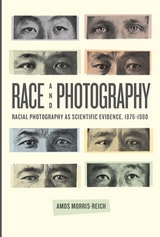
Race and Photography
Racial Photography as Scientific Evidence, 1876-1980Amos Morris-Reich
University of Chicago Press, 2015
Exploring the development of racial photography wherever it took place, including countries like France and England, Morris-Reich pays special attention to the German and Jewish contexts of scientific racism. Through careful reconstruction of individual cases, conceptual genealogies, and patterns of practice, he compares the intended roles of photography with its actual use in scientific argumentation. He examines the diverse ways it was used to establish racial ideologies—as illustrations of types, statistical data, or as self-evident record of racial signs. Altogether, Morris-Reich visits this troubling history to outline important truths about the roles of visual argumentation, imagination, perception, aesthetics, epistemology, and ideology within scientific study.

Race, Resistance, and the Boy Scout Movement in British Colonial Africa
In British Colonial AfricaTimothy H. Parsons
Ohio University Press, 2004
Conceived by General Sir Robert Baden-Powell as a way to reduce class tensions in Edwardian Britain, scouting evolved into an international youth movement. It offered a vision of romantic outdoor life as a cure for disruption caused by industrialization and urbanization. Scouting’s global spread was due to its success in attaching itself to institutions of authority. As a result, scouting has become embroiled in controversies in the civil rights struggle in the American South, in nationalist resistance movements in India, and in the contemporary American debate over gay rights.
In Race, Resistance, and the Boy Scout Movement in British Colonial Africa, Timothy Parsons uses scouting as an analytical tool to explore the tensions in colonial society. Introduced by British officials to strengthen their rule, the movement targeted the students, juvenile delinquents, and urban migrants who threatened the social stability of the regime. Yet Africans themselves used scouting to claim the rights of full imperial citizenship. They invoked the Fourth Scout Law, which declared that a scout was a brother to every other scout, to challenge racial discrimination.
Parsons shows that African scouting was both an instrument of colonial authority and a subversive challenge to the legitimacy of the British Empire. His study of African scouting demonstrates the implications and far-reaching consequences of colonial authority in all its guises.

Racism And Anti-Racism In Europe
Alana Lentin
Pluto Press, 2004
Radical Thought in Italy
A Potential PoliticsPaolo Virno
University of Minnesota Press, 2006
Radicalism and Reputation
The Career of Bronterre O'BrienMichael J. Turner
Michigan State University Press, 2017
Radicalizing Men
Fascist Desires, Great Replacement Propaganda, and Political ViolenceJessica Johnson
Duke University Press, 2026

Radio and Television Broadcasting on the European Continent
Burton Paulu
University of Minnesota Press, 1967
Radio and Television Broadcasting on the European Continent was first published in
1967. Minnesota Archive Editions uses digital technology to make long-unavailable books once again accessible, and are published unaltered from the original University of Minnesota Press editions.In this book Dr. Paulu provides a comprehensive survey based on firsthand study of the development and current status of radio and television broadcasting in continental Europe. He discusses the technical, organizational, financial, and programming aspects of European broadcasting in both Communist and Western countries. The material is organized, not on a country-by-country basis, but as it relates to broad basic issues, and it is presented in a framework of such interrelated factors as geography, history politics, international relations, religious traditions, language, national economic standards, and cultural and social life. The broadcasting systems studied include those of the Soviet Union and other Communist countries, France, West Germany, Belgium, the Netherlands, Italy, Sweden, and Switzerland.
The account is particularly timely in view of the concern and discussion about the future course of broadcasting in the United States. It has relevance not only for communications specialists but for political scientists and other scholars in the social sciences as well as for the growing public which is interested in the improvement of American broadcasting.
Radio and the Performance of Government
Broadcasting by the Czechoslovaks in Exile in London, 1939–1945Erica Harrison
Karolinum Press, 2023
Between 1939 and 1945, Czechoslovakia disappeared from the maps, existing only as an imagined ‘free republic’ on the radio waves. Following the German invasion and annexation of Bohemia and Moravia and the declaration of independence by Slovakia on 15 March 1939, the Czechoslovak Republic was gone. From their position in exile in wartime London, former Czechoslovak President Edvard Beneš and the government that formed around him depended on radio to communicate with the public they strove to represent. The broadcasts made by government figures in London enabled a performance of authority to impress their hosts, allies, occupying enemies, and claimed constituents.
This book examines this government program for the first time, making use of previously unstudied archival sources to examine how the exiles understood their mission and how their propaganda work was shaped by both British and Soviet influences. This study assesses the strengths, weaknesses, and limitations of the government’s radio propaganda as they navigated the complexities of exile, with chapters examining how they used the radio to establish their authority, how they understood the past and future of the Czechoslovak nation, and how they struggled to include Slovakia and Subcarpathian Ruthenia within it.
Rainbow Dust
Three Centuries of Butterfly DelightPeter Marren
University of Chicago Press, 2016
At the age of five, Marren had his “Nabokov Moment,” catching his first butterfly and feeling the dust of its colored scales between his fingers. It was a moment that would launch a lifetime’s fascination rivaling that of the famed novelist—a fascination that put both in good company. From the butterfly collecting and rearing craze that consumed North America and Europe for more than two hundred years (a hobby that in some cases bordered on madness), to the potent allure of butterfly iconography in contemporary advertisements and their use in spearheading calls to conserve and restore habitats (even though butterflies are essentially economically worthless), Marren unveils the many ways in which butterflies inspire us as objects of beauty and as symbols both transient and transcendent.
Floating around the globe and through the whole gamut of human thought, from art and literature to religion and science, Rainbow Dust is a cultural history rather than merely a natural one, a tribute to butterflies’ power to surprise, entertain, and obsess us. With a sway that far surpasses their fragile anatomy and gentle beat, butterfly wings draw us into the prismatic wonders of the natural world—and, in the words of Marren, these wonders take flight.

Ralph Ayres' Cookery Book
Edited by Jane Jakeman
Bodleian Library Publishing, 2006
If you've ever wondered what a London Wigg was or why plum cake does not actually contain plums, Ralph Ayres' Cookery Book will prove to be a most rewarding collection. Here the details of sumptuous British meals are meticulously presented, as is their larger context in the history of cooking. Recipes for such famous dishes as Quaking Pudding, Oxford Sausages, Damson Preserve, and other savory English delights fill the pages. Some, such as the famous New College Pudding, are still used today. The volume is beautifully produced, featuring a wealth of full-color botanical illustrations and elegant script reproduced from the original text, and also includes an informative foreword by Bodleian emeritus librarian David Vaisey.
A captivating glimpse into the world of eighteenth-century food and the culture of academia's apex, Ralph Ayres' Cookery Book is a valuable and engaging historical chronicle of British cuisine. It will appeal to social and culinary historians, as well as to the many lovers of griskin and collops.
Ramsey
The Lives of an English Fenland Town, 1200–1600Anne Reiber DeWindt
Catholic University of America Press, 2006
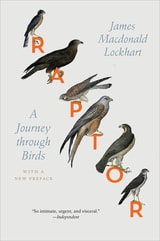
Raptor
A Journey through BirdsJames Macdonald Lockhart
University of Chicago Press, 2017
Taking as his guide the nineteenth-century Scottish naturalist and artist William MacGillivray, Lockhart loosely follows the historical trail forged by MacGillivray as he ventured from Aberdeen to London filling his pockets with plants and writing and illustrating the canonical A History of British Birds. Linking his journey to that of his muse, Lockhart shares his own encounters with raptors ranging from the scarce osprey to the successfully reintroduced red kite, a species once protected by medieval royal statute, revealing with poetic immediacy the extraordinary behaviors of these birds and the extreme environments they call home.
Creatures both worshipped and reviled, raptors have a talon-hold on the human heart and imagination. With his book, Lockhart unravels these complicated ties in a work by turns reverent and euphoric—an interweaving of history, travel, and nature writing at its best. A hymn to wanderers, to the land and to the sky, and especially to the birds, Raptor soars.
Rational Empires
Institutional Incentives and Imperial ExpansionLeo J. Blanken
University of Chicago Press, 2012
The nineteenth century marked the high point of imperialism, when tsarist Russia expanded to the Pacific and the sun was said never to set on the British Empire. Imperialism remains a perennial issue in international relations today, and nowhere is this more evident than in the intensifying competition for global resources.
Leo J. Blanken explains imperialism through an analysis of the institutions of both the expanding state and its targets of conquest. While democratic states favoring free trade generally resort to imperialism only to preempt aggressive rivals—or when they have reason to believe another state’s political institutions will not hold up when making bargains—authoritarian states tend toward imperialism because they don’t stand to benefit from free trade. The result is three distinct strategies toward imperialism: actors fighting over territory, actors peaceably dividing territory among themselves, and actors refraining from seizing territory altogether. Blanken examines these dynamics through three case studies: the scramble for Africa, the unequal treaties imposed on Qing Dynasty China, and the evolution of Britain’s imperial policy in India. By separating out the different types of imperialism, Blanken provides insight into its sources, as well as the potential implications of increased competition in the current international arena.

Ravenna
its role in earlier medieval change and exchangeVolume editor Judith Herrin and Jinty Nelson
University of London Press, 2016
Raw Material
Producing Pathology in Victorian CultureErin O'Connor
Duke University Press, 2000
O’Connor focuses on how four particularly troubling physical conditions were represented in a variety of literature. She begins by exploring how Asiatic cholera, which reached epidemic proportions on four separate occasions between 1832 and 1865, was thought to represent the dangers of cultural contamination and dissolution. The next two chapters concentrate on the problems breast cancer and amputation posed for understanding gender. After discussing how breast cancer was believed to be caused by the female body’s intolerance to urban life, O'Connor turns to men’s bodies, examining how new prosthetic technology allowed dismembered soldiers and industrial workers to reconstruct themselves as productive members of society. The final chapter explores how freak shows displayed gross deformity as the stuff of a new and improved individuality. Complicating an understanding of the Victorian body as both a stable and stabilizing structure, she elaborates how Victorians used disease as a messy, often strategically unintelligible way of articulating the uncertainties of chaotic change. Over the course of the century, O’Connor shows, the disfiguring process of disease became a way of symbolically transfiguring the self. While cholera, cancer, limb loss, and deformity incapacitated and even killed people, their dramatic symptoms provided opportunities for imaginatively adapting to a world where it was increasingly difficult to determine not only what it meant to be human but also what it meant to be alive.
Raw Material will interest an audience of students and scholars of Victorian literature, cultural history, and the history of medicine.
Re-Envisioning Past Musical Cultures
Ethnomusicology in the Study of Gregorian ChantPeter Jeffery
University of Chicago Press, 1992
Peter Jeffery offers an innovative new approach for understanding how these melodies were created, memorized, performed, and modified. Drawing on a variety of disciplines, including anthropology and ethnomusicology, he identifies characteristics of Gregorian chant that closely resemble other oral traditions in non-Western cultures and demonstrates ways music historians can take into account the social, cultural, and anthropological contexts of chant's development.
Re-Forming the State
The Politics of Privatization in Latin America and EuropeHector E. Schamis
University of Michigan Press, 2002
The experience of privatization shows that the public and the private are neither contradictory nor mutually exclusive spheres, and that power relations between them are not necessarily zero-sum. To stress the point, the author borrows from the literature on state formation, which has extensively examined the historical processes of key private groups. The evidence presented shows why and how, by restructuring coalitional and institutional arenas, the state uses marketization to generate political order and to distribute political power. Thus, the author specifies the conditions under which political change is conceived in terms of and channeled through economic policy; in other words, how the state is "re-formed" through privatization. Re-forming the State thus highlights how privatization is simultaneously a movement from public to private, but also a movement from non-state to state, as the reduction of state assets leads to institutional changes that increase state capacities for defining and enforcing property rights, extracting revenue, and centralizing administrative and political resources.
Hector E. Schamis is Assistant Professor of Government, Cornell University.
Re-Mapping Centre and Periphery
Asymmetrical Encounters in European and Global ContextsEdited by Tessa Hauswedell, Axel Körner, and Ulrich Tiedau
University College London, 2019
Re/imaginations of Disability in State Socialism
Visions, Promises, FrustrationsEdited by Katerina Kolárová and Martina Winkler
Campus Verlag, 2021
In Re/imaginations of Disability in State Socialism, an interdisciplinary group of scholars examines how disability has been conceptualized and treated in socialist states throughout global history. Drawing on intersectional theories that set disability in conversation with other identity categories such as race, age, gender, and sexuality, this book offers a unique approach to this crucial issue.
Reactionary Mathematics
A Genealogy of PurityMassimo Mazzotti
University of Chicago Press, 2023
The nineteenth century opened with a major shift in European mathematics, and in the Kingdom of Naples, this occurred earlier than elsewhere. Between 1790 and 1830 its leading scientific institutions rejected as untrustworthy the “very modern mathematics” of French analysis and in its place consolidated, legitimated, and put to work a different mathematical culture. The Neapolitan mathematical resistance was a complete reorientation of mathematical practice. Over the unrestricted manipulation and application of algebraic algorithms, Neapolitan mathematicians called for a return to Greek-style geometry and the preeminence of pure mathematics.
For all their apparent backwardness, Massimo Mazzotti explains, they were arguing for what would become crucial features of modern mathematics: its voluntary restriction through a new kind of rigor and discipline, and the complete disconnection of mathematical truth from the empirical world—in other words, its purity. The Neapolitans, Mazzotti argues, were reacting to the widespread use of mathematical analysis in social and political arguments: theirs was a reactionary mathematics that aimed to technically refute the revolutionary mathematics of the Jacobins. During the Restoration, the expert groups in the service of the modern administrative state reaffirmed the role of pure mathematics as the foundation of a newly rigorous mathematics, which was now conceived as a neutral tool for modernization. What Mazzotti’s penetrating history shows us in vivid detail is that producing mathematical knowledge was equally about producing certain forms of social, political, and economic order.

Reading Holinshed's Chronicles
Annabel Patterson
University of Chicago Press, 1994
Although we know it by the name of Raphael Holinshed, editor and major compiler of the 1577 edition, the Chronicles was the work of a group, a collaboration between antiquarians, clergymen, members of parliament, poets, publishers, and booksellers. Through a detailed reading, Patterson argues that the Chronicles convey rich insights into the way the Elizabethan middle class understood their society. Responding to the crisis of disunity which resulted from the Reformation, the authors of the Chronicles embodied and encouraged an ideal of justice, what we would now call liberalism, that extended beyond the writing of history into the realms of politics, law, economics, citizenship, class, and gender. Also, since the second edition of 1587 was called in by the Privy Council and revised under supervision, the work constitutes an important test case for the history of early modern censorship.
An essential book for all students of Tudor history and literature, Reading Holinshed's Chronicles brings into full view a long misunderstood masterpiece of sixteenth-century English culture.
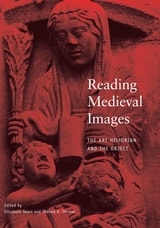
Reading Medieval Images
The Art Historian and the ObjectElizabeth Sears and Thelma K. Thomas, Editors
University of Michigan Press, 2002
What kind of language do they use to descibe what they see? How do they construct arguments using visual evidence? What sorts of arguments do they make? In this unusual anthology, eighteen prominent art historians specializing in the medieval field (European, Byzantine, and Islamic) provide answers to these fundamental questions, not directly but by way of example. Each author, responding to invitation, has chosen for study a single image or object and has submitted it to sustained analysis. The collection of essays, accompanied by statements on methodology by the editors, offers an accessible introduction to current art-historical practice.
Thelma K. Thomas is Associate Professor of the History of Art and Associate Curator of the Kelsey Museum, University of Michigan.
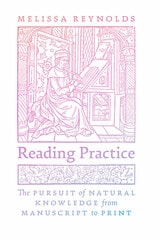
Reading Practice
The Pursuit of Natural Knowledge from Manuscript to PrintMelissa Reynolds
University of Chicago Press, 2024
Reading Practice tells the story of how ordinary people grew comfortable learning from commonplace manuscripts and printed books, such as almanacs, medical recipe collections, and herbals. From the turn of the fifteenth century to the close of the sixteenth century, these were the books English people read when they wanted to attend to their health or understand their place in the universe. Before then, these works had largely been the purview of those who could read Latin. Around 1400, however, medical and scientific texts became available in Middle English while manuscripts became less expensive. These vernacular manuscripts invited their readers into a very old and learned conversation: Hippocrates and Galen weren’t distant authorities whose word was law, they were trusted guides, whose advice could be excerpted, rearranged, recombined, and even altered to suit a manuscript compiler’s needs. This conversation continued even after the printing press arrived in England in 1476. Printers mined manuscripts for medical and scientific texts that they would publish throughout the sixteenth century, though the pressures of a commercial printing market encouraged printers to package these old texts in new ways. Without the weight of authority conditioning their reactions and responses to very old knowledge, and with so many editions of practical books to choose from, English readers grew into confident critics and purveyors of natural knowledge in their own right.
Melissa Reynolds reconstructs shifting attitudes toward medicine and science over two centuries of seismic change within English culture, attending especially to the effects of the Reformation on attitudes toward nature and the human body. Her study shows how readers learned to be discerning and selective consumers of knowledge gradually, through everyday interactions with utilitarian books.
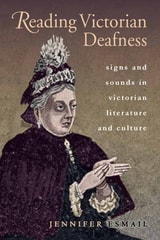
Reading Victorian Deafness
Signs and Sounds in Victorian Literature and CultureJennifer Esmail
Ohio University Press, 2013
Winner of the 2013 Sonya Rudikoff Award for best first book in Victorian Studies
Short-listed for the 2013 British Society for Literature and Science Book Prize.
Reading Victorian Deafness is the first book to address the crucial role that deaf people, and their unique language of signs, played in Victorian culture. Drawing on a range of works, from fiction by Charles Dickens and Wilkie Collins, to poetry by deaf poets and life writing by deaf memoirists Harriet Martineau and John Kitto, to scientific treatises by Alexander Graham Bell and Francis Galton, Reading Victorian Deafness argues that deaf people’s language use was a public, influential, and contentious issue in Victorian Britain.
The Victorians understood signed languages in multiple, and often contradictory, ways: they were objects of fascination and revulsion, were of scientific import and literary interest, and were considered both a unique mode of human communication and a vestige of a bestial heritage. Over the course of the nineteenth century, deaf people were increasingly stripped of their linguistic and cultural rights by a widespread pedagogical and cultural movement known as “oralism,” comprising mainly hearing educators, physicians, and parents.
Engaging with a group of human beings who used signs instead of speech challenged the Victorian understanding of humans as “the speaking animal” and the widespread understanding of “language” as a product of the voice. It is here that Reading Victorian Deafness offers substantial contributions to the fields of Victorian studies and disability studies. This book expands current scholarly conversations around orality, textuality, and sound while demonstrating how understandings of disability contributed to Victorian constructions of normalcy. Reading Victorian Deafness argues that deaf people were used as material test subjects for the Victorian process of understanding human language and, by extension, the definition of the human.
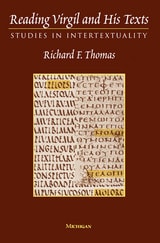
Reading Virgil and His Texts
Studies in IntertextualityRichard F. Thomas
University of Michigan Press, 2000
The articles and notes included in this volume have been selected for their diachronic aspect in addition to the synchronic status they had in their original context. Dealing with the intricate ways in which Virgil, and in the introductory chapter his predecessor Catullus, manipulated and appropriated their inherited Greek and Roman literary tradition, this book presents a coherent profile, through these detailed studies, of the mechanics of one of the most dynamic periods in the literary history of any culture.
Richard Thomas--one of the most important voices in Latin literary studies today--shows little anxiety about objections to authorial intentionality. Throughout there is a working assumption that intertextual connections can be established and, further, that functions and purposes, even intended ones, may be inferred from those connections.
This book will be of interest to scholars and students of Greek and Latin literature but will also be of great value to students of medieval, Renaissance, and early modern vernacular literatures, most of whose poets see themselves as closely connected to Virgil.
Richard F. Thomas is Professor of Greek and Latin, Harvard University.
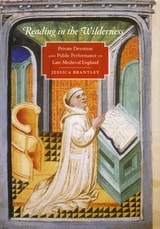
Reading in the Wilderness
Private Devotion and Public Performance in Late Medieval EnglandJessica Brantley
University of Chicago Press, 2007
Drawing on the work of W. J. T. Mitchell, Michael Camille, and others working at the image-text crossroads, Reading in the Wilderness addresses the manuscript’s texts and illustrations to examine connections between reading and performance within the solitary monk’s cell and also outside. Brantley reimagines the medieval codex as a site where the meanings of images and words are performed, both publicly and privately, in the act of reading.
Reading the Book of Nature
How Eight Best Sellers Reconnected Christianity and the Sciences on the Eve of the Victorian AgeJonathan R. Topham
University of Chicago Press, 2022
When Charles Darwin returned to Britain from the Beagle voyage in 1836, the most talked-about scientific books of the day were the Bridgewater Treatises. This series of eight works was funded by a bequest of the last Earl of Bridgewater and written by leading men of science appointed by the president of the Royal Society to explore "the Power, Wisdom, and Goodness of God, as manifested in the Creation." Securing public attention beyond all expectations, the series offered Darwin’s generation a range of approaches to one of the great questions of the age: how to incorporate the newly emerging disciplinary sciences into Britain’s overwhelmingly Christian culture.
Drawing on a wealth of archival and published sources, including many unexplored by historians, Jonathan R. Topham examines how and to what extent the series contributed to a sense of congruence between Christianity and the sciences in the generation before the fabled Victorian conflict between science and religion. Building on the distinctive insights of book history and paying close attention to the production, circulation, and use of the books, Topham offers new perspectives on early Victorian science and the subject of science and religion as a whole.
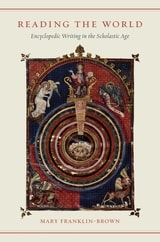
Reading the World
Encyclopedic Writing in the Scholastic AgeMary Franklin-Brown
University of Chicago Press, 2012
Reading, Gender and Identity in Seventeenth-Century England
Hannah Jeans
University of London Press, 2025
This ambitious and interdisciplinary book redraws the history of early modern Englishwomen’s reading, exploring the connections between gender, reading habits, and genre throughout the seventeenth century. Reading, Gender and Identity in Seventeenth-Century England challenges accepted historiographical narratives about reading that have privileged male experience and the impact of the Civil War; the book highlights the multiplicity and complexity of women’s reading practices, focusing on how women used reading in constructing their gender identity. Reading was a gendered act in the early modern period; across genres, women were depicted negotiating a range of gendered behavioral norms. From religious texts, romances, and cookbooks, to news, household records, and scientific and medical treatises, Jeans draws on archival sources across a wide range of writing types to offer a more complete picture of women’s reading experiences, ultimately questioning the accepted notion of the woman reader itself.

Real del Monte
A British Silver Mining Venture in MexicoBy Robert W. Randall
University of Texas Press, 1972
To speak of mining in newly independent Mexico is to speak of silver. And silver, historically abundant in the Real del Monte–Pachuca district, was the object of the Company of Adventurers in the Mines of Real del Monte. Organized in response to a plea by Pedro Romero de Terreros for help in rehabilitating his famous family’s once-rich properties, the English Real del Monte was led by men convinced that the application of English capital, management practices, and technology to those ruined mines and mills would reap them a profit and would revitalize the new nation’s most promising industry.
The adventurers were to be disappointed. The story of the English company is one of financial disaster: the loss of more than $5 million between its beginning in 1824 and its dissolution in 1849. Yet this failure was ironic, for upon the foundations of the English company was built a modern concern that yielded great rewards to Mexican and American successors to the hapless Englishmen.
A full account of a single risky venture, this inquiry is a microcosm of early foreign economic penetration into the Mexican mining industry. It offers specific solutions to poorly understood historical problems concerning the wave of capital that flowed from Great Britain into Latin America upon the disruption of the Spanish Empire, problems hitherto treated only in generalizations.

Reason after Its Eclipse
On Late Critical TheoryMartin Jay
University of Wisconsin Press, 2017
After surveying Western ideas of reason from the ancient Greeks through Kant, Hegel, and Marx, Jay engages at length with the ways leading theorists of the Frankfurt School—Horkheimer, Marcuse, Adorno, and most extensively Habermas—sought to salvage a viable concept of reason after its apparent eclipse. They despaired, in particular, over the decay in the modern world of reason into mere instrumental rationality. When reason becomes a technical tool of calculation separated from the values and norms central to daily life, then choices become grounded not in careful thought but in emotion and will—a mode of thinking embraced by fascist movements in the twentieth century.
Is there a more robust idea of reason that can be defended as at once a philosophical concept, a ground of critique, and a norm for human emancipation? Jay explores at length the ommunicative rationality advocated by Habermas and considers the range of arguments, both pro and con, that have greeted his work.
Reasons of Conscience
The Bioethics Debate in GermanyStefan Sperling
University of Chicago Press, 2013
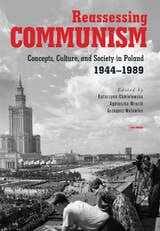
Reassessing Communism
Concepts, Culture, and Society in Poland 1944–1989Instytutem Badan Literackich PAN Chmielewska
Central European University Press, 2021
The thirteen authors of this collective work undertook to articulate matter-of-fact critiques of the dominant narrative about communism in Poland while offering new analyses of the concept, and also examining the manifestations of anticommunism. Approaching communist ideas and practices, programs and their implementations, as an inseparable whole, they examine the issues of emancipation, upward social mobility, and changes in the cultural canon.
The authors refuse to treat communism in Poland in simplistic categories of totalitarianism, absolute evil and Soviet colonization, and similarly refuse to equate communism and fascism. Nor do they adopt the neoliberal view of communism as a project doomed to failure. While wholly exempt from nostalgia, these essays show that beyond oppression and bad governance, communism was also a regime in which people pursued a variety of goals and sincerely attempted to build a better world for themselves.
The book is interdisciplinary and applies the tools of social history, intellectual history, political philosophy, anthropology, literature, cultural studies, and gender studies to provide a nuanced view of the communist regimes in east-central Europe.
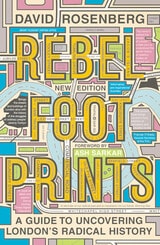
Rebel Footprints
A Guide to Uncovering London's Radical HistoryDavid Rosenberg
Pluto Press, 2019
If you visit London, and you’ve only experienced Buckingham Palace, The Tower of London, and The Millennium Wheel, you’ve missed the true essence of London, and its politically-charged, rebellious history. A truly radical response to conservative heritage tours and banal day trips, Rebel Footprints brings to life the history of social movements in England's capital by providing lively commentary, maps, and walking tours you will not find anywhere else.
David Rosenberg transports readers from well-known landmarks to history-making hidden corners, while telling the story of protest and struggle in London from the early nineteenth to the mid-twentieth century.
From the suffragettes to the socialists, from the chartists to the trade unionists: Rosenberg invites us to step into the footprints of a diverse cast of dedicated fighters for social justice. Individual chapters highlight particular struggles and their participants, from famous faces to lesser-known luminaries. Chapters include:
*Writers and Rioters in the Fleet Street Precinct
*Trailblazers for Democracy in Clerkenwell Green
*The Spark of Rebellion in Bow
*Coming in from the Cold: Immigrant Agitators and Radicals in Spitalfields
*No Gods, No Masters: Radical Bloomsbury
*Life on the Boundary: Fighting for Housing in Bethnal Green and Shoreditch
*Stirrings from the South: The Battersea Four
*peaking Truth to Power: Suffragettes and Westminster
*Not Afraid of the Prison Walls: Rebel Women and Men of Poplar
*People's Power in Bermondsey
Rebel Footprints sets London's radical campaigners against the backdrop of the city's multi-faceted development. Self-directed walks pair with narratives that seamlessly blend history, politics, and geography, while specially commissioned maps and illustrations immerse the reader in the story of the city.
Whether you're visiting London for the first time, or born and raised there, Rosenberg invites you to see London as you never have before—the radical center of the English-speaking world.
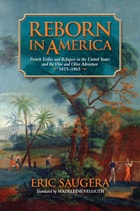
Reborn in America
French Exiles and Refugees in the United States and the Vine and Olive Adventure, 1815-1865Eric Saugera, translated by Madeleine Velguth
University of Alabama Press, 2011
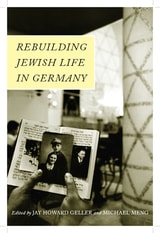
Rebuilding Jewish Life in Germany
Jay Howard Geller
Rutgers University Press, 2020
Recipes and Everyday Knowledge
Medicine, Science, and the Household in Early Modern EnglandElaine Leong
University of Chicago Press, 2018
In Recipes and Everyday Knowledge, Elaine Leong situates recipe knowledge and practices among larger questions of gender and cultural history, the history of the printed word, and the history of science, medicine, and technology. The production of recipes and recipe books, she argues, were at the heart of quotidian investigations of the natural world or “household science”. She shows how English homes acted as vibrant spaces for knowledge making and transmission, and explores how recipe trials allowed householders to gain deeper understandings of sickness and health, of the human body, and of natural and human-built processes. By recovering this story, Leong extends the parameters of natural inquiry and productively widens the cast of historical characters participating in and contributing to early modern science.
Reckoning with Matter
Calculating Machines, Innovation, and Thinking about Thinking from Pascal to BabbageMatthew L. Jones
University of Chicago Press, 2016
In Reckoning with Matter, Matthew L. Jones draws on the remarkably extensive and well-preserved records of the quest to explore the concrete processes involved in imagining, elaborating, testing, and building calculating machines. He explores the writings of philosophers, engineers, and craftspeople, showing how they thought about technical novelty, their distinctive areas of expertise, and ways they could coordinate their efforts. In doing so, Jones argues that the conceptions of creativity and making they exhibited are often more incisive—and more honest—than those that dominate our current legal, political, and aesthetic culture.
Reclaiming Catherine of Siena
Literacy, Literature, and the Signs of OthersJane Tylus
University of Chicago Press, 2009
Jane Tylus charts here the contested struggles of scholars over the centuries to situate Catherine in the history of Italian culture in early modernity. But she mainly focuses on Catherine’s works, calling attention to the interplay between orality and textuality in the letters and demonstrating why it was so important for Catherine to envision herself as a writer. Tylus argues for a reevalution of Catherine as not just a medieval saint, but one of the major figures at the birth of the Italian literary canon.
Reconstructing Europe's Trade and Payments
The European Payments UnionBarry Eichengreen
University of Michigan Press, 1993

Red Hangover
Legacies of Twentieth-Century CommunismKristen Ghodsee
Duke University Press, 2017
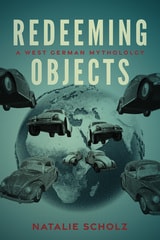
Redeeming Objects
A West German MythologyNatalie Scholz
University of Wisconsin Press, 2023
Postwar advertising, film, and print culture sought to divest mass-produced goods—such as the Volkswagen and modern interiors—of their fascist legacies. But Scholz demonstrates that postwar representations were saturated with unacknowledged references to the Nazi past. Drawing on a vast array of popular and highbrow publications and films, Redeeming Objects adds a new perspective to debates about postwar reconstruction, memory, and consumerism.
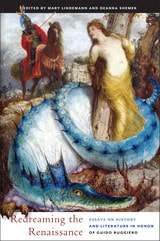
Redreaming the Renaissance
Essays on History and Literature in Honor of Guido RuggieroMary Lindemann
University of Delaware Press, 2024
Refiguring Spain
Cinema/Media/RepresentationMarsha Kinder, ed.
Duke University Press, 1997
These essays consider a diverse array of texts, ranging from recent films by Almodóvar, Saura, Erice, Miró, Bigas Luna, Gutiérrez Aragón, and Eloy de la Iglesia to media coverage of the 1993 elections. Francoist cinema and other popular media are examined in light of strategies used to redefine Spain’s cultural identity. The importance of the documentary, the appropriation of Hollywood film, and the significance of gender and sexuality in Spanish cinema are also discussed, as is the discourse of the Spanish media star—whether involving film celebrities like Rita Hayworth and Antonio Banderas or historical figures such as Cervantes. The volume concludes with an investigation of larger issues of government policy in relation to film and media, including a discussion of the financing of Spanish cinema and an exploration of the political dynamics of regional television and art museums. Drawing on a wide range of critical discourses, including feminist, postcolonial, and queer theory, political economy, cultural history, and museum studies, Refiguring Spain is the first comprehensive anthology on Spanish cinema in the English language.
Contributors. Peter Besas, Marvin D’Lugo, Selma Reuben Holo, Dona M. Kercher, Marsha Kinder, Jaume Martí-Olivella, Richard Maxwell, Hilary L. Neroni, Paul Julian Smith, Roland B. Tolentino, Stephen Tropiano, Kathleen M. Vernon, Iñaki Zabaleta
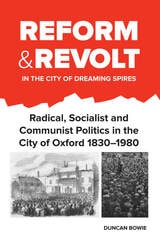
Reform and Revolt in the City of Dreaming Spires
Radical, Socialist and Communist Politics in the City of Oxford 1830–1980Duncan Bowie
University of Westminster Press, 2018
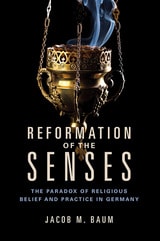
Reformation of the Senses
The Paradox of Religious Belief and Practice in GermanyJacob M. Baum
University of Illinois Press, 2018
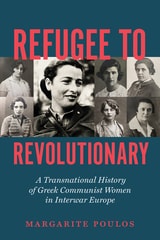
Refugee to Revolutionary
A Transnational History of Greek Communist Women in Interwar EuropeMargarite Poulos
Vanderbilt University Press, 2024
Refugee to Revolutionary examines the national and transnational world the female cadres of the Greek communist movement traversed, situated between their own aspirations, the objectives of the Greek Communist Party (KKE), and the global ambitions of the Comintern. Drawing largely on data contained in the individual files (anketas) of the KKE cadres located in the Comintern archive at the Russian State Archive for Socio-Political History (RGASPI), as well as Greek Communist Party archival materials, this history is told largely in the voice, albeit the “official” voice, of the subjects themselves. These voices reveal much about the personal, cultural, social, and gendered dimensions of their experience. They convey a story of opportunity and sacrifice and the sense of being part of something historic and extraordinary.
The overarching purpose of this book is two-pronged: The first is to address a historiographical void attributable to a combination of factors, which includes the inaccessibility of Soviet archival materials and a persistent hegemonic masculinity that continues to define the historiography of Greek communism. Second, this work is situated within a new literature represented by scholars such as Brigitte Studer, Lisa Kirschenbaum, Francisca De Haan, and others, which destabilizes Cold War paradigms that have long dominated evaluations of agency, identity, and subjectivity in the Western historiography of communism.
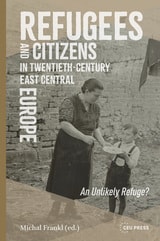
Refugees and Citizens in Twentieth-Century East Central Europe
An Unlikely Refuge?Michal Frankl
Central European University Press, 2026