Results by title
8113 books match the query 'Literary Criticism' and 415 start with r

R. K. Narayan
A Critical AppreciationWilliam Walsh
University of Chicago Press, 1982
This lucid and often eloquent study provides both new and devoted Narayan readers with an introduction to his life and work. William Walsh, who makes generous and apt use of quotations from Narayan's work, traces Narayan's artistic development and brings into clear relief the qualities that characterize his fiction: gentle irony, humor, and a tolerance of human foibles. Both a criticism and an appreciation, this work will prove valuable to those already acquainted with this delightful and important novelist and will lead others to his work for the first time.
R. K. Narayan
Contemporary Critical EssaysGeoffrey Kain
Michigan State University Press, 1993
RD vol 41 num 12
The University of Chicago Press
University of Chicago Press Journals, 2013
RE-FORMING THE PAST
HISTORY, THE FANTASTIC, & THE POSTMODERN SLAVE NARRATIVEA. Timothy Spaulding
The Ohio State University Press, 2005
In their rejection of mimetic representation and traditional historiography, Spaulding contextualizes postmodern slave narrative. By addressing both literary and popular African American texts, Re-Forming the Past expands discussions of both the African American literary tradition and postmodern culture.
READING LONDON
URBAN SPECULATION AND IMAGINATIVE GOVERNMENT EIGHTEENTH-CENTURY LITERATUREERIK BOND
The Ohio State University Press, 2007

READING THUCYDIDES
James V. Morrison
The Ohio State University Press, 2006
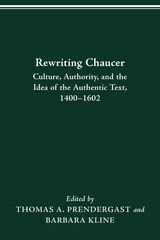
REWRITING CHAUCER
CULTURE, AUTHORITY, AND THE IDEA OF THE AUTHENTIC TEXT, 1400–1602THOMAS A. PRENDERGAST
The Ohio State University Press, 1999
This collection of original essays examines how the idea of an authentic Chaucerian text was reimagined and reproduced by medieval and early modern scribes and editors to satisfy and shape the cultural expectations of their audiences. These “reproductions” of Chaucer’s works epitomize the tension between developing notions of what makes a text “authentic” and the cultural pressures that led scribes and editors to construct their own versions of Chaucer and his works.
The book begins by exploring medieval and early modern notions of origins and how they at once illuminate and problematize the recovery of Chaucerian texts. Essays in the second section examine how individual scribes and reading communities reshaped Chaucer’s texts. Finally, we see how the printing press—bringing with it a renewed concern about the idea of authenticity—led both to an increase in the number of works attributed to Chaucer and to increasing anxiety about their authenticity.
The focus on the ways in which Chaucer was rewritten in different cultural and aesthetic contexts will enable medieval and early modern critics to situate Chaucer more fully within his cultural milieu, while illuminating the ways in which his reputation as both a “laureate poet” and a “lewed compilator” affected rewritings of his works. Rewriting Chaucer, then, will appeal both to scholars interested in the critical juncture between manuscript and print culture and to those interested in how culture affects the reproduction of authoritative texts.
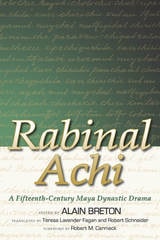
Rabinal Achi
A Fifteenth-Century Maya Dynastic DramaAlain Breton
University Press of Colorado, 2007
The drama is set in the Guatemalan highlands in the second half of the fifteenth century. In an exemplary trial that takes place in Kajyub, the capital of the Rabinaleb at that time, a captured enemy warrior (Quiché Achi) appears before the royal court. A series of combative dialogues pits the offending warrior against the local warrior (Rabinal Achi) and the king (Job Toj), reconstructing the deeds of those involved and retracing the antagonistic history of these two Mayan groups, the Quiché and the Rabinaleb.
Alain Breton approaches the text from an anthropological and ethnographical perspective, demonstrating that this indigenous text reenacts pre-Columbian historic paradigms. Breton's work is based on the Pérez Manuscript (1913), a facsimile of which is included in its entirety. Breton translated into French an entirely new transcription of the original text, and Teresa Lavender Fagan and Robert Schneider translated the text into English. Both the transcription and the translation are accompanied by detailed commentary and a glossary.
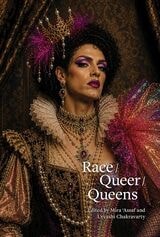
Race / Queer / Queens
Edited by Mira ‘Assaf and Urvashi Chakravarty
Arizona Center for Medieval and Renaissance Studies, 2026
This expansive volume examines the intersections of gender, race, sexuality, and other formations of identity in early modern representations of queens.
Race/Queer/Queens is a new intervention into the well-established field of queenship and royalty studies. Queens/(queans) are at once the epitome of royal power and the exemplum of gendered disenfranchisement. The essays in this volume address the interlocking methodologies of premodern critical race studies, gender and sexuality studies, and queer and trans theory to shed light on how gendered negotiations of power, reproductive politics, and embodied performance are determined by and inscribed within a hierarchy of gender, race, class, religion, nationhood, and sexuality. Ranging across early modern drama, poetry, and prose by the likes of William Shakespeare, Ben Jonson, Lucy Hutchinson, and Hester Pulter, the essays in Race/Queer/Queens offer new intersectional approaches to studies of early modern history, genealogy, embodiment, and the nation, including model methodologies and directions for future scholarship.
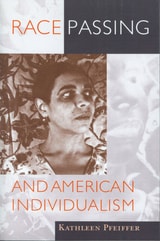
Race Passing and American Individualism
Kathleen Pfeiffer
University of Massachusetts Press, 2009
In this book, Kathleen Pfeiffer explores the implications of this dilemma by analyzing its treatment in the fiction of six writers: William Dean Howells, Frances E. W. Harper, Jean Toomer, James Weldon Johnson, Jessie Fauset, and Nella Larsen. Although passing for white has sometimes been viewed as an expression of racial self-hatred or disloyalty, Pfeiffer argues that the literary evidence is much more ambiguous than that. Rather than indicating a denial of "blackness" or co-optation by the dominant white culture, passing can be viewed as a form of self-determination consistent with American individualism. In their desire to manipulate personal identity in order to achieve social acceptance and upward mobility, light-skinned blacks who pass for white are no different than those Americans who reinvent themselves in terms of class, religion, or family history.
In Pfeiffer's view, to see race passing as a problematic but potentially legitimate expression of individualism is to invite richer and more complex readings of a broad range of literary texts. More than that, it represents a challenge to the segregationist logic of the "one drop" rule and, as such, subverts the ideology of racial essentialism.
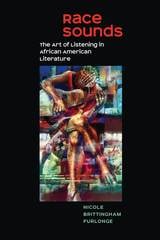
Race Sounds
The Art of Listening in African American LiteratureNicole Brittingham Furlonge
University of Iowa Press, 2018
We live in a world of talk. Yet Race Sounds argues that we need to listen more—not just hear things, but actively listen—particularly in relation to how we engage race, gender, and class differences. Forging new ideas about the relationship between race and sound, Furlonge explores how black artists—including well-known figures such as writers Ralph Ellison and Zora Neale Hurston, and singers Bettye LaVette and Aretha Franklin, among others—imagine listening. Drawing from a multimedia archive, Furlonge examines how many of the texts call on readers to “listen in print.” In the process, she gives us a new way to read and interpret these canonical, aurally inflected texts, and demonstrates how listening allows us to engage with the sonic lives of difference as readers, thinkers, and citizens.
Intervening in discourses of African American and black feminist literatures, where sound and voice dominate, Furlonge shifts our attention to listening as an aural strategy of cultural, social, and civic engagement that not only enlivens how we read, write, and critique texts, but also informs how we might be more effective audiences for each other and against injustice in our midst. The result is a fascinating examination that brings new insights to African American literature and art, American literature, democratic philosophy, and sound studies.
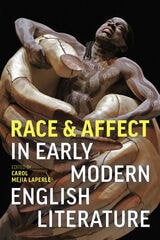
Race and Affect in Early Modern English Literature
Carole Mejia LaPerle
Arizona Center for Medieval and Renaissance Studies, 2021
Race and Affect in Early Modern English Literature puts the fields of critical race studies and affect theory into dialogue. Doing so opens a new set of questions: What are the emotional experiences of racial formation and racist ideologies? How do feelings—through the physical senses, emotional passions, or sexual encounters—come to signify race? What is the affective register of anti-blackness that pervades canonical literature? How can these visceral forms of racism be resisted in discourse and in practice? By investigating how race feels, this book offers new ways of reading and interpreting literary traditions, religious differences, gendered experiences, class hierarchies, sexuality, and social identities. So far scholars have shaped the discussion of race in the early modern period by focusing on topics such as genealogy, language, economics, religion, skin color, and ethnicity. This book, however, offers something new: it considers racializing processes as visceral, affective experiences.
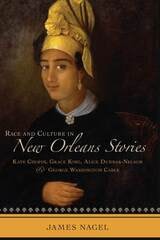
Race and Culture in New Orleans Stories
Kate Chopin, Grace King, Alice Dunbar-Nelson, and George Washington CableJames Nagel
University of Alabama Press, 2013
Race and Culture in New Orleans Stories is a study of four volumes of interrelated short stories set in New Orleans and the surrounding Louisiana bayous: Kate Chopin’s Bayou Folk; George Washington Cable’s Old Creole Days; Grace King’s Balcony Stories; and Alice Dunbar-Nelson’s The Goodness of St. Rocque and Other Stories. James Nagel argues that the conflicts and themes in these stories cannot be understood without a knowledge of the unique historical context of the founding of Louisiana, its four decades of rule by the Spanish, the Louisiana Purchase and the resulting cultural transformations across the region, Napoleonic law, the Code Noir, the plaçage tradition, the immigration of various ethnic and natural groups into the city, and the effects of the Civil War and Reconstruction. All of these historical factors energize and enrich the fiction of this important region.
The literary context of these volumes is also central to understanding their place in literary history. They are short-story cycles—collections of short fiction that contain unifying settings, recurring characters or character types, and central themes and motifs. They are also examples of the “local color” tradition in fiction, a movement that has been much misunderstood. Nagel maintains that regional literature was meant to be the highest form of American writing, not the lowest, and its objective was to capture the locations, folkways, values, dialects, conflicts, and ways of life in the various regions of the country in order to show that the lives of common citizens were sufficiently important to be the subject of serious literature.
Finally, Nagel shows that New Orleans provided a profoundly rich and complex setting for the literary exploration of some of the most crucial social problems in America, including racial stratification, social caste, economic exploitation, and gender roles, all of which were undergoing rapid transformation at the end of the nineteenth century and the beginning of the twentieth.
Race and Displacement
Nation, Migration, and Identity in the Twenty-First CenturyEdited by Maha Marouan and Merinda Simmons
University of Alabama Press, 2013
Race and Romance
Coloring the PastMargo Hendricks
Arizona Center for Medieval and Renaissance Studies, 2021
Race and Romance: Coloring the Past explores the literary and cultural genealogy of colorism, white passing, and white presenting in the romance genre. The scope of the study ranges from Heliodorus’ Aithiopika to the short novels of Aphra Behn, to the modern romance novel Forbidden by Beverly Jenkins. This analysis engages with the troublesome racecraft of “passing” and the instability of racial identity and its formation from the premodern to the present. The study also looks at the significance of white settler colonialism to early modern romance narratives. A bridge between studies of early modern romance and scholarship on twenty-first-century romance novels, this book is well-suited for those interested in the romance genre.
Race and Time
American Women's Poetics from Antislavery to Racial ModernityJanet Gray
University of Iowa Press, 2004
Gray clarifies the cultural roles women’s poetry played in the nineteenth-century United States and also reveals that these poems offer a fascinating, dynamic, and diverse field for students of social and cultural history. Gray’s readings provide a rich sense of the contexts in which this poetry is embedded and examine its aesthetic and political vitality in meticulous detail, linking careful explication of the texts with analysis of the history of poetry, canons, literacy, and literary authority.
Race and Time distinguishes itself from other critical studies not only through its searching, in-depth readings but also through its sustained attention to less known poets and its departure from a Dickinson-centered model. Most significantly, it offers a focus on race, demonstrating how changes in both the U.S. racial structure and women’s place in public culture set the terms for change in how women poets envisioned the relationship between poetry and social power.
Gray’s work makes contributions to several fields of study: poetry, U.S. literary history and American studies, women’s studies, African American studies and whiteness studies, children’s literature, and cultural studies. While placing the works of figures who have been treated elsewhere (e.g., Dickinson and Harper) into revealing new relationships, Race and Time does much to open interdisciplinary discussion of unfamiliar works.
Race and the Rhetoric of Resistance
Jeffrey B. Ferguson
Rutgers University Press, 2021
Race in the Multiethnic Literature Classroom
Edited by Cristina Stanciu and Gary Totten
University of Illinois Press, 2024
The contemporary rethinking and relearning of history and racism has sparked creative approaches for teaching the histories and representations of marginalized communities. Cristina Stanciu and Gary Totten edit a collection that illuminates these ideas for a variety of fields, areas of education, and institutional contexts.
The authors draw on their own racial and ethnic backgrounds to examine race and racism in the context of addressing necessary and often difficult classroom conversations about race, histories of exclusion, and racism. Case studies, reflections, and personal experiences provide guidance for addressing race and racism in the classroom. In-depth analysis looks at attacks on teaching Critical Race Theory and other practices for studying marginalized histories and voices. Throughout, the contributors shine a light on how a critical framework focused on race advances an understanding of contemporary and historical US multiethnic literatures for students around the world and in all fields of study.
Contributors: Kristen Brown, Nancy Carranza, Luis Cortes, Marilyn Edelstein, Naomi Edwards, Joanne Lipson Freed, Yadira Gamez, Lauren J. Gantz, Jennifer Ho, Shermaine M. Jones, Norell Martinez, Sarah Minslow, Crystal R. Pérez, Kevin Pyon, Emily Ruth Rutter, Ariel Santos, and C. Anneke Snyder
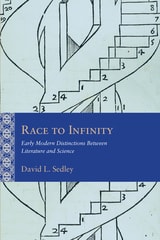
Race to Infinity
Early Modern Distinctions Between Literature and ScienceDavid L. Sedley
Northwestern University Press, 2027
Studying the early modern split between science and literature and the aftermath of their division
The conception of computers as thinking machines and literature as a social field stems from the early modern phenomenon of competing over the infinite as an object not just of contemplation but of appropriation in a race toward virtual control. The rediscovery of this origin undoes a collective forgetting of what technology and texts have in common, what they don’t, and what they can and ought to be in the future. David L. Sedley offers a new history of literature and science’s disciplinary divide—its origin and significance—tracing a series of points along the emerging frontier between these two fields. At each point there are two objects in play and two authors who push the objects in opposite directions: on the one hand, mechanical arts and the essay, probability theory and the novel, and geometry and epic; on the other, Montaigne and Bacon, Pascal and Lafayette, and Hobbes and Milton. Each of these authors, Sedley shows, tried to render an object either algorithmic or infinite to oppose the other’s efforts. Ultimately, Race to Infinity: Early Modern Distinctions Between Literature and Science illuminates the fortunes of the literary in the digital revolution and beyond.
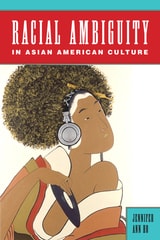
Racial Ambiguity in Asian American Culture
Ho, Jennifer Ann
Rutgers University Press, 2015
Racial Beings
Experiments in Asian American New MaterialismsMichelle N. Huang
Duke University Press, 2026
Racial Blackness and the Discontinuity of Western Modernity
Edited by Justin A. Joyce, Dwight A. McBride, and John Carlos Rowe
University of Illinois Press, 2013

Racial Feelings
Asian America in a Capitalist Culture of EmotionJeffrey Santa Ana
Temple University Press, 2015
Santa Ana explores various forms of Asian American cultural production, ranging from literature and graphic narratives to film and advertising, to illuminate the connections between global economic relations and the emotions that shape aspirations for the good life. He illustrates his argument with examples including the destitute Filipino immigrant William Paulinha, in Han Ong’s Fixer Chao, who targets his anger on the capitalist forces of objectification that racially exploit him, and Nan and Pingpin in Ha Jin’s A Free Life, who seek happiness and belonging in America.
Racial Feelings addresses how Asian Americans both resist and rely on stereotypes in their writing and art work. In addition, Santa Ana investigates how capitalism shapes and structures an emotional discourse that represents Asians as both economic exemplars and threats.
Racial Things, Racial Forms
Objecthood in Avant-Garde Asian American PoetryJoseph Jonghyun Jeon
University of Iowa Press, 2012
Racially Writing the Republic
Racists, Race Rebels, and Transformations of American IdentityBruce Baum and Duchess Harris, eds.
Duke University Press, 2009
The contributors analyze Thomas Jefferson’s legacy in light of his sexual relationship with his slave, Sally Hemings; the way that Samuel Gompers, the first president of the American Federation of Labor, rallied his organization against Chinese immigrant workers; and the eugenicist origins of the early-twentieth-century birth-control movement led by Margaret Sanger. They draw attention to the writing of Sarah Winnemucca, a Northern Piute and one of the first published Native American authors; the anti-lynching activist Ida B. Wells-Barnett; the Filipino American writer Carlos Bulosan; and the playwright Lorraine Hansberry, who linked civil rights struggles in the United States to anticolonial efforts abroad. Other figures considered include Alexis de Tocqueville and his traveling companion Gustave de Beaumont, Juan Nepomuceno Cortina (who fought against Anglo American expansion in what is now Texas), Abraham Lincoln, Theodore Roosevelt, and W. E. B. Du Bois. In the afterword, George Lipsitz reflects on U.S. racial politics since 1965.
Contributors. Bruce Baum, Cari M. Carpenter, Gary Gerstle, Duchess Harris, Catherine A. Holland, Allan Punzalan Isaac, Laura Janara, Ben Keppel, George Lipsitz, Gwendolyn Mink, Joel Olson, Dorothy Roberts, Patricia A. Schechter, John Kuo Wei Tchen, Jerry Thompson
Racine and English Classicism
By Katherine E. Wheatley
University of Texas Press, 1956
Literary historians and critics who have written on the influence of Racine in England during the neoclassical period apparently have assumed that the English translators and adapters of Racine’s plays in general succeeded in presenting the real Racine to the English public.
Katherine Wheatley here reveals the wide discrepancy between avowed intentions and actual results. Among the English plays she compares with their French originals are Otway’s Titus and Berenice, Congreve’s The Mourning Bride, and Philips’s The Distrest Mother. These comparisons, fully supported by quoted passages, reveal that those among the English public and contemporary critics who could not themselves read French had no chance whatever to know the real Racine: “The adapters and translators, so-called, had eliminated Racine from his tragedies before presenting them to the public.” Unacknowledged excisions and additions, shifts in plot, changes in dénouement, and frequent mistranslation turned Racine’s plays into “wretched travesties.” Two translations of Britannicus, intended for reading rather than for acting, are especially revealing in that they show which Racinian qualities eluded the British translators even when they were not trying to please an English theatergoing audience.
Why it is, asks the author, that no English dramatist could or would present Racine as he is to the English public of the neoclassical period? To answer this question she traces the development of Aristotelian formalism in England, showing the relation of the English theory of tragedy to French classical doctrine and the relation of the English adaptations of Racine to the English neoclassical theory of tragedy. She concludes that “deliberate alterations made by the English, far from violating classical tenets, bring Racine’s tragedies closer to the English neoclassical ideal than they were to begin with, and this despite the fact that some tenets of English doctrine came from parallel tenets widely accepted in France.” She finds that “in the last analysis, French classical doctrine was itself a barrier to the understanding of Racinian tragedy in England and an incentive to the sort of change English translators and adapters made in Racine.” This paradox she explains by the fact that Racine himself had broken with the classical tradition as represented by Corneille.

Racine
From Ancient Myth to Tragic ModernityMitchell Greenberg
University of Minnesota Press, 2009
A study of all of the major tragedies of Jean Racine, France's preeminent dramatist-and, according to many, its greatest and most representative author-Mitchell Greenberg's work offers an exploration of Racinian tragedy to explain the enigma of the plays' continued fascination.
Greenberg shows how Racine uses myth, in particular the legend of Oedipus, to achieve his emotional power. In the seventeenth-century tragedies of Racine, almost all references to physical activity were banned from the stage. Yet contemporary accounts of the performances describe vivid emotional reactions of the audiences, who were often reduced to tears. Greenberg demonstrates how Racinian tragedy is ideologically linked to Absolutist France's attempt to impose the "order of the One" on its subjects. Racine's tragedies are spaces where the family and the state are one and the same, with the result that sexual desire becomes trapped in a closed, incestuous, and highly formalized universe.
Greenberg ultimately suggests that the politics and sexuality associated with the legend of Oedipus account for our attraction to charismatic leaders and that this confusion of the state with desire explains our continued fascination with these timeless tragedies.
Radical Affections
Essays on the Poetics of OutsideMiriam Nichols
University of Alabama Press, 2011
In 1950 the poet Charles Olson published his influential essay “Projective Verse” in which he proposed a poetry of “open field” composition—to replace traditional closed poetic forms with improvised forms that would reflect exactly the content of the poem.
The poets and poetry that have followed in the wake of the “projectivist” movement—the Black Mountain group, the New York School, the San Francisco Renaissance, and the Language poets—have since been studied at length. But more often than not they have been studied through the lens of continental theory with the effect that these highly propositional, pragmatic, and adaptable forms of verse were interpreted in very cramped, polemical ways.
Miriam Nichols highlights many of the impulses original to the thinking and methods of each poet: appeals to perceptual experience, spontaneity, renewed relationships with nature, engaging the felt world—what Nichols terms a “poetics of outside”—focusing squarely on experiences beyond the self-regarding self. As Nichols states, these poets may well “represent the last moment in recent cultural history when a serious poet could write from perception or pursue a visionary poetics without irony or quotation marks and expect serious intellectual attention.”
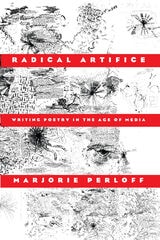
Radical Artifice
Writing Poetry in the Age of MediaMarjorie Perloff
University of Chicago Press, 1992
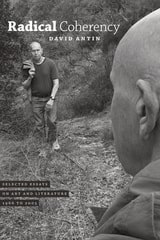
Radical Coherency
Selected Essays on Art and Literature, 1966 to 2005David Antin
University of Chicago Press, 2011
“We got to talking”—so David Antin begins the introduction to Radical Coherency, embarking on the pursuit that has marked much of his breathless, brilliantly conversational work. For the past forty years, whether spoken under the guise of performance artist or poet, cultural explorer or literary critic, Antin’s innovative observations have helped us to better understand everything from Pop to Postmodernism.
Intimately wedded to the worlds of conceptual art and poetics, Radical Coherency collects Antin’s influential critical essays and spontaneous, performed lectures (or “talk pieces”) for the very first time, capturing one of the most distinctive perspectives in contemporary literature. The essays presented here range from the first serious assessment of Andy Warhol published in a major art journal, as well as Antin’s provocative take on Clement Greenberg’s theory of Modernism, to frontline interventions in present debates on poetics and fugitive pieces from the ’60s and ’70s that still sparkle today—and represent a gold mine for art historians of the period. From John Cage to Allan Kaprow, Mark Rothko to Ludwig Wittgenstein, Antin takes the reader on an idiosyncratic, personal journey through twentieth-century culture with his trademark antiformalist panache—one thatwill be welcomed by any fan of this consummate trailblazer.
Radical Poetics and Secular Jewish Culture
Edited by Stephen Paul Miller and Daniel Morris
University of Alabama Press, 2009
--Franz Kafka
Kafka's quip--paradoxical, self-questioning, ironic--highlights vividly some of the key issues of identity and self-representation for Jewish writers in the 20th century. No group of writers better represents the problems of Jewish identity than Jewish poets writing in the American modernist tradition--specifically secular Jews: those disdainful or suspicious of organized religion, yet forever shaped by those traditions.
This collection of essays is the first to address this often obscured dimension of modern and contemporary poetry: the secular Jewish dimension. Editors Daniel Morris and Stephen Paul Miller asked their contributors to address what constitutes radical poetry written by Jews defined as "secular," and whether or not there is a Jewish component or dimension to radical and modernist poetic practice in general. These poets and critics address these questions by exploring the legacy of those poets who preceded and influenced them--Stein, Zukofsky, Reznikoff, Oppen, and Ginsberg, among others.
While there is no easy answer for these writers about what it means to be a Jew, in their responses there is a rich sense of how being Jewish reflects on their aesthetics and practices as poets, and how the tradition of the avant-garde informs their identities as Jews. Fragmented identities, irony, skepticism, a sense of self as "other" or "outsider," distrust of the literal, and belief in a tradition that questions rather than answers--these are some of the qualities these poets see as common to themselves, the poetry they make, and the tradition they work within.
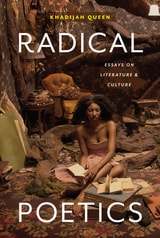
Radical Poetics
Essays on Literature & CultureKhadijah Queen
University of Michigan Press, 2025
Instead of operating from a base of unquestioned thought and systemic tradition, Radical Poetics presents more inclusive and accurate ways of contemplating literary work. Building on ideas and theoretical practices from Édouard Glissant, Toni Morrison, bell hooks, Saidiya Hartman, and Kimberlé Crenshaw, Queen reads for where love is present as well as for where it is absent—tracing systems of thought and aesthetic choices to track how characters are portrayed in terms of race, gender, class, and disability. She analyzes short stories, novels, nonfiction narratives, poetry, and a play from authors such as Herman Melville, Kate Chopin, Dionne Brand, Frances Ellen Watkins Harper, Ma-ka-tai-me-she-kia-kiak, Sor Juana Inés de la Cruz, Natasha Trethewey, and Muriel Rukeyser. Queen’s essays offer shifts in thinking about language—beyond calling out the ways language punishes vulnerability, entrenches harm, and suppresses true intercultural communication. Her intuitive approach aims to correct inaccuracies that have served as a foundation for the discriminatory thinking that undergirds American institutions and culture, particularly the continued glorification of violence. Radical Poetics makes a case for the imperative and practical value of understanding poetics beyond artistic and academic spaces and into everyday life.
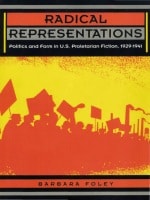
Radical Representations
Politics and Form in U.S. Proletarian Fiction, 1929–1941Barbara Foley
Duke University Press, 1994
Josephine Herbst, William Attaway, Jack Conroy, Thomas Bell and Tillie Olsen, are among the radical writers whose work Foley reexamines. Her fresh approach to the U.S. radicals' debates over experimentalism, the relation of art to propaganda, and the nature of proletarian literature recasts the relation of writers to the organized left. Her grasp of the left's positions on the "Negro question" and the "woman question" enables a nuanced analysis of the relation of class to race and gender in the proletarian novel. Moreover, examining the articulation of political doctrine in different novelistic modes, Foley develops a model for discussing the interplay between politics and literary conventions and genres.
Radical Representations recovers a literature of theoretical and artistic value meriting renewed attention form those interested in American literature, American studies, the U. S. left, and cultural studies generally.
Radical Science
Plants, Agency, and Nineteenth-Century British NarrativeMary Bowden
The Ohio State University Press, 2026
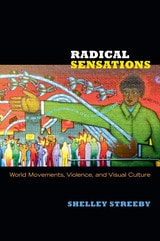
Radical Sensations
World Movements, Violence, and Visual CultureShelley Streeby
Duke University Press, 2013

Radical Tragedy
Religion, Ideology and Power in the Drama of Shakespeare and His ContemporariesJonathan Dollimore
Duke University Press, 2004
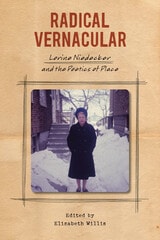
Radical Vernacular
Lorine Niedecker and the Poetics of PlaceElizabeth Willis
University of Iowa Press, 2008
Aesthetically linked with the New York Objectivist poets, Niedecker remained committed to her community in rural Wisconsin despite the grinding poverty that dogged her throughout her life. Largely self-taught, Niedecker formed attachments through her voracious reading and correspondence, but she also delighted in the disruptive richness of vernacular usage and in the homegrown, improvisational aesthetics that thrived within her immediate world. Niedecker wrote from a highly attenuated concern with biological, cultural, and political sustainability and, in her stridently modernist poems, anticipated many of the most urgent concerns in twenty-first-century poetics. In Radical Vernacular, Elizabeth Willis collects essays by leading poets and scholars that make a major contribution to the study of an important but long overlooked American poet.
This pathbreaking volume contains essays by seventeen leading scholars: Rae Armantrout, Glenna Breslin, Michael Davidson, Rachel Blau DuPlessis, Ruth Jennison, Peter Middleton, Jenny Penberthy, Mary Pinard, Patrick Pritchett, Peter Quartermain, Lisa Robertson, Elizabeth Robinson, Eleni Sikelianos, Jonathan Skinner, Anne Waldman, Eliot Weinberger, and Elizabeth Willis.
Radical as Reality
Form and Freedom in American PoetryPeter Campion
University of Chicago Press, 2019
Through close readings of the great modernists, midcentury objectivists, late twentieth-century poets, his contemporaries, and more, Campion unearths an American poetic landscape that is subtler and more varied than most critics have allowed. He discovers commonalities among poets considered opposites, dramatizes how form and history are mutually entailing, and explores how the conventions of poetry, its inheritance, and its inventions sprang from the tensions of ordinary life. At its core, this is a book about poetic making, one that reveals how the best poets not only receive but understand and adapt what comes before them, reinterpreting the history of their art to create work that is, indeed, radical as reality.
Radio Free Stein
Gertrude Stein's Parlor PlaysAdam J. Frank
Northwestern University Press, 2025
Returns us to Gertrude Stein’s theater by way of the modernist medium of radio
What happens when we listen to Gertrude Stein’s plays as radio and music theater? This book explores the sound of Stein’s theater and proposes that radio, when approached both historically and phenomenologically, offers technical solutions to her texts’ unique challenges. Adam J. Frank documents the collaborative project of staging Stein’s early plays and offers new critical interpretations of these lesser-known works. Radio Free Stein grapples with her innovative theater poetics from a variety of disciplinary perspectives: sound and media studies, affect and object relations theory, linguistic performativity, theater scholarship, and music composition.
Radium of the Word
A Poetics of MaterialityCraig Dworkin
University of Chicago Press, 2020
Radium of the Word takes its title from Mina Loy’s poem for Gertrude Stein, which hails her as the Madame “Curie / of the laboratory / of vocabulary.” In this spirit, Dworkin considers prose as a dynamic literary form, characterized by experimentation. Dworkin draws on examples from writers as diverse as Lyn Hejinian, William Faulkner, and Joseph Roth. He takes up the status of the proper name in Modernism, with examples from Stein, Loy, and Guillaume Apollinaire, and he offers in-depth analyses of individual authors from the counter-canon of the avant-garde, including P. Inman, Russell Atkins, N. H. Pritchard, and Andy Warhol. The result is an inspiring intervention in contemporary poetics.
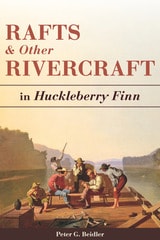
Rafts and Other Rivercraft
in Huckleberry FinnPeter G. Beidler
University of Missouri Press, 2018
Huck and Jim’s little raft is not made of logs, as it is often depicted in illustrations, but of sawn planks, and it was originally part of a much larger raft. Beidler explains why this matters and describes the other rivercraft that appear in the book. He gives what will almost certainly be the last word on the vexed question of whether the lengthy “raft episode,” removed at the publisher’s suggestion from the novel, should be restored to its original place.
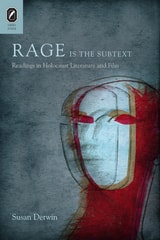
Rage Is the Subtext
Readings in Holocaust Literature and FilmSusan Derwin
The Ohio State University Press, 2012
Rage Is the Subtext charts the internal shifts of Holocaust survivors who tell their stories of suffering, loss, and endurance. Susan Derwin locates the healing effect of literary testimony in its capacity to represent the reactions of survivors to traumatic experience, while concealing other more unsettling responses from view. Beneath the explicit concerns of works by Primo Levi, Saul Friedländer, Binjamin Wilkomirski, Imre Kertész and Liliana Cavani, Derwin uncovers unspoken reserves of rage, which then become legible as formal properties of the text.
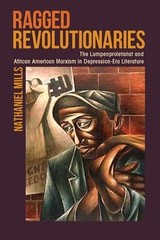
Ragged Revolutionaries
The Lumpenproletariat and African American Marxism in Depression-Era LiteratureNathaniel Mills
University of Massachusetts Press, 2017
By analyzing multiple published and unpublished works from the period, Mills shows how Richard Wright, Ralph Ellison, and Margaret Walker used the lumpenproletariat to imagine new forms of revolutionary knowledge and agency. In their writings, hobos riding the rails, criminals hustling to make ends meet, heroic black folk-outlaws, and individuals who fall out of the proletariat into the social margins all furnish material for thinking through resistance to the exploitations of capitalism, patriarchy, and Jim Crow. Ragged Revolutionaries introduces the lumpenproletariat into literary study, offers a new account of the place of Marxism in African American literature and politics, and clarifies the political and aesthetic commitments of three major modern black writers.
Rainer Maria Rilke
The Ring of FormsFrank Wood
University of Minnesota Press, 1958
Rainer Maria Rilke was first published in 1958. Minnesota Archive Editions uses digital technology to make long-unavailable books once again accessible, and are published unaltered from the original University of Minnesota Press editions.
The German poet Rainer Maria Rilke died in 1926, and interest in his poetry has been mounting ever since. The winds of fashion, taste, or personal bias have shifted several times to affect his audience of readers. There have been, according to previous Rilke criticism, not one but many Rilkes. Thus the critics have pointed to the "early Rilke" and the "late Rilke," to the Prague poet, the Paris poet, and the Muzot poet.
Now, in a fresh approach yet one which takes full cognizance of the varying viewpoints and conflicting purposes of earlier criticism, Professor Wood carefully examines Rilke's entire poetic output. The major concern here is with the poetry itself rather than with the biographical, psychological, or philosophical questions which have dominated most previous criticism.
Through a close textual analysis of the poems, Professor Wood demonstrates that the whole body of Rilke's writing, from beginning to end, is thoroughly interrelated and interdependent. As he points out, many more published materials, both posthumous verse and correspondence, are available now than in the earlier periods of Rilke's fame, a situation which adds significance to this new evaluation.
In addition to analyzing Rilke's own poetry, Professor Wood shows the links between Rilke and such contemporary poets and writers as Gide, Proust, T.S. Eliot, and Yeats.
The excerpts quoted from Rilke's poetry are given both in the original German text and in standard English translation.
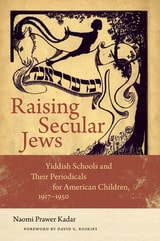
Raising Secular Jews
Yiddish Schools and Their Periodicals for American Children, 1917–1950Naomi Prawer Kadar
Brandeis University Press, 2016

Raising Your Kids Right
Children's Literature and American Political ConservatismAbate, Michelle Ann
Rutgers University Press, 2011
Highlighting the works of William Bennett, Lynne Cheney, Bill O'Reilly, and others, Michelle Ann Abate brings together such diverse fields as cultural studies, literary criticism, political science, childhood studies, brand marketing, and the cult of celebrity. Raising Your Kids Right dispels lingering societal attitudes that narratives for young readers are unworthy of serious political study by examining a variety of texts that offer information, ideology, and even instructions on how to raise kids right, not just figuratively but politically.
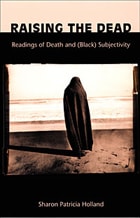
Raising the Dead
Readings of Death and (Black) SubjectivitySharon Patricia Holland
Duke University Press, 2000
Holland argues that the presence of blacks, Native Americans, women, queers, and other “minorities” in society is, like death, “almost unspeakable.” She gives voice to—or raises—the dead through her examination of works such as the movie Menace II Society, Toni Morrison’s novel Beloved, Leslie Marmon Silko’s Almanac of the Dead, Randall Kenan’s A Visitation of Spirits, and the work of the all-white, male, feminist hip-hop band Consolidated. In challenging established methods of literary investigation by putting often-disparate voices in dialogue with each other, Holland forges connections among African-American literature and culture, queer and feminist theory.
Raising the Dead will be of interest to students and scholars of American culture, African-American literature, literary theory, gender studies, queer theory, and cultural studies.

Raising the Dust
The Literary Housekeeping of Mary Ward, Sarah Grand, and Charlotte Perkins GilmanBeth Sutton-Ramspeck
Ohio University Press, 2004
To Mary Augusta Ward, Sarah Grand, and Charlotte Perkins Gilman, housekeeping represented public responsibilities: making the food supply safe, reforming politics, and improving the human race itself. Raising the Dust places their writing in the context of the late-Victorian era, in particular the eugenics movement, the proliferation of household conveniences, the home economics movement, and decreased reliance on servants. These changes affected relationships between the domestic sphere and the public sphere, and hence shaped the portrayal of domesticity in the era's fiction and nonfiction.
Moreover, Ward, Grand, and Gilman articulated a domestic aesthetic that swept away boundaries. Sutton-Ramspeck uncovers a new paradigm here: literature as engaging the public realm through the devices and perspectives of the domestic. Her innovative and ambitious book also connects fixations on cleaning with the discovery of germs (the first bacterium discovered was anthrax, and knowledge of its properties increased fears of dust); analyzes advertising cards for soap; and links the mental illness in Gilman's “The Yellow Wall-Paper” to fears during the period of arsenic poisoning from wallpaper.
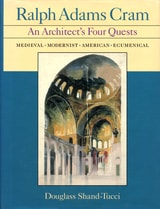
Ralph Adams Cram
An Architect's Four QuestsDouglass Shand-Tucci
University of Massachusetts Press, 2005
With his partner Bertram Goodhue, Cram won a number of important commissions, beginning with the West Point competition in 1903. Although an increasingly bitter rivalry with Goodhue would lead to the dissolution of their partnership in 1912, Cram had already begun to strike out on his own. Supervising architect at Princeton, consulting architect at Wellesley, and head of the MIT School of Architecture, he would also design most of New York's Cathedral of St. John the Divine and the campus of Rice University, as well as important church and collegiate structures throughout the country. By the 1920s Cram had become a household name, even appearing on the cover of Time magazine.
A complex man, Cram was a leading figure in what Shand-Tucci calls "a full-fledged homosexual monastery" in England, while at the same time married to Elizabeth Read. Their relationship was a complicated one, the effect of which on his children and his career is explored fully in this book. So too is his work as a religious leader and social theorist.
Shand-Tucci traces the influence on Cram of such disparate figures as Franklin Delano Roosevelt, Phillips Brooks, Henry Adams, and Ayn Rand. He divides Cram's career into four lifelong "quests": medieval, modernist, American, and ecumenical. Some quests may have failed, but in each he left a considerable legacy, ultimately transforming the visual image of American Christianity in the twentieth century.
Handsomely illustrated with over 130 photographs and drawings and eight pages of color plates, Ralph Adams Cram can be read on its own or in conjunction with Boston Bohemia, 1881–1900. Together, the two volumes complete what the Christian Century has described as a "superbly researched and captivating biography."
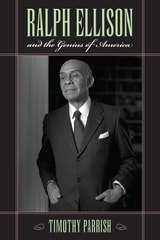
Ralph Ellison and the Genius of America
Timothy Parrish
University of Massachusetts Press, 2012
Ralph Ellison has long been admired as the author of one of the most important American novels of the twentieth century, Invisible Man. Yet he has also been dismissed by some critics as a writer who only published one major work of fiction and a black intellectual out of touch with his times. In this book, Timothy Parrish offers a fundamentally different assessment of Ellison's legacy, describing him as the most important American writer since William Faulkner and someone whose political and cultural achievements have not been fully recognized.
Embracing jazz artist Wynton Marsalis's characterization of Ellison as the unacknowledged “political theorist” of the civil rights movement, Parrish argues that the defining event of Ellison's career was not Invisible Man but the 1954 Supreme Court decision that set his country on the road to racial integration. In Parrish's view, no other American intellectual, black or white, better grasped the cultural implications of the new era than Ellison did; no other major American writer has been so misunderstood.
Drawing on Ellison's recently published “unfinished” novel, newly released archival materials, and unpublished correspondence, Parrish provides a sustained reconsideration of the writer's crucial friendships with Richard Wright, Robert Penn Warren, and C. Vann Woodward to show how his life was dedicated to creating an American society in which all could participate equally. By resituating Ellison's career in the historical context of its making, Parrish challenges the premises that distorted the writer's reception in his own lifetime to make the case for Ellison as the essential visionary of post–Civil War America.