Results by title
2335 books match the query 'Modern' and 96 start with r
READING LONDON
URBAN SPECULATION AND IMAGINATIVE GOVERNMENT EIGHTEENTH-CENTURY LITERATUREERIK BOND
The Ohio State University Press, 2007
Race and Romance
Coloring the PastMargo Hendricks
Arizona Center for Medieval and Renaissance Studies, 2021
Race and Romance: Coloring the Past explores the literary and cultural genealogy of colorism, white passing, and white presenting in the romance genre. The scope of the study ranges from Heliodorus’ Aithiopika to the short novels of Aphra Behn, to the modern romance novel Forbidden by Beverly Jenkins. This analysis engages with the troublesome racecraft of “passing” and the instability of racial identity and its formation from the premodern to the present. The study also looks at the significance of white settler colonialism to early modern romance narratives. A bridge between studies of early modern romance and scholarship on twenty-first-century romance novels, this book is well-suited for those interested in the romance genre.
Race to Infinity
Early Modern Distinctions Between Literature and ScienceDavid L. Sedley
Northwestern University Press, 2027
Studying the early modern split between science and literature and the aftermath of their division
The conception of computers as thinking machines and literature as a social field stems from the early modern phenomenon of competing over the infinite as an object not just of contemplation but of appropriation in a race toward virtual control. The rediscovery of this origin undoes a collective forgetting of what technology and texts have in common, what they don’t, and what they can and ought to be in the future. David L. Sedley offers a new history of literature and science’s disciplinary divide—its origin and significance—tracing a series of points along the emerging frontier between these two fields. At each point there are two objects in play and two authors who push the objects in opposite directions: on the one hand, mechanical arts and the essay, probability theory and the novel, and geometry and epic; on the other, Montaigne and Bacon, Pascal and Lafayette, and Hobbes and Milton. Each of these authors, Sedley shows, tried to render an object either algorithmic or infinite to oppose the other’s efforts. Ultimately, Race to Infinity: Early Modern Distinctions Between Literature and Science illuminates the fortunes of the literary in the digital revolution and beyond.
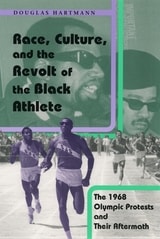
Race, Culture, and the Revolt of the Black Athlete
The 1968 Olympic Protests and Their AftermathDouglas Hartmann
University of Chicago Press, 2003
Drawing on extensive archival research and newly gathered oral histories, Douglas Hartmann sets out to answer these questions, reconsidering this pivotal event in the history of American sport. He places Smith and Carlos within the broader context of the civil rights movement and the controversial revolt of the black athlete. Although the movement drew widespread criticism, it also led to fundamental reforms in the organizational structure of American amateur athletics. Moving from historical narrative to cultural analysis, Hartmann explores what we can learn about the complex relations between race and sport in contemporary America from this episode and its aftermath.
Races to Modernity
Metropolitan Aspirations in Eastern Europe, 1890–1940Martin Kohlrausch
Central European University Press, 2014

Racine
From Ancient Myth to Tragic ModernityMitchell Greenberg
University of Minnesota Press, 2009
A study of all of the major tragedies of Jean Racine, France's preeminent dramatist-and, according to many, its greatest and most representative author-Mitchell Greenberg's work offers an exploration of Racinian tragedy to explain the enigma of the plays' continued fascination.
Greenberg shows how Racine uses myth, in particular the legend of Oedipus, to achieve his emotional power. In the seventeenth-century tragedies of Racine, almost all references to physical activity were banned from the stage. Yet contemporary accounts of the performances describe vivid emotional reactions of the audiences, who were often reduced to tears. Greenberg demonstrates how Racinian tragedy is ideologically linked to Absolutist France's attempt to impose the "order of the One" on its subjects. Racine's tragedies are spaces where the family and the state are one and the same, with the result that sexual desire becomes trapped in a closed, incestuous, and highly formalized universe.
Greenberg ultimately suggests that the politics and sexuality associated with the legend of Oedipus account for our attraction to charismatic leaders and that this confusion of the state with desire explains our continued fascination with these timeless tragedies.

Radical Protest and Social Structure
The Southern Farmers' Alliance and Cotton Tenancy, 1880-1890Michael Schwartz
University of Chicago Press, 1988
Radical Science
Plants, Agency, and Nineteenth-Century British NarrativeMary Bowden
The Ohio State University Press, 2026
Radicalism and Reputation
The Career of Bronterre O'BrienMichael J. Turner
Michigan State University Press, 2017
Radio Free Stein
Gertrude Stein's Parlor PlaysAdam J. Frank
Northwestern University Press, 2025
Returns us to Gertrude Stein’s theater by way of the modernist medium of radio
What happens when we listen to Gertrude Stein’s plays as radio and music theater? This book explores the sound of Stein’s theater and proposes that radio, when approached both historically and phenomenologically, offers technical solutions to her texts’ unique challenges. Adam J. Frank documents the collaborative project of staging Stein’s early plays and offers new critical interpretations of these lesser-known works. Radio Free Stein grapples with her innovative theater poetics from a variety of disciplinary perspectives: sound and media studies, affect and object relations theory, linguistic performativity, theater scholarship, and music composition.
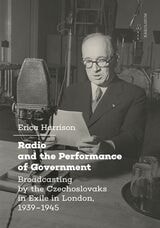
Radio and the Performance of Government
Broadcasting by the Czechoslovaks in Exile in London, 1939–1945Erica Harrison
Karolinum Press, 2023
Between 1939 and 1945, Czechoslovakia disappeared from the maps, existing only as an imagined ‘free republic’ on the radio waves. Following the German invasion and annexation of Bohemia and Moravia and the declaration of independence by Slovakia on 15 March 1939, the Czechoslovak Republic was gone. From their position in exile in wartime London, former Czechoslovak President Edvard Beneš and the government that formed around him depended on radio to communicate with the public they strove to represent. The broadcasts made by government figures in London enabled a performance of authority to impress their hosts, allies, occupying enemies, and claimed constituents.
This book examines this government program for the first time, making use of previously unstudied archival sources to examine how the exiles understood their mission and how their propaganda work was shaped by both British and Soviet influences. This study assesses the strengths, weaknesses, and limitations of the government’s radio propaganda as they navigated the complexities of exile, with chapters examining how they used the radio to establish their authority, how they understood the past and future of the Czechoslovak nation, and how they struggled to include Slovakia and Subcarpathian Ruthenia within it.

Raising the Dust
The Literary Housekeeping of Mary Ward, Sarah Grand, and Charlotte Perkins GilmanBeth Sutton-Ramspeck
Ohio University Press, 2004
To Mary Augusta Ward, Sarah Grand, and Charlotte Perkins Gilman, housekeeping represented public responsibilities: making the food supply safe, reforming politics, and improving the human race itself. Raising the Dust places their writing in the context of the late-Victorian era, in particular the eugenics movement, the proliferation of household conveniences, the home economics movement, and decreased reliance on servants. These changes affected relationships between the domestic sphere and the public sphere, and hence shaped the portrayal of domesticity in the era's fiction and nonfiction.
Moreover, Ward, Grand, and Gilman articulated a domestic aesthetic that swept away boundaries. Sutton-Ramspeck uncovers a new paradigm here: literature as engaging the public realm through the devices and perspectives of the domestic. Her innovative and ambitious book also connects fixations on cleaning with the discovery of germs (the first bacterium discovered was anthrax, and knowledge of its properties increased fears of dust); analyzes advertising cards for soap; and links the mental illness in Gilman's “The Yellow Wall-Paper” to fears during the period of arsenic poisoning from wallpaper.
Raw Material
Producing Pathology in Victorian CultureErin O'Connor
Duke University Press, 2000
O’Connor focuses on how four particularly troubling physical conditions were represented in a variety of literature. She begins by exploring how Asiatic cholera, which reached epidemic proportions on four separate occasions between 1832 and 1865, was thought to represent the dangers of cultural contamination and dissolution. The next two chapters concentrate on the problems breast cancer and amputation posed for understanding gender. After discussing how breast cancer was believed to be caused by the female body’s intolerance to urban life, O'Connor turns to men’s bodies, examining how new prosthetic technology allowed dismembered soldiers and industrial workers to reconstruct themselves as productive members of society. The final chapter explores how freak shows displayed gross deformity as the stuff of a new and improved individuality. Complicating an understanding of the Victorian body as both a stable and stabilizing structure, she elaborates how Victorians used disease as a messy, often strategically unintelligible way of articulating the uncertainties of chaotic change. Over the course of the century, O’Connor shows, the disfiguring process of disease became a way of symbolically transfiguring the self. While cholera, cancer, limb loss, and deformity incapacitated and even killed people, their dramatic symptoms provided opportunities for imaginatively adapting to a world where it was increasingly difficult to determine not only what it meant to be human but also what it meant to be alive.
Raw Material will interest an audience of students and scholars of Victorian literature, cultural history, and the history of medicine.
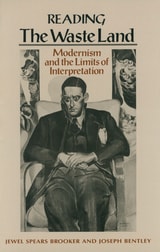
Reading "The Waste Land"
Modernism and the Limits of InterpretationJewel Spears Brooker
University of Massachusetts Press, 1990
This study of T.S. Eliot's The Waste Land guides the reader through the poem line by line, taking into account a number of previous interpretations. Aims to offer a part-by-part analysis of the poem with periodic summations and a meditation on the limits of interpretation and the problematic nature of reading in the late 20th century.
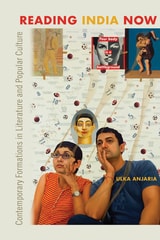
Reading India Now
Contemporary Formations in Literature and Popular CultureUlka Anjaria
Temple University Press, 2019
In an age of social media and reality television, reading and consumption habits in India now demand homegrown pulp fictions. Ulka Anjaria categorizes post-2000 Indian literature and popular culture as constituting “the contemporary,” a movement defined by new and experimental forms—where high- and low-brow meet, and genres break down.
Reading India Now studies the implications of this developing trend as both the right-wing resurges and marginalized voices find expression. Anjaria explores the fiction of Chetan Bhagat and Anuja Chauhan as well as Aamir Khan’s television talk show, Satyamev Jayate, plus the work of documentarian Paromita Vohra, to argue how different kinds of texts are involved in imagining new political futures for an India in transition. Contemporary literature and popular culture in India might seem artless and capitalistic, but it is precisely its openness to the world outside that allows these new works to offer significant insight into the experiences and sensibilities of contemporary India.

Reading Relations
How Authors Enter Our LivesDixon, Dan
University of Iowa Press, 2026
Drawing on the ordinary language philosophy of Toril Moi and Stanley Cavell, Dan Dixon argues that the act of reading shares emotional ground with our social lives. It prompts us to attend to the kinds of affective attachments that frequently resist description, as well as the attachments that encourage debate among scholars of literature.
Dixon posits that the interpretation of a text is significantly shaped by our impression of the writer. Through the lens of persona, this book examines the work of influential and iconic post-1945 American essayists, such as Joan Didion, Maggie Nelson, James Baldwin, Janet Malcolm, Teju Cole, David Foster Wallace, and Ben Lerner. The attachments we form might facilitate insight, consolation, distrust, or vanity. But whatever their effects, they can’t be ignored.
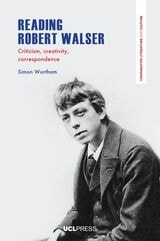
Reading Robert Walser
Criticism, Creativity, CorrespondenceSimon Wortham
University College London, 2025
Robert Walser’s letters to Frieda Mermet, the laundry manager at a Swiss psychiatric hospital, offer an intimate and enigmatic glimpse into the mind of a writer whose literary fortunes waned even as his influence grew in the decades following his death. Covering nearly thirty years, from 1913 to 1942, these letters chart Walser’s transition from a celebrated modernist to a man institutionalized, yet still deeply engaged with language and identity.
In Reading Robert Walser, Simon Wortham studies Walser’s letters within the broader context of modernist literature and deconstruction, and also imaginatively reconstructs Mermet’s possible lost responses, blurring the lines between criticism and creativity. The result is an innovative exploration of authorship and the act of reading itself—one that deepens our understanding of Walser’s life and work while questioning the very nature of literary correspondence.
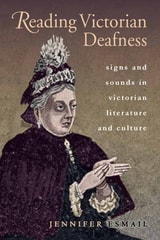
Reading Victorian Deafness
Signs and Sounds in Victorian Literature and CultureJennifer Esmail
Ohio University Press, 2013
Winner of the 2013 Sonya Rudikoff Award for best first book in Victorian Studies
Short-listed for the 2013 British Society for Literature and Science Book Prize.
Reading Victorian Deafness is the first book to address the crucial role that deaf people, and their unique language of signs, played in Victorian culture. Drawing on a range of works, from fiction by Charles Dickens and Wilkie Collins, to poetry by deaf poets and life writing by deaf memoirists Harriet Martineau and John Kitto, to scientific treatises by Alexander Graham Bell and Francis Galton, Reading Victorian Deafness argues that deaf people’s language use was a public, influential, and contentious issue in Victorian Britain.
The Victorians understood signed languages in multiple, and often contradictory, ways: they were objects of fascination and revulsion, were of scientific import and literary interest, and were considered both a unique mode of human communication and a vestige of a bestial heritage. Over the course of the nineteenth century, deaf people were increasingly stripped of their linguistic and cultural rights by a widespread pedagogical and cultural movement known as “oralism,” comprising mainly hearing educators, physicians, and parents.
Engaging with a group of human beings who used signs instead of speech challenged the Victorian understanding of humans as “the speaking animal” and the widespread understanding of “language” as a product of the voice. It is here that Reading Victorian Deafness offers substantial contributions to the fields of Victorian studies and disability studies. This book expands current scholarly conversations around orality, textuality, and sound while demonstrating how understandings of disability contributed to Victorian constructions of normalcy. Reading Victorian Deafness argues that deaf people were used as material test subjects for the Victorian process of understanding human language and, by extension, the definition of the human.
Reading and Writing Instruction in the Twenty-First Century
Recovering and Transforming the Pedagogy of Robert ScholesEllen C. Carillo
Utah State University Press, 2021
In this volume, Scholes’s scholarship is included alongside original essays, providing a resource for those considering everything from the place of the English major in the twenty-first century to best practices for helping students navigate misinformation and disinformation. Reading and Writing Instruction in the Twenty-First Century not only keeps Scholes’s legacy alive but carries it on through a commitment, in Scholes’s (1998) own words, to “offer our students . . . the cultural equipment they are going to need when they leave us.”
Contributors:
Angela Christie, Paul T. Corrigan, Lynée Lewis Gaillet, Doug Hesse, Alice S. Horning, Emily J. Isaacs, Christopher La Casse, Robert Lestón, Kelsey McNiff, Thomas P. Miller, Jessica Rivera-Mueller, Christian Smith, Kenny Smith
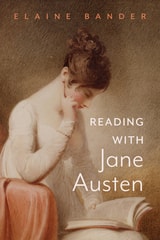
Reading with Jane Austen
Elaine Bander
Bucknell University Press, 2026
Jane Austen has more readers today than at any time in history. Many of Austen’s legions of fans, however, came to her novels after first seeing films or other adaptations made for twenty-first-century audiences. Austen herself conversely spent her literary career undermining romantic clichés and rethinking novel conventions. Confident that she and her contemporaries shared a common reading culture, Austen deliberately constructed her novels to set readerly expectations, only to disrupt or confound those expectations by challenging her readers’ assumptions and values. In Reading with Jane Austen, Elaine Bander carefully rereads the great author’s novels—beginning with her late work of juvenilia, “Catharine, or The Bower,” and ending with her final fragment, “Sanditon”—against the rich context of late Georgian literary and intellectual culture. In doing so, Bander invites us into the transformative experience that Austen intentionally designed for her earliest readers, adding new layers of appreciation for those who love her work.
Published by Bucknell University Press. Distributed worldwide by Rutgers University Press.
Elaine Bander speaking at the Atwater Library in Quebec (https://youtu.be/UeEjFOfp9cQ?si=Wv2hsLxkGK157WZI)
Reading with the Transcendentalists
Ten Works that Made a MovementPhilip F. Gura
University of Massachusetts Press, 2026
Exploring the books and reading practices behind the creation of Transcendentalist philosophy and community
Transcendentalism emerged in early 19th century New England as a uniquely American philosophical, spiritual, and literary movement. Its first generation of thinkers—including Ralph Waldo Emerson, Theodore Parker, and Margaret Fuller—created a worldview that stressed the inherent goodness of the “self-reliant” individual and the presence of the divine in nature. These intellectuals gathered in informal symposia devoted to what Emerson called “creative reading,” a practice that stresses the transformative potential of the written word that was central to the movement’s emergence, growth, and spread. But what were these thinkers reading and how did it influence the development of Transcendentalism?
In Reading with the Transcendentalists, renowned literary scholar Philip F. Gura focuses on 10 American, British, and European books that were essential to the movement’s thoughts, writings, and activities. Many of the authors of these books—James Marsh, Madame de Staël, Samson Reed, George Ripley, Thomas Carlyle, Albert Brisbane, and George Sand—stood outside of Transcendentalism yet profoundly influenced it. Others such as Emerson, Parker, and Fuller were the movement’s central architects, whose writings in turn inspired the next generation, including Henry David Thoreau and Caroline Healey Dall. Each of these books challenged prevailing religious, philosophical, and social conventions in ways that resonated deeply with burgeoning Transcendentalist ideals.
Blending intellectual biography with book history, Gura crafts a captivating cultural history that reconstructs the dynamic social networks of the early Transcendentalists, in which ideas from the written word circulated, evolved, and acquired new meanings. The result is an rich portrait of reading as a creative and communal act, and an exploration of how books ignite curiosity, sustain friendship, and catalyze intellectual transformation. Through a carefully developed narrative structure that is filled not only with books and reading but with headline-worthy scandals, disputes, and falling outs and realignments, Gura traces the historical arc of a transnational intellectual movement that helped lay the foundation for the idea of “America.”
Realism after the Individual
Women, Desire, and the Modern American NovelRafael Walker
University of Chicago Press, 2026
Realism after the Individual offers a new theoretical paradigm for understanding realist novels published in the United States between 1900 and 1920, a period that has been described wrongheadedly as a “gulf” or a “valley” in American literary history. In this generation of writers, only three have remained in favor among critics: Kate Chopin, Edith Wharton, and Theodore Dreiser. Others have disappeared from view altogether—writers such as Robert Grant, Robert Herrick, and Booth Tarkington, all of whom were critically acclaimed bestsellers in their day.
As Rafael Walker shows, this generation of writers deserves new attention for the way they revised many core facets of the nineteenth-century novel in response to the historical shifts around it. This generation of novelists not only rejected liberal individualism but also formulated alternative paradigms for conceptualizing selfhood. The result was a slew of woman-centered realist novels that broke with literary precedent: The novels punish characters not for desiring too much but for failing to desire enough, they depict subjectivity not as private and interior but as outward-facing, and they view closure not as the novel’s aim but as a convention to flout. Realism after the Individual both revises prevailing views of American realism and lays the foundation for an alternative account of the development of literary modernism, one that illuminates the continuity between realism and the modernism that followed it.

Realizing the Dream of R. A. Kartini
Her Sisters’ Letters from Colonial JavaJoost J. Coté
Ohio University Press, 2008
Realizing the Dream of R. A. Kartini: Her Sisters’ Letters from Colonial Java presents a unique collection of documents reflecting the lives, attitudes, and politics of four Javanese women in the early twentieth century. Joost J. Coté translates the correspondence between Raden Ajeng Kartini, Indonesia’s first feminist, and her sisters, revealing for the first time her sisters’ contributions in defining and carrying out her ideals. With this collection, Coté aims to situate Kartini’s sisters within the more famous Kartini narrative–and indirectly to situate Kartini herself within a broader narrative.
The letters reveal the emotional lives of these modern women and their concerns for the welfare of their husbands and the success of their children in rapidly changing times. While by no means radical nationalists, and not yet extending their horizons to the possibility of an Indonesian nation, these members of a new middle class nevertheless confidently express their belief in their own national identity.
Realizing the Dream of R. A. Kartini is essential reading for scholars of Indonesian history, providing documentary evidence of the culture of modern, urban Java in the late colonial era and an insight into the ferment of the Indonesian nationalist movement in which these women and their husbands played representative roles.

Reason Fulfilled by Revelation
The 1930s Christian Philosophy Debates in FranceGregory B. Sadler
Catholic University of America Press, 2011
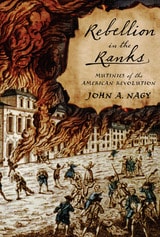
Rebellion in the Ranks
Mutinies of the American RevolutionJohn A. Nagy
Westholme Publishing, 2007
How General Washington Avoided the Peril From Within His Own Forces
"It gives me great pain to be obliged to solicit the attention of the honorable Congress to the state of the army...the greater part of the army is in a state not far from mutiny...I know not to whom to impute this failure, but I am of the opinion, if the evil is not immediately remedied and more punctuality observed in future, the army must absolutely break up."—George Washington, September 1775
Mutiny has always been a threat to the integrity of armies, particularly under trying circumstances, and since Concord and Lexington, mutiny had been the Continental Army's constant traveling companion. It was not because the soldiers lacked resolve to overturn British rule or had a lack of faith in their commanders. It was the scarcity of food—during winter months it was not uncommon for soldiers to subsist on a soup of melted snow, a few peas, and a scrap of fat—money, clothing, and proper shelter, that forced soldiers to desert or organize resistance. Mutiny was not a new concept for George Washington. During his service in the French and Indian War he had tried men under his command for the offense and he knew that disaffection and lack of morale in an army was a greater danger than an armed enemy.
In Rebellion in the Ranks: Mutinies of the American Revolution, John A. Nagy provides one of the most original and valuable contributions to American Revolutionary War history in recent times. Mining previously ignored British and American primary source documents and reexamining other period writings, Nagy has corrected misconceptions about known events, such as the Pennsylvania Line Mutiny, while identifying for the first time previously unknown mutinies. Covering both the army and the navy, Nagy relates American officers' constant struggle to keep up the morale of their troops, while highlighting British efforts to exploit this potentially fatal flaw.
Rebuilding Jewish Life in Germany
Jay Howard Geller
Rutgers University Press, 2020
Recapitulations
Thomas Prufer
Catholic University of America Press, 2018
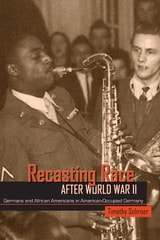
Recasting Race after World War II
Germans and African Americans in American-Occupied GermanyTimothy L. Schroer
University Press of Colorado, 2007
The segregation of U.S. Army forces fed a growing debate in America about whether a Jim Crow army could truly be a democratizing force in postwar Germany. Schroer follows the evolution of that debate and examines the ways in which postwar conditions necessitated reexamination of race relations. He reveals how anxiety about interracial relationships between African American men and German women united white American soldiers and the German populace. He also traces the importation and influence of African American jazz music in Germany, illuminating the subtle ways in which occupied Germany represented a crucible in which to recast the meaning of race in a post-Holocaust world.
Recasting Race after World War II will appeal to historians and scholars of American, African American, and German studies.

Receiving States
Refugee Policy in Central America During the Salvadoran Civil WarRachael De La Cruz
University of Wisconsin Press, 2026
Between the outbreak of civil war in El Salvador in 1979 and its conclusion in 1992, some 1.5 million Salvadorans fled the violence. This book focuses on the displaced Salvadorans who remained in Central America, seeking refuge in Belize, Costa Rica, Guatemala, Honduras, Nicaragua, and Panama. Their story has been almost entirely overshadowed by the greater numbers who fled farther north to the United States; however, as Rachael De La Cruz shows, the Central American history of Salvadoran refugees is rich, complex, and instructive for scholars of refugee studies, international relations, and human rights.
The isthmus nations that received Salvadoran refugees did not react consistently, and the arriving Salvadorans themselves were not passive participants. National mythologies, perceptions of economic contributions and burdens, regional militarization, state violence, and varying capacities for refugee activism, compounded by the fraught and variable circumstances of the Cold War, together shaped the multitude of government attitudes and policies toward the refugee communities within these countries’ borders. Rarely were refugees simply “a problem to solve”; rather, they represented and acted as catalysts for economic, social, and geopolitical change.
Recognizing Reality
German Realism and the Mediation of PresenceJessica C. Resvick
Northwestern University Press, 2026
Reveals how literary scenes of recognition stage the process of coming to know reality
In this deeply researched and thought-provoking study, Jessica C. Resvick traces nineteenth-century German realist writing’s paradoxical investment in mediated accounts of the world and the direct, unfiltered experience of reality. Focusing on the motif and operation of recognition in its Aristotelean sense, Resvick examines self-reflexive narratives in which the authors struggle to resolve this tension between the media they choose and the immediacy they hope to create.
Through close readings of key works by canonical authors such as E. T. A. Hoffmann, Annette von Droste-Hülshoff, Adalbert Stifter, Gottfried Keller, and Wilhelm Raabe, Resvick demonstrates the medially influenced and historically contingent ways in which they represent reality. Each chapter focuses on a different form of recognition, reconstructing the techniques that allow these authors to generate an effect of presence. Exploring the history and poetics of knowledge exchange, Recognizing Reality: German Realism and the Mediation of Presence expands on recent media histories of realism, examining the material bases for realist aesthetics while also investigating media’s epistemological accomplishments, and astutely elaborates the role of recognition as a medium-specific tool.
Reconstructing the National Bank Controversy
Politics and Law in the Early American RepublicEric Lomazoff
University of Chicago Press, 2018
With Reconstructing the National Bank Controversy, Eric Lomazoff offers a far more robust account of the constitutional politics of national banking between 1791 and 1832. During that time, three forces—changes within the Bank itself, growing tension over federal power within the Republican coalition, and the endurance of monetary turmoil beyond the War of 1812 —drove the development of our first major debate over the scope of federal power at least as much as the formal dimensions of the Constitution or the absence of a shared legal definition for the word “necessary.” These three forces—sometimes alone, sometimes in combination—repeatedly reshaped the terms on which the Bank’s constitutionality was contested. Lomazoff documents how these three dimensions of the polity changed over time and traces the manner in which they periodically led federal officials to adjust their claims about the Bank’s constitutionality. This includes the emergence of the Coinage Clause—which gives Congress power to “coin money, regulate the value thereof”—as a novel justification for the institution. He concludes the book by explaining why a more robust account of the national bank controversy can help us understand the constitutional basis for modern American monetary politics.
Records of Reward
Essays on Literature and ValueFrances Ferguson
University of Chicago Press, 2026
A selection of essays revealing the singular brilliance of Ferguson’s critical writing over four decades.
Ranging across literature, philosophy, and social thought, Frances Ferguson asks how forms—whether aesthetic, legal, or bureaucratic—help to assign value and thereby organize our relations as well as our personal identities. Ferguson is a literary critic who takes her lead, unexpectedly, from Jeremy Bentham, showing how modernity tracks and makes perceptible the values of a host of human activities—the knowledge that comes from early learning exercises, the specialized knowledge that funds particular professions, and the exacting if unspecialized knowledge of the social world of courtship or hanging out.
Gathering Ferguson’s most influential and still timely essays, Records of Reward includes, among others, “The Nuclear Sublime,” in which Ferguson turns to Mary Shelley’s Frankenstein to examine how the aesthetic logic of the sublime obscures the claims of domesticity and the beautiful; “Rape and the Rise of the Novel,” which examines the history of rape law to highlight the importance of Samuel Richardson’s foregrounding of consent in Clarissa; “Pornography, the Theory,” where she explores the threshold between speech and action to identify environments—such as schools and workplaces—in which pornographic expression can be harmfully potentiated; and “Jane Austen, Emma, and the Impact of Form,” in which she analyzes Austen’s use of free indirect style to depict both her protagonist and her reader engaged in acts of “over-knowing” others in everyday life. Most unexpectedly, perhaps, the collection also includes an essay analyzing Bitcoin as a small language model that exerts enormous affective pressure on its partisans.
A vivid demonstration of the enduring rewards of theory and close reading alike, Records of Reward will be essential reading across the fields of literary studies, cultural studies, and political thought.
Recovered Land
Alicia Nitecki
University of Massachusetts Press, 1995
Alicia Nitecki was born in Warsaw to a Catholic family that was active in the resistance movement. Following the Nazi conquest of Poland, she and her relatives were dispersed to German prisoner-of-war, labor, and concentration camps. In this book, she revisits the places that have formed her and confronts a past that has haunted her: Warsaw during the 1944 uprising, the Black Forest village where she and the women in her family were taken as slaves in the last months of the war, and Buchenwald and Flossenbürg, the concentration camps where her grandfather was imprisoned.
Nitecki's private odyssey coincided with the collapse of communism in Poland and the reunification of Germany. These essays mark her movement from fear and rage toward fuller knowledge and reconciliation.
Red Leviathan
The Secret History of Soviet WhalingRyan Tucker Jones
University of Chicago Press, 2022
The Soviet Union killed over six hundred thousand whales in the twentieth century, many of them illegally and secretly. That catch helped bring many whale species to near extinction by the 1970s, and the impacts of this loss of life still ripple through today’s oceans. In this new account, based on formerly secret Soviet archives and interviews with ex-whalers, environmental historian Ryan Tucker Jones offers a complete history of the role the Soviet Union played in the whales’ destruction. As other countries—especially the United States, Great Britain, Japan, and Norway—expanded their pursuit of whales to all corners of the globe, Stalin determined that the Soviet Union needed to join the hunt. What followed was a spectacularly prodigious, and often wasteful, destruction of humpback, fin, sei, right, and sperm whales in the Antarctic and the North Pacific, done in knowing violation of the International Whaling Commission’s rules. Cold War intrigue encouraged this destruction, but, as Jones shows, there is a more complex history behind this tragic Soviet experiment. Jones compellingly describes the ultimate scientific irony: today’s cetacean studies benefited from Soviet whaling, as Russian scientists on whaling vessels made key breakthroughs in understanding whale natural history and behavior. And in a final twist, Red Leviathan reveals how the Soviet public began turning against their own country’s whaling industry, working in parallel with Western environmental organizations like Greenpeace to help end industrial whaling—not long before the world’s whales might have disappeared altogether.
Reel Pleasures
Cinema Audiences and Entrepreneurs in Twentieth-Century Urban TanzaniaLaura Fair
Ohio University Press, 2017
Reframing Russian Modernism
Edited by Irina Shevelenko
University of Wisconsin Press, 2018
Expanding upon prior studies that focus more specifically on literary manifestations of the movement, Reframing Russian Modernism features original research that ranges broadly, from political aesthetics to Darwinism to yoga. These unique complementary perspectives counter reductionism of any kind, integrating the study of Russian modernism into the larger body of humanistic scholarship devoted to modernity.

Refuge Denied
The St. Louis Passengers and the HolocaustSarah A. Ogilvie and Scott Miller
University of Wisconsin Press, 2006
Although the episode of the St. Louis is well known, the actual fates of the passengers, once they disembarked, slipped into historical obscurity. Prompted by a former passenger’s curiosity, Sarah Ogilvie and Scott Miller of the United States Holocaust Memorial Museum set out in 1996 to discover what happened to each of the 937 passengers. Their investigation, spanning nine years and half the globe, took them to unexpected places and produced surprising results. Refuge Denied chronicles the unraveling of the mystery, from Los Angeles to Havana and from New York to Jerusalem.
Some of the most memorable stories include the fate of a young toolmaker who survived initial selection at Auschwitz because his glasses had gone flying moments before and a Jewish child whose apprenticeship with a baker in wartime France later translated into the establishment of a successful business in the United States. Unfolding like a compelling detective thriller, Refuge Denied is a must-read for anyone interested in the Holocaust and its impact on the lives of ordinary people.
Regimens of the Mind
Boyle, Locke, and the Early Modern Cultura Animi TraditionSorana Corneanu
University of Chicago Press, 2011
Reimagining Nabokov
Pedagogies for the 21st CenturyJosé Vergara
Amherst College Press, 2022
“It is both timely and refreshing to have an influx of teacher-scholars who engage Nabokov from a variety of perspectives… this volume does justice to the breadth of Nabokov’s literary achievements, and it does so with both pedagogical creativity and scholarly integrity."—Dana Dragunoiu, Carleton University
"[A] valuable study for any reader, teacher, scholar, or student of Nabokov. Amongst specific and urgent insights on the potential for digital methods, the relevance of Nabokov for students today, and how to reconcile issues of identity with an author who disavowed history and politics, are much wider and timeless questions of authorial control and the ability to access reality."—Anoushka Alexander-Rose, Nabokov Online Journal
Contributions by Galya Diment, Tim Harte, Robyn Jensen, Sara Karpukhin, Yuri Leving, Roman Utkin, José Vergara, Meghan Vicks, Olga Voronina, Lisa Ryoko Wakamiya, and Matthew Walker.
Reinventing Dance in the 1960s
Everything Was PossibleEdited by Sally Banes
University of Wisconsin Press, 2003
The 1960s was a pivotal decade in dance, an era of intense experimentation and rich invention. In this volume an impressive range of dance critics and scholars examine the pioneering choreographers and companies of the era, such as Anna Halprin’s West Coast experiments, the innovative Judson Dance Theater, avant-garde dance subcultures in New York, the work of Meredith Monk and Kenneth King, and parallel movements in Britain. The contributors include Janice Ross, Leslie Satin, Noël Carroll, Gus Solomons jr., Deborah Jowitt, Stephanie Jordan, Joan Acocella, and Sally Banes.
Religion and Peace
Global Perspectives and PossibilitiesNukhet A. Sandal
Ohio University Press, 2022

Religion in China and Its Modern Fate
Paul R. Katz
Brandeis University Press, 2014
Reluctant Interveners
America's Failed Responses to Genocide from Bosnia to DarfurEyal Mayroz
Rutgers University Press, 2020
Featured in the 2020 Association of University Presses Book, Jacket, and Journal Show
Why do we allow our governments to get away with “bystanding” to genocide? How can we, when alerted to the mass slaughter of innocents, still not take a stand? Reluctant Interveners provides the most comprehensive answers yet to these confronting questions, focusing on the complex relationships between the citizenry, the media, the political elites, and institutions in the most powerful nation in the world, the United States of America.
Eyal Mayroz offers a sobering account of the interactions between the governing and the governed, and the dynamics which transformed moral concerns for the lives of faraway “others” into cold political calculations. Exposed are the processes that turned the promise of “never again” to a recurring reality of ever again, the role of the office of the presidency in their advancement, and the resultant image of America as seen by the rest of the world. In a time of ubiquitous social media and populist revival, a greater role for the U.S. citizenry in decision-making on responses to genocide may be in the cards. The question is, in which directions will these trends take American foreign policy?
Remarks on Mathematics and Logic
Volume III, 1939–1941Ludwig Wittgenstein
University of Chicago Press, 0
The second of five planned volumes, this book collects Wittgenstein’s unabridged writings on mathematics and logic composed between 1939 and 1941.
In 1956, a significant but abridged portion of Ludwig Wittgenstein’s 1937–1944 writings for a continuation of what became Philosophical Investigations was published as Remarks on the Foundations of Mathematics. Now, in these five German-English facing-page volumes, the writings of Remarks on Mathematics and Logic are presented in full as Wittgenstein wrote them: in chronological order, without editorial omissions, selections, or rearrangements.
Volume III contains materials from 1939 to 1941, including previously unpublished—one manuscript and four manuscript parts—and one manuscript from which selections were made for previous abridgements.
The topics covered in this volume include surveyability and perspicuity in mathematics; Cantor and Gödel; Russellian logicism; geometrical cogency of proofs; consensus as part of the phenomenon of our calculating; rule-following and unwinding; consistency proofs; calculation as invention rather than discovery; superstitious fear of contradictions; why mathematicians cannot philosophize about mathematics; mathematical propositions are overdetermined; the idea of a mathematical reality; the connection between the sense of a mathematical proposition and its use; positioning a proposition in a system; an unproved mathematical proposition as the expression of a problem; the role of mathematical propositions in descriptions (of reality).
This edition will be the authoritative source for Wittgenstein’s writings in their original context.
Remarks on Mathematics and Logic
Volume IV, 1941–1943Ludwig Wittgenstein
University of Chicago Press, 0
In 1956, a significant but abridged portion of Ludwig Wittgenstein’s 1937–1944 writings for a continuation of what became Philosophical Investigations was published as Remarks on the Foundations of Mathematics. Now, in the five German-English facing pages volumes of Remarks on Mathematics and Logic, these writings are presented in full as Wittgenstein wrote them: in chronological order, without editorial omissions, selections, or rearrangements.
Volume IV contains materials from 1941 to 1943, including one previously unpublished manuscript and three manuscripts from which selections were made for the previous abridgment. The topics covered in this volume include the philosophy of mathematics, mathematical foundationalism, surveyability in mathematics, language-games and proof-networks, Gödelian undecidability, pictures in mathematics, Cantorian diagonal proofs, applied mathematics without pure mathematics, and mathematics and chess, among others.
This German-English facing pages edition presents Wittgenstein’s writings in their original context—as Wittgenstein wrote them, in chronological order, and without editorial omissions, selections, or rearrangements.
Remembering 1989
Future Archives of Public ProtestAnke Pinkert
University of Chicago Press, 2024
For many, 1989 is an iconic date, one we associate with the fall of the Berlin Wall and the end of the Cold War. The year prompts some to rue the defeat of socialism in the East, while others celebrate a victory for democracy and capitalism in the reunified Germany. Remembering 1989 focuses on a largely forgotten interregnum: the months between the outbreak of protests in the German Democratic Republic in 1989 and its absorption by the West in 1990. Anke Pinkert, who herself participated in those protests, recalls these months as a volatile but joyous “laboratory of radical democracy,” and tells the story of how and why this “time out of joint” has been erased from Germany’s national memory.
Remembering 1989 argues that in order to truly understand Germany’s historic transformation, we must revisit protesters’ actions across a wide range of minor, vernacular, and often transient sources. Drawing on rich archives including videotapes of untelevised protests, illegally printed petitions by Church leaders, audio recordings of dissident meetings, and interview footage with military troops, Pinkert opens the discarded history of East European social uprisings to new interpretations and imagines alternatives to Germany’s neoliberal status quo. The result is a vivid, unexpected contribution to memory studies and European history.
Remembering Communism
Private and Public Recollections of Lived Experience in Southeast EuropeContributors: Simina Bădica, Iskra Baeva, Tanya Boneva, Corina Cimpoieru, Liliana Deyanova, Albena Hranova, Nataliya Hristova, Petya Kabakchieva, Evgenia Kalinova, Anny Kirilova, Thomas Lindenberger, Tamás Lőnhárt, Izabella Main, Tsvetana Manova, Iliiana Marcheva, Vasil Markov, Andi Mihalache, Cătălina Mihalache, Milla Mineva, Cristina Petrescu, Dragoş Petrescu, Vania Stoyanova, Virgiliu Ţârău, Nikolai Vukov, Smaranda Vultur
Central European University Press, 2014
Remembering Communism examines the formation and transformation of the memory of communism in the post-communist period. The majority of the articles focus on memory practices in the post-Stalinist era in Bulgaria and Romania, with occasional references to the cases of Poland and the GDR. Based on an interdisciplinary approach, including history, anthropology, cultural studies and sociology, the volume examines the mechanisms and processes that influence, determine and mint the private and public memory of communism in the post-1989 era. The common denominator to all essays is the emphasis on the process of remembering in the present, and the modalities by means of which the present perspective shapes processes of remembering, including practices of commemoration and representation of the past.
The volume deals with eight major thematic blocks revisiting specific practices in communism such as popular culture and everyday life, childhood, labor, the secret police, and the perception of “the system”.

Remembering Paris in Text and Film
Echoes of Baudelaire in Text and on ScreenEdited by Alistair Rolls and Marguerite Johnson
Intellect Books, 2021
Experiencing urban space conjures visions of the past alongside contemplation of the present. This edited volume investigates this feeling of seeing double by investigating Paris—a city that has come to embody the tension of this sensation—through a dual lens of nostalgia and modernity.
Contributors survey Paris in film, poetry, and prose in the nineteenth and twentieth centuries, presenting the city as both a concrete reality and as a collection of the myths associated with it. Interdisciplinary and deeply researched, the essays distill complex concepts of the urban, the textual, and the modern for a wide readership.
Remembering the Forgotten War
The Enduring Legacies of the U.S.-Mexican WarMichael Scott Van Wagenen
University of Massachusetts Press, 2012
On February 2, 1848, representatives of the United States and Mexico signed the Treaty of Guadalupe Hidalgo, officially ending hostilities between the two countries and ceding over one-half million square miles of land to the northern victors. In Mexico, this defeat has gradually moved from the periphery of dishonor to the forefront of national consciousness. In the United States, the war has taken an opposite trajectory, falling from its once-celebrated prominence into the shadowy margins of forgetfulness and denial.
Why is the U.S.–Mexican War so clearly etched in the minds of Mexicans and so easily overlooked by Americans? This book investigates that issue through a transnational, comparative analysis of how the tools of collective memory—books, popular culture, historic sites, heritage groups, commemorations, and museums—have shaped the war's multifaceted meaning in the 160 years since it ended. Michael Van Wagenen explores how regional, ethnic, and religious differences influence Americans and Mexicans in their choices of what to remember and what to forget. He further documents what happens when competing memories clash in a quest for dominance and control.
In the end, Remembering the Forgotten War addresses the deeper question of how remembrance of the U.S.–Mexican War has influenced the complex relationship between these former enemies now turned friends. It thus provides a new lens through which to view today's cross-border rivalries, resentments, and diplomatic pitfalls.
Remembering the Holocaust
Michael E. Stevens
Wisconsin Historical Society Press, 1997