Results by title
28167 books match the query 'History' and 1206 start with r
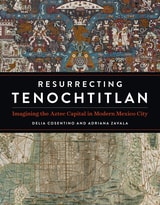
Resurrecting Tenochtitlan
Imagining the Aztec Capital in Modern Mexico CityDelia Cosentino and Adriana Zavala
University of Texas Press, 2023
Honorable Mention, ALAA-Arvey Foundation Book Award, Association of Latin American Art
Finalist, 2024 Charles Rufus Morey Book Award, College Art Association
How Mexican artists and intellectuals created a new identity for modern Mexico City through its ties to Aztec Tenochtitlan.
After archaeologists rediscovered a corner of the Templo Mayor in 1914, artists, intellectuals, and government officials attempted to revive Tenochtitlan as an instrument for reassessing Mexican national identity in the wake of the Revolution of 1910. What followed was a conceptual excavation of the original Mexica capital in relation to the transforming urban landscape of modern Mexico City.
Revolutionary-era scholars took a renewed interest in sixteenth century maps as they recognized an intersection between Tenochtitlan and the foundation of a Spanish colonial settlement directly over it. Meanwhile, Mexico City developed with modern roads and expanded civic areas as agents of nationalism promoted concepts like indigenismo, the embrace of Indigenous cultural expressions. The promotion of artworks and new architectural projects such as Diego Rivera’s Anahuacalli Museum helped to make real the notion of a modern Tenochtitlan. Employing archival materials, newspaper reports, and art criticism from 1914 to 1964, Resurrecting Tenochtitlan connects art history with urban studies to reveal the construction of a complex physical and cultural layout for Mexico’s modern capital.
Resurrecting the First Great American Play
Imperial Politics and Colonial Ambitions in Frontier DetroitSämi Ludwig
University of Wisconsin Press, 2020
Sämi Ludwig contends that Ponteach's literary and artistic merits are worthy of further exploration. He investigates questions of authorship and analyzes the play's content, embracing its many contradictions as enriching windows into the era. In this way, he suggests using Ponteach as a tool to better understand British imperialism in North America and the emerging theatrical forms of the Young Republic.
Resurrecting the Granary of Rome
Environmental History and French Colonial Expansion in North AfricaDiana K. Davis
Ohio University Press, 2007
Tales of deforestation and desertification in North Africa have been told from the Roman period to the present. Such stories of environmental decline in the Maghreb are still recounted by experts and are widely accepted without question today. International organizations such as the United Nations frequently invoke these inaccurate stories to justify environmental conservation and development projects in the arid and semiarid lands in North Africa and around the Mediterranean basin. Recent research in arid lands ecology and new paleoecological evidence, however, do not support many claims of deforestation, overgrazing, and desertification in this region.
Diana K. Davis’s pioneering analysis reveals the critical influence of French scientists and administrators who established much of the purported scientific basis of these stories during the colonial period in Algeria, Morocco, and Tunisia, illustrating the key role of environmental narratives in imperial expansion. The processes set in place by the use of this narrative not only systematically disadvantaged the majority of North Africans but also led to profound changes in the landscape, some of which produced the land degradation that continues to plague the Maghreb today.
Resurrecting the Granary of Rome exposes many of the political, economic, and ideological goals of the French colonial project in these arid lands and the resulting definition of desertification that continues to inform global environmental and development projects. The first book on the environmental history of the Maghreb, this volume reframes much conventional thinking about the North African environment. Davis’s book is essential reading for those interested in global environmental history.
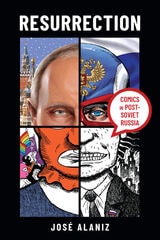
Resurrection
Comics in Post-Soviet RussiaJosé Alaniz
The Ohio State University Press, 2022
Resurrection: Comics in Post-Soviet Russia traces the “kopecks to rubles” journey of Russian comics at the turn of the century. As the follow-up to José Alaniz’s groundbreaking Komiks: Comic Art in Russia (2010), Resurrection authoritatively and exhaustively details the Russian comic landscape of the last three decades: beginning after the 1991 fall of the Soviet Union and encompassing the fourth Putin administration, the COVID-19 crisis, and beyond. Bolstering his analysis with interviews with some of the major figures in Russia’s comics industry, Alaniz particularly focuses on the representation of masculinity, disability, historical trauma, and superheroes, as well as on the recent rise of fandom, alternative micropresses, and nonfiction graphic narrative. Resurrection is a sweeping discussion of the metamorphosis of contemporary Russian comic art from its rebirth to its entry into mainstream culture.
Retelling the Siege of Jerusalem in Early Modern England
Vanita Neelakanta
University of Delaware Press, 2019
Published by University of Delaware Press. Distributed worldwide by Rutgers University Press.
Rethinking America's Highways
A 21st-Century Vision for Better InfrastructureRobert W. Poole Jr.
University of Chicago Press, 2018
In Rethinking America’s Highways, Poole examines how our current model of state-owned highways came about and why it is failing to satisfy its customers. He argues for a new model that treats highways themselves as public utilities—like electricity, telephones, and water supply. If highways were provided commercially, Poole argues, people would pay for highways based on how much they used, and the companies would issue revenue bonds to invest in facilities people were willing to pay for. Arguing for highway investments to be motivated by economic rather than political factors, this book makes a carefully-reasoned and well-documented case for a new approach to highways that is sure to inform future decisions and policies for U.S. infrastructure.
Rethinking America's Past
Voices from the Kinsey African American Art and History CollectionEdited by Tim Gruenewald
University of Minnesota Press, 2019
Among the first scholarly books dedicated to a private African American collection, Rethinking America’s Past: Voices from the Kinsey African American Art and History Collection both chronicles the reach of this important cultural collection and contributes to its project by sharing selected objects and stories with a broader audience. Essays range in subject from iconic African American artists, such as Loïs Mailou Jones and Beauford Delaney, to important historical figures such as Frederick Douglas and Martin Luther King, to individuals whose experiences might be lost to history but for the found objects that preserve their stories. Rethinking America’s Past demonstrates how the African American story, from slavery through the present, is represented and can be actively remembered through the act of collecting.
Rethinking America’s Past will appeal to audiences interested in African American history as well as art history, but its real power is in linking the two, showing how important collections are in constructing and repairing historical narratives, and how in the words of editor Tim Gruenewald, “Collecting overlooked aspects of our past and sharing such collections enables a deeper understanding of the present moment, and facilitates a more inclusive and just future.”

Rethinking American Music
Edited by Tara Browner and Thomas L. Riis
University of Illinois Press, 2019
Rethinking Chinese Socialist Theaters of Reform
Performance Practice and Debate in the Mao EraXiaomei Chen, Tarryn Li-Min Chun, and Siyuan Liu, Editors
University of Michigan Press, 2021

Rethinking Cosmopolitanism
Africa in Europe / Europe in AfricaSalah M. Hassan and Chika Okeke-Agula, special issue editors
Duke University Press, 2020
Contributors. Hans Belting, Susan Buck-Morss, Jareh Das, Naminata Diabate, Fatima El Tayeb, Salah M. Hassan, Achille Mbembe, Sandy Prita Meier, Chika Okeke-Agulu, Tejumola Olaniyan, Manuela Ribeiro Sanches, Berni Searle, Bahia Shehab, Brett M. Van Hoesen, Selene Wendt, Siegfried Zielinski
Rethinking Evidence
Exploratory EssaysWilliam Twining
Northwestern University Press, 1994
Rethinking France
Les Lieux de mémoire, Volume 1: The StateEdited by Pierre Nora. David P. Jordan, General Editor
University of Chicago Press, 2001
The first volume in the Chicago translation, Rethinking France, brings together works addressing the omnipresent role of the state in French life. As in the other volumes, the lieux de mémoire serve as entries into the French past, whether they are actual sites, political traditions, rituals, or even national pastimes and textbooks. Volume I: The State offers a sophisticated and engaging view of the French and their past through widely diverse essays on, for example, the château of Versailles and the French history of absolutism; the Code civil and its ordering of French life; memoirs written by French statesmen; and Charlemagne and his place in French history. Nora's authors constitute a who's who of French academia, yet they wear their erudition lightly. Taken as a whole, this extraordinary series documents how the French have come to see themselves and why.
Contributors:
Alain Guéry
Maurice Agulhon
Bernard Guenée
Daniel Nordman
Robert Morrissey
Alain Boureau
Anne-Marie Lecoq
Hélène Himelfarb
Jean Carbonnier
Hervé Le Bras
Pierre Nora
Rethinking France
Les Lieux de mémoire, Volume 2: SpaceEdited by Pierre Nora. David P. Jordan, General Editor
University of Chicago Press, 2006
In Space, the second volume in the University of Chicago Press’s translation of Nora’s ambitious Les Lieux de mémoire, a group of France’s leading historians and cultural commentators call attention to the meaning of space for the French and the firm connection between the nation’s history and its geography. The essays gathered here cover the most essential approaches to French space: external and internal boundaries, the base unit of local space, and the mental construction that gives a general idea of the concept of landscape. The analyses focus on three aspects of natural boundaries: the forest, the north and the south, and the coastline. Each region of France, they show, is a space of memory that is the fruit of all the knowledge that gives it shape: statistical, cartographical, geological, and historical.
A crucial piece in Nora’s profound historical project on the way the French understand themselves, this volume will be appreciated by any critical thinker with an interest in French history, politics, culture, or philosophy.
Rethinking France
Les Lieux de mémoire, Volume 3: LegaciesEdited by Pierre Nora. David P. Jordan, General Editor
University of Chicago Press, 2009
The third volume of Pierre Nora’s monumental work documenting the history and culture of France turns to French manners, mores, and society. While previous volumes focused on specific historical events, people, and institutions within France, the essays in Legacies are concerned with the kinds of things that make up the heart of French culture: conversation, cafés, songs, wine, gallantry, and places imbued with national symbolism such as Notre Dame and Sacré Coeur cathedrals. Linking these diverse topics together is the idea of patrimony—a term used by the French to designate the collective culture of the country or its national heritage—a concept that has undergone radical changes beginning with the Revolution and corresponding to other dramatic ruptures throughout France’s history.
As a whole, these twelve essays by leading French historians add up to an illuminating and well-rounded portrait of those cherished traditions that together form the basic foundation for the distinctive culture of the French.
Rethinking France
Les Lieux de mémoire, Volume 4: Histories and MemoriesEdited by Pierre Nora. David P. Jordan, Translation Editor
University of Chicago Press, 2010
Rethinking Global Sisterhood
Western Feminism and IranNima Naghibi
University of Minnesota Press, 2007
Western women’s involvement in Persia dates from the mid-nineteenth century, when female adventurers and missionaries first encountered their veiled Muslim “sisters.” Twentieth-century Western and state-sponsored Iranian feminists continued to use the image of the veiled woman as the embodiment of backwardness. Yet, following the 1979 revolution, indigenous Iranian feminists became more vocal in their resistance to this characterization.
In Rethinking Global Sisterhood, Nima Naghibi makes powerful connections among feminism, imperialism, and the discourses of global sisterhood. Naghibi investigates topics including the state-sponsored Women’s Organization of Iran and the involvement of feminists such as Betty Friedan and Gloria Steinem in the Iranian feminism movement before and during the 1979 revolution. With a potent analysis of cinema, she examines the veiled woman in the films of Tahmineh Milani, Ziba Mir-Hosseini and Kim Longinotto, and Mahnaz Afzali.
At a time when Western relations with the Muslim world are in crisis, Rethinking Global Sisterhood provides much-needed insights and explores the limitations and possibilities of cross-cultural feminist social and political interventions.
Nima Naghibi is assistant professor of English at Ryerson University in Toronto.
Rethinking India's Oral and Classical Epics
Draupadi among Rajputs, Muslims, and DalitsAlf Hiltebeitel
University of Chicago Press, 1999
Using his own fieldwork as a starting point, Alf Hiltebeitel analyzes how the oral tradition of the south Indian cult of the goddess Draupadi and five regional martial oral epics compare with one another and tie in with the Sanskrit epics. Drawing on literary theory and cultural studies, he reveals the shared subtexts of the Draupadi cult Mahabharata and the five oral epics, and shows how the traditional plots are twisted and classical characters reshaped to reflect local history and religion. In doing so, Hiltebeitel sheds new light on the intertwining oral traditions of medieval Rajput military culture, Dalits ("former Untouchables"), and Muslims.
Breathtaking in scope, this work is indispensable for those seeking a deeper understanding of South Asia's Hindu and Muslim traditions.
This work is the third volume in Hiltebeitel's study of the Draupadi cult. Other volumes include Mythologies: From Gingee to Kuruksetra (Volume One), On Hindu Ritual and the Goddess (Volume Two), and Rethinking the Mahabharata (Volume Four).
Rethinking Iranian Nationalism and Modernity
Edited by Kamran Scot Aghaie and Afshin Marashi
University of Texas Press, 2014
While recent books have explored Arab and Turkish nationalism, the nuances of Iran have received scant book-length study—until now. Capturing the significant changes in approach that have shaped this specialization, Rethinking Iranian Nationalism and Modernity shares innovative research and charts new areas of analysis from an array of scholars in the field.
Delving into a wide range of theoretical and conceptual perspectives, the essays—all previously unpublished—encompass social history, literary theory, postcolonial studies, and comparative analysis to address such topics as:
- Ethnicity in the Islamic Republic of Iran
- Political Islam and religious nationalism
- The evolution of U.S.-Iranian relations before and after the Cold War
- Comparing Islamic and secular nationalism(s) in Egypt and Iran
- The German counterrevolution and its influence on Iranian political alliances
- The effects of Israel’s image as a Euro-American space
- Sufism
- Geocultural concepts in Azar’s Atashkadeh
Interdisciplinary in essence, the essays also draw from sociology, gender studies, and art and architecture. Posing compelling questions while challenging the conventional historiographical traditions, the authors (many of whom represent a new generation of Iranian studies scholars) give voice to a research approach that embraces the modern era’s complexity while emphasizing Iranian nationalism’s contested, multifaceted, and continuously transformative possibilities.
Rethinking Japanese History
Amino Yoshihiko; Translated and with an Introduction by Alan S. Christy; Preface and Afterword by Hitomi Tonomura
University of Michigan Press, 2012
Rethinking Modern Judaism
Ritual, Commandment, CommunityArnold M. Eisen
University of Chicago Press, 1998
"Fascinating . . . an insightful entrance point to understanding the evolution of the theologies of America's largest Jewish denominations."—Tikkun
"I know of no other treatment of these issues that matches Eisen's talents for synthesizing a wide variety of historical, philosophical, and social scientific sources, and bringing them to bear in a balanced and open-minded way on the delicate questions of why modern Jews relate as they do to the practices of Judaism."—Joseph Reimer, Boston Book Review
"At once an incisive survey of modern Jewish thought and an inquiry into how Jews actually live their religious lives, Mr. Eisen's book is an invaluable addition to the study of American Judaism."—Elliott Abrams, Washington Times

Rethinking Past and Present in Cuba
essays in memory of Alistair HennessyEdited by Antoni Kapcia
University of London Press, 2018

Rethinking Pastoralism In Africa
Gender, Culture, and the Myth of the Patriarchal PastoralistDorothy L. Hodgson
Ohio University Press, 2001
The dominant trend in pastoralist studies has long assumed that pastoralism and pastoral gender relations are inherently patriarchal. The contributors to this collection, in contrast, use diverse analytic approaches to demonstrate that pastoralist gender relations are dynamic, relational, historical, and produced through complex local-translocal interactions. Combining theoretically sophisticated analysis with detailed case studies, this collection will appeal to those doing research and teaching in African studies, gender studies, anthropology, and history. Among the topics discussed are pastoralism, patriarchy, and history among Maasai in Tanganyika; women’s roles in peacemaking in Somali society; the fertility of houses and herds; gender, aging, and postchildbearing experience in a Tuareg community; and milk selling among Fulani women in Northern Burkina Faso.
Rethinking Protestantism in Latin America
David Stoll
Temple University Press, 1993
Rethinking Puerto Rican Precolonial History
Reniel Rodríguez Ramos
University of Alabama Press, 2010
The history of Puerto Rico has usually been envisioned as a sequence of colonizations-various indigenous peoples from Archaic through Taíno were successively invaded, assimilated, or eliminated, followed by the Spanish entrada, which was then modified by African traditions and, since 1898, by the United States. The truth is more complex, but in many ways Puerto Rico remains one of the last colonies in the world. This volume focuses on the successive indigenous cultures of Puerto Rico prior to 1493.
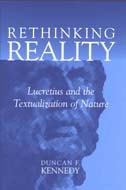
Rethinking Reality
Lucretius and the Textualization of NatureDuncan F. Kennedy
University of Michigan Press, 2002
The book engages in a sustained argument about realist assumptions in scientific and other discourses through detailed analysis and discussion of some of the most important recent contributions to this debate. Engaging sympathetically but not uncritically with constructivist accounts of scientific knowledge, the book takes up a sustained critique of recent contributions to that debate, including those of Ian Hacking, Evelyn Fox Keller, Bruno Latour, and Hans-Jörg Rheinberger. What are the implications of regarding such knowledge as "discovered" or "invented"? How is the rhetoric of such claims to be identified and the pretentions of those claims assessed?In what ways can realist and constructivist approaches be reconciled? How do these considerations affect the way we read scientific texts from the past and regard them historically?
What emerges is a fresh and challenging assessment of the role of time and temporal perspective in assessing claims to knowledge in scientific thought and of the importance of textuality to the history of knowledge. A wide variety of readers, from classicists and intellectual historians to epistemologists of science, will enjoy and learn from Rethinking Reality.
Duncan Kennedy is Reader in Latin Literature and the Theory of Criticism, University of Bristol. He is also the author of The Arts of Love: Five Studies in the Discourse of Roman Love Elegy.
Rethinking Rights
Historical, Political, and Philosophical PerspectivesEdited by Bruce P. Frohnen and Kenneth L. Grasso
University of Missouri Press, 2008
Rethinking Therapeutic Culture
Edited by Timothy Aubry and Trysh Travis
University of Chicago Press, 2015
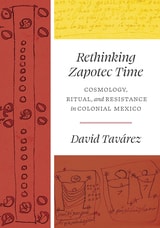
Rethinking Zapotec Time
Cosmology, Ritual, and Resistance in Colonial MexicoDavid Tavárez
University of Texas Press, 2022
2024 — Best Book in Colonial Latin American Studies — Colonial Section, Latin American Studies Association
2023 — Best Subsequent Book — Native American and Indigenous Studies Association
2023 — Honorable Mention, Best Book in the Social Sciences — Latin American Studies Association, Mexico Section
2022 — Marysa Navarro Best Book Prize — New England Council of Latin American Studies
As the first exhaustive translation and analysis of an extraordinary Zapotec calendar and ritual song corpus, seized in New Spain in 1704, this book expands our understanding of Mesoamerican history, cosmology, and culture.
In 1702, after the brutal suppression of a Zapotec revolt, the bishop of Oaxaca proclaimed an amnesty for idolatry in exchange for collective confessions. To evade conflict, Northern Zapotec communities denounced ritual specialists and surrendered sacred songs and 102 divinatory manuals, which preserve cosmological accounts, exchanges with divine beings, and protocols of pre-Columbian origin that strongly resemble sections of the Codex Borgia. These texts were sent to Spain as evidence of failed Dominican evangelization efforts, and there they remained, in oblivion, until the 1960s.
In this book, David Tavárez dives deep into this formidable archive of ritual and divinatory manuals, the largest calendar corpus in the colonial Americas, and emerges with a rich understanding of Indigenous social and cultural history, Mesoamerican theories of cosmos and time, and Zapotec ancestor worship. Drawing on his knowledge of Zapotec and Nahuatl, two decades of archival research, and a decade of fieldwork, Tavárez dissects Mesoamerican calendars as well as Native resistance and accommodation to the colonial conquest of time, while also addressing entangled transatlantic histories and shining new light on texts still connected to contemporary observances in Zapotec communities.
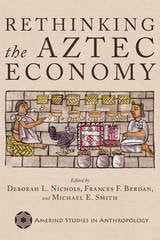
Rethinking the Aztec Economy
Edited by Deborah L. Nichols, Frances F. Berdan, and Michael E. Smith
University of Arizona Press, 2017
With its rich archaeological and historical record, the Aztec empire provides an intriguing opportunity to understand the dynamics and structure of early states and empires. Rethinking the Aztec Economy brings together leading scholars from multiple disciplines to thoroughly synthesize and examine the nature of goods and their movements across rural and urban landscapes in Mesoamerica. In so doing, they provide a new way of understanding society and economy in the Aztec empire.
The volume is divided into three parts. Part 1 synthesizes our current understanding of the Aztec economy and singles out the topics of urbanism and provincial merchant activity for more detailed analysis. Part 2 brings new data and a new conceptual approach that applies insights from behavioral economics to Nahua and Aztec rituals and social objects. Contributors also discuss how high-value luxury goods, such as feather art, provide insights about both economic and sacred concepts of value in Aztec society. Part 3 reexamines the economy at the Aztec periphery. The volume concludes with a synthesis on the scale, integration, and nature of change in the Aztec imperial economy.
Rethinking the Aztec Economy illustrates how superficially different kinds of social contexts were in fact integrated into a single society through the processes of a single economy. Using the world of goods as a crucial entry point, this volume advances scholarly understanding of life in the Aztec world.
Contributors:
Frances F. Berdan
Laura Filloy Nadal
Janine Gasco
Colin Hirth
Kenneth G. Hirth
Sarah Imfeld
María Olvido Moreno Guzmán
Deborah L. Nichols
Alan R. Sandstrom
Pamela Effrein Sandstrom
Michael E. Smith
Barbara L. Stark
Emily Umberger

Rethinking the Cold War
edited by Allen Hunter
Temple University Press, 1997
This collection of essays offers a more complex and nuanced analysis of Cold War history. It challenges the prevailing perspective, which editor Allen Hunter terms "vindicationism." Writing from different disciplinary and conceptual vantage points, the contributors to the collection invite a rethinking of what the Cold War was, how fully it defined the decades after World War II, what forces sustained it, and what forces led to its demise. By exploring a wide range of central themes of the era, Rethinking the Cold War widens the discussion of the Cold War's place in post-war history and intellectual life.
Rethinking the Greek Campaign to Repatriate the Parthenon Marbles
Problems and Complexities with Contested Cultural HeritageJames Beresford
Central European University Press, 2026
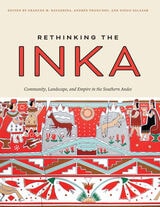
Rethinking the Inka
Community, Landscape, and Empire in the Southern AndesEdited by Frances M. Hayashida, Andrés Troncoso, and Diego Salazar
University of Texas Press, 2022
2023 Book Award, Society for American Archaeology
A dramatic reappraisal of the Inka Empire through the lens of Qullasuyu.
The Inka conquered an immense area extending across five modern nations, yet most English-language publications on the Inka focus on governance in the area of modern Peru. This volume expands the range of scholarship available in English by collecting new and notable research on Qullasuyu, the largest of the four quarters of the empire, which extended south from Cuzco into contemporary Bolivia, Argentina, and Chile.
From the study of Qullasuyu arise fresh theoretical perspectives that both complement and challenge what we think we know about the Inka. While existing scholarship emphasizes the political and economic rationales underlying state action, Rethinking the Inka turns to the conquered themselves and reassesses imperial motivations. The book’s chapters, incorporating more than two hundred photographs, explore relations between powerful local lords and their Inka rulers; the roles of nonhumans in the social and political life of the empire; local landscapes remade under Inka rule; and the appropriation and reinterpretation by locals of Inka objects, infrastructure, practices, and symbols. Written by some of South America’s leading archaeologists, Rethinking the Inka is poised to be a landmark book in the field.
Rethinking the Rule of Law after Communism
Wojciech Sadurski
Central European University Press, 2005
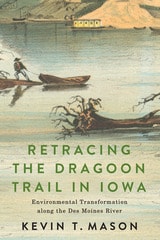
Retracing the Dragoon Trail in Iowa
Environmental Transformation along the Des Moines RiverKevin T. Mason
Michigan State University Press, 2026
In Retracing the Dragoon Trail in Iowa, historian Kevin T. Mason presents a vivid and deeply researched account of Iowa’s evolving landscape, beginning with the 1835 expedition of the First U.S. Dragoons. Drawing from archival records, maps, government surveys, Indigenous histories, and ecological data, Mason explores how Iowa’s prairies and wetlands gave way to farms, towns, and transportation networks. He situates these environmental shifts within the broader forces of Manifest Destiny, military expansion, and settler colonialism, while amplifying the voices of the Sauk, Meskwaki, Dakota, and other Indigenous nations whose histories are often marginalized.
But Mason doesn’t just write about history—he walks it. His 371-mile journey retracing the original dragoon route across Iowa blends scholarship with storytelling, captured through video essays, photography, and writing. This modern-day trek, featured on Iowa PBS’s Iowa Life and Iowa Public Radio’s Talk of Iowa, brings the past into the present, offering a compelling look at how landscapes remember. The result is a powerful contribution to environmental history, regional studies, and Indigenous scholarship—one that reveals the layered interactions between land use, policy, and historical change.
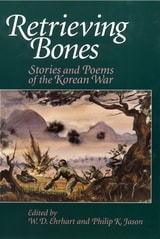
Retrieving Bones
Stories and Poems of the Korean WarEhrhart, W. D.
Rutgers University Press, 1999
The Korean War was a major event in American history. It marked an abrupt end to the euphoria Americans felt in the wake of victory in World War II and turned out to be the harbinger of disaster in Vietnam a decade later.
Though three years of brutal fighting resulted in millions of casualties, the final truce line of 1953 corresponded almost exactly to the positions the opponents held when the fighting began. Back home, the returning veterans met with little interest in or appreciation of what they had endured. Consequently, literary responses to the Korean War did not find an eager readership. Few people, it seemed, wanted to read about what they perceived as a backwater war that possessed neither grand scale nor apparent nobility, a war that ended not with a bang, but a whimper.
Yet an important literature has come out of the Korean War. As we mark the fiftieth anniversary of the war, these writings are well worth our attention. Many of the twelve stories and fifty poems assembled in Retrieving Bones have long been out of print and are almost impossible to find in any other source. The editors have enhanced this collection by providing maps, a chronology of the Korean War, and annotated lists of novels, works of nonfiction, and films. In a detailed introduction, Ehrhart and Jason discuss the milestones of the Korean War and place each fiction writer and poet represented into historical and literary contexts.
Among the writers and poets are
· James Lee Burke
· Eugene Burdick
· William Chamberlain
· Rolando Hinojosa
· Reg Saner
· Vern Sneider
· Stanford Whitmore
· Keith Wilson
Retuning Culture
Musical Changes in Central and Eastern EuropeMark Slobin
Duke University Press, 1996
During the period of state socialism, both the reinterpretation of the folk music heritage and the domestication of Western forms of music offered ways to resist and redefine imposed identities. With the removal of state control and support, music was free to channel and to shape emerging forms of cultural identity. Stressing both continuity and disjuncture in a period of enormous social and cultural change, this volume focuses on the importance and evolution of traditional and popular musics in peasant communities and urban environments in Hungary, Poland, Romania, Russia, the Czech Republic, Ukraine, the former Yugoslavia, Macedonia, and Bulgaria. Written by longtime specialists in the region and considering both religious and secular trends, these essays examine music as a means of expressing diverse aesthetics and ideologies, participating in the formation of national identities, and strengthening ethnic affiliation.
Retuning Culture provides a rich understanding of music’s role at a particular cultural and historical moment. Its broad range of perspectives will attract readers with interests in cultural studies, music, and Central and Eastern Europe.
Contributors. Michael Beckerman, Donna Buchanan, Anna Czekanowska, Judit Frigyesi, Barbara Rose Lange, Mirjana Lausevic, Theodore Levin, Margarita Mazo, Steluta Popa, Ljerka Vidic Rasmussen, Timothy Rice, Carol Silverman, Catherine Wanner
Return Engagements
Contemporary Art's Traumas of Modernity and History in Sài Gòn and Phnom PenhViet Lê
Duke University Press, 2021
Return Of Guatemala'S Refugees
Clark Taylor
Temple University Press, 1998
Twelve years later, utilizing terms of refugee agreements reached in 1982, villagers from Santa Maria who had fled to Mexico returned to their homes and lands to re-create their community with those who had stayed in Guatemala. Return of Guatemala's Refugees tells the story of that process. In this moving and provocative book, Clark Taylor describes the experiences of the survivors -- both those who stayed behind in conditions of savage repression and those who fled to Mexico where they learned to organize and defend their rights. Their struggle to rebuild is set in the wider drama of efforts by grassroots groups to pressure the government, economic elites, and army to fulfill peace accords signed in December of 1996.
Focusing on the village of Santa Maria Tzeja, Taylor defines the challenges that faced returning refugees and their community. How did the opposing subcultures of fear (generated among those who stayed in Guatemala) and of education and human rights (experienced by those who took refuge in Mexico) coexist? Would the flood of international money sent to settle the refugees and fulfill the peace accords serve to promote participatory development or new forms of social control? How did survivors expand the space for democracy firmly grounded in human rights? How did they get beyond the grief and trauma that remained from the terror of the early eighties? Finally, the ultimate challenge, how did they work within conditions of extreme poverty to create a grassroots democracy in a militarized society?

Return from Berlin
The Eye of a NavigatorRobert Grilley
University of Wisconsin Press, 2003
Wakened with flashlights on their faces in the predawn hours, he and his crew repeatedly face the Luftwaffe in battles five miles high, flying through flak "so thick you could get out and walk on it." Stretching their stamina to the limits, they succeed time after time in their missions to bomb munitions works, railyards, the Leüna synthetic oil plant at Merseburg in eastern Germany, the V2 rocket research center at Peenemünde on the distant Baltic Coast, and even to strike Hitler’s capital city, Berlin.
But Grilley finds interludes of unexpected grace and restoration on his days off, making serious drawings from nature at the neighboring Yokehill Farm. There he slowly cultivates a friendship with a curious eight-year-old, the lively child Elizabeth, who becomes for the combat flyer a symbol of survival.
Return to Casablanca
Jews, Muslims, and an Israeli AnthropologistAndré Levy
University of Chicago Press, 2015
Levy visits a host of sites and historical figures to assemble a compelling history of social change, while seamlessly interweaving his study with personal accounts of his returns to his homeland. Central to this story is the massive migration of Jews out of Morocco. Levy traces the institutional and social changes such migrations cause for those who choose to stay, introducing the concept of “contraction” to depict the way Jews deal with the ramifications of their demographic dwindling. Turning his attention outward from Morocco, he goes on to explore the greater complexities of the Jewish diaspora and the essential paradox at the heart of his adventure—leaving Israel to return home.
Return to Havana
The Decline of Cuban Society Under CastroMaurice Halperin
Vanderbilt University Press, 1994
Return to Ixil
Maya Society in an Eighteenth-Century Yucatec TownMark Z. Christensen
University Press of Colorado, 2019
Supplemented with additional archival research, the wills provide new and detailed descriptions of various aspects of life in eighteenth-century Ixil. In each chapter, authors Mark Christensen and Matthew Restall examine a different dimension of Ixil’s colonial history, including the role of notaries, Maya participation in a coastal militia, economy and modes of production, religious life and records, and the structures and patterns of familial relationships. These details offer insight into the complex network of societies in colonial Yucatan, colonial Mesoamerica, and colonial Latin America.
Including an appendix presenting the original Maya texts as well as translations by Christensen and Restall, Return to Ixil not only analyzes the largest body of substantive wills in any Mayan language known today but also provides a rare closeup view of the inner workings of a colonial Maya town and the communal and familial affairs that made up a large part of the Maya colonial experience. It will be of great interest to Mayanists as well as to students and scholars of history, anthropology, ethnohistory, linguistics, and social history.
The publication of this book is supported in part byBrigham Young University and Penn State University.

Return to Wake Robin
One Cabin in the Heyday of Northwoods ResortsMarnie O. Mamminga
Wisconsin Historical Society Press, 2012
Five generations of Marnie O. Mamminga’s family have been rejuvenated by times together in Wisconsin’s Northwoods. In a series of evocative remembrances accompanied by a treasure trove of vintage family photos, Mamminga takes us to Wake Robin, the cabin her grandparents built in 1929 on Big Spider Lake near Hayward, on land adjacent to Moody’s Camp. Along the way she preserves the spirit and cultural heritage of a vanishing era, conveying the heart of a place and the community that gathered there.
Bookended by the close of the logging era and the 1970s shift to modern lake homes, condos, and Jet Skis, the 1920s to 1960s period covered in these essays represents the golden age of Northwoods camps and cabins—a time when retreats such as Wake Robin were the essence of simplicity. In Return to Wake Robin, Mamminga describes the familiar cadre of fishing guides casting their charm, the camaraderie and friendships among resort workers and vacationers, the call of the weekly square dance, the splash announcing a perfectly executed cannonball, the lodge as gathering place. By tracing the history of one resort and cabin, she recalls a time and experience that will resonate with anyone who spent their summers Up North—or wishes they had.

Return to Wake Robin
One Cabin in the Heyday of Northwoods ResortsMarnie O. Mamminga
Wisconsin Historical Society Press, 2013
Five generations of Marnie O. Mamminga’s family have been rejuvenated by times together in Wisconsin’s Northwoods. In a series of evocative remembrances accompanied by a treasure trove of vintage family photos, Mamminga takes us to Wake Robin, the cabin her grandparents built in 1929 on Big Spider Lake near Hayward, on land adjacent to Moody’s Camp. Along the way she preserves the spirit and cultural heritage of a vanishing era, conveying the heart of a place and the community that gathered there.
Bookended by the close of the logging era and the 1970s shift to modern lake homes, condos, and Jet Skis, the 1920s to 1960s period covered in these essays represents the golden age of Northwoods camps and cabins—a time when retreats such as Wake Robin were the essence of simplicity. In Return to Wake Robin, Mamminga describes the familiar cadre of fishing guides casting their charm, the camaraderie and friendships among resort workers and vacationers, the call of the weekly square dance, the splash announcing a perfectly executed cannonball, the lodge as gathering place. By tracing the history of one resort and cabin, she recalls a time and experience that will resonate with anyone who spent their summers Up North—or wishes they had.
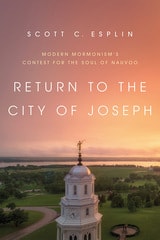
Return to the City of Joseph
Modern Mormonism's Contest for the Soul of NauvooScott C. Esplin
University of Illinois Press, 2018
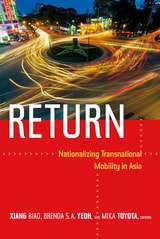
Return
Nationalizing Transnational Mobility in AsiaXiang Biao, Brenda S. A. Yeoh and Mika Toyota, eds.
Duke University Press, 2013
Contributors. Sylvia Cowan, Johan Lindquist, Melody Chia-wen Lu, Koji Sasaki, Shin Hyunjoon, Mariko Asano Tamanoi, Mika Toyota, Carol Upadhya, Wang Cangbai, Xiang Biao, Brenda S. A. Yeoh
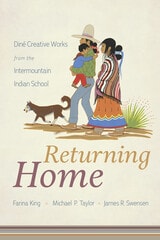
Returning Home
Diné Creative Works from the Intermountain Indian SchoolFarina King, Michael P. Taylor, and James R. Swensen With Contributions by Robert Dodson, Rena Dunn, Terence Wride, and Students of the Intermountain Indian School
University of Arizona Press, 2021
This book works to recover the lived experiences of Native American boarding school students through creative works, student interviews, and scholarly collaboration. It shows the complex agency and ability of Indigenous youth to maintain their Diné culture within the colonial spaces that were designed to alienate them from their communities and customs. Returning Home provides a view into the students’ experiences and their connections to Diné community and land. Despite the initial Intermountain Indian School agenda to send Diné students away and permanently relocate them elsewhere, Diné student artists and writers returned home through their creative works by evoking senses of Diné Bikéyah and the kinship that defined home for them.
Returning Home uses archival materials housed at Utah State University, as well as material donated by surviving Intermountain Indian School students and teachers throughout Utah, Arizona, and New Mexico. Artwork, poems, and other creative materials show a longing for cultural connection and demonstrate cultural resilience. This work was shared with surviving Intermountain Indian School students and their communities in and around the Navajo Nation in the form of a traveling museum exhibit, and now it is available in this thoughtfully crafted volume. By bringing together the archived student arts and writings with the voices of living communities, Returning Home traces, recontextualizes, reconnects, and returns the embodiment and perpetuation of Intermountain Indian School students’ everyday acts of resurgence.
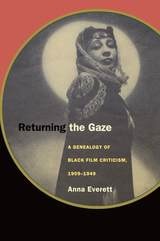
Returning the Gaze
A Genealogy of Black Film Criticism, 1909–1949Anna Everett
Duke University Press, 2001
Culling black newspapers, magazines, scholarly and political journals, and monographs, Everett has produced an unparalleled investigation of black critical writing on the early cinema during the era of racial segregation in America. Correcting the notion that black critical interest in the cinema began and ended with the well-documented press campaign against D. W. Griffith’s Birth of a Nation, she discovers that as early as 1909 black newspapers produced celebratory discourses about the cinema as a much-needed corrective to the predominance of theatrical blackface minstrelsy. She shows how, even before the Birth of a Nation controversy, the black press succeeded in drawing attention to both the callous commercial exploitation of lynching footage and the varied work of black film entrepreneurs. The book also reveals a feast of film commentaries that were produced during the “roaring twenties” and the jazz age by such writers as W.E.B. DuBois, Langston Hughes, and Zora Neale Hurston, as well as additional pieces that were written throughout the Depression and the pre– and post–war periods. Situating this wide-ranging and ideologically complex material in its myriad social, political, economic, and cultural contexts, Everett aims to resuscitate a historical tradition for contemporary black film literature and criticism.
Returning the Gaze will appeal to scholars and students of film, black and ethnic studies, American studies, cultural studies, literature, and journalism.
Revealing Prophets
Prophecy In Eastern African HistoryDavid M. Anderson
Ohio University Press, 1994
This book examines the richly textured histories of prophets and prophecies within East Africa. It gives an analytical account of the significantly different forms prophecy has taken over the past century across the country.
Each of the chapters takes a new look at the active dialogue between prophets and the communities whom they addressed. This dialogue continues today as the politicians and activists throughout the region still look to prophetic traditions, garnering interpretations of the past in order to provide the validation of prophetic wisdom and heroes for the present.
Revealing the Unseen
New Perspectives on Qajar ArtEdited by Melanie Gibson and Gwenaëlle Fellinger
Gingko, 2022
The thirteen articles in this volume were originally given as presentations at the symposium of the same name organized in June 2018 by the Musée du Louvre and the Musée du Louvre-Lens in conjunction with the exhibition The Empire of Roses: Masterpieces of 19th Century Persian Art. The exhibition explored the art of Iran in the nineteenth and early twentieth centuries, while the nation was under the rule of the Qajar dynasty. The symposium set out to present research on previously unknown and unpublished objects from this rich period of art history.
This volume, published with the Louvre Museum in France, is divided into four sections. The first, “Transitions and Transmissions,” is dedicated to the arts of painting, illumination, and lithography. The focus of the second section, entitled “The Image Revealed,” also considers works on paper, looking at new themes and techniques. “The Material World” examines the use of materials such as textiles, carpets, and armor. The articles in the final section discuss the history of two groups of artifacts acquired by their respective museums.