Results by title
8113 books match the query 'Literary Criticism' and 415 start with r
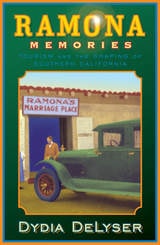
Ramona Memories
Tourism and the Shaping of Southern CaliforniaDydia DeLyser
University of Minnesota Press, 2005
Rape Of Clarissa
Writing, Sexuality, and Class Struggle in Samuel RichardsonTerry Eagleton
University of Minnesota Press, 1982
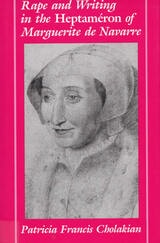
Rape and Writing in the Heptameron of Marguerite de Navarre
Patricia Francis Cholakian
Southern Illinois University Press, 1991
Marguerite de Navarre (1492–1549), the sister of the French king François I, composed the Heptaméron as a complex collection of seventy-two novellas, creating one of the first examples of realistic, psychological fiction in French literature. These novellas, framed by debates among ten storytellers, all noble lords and ladies, reveal the author’s desire to depart from the purely masculine voice of the age.
Cholakian contends that this Renaissance text is characterized by feminine writing. She reads the text as the product of the author’s personal experience. Beginning her study with the rape narrative in the autobiographical novella 4, she examines how the Heptaméron interacts with male literary traditions and narrative conventions about gender relations. She analyzes such words as rape, and honor, noting how they are defined differently by men and women and how these differences in perception affect the development of both plot and character.
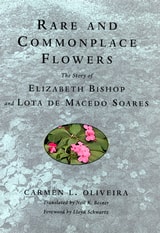
Rare and Commonplace Flowers
The Story of Elizabeth Bishop and Lota de Macedo SoaresOliveira, Carmen
Rutgers University Press, 2003
Rare and Commonplace Flowers—a Brazilian bestseller—tells the story of two women. Elizabeth Bishop, the Pulitzer Prize–winning American poet, sought artistic inspiration in Brazil. There she met and fell in love with Lota de Macedo Soares, a self-trained Brazilian architect. This dual biography—brilliantly researched, and written in a lively, novelistic style—follows their relationship from 1951 to 1967, the time when the two lived together in Brazil. The fact that these two women had an intimate relationship caused an uproar when it first came to public notice.
The relationship started out happily, yet ended tragically. In 1961, Soares became increasingly obsessed with building and administering Flamengo Park, Rio de Janeiro’s equivalent to New York City’s Central Park. Though she had been the driving force behind the park’s inception, the ultimate credit that was due her was stripped away because of petty politics and chicanery. As Soares’s career declined and Bishop’s flourished, their relationship crumbled.
Rare and Commonplace Flowers is a tale of two artists and two cultures, offering unique perspectives on both women and their work. Carmen L. Oliveira provides an unparalleled level of detail and insight, due to both her familiarity with Brazil as well as her access to the country’s artistic elite, many of whom had a direct connection with Bishop and Soares. Rare pictures of the two artists and their home bring this unique story to life.
Ray Bradbury
David Seed
University of Illinois Press, 2015
David Seed follows Bradbury's long career from the early short story masterpieces through his work in a wide variety of broadcast and film genres to the influential cultural commentary he spread via essays, speeches, and interviews. Mining Bradbury's classics and hard-to-find archival, literary, and cultural materials, Seed analyzes how the author's views on technology, authoritarianism, and censorship affected his art; how his Midwest of dream and dread brought his work to life; and the ways film and television influenced his creative process and visually-oriented prose style. The result is a passionate statement on Bradbury's status as an essential literary writer deserving of a place in the cultural history of his time.
Ray Bradbury Unbound
Jonathan R. Eller
University of Illinois Press, 2020
At the height of his powers as a poetic prose stylist, Bradbury shifted his creative attention to film and television, where new successes gave him an enduring platform as a compelling cultural commentator. His passionate advocacy validated the U.S. space program's mission, extending his pivotal role as a chronicler of human values in an age of technological wonders.
Informed by many years of interviews with Bradbury as well as an unprecedented access to personal papers and private collections, Ray Bradbury Unbound provides the definitive portrait of how a legendary American author helped shape his times.
Re Verse
Essays on Poetry and PoetsDavid R. Slavitt
Northwestern University Press, 2009
Combining personal reminiscence with deft literary analysis, incisive biographical sketches, and, sometimes, literary gossip, these essays give new perspectives on the famous--such as Harold Bloom, Robert Penn Warren, Robert Frost, and Stephen Spender--and recover the charms of the near-forgotten--such as Dudley Fitts, Winfield Townley Scott, Merrill Moore and John Hall Wheelock. Slavitt writes with self-deprecating humor of his own literary education, and uses his impressive experience and erudition to illuminate the whims of poetic influence, passion, and reputation. With a refreshing honesty and considerable poise, he gives readers an enlightening view of the vast and ever-changing literary universe.
Re-Enchanted
The Rise of Children's Fantasy Literature in the Twentieth CenturyMaria Sachiko Cecire
University of Minnesota Press, 2019
Why are so many people drawn to fantasy set in medieval, British-looking lands? This question has immediate significance for millions around the world: from fans of Lord of the Rings, Narnia, Harry Potter, and Game of Thrones to those who avoid fantasy because of the racist, sexist, and escapist tendencies they have found there. Drawing on the history and power of children’s fantasy literature, Re-Enchanted argues that magic, medievalism, and childhood hold the paradoxical ability to re-enchant modern life.
Focusing on works by authors such as J. R. R. Tolkien, C. S. Lewis, Susan Cooper, Philip Pullman, J. K. Rowling, and Nnedi Okorafor, Re-Enchanted uncovers a new genealogy for medievalist fantasy—one that reveals the genre to be as important to the history of English studies and literary modernism as it is to shaping beliefs across geographies and generations. Maria Sachiko Cecire follows children’s fantasy as it transforms over the twentieth and twenty-first centuries—including the rise of diverse counternarratives and fantasy’s move into “high-brow” literary fiction. Grounded in a combination of archival scholarship and literary and cultural analysis, Re-Enchanted argues that medievalist fantasy has become a psychologized landscape for contemporary explorations of what it means to grow up, live well, and belong. The influential “Oxford School” of children’s fantasy connects to key issues throughout this book, from the legacies of empire and racial exclusion in children’s literature to what Christmas magic tells us about the roles of childhood and enchantment in Anglo-American culture.
Re-Enchanted engages with critical debates around what constitutes high and low culture during moments of crisis in the humanities, political and affective uses of childhood and the mythological past, the anxieties of modernity, and the social impact of racially charged origin stories.
Re-Membering and Surviving
African American Fiction of the Vietnam WarShirley A. James Hanshaw
Michigan State University Press, 2020
Re-imagining the Modern American West
A Century of Fiction, History, and ArtRichard W. Etulain
University of Arizona Press, 1996
He discusses novelists from Jack London to John Steinbeck and on to Joan Didion. He covers historians from Frederick Jackson Turner to Earl Pomeroy and Patricia Nelson Limerick, and artists from Frederic Remington and Charles Russell to Georgia O’Keeffe and R. C. Gorman. The author places emphasis on women painters and authors such as Mary Hallock Foote, Mary Austin, Willa Cather, and Judith Baca. He also stresses important works of ethnic writers including Leslie Marmon Silko, Rudolfo Anaya, and Amy Tan. An intriguing survey of tendencies and trends and a well-defined profile of influences and outgrowths, this book will be valuable to students and scholars of western culture and history, American studies, and related disciplines. General readers will appreciate the book’s balanced structure and spirited writing style. All readers, whatever their level of interest, will discover the major cultural inventions of the American West over the past one hundred years.
Reader Of The Purple Sage
Essays On Western Writers And Environmental LiteratureAnn Ronald
University of Nevada Press, 2003
Literary scholar Ann Ronald gathers her most notable published essays about Nevada, environmental writing, and Western American literature in one volume. These essays reflect Ronald’s wide-ranging interests. Here are deeply informed, critical essays on writers as diverse as Zane Gray, Edward Abbey, Wallace Stegner, and Terry Tempest Williams, as well as the Tonopah Ladies—a group of literary women who found their voices in the unlikely setting of a mining boomtown—and on such varied topics as the image of Reno in nineteenth- and twentieth-century fiction. Included are several recent essays in which Ronald thoughtfully discusses the burgeoning field of environmental writing, some of its principal themes and concerns, and its best-known practitioners.
Reader as Accomplice
Narrative Ethics in Dostoevsky and NabokovAlexander Spektor
Northwestern University Press, 2021
Reader as Accomplice: Narrative Ethics in Dostoevsky and Nabokov argues that Fyodor Dostoevsky and Vladimir Nabokov seek to affect the moral imagination of their readers by linking morally laden plots to the ethical questions raised by narrative fiction at the formal level. By doing so, these two authors ask us to consider and respond to the ethical demands that narrative acts of representation and interpretation place on authors and readers.
Using the lens of narrative ethics, Alexander Spektor brings to light the important, previously unexplored correspondences between Dostoevsky and Nabokov. Ultimately, he argues for a productive comparison of how each writer investigates the ethical costs of narrating oneself and others. He also explores the power dynamics between author, character, narrator, and reader. In his readings of such texts as “The Meek One” and The Idiot by Dostoevsky and Bend Sinister and Despair by Nabokov, Spektor demonstrates that these authors incite the reader’s sense of ethics by exposing the risks but also the possibilities of narrative fiction.
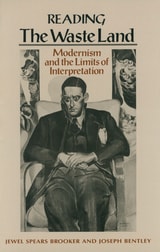
Reading "The Waste Land"
Modernism and the Limits of InterpretationJewel Spears Brooker
University of Massachusetts Press, 1990
This study of T.S. Eliot's The Waste Land guides the reader through the poem line by line, taking into account a number of previous interpretations. Aims to offer a part-by-part analysis of the poem with periodic summations and a meditation on the limits of interpretation and the problematic nature of reading in the late 20th century.
Reading Adoption
Family and Difference in Fiction and DramaMarianne Novy
University of Michigan Press, 2005
Marianne Novy is Professor of English and Women's Studies at the University of Pittsburgh. She is author or editor of numerous books, including Imagining Adoption: Essays on Literature and Culture.
Reading America
Citizenship, Democracy, and Cold War LiteratureKristin L. Matthews
University of Massachusetts Press, 2016
During the Cold War, the editor of Time magazine declared, “A good citizen is a good reader.” As postwar euphoria faded, a wide variety of Americans turned to reading to understand their place in the changing world. Yet, what did it mean to be a good reader? And how did reading make you a good citizen?
In Reading America, Kristin L. Matthews puts into conversation a range of political, educational, popular, and touchstone literary texts to demonstrate how Americans from across the political spectrum—including “great works” proponents, New Critics, civil rights leaders, postmodern theorists, neoconservatives, and multiculturalists—celebrated particular texts and advocated particular interpretive methods as they worked to make their vision of "America" a reality. She situates the fiction of J. D. Salinger, Ralph Ellison, Thomas Pynchon, John Barth, and Maxine Hong Kingston within these debates, illustrating how Cold War literature was not just an object of but also a vested participant in postwar efforts to define good reading and citizenship.
Reading Arab Women's Autobiographies
Shahrazad Tells Her StoryBy Nawar Al-Hassan Golley
University of Texas Press, 2003
Authors of autobiographies are always engaged in creating a "self" to present to their readers. This process of self-creation raises a number of intriguing questions: why and how does anyone choose to present herself or himself in an autobiography? Do women and men represent themselves in different ways and, if so, why? How do differences in culture affect the writing of autobiography in various parts of the world?
This book tackles these questions through a close examination of Arab women's autobiographical writings. Nawar Al-Hassan Golley applies a variety of western critical theories, including Marxism, colonial discourse, feminism, and narrative theory, to the autobiographies of Huda Shaarawi, Fadwa Tuqan, Nawal el-Saadawi, and others to demonstrate what these critical methodologies can reveal about Arab women's writing. At the same time, she also interrogates these theories against the chosen texts to see how adequate or appropriate these models are for analyzing texts from other cultures. This two-fold investigation sheds important new light on how the writers or editors of Arab women's autobiographies have written, documented, presented, and organized their texts.
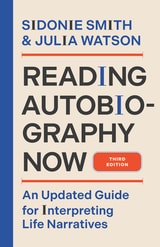
Reading Autobiography Now
An Updated Guide for Interpreting Life Narratives, Third EditionSidonie Smith
University of Minnesota Press, 2024
A user-friendly guide to reading, writing, and theorizing autobiographical texts and practices for students, scholars, and practitioners of life narrative
The boom in autobiographical narratives continues apace. It now encompasses a global spectrum of texts and practices in such media as graphic memoir, auto-photography, performance and plastic arts, film and video, and online platforms. Reading Autobiography Now offers both a critical engagement with life narrative in historical perspective and a theoretical framework for interpreting texts and practices in this wide-ranging field. Hailed upon its initial publication as “the Whole Earth Catalog of autobiography studies,” this essential book has been updated, reorganized, and expanded in scope to serve as an accessible and contemporary guide for scholars, students, and practitioners.
Sidonie Smith and Julia Watson explore definitions of life narrative, probe issues of subjectivity, and outline salient features of autobiographical acts and practices. In this updated edition, they address emergent topics such as autotheory, autofiction, and autoethnography; expand the discussions of identity, relationality, and agency; and introduce new material on autobiographical archives and the profusion of “I”s in contemporary works. Smith and Watson also provide a helpful toolkit of strategies for reading life narrative and an extensive glossary of mini-essays analyzing key theoretical concepts and dozens of autobiographical genres.
An indispensable exploration of this expansive, transnational, multimedia field, Reading Autobiography Now meticulously unpacks the heterogeneous modes of life narratives through which people tell their stories, from traditional memoirs and trauma narratives to collaborative life narrative and autobiographical comics.
Reading Autobiography
A Guide for Interpreting Life NarrativesSidonie Smith
University of Minnesota Press, 2002

Reading Behind Bars
Alan Tansman
Prickly Paradigm Press, 2027
A reflection on how literature can function as a medium of lived experience rather than intellectual abstraction under conditions of radical constraint.
Drawing on the experience of teaching at Mt. Tam College at the San Quentin Correctional Facility, literary scholar Alan Tansman traces the extraordinary seriousness with which incarcerated students engage literary works form many times and places; Natsume Soseki's Kokoro, Toni Morrison's The Bluest Eye, Jorge Luis Borges's "Funes the Memorious," and Jean Améry's "On Torture." The heart of the book lies not in these canonical works themselves but in the students' responses—writing and discussion that is spare, precise, and emotionally exacting. These students are not merely powerful witnesses to suffering; they are careful, committed readers. Their interpretations are alert to ethical stakes and formal detail, shaped by firsthand knowledge of trauma, isolation, guilt, and the struggle with living in a painful present looking toward a hard future. What kind of refuge can literature offer from pain, guilt, and the weight of the past? Can that refuge also offer a guide for living behind bars?
Reading Billy Budd
Hershel Parker
Northwestern University Press, 1990
Reading Books
Essays on the Material Text and Literature in AmericaMichele Moylan
University of Massachusetts Press, 1996
This collection takes as its point of departure the proposition that one can, in fact, tell a book by its cover. The contributors examine the ways in which the material qualities of books—including typography, paper, bindings, layout , and promotional copy—as well as their editing, production, and distribution profoundly affect how they have been read and understood.
The volume includes essays on the publishing history of Melville's early novels, Twain's The Innocents Abroad, the Tauchnitz edition of Hawthornes's The Marble Faun, and Jackson's Romona. Other chapters examine the reception of Dante's works in America, Houghton Mifflin's biographical series, the binding styles of Ticknor and Fields, and the packaging of literature for American high schools.
Reading Capitalist Realism
Alison Shonkwiler and Leigh Claire LaBerge
University of Iowa Press, 2014
Reading Capitalist Realism presents some of the latest and most sophisticated approaches to the question of the relation between capitalism and narrative form, partly by questioning how the “realism” of austerity, privatization, and wealth protection relate to the realism of narrative and cultural production. Even as critics have sought to locate a new aesthetic mode that might consider and move beyond theorizations of the postmodern, this volume contends that narrative realism demands renewed scrutiny for its ability to represent capitalism’s latest scenes of enclosure and indebtedness.
Ranging across fiction, nonfiction, television, and film, the essays collected here explore to what extent realism is equipped to comprehend and historicize our contemporary economic moment and what might be the influence or complicity of the literary in shaping the global politics of lowered expectations. Including essays on writers such as Mohsin Hamid, Lorrie Moore, Jess Walter, J. M. Coetzee, James Kelman, Ali Smith, Russell Banks, William Vollmann, and William Gibson, as well as examinations of Hollywood film productions and The Wire television series, Reading Capitalist Realism calls attention to a resurgence of realisms across narrative genres and questions realism’s ability to interrogate the crisis-driven logic of political and economic “common sense.”
Reading Chican@ Like a Queer
The De-Mastery of DesireBy Sandra K. Soto
University of Texas Press, 2010
A race-based oppositional paradigm has informed Chicano studies since its emergence. In this work, Sandra K. Soto replaces that paradigm with a less didactic, more flexible framework geared for a queer analysis of the discursive relationship between racialization and sexuality. Through rereadings of a diverse range of widely discussed writers—from Américo Paredes to Cherríe Moraga—Soto demonstrates that representations of racialization actually depend on the sexual and that a racialized sexuality is a heretofore unrecognized organizing principle of Chican@ literature, even in the most unlikely texts. Soto gives us a broader and deeper engagement with Chican@ representations of racialization, desire, and both inter- and intracultural social relations.
While several scholars have begun to take sexuality seriously by invoking the rich terrain of contemporary Chicana feminist literature for its portrayal of culturally specific and historically laden gender and sexual frameworks, as well as for its imaginative transgressions against them, this is the first study to theorize racialized sexuality as pervasive to and enabling of the canon of Chican@ literature. Exemplifying the broad usefulness of queer theory by extending its critical tools and anti-heteronormative insights to racialization, Soto stages a crucial intervention amid a certain loss of optimism that circulates both as a fear that queer theory was a fad whose time has passed, and that queer theory is incapable of offering an incisive, politically grounded analysis in and of the current historical moment.
Reading Conrad
Edited by John G. Peters and Jakob Lothe
The Ohio State University Press, 2017
Reading Conrad by J. Hillis Miller demonstrates a surprising cohesiveness across Miller’s career as well as the richness of Conrad’s fiction, which affords varied opportunities for critical approaches as different as phenomenology, new criticism, deconstruction, narrative theory, and narrative ethics. Miller’s analyses emphasize literature’s rhetorical and performative power, ultimately suggesting that while narrative fiction is an effect of a series of complex phenomena in society and in the human psyche, as literary language it can also refer to the external world indirectly and contribute to the formation of history from within.

Reading De Man Reading
Lindsey Waters and Wlad Godzich, Editors
University of Minnesota Press, 1989
Reading De Man Reading was first published in 1989. Minnesota Archive Editions uses digital technology to make long-unavailable books once again accessible, and are published unaltered from the original University of Minnesota Press editions.
Paul de Man, from the outset of his career, concerned himself with the act of reading and with discovering what a rigorous mode of reading can produce. The contributors to this volume—conceived not long before de Man's death in 1983—address his theory and practice of reading: the nature of those readings and what they signify for reading in general, not just for literary texts. De Man explored the act of reading because in it he could bring together—in order to cancel—the subjects known as reader and writer, the referent known as reality, and the medium known as language. In the act of reading de Man, the authors of this book ask where his work leaves us, what changes he made in the world of criticism and writing in general, and what we do differently because of him.
The contributors: Geoffrey Hartman, Jacques Derrida, Deborah Esch, Neil Hertz, Carol Jacobs, Kevin Newmark, Peggy Kamuf, J. Hillis Miller, Werner Hamacher, Hans Robert Jauss, Geoffrey Bennington, Bill Readings, Timothy Bahti, and Rodolphe Gasché.
Lindsay Waters is General Editor at Harvard University Press. Wlad Godzich is professor of comparative literature at the Université de Montréal and co-editor of the Theory and History of Literature series.
Reading Death in Ancient Rome
Mario Erasmo
The Ohio State University Press, 2008
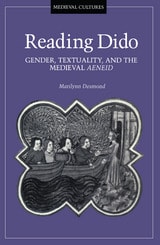
Reading Dido
Gender, Textuality, and the Medieval AeneidMarilynn Desmond
University of Minnesota Press, 1994
Describes the variations in the figure of Dido as she emerges from ancient literary texts.
If we view the Aeneid—the poem of empire, conquest, and male hierarchy-as the West's quintessential canonical text and Latin primer, then the history of Virgil readership should tell us much about the concept of education in the West. In this book, Marilynn Desmond reveals how a constructed and mediated tradition of reading Virgil has conditioned various interpretations among readers responding to medieval cultural and literary texts. In particular, she shows how the story of Dido has been marginalized within canonical readings of the Aeneid. Reaching back to the Middle Ages and vernacular poetic readings of Dido, Desmond recovers an alternative Virgil from historical tradition and provides another paradigm for reading the Aeneid.
Desmond follows the figure of Dido as she emerges from ancient historical and literary texts (from Timaeus and Justin to Virgil and Ovid) and circulates in medieval textual cultures. Her study ranges from the pedagogical discourses of Latin textual traditions (including Servius, Augustine, Bernard Silvestris, and John of Salisbury) to the French and English vernacular cultures inscribed in the Roman d'Eneas, the Histoire ancienne jusqu'à César, and the work of Dante, Chaucer, Gavin Douglas, Caxton, and Christine de Pizan. The positions of all these readers point to the cultural specificity and historical contingency of all traditions of reading; thus, this book demonstrates how medieval traditions of reading Dido offer the modern reader a series of countertraditions that support feminist, antihomophobic, and postcolonial interpretive gestures.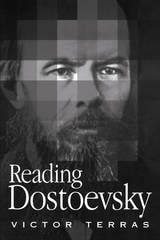
Reading Dostoevsky
Victor Terras
University of Wisconsin Press, 1998
“A substantial contribution both to Dostoevsky scholarship and to scholarship on the novel. . . . The first book in quite a while to address itself to all of Dostoevsky’s opus, certainly a bold move that only someone of Terras’s stature could pull off.”—Gary Rosenshield, University of Madison–Wisconsin
Admirers have praised Fedor Dostoevsky as the Russian Shakespeare, while his critics have slighted his novels as merely cheap amusements. In this stimulating critical introduction to Dostoevsky’s fiction, literary scholar Victor Terras asks readers to draw their own conclusions about the nineteenth-century Russian writer. Discussing psychological, political, mythical, and philosophical approaches, Terras deftly guides readers through the range of diverse and even contradictory interpretations of Dostoevsky's rich novels.
Moving through the novelist's career, Terras presents a general analysis of the novel at issue, each chapter focusing on a particular aspect of Dostoevsky's art. He probes the form and style of Crime and Punishment, and explores the ambiguity of The Brothers Karamazov. Terras emphasizes the "markedness," of Dostoevsky's novels, their wealth of literary devices such as irony, literary allusions, scenic effects, puns, and witticisms.
Terras conveys the vital contradictions and ambiguities of the novels. In this informative, engaging literary study, Terras brings Dostoevsky and his art to life.
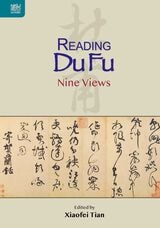
Reading Du Fu
Nine ViewsEdited by Xiaofei Tian
Hong Kong University Press, 2020
Reading Duncan Reading
Robert Duncan and the Poetics of DerivationStephen Collis
University of Iowa Press, 2012
In part two, the volume turns to examinations of poets who can be seen to in some way derive from Duncan—and so in turn reveals another angle of Duncan’s derivative poetics. J. P. Craig traces Nathaniel MacKey’s use of Duncan’s “would-be shaman,” Catherine Martin sees Duncan’s influence in Susan Howe’s “development of a poetics where the twin concepts of trespass and ‘permission’ hold comparable sway,” and Ross Hair explores poet Ronald Johnson’s “reading to steal.” These and other essays collected here trace paths of poetic affiliation and affinity and hold them up as provocative possibilities in Duncan’s own inexhaustible work.
Reading Embodied Citizenship
Disability, Narrative, and the Body PoliticRussell, Emily
Rutgers University Press, 2011
Liberal individualism, a foundational concept of American politics, assumes an essentially homogeneous population of independent citizens. When confronted with physical disability and the contradiction of seemingly unruly bodies, however, the public searches for a story that can make sense of the difference. The narrative that ensues makes "abnormality" an important part of the dialogue about what a genuine citizen is, though its role is concealed as an exception to the rule of individuality rather than a defining difference. Reading Embodied Citizenship brings disability to the forefront, illuminating its role in constituting what counts as U.S. citizenship.
Drawing from major figures in American literature, including Mark Twain, Flannery O'Connor, Carson McCullers, and David Foster Wallace, as well as introducing texts from the emerging canon of disability studies, Emily Russell demonstrates the place of disability at the core of American ideals. The narratives prompted by the encounter between physical difference and the body politic require a new understanding of embodiment as a necessary conjunction of physical, textual, and social bodies. Russell examines literature to explore and unsettle long-held assumptions about American citizenship.
Reading Emily Dickinson's Letters
Critical EssaysJane Donahue Eberwein
University of Massachusetts Press, 2009
Emily Dickinson, who regarded a letter as “a joy of Earth,” was herself a gifted epistolary artist—cryptic and allusive in style, dazzling in verbal effects, and sensitively attuned to the recipients of her many letters. In this volume, distinguished literary scholars focus intensively on Dickinson's letter-writing and what her letters reveal about her poetics, her personal associations, and her self-awareness as a writer.
Although Dickinson's letters have provided invaluable perspective for biographers and lovers of poetry since Mabel Loomis Todd published the first selection in 1894, today's scholarly climate opens potential for fresh insights drawn from new theoretical approaches, informed cultural contextualizations, and rigorous examination of manuscript evidence. Essays in this collection explore ways that Emily Dickinson adapted nineteenth-century epistolary conventions of women's culture, as well as how she directed her writing to particular readers, providing subtly tactful guidance to ways of approaching her poetics.
Close examination of her letters reveals the conscious artistry of Dickinson's writing, from her auditory effects to her experiments with form and tone. Her well-known correspondences with Thomas Wentworth Higginson, Susan Dickinson, Helen Hunt Jackson, and Otis Phillips Lord are examined here, but so too are previously neglected family communications with her aunt Kate Sweetser and cousin Eugenia Montague. Contributors find in these various letters evidence of Dickinson's enthusiastic participation in a sort of epistolary book club involving multiple friends, as well as her loving attentiveness to individuals in times of both suffering and joy. These inquiries highlight her thoughts on love, marriage, gender roles, art, and death, while unraveling mysteries ranging from legal discourse to Etruscan smiles.
In addition to a foreword by Marietta Messmer, the volume includes essays by Paul Crumbley, Karen Dandurand, Jane Donahue Eberwein, Judith Farr, James Guthrie, Ellen Louise Hart, Eleanor Heginbotham, Cindy MacKenzie, Martha Nell Smith, and Stephanie Tingley.
Reading Hegel
Irony, Recollection, CritiqueRobert Lucas Scott
University of Chicago Press, 2025
The relationship between Hegel and literary theory has for a long time been both contested and paradoxical. On the one hand, “theory” is often skeptical of all that Hegel ostensibly stood for: idealism, systematicity, and identity at the expense of difference. Yet, in spite of itself, literary theory is taken to owe a profound debt to Hegel’s philosophy. Robert Lucas Scott’s book complicates this account and argues that literary theory has made the mistake of abstracting Hegel’s thought from its more dynamic presentation in Hegel’s writings, reducing “Hegel” to a series of propositions or positions. Literary theory, Scott argues, misses what is perhaps the greatest innovation of Hegel’s philosophy: a presentation of experience that begins precisely by setting aside all preconceptions or prior assumptions. It is on this point that Hegel’s philosophy itself approaches literature: its content cannot be simply abstracted from the singular experience of reading it. Only through a mode of reading alive to speculative experience can literary theory become truly Hegelian. Scott’s exposition of Hegel offers a model of reading with relevance beyond philosophy: one that is critical without pretensions of mastery and detachment and that honors the singularity of the reading experience without succumbing to the subjectivism of the “postcritical.”
The book also includes engagements with the work of Luther, Kant, Marx, Gillian Rose, Fredric Jameson, Robert Brandom, Catherine Malabou, and more in its recovery of Hegel’s thought for a critical understanding of our time.
Reading Holinshed's Chronicles
Annabel Patterson
University of Chicago Press, 1994
Although we know it by the name of Raphael Holinshed, editor and major compiler of the 1577 edition, the Chronicles was the work of a group, a collaboration between antiquarians, clergymen, members of parliament, poets, publishers, and booksellers. Through a detailed reading, Patterson argues that the Chronicles convey rich insights into the way the Elizabethan middle class understood their society. Responding to the crisis of disunity which resulted from the Reformation, the authors of the Chronicles embodied and encouraged an ideal of justice, what we would now call liberalism, that extended beyond the writing of history into the realms of politics, law, economics, citizenship, class, and gender. Also, since the second edition of 1587 was called in by the Privy Council and revised under supervision, the work constitutes an important test case for the history of early modern censorship.
An essential book for all students of Tudor history and literature, Reading Holinshed's Chronicles brings into full view a long misunderstood masterpiece of sixteenth-century English culture.
Reading Homer's Iliad
Kostas Myrsiades
Bucknell University Press, 2023
Reading Homer’s Odyssey
Kostas Myrsiades
Bucknell University Press, 2019
Homer’s Odyssey is the first great travel narrative in Western culture. A compelling tale about the consequences of war, and about redemption, transformation, and the search for home, the Odyssey continues to be studied in universities and schools, and to be read and referred to by ordinary readers. Reading Homer’s Odyssey offers a book-by-book commentary on the epic’s themes that informs the non-specialist and engages the seasoned reader in new perspectives. Among the themes discussed are hospitality, survival, wealth, reputation and immortality, the Olympian gods, self-reliance and community, civility, behavior, etiquette and technology, ease, inactivity and stagnation, Penelope’s relationship with Odysseus, Telemachus’ journey, Odysseus’ rejection of Calypso’s offer of immortality, Odysseus’ lies, Homer’s use of the House of Atreus and other myths, the cinematic qualities of the epic’s structure, women’s role in the epic, and the Odyssey’s true ending. Footnotes clarify and elaborate upon myths that Homer leaves unfinished, explain terms and phrases, and provide background information. The volume concludes with a general bibliography of work on the Odyssey, in addition to the bibliographies that accompany each book’s commentary.
Published by Bucknell University Press. Distributed worldwide by Rutgers University Press.
Reading India Now
Contemporary Formations in Literature and Popular CultureUlka Anjaria
Temple University Press, 2019
In an age of social media and reality television, reading and consumption habits in India now demand homegrown pulp fictions. Ulka Anjaria categorizes post-2000 Indian literature and popular culture as constituting “the contemporary,” a movement defined by new and experimental forms—where high- and low-brow meet, and genres break down.
Reading India Now studies the implications of this developing trend as both the right-wing resurges and marginalized voices find expression. Anjaria explores the fiction of Chetan Bhagat and Anuja Chauhan as well as Aamir Khan’s television talk show, Satyamev Jayate, plus the work of documentarian Paromita Vohra, to argue how different kinds of texts are involved in imagining new political futures for an India in transition. Contemporary literature and popular culture in India might seem artless and capitalistic, but it is precisely its openness to the world outside that allows these new works to offer significant insight into the experiences and sensibilities of contemporary India.
Reading Machines
Toward and Algorithmic CriticismStephen Ramsay
University of Illinois Press, 2011
Reading Medieval Latin with the Legend of Barlaam and Josaphat
Donka D. Markus
University of Michigan Press, 2018
In Reading Medieval Latin with the Legend of Barlaam and Josaphat, Donka D. Markus offers comprehensive commentary on the 13th-century Dominican theologian Jacobus de Voragine’s retelling of the ancient story of the life of the Buddha that will resonate with contemporary students of Latin.
Jacobus’s version of the legend serves as a compelling, original Latin text. Vividly conveyed through parables, fables, and anecdotes, it naturally lends itself to a critical consideration of ethical principles and philosophical truths commonly shared across many cultures. With its rich stylistic devices and authentic classical Latin word order, it provides superb training for reading rhetorical prose before advancing to the works of more complex classical prose authors. At the same time, the text offers a unique opportunity for systematically learning the special features of Late and Medieval Latin. Included in this volume are two presentations of Jacobus’s text: one maintaining the original orthography reflecting Latin as it appears in medieval manuscripts, and one in which the orthography follows Classical Latin norms.
This textbook is designed for intermediate-level learners of Classical or Medieval Latin, whether in college, high school, or by self-directed study. The 5,000-word narrative text lends itself to a semester-long experience of reading one continuous work of prose. Each of the legend’s embedded stories can also be read as an independent selection with the help of the ample commentary, vocabulary, and grammar guidance. The extensive introduction provides the necessary background to contextualize the legend in its Latin iteration and sufficient historical information to make the reading meaningful for those without prior knowledge of Buddhism or medieval history. Additionally, this work makes Latin attractive to students of diverse backgrounds, as it highlights the language’s important role in disseminating the universally shared cultural legacy of humanity.
Reading Nature
The Evolution of American Nature WritingJohn Seibert Farnsworth
Michigan State University Press, 2025
Reading Network Fiction
David Ciccoricco
University of Alabama Press, 2007
A theoretical framework for understanding fiction built on nodes, links, and distributed narrative systems.
The marriage of narrative and the computer dates back to the 1980s, with the hypertext experiments of luminaries such as Judy Malloy and Michael Joyce. What has been variously called "hypertext fiction," "literary hypertext," and "hyperfiction" has surely surrendered any claim to newness in the 21st century.
David Ciccoricco establishes the category of "network fiction" as distinguishable from other forms of hypertext and cybertext: network fictions are narrative texts in digitally networked environments that make use of hypertext technology in order to create emergent and recombinant narratives. Though they both pre-date and post-date the World Wide Web, they share with it an aesthetic drive that exploits the networking potential of digital composition and foregrounds notions of narrative recurrence and return.
Ciccoricco analyzes innovative developments in network fiction from first-generation writers Michael Joyce (Twilight, a symphony, 1997) and Stuart Moulthrop (Victory Garden, 1991) through Judd Morrissey’s The Jew's Daughter (2000), an acclaimed example of digital literature in its latter instantiations on the Web. Each investigation demonstrates not only what the digital environment might mean for narrative theory but also the ability of network fictions to sustain a mode of reading that might, arguably, be called "literary." The movement in the arts away from representation and toward simulation, away from the dynamics of reading and interpretation and toward the dynamics of interaction and play, has indeed led to exaggerated or alarmist claims of the endangerment of the literary arts. At the same time, some have simply doubted that the conceptual and discursive intricacy of print fiction can migrate to new media. Against these claims, Reading Network Fiction attests to the verbal complexity and conceptual depth of a body of writing created for the surface of the screen.
Reading Novels
George Hughes
Vanderbilt University Press, 2002
Reading Old English
A Primer and First Reader, Revised EditionROBERT HASENFRATZ
West Virginia University Press, 2010
With the immersion method dominating contemporary language learning, the knowledge of traditional grammar is at a low ebb, creating real barriers to any student wanting to learning dead or historical languages. This revised edition of Reading Old English aims to equip readers (advanced undergraduates, graduate students, and autodidacts) with the necessary tools to read the oldest recorded forms of the English language by explaining key language features clearly and methodically, without simplifying any of the core grammatical concepts. It includes a number of helpful exercises, a variety of interesting and unusual Old English texts to translate, as well as appendices covering the basics of traditional grammar and sound changes in Old English, along with an introduction to poetic structure.
Reading Ovid in Medieval Wales
Paul Russell
The Ohio State University Press, 2017
Russell argues that this annotated version of the Ars amatoria arose out of the teaching traditions of the Carolingian world and that the annotation, as we have it, was the product of a cumulative process of glossing and commenting on the text. He then surveys other glossed Ovid manuscripts to demonstrate how that accumulation was built up. Russell also explores the fascinating issue of why Ovid’s love poetry should be used to teach Latin verse in monastic contexts. Finally, he discusses the connection between this manuscript and the numerous references to Ovid in later Welsh poetry, suggesting that the Ovidian references should perhaps be taken to refer to love poetry more generically.

Reading Piers Plowman and the Pilgrim's Progress
Reception and the Protestant ReaderBarbara A. Johnson
Southern Illinois University Press, 1992
Centering her discussion on two historical "ways of reading"—which she calls the Protestant and the lettered—Barbara A. Johnson traces the development of a Protestant readership as it is reflected in the reception of Langland’s Piers Plowman and Bunyan’s Pilgrim’s Progress.
Informed by reader-response and reception theory and literacy and cultural studies, Johnson’s ambitious examination of these two ostensibly literary texts charts the cultural roles they played in the centuries following their composition, roles far more important than their modern critical reputations can explain.
Johnson argues that much more evidence exists about how earlier readers read than has hitherto been acknowledged. The reception of Piers Plowman, for example, can be inferred from references to the work, the apparatus its Renaissance printer inserted in his editions, the marginal comments readers inscribed both in printed editions and in manuscripts, and the apocryphal "plowman" texts that constitute interpretations of Langland’s poem. She demonstrates by example that what is culturally transmitted has not been just the work itself; it includes vestiges of past readers’ encounters with the text that are traceable both in the way a text is presented as well as in the way that presentation is received.
Conditioned more by religious, historical, and economic forces than by literary concerns, Langland’s poem became a part of the reformist tradition that culminated in Bunyan’s Pilgrim’s Progress. By understanding this tradition, Bunyan’s place in it, and the way the reception of The Pilgrim’s Progress illustrates the beginning of a new, more realistic fictional tradition, Johnson concludes, we can begin to delineate a more accurate history of the ways literature and society intersect, a history of readers reading.
Reading Places
Literacy, Democracy, and the Public Library in Cold War AmericaChristine Pawley
University of Massachusetts Press, 2010
Central to the experiment were well-stocked bookmobiles that brought books to rural districts and the one-room schools that dotted the region. Three years after the project began, state officials and local librarians judged it an overwhelming success. Library circulation figures soared to two-and-a-half times their previous level. Over 90 percent of grade-school children in the rural schools used the bookmobile service, and their reading scores improved beyond expectation.
Despite these successes, however, local communities displayed deeply divided reactions. Some welcomed the book-mobiles and new library services wholeheartedly, valuing print and reading as essential to the exercise of democracy, and keen to widen educational opportunities for children growing up on hardscrabble farms where books and magazines were rare. Others feared the intrusion of govern- ment into their homes and communities, resented the tax increases that library services entailed, and complained about the subversive or immoral nature of some books.
Analyzing the history of tensions between various community groups, Pawley delineates the long-standing antagonisms arising from class, gender, and ethnic differences which contributed to a suspicion of official projects to expand education. Relating a seemingly small story of library policy, she teases out the complex interaction of reading, locality, and cultural difference. In so doing, she illuminates broader questions regarding libraries, literacy, and citizenship, reaching back to the nineteenth century and forward to the present day.
Reading Pleasures
Everyday Black Living in Early AmericaTara A. Bynum
University of Illinois Press, 2023
A daring assertion of Black people’s humanity, Reading Pleasures reveals how four Black writers experienced positive feelings and analyzes the ways these emotions served creative, political, and racialized ends.
Reading Practice
The Pursuit of Natural Knowledge from Manuscript to PrintMelissa Reynolds
University of Chicago Press, 2024
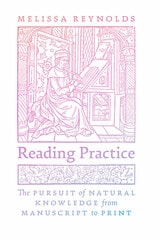
Reading Practice tells the story of how ordinary people grew comfortable learning from commonplace manuscripts and printed books, such as almanacs, medical recipe collections, and herbals. From the turn of the fifteenth century to the close of the sixteenth century, these were the books English people read when they wanted to attend to their health or understand their place in the universe. Before then, these works had largely been the purview of those who could read Latin. Around 1400, however, medical and scientific texts became available in Middle English while manuscripts became less expensive. These vernacular manuscripts invited their readers into a very old and learned conversation: Hippocrates and Galen weren’t distant authorities whose word was law, they were trusted guides, whose advice could be excerpted, rearranged, recombined, and even altered to suit a manuscript compiler’s needs. This conversation continued even after the printing press arrived in England in 1476. Printers mined manuscripts for medical and scientific texts that they would publish throughout the sixteenth century, though the pressures of a commercial printing market encouraged printers to package these old texts in new ways. Without the weight of authority conditioning their reactions and responses to very old knowledge, and with so many editions of practical books to choose from, English readers grew into confident critics and purveyors of natural knowledge in their own right.
Melissa Reynolds reconstructs shifting attitudes toward medicine and science over two centuries of seismic change within English culture, attending especially to the effects of the Reformation on attitudes toward nature and the human body. Her study shows how readers learned to be discerning and selective consumers of knowledge gradually, through everyday interactions with utilitarian books.
Reading Project
A Collaborative Analysis of William Poundstone's Project for Tachistoscope {Bottomless Pit}Jessica Pressman, Mark C. Marino, and Jeremy Douglass
University of Iowa Press, 2015
Project for the Tachistoscope {Bottomless Pit} is a work of electronic literature that presents a high-speed, one-word-at-a-time animation synchronized to visual and aural effects. It tells the tale of a mysterious pit and its impact on the surrounding community. Programmed in Flash and published online, its fast-flashing aesthetic of information overload bombards the reader with images, text, and sound in ways that challenge the ability to read carefully, closely, and analytically in traditional ways. The work’s multiple layers of poetics and programming can be most effectively read and analyzed through collaborative efforts at computational criticism such as is modeled in this book. The result is a unique and trailblazing book that presents the authors’ collaborative efforts and interpretations as a case study for performing digital humanities literary criticism of born-digital poetics.
Reading Proust
In Search of Wolf-FishMaria Paganini
University of Minnesota Press, 1994