Results by title
28164 books match the query 'History' and 1206 start with r
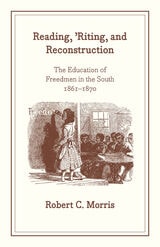
Reading, 'Riting, and Reconstruction
The Education of Freedmen in the South, 1861-1870Robert C. Morris
University of Chicago Press, 1981
This study of education for freedmen following Emancipation is the definitive treatment of the subject. Employing a wide range of sources, Robert C. Morris examines the organizations that staffed and managed black schools in the South, with particular attention paid to the activities of the Freedman’s Bureau. He looks as well at those who came to teach, a diverse group—white, black, Northern, Southern—and at the curricula and textbooks they used. While giving special emphasis to the Freedmen’s Bureau school program, Morris places the freedmen’s educational movement fully in its nineteenth-century context, relating it both to the antislavery crusade that preceded it and to the conservative era of race relations that followed.

Reading, Gender and Identity in Seventeenth-Century England
Hannah Jeans
University of London Press, 2025
This ambitious and interdisciplinary book redraws the history of early modern Englishwomen’s reading, exploring the connections between gender, reading habits, and genre throughout the seventeenth century. Reading, Gender and Identity in Seventeenth-Century England challenges accepted historiographical narratives about reading that have privileged male experience and the impact of the Civil War; the book highlights the multiplicity and complexity of women’s reading practices, focusing on how women used reading in constructing their gender identity. Reading was a gendered act in the early modern period; across genres, women were depicted negotiating a range of gendered behavioral norms. From religious texts, romances, and cookbooks, to news, household records, and scientific and medical treatises, Jeans draws on archival sources across a wide range of writing types to offer a more complete picture of women’s reading experiences, ultimately questioning the accepted notion of the woman reader itself.
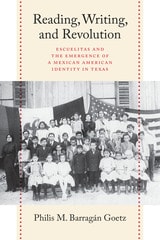
Reading, Writing, and Revolution
Escuelitas and the Emergence of a Mexican American Identity in TexasBy Philis M. Barragán Goetz
University of Texas Press, 2020
2022 National Association for Chicana and Chicano Studies Book Award
Tejas Foco Non-fiction Book Award, National Association for Chicana and Chicano Studies
2021 Tejano Book Prize, Tejano Genealogy Society of Austin
2021 Jim Parish Award for Documentation and Publication of Local and Regional History, Webb County Heritage Foundation
2021 Runner-up, Ramirez Family Award for Most Significant Scholarly Book
The first book on the history of escuelitas, Reading, Writing, and Revolution examines the integral role these grassroots community schools played in shaping Mexican American identity.
Language has long functioned as a signifier of power in the United States. In Texas, as elsewhere in the Southwest, ethnic Mexicans’ relationship to education—including their enrollment in the Spanish-language community schools called escuelitas—served as a vehicle to negotiate that power. Situating the history of escuelitas within the contexts of modernization, progressivism, public education, the Mexican Revolution, and immigration, Reading, Writing, and Revolution traces how the proliferation and decline of these community schools helped shape Mexican American identity.
Philis M. Barragán Goetz argues that the history of escuelitas is not only a story of resistance in the face of Anglo hegemony but also a complex and nuanced chronicle of ethnic Mexican cultural negotiation. She shows how escuelitas emerged and thrived to meet a diverse set of unfulfilled needs, then dwindled as later generations of Mexican Americans campaigned for educational integration. Drawing on extensive archival, genealogical, and oral history research, Barragán Goetz unravels a forgotten narrative at the crossroads of language and education as well as race and identity.
Readings In American Health Care
Current Issues In Socio-Historical PerspectiveWilliam G. Rothstein
University of Wisconsin Press, 1995
• Basic Concepts: mortality trends, concepts of disease, changes in medical therapy
• Public Health: AIDS, cigarette smoking, preventive medicine, fluoridation
• Health Care Professions: cardiology, pathology, women in medicine, nursing, podiatry, midwives
• Health Care Organizations: hospitals, HMOs
• Mental Illness
• Financing Health Care
• Medical Education
• Issues: abortion, ethical issues, cancer control, prenatal care, home care, the pharmaceutical industry
• Background Readings: American medicine from 1920 to midcentury.
The readings were chosen especially for course use in history, sociology, public health, and related fields, but can also provide useful background reading for anyone interested or involved in American health care. Each selection includes an introduction, questions for the reader, and a bibliography. Scholars and students alike will find the book an invaluable resource.
Readings in Arkansas Politics and Government
Kim U. Hoffman
University of Arkansas Press, 2020

Readings in Interpretation
Holderlin, Hegel, HeideggerAndrzej WarminskiIntroduction by Rodolphe Gasche
University of Minnesota Press, 1987
Readings in Interpretation was first published in 1987. Minnesota Archive Editions uses digital technology to make long-unavailable books once again accessible, and are published unaltered from the original University of Minnesota Press editions.
Readings in Interpretation — a volume primarily on the texts of Holderlin, Hegel, and their interpreter Heidegger—locates itself strategically between literature and philosophy. In keeping with this juxtaposition, it treats the question of self-consciousness and reflection on the levels of "theme" and "text." For both Hegel and Holderlin, selfconsciousness and its relation to knowing are explicit themes, but Waminski's readings show that a more disruptive reflection is operative on the level of text.
In an argument that centers on the textual aspects of Hegel's Phenomenology of the Spirit,Warminski demonstrates that the negative moment—which is often interpreted as a prelude to a unified self-consciousness—cannot be accounted for by interpretive models drawn from outside the text—by concepts like the self, consciousness, or the subject. Instead, a completely different practice and theory is necessary. The author's "Prefatory Postscript" at the beginning of the book therefore serves as an introduction to sketch the theoretical basis of the readings that follow and as a "postscript" that explains the difference between "reading" and "interpretation" which those readings make necessary.

Readings in Russian Civilization Volume I
Russia before Peter the Great, 900-1700Edited by Thomas Riha
University of Chicago Press, 1969
"The bibliographical headnotes have been enlarged, with the result that there are now approximately twice as many entries as in the old edition. New citations include not only works which have appeared since 1963, but also older books and articles which have come to the editor's attention."—From the Editor's Preface
". . . a judicious combination of seminal works and more recent commentaries that achieves the editor's purpose of stimulating curiosity and developing a point of view."—C. Bickford O'Brien, The Russian Review
"These three volumes cover quite well the main periods of Russian civilization. The choice of the articles and other material is made by a competent and unbiased scholar."—Ivan A. Lopatin, Professor of Asian and Slavic Studies, University of Southern California

Readings in Russian Civilization Volume II
Imperial Russia, 1700-1917Edited by Thomas Riha
University of Chicago Press, 1969
"The bibliographical headnotes have been enlarged, with the result that there are now approximately twice as many entries as in the old edition. New citations include not only works which have appeared since 1963, but also older books and articles which have come to the editor's attention."—From the Editor's Preface
". . . a judicious combination of seminal works and more recent commentaries that achieves the editor's purpose of stimulating curiosity and developing a point of view."—C. Bickford O'Brien, The Russian Review
"These three volumes cover quite well the main periods of Russian civilization. The choice of the articles and other material is made by a competent and unbiased scholar."—Ivan A. Lopatin, Professor of Asian and Slavic Studies, University of Southern California
Readings in Russian Civilization Volume III
Soviet Russia, 1917-1963Edited by Thomas Riha
University of Chicago Press, 1969
"The bibliographical headnotes have been enlarged, with the result that there are now approximately twice as many entries as in the old edition. New citations include not only works which have appeared since 1963, but also older books and articles which have come to the editor's attention."—From the Editor's Preface
". . . a judicious combination of seminal works and more recent commentaries that achieves the editor's purpose of stimulating curiosity and developing a point of view."—C. Bickford O'Brien, The Russian Review
"These three volumes cover quite well the main periods of Russian civilization. The choice of the articles and other material is made by a competent and unbiased scholar."—Ivan A. Lopatin, Professor of Asian and Slavic Studies, University of Southern California
Ready for Air
A Journey through Premature MotherhoodKate Hopper
University of Minnesota Press, 2013
For Kate Hopper, pregnancy is downright unpleasant. She is tired and heavy and worried, and she wants her wine and caffeine back. But then, at a routine checkup, her doctor frowns at her chart and says, “I’m worried about a couple of things”—and unpleasant suddenly seems like paradise. What follows is a harrowing, poignant, and occasionally hysterical journey through premature motherhood, from the starting point of “leaking a little protein” to the early delivery of her tiny daughter because of severe preeclampsia and the beginning of a new chapter of frightful, lifelong love.
Half a million babies are born prematurely in the United States every year—almost one every minute—each with a unique story, and Hopper eloquently gives a voice to what their parents share: the shock, the scares, the lonely nights in the neonatal intensive care unit, the fierce attention to detail that makes for sanity and craziness, the light of faith, the warmth of family, and the terrifying attachment. Through it all runs the power of words to connect us to one another, as Hopper draws on her gifts as a writer first to help her navigate this uncertain territory and then to tell her story. With candor, grace, and a healthy dose of humor, she takes us into the final weeks of her pregnancy, the this-was-not-part-of-the-plan first weeks of little Stella’s life, and the isolated world she and her husband inhabited when they took their daughter home at the onset of a cold Minnesota winter. Finally, frankly, Hopper ventures into the complicated question of whether to have another child. Down-to-earth and honest about the hard realities of having a baby, as well as the true joys, Ready for Air is a testament to the strength of motherhood—and stories—to transform lives.
Ready-Made Democracy
A History of Men's Dress in the American Republic, 1760-1860Michael Zakim
University of Chicago Press, 2003
By the early nineteenth century, homespun began to disappear from the American material landscape. Exhortations of industry and modesty, however, remained a common fixture of public life. In fact, they found expression in the form of the business suit. Here, Zakim traces the evolution of homespun clothing into its ostensible opposite—the woolen coats, vests, and pantaloons that were "ready-made" for sale and wear across the country. In doing so, he demonstrates how traditional notions of work and property actually helped give birth to the modern industrial order. For Zakim, the history of men's dress in America mirrored this transformation of the nation's social and material landscape: profit-seeking in newly expanded markets, organizing a waged labor system in the city, shopping at "single-prices," and standardizing a business persona.
In illuminating the critical links between politics, economics, and fashion in antebellum America, Ready-Made Democracy will prove essential to anyone interested in the history of the United States and in the creation of modern culture in general.
Ready-to-Wear and Ready-to-Work
A Century of Industry and Immigrants in Paris and New YorkNancy L. Green
Duke University Press, 1997
Green focuses on issues of fashion and fabrication as they involve both the production and consumption of clothing. Traditionally, much of the urban garment industry has been organized around small workshops and flexible homework, and Green emphasizes the effect this labor organization had on the men and mostly women who have sewn the garments. Whether considering the immigrant Jews, Italians, Puerto Ricans, Dominicans, and Chinese in New York or the Chinese-Cambodians, Turks, Armenians, and Russian, Polish, and Tunisian Jews in Paris, she outlines similarities of social experience in the shops and the unions, while allowing the voices of the workers, in all their diversity to be heard.
A provocative examination of gender and ethnicity, historical conflict and consensus, and notions of class and cultural difference, Ready-to-Wear and Ready-to-Work breaks new ground in the methodology of comparative history.
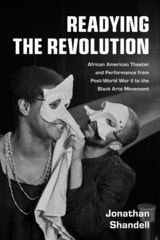
Readying the Revolution
African American Theater and Performance from Post-World War II to the Black Arts MovementJonathan Shandell
University of Michigan Press, 2025
2026 American Theatre and Drama Society John W. Frick Book Award Winner
Starting in 1966, African American activist Stokely Carmichael and other political leaders adopted the phrase "Black Power!" The slogan captured a militant, revolutionary spirit that was already emerging in the work of playwrights, poets, musicians, and visual artists throughout the Black Arts movement of the mid-1960s. But the story of those theater artists and performers whose work helped bring about the Black Arts revolution has not fully been told. Readying the Revolution: African American Theater and Performance from Post-World War II to the Black Arts Movement explores the dynamic era of Black culture between the end of World War II and the start of the Black Arts Movement (1946-1964) by illuminating how artists and innovators such as Jackie Robinson, Lorraine Hansberry, Ossie Davis, Nina Simone, and others helped radicalize Black culture and Black political thought. In doing so, these artists defied white cultural hegemony in the United States, and built the foundation for the revolutionary movement in Black theater that followed in the mid 1960s. Through archival research, close textual reading, and an analysis of performance artifacts, Shandell demonstrates how these artists negotiated a space on the public stage for cultivating radical Black aesthetics and built the foundation for the revolutionary movement in Black theater that followed in the mid-1960s.
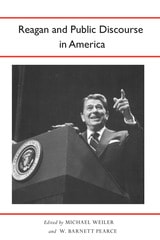
Reagan and Public Discourse in America
Michael Weiler
University of Alabama Press, 1992
The authors show that more than any president since John F. Kennedy, Reagan’s influence flowed from his rhetorical practices. And he is remembered as having reversed certain trends and cast the U.S. on a new course. The contributors to this insightful collection of essays show that Reagan’s rhetorical tactics were matters of primary concern to his administration’s chief political strategists.
Real Folks
Race and Genre in the Great DepressionSonnet H. Retman
Duke University Press, 2011
Real Influencers
Fourteen Disappearing Acts that Left Fingerprints on HistoryKenneth Weisbrode
St. Augustine's Press, 2022
"The influencer is a person who made an art of absence in the trade of cultural and sometimes political capital. The ones in this book represent a range of vocations, from politics to diplomacy to novel-writing, but almost all were cultural entrepreneurs. They were not puppet masters, gray eminences, unsung heroes, or Svengalis––although one or two have been portrayed thus. Rather, their influence is spread by virtue of their willful disappearance, of its perpetuation of a new language and cultural standard, and of their many conscious and unconscious imitators. The reason they had such influence was precisely because a part of their method was to be less visible in order to watch their ideas, habits, and styles proliferate without their names necessarily being affixed. […] Yet, to understand such a modus operandi is necessary today when the proliferation of social media influencers are squandering cultural capital so quickly by the simultaneous promotion of their products, above all, themselves."

Real Magic
Edited by Susanne Witzgall
Diaphanes, 2018
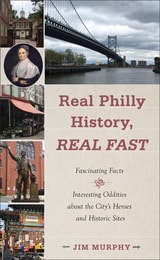
Real Philly History, Real Fast
Fascinating Facts and Interesting Oddities about the City's Heroes and Historic SitesJim Murphy
Temple University Press, 2021
Philadelphia is known as the home of vibrant colonial history: the Liberty Bell, the Betsy Ross House, and Independence Hall. But the City of Brotherly Love is also home to—and less well known for—its quirky history. The country’s first quarantine station was located here. One of Philly’s clocks has a face larger than Big Ben’s in London. And a unique skill of Black abolitionist James Forten saved him from a life of West Indian servitude (and “Forten” was not even his real name).
In Real Philly History, Real Fast, Jim Murphy provides an original tour of the city. He highlights artistic gems including the Dream Garden Tiffany mosaic and Isaiah Zagar’s glittering Magic Gardens. He profiles intriguing historical figures from military leader Commodore Barry to civil rights heroes like Lucretia Mott. Murphy also explores neighborhoods from Chinatown to the Italian Market and the unique architectural details of Carpenters’ Hall and the PSFS building.
Each chapter provides a pithy story about a historical person or site, along with bullet points featuring interesting oddities, and nearby attractions along with fun facts such as: Why there are so many churches? What is the Philadelphia Eagles’ connection to the U.S. Custom House? Which famous artist may have been Philadelphia’s first nude model? And where was the Liberty Bell secretly damaged? (We didn’t do it!)
This is Philly history in bites that are as digestible as a soft pretzel with mustard.
Real Places
An Unconventional Guide to America's Generic LandscapeGrady Clay
University of Chicago Press, 1994
"This book provides a language for the architecture of everyday life."—Ross Miller, Chicago Tribune
"Spirited observations and capsule histories."—Suzanne Stephens, New York Times Book Review
"Compelling. . . . Included here are many nuggets of insight and illumination."—Brad Knickerbocker, Christian Science Monitor
"An amusing and touching book about the reality we Americans have captured in our language."—Boston Sunday Globe

Real del Monte
A British Silver Mining Venture in MexicoBy Robert W. Randall
University of Texas Press, 1972
To speak of mining in newly independent Mexico is to speak of silver. And silver, historically abundant in the Real del Monte–Pachuca district, was the object of the Company of Adventurers in the Mines of Real del Monte. Organized in response to a plea by Pedro Romero de Terreros for help in rehabilitating his famous family’s once-rich properties, the English Real del Monte was led by men convinced that the application of English capital, management practices, and technology to those ruined mines and mills would reap them a profit and would revitalize the new nation’s most promising industry.
The adventurers were to be disappointed. The story of the English company is one of financial disaster: the loss of more than $5 million between its beginning in 1824 and its dissolution in 1849. Yet this failure was ironic, for upon the foundations of the English company was built a modern concern that yielded great rewards to Mexican and American successors to the hapless Englishmen.
A full account of a single risky venture, this inquiry is a microcosm of early foreign economic penetration into the Mexican mining industry. It offers specific solutions to poorly understood historical problems concerning the wave of capital that flowed from Great Britain into Latin America upon the disruption of the Spanish Empire, problems hitherto treated only in generalizations.
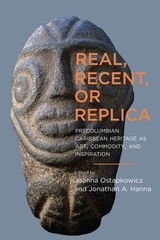
Real, Recent, or Replica
Precolumbian Caribbean Heritage as Art, Commodity, and InspirationEdited by Joanna Ostapkowicz and Jonathan A. Hanna
University of Alabama Press, 2021
A CHOICE OUTSTANDING ACADEMIC TITLE, 2022
Examines the largely unexplored topics in Caribbean archaeology of looting of heritage sites, fraudulent artifacts, and illicit trade of archaeological materials
Real, Recent, or Replica: Precolumbian Caribbean Heritage as Art, Commodity, and Inspiration is the first book-length study of its kind to highlight the increasing commodification of Caribbean Precolumbian heritage. Amerindian art, including “Taíno” art, has become highly coveted by collectors, spurring a prolific and increasingly sophisticated black market of forgeries, but also contemporary artistic engagement, openly appreciated as modern artworks taking inspiration from the past. The contributors to this volume contend with difficult subject matter including the continued looting of archaeological sites in the region, the seismic increase of forgeries, and the imbalance of power and economic relations between the producers and consumers of neo-Amerindian art.
The case studies document the considerable time depth of forgeries in the region (since the late nineteenth century), address the policies put in place by Caribbean governments and institutions to safeguard national patrimony, and explore the impact looted and forged artifacts have on how museums and institutions collect and ultimately represent the Caribbean past to their audiences. Overall, the volume emphasizes the continued desire for the “authentic” Precolumbian artifact, no matter the cost. It provides insights for archaeologists, museum professionals, art historians, and collectors to combat illegal trade and support communities in creating sustainable heritage industries.
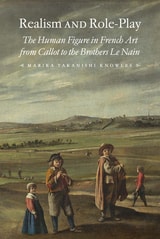
Realism and Role-Play
The Human Figure in French Art from Callot to the Brothers Le NainMarika Takanishi Knowles
University of Delaware Press, 2011
Published by University of Delaware Press. Distributed worldwide by Rutgers University Press.
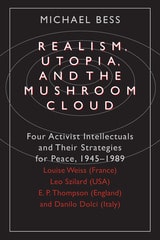
Realism, Utopia, and the Mushroom Cloud
Four Activist Intellectuals and their Strategies for Peace, 1945-1989--Louise Weiss (France), Leo Szilard (USA), E. P. Thompson (England), Danilo Dolci (Italy)Michael Bess
University of Chicago Press, 1993
Nagasaki, and continued preparations for nuclear war illustrate the modern
world's propensity for mass destruction. . . . Yet there have been
important signs of resistance to this trend. These have included not only
the emergence of mass-based peace and disarmament movements but activist
intellectuals grappling with the growing problem posed by mass violence
among nation-states. . . . Bess examines the lives and ideas of four of
these intellectuals: Leo Szilard of Hungary and (later) the United States,
E. P. Thompson of England, Danilo Dolci of Italy, and Louise Weiss of
France. . . . Realism, Utopia, and the Mushroom Cloud is a powerful,
important scholarly work, casting new light upon some of the great issues
of modern times. Readers will learn much from it."—Lawrence S.
Wittner, Peace and Change
"Bess seeks to understand the way in which the creation of the atomic bomb
has changed the social and political situation of humankind. Are we to be
held hostage by military forces or can we transform our situation? He
describes the lives of four very different activists, each with different
views on what causes conflict and how best to address conflict. . . .
Overall, this book offers an interesting perspective on life after the
atomic bomb. . . . In asking ourselves what the possibilities of our future
are, we can turn to these lives for some guidance. . . . This book is
informative, provocative, and encourages one to consider carefully how s/he
chooses to live."—Erin McKenna, Utopian Studies
"These four lives, researched and skillfully presented by historian Michael
Bess, make fascinating stories in themselves. They also serve as useful
vehicles for examining major cross-currents of Cold War resistance. . . .
From Weiss the cynical pragmatist to Szilard the high-level fixer to
hompson the social reformer to Dolce the spiritual street organizer,
Michael Bess has woven an illuminating tapestry of human efforts to cope
with life under the mushroom cloud."—Samuel H. Day Jr., The
Progressive

Realism, Writing, Disfiguration
On Thomas Eakins and Stephen CraneMichael Fried
University of Chicago Press, 1987
"An extraordinary achievement of scholarship and critical analysis. It is a book distinguished not only for its brilliance but for its courage, its grace and wit, its readiness to test its arguments in tough-minded ways, and its capacity to meet the challenge superbly. . . . This is a landmark in American cultural and intellectual studies."—Sacvan Bercovitch, Harvard University
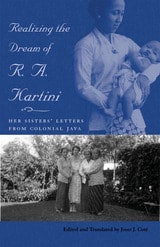
Realizing the Dream of R. A. Kartini
Her Sisters’ Letters from Colonial JavaJoost J. Coté
Ohio University Press, 2008
Realizing the Dream of R. A. Kartini: Her Sisters’ Letters from Colonial Java presents a unique collection of documents reflecting the lives, attitudes, and politics of four Javanese women in the early twentieth century. Joost J. Coté translates the correspondence between Raden Ajeng Kartini, Indonesia’s first feminist, and her sisters, revealing for the first time her sisters’ contributions in defining and carrying out her ideals. With this collection, Coté aims to situate Kartini’s sisters within the more famous Kartini narrative–and indirectly to situate Kartini herself within a broader narrative.
The letters reveal the emotional lives of these modern women and their concerns for the welfare of their husbands and the success of their children in rapidly changing times. While by no means radical nationalists, and not yet extending their horizons to the possibility of an Indonesian nation, these members of a new middle class nevertheless confidently express their belief in their own national identity.
Realizing the Dream of R. A. Kartini is essential reading for scholars of Indonesian history, providing documentary evidence of the culture of modern, urban Java in the late colonial era and an insight into the ferment of the Indonesian nationalist movement in which these women and their husbands played representative roles.
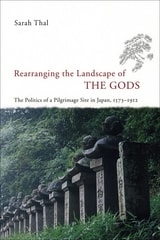
Rearranging the Landscape of the Gods
The Politics of a Pilgrimage Site in Japan, 1573-1912Sarah Thal
University of Chicago Press, 2005
Using miracle tales, votive plaques, diaries, and newspapers, Sarah Thal traces such changes at one of the most popular Japanese pilgrimage sites of the nineteenth and twentieth centuries: the shrine of Konpira on the island of Shikoku. This rich and fascinating history explores how people from all walks of life gave shape to the gods, shrines, and rituals so often attributed to ancient, indigenous Japan. Thal shows how worshippers and priests, rulers and entrepreneurs, repeatedly rebuilt and reinterpreted Konpira to reflect their needs and aspirations in a changing world—and how, in doing so, they helped shape the structures of the modern state, economy, and society in turn.
Rearranging the Landscape of the Gods will be welcomed by all scholars of Japanese history and by students of religion interested in the construction of modernity.
Reason Fulfilled by Revelation
The 1930s Christian Philosophy Debates in FranceGregory B. Sadler
Catholic University of America Press, 2011
Reason after Its Eclipse
On Late Critical TheoryMartin Jay
University of Wisconsin Press, 2017
After surveying Western ideas of reason from the ancient Greeks through Kant, Hegel, and Marx, Jay engages at length with the ways leading theorists of the Frankfurt School—Horkheimer, Marcuse, Adorno, and most extensively Habermas—sought to salvage a viable concept of reason after its apparent eclipse. They despaired, in particular, over the decay in the modern world of reason into mere instrumental rationality. When reason becomes a technical tool of calculation separated from the values and norms central to daily life, then choices become grounded not in careful thought but in emotion and will—a mode of thinking embraced by fascist movements in the twentieth century.
Is there a more robust idea of reason that can be defended as at once a philosophical concept, a ground of critique, and a norm for human emancipation? Jay explores at length the ommunicative rationality advocated by Habermas and considers the range of arguments, both pro and con, that have greeted his work.
Reason's Muse
Sexual Difference and the Birth of DemocracyGeneviève Fraisse
University of Chicago Press, 1994
Through an analysis of literary, religious, legal, philosophical, and medical texts, Fraisse links a range of positions on women's proper role in society to specific historical and rhetorical circumstances. She shows how the Revolution marked a sharp break in the way women were represented in language, as traditional bantering about the "war of the sexes" gave way to serious discussions of the political and social meanings of sexual difference. Following this discussion on three different planes—the economical, the political, and the biological—Fraisse looks at the exclusion of women against the backdrop of democracy's inevitable lie: the affirmation of an equality so abstract it was impossible to concretely apply.
This study of the place of sexual equality in the founding moment of democracy offers insight into a persistent question: whether female emancipation is to be found through the achievement of equality with men or in the celebration of female difference.
Reasoning with the Infinite
From the Closed World to the Mathematical UniverseMichel Blay
University of Chicago Press, 1998
"One of Michael Blay's many fine achievements in Reasoning with the Infinite is to make us realize how velocity, and later instantaneous velocity, came to play a vital part in the development of a rigorous mathematical science of motion."—Margaret Wertheim, New Scientist

Reasons of Conscience
The Bioethics Debate in GermanyStefan Sperling
University of Chicago Press, 2013
Reassembling the UAW
Insurgency, Contention, and the Struggle for Unionism in the American SouthAbe Walker
Temple University Press, 2026
Abe Walker chronicles the organizing campaign from its origin in 2014 to the union’s breakthrough victory in 2024, illustrating what went wrong—and what went right—along the way. Walker provides a systematic analysis of the strategic challenges and tactical shifts, showing the patterns that persisted across three election cycles while highlighting their differences, from global-level alliances to local labor issues.
Reassembling the UAW also demonstrates how rebel rank-and-file workers ousted the old-guard leadership and transformed the UAW into a militant union to achieve results. Ultimately, Walker offers valuable lessons for organizational strategy, the power of collective action, and the future of the labor movement.
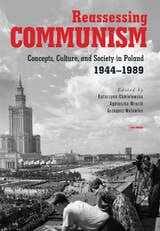
Reassessing Communism
Concepts, Culture, and Society in Poland 1944–1989Instytutem Badan Literackich PAN Chmielewska
Central European University Press, 2021
The thirteen authors of this collective work undertook to articulate matter-of-fact critiques of the dominant narrative about communism in Poland while offering new analyses of the concept, and also examining the manifestations of anticommunism. Approaching communist ideas and practices, programs and their implementations, as an inseparable whole, they examine the issues of emancipation, upward social mobility, and changes in the cultural canon.
The authors refuse to treat communism in Poland in simplistic categories of totalitarianism, absolute evil and Soviet colonization, and similarly refuse to equate communism and fascism. Nor do they adopt the neoliberal view of communism as a project doomed to failure. While wholly exempt from nostalgia, these essays show that beyond oppression and bad governance, communism was also a regime in which people pursued a variety of goals and sincerely attempted to build a better world for themselves.
The book is interdisciplinary and applies the tools of social history, intellectual history, political philosophy, anthropology, literature, cultural studies, and gender studies to provide a nuanced view of the communist regimes in east-central Europe.
Reassessing Reform
Christopher M. Bellitto
Catholic University of America Press, 2012

Rebecca Harding Davis
A Life Among WritersSharon M. Harris
West Virginia University Press, 2019
2018 Choice Outstanding Academic Title
This accessible treatment of Davis’s life, based on deep research in archival sources, provides new perspective on topics ranging from sectional tensions in the border South to the gendered world of nineteenth-century publishing. It promises to be the authoritative treatment of an important figure in the literary history of West Virginia and the wider world.
Rebel Bulldog
The Story of One Family, Two States, and the Civil WarJason Lantzer
Indiana Historical Society Press, 2017
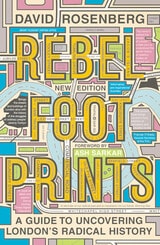
Rebel Footprints
A Guide to Uncovering London's Radical HistoryDavid Rosenberg
Pluto Press, 2019
If you visit London, and you’ve only experienced Buckingham Palace, The Tower of London, and The Millennium Wheel, you’ve missed the true essence of London, and its politically-charged, rebellious history. A truly radical response to conservative heritage tours and banal day trips, Rebel Footprints brings to life the history of social movements in England's capital by providing lively commentary, maps, and walking tours you will not find anywhere else.
David Rosenberg transports readers from well-known landmarks to history-making hidden corners, while telling the story of protest and struggle in London from the early nineteenth to the mid-twentieth century.
From the suffragettes to the socialists, from the chartists to the trade unionists: Rosenberg invites us to step into the footprints of a diverse cast of dedicated fighters for social justice. Individual chapters highlight particular struggles and their participants, from famous faces to lesser-known luminaries. Chapters include:
*Writers and Rioters in the Fleet Street Precinct
*Trailblazers for Democracy in Clerkenwell Green
*The Spark of Rebellion in Bow
*Coming in from the Cold: Immigrant Agitators and Radicals in Spitalfields
*No Gods, No Masters: Radical Bloomsbury
*Life on the Boundary: Fighting for Housing in Bethnal Green and Shoreditch
*Stirrings from the South: The Battersea Four
*peaking Truth to Power: Suffragettes and Westminster
*Not Afraid of the Prison Walls: Rebel Women and Men of Poplar
*People's Power in Bermondsey
Rebel Footprints sets London's radical campaigners against the backdrop of the city's multi-faceted development. Self-directed walks pair with narratives that seamlessly blend history, politics, and geography, while specially commissioned maps and illustrations immerse the reader in the story of the city.
Whether you're visiting London for the first time, or born and raised there, Rosenberg invites you to see London as you never have before—the radical center of the English-speaking world.
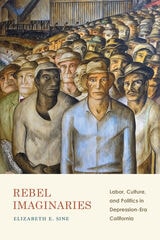
Rebel Imaginaries
Labor, Culture, and Politics in Depression-Era CaliforniaElizabeth E. Sine
Duke University Press, 2021
Rebel Poet
More Stories from a 21st Century IndianLouis V. Clark (Two Shoes)
Wisconsin Historical Society Press, 2019
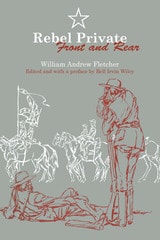
Rebel Private Front and Rear
By William Andrew Fletcher
University of Texas Press, 1954
Rebel Private Front and Rear is a line soldier’s account of the Civil War without heroics. Private Fletcher tells how at Gettysburg he was overcome by a “bad case of cowardly horror” when an order came on the third day to get ready to charge. “I tried to force manhood to the front, but fright would drive it back with a shudder,” he confessed. The attack of jitters lasted about fifteen minutes, and then he fell asleep while awaiting the order to advance.
But Fletcher could be brave to a fault. He was restless and venturesome and during the lulls between fighting would sometimes ask for permission to go on dangerous scouts into enemy territory. Once, just before Fredericksburg, he slipped out to a haystack in the no-man’s-land near the Rappahannock so that he could watch the Yankees build a bridge. And in his last fight at Bentonville he risked his life on a rash and futile impulse to capture a whole squad of Federals. At Second Manassas, Fletcher was struck by a bullet that grazed his bowels and lodged in his hip. His detailed description of his subsequent sensations and experiences is one of the most interesting portions of his narrative. He begged the surgeons to operate, but when they started cutting he howled so profanely that they threatened to abandon him. His reply was: “It don’t hurt as badly when I am cursing.”
Wounded again at Chickamauga, Fletcher was incapacitated for further infantry service and was transferred to Company E, Eighth Texas Cavalry, and served with Terry’s Rangers until the end of the war. In north Georgia he participated in a number of thrilling skirmishes with mounted forces of Sherman’s command, and in one of these encounters he lost his horse. A short time later, in a daring effort to capture a mount from the Yankees, he was taken prisoner. The story of the forming and execution of his plan to escape by jumping from a moving boxcar is full of suspense and excitement.
Rebel Private also reveals Fletcher as something of a philosopher. The narrative is sprinkled with dissertations on unexpected subjects, such as God, justice, and war. He reflects on the rightness and the necessity of “foraging,” in home as well as enemy territory, but he tells with evident relish how he and his “pard” of the occasion “pressed” whiskey, honey, and chickens.
Fletcher set down his experiences some forty years after the close of the Civil War. His story is told with the artlessness of the natural raconteur. Though the style is unpolished, the memoir makes lively reading because of the author’s eye for detail, his straightforward language, and his sense of humor. One of the most frequently cited narratives written by soldiers of Lee’s army, it derives its value as a historical source mainly from Fletcher’s honesty, his close observations, the richness and variety of his experiences, and the sharpness of his memory.
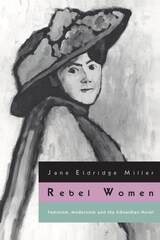
Rebel Women
Feminism, Modernism and the Edwardian NovelJane Eldridge Miller
University of Chicago Press, 1996
"Miller's is the best account we have, not only of Edwardian women novelists, but of early 20th-century women novelists; the measure of her achievement is that the distinction no longer seems workable." —David Trotter, The London Review of Books
Rebellion and Realignment
Arkansas's Road to SecessionJames M. Woods
University of Arkansas Press, 1987
Arkansas, the Old South’s last frontier, was forced, after the election of Lincoln, to face the issue of secession. A decade earlier, the state had spurned all efforts from within to withdraw from the Union, but the following ten years drew Arkansas deeper into the economic and cultural community that bound it to the other slaveholding states. Now rumblings of secession were heard even before the president-elect assumed office on March 4, 1861. The question was asked on street corners, in offices, barbershops and living rooms: Would Arkansas leave the Union?
Answers to that question caused a fundamental realignment of politics in Arkansas during the winter of 1860–61. The former political coalition of Democrat and Whig fell away in a geographical split between the uplands and the lowlands. In this important and exciting book, the first to tell the story of Arkansas’s road to secession, James Woods examines the differences between uplanders, whose mountain regions offered little useful farmland for any crop, and lowlanders, whose vast deltas were ideally suited for cotton farming. The southern portion of the state began to rely increasingly upon slavery as it became linked to the economy of cotton and Southern antebellum values, but the northern region of the state did not. Woods focuses upon the resulting social, economic, and geographic divisions that grew within Arkansas before and during the secession crisis. He captures the political struggles of the state as it tore away from the nation, and as it threatened, in so doing, to tear itself apart.
Rebellion in the Backlands
Euclides da Cunha
University of Chicago Press, 1957
Euclides da Cunha's classic account of the brutal campaigns against religious mystic Antonio Conselheiro has been praised by readers around the world as perhaps the greatest book ever written about Brazil. An epic of nonfiction that reads like a novel, it has been hailed by the likes of Stefan Zweig and Elizabeth Hardwick for its prose and its insights into the character of Brazil as the nation was being formed. Da Cunha tells the story of a guerrilla rebellion in the remote village of Canudos that fought the central government from 1893 to 1897, of the challenging conditions that led the people to revolt, and of the violent repression that resulted. A national epic like no other, Rebellion in the Backlands is a lasting classic, a book that has been handed from reader to reader for decades.
Rebellion in the Ranks
Mutinies of the American RevolutionJohn A. Nagy
Westholme Publishing, 2007
How General Washington Avoided the Peril From Within His Own Forces
"It gives me great pain to be obliged to solicit the attention of the honorable Congress to the state of the army...the greater part of the army is in a state not far from mutiny...I know not to whom to impute this failure, but I am of the opinion, if the evil is not immediately remedied and more punctuality observed in future, the army must absolutely break up."—George Washington, September 1775
Mutiny has always been a threat to the integrity of armies, particularly under trying circumstances, and since Concord and Lexington, mutiny had been the Continental Army's constant traveling companion. It was not because the soldiers lacked resolve to overturn British rule or had a lack of faith in their commanders. It was the scarcity of food—during winter months it was not uncommon for soldiers to subsist on a soup of melted snow, a few peas, and a scrap of fat—money, clothing, and proper shelter, that forced soldiers to desert or organize resistance. Mutiny was not a new concept for George Washington. During his service in the French and Indian War he had tried men under his command for the offense and he knew that disaffection and lack of morale in an army was a greater danger than an armed enemy.
In Rebellion in the Ranks: Mutinies of the American Revolution, John A. Nagy provides one of the most original and valuable contributions to American Revolutionary War history in recent times. Mining previously ignored British and American primary source documents and reexamining other period writings, Nagy has corrected misconceptions about known events, such as the Pennsylvania Line Mutiny, while identifying for the first time previously unknown mutinies. Covering both the army and the navy, Nagy relates American officers' constant struggle to keep up the morale of their troops, while highlighting British efforts to exploit this potentially fatal flaw.
Rebellion or Revolution?
Harold Cruse
University of Minnesota Press, 2009
A classic work of African American cultural, social, and political thought by a forerunner of the Black Power movement
One of the leading writers of African American intellectual life in the second half of the twentieth century, Harold Cruse first came to international attention in 1967 with the publication of his influential and inflammatory book, The Crisis of the Negro Intellectual. This fiercely opinionated and deeply informed critique of both integrationism and black nationalism established Cruse as a bold new voice on race and resistance in America.
First published in the wake of The Crisis of the Negro Intellectual’s success, Rebellion or Revolution? collects reviews and essays Cruse wrote between 1950 and 1966, examining the relevance of such figures as James Baldwin, Booker T. Washington, Albert Camus, and Josephine Baker, as well as such subjects as Marxism and the African American community, the economics of black nationalism, and the emerging Black Power movement. Rebellion or Revolution? contains a number of significant writings not available elsewhere.Now, with a new foreword by Cedric Johnson, this work finally emerges as both an essential document from a crucial moment in African American history and a road map to the origins and evolution of Cruse’s critical thought, asserting its importance in today’s debates on race in America.
Rebels Against War
The American Peace Movement, 1933-1983Lawrence Wittner
Temple University Press, 1984
Rebels All!
Rebels All! A Short History of the Conservative Mind in Postwar AmericaMattson, Kevin
Rutgers University Press, 2008
Outstanding Academic Title of 2008
Do you ever wonder why conservative pundits drop the word “faggot” or talk about killing and then Christianizing Muslims abroad? Do you wonder why the right’s spokespeople seem so confrontational, rude, and over-the-top recently? Does it seem strange that conservative books have such apocalyptic titles? Do you marvel at why conservative writers trumpeted the “rebel” qualities of George W. Bush just a few years back?
There is no doubt that the style of the political right today is tough, brash, and by many accounts, not very conservative sounding. After all, isn’t conservatism supposed to be about maintaining standards, upholding civility, and frowning upon rebellion? Historian Kevin Mattson explains the apparent contradictions of the party in this fresh examination of the postwar conservative mind. Examining a big cast of characters that includes William F. Buckley, Whittaker Chambers, Norman Podhoretz, Irving Kristol, Kevin Phillips, David Brooks, and others, Mattson shows how right-wing intellectuals have always, but in different ways, played to the populist and rowdy tendencies in America’s political culture. He boldly compares the conservative intellectual movement to the radical utopians among the New Left of the 1960s and he explains how conservatism has ingested central features of American culture, including a distrust of sophistication and intellectualism and a love of popular culture, sensation, shock, and celebrity.
Both a work of history and political criticism, Rebels All! shows how the conservative mind made itself appealing, but also points to its endemic problems. Mattson’s conclusion outlines how a recast liberalism should respond to the conservative ascendancy that has marked our politics for the last thirty years.
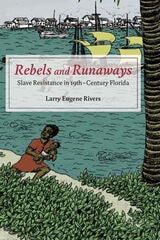
Rebels and Runaways
Slave Resistance in Nineteenth-Century FloridaLarry Eugene Rivers
University of Illinois Press, 2013
Against a smoldering backdrop of violence, this study analyzes the various degrees of slave resistance--from the perspectives of both slave and master--and how they differed in various regions of antebellum Florida. In particular, Rivers demonstrates how the Atlantic world view of some enslaved blacks successfully aided their escape to freedom, a path that did not always lead North but sometimes farther South to the Bahama Islands and Caribbean. Identifying more commonly known slave rebellions such as the Stono, Louisiana, Denmark (Telemaque) Vesey, Gabriel, and the Nat Turner insurrections, Rivers argues persuasively that the size, scope, and intensity of black resistance in the Second Seminole War makes it the largest sustained slave insurrection ever to occur in American history.
Meticulously researched, Rebels and Runaways offers a detailed account of resistance, protest, and violence as enslaved blacks fought for freedom.
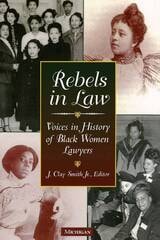
Rebels in Law
Voices in History of Black Women LawyersJ. Clay Smith, Jr., Editor
University of Michigan Press, 2000
The essays demonstrate the involvement of black women lawyers in important public issues of our time and show them addressing the sensitive subjects of race, equality, justice and freedom. Drawing together many writings that have never been published or have been published in obscure journals or newspapers, Rebels in Law is a groundbreaking study. In addition, it offers historical background information on each writer and on the history of black women lawyers. Providing an opportunity to study the origins of black women as professionals, community leaders, wives, mothers, and feminists, it will be of interest to scholars in the fields of law, history, political science, sociology, black studies and women's studies.
J. Clay Smith, Jr., is Professor of Law, Howard University Law School. He was formerly a member of the United States Equal Employment Opportunity Commission, Dean of Howard University Law School, and President of the Washington Bar Association. He is the author of Emancipation: The Making of the Black Lawyer, 1844-1944 and numerous articles.
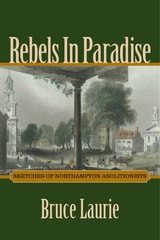
Rebels in Paradise
Sketches of Northampton AbolitionistsBruce Laurie
University of Massachusetts Press, 2014
Long ago dubbed the “Paradise of America,” Northampton, Massachusetts, is also known as the home of visionaries—from the Reverend Jonathan Edwards, father of the First Great Awakening, to George W. Benson, brother-in-law of William Lloyd Garrison and a founder of the utopian Northampton Association for Education and Industry. During the mid-nineteenth century the town became a center of political abolitionism and a hub in the Underground Railroad. In this book, Bruce Laurie profiles five rebellious figures who launched Northampton's abolitionist movement—Sylvester Judd Jr., John Payson Williston, David Ruggles, Henry Sherwood Gere, and Erastus Hopkins. Through their individual stories he traces the evolution of the antislavery movement in western Massachusetts and links it to broader developments in economics, civil life, and political affairs.
Northampton's abolitionists were a heterodox group, yet most were intrepid devotees of democracy and racial equality, idealists who enjoyed genuine friendships and political alliances with African Americans. Several even took the bold step of hiring African Americans in their businesses. They avoided the doctrinal rivalries that sometimes troubled the antislavery movement in other places, skillfully steering clear of the xenophobic nativism that infected Massachusetts politics in the mid–1850s and divided the Republican Party at large. Although a prohibitionist faction disrupted the Northampton abolitionist movement for a time, the leaders prevailed on the strength of their personal prestige and political experience, making the seat of Hampshire County what one of them called an abolitionist “stronghold.”