Results by title
788 books match the query 'Caribbean & Latin American' and 43 start with s
Salsa Consciente
Politics, Poetics, and Latinidad in the Meta-BarrioAndrés Espinoza Agurto
Michigan State University Press, 2021

Salvador Allende
Revolutionary Democrat: Revolutionarvy DemocratVictor Figueroa Clark
Pluto Press, 2013
This is a political biography of one of the 20th century’s most emblematic left-wing figures - Salvador Allende, who was president of Chile until he was ousted by General Pinochet in a US-supported coup in 1973.
Victor Figueroa Clark guides us through Allende's life and political project, answering some of the most frequently asked questions. Was he a revolutionary or a reformist? A bureaucrat or inspirational democrat? Clark argues that Allende and the Popular Unity Party created a unique fusion which was both revolutionary and democratic.
The process led by Allende was a symbol of hope for the left during his short time in power. Forty years on, and with left governments back in power across Latin America, this book looks back at the man and the process in order to draw vital lessons for the left in Latin America and around the world today.
Samurai in the Land of the Gaucho
Transpacific Modernity and Nikkei Literature in ArgentinaKoichi Hagimoto
Vanderbilt University Press, 2023
In the early twentieth century, historical imaginings of Japan contributed to the Argentine vision of “transpacific modernity." Intellectuals such as Eduardo Wilde and Manuel Domecq García celebrated Japanese customs and traditions as important values that can be integrated into Argentine society. But a new generation of Nikkei or Japanese Argentines is rewriting this conventional narrative in the twenty-first century. Nikkei writers such as Maximiliano Matayoshi and Alejandra Kamiya are challenging the earlier, unapologetic view of Japan based on their own immigrant experiences.
Compared to the experience of political persecution against Japanese immigrants in Brazil and Peru, the Japanese in Argentina generally lived under a more agreeable sociopolitical climate. In order to understand the "positive" perception of Japan in Argentine history and literature, Samurai in the Land of the Gaucho turns to the current debate on race in Argentina, particularly as it relates to the discourse of whiteness. One of the central arguments is that Argentina's century-old interest in Japan represents a disguised method of (re)claiming its white, Western identity.
Through close readings of diverse genres (travel writing, essay, novel, short story, and film) Samurai in the Land of the Gaucho yields a multi-layered analysis in order to underline the role Japan has played in both defining and defying Argentine modernity from the twentieth century to the present.
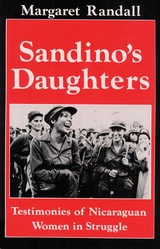
Sandino's Daughters
Testimonies of Nicaraguan Women in StruggleRandall, Margaret
Rutgers University Press, 1995
"A collection of varied and amazing lives, all bent on shaping history. Together, these experienced, undeterred Nicaraguan women offer powerful clues about a truly revolutionary and democratizing feminism."––Adrienne Rich
"If it were not for writers like Margaret, how would women around the world find each other when there is such an institutional effort to keep us apart and silent? Here Margaret brings us the voice of Sandino's daughters, honoring his hat and wearing their own, wiser now, having been part of political and personal revolution."––Holly Near
"Powerful, moving, and challenging. Everyone interested in decency and justice will want to read Sandino's Daughters Revisited."––Blanche Wiesen Cook
Sandino's Daughters, Margaret Randall's conversations with Nicaraguan women in their struggle against the dictator Somoza in 1979, brought the lives of a group of extraordinary female revolutionaries to the American and world public. The book remains a landmark. Now, a decade later, Randall returns to interview many of the same women and others. In Sandino's Daughters Revisited, they speak of their lives during and since the Sandinista administration, the ways in which the revolution made them strong––and also held them back. Ironically, the 1990 defeat of the Sandinistas at the ballot box has given Sandinista women greater freedom to express their feelings and ideas.
Randall interviewed these outspoken women from all walks of life: working-class Diana Espinoza, head bookkeeper of a employee-owned factory; Daisy Zamora, a vice minister of culture under the Sandinistas; and Vidaluz Meneses, daughter of a Somozan official, who ties her revolutionary ideals to her Catholicism. The voices of these women, along with nine others, lead us to recognize both the failed promises and continuing attraction of the Sandinista movement for women. This is a moving account of the relationship between feminism and revolution as it is expressed in the daily lives of Nicaraguan women.
Satire in Colonial Spanish America
Turning the New World Upside DownBy Julie Greer Johnson
University of Texas Press, 1993
Satire, the use of criticism cloaked in wit, has been employed since classical times to challenge the established order of society. In colonial Spanish America during the sixteenth through the eighteenth centuries, many writers used satire to resist Spanish-imposed social and literary forms and find an authentic Latin American voice. This study explores the work of eight satirists of the colonial period and shows how their literary innovations had a formative influence on the development of the modern Latin American novel, essay, and autobiography.
The writers studied here include Sor Juana Inés de la Cruz, Juan del Valle y Caviedes, Cristóbal de Llerena, and Eugenio Espejo. Johnson chronicles how they used satire to challenge the "New World as Utopia" myth propagated by Spanish authorities and criticize the Catholic church for its role in fulfilling imperialistic designs. She also shows how their marginalized status as Creoles without the rights and privileges of their Spanish heritage made them effective satirists. From their writings, she asserts, emerges the first self-awareness and national consciousness of Spanish America.
By linking the two great periods of Latin American literarure—the colonial writers and the modern generation—Satire in Colonial Spanish America makes an important contribution to Latin American literature and culture studies. It will also be of interest to all literary scholars who study satire.
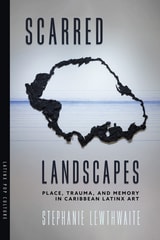
Scarred Landscapes
Place, Trauma, and Memory in Caribbean Latinx ArtStephanie Lewthwaite
University of Arizona Press, 2025
The book combines formal analysis with artist testimony, exhibition histories, and theoretical frameworks from trauma, memory, and archipelagic studies, to offer a multifaceted examination of Caribbean Latinx art. Lewthwaite explores how these artists practice “archipelagic memory,” a generative, decolonial, and coalitional form of memory work that envisions alternative modes of belonging in difference and solidarity with others. By connecting different people, pasts, and places, Caribbean Latinx artists expose the reverberations of trauma while imagining other worlds beyond it.
This work puts Caribbean Latinx artists at the center of debates about the exclusions of dominant memory narratives and contemporary art worlds, highlighting their contributions to a wider decolonial project of remembrance. By revealing the interconnectedness of traumatic histories and the potential for art to foster empathy and justice, Lewthwaite’s work underscores the importance of relational and decolonial thought for imagining a better society.
Science Fiction in Argentina
Technologies of the Text in a Material MultiverseJoanna Page
University of Michigan Press, 2016
Science Fusion in Contemporary Mexican Literature
Brian T. Chandler
Bucknell University Press, 2024
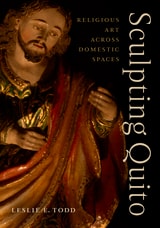
Sculpting Quito
Religious Art across Domestic SpacesLeslie E. Todd
University of Texas Press, 2026
A study of domestic religious sculptures in Quito.
During the eighteenth century, the colonial capital of Quito established itself as a prolific producer of wooden polychrome sculpture. With large glass eyes, smooth shiny surfaces, and minute attention to detail, the sculptures possessed an artistic refinement that enchanted contemporaries. While these objects depicted Christian sacred personages, they were not always sequestered in churches and shrines. They filled domestic spaces, becoming signifiers not only of holiness but also of a distinctive Quitenian culture.
Devotional sculpture was, on its face, an aesthetic reifiction of the colonial project, commissioned by creole elites. However, drawing on published accounts and archival evidence, including wills and dowries, Leslie Todd shows that sculpture was diffused across society, contributing to a complex localized identity. As makers, viewers, and owners of sculpture, Quiteños of Indigenous and mixed heritage and varying socioeconomic backgrounds took active roles in creating the city’s visual culture. In doing so, Todd argues, they simultaneously underscored and challenged colonial class and power systems, investing a European form with styles that revealed and reinforced specifically Spanish American subjectivity.
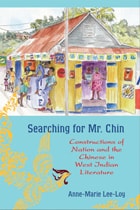
Searching for Mr. Chin
Constructions of Nation and the Chinese in West Indian LiteratureAuthored by Anne-Marie Lee-Loy
Temple University Press, 2010
What do twentieth-century fictional images of the Chinese reveal about the construction of nationhood in the former West Indian colonies? In her groundbreaking interdisciplinary work, Searching for Mr. Chin, Anne-Marie Lee-Loy seeks to map and understand a cultural process of identity formation: “Chineseness” in the West Indies.
Reading behind the stereotypical image of the Chinese in the West Indies, she compares fictional representations of Chinese characters in Jamaica, Trinidad, and Guyana to reveal the social and racial hierarchies present in literature by popular authors such as V.S. Naipaul and Samuel Selvon, as well as lesser known writers and hard to access literary texts.
Using historical, discursive, and theoretical frameworks for her literary analysis, Lee-Loy shows how the unstable and ambiguous “belonging” afforded to this “middleman minority” speaks to the ways in which narrative boundaries of the nation are established. In addition to looking at how Chinese have been viewed as “others,” Lee-Loy examines self-representations of “Chineseness” and how they complicate national narratives of belonging.
Selected Poems of Rubén Darío
By Rubén Darío
University of Texas Press, 1965
Toward the close of the last century, the poetry of the Spanish-speaking world was pallid, feeble, almost a corpse. It needed new life and a new direction. The exotic, erratic, revolutionary poet who changed the course of Spanish poetry and brought it into the mainstream of twentieth-century Modernism was Félix Rubén García Sarmiento (1867-1916) of Nicaragua, who called himself Rubén Darío.
Since its original publication in 1965, this edition of Darío's poetry has made English-speaking readers better acquainted with the poet who, as Enrique Anderson Imbert said, "divides literary history into 'before' and 'after.'" The selection of poems is intended to represent the whole range of Darío's verse, from the stinging little poems of Thistles to the dark, brooding lines of Songs of the Argentine and Other Poems. Also included, in the Epilogue, is a transcript of a radio dialogue between two other major poets, Federico García Lorca of Spain and Pablo Neruda of Chile, who celebrate the rich legacy of Rubén Darío.
Selected Poetry of Delmira Agustini
Poetics of ErosEdited and Translated by Alejandro Cáceres. Foreword by Willis Barnstone.
Southern Illinois University Press, 2008
This graceful translation and bilingual edition, now in paperback, is the first to bring English readers a representative sampling of the poetry Delmira Agustini published before her untimely death on July 6, 1914 at the age of twenty-seven. Translated by native Uruguayan Alejandro Cáceres and including work from each of Agustini's four published books, Selected Poetry of Delmira Agustini: Poetics of Eros is a response to a resurgent interest not just in the poems but in the passionate and daring woman behind them and the social and political world she inhabited.
Delmira Agustini was born in Montevideo, Uruguay, on October 24, 1886 to wealthy parents of German and Italian descent. She published her first volume of poetry when she was twenty-one and followed with two more in the next six years: the fourth volume was a posthumous publication. Her life was cut short in 1914, when Enrique Job Reyes, her ex-husband, shot her to death and then turned the gun on himself.
Carefully selected for this bilingual, en face edition, the poems collected here track and highlight Agustini's development and strengths as an artist—including her methods of experimentation, first relying on modernista forms and later abandoning them—and her focus on the figure of the male, which she portrays as the crux of devotion and attention but deems ultimately unreachable. Cáceres's introduction presents biographical information and situates Agustini's work and life in a larger political, historical, and literary context, particularly the modernismo movement, whose followers broke linguistic and political ties with the pathos and excesses of romanticism.
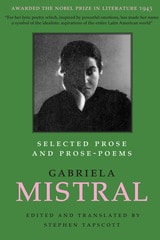
Selected Prose and Prose-Poems
By Gabriela Mistral
University of Texas Press, 2002
The first Latin American to receive a Nobel Prize for Literature, the Chilean writer Gabriela Mistral (1889-1957) is often characterized as a healing, maternal voice who spoke on behalf of women, indigenous peoples, the disenfranchised, children, and the rural poor. She is that political poet and more: a poet of philosophical meditation, self-consciousness, and daring. This is a book full of surprises and paradoxes. The complexity and structural boldness of these prose-poems, especially the female-erotic prose pieces of her first book, make them an important moment in the history of literary modernism in a tradition that runs from Baudelaire, the North American moderns, and the South American postmodernistas. It's a book that will be eye-opening and informative to the general reader as well as to students of gender studies, cultural studies, literary history, and poetry.
This Spanish-English bilingual volume gathers the most famous and representative prose writings of Gabriela Mistral, which have not been as readily available to English-only readers as her poetry. The pieces are grouped into four sections. "Fables, Elegies, and Things of the Earth" includes fifteen of Mistral's most accessible prose-poems. "Prose and Prose-Poems from Desolación / Desolation [1922]" presents all the prose from Mistral's first important book. "Lyrical Biographies" are Mistral's poetic meditations on Saint Francis and Sor Juana de la Cruz. "Literary Essays, Journalism, 'Messages'" collects pieces that reveal Mistral's opinions on a wide range of subjects, including the practice of teaching; the writers Alfonso Reyes, Alfonsina Storni, Rainer Maria Rilke, and Pablo Neruda; Mistral's own writing practices; and her social beliefs. Editor/translator Stephen Tapscott rounds out the volume with a chronology of Mistral's life and a brief introduction to her career and prose.
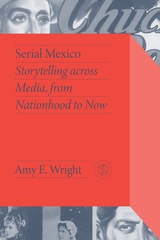
Serial Mexico
Storytelling across Media, from Nationhood to NowAmy E. Wright
Vanderbilt University Press, 2023
Honorable Mention, Premio al Mejor Libro en Humanidades, Latin American Studies Association–Mexico Section, 2025
No book until now has tied in two centuries of Mexican serial narratives—tales of glory, of fame, and of epic characters, grounded in oral folklore—with their subsequent retelling in comics, radio, and television soap operas. Wright’s multidisciplinary Serial Mexico delves into this storytelling tradition: examining the nostalgic tales reimagined in novelas, radionovelas, telenovelas and onwards, and examining the foundational figures who have been woven into society.
This panorama shows the Mexican experience of storytelling from the country’s early days until now, showcasing protagonists that mock authority, make light of hierarchy, and embrace the hybridity and mestizaje of Mexico. These tales reflect on and respond to crucial cultural concerns such as family, patriarchy, gender roles, racial mixing, urbanization, modernization, and political idealism. Serial Mexico thus examines how serialized storytelling’s melodrama and sensationalism reveals key political and cultural messaging.
In a detailed yet accessible style, Wright describes how these stories have continued to morph with current times’ concerns and social media. Will tropes and traditions carry on in new and reimagined serial storytelling forms? Only time will tell. Stay tuned for the next episode.
Seriously Funny
Mexican Political Jokes as Social ResistanceSamuel Schmidt, Translated by Adam Schmidt
University of Arizona Press, 2014
Now available in English for the first time, Seriously Funny is a groundbreaking work. Its goal is to examine the ways in which political humor—including nicknames, anagrams, poems, and parodies of religious prayers, in addition to jokes—has developed and operated in one country over more than four centuries. Although political humor thrives in Mexico, it is often cleverly encoded so that it doesn’t appear to be critical of government policies or officials. But, writes Samuel Schmidt, that is precisely its purpose: to question the actions and assumptions of the party in power. Schmidt argues persuasively that political jokes are acts of minor rebellion: their objective is not to overthrow a government but to correct its mistakes.
Seven Trees Against the Dying Light
A Bilingual EditionPablo Antonio Cuadra
Northwestern University Press, 2007
Standing against the visible landscape—the mountainous volcanoes, the jungles and savannahs—the seven trees conjured in these narrative poems by one of Latin America's masters also evoke another, more mysterious terrain. It is this other landscape, as invisible as poetry before it is written down but etched by history and animated by the collective memory of a people, that speaks through Pablo Antonio Cuadra’s Seven Trees against the Dying Light.
Storing experience as they exist, these tree-poems conserve local soil and memory in the place they inhabit. They are figures of life, stained by seawater and gun powder, by the bright red, bittersweet juice of the many life-giving plums that flourish in Nicaragua, and blood that has been spilled there. And they offer a way of remembering who we are, where we come from, and, above all, where we are bound if we cannot learn to root language in the earth that sustains us.
Printed here in Spanish with facing English translations, the edition includes an introduction with ecocritical focus, as well as complete notes on botanical, historical, mythological, and socio-political references.
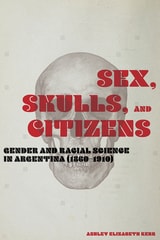
Sex, Skulls, and Citizens
Gender and Racial Science in Argentina (1860-1910)Ashley Elizabeth Kerr
Vanderbilt University Press, 2020
PROSE Awards Subject Category Finalist—Biological Anthropology, Ancient History, and Archaeology, 2021
Best Nineteenth-Century Book Award, Latin American Studies Association Nineteenth-Century Section, 2021
Analyzing a wide variety of late-nineteenth-century sources, Sex, Skulls, and Citizens argues that Argentine scientific projects of the era were not just racial encounters, but were also conditioned by sexual relationships in all their messy, physical reality.
The writers studied here (an eclectic group of scientists, anthropologists, and novelists, including Estanislao Zeballos, Lucio and Eduarda Mansilla, Ramón Lista, and Florence Dixie) reflect on Indigenous sexual practices, analyze the advisability and effects of interracial sex, and use the language of desire to narrate encounters with Indigenous peoples as they try to scientifically pinpoint Argentina's racial identity and future potential.
Kerr's reach extends into history of science, literary studies, and history of anthropology, illuminating a scholarly time and place in which the lines betwixt were much blurrier, if they existed at all.
Sexual Textualities
Essays on Queer/ing Latin American WritingBy David William Foster
University of Texas Press, 1997
Since the 1991 publication of his groundbreaking book Gay and Lesbian Themes in Latin American Writing, David William Foster has proposed a series of theoretical and critical principles for the analysis of Latin American culture from the perspectives of the queer. This book continues that project with a queer reading of literary and cultural aspects of Latin American texts.
Moving beyond its predecessor, which provided an initial inventory of Latin American gay and lesbian writing, Sexual Textualities analyzes questions of gender representation in Latin American cultural productions to establish the interrelationships, tensions, and irresolvable conflicts between heterosexism and homoeroticism. The topics that Foster addresses include Eva Peron as a cultural/sexual icon, feminine pornography, Luis Humberto Hermosillo's classic gay film Doña Herlinda y su hijo, homoerotic writing and Chicano authors, Matias Montes Huidobro's Exilio and the representation of gay identity, representation of the body in Alejandra Pizarnik's poetry, and the crisis of masculinity in Argentine fiction from 1940 to 1960.
Sexuality and Being in the Poststructuralist Universe of Clarice Lispector
The Différance of DesireBy Earl E. Fitz
University of Texas Press, 2001
Driven by an unfulfilled desire for the unattainable, ultimately indefinable Other, the protagonists of the novels and stories of acclaimed Brazilian writer Clarice Lispector exemplify and humanize many of the issues central to poststructuralist thought, from the nature of language, truth, and meaning to the unstable relationships between language, being, and reality. In this book, Earl Fitz demonstrates that, in turn, poststructuralism offers important and revealing insights into all aspects of Lispector's writing, including her style, sense of structure, characters, themes, and socio-political conscience.
Fitz draws on Lispector's entire oeuvre—novels, stories, crônicas, and children's literature—to argue that her writing consistently reflects the basic tenets of poststructuralist theory. He shows how Lispector's characters struggle over and humanize poststructuralist dilemmas and how their essential sense of being is deeply dependent on a shifting, and typically transgressive, sense of desire and sexuality.
Shaming into Brown
Somatic Transactions of Race in Latina/o LiteratureStephanie Fetta
The Ohio State University Press, 2018
In Shaming into Brown: Somatic Transactions of Race in Latina/o Literature, Stephanie Fetta asserts that our bodies are fundamental to how we live and how we make meaning. Anchored by two psychoanalytic theories, bioenergetic analysis developed by Alexander Lowen and affect theory put forth by Silvan Tomkins, Fetta examines Latinx fiction to draw attention to the cultural role of the intelligent, emotional, and communicative body—the soma—in relation to shame. She argues that we bring the soma—the physical, emotive, and social register of our subjectivity—to the text as we do to our lives,proposing that the power of racialization operates at the level of somatic expression and reception through habituated, socially cued behaviors that are not readily subject to intentional control.
Fetta examines shame beyond individual experiences, looking at literary renderings of the cultural practice of racial shaming that are deeply embedded into our laws, hiring practices, marketing strategies, and more. Grounding her analysis in the works of Gloria Anzaldúa and Cherríe Moraga, Shaming into Brown focuses on exposing the underpinnings of racialized shame and does so through analyzing “scenes of racialization” in prominent works by authors such as Junot Díaz, Sandra Cisneros, and Oscar Zeta Acosta.

Shaping Migration between Europe and Latin America
New Perspectives and ChallengesEdited by Ana Margheritis
University of London Press, 2018
Signs of Borges
Sylvia Molloy
Duke University Press, 1994
Borges's sustained practice of the uncanny gives rise in his texts to endless tensions between illusion and meaning, and to the competing desires for fragmentation, dispersal, and stability. Molloy traces the movement of Borges's own writing by repeatedly spanning the boundaries of genre and cutting across the conventional separations of narrative, lyric and essay, fact and fiction. Rather than seeking to resolve the tensions and conflicts, she preserves and develops them, thereby maintaining the potential of these texts to disturb. At the site of these tensions, Molloy locates the play between meaning and meaninglessness that occurs in Borges's texts. From this vantage point his strategies of deception, recourse to simulacra, inquisitorial urge to unsettle binarism, and distrust of the permanent--all that makes Borges Borges--are examined with unmatched skill and acuity.
Elegantly written and translated, Signs of Borges presents a remarkable and dynamic view of one of the most international and compelling writers of this century. It will be of great interest to all students of twentieth-century literature, particularly to students of Latin American literature.
Signs of the Americas
A Poetics of Pictography, Hieroglyphs, and KhipuEdgar Garcia
University of Chicago Press, 2020
Garcia tells the story of the present life of these sign-systems, examining the contemporary impact they have had on poetry, prose, visual art, legal philosophy, political activism, and environmental thinking. In doing so, he brings together a wide range of indigenous and non-indigenous authors and artists of the Americas, from Aztec priests and Amazonian shamans to Simon Ortiz, Gerald Vizenor, Jaime de Angulo, Charles Olson, Cy Twombly, Gloria Anzaldúa, William Burroughs, Louise Erdrich, Cecilia Vicuña, and many others. From these sources, Garcia depicts the culture of a modern, interconnected hemisphere, revealing that while these “signs of the Americas” have suffered expropriation, misuse, and mistranslation, they have also created their own systems of knowing and being. These indigenous systems help us to rethink categories of race, gender, nationalism, and history. Producing a new way of thinking about our interconnected hemisphere, this ambitious, energizing book redefines what constitutes a “world” in world literature.
Sky Below
Selected WorksRaul Zurita; Translated from the Spanish and with an introduction by Anna Deeny Morales
Northwestern University Press, 2016
Social Exchange
Barter as Economic and Cultural Activism in Medellín, ColombiaBrian J. Burke
Rutgers University Press, 2022
Social Fabric
Art and Activism in Contemporary BrazilEdited by Maria Emilia Fernandez, Adele Nelson, and MacKenzie Stevens
University of Texas Press, 2023
Social Fabric: Art and Activism in Contemporary Brazil brings together the work of ten artists who reflect upon the long-standing histories of oppressive power structures in the territory now known as Brazil. Blurring the line between art and activism and spanning installation, painting, performance, photography, sculpture, and video, these artists contribute to local and global conversations about the state of democracy, racial injustice, and the violence inflicted by the nation-state. This first English-language, book-length study of contemporary Brazilian art in relationship to activism assembles artist-authored texts, interviews, essays, and a conceptual mapping of Brazilian history to illuminate the function of art as a platform for critical engagement with the historical, political, and cultural configurations of a particular place. By refusing to remain neutral, these artists create spaces of vibrant and vital community and self-construction to explore how healing and justice may be possible, especially in the Black, LGBTQIA+, and Indigenous communities to which many of them belong.
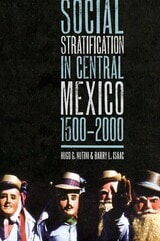
Social Stratification in Central Mexico, 1500-2000
By Hugo G. Nutini and Barry L. Isaac
University of Texas Press, 2009
In Aztec and colonial Central Mexico, every individual was destined for lifelong placement in a legally defined social stratum or estate. Social mobility became possible after independence from Spain in 1821 and increased after the 1910–1920 Revolution. By 2000, the landed aristocracy that was for long Mexico's ruling class had been replaced by a plutocracy whose wealth derives from manufacturing, commerce, and finance—but rapid growth of the urban lower classes reveals the failure of the Mexican Revolution and subsequent agrarian reform to produce a middle-class majority. These evolutionary changes in Mexico's class system form the subject of Social Stratification in Central Mexico, 1500–2000, the first long-term, comprehensive overview of social stratification from the eve of the Spanish Conquest to the end of the twentieth century.
The book is divided into two parts. Part One concerns the period from the Spanish Conquest of 1521 to the Revolution of 1910. The authors depict the main features of the estate system that existed both before and after the Spanish Conquest, the nature of stratification on the haciendas that dominated the countryside for roughly four centuries, and the importance of race and ethnicity in both the estate system and the class structures that accompanied and followed it. Part Two portrays the class structure of the post-revolutionary period (1920 onward), emphasizing the demise of the landed aristocracy, the formation of new upper and middle classes, the explosive growth of the urban lower classes, and the final phase of the Indian-mestizo transition in the countryside.
Song of the Heart
Selected Poems by Ramón López VelardeBy Ramón López Velarde
University of Texas Press, 1995
Ramón López Velarde (1888-1921) was one of the most Mexican of Mexican poets, whose sense of history found expression in many poems, including his best-known "La suave Patria" ("Sweet Land"). This bilingual collection, drawn primarily from Poesías completas y el minutero, offers English-language readers our first book-length introduction to his poetry.
Often called a "poet of the provinces," López Velarde gives us a glimpse into a slower and more gentle way of life. His poems present the contrast between city and hometown and between urban and pastoral landscapes. Through these contrasts runs the thread of religious faith, while urgency of language informs the entire body of his poetic production.
Original, specially commissioned drawings by noted contemporary Mexican artist Juan Soriano complement the poems. This combination of poetry and art speaks to universal emotions; indeed the poetry of López Velarde belongs to everyone who sings the Song of the Heart.
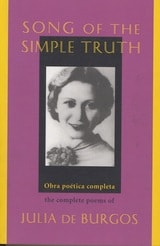
Song of the Simple Truth
The Complete Poems of Julia de BurgosJulia de Burgos
Northwestern University Press, 1995
Songs of Life and Hope/Cantos de vida y esperanza
Rubén Darío
Duke University Press, 2004
Written over the course of seven years and in many locales in Latin America and Europe, the poems in Cantos de vida y esperanza reflect both Darío’s anguished sense of modern life and his ecstatic visions of transcendence, freedom, and the transformative power of art. They reveal Darío’s familiarity with Spanish, French, and English literature and the wide range of his concerns—existential, religious, erotic, and socio-political. Derusha and Acereda’s translation renders Darío’s themes with meticulous clarity and captures the structural and acoustic dimensions of the poet’s language in all its rhythmic sonority. Their introduction places this singular poet—arguably the greatest to emerge from Latin America in modern literature—and his best and most widely known work in historical and literary context. An extensive glossary offers additional information, explaining terms related to modernismo, Hispanic history, mythological allusions, and artists and writers prominent at the turn of the last century.
Sor Juana's Love Poems
Sor Juana Inés de la Cruz; Translated by Joan Larkin and Jaime Manrique
University of Wisconsin Press, 2003
These exquisite love poems, some of them clearly addressed to women, were written by the visionary and passionate genius of Mexican letters, the seventeenth-century nun Sor Juana Inés de la Cruz. In this volume they are translated into the idiom of our own time by poets Joan Larkin and Jaime Manrique. Some of them are rooted in Renaissance courtly conventions; others are startlingly ahead of their time, seemingly modern in the naked power of the complex sexual feelings they address.
Spanish American Poetry at the End of the Twentieth Century
Textual DisruptionsBy Jill Kuhnheim
University of Texas Press, 2005
Has poetry lost its relevance in the postmodern age, unable to keep pace with other forms of cultural production such as film, mass media, and the Internet? Quite the contrary, argues Jill Kuhnheim in this pathfinding book, which explores how recent Spanish American poetry participates in the fundamental cultural debates of its time.
Using a variety of interdisciplinary approaches, Kuhnheim engages in close readings of numerous poetic works to show how contemporary Spanish American poetry struggles with the divisions between politics and aesthetics and between visual and written images; grapples with issues of ethnic, national, sexual, and urban identities; and incorporates rather than rejects technological innovations and elements from the mass media. Her analysis illuminates the ways in which contemporary issues such as indigenismo and Latin America's postcolonial legacy, modernization, immigration, globalization, economic shifts toward neoliberalism and informal economies, urbanization, and the technological revolution have been expressed in—and even changed the very form of—Spanish American poetry since the 1970s.
Spanish Perspectives on Chicano Literature
Literary and Cultural EssaysVanessa Fonseca and Jesús Rosales
The Ohio State University Press, 2017
For Chicanos this interest is intriguing, for they see Spain’s vision of the Chicano both with inviting enthusiasm and justifiable reservation—enthusiasm because this interest shows a humanistic concern in understanding their social issues (national identity, bilingualism, immigration, feminism, and so on) in relation to Spain’s own, and reservation because there still prevails an “open wound” from their historical connection with that country. In other words, a lingering Spanish colonial presence still exists in the Chicano psyche. These Spanish perspectives are important to consider as Chicano literature reflects on its place in twenty-first-century America and its transnational and global aspirations.
Spanish and Empire
Nelsy Echavez-Solano
Vanderbilt University Press, 2007
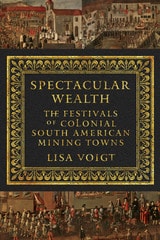
Spectacular Wealth
The Festivals of Colonial South American Mining TownsBy Lisa Voigt
University of Texas Press, 2016
Bridging print culture and performance, Spectacular Wealth draws on eighteenth-century festival accounts to explore how colonial residents of the silver-mining town of Potosí, in the viceroyalty of Peru, and the gold-mining region of Minas Gerais, in Brazil, created rich festive cultures that refuted European allegations of barbarism and greed. In her examination of the festive participation of the towns’ diverse inhabitants, including those whose forced or slave labor produced the colonies’ mineral wealth, Lisa Voigt shows how Amerindians, Afro-descendants, Europeans, and creoles displayed their social capital and cultural practices in spectacular performances.
Tracing the multiple meanings and messages of civic festivals and religious feast days alike, Spectacular Wealth highlights the conflicting agendas at work in the organization, performance, and publication of festivals. Celebrants and writers in mining boomtowns presented themselves as far more than tributaries yielding mineral wealth to the Spanish and Portuguese empires, using festivals to redefine their reputations and to celebrate their cultural, spiritual, and intellectual wealth.
Specters of War
The Battle of Mourning in Postconflict Central AmericaIgnacio Sarmiento
University of Arizona Press, 2025
Specters of War explores mourning practices in postwar Central America, particularly in El Salvador and Guatemala. Ignacio Sarmiento delves into the intricate dynamics of grieving through an interdisciplinary lens, analyzing expressions of mourning in literature, theater, and sites of memory. At the heart of this analysis is the contention over who has the right to mourn, how mourning is performed, and who is included in this process. Sarmiento reveals mourning not as a private affair but as a battleground where different societal factions vie for the possibility of grieving the dead.
Through meticulous research and theoretical nuance, Specters of War sheds light on the politics of mourning in postconflict societies. Sarmiento argues that mourning is not merely a personal experience but a deeply political act intertwined with power struggles and societal divisions. From victims of state terrorism to military elites, various groups engage in a complex dance of grief, revealing the fraught nature of public mourning in postwar Central America. By examining cultural artifacts and memorialization projects, Sarmiento uncovers the multifaceted nature of mourning and its implications for memory, justice, and reconciliation.
This groundbreaking work is essential reading for scholars, students, and professionals interested in Central American history and culture, as well as post-authoritarian societies. Specters of War promises to deepen our understanding of postwar Central America and the legacy of loss in shaping collective identities and narratives of the past.
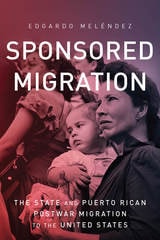
Sponsored Migration
The State and Puerto Rican Postwar Migration to the United StatesEdgardo Meléndez
The Ohio State University Press, 2017
Sponsored Migration places Puerto Rico’s migration policy in its historical context, examining the central role the Puerto Rican government played in encouraging and organizing migration during the postwar period. Meléndez sheds an important new light on the many ways in which the government intervened in the movement of its people: attempting to provide labor to U.S. agriculture, incorporating migrants into places like New York City, seeking to expand the island’s air transportation infrastructure, and even promoting migration in the public school system. One of the first scholars to explore this topic in depth, Meléndez illuminates how migration influenced U.S. and Puerto Rican relations from 1898 onward.
Struggle in the Andes
Peasant Political Mobilization in PeruBy Howard Handelman
University of Texas Press, 1975
A massive land-seizure movement first erupted in Peru in 1958 and spread across the Andean highlands in 1963–1964. Several hundred peasant communities in the Peruvian Andes occupied neighboring haciendas in an attempt to retake lands they felt had been stolen from them over the years. Hacienda peasants also participated in this movement, forming peasant sindicatos (unions) to improve their labor conditions.
The land-seizure movement brought with it an upsurge in community political mobilization. Throughout the highlands, village leaders banded together in regional federations, often allying themselves with progressive or radical urban groups. Radical activists from labor unions and university student groups joined with indigenous peasant leaders, breaking down the highland peasantry’s traditional isolation from the political system.
Struggle in the Andes is an analysis of the causes and consequences of extensive social and political mobilization among Peru’s peasant population in the 1960s. In addition to describing the growth of the peasant land movement, Howard Handelman investigates the social and economic conditions that contributed to rural unrest. Using data that he collected in forty-one diverse highland communities, Handelman examines the correlates of peasant political activity, concluding that land seizures in the traditional southern sierra had different origins and political implications than did unrest in the more socioeconomically modernized central highlands.
The data suggest a model of peasant mobilization that calls into question prevailing scholarly hypotheses on the relationships between modernization, peasant political mobilization, and radicalization. Handelman discusses the land-reform program and the accompanying rural mobilization that was being implemented by Peru’s reformist military regime. Using his model of peasant mobilization, he speculates on the possible effects of the government’s contemporary programs on future peasant political behavior.
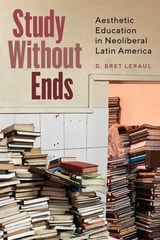
Study Without Ends
Aesthetic Education in Neoliberal Latin AmericaD. Bret Leraul
Northwestern University Press, 2026
Calls for aesthetic education to unite cultural practices of radical imagination with everyday practices of care
While Latin America was neoliberalism’s laboratory, Argentina and Chile have been crucibles for its cultural logics. In this book, D. Bret Leraul examines the rise of neoliberal culture in the Southern Cone through the educational infrastructures that disseminate and reproduce it. Leraul draws on literature and criticism, the history of higher education, and examples of recent social movements to propose a theory of cultural production for social transformation.
Study Without Ends charts the cultural consequences of introducing a neoliberal rationality into the region’s higher education landscape. The university’s increasing centrality within the literary institution and the rise of theoretical prose fiction suggest that poetics today is less about crafting literary works than instructing readers. At the same time, despite efforts to reduce education to human capital investment, it remains a process of personal and social transformation, as recent activism by Chilean students and Argentinean unemployed workers shows. In response to the compounding crises of social reproduction represented by the informal work and precarious livelihoods of people rendered surplus populations, and inspired by the decommodified labor of students, artists, women, and the unemployed, Leraul calls for a materialist aesthetic education that unites artistic culture’s practices of radical imagination and everyday culture’s practices of care.
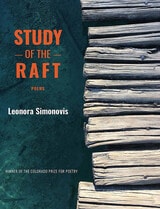
Study of the Raft
Leonora Simonovis
University Press of Colorado, 2021
In Study of the Raft, Leonora Simonovis’s poems weave the outer world of a failed political revolution in her native country, Venezuela, with an inner journey into the memories of migration and exile, of a home long gone, and of family relations, especially among womxn. The collection explores the consequences of colonization, starting with “Maps,” a poem that speaks of loss and uprootedness, recalling a time when indigenous lands were stolen and occupied, where stories were lost as new languages and beliefs were imposed on people. The politics of the present are also the politics of the past, not just in the Venezuelan context, but in many other Latin American and Caribbean countries. It is the reality of all indigenous people. Simonovis’s poems question the capacity of language to represent the complexity of lived experience, especially when it involves living from more than one language and culture. These poems wrestle with questions of life and death, of what remains after what and whom we know are no longer with us, and how we, as humans, constantly change and adjust in the face of uncertainty.
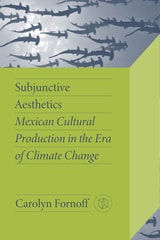
Subjunctive Aesthetics
Mexican Cultural Production in the Era of Climate ChangeCarolyn Fornoff
Vanderbilt University Press, 2024
Honorable Mention, LASA Environment Best Book Prize, Latin American Studies Association–Environment Section, 2025
During the twenty-first century, Mexico has escalated extractive concessions at the same time that it has positioned itself as an international leader in the fight against climate change. Cultural production emergent from this contradiction frames this impasse as a crisis of imagination. Subjunctive Aesthetics studies how contemporary writers, filmmakers, and visual artists grapple with the threat that climate change and extractivist policies pose to Mexico's present and future. It explores how artists rise to the challenge of envisioning alternative forms of territoriality (ways of being in relation to the environment) through strategies ranging from rewriting to counterfactual speculation.
Whereas ecocritical studies have often focused on art's evidentiary role—its ability to visualize and prove the urgency of environmental damage—author Carolyn Fornoff argues that what unites the artists under consideration is their use of more hypothetical, uncertain representational modes, or "subjunctive aesthetics." In English, the subjunctive is a grammatical mode that articulates the imagined, desired, and possible. In the Spanish language, it is even more widely used to express doubts, denials, value judgments, and emotions. Each chapter of Subjunctive Aesthetics takes up one of these modalities to examine how Mexican artists, writers, and filmmakers activate approaches to the planet not just as it is, but as it could be or should be.
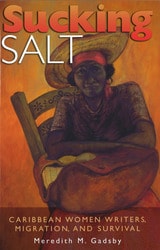
Sucking Salt
Caribbean Women Writers, Migration, and SurvivalMeredith M. Gadsby
University of Missouri Press, 2006
Supermadre
Women in Politics in Latin AmericaBy Elsa M. Chaney
University of Texas Press, 1979
The title of this book, Supermadre, is ironic. It means, not that women have begun to exercise real power in Latin American political life, but that their participation is mostly confined to roles that are extensions of their roles as mothers—health, education, welfare, for example—and then only on the lower levels of policy-making.
Elsa Chaney begins her study with an examination of various attempts to explain women's virtual absence from decision-making councils not only in Latin America but also world-wide, concluding that their motherhood role has had the profoundest effect on the nature of their political activities. She then analyzes the images and realities of women in Latin American society from colonial times to the present.
The remainder of the book is a detailed study of women in politics and government in Latin America, with emphasis on the contrasting cases of Peru and Chile. In conclusion, Chaney suggests that women will make only slow progress toward full participation in public life until they themselves stop seeing their role in politics as that of the supermadre.