Results by title
8113 books match the query 'Literary Criticism' and 542 start with s

SCOTLAND BRITAIN EMPIRE
WRITING THE HIGHLANDS, 1760-1860KENNETH MCNEIL
The Ohio State University Press, 2007
Kenneth McNeil invokes recent work in postcolonial studies to show how British writers of the Romantic period were actually shaping a more complex national and imperial consciousness. He discusses canonical works—the works of James Macpherson and Sir Walter Scott—and noncanonical and nonliterary works—particularly in the fields of historiography, anthropology, and sociology. This book calls for a rethinking of the “romanticization” of the Highlands and shows that Scottish writing on the Highlands reflects the unique circumstances of a culture simultaneously feeling the weight of imperial “anglobalization” while playing a vital role in its inception.

SEXTON
SELECTED CRITICISMEdited by Diana Hume George
University of Illinois Press, 1988
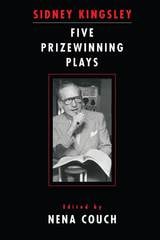
SIDNEY KINGSLEY
FIVE PRIZEWINNING PLAYSNena Couch
The Ohio State University Press, 1997
Sidney Kingsley was a playwright, but through his writing he played many other parts as well—a social and political activist, a health care reformer, an advocate for children, a patriot, a visionary. Of his nine professionaly produced plays, five garnered major awards. This collection of Kingsley’s award-winning plays fills a void in American dramatic publishing and provides the definitive edition of the plays, each with an introduction by the playwright. Although critical statements on Kingley’s work do appear in significant studies of American theatre, and though his plays continue to be produced, there has never been a standard edition of his major works.
Strong threads weave these plays inextricably into the fabric of twentieth-century American theatre—their meticulous, gut-wrenching, yet inspiring realism; their roles of great breadth for actors; their masterfully constructed scripts that in combination with outstanding design provide first-rate theatrical presentations; and perhaps most importantly, their unswerving attention to grave human issues.
At a time when abortion may again become illegal and the inadequacy of the health care system is a daily topic, when children facing hopelessness and poverty stare at us from the evening news, when police brutality cases are before the courts, and when issues of individual patriotism and the position of the United States as a democracy in a rapidly changing world arise—in a time, in fact, when all the human rights issues and social problems dealt with in these plays are still, or again, with us—Sidney Kingsley has proven to be a playwright whose work is timely as well as timeless.
Includes: Men in White, Dead End, The Patriots, Detective Story, and Darkness at Noon.
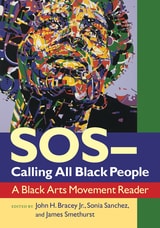
SOS—Calling All Black People
A Black Arts Movement ReaderJohn H. Bracey
University of Massachusetts Press, 2014
Many of the movement's leading artists, including Ed Bullins, Nikki Giovanni, Woodie King, Haki Madhubuti, Sonia Sanchez, Askia Touré, and Val Gray Ward remain artistically productive today. Its influence can also be seen in the work of later artists, from the writers Toni Morrison, John Edgar Wideman, and August Wilson to actors Avery Brooks, Danny Glover, and Samuel L. Jackson, to hip hop artists Mos Def, Talib Kweli, and Chuck D.
SOS—Calling All Black People includes works of fiction, poetry, and drama in addition to critical writings on issues of politics, aesthetics, and gender. It covers topics ranging from the legacy of Malcolm X and the impact of John Coltrane's jazz to the tenets of the Black Panther Party and the music of Motown. The editors have provided a substantial introduction outlining the nature, history, and legacy of the Black Arts Movement as well as the principles by which the anthology was assembled.
SPS vol 33 num 1
The University of Chicago Press
University of Chicago Press Journals, 2019
SPS vol 34 num 1
The University of Chicago Press
University of Chicago Press Journals, 2020

Sacramental Shopping
Louisa May Alcott, Edith Wharton, and the Spirit of Modern ConsumerismSarah Way Sherman
University of New Hampshire Press, 2013
Written a generation apart and rarely treated together by scholars, Little Women (1868) and The House of Mirth (1905) share a deep concern with materialism, moral development, and self-construction. The heroines in both grapple with conspicuous consumption, an aspect of modernity that challenges older beliefs about ethical behavior and core identity.
Placing both novels at the historical intersection of modern consumer culture and older religious discourse on materialism and identity, Sarah Way Sherman analyzes how Alcott and Wharton rework traditional Protestant discourse to interpret their heroines' struggle with modern consumerism. Her conclusion reveals how Little Women's optimism, still buoyed by otherworldly justice, providential interventions, and the notion of essential identity, ultimately gives way to the much darker vision of modern materialistic culture in The House of Mirth.
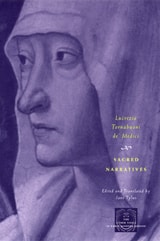
Sacred Narratives
Lucrezia Tornabuoni de' Medici
University of Chicago Press, 2001
This is the first major collection in any language of her extensive body of religious poems. Ranging from gentle lyrics on the Nativity to moving dialogues between a crucified Christ and the weeping sinner who kneels before him, the nine laudi (poems of praise) included here are among the few such poems known to have been written by a woman. Tornabuoni's five storie sacre, narrative poems based on the lives of biblical figures-three of whom, Judith, Susanna, and Esther, are Old Testament heroines-are virtually unique in their range and expressiveness. Together with Jane Tylus's substantial introduction, these poems offer us both a fascinating portrait of a highly educated and creative woman and a lively sense of cultural and social life in Renaissance Florence.
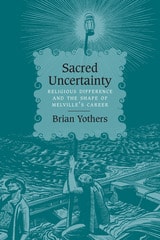
Sacred Uncertainty
Religious Difference and the Shape of Melville's CareerBrian Yothers
Northwestern University Press, 2015

Sacred and Secular Transactions in the Age of Shakespeare
Edited by Katherine Steele Brokaw and Jay Zysk
Northwestern University Press, 2019
The term “secular” inspires thinking about disenchantment, periodization, modernity, and subjectivity. The essays in Sacred and Secular Transactions in the Age of Shakespeare argue that Shakespeare’s plays present “secularization” not only as a historical narrative of progress but also as a hermeneutic process that unleashes complex and often problematic transactions between sacred and secular. These transactions shape ideas about everything from pastoral government and performative language to wonder and the spatial imagination.
Thinking about Shakespeare and secularization also involves thinking about how to interpret history and temporality in the contexts of Shakespeare’s medieval past, the religious reformations of the sixteenth century, and the critical dispositions that define Shakespeare studies today. These essays reject a necessary opposition between “sacred” and “secular” and instead analyze how such categories intersect. In fresh analyses of plays ranging from Hamlet and The Tempest to All’s Well that Ends Well and All Is True, secularization emerges as an interpretive act that explores the cultural protocols of representation within both Shakespeare’s plays and the critical domains in which they are studied and taught.
The volume’s diverse disciplinary perspectives and theoretical approaches shift our focus from literal religion and doctrinal issues to such aspects of early modern culture as theatrical performance, geography, race, architecture, music, and the visual arts.
Sacrifice Your Love
Psychoanalysis, Historicism, ChaucerL.O. Aranye Fradenburg
University of Minnesota Press, 2002
A long-awaited reevaluation of Chaucer through the lens of sacrifice by a major figure in medieval studies
Historicism and its discontents have long been central to the work of Louise Fradenburg, one of the world’s most original and provocative literary medievalists. Sacrifice Your Love brings this interest to bear on Chaucer’s writing and his world, rethought in light of a theory of sacrifice and its part in cultural production. Fradenburg writes the "history of the signifier"—a way of reading change in the symbolic order—and its role in making sacrifice enjoyable.
Sacrifice Your Love develops the idea that sacrifice is a mode of enjoyment—that our willingness to sacrifice our desire is actually a way of pursuing it. Fradenburg considers the implications of this idea for various problems important in medieval studies today—how to understand the religiosity of cultural forms, particularly chivalry, in the later Middle Ages and how to understand the ethics of Chaucer’s famously nondidactic poetry—as well as in other fields of inquiry. A major rethinking of Chaucer, Sacrifice Your Love works in depth as well as across a broad range of topics from medievalism to psychoanalysis, advancing both the theory and practice of a new kind of historicist approach.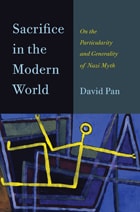
Sacrifice in the Modern World
On the Particularity and Generality of Nazi MythDavid Pan
Northwestern University Press, 2012
A landmark book, David Pan’s Sacrifice in the Modern World seeks to explain the continuing emphasis, in modern times, on sacrifice. Pan specifically turns to the culture of sacrifice—ritualized and sanctified death—in Nazi Germany, showing how that regime co-opted an existing discussion of sacrifice and infused it with its own mythology. Pan suggests that sacrifice is a key value in every society but that there is a preponderance of association of sacrifice with Nazi culture and therefore a largely pejorative treatment of sacrifice.
Surveying the arguments of philosopher Alfred Baeumler and other symptomatic Nazi texts, Pan shows how the Nazis’ reactionary intellectual culture unraveled much of the Enlightenment project. In so doing, he is able to offer a compelling new perspective on basic theoretical concepts in the work of Kant, Nietzsche, Adorno, Bataille, Girard, and others. He posits that it is only by clearing our way through the Nazis’ misuse of sacrifice that we can understand the durability of sacrificial structures that—following several of the theorists he discusses— establish the fundamental values by which we live our lives.
Rather than condemning the Nazi appeal to sacrifice itself, this book looks at the particular ways in which sacrifice was distributed and structured within that society. All cultures must grapple with the existential violence of the human condition, and they frequently do so through aesthetic treatments of sacrifice, rooted in myths and traditions. Pan argues that our task is not to eradicate these traditions but to engage them by carefully evaluating the commitments and values that they imply.
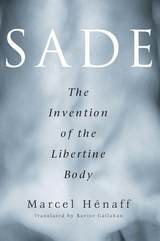
Sade
The Invention Of The Libertine BodyMarcel Henaff
University of Minnesota Press, 1999
A new model for examining Sade and his creations.
A new model for examining Sade and his creations.
Decried as a misogynist and pornographer, imprisoned for debauchery and for his writings, there is scarcely a cultural figure as flamboyant and controversial as the Marquis de Sade, the father of the new libertine body. But this is not, Hénaff maintains, the only way to see Sade. In this long-awaited English translation, Hénaff says that Sade should be discussed less for the sensual heat of his writing and more for the larger poetic and economic model his work represents.With unabashed candor, Sade describes bodies in terms not of flesh but of production, use, exchange, and waste. In his writing, this libertine self is unleashed from its constraints, no longer bound by old conceptions of desire and traditions of courtship. Hénaff’s argument that Sade is a sign of his times-exposing the courtly facade of a society unable to preserve itself-reveals dark, disquieting secrets about the direction of civilization. The libertine body, he says, is a child of this new order.ISBN 0-8166-2536-0 Cloth £34.50 $49.95xxISBN 0-8166-2537-9 Paper £14.00 $19.95x296 Pages 5 7/8 x 9 OctoberTranslation inquiries: University of Minnesota Press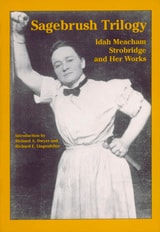
Sagebrush Trilogy
Dwayne Kling
University of Nevada Press, 1990
A comprehensive treatise on the life and works of Idah Meacham Strobridge, an American writer and bookbinder known primarily for a trio of works about the Great Basin.
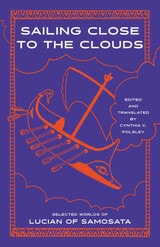
Sailing Close to the Clouds
Selected Worlds of Lucian of SamosataLucian of Samosata
University of Chicago Press, 0
Approachable translations and discussions of Lucian that reveal his world-building, world-bending, and multiversal thinking.
Lucian of Samosata was ahead of his time. A rhetorician and writer active in the second century CE, he was one of the earliest known worldbuilders and science-fiction enthusiasts. Popular and prolific in antiquity—more than eighty texts attributed to him have come down to us today, including satires, dialogues, and part of a fictional work called True History—Lucian crafted astonishing tales that unfold on the surface of the moon or other planets, high above in Earth’s atmosphere, or through the eyes of underworld inhabitants or other entities who view mortal humans as otherworldly beings.
Ideal for readers interested in science fiction, fantasy, and mythology, this accessible collection offers a guided journey through Lucian’s many worlds. Bringing together fresh vernacular translations of eight works with substantial discussion, this selection showcases Lucian as a proto-multiversal thinker, presenting multiform narratives that herald developments in modern genres ranging from literature and film to gaming and fan fiction. Translator and editor Cynthia Polsley introduces each with a short excerpt from another piece of classical literature, showing how other ancient authors—including Homer, Ovid, and Vergil—influenced Lucian’s literary landscapes or were inspired by him in turn.
Sails of the Herring Fleet
Essays on BeckettHerbert Blau
University of Michigan Press, 2003

Saint Petersburg Notebook
Ann Lauterbach
Omnidawn, 2014
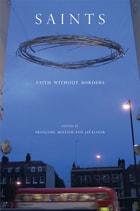
Saints
Faith without BordersEdited by Françoise Meltzer and Jas Elsner
University of Chicago Press, 2011
While the modern world has largely dismissed the figure of the saint as a throwback, we remain fascinated by excess, marginality, transgression, and porous subjectivity—categories that define the saint. In this collection, Françoise Meltzer and Jas Elsner bring together top scholars from across the humanities to reconsider our denial of saintliness and examine how modernity returns to the lure of saintly grace, energy, and charisma.
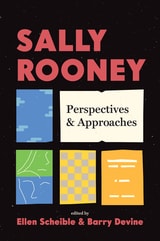
Sally Rooney
Perspectives and ApproachesEllen Scheible
Bucknell University Press, 2026
Bestselling Irish novelist Sally Rooney has emerged as the defining voice of a generation, a cultural phenomenon whose spare, intelligent prose and sharp social insight have reshaped contemporary fiction and sparked a global conversation about intimacy, politics, and the millennial condition. This new collection brings together contributors from a wide range of disciplines to offer fresh critical readings of Rooney’s influential novels, alongside adaptable strategies for teaching her work in today’s undergraduate and graduate classrooms. The essays situate Rooney within literary traditions from Romantic poetry to the bildungsroman and the contemporary campus novel, while engaging with contemporary topics such as gender politics, late capitalism, and media adaptation. Providing accessible yet rigorous frameworks for exploring Rooney’s fiction, this volume confirms her significance not only within contemporary literary studies but also as a cultural force whose work reaffirms the relevance of the humanities in the twenty-first-century classroom.
Published by Bucknell University Press. Distributed worldwide by Rutgers University Press.
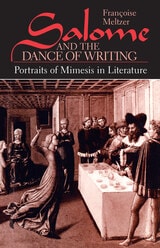
Salome and the Dance of Writing
Portraits of Mimesis in LiteratureFrançoise Meltzer
University of Chicago Press, 1987
Meltzer's readings of textual portraits—in the Gospel writers and Huysmans, Virgil and Stendhal, the Old Testament and Apuleius, Hawthorne and Poe, Kafka and Rousseau, Walter Scott and Mme de Lafayette—reveal an interplay of control and subversion: writing attempts to veil the visual and to erase the sensual in favor of "meaning," while portraiture, with its claims to bringing the natural object to "life," resists and eludes such control. Meltzer shows how this tension is indicative of a politics of repression and subversion intrinsic to the very act of representation. Throughout, she raises and illuminates fascinating issues: about the relation of flattery to caricature, the nature of the uncanny, the relation of representation to memory and history, the narcissistic character of representation, and the interdependency of representation and power.
Writing, thinking, speaking, dreaming, acting—the extent to which these are all controlled by representation must, Meltzer concludes, become "consciously unconscious." In the textual portrait, she locates the moment when this essential process is both revealed and repressed.
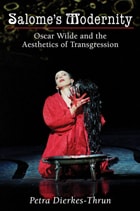
Salome's Modernity
Oscar Wilde and the Aesthetics of TransgressionPetra Dierkes-Thrun
University of Michigan Press, 2014
Oscar Wilde's 1891 symbolist tragedy Salomé has had a rich afterlife in literature, opera, dance, film, and popular culture. Salome's Modernity: Oscar Wilde and the Aesthetics of Transgression is the first comprehensive scholarly exploration of that extraordinary resonance that persists to the present. Petra Dierkes-Thrun positions Wilde as a founding figure of modernism and Salomé as a key text in modern culture's preoccupation with erotic and aesthetic transgression, arguing that Wilde's Salomé marks a major turning point from a dominant traditional cultural, moral, and religious outlook to a utopian aesthetic of erotic and artistic transgression. Wilde and Salomé are seen to represent a bridge linking the philosophical and artistic projects of writers such as Mallarmé, Pater, and Nietzsche to modernist and postmodernist literature and philosophy and our contemporary culture. Dierkes-Thrun addresses subsequent representations of Salome in a wide range of artistic productions of both high and popular culture through the works of Richard Strauss, Maud Allan, Alla Nazimova, Ken Russell, Suri Krishnamma, Robert Altman, Tom Robbins, and Nick Cave, among others.
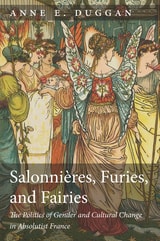
Salonnières, Furies, and Fairies, revised edition
The Politics of Gender and Cultural Change in Absolutist FranceAnne E. Duggan
University of Delaware Press, 2021
Samizdat Past+Present
Edited by Tomáš Glanc
Karolinum Press, 2019
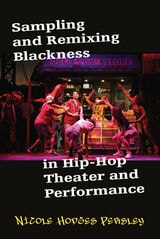
Sampling and Remixing Blackness in Hip-Hop Theater and Performance
Nicole Hodges Persley
University of Michigan Press, 2021
Sampling and Remixing Blackness is a timely and accessible book that examines the social ramifications of cultural borrowing and personal adaptation of Hip-hop culture by non-Black and non-African American Black artists in theater and performance. In a cultural moment where Hip-hop theater hits such as Hamilton offer glimpses of Black popular culture to non-Black people through musical soundtracks, GIFs, popular Hip-hop music, language, clothing, singing styles and embodied performance, people around the world are adopting a Blackness that is at once connected to African American culture--and assumed and shed by artists and consumers as they please. As Black people around the world live a racial identity that is not shed, in a cultural moment of social unrest against anti-blackness, this book asks how such engagements with Hip-hop in performance can be both dangerous and a space for finding cultural allies. Featuring the work of some of the visionaries of Hip-hop theater including Lin-Manuel Miranda, Sarah Jones and Danny Hoch, this book explores the work of groundbreaking Hip-hop theater and performance artists who have engaged Hip-hop's Blackness through popular performance. The book challenges how we understand the performance of race, Hip-hop and Blackness in the age of Instagram, TikTok and Facebook. In a cultural moment where racial identity is performed through Hip-hop culture's resistance to the status quo and complicity in maintaining it, Hodges Persley asks us to consider who has the right to claim Hip-hop's blackness when blackness itself is a complicated mixtape that offers both consent and resistance to transgressive and inspiring acts of performance.
Samuel Johnson and Moral Discipline
Paul Kent Alkon
Northwestern University Press, 1967

Samuel Johnson
A Survey and Bibliography of Critical StudiesJames L. Clifford and Donald J. Greene
University of Minnesota Press, 1970
Samuel Johnson was first published in 1970. Minnesota Archive Editions uses digital technology to make long-unavailable books once again accessible, and are published unaltered from the original University of Minnesota Press editions.
For anyone interested in the work of Samuel Johnson and his place in eighteenth-century studies, this bibliography will be of great value, for it includes virtually everything of importance that has been written about Johnson from his own lifetime to the present. In addition, Professors Clifford and Greene, in an introductory essay, survey and evaluate the changing attitudes toward Johnson through the entire period covered in the bibliography.
This volume is a revision and enlargement of Professor Clifford's earlier work Johnsonian Studies, 1887–1950: A Survey and Bibliography,long recognized as an indispensable tool for the study of Samuel Johnson, his circle, and his times, and now out of print. The present volume contains nearly four thousand bibliographical entries, grouped under twenty-five subject headings, and arranged chronologically within each classification. This arrangement enables the student to trace the development of the scholarship of the various aspects of Johnson's life and work. A detailed author and subject index to the whole volume makes it easy for him to find the description of the particular book or article for which he is searching.
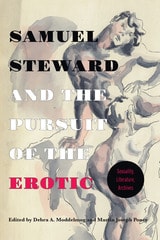
Samuel Steward and the Pursuit of the Erotic Sexuality, Literature, Archives
Sexuality, Literature, ArchivesEdited by Debra A. Moddelmog and Martin Joseph Ponce
The Ohio State University Press, 2017
With work by prominent scholars in queer, transgender, and sexuality studies, and with topics such as the queer archive, hoarding, masochism, the queer mystery, race and desire, sexology, and gay pornography, Samuel Steward and the Pursuit of the Erotic will appeal to a wide range of readers across a variety of disciplines invested in queer experience. Closing on a personal recollection from one of Steward’s last close friends, the volume will also appeal to readers interested in the personal aspects of this fascinating, idiosyncratic figure’s multifaceted life.
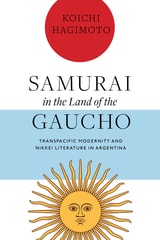
Samurai in the Land of the Gaucho
Transpacific Modernity and Nikkei Literature in ArgentinaKoichi Hagimoto
Vanderbilt University Press, 2023
In the early twentieth century, historical imaginings of Japan contributed to the Argentine vision of “transpacific modernity." Intellectuals such as Eduardo Wilde and Manuel Domecq García celebrated Japanese customs and traditions as important values that can be integrated into Argentine society. But a new generation of Nikkei or Japanese Argentines is rewriting this conventional narrative in the twenty-first century. Nikkei writers such as Maximiliano Matayoshi and Alejandra Kamiya are challenging the earlier, unapologetic view of Japan based on their own immigrant experiences.
Compared to the experience of political persecution against Japanese immigrants in Brazil and Peru, the Japanese in Argentina generally lived under a more agreeable sociopolitical climate. In order to understand the "positive" perception of Japan in Argentine history and literature, Samurai in the Land of the Gaucho turns to the current debate on race in Argentina, particularly as it relates to the discourse of whiteness. One of the central arguments is that Argentina's century-old interest in Japan represents a disguised method of (re)claiming its white, Western identity.
Through close readings of diverse genres (travel writing, essay, novel, short story, and film) Samurai in the Land of the Gaucho yields a multi-layered analysis in order to underline the role Japan has played in both defining and defying Argentine modernity from the twentieth century to the present.
Sanity Plea
Schizophrenia in the Novels of Kurt VonnegutLawrence R. Broer
University of Alabama Press, 1994
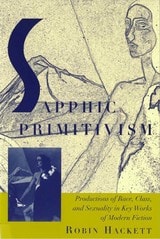
Sapphic Primitivism
Productions of Race, Class, and Sexuality in Key Works of Modern FictionHackett, Robin
Rutgers University Press, 2003
In this book, Robin Hackett examines portrayals of race, class, and sexuality in modernist texts by white women to argue for the existence of a literary device that she calls “Sapphic primitivism.” The works vary widely in their form and content and include Olive Schreiner’s proto-modernist exploration of New Womanhood, The Story of an African Farm; Virginia Woolf’s high modernist “play-poem,” The Waves; Sylvia Townsend Warner’s historical novel, Summer Will Show; and Willa Cather’s Southern pastoral, Sapphira and the Slave Girl. In each, blackness and working-class culture are figured to represent sexual autonomy, including lesbianism, for white women. Sapphic primitivism exposes the ways several classes of identification were intertwined with the development of homosexual identities at the turn of the century. Sapphic primitivism is not, however, a means of disguising lesbian content. Rather, it is an aesthetic displacement device that simultaneously exposes lesbianism and exploits modern, primitivist modes of self-representation. Hackett’s revelations of the mutual interests of those who study early twentieth-century constructions of race and sexuality and twenty-first-century feminists doing anti-racist and queer work are a major contribution to literary studies and identity theory.
Sappho Is Burning
Page duBois
University of Chicago Press, 1995
In Sappho is Burning, duBois reads Sappho as a disruptive figure at the very origin of our story of Western civilization. Sappho is beyond contemporary categories, inhabiting a space outside of reductively linear accounts of our common history. She is a woman, but also an aristocrat, a Greek, but one turned toward Asia, a poet who writes as a philosopher before philosophy, a writer who speaks of sexuality that can be identified neither with Michel Foucault's account of Greek sexuality, nor with many versions of contemporary lesbian sexuality. She is named as the tenth muse, yet the nine books of her poetry survive only in fragments. She disorients, troubles, undoes many certitudes in the history of poetry, the history of philosophy, the history of sexuality. DuBois argues that we need to read Sappho again.
Sappho in Early Modern England
Female Same-Sex Literary Erotics, 1550-1714Harriette Andreadis
University of Chicago Press, 2001

Sarah Orne Jewett
Reconstructing GenderMargaret Roman
University of Alabama Press, 1992
With the details of Jewett’s free-spirited life, Roman’s book represents a solid work of literary scholarship, which traces a gender-dissolving theme throughout Jewett’s writing. Whereas previous critics have focused primarily on her best-known works, including “A White Heron,” Deephaven, A Country Doctor, and The Country of the Pointed Firs, Roman encompasses within her own discussion virtually all of the stories found in the nineteen volumes Jewett published during her lifetime. And although much recent criticism has centered around Jewett’s strong female characters, Roman is the first to explore in depth Jewett’s male characters and married couples.
The book progresses through distinct phases that roughly correspond to Jewett’s psychological development as a writer. In general, the characters in her early works exhibit one of two modes of behavior. Youngsters, free as Jewett was to explore the natural world of woods and field, glimpse the possibility of escape from the confining standards that society has set, though some experience turbulent and confusing adolescences where those norms have become more pressing, more demanding. At the opposite extreme are those who have mindlessly accepted the roles in which they have been trapped since youth—greedy, selfish men, dutiful women who tend emotionally empty houses, young couples unable to communicate either between themselves or with others—in short, characters who are too alienated within their roles to function as whole human beings.
On the other hand, Jewett approaches the men and women of her later works with a higher degree of optimism, in that each person is free to live according to the dictates of his or her inherent personality—each character is able to measure life from within rather than from without. This group includes the self-confident men who are not reluctant to present a nurturing side, and the warm, giving women who are unafraid of displaying a decided inner strength. As Roman summarizes, “In her writings, Jewett attempts to shift society’s focus from a grasping power over people to the personal development of each member of society.”
Ahead of her time in many ways, Sarah Orne Jewett confronted the Victorian polarized gender system, presaging the modern view that men and women should be encouraged to develop along whatever paths are most comfortable and most natural for them.
Sardonic Smile
Nonverbal Behavior in Homeric EpicDonald Lateiner
University of Michigan Press, 1998
Satire and the Threat of Speech
Horace's Satires, Book 1Catherine M. Schlegel
University of Wisconsin Press, 2006
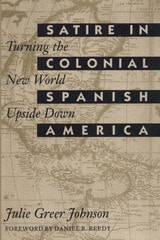
Satire in Colonial Spanish America
Turning the New World Upside DownBy Julie Greer Johnson
University of Texas Press, 1993
Satire, the use of criticism cloaked in wit, has been employed since classical times to challenge the established order of society. In colonial Spanish America during the sixteenth through the eighteenth centuries, many writers used satire to resist Spanish-imposed social and literary forms and find an authentic Latin American voice. This study explores the work of eight satirists of the colonial period and shows how their literary innovations had a formative influence on the development of the modern Latin American novel, essay, and autobiography.
The writers studied here include Sor Juana Inés de la Cruz, Juan del Valle y Caviedes, Cristóbal de Llerena, and Eugenio Espejo. Johnson chronicles how they used satire to challenge the "New World as Utopia" myth propagated by Spanish authorities and criticize the Catholic church for its role in fulfilling imperialistic designs. She also shows how their marginalized status as Creoles without the rights and privileges of their Spanish heritage made them effective satirists. From their writings, she asserts, emerges the first self-awareness and national consciousness of Spanish America.
By linking the two great periods of Latin American literarure—the colonial writers and the modern generation—Satire in Colonial Spanish America makes an important contribution to Latin American literature and culture studies. It will also be of interest to all literary scholars who study satire.
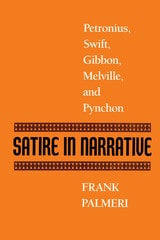
Satire in Narrative
Petronius, Swift, Gibbon, Melville, & PynchonBy Frank Palmeri
University of Texas Press, 1990
Virtually all theories of satire define it as a criticism of contemporary society. Some argue that satire criticizes the present in favor of a standard of values that has been superseded, and thus that satire is generally backward-looking and conservative. While this is often true of poetic satire, in this study Frank Palmeri asserts that narrative satire performs a different function, that it parodies both the established view of the world and that of its opponents, offering its own distinctive critical perspective.
This theory of satire builds on the idea of dialogical parody in the work of Russian theorist Mikhail Bakhtin, while revising Bakhtin's estimate of carnival. In Palmeri's view, the carnivalesque offers only an inverted mirror image of authoritative discourse, while parodic narrative satire suggests an alternative to both the official world and its inverted opposite.
Palmeri applies this theory of narrative satire to five works of world literature, each of which has generated sharp controversy about the genre to which it rightly belongs: Petronius' Satyricon, Jonathan Swift's A Tale of a Tub, Edward Gibbon's Decline and Fall of the Roman Empire, Herman Melville's The Confidence-Man, and Thomas Pynchon's The Crying of Lot 49. He analyzes the features that link these works and shows how the changing pairs of alternatives that are parodied in these satires reflect changes in the terms of social and cultural oppositions.
Satire in Narrative will appeal to comparatists, specialists in eighteenth-century and American literature, and others interested in theories of genre and the relations between literary forms and social history.
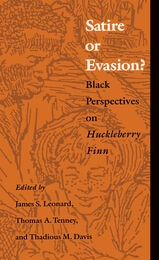
Satire or Evasion?
Black Perspectives on Huckleberry FinnJames S. Leonard, Thomas A. Tenney and Thadious M. Davis, eds.
Duke University Press, 1992
Ranging from the laudatory to the openly hostile, these essays include personal impressions of Huckleberry Finn, descriptions of classroom experience with the book, evaluations of its ironic and allegorical aspects, explorations of its nineteenth-century context, and appraisal of its effects on twentieth-century African American writers. Among the issues the authors contend with are Twain’s pervasive use of the word “nigger,” his portrayal of the slave Jim according to the conventions of the minstrel show “darky,” and the thematic chaos created by the “evasion” depicted in the novel’s final chapters.
Sure to provoke thought and stir debate, Satire or Evasion? provides a variety of new perspectives on one of this country’s most troubling classics.
Contributors. Richard K. Barksdale, Bernard W. Bell, Mary Kemp Davis, Peaches M. Henry, Betty Harris Jones, Rhett S. Jones, Julius Lester, Donnarae MacCann, Charles H. Nichols, Charles H. Nilon, Arnold Rampersad, David L. Smith, Carmen Dubryan, John H. Wallace, Kenny Jackson Williams, Fredrick Woodard
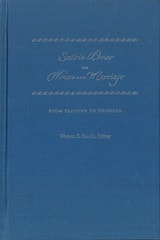
Satiric Advice on Women and Marriage
From Plautus to ChaucerWarren S. Smith, Editor
University of Michigan Press, 2005
Advice on sex and marriage in the literature of antiquity and the middle ages typically stressed the negative: from stereotypes of nagging wives and cheating husbands to nightmarish visions of women empowered through marriage. Satiric Advice on Women and Marriage brings together the leading scholars of this fascinating body of literature. Their essays examine a variety of ancient and early medieval writers' cautionary and often eccentric marital satire beginning with Plautus in the third century B.C.E. through Chaucer (the only non-Latin author studied). The volume demonstrates the continuity in the Latin tradition which taps into the fear of marriage and intimacy shared by ancient ascetics (Lucretius), satirists (Juvenal), comic novelists (Apuleius), and by subsequent Christian writers starting with Tertullian and Jerome, who freely used these ancient sources for their own purposes, including propaganda for recruiting a celibate clergy and the promotion of detachment and asceticism as Christian ideals.
Warren S. Smith is Professor of Classical Languages at the University of New Mexico.

Savage West
The Life and Fiction of Thomas SavageO. Alan Weltzien
University of Nevada Press, 2022
O. Alan Weltzien's insightful and detailed literary biography chronicles the life and work of this neglected but deeply talented novelist. Savage, a closeted gay family man, was both an outsider and an insider, navigating an intense conflict between his sexual identity and the claustrophobic social restraints of the rural West. Unlike many other Western writers, Savage avoided the formula westerns— so popular in his time— and offered instead a realistic, often subversive version of the region. His novels tell a hard, harsh story about dysfunctional families, loneliness, and stifling provincialism in the small towns and ranches of the northern Rockies, and his minority interpretation of the West provides a unique vision and caustic counternarrative contrary to the triumphant settler-colonialism themes that have shaped most Western literature. Savage West seeks to claim Thomas Savage's well-deserved position in American literature and to reintroduce twenty-first-century readers to a major Montana writer.
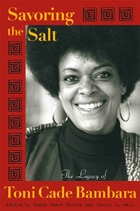
Savoring the Salt
The Legacy of Toni Cade Bambaraedited by Linda Janet Holmes and Cheryl A. Wall
Temple University Press, 2007
Admiring readers have kept Bambara's fiction in print since her first collection of stories, Gorilla, My Love, was published in 1972. She continued to write -- and her audience and reputation continued to grow -- until her untimely death in 1995. Savoring the Salt includes excerpts from her published and unpublished writings, along with interviews and photos of Bambara. The mix of poets and scholars, novelists and critics, political activists and filmmakers represented here testifies to the ongoing importance and enduring appeal of her work.

Saying I No More
Subjectivity and Consciousness in the Prose of Samuel BeckettDaniel Katz
Northwestern University Press, 1999
Scales of Captivity
Racial Capitalism and the Latinx ChildMary Pat Brady
Duke University Press, 2022
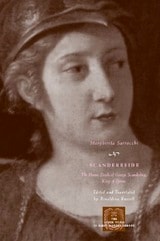
Scanderbeide
The Heroic Deeds of George Scanderbeg, King of EpirusMargherita Sarrocchi
University of Chicago Press, 2006
First published posthumously in 1623, Scanderbeide reemerges here in an adroit English prose translation that maintains the suspense of the original text and gives ample context to its rich cultural implications.
Scandinavian Elements of Finnegans Wake
Dounia Bunis Christiani
Northwestern University Press, 1965

Scarring the Black Body
Race and Representation in African American LiteratureCarol E. Henderson
University of Missouri Press, 2002
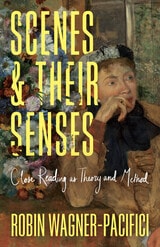
Scenes and Their Senses
Close Reading as Theory and MethodRobin Wagner-Pacifici
University of Chicago Press, 0
Makes the case for close readings of small scenes appearing in works of literature, scholarship, film, and visual art, showing how close attention to details can reveal the meaningful sociological action that often occurs on the margins.
Why do certain images, stories, and scenes impress upon us so strongly, inviting us to linger over the nuances of their meaning? In Scenes and Their Senses, sociologist Robin Wagner-Pacifici seeks to uncover the deeper meaning behind twenty “scenes” that have captured her theoretical imagination over her lifetime. Some of these come from classics of sociological theory or literature—Geertz, Habermas, Lévi-Strauss, Zola—and some are more contemporary, including the films Good Will Hunting and Luis Buñuel’s The Phantom ofLiberty. She seeks here to understand each scene less as examples of a given condition or conundrum and more as worlds in themselves.
As Wagner-Pacifici shows, close attention to the forms and flows of these minor, often quiet scenes reveals how meaningful action occurs in what might appear to be the margins or interstices of the bigger, noisier story being told. Providing an entry point to larger social conditions, relations, and change, the scenes analyzed here evoke sociological themes of belonging and exile, strength and weakness, cleanliness and pollution, reality and fantasy, courage and cowardice, and vision and obscurity, among others. As an ethnography of texts recalled from previous readings and revisited by the author, the scenes highlight the role of memory in sense-making. Furthermore, the activation of the scenes as a focused point of sustained contemplation functions as a remarkable bridge between method and theory.
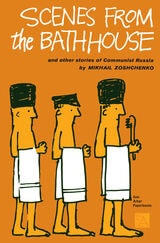
Scenes from the Bathhouse
And Other Stories of Communist RussiaMikhail Zoshchenko
University of Michigan Press, 1959
Scenes from the Drama of European Literature
Erich AuerbachForeword by Paolo Valesio
University of Minnesota Press, 1984
Scenes from the Drama of European Literature was first published in 1984. Minnesota Archive Editions uses digital technology to make long-unavailable books once again accessible, and are published unaltered from the original University of Minnesota Press editions.
In his foreword to this reprint of Erich Auerbach's major essays, Paolo Valesio pays tribute to the author with an old saying that he feels is still the best metaphor for the genesis of a literary critic: the critic is born of the marriage of Mercury and Philology. The German-born Auerbach was a scholar who specialized in Romance philology, a tradition rooted in German historicism—the conviction that works of art must be judged as products of variable places and times, not from the eye of eternity, nor by a single unchanging aesthetic standard. The mercurial element in Auerbach's work is significant, for in a life of motion—of exile from Hitler's Germany—he came to believe that literary history was evolutionary, ever-changing—a view reflected in the title of his book, which suggests life and literature are historical drama.
Auerbach is best known for his magisterial study Mimesis: The Representation of Reality in Western Literature, written during the war, in Istanbul, when he was far from his own culture and from the books that he normally relied on. In 1957, just before his death, he arranged for the publication in English of his six most important essays, in a volume called Scenes from the Drama of European Literature.As in Mimesis,Auerbach's fresh insights bring to the disparate subjects of the essays a coherence that reflects the unity of Western, humanistic tradition, even while they hint at the deepening pessimism of his later years.
In the first essay, "Figura," Auerbach develops his concept of the figural interpretation of reality; applied here to Dante's Divine Comedy,it also served as groundwork for his treatment of realism in Mimesis. A second essay on Dante's examines the poet's depiction of St. Francis of Assisi. The next three essays deal with the paradoxical nature of Pascal's political thought; the merging of la cour and la ville—the king's entourage and the bourgeoisie—chiefly in relation to the seventeenth-century French theater; and Vico's formulation concepts by the German Romantics. In the final essay Auerbach confers upon Baudelaire's Fleurs du Mal the designation "aesthetic dignity" because, not in spite of, the hideous reality of the peoms.
"A major collection of important essays on European literature, almost all classics, and almost all required reading for their various centuries—thus the book is indispensable for the medieval period,the seventeenth and nineteenth centuries; in addition, the 'Figura' and the Vico essays are very significant theoretical statements. The book is lucid and far more accessible for undergraduates than, say, current high theory. Nor has Auerbach's own work aged . . . All of his varied strengths are evidence in this collection, which is a better way into his work than Mimesis." –Fredric Jameson, University of California, Santa Cruz.
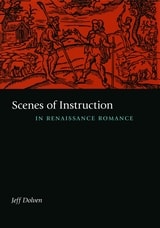
Scenes of Instruction in Renaissance Romance
Jeff Dolven
University of Chicago Press, 2007
We take it for granted today that the study of poetry belongs in school—but in sixteenth-century England, making Ovid or Virgil into pillars of the curriculum was a revolution. Scenes of Instruction in Renaissance Romance explores how poets reacted to the new authority of humanist pedagogy, and how they transformed a genre to express their most radical doubts.
Jeff Dolven investigates what it meant for a book to teach as he traces the rivalry between poet and schoolmaster in the works of John Lyly, Philip Sydney, Edmund Spenser, and John Milton. Drawing deeply on the era’s pedagogical literature, Dolven explores the links between humanist strategies of instruction and romance narrative, rethinking such concepts as experience, sententiousness, example, method, punishment, lessons, and endings. In scrutinizing this pivotal moment in the ancient, intimate contest between art and education, Scenes of Instruction in Renaissance Romance offers a new view of one of the most unconsidered—yet fundamental—problems in literary criticism: poetry’s power to please and instruct.