Results by title
310 books match the query 'Performance' and 36 start with s

Salted Earth
Poetics of Place and Migration through Four Journeys in Search of SaltKaty Beinart
Intellect Books, 2026
While histories of salt have long emphasized its central role in trade, power, and capitalism, is that the only way to understand this everyday substance? In Salted Earth, artist and researcher Katy Beinart offers a fresh perspective, exploring the poetics of salt. Through a series of journeys to South Africa, Lithuania and Russia, Portugal, and Haiti, Beinart and her collaborators investigate the everyday rituals and cultural meanings of salt in diverse contexts. In her work, salt becomes a medium through which large-scale histories of migration, trade, empire, slavery, and colonialism—as well as deeply personal relationships, emotional geographies, memory, and intercultural connections—are symbolized and reimagined.
Drawing on fiction, poetry, and visual art, alongside family history, travel writing, trade archives, and artistic process, Beinart builds a rich, interdisciplinary portrait of salt as both a material and a cultural symbol. These journeys and embodied artistic practices open a sensorial and situated way of understanding material entanglements, where knowledge emerges through movement, encounter, and acts of making. Salted Earth offers valuable insights for students and researchers in art, creative writing, cultural history and geography, memory studies, and across the wider fields of aesthetics and the humanities.
Seeing Sarah Bernhardt
Performance and Silent FilmVictoria Duckett
University of Illinois Press, 2015
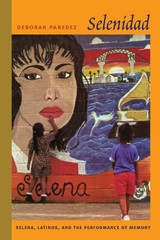
Selenidad
Selena, Latinos, and the Performance of MemoryDeborah Paredez
Duke University Press, 2009
Paredez argues that Selena’s death galvanized Latina/o efforts to publicly mourn collective tragedies (such as the murders of young women along the U.S.-Mexico border) and to envision a brighter future. At the same time, reactions to the star’s death catalyzed political jockeying for the Latino vote and corporate attempts to corner the Latino market. Foregrounding the role of performance in the politics of remembering, Paredez unravels the cultural, political, and economic dynamics at work in specific commemorations of Selena. She analyzes Selena’s final concert, the controversy surrounding the memorial erected in the star’s hometown of Corpus Christi, and the political climate that served as the backdrop to the touring musicals Selena Forever and Selena: A Musical Celebration of Life. Paredez considers what “becoming” Selena meant to the young Latinas who auditioned for the biopic Selena, released in 1997, and she surveys a range of Latina/o queer engagements with Selena, including Latina lesbian readings of the star’s death scene and queer Selena drag. Selenidad is a provocative exploration of how commemorations of Selena reflected and changed Latinidad.
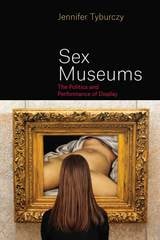
Sex Museums
The Politics and Performance of DisplayJennifer Tyburczy
University of Chicago Press, 2015
All museums are sex museums. In Sex Museums, Jennifer Tyburczy takes a hard look at the formation of Western sexuality—particularly how categories of sexual normalcy and perversity are formed—and asks what role museums have played in using display as a technique for disciplining sexuality. Most museum exhibits, she argues, assume that white, patriarchal heterosexuality and traditional structures of intimacy, gender, and race represent national sexual culture for their visitors. Sex Museums illuminates the history of such heteronormativity at most museums and proposes alternative approaches for the future of public display projects, while also offering the reader curatorial tactics—what she calls queer curatorship—for exhibiting diverse sexualities in the twenty-first century.
Tyburczy shows museums to be sites of culture-war theatrics, where dramatic civic struggles over how sex relates to public space, genealogies of taste and beauty, and performances of sexual identity are staged. Delving into the history of erotic artifacts, she analyzes how museums have historically approached the collection and display of the material culture of sex, which poses complex moral, political, and logistical dilemmas for the Western museum. Sex Museums unpacks the history of the museum and its intersections with the history of sexuality to argue that the Western museum context—from its inception to the present—marks a pivotal site in the construction of modern sexual subjectivity.
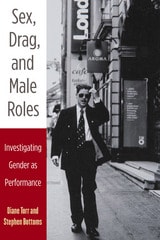
Sex, Drag, and Male Roles
Investigating Gender as PerformanceDiane Torr and Stephen Bottoms
University of Michigan Press, 2010
"Few books blend the critical and creative approaches to drag performance this provocatively and engagingly, and none provides both the historical and the personal perspectives so effectively. Torr and Bottoms fundamentally challenge many long-standing ideas about drag kings and the performance of masculinity."
---Sarah Bay-Cheng, University at Buffalo
"This book brings the reader inside an artist's creative imagination and intellect, showing us Diane Torr's work in a detailed, thoughtful, and engaging way. We discover how Torr uses different physical disciplines to explore how gender is constructed, interpreted, and expressed. Along the way---by taking us into various venues in which she performed---she evokes the lively, dynamic scene in New York in the '80s and '90s."
---Alisa Solomon, Columbia University
Why would women want to perform as men? Why is gender crossing so compelling, whether it happens onstage or in everyday life? What can drag performance teach, and what aesthetic, political, and personal questions does it raise?
Performance artist Diane Torr has been experimenting with the performance of gender for thirty years---exploring everything from feminist go-go dancing to masculine power play. One of the key pioneers of "drag king" performance, Torr has been celebrated internationally for her gender transformation workshops, in which she has taught hundreds of ordinary women how to pass as men on city streets around the world. This cultural subterfuge appeals to participants for many different reasons: personal confidence-building, sexual frisson, gender subversion, trans-curiosity, or simply the appeal of disguise and role play.
Sex, Drag, and Male Roles documents the evolution of Torr's work by blending first-person memoir and commentary from Torr with critical reflections and contextualization from leading performance critic Stephen J. Bottoms. The book includes a consideration of the long cultural history of female-to-male cross-dressing and concludes with Torr's "Do-It-Yourself" guide to becoming a "Man for a Day."
Diane Torr developed her cross-disciplinary art in the downtown New York art scene from 1976 to 2002. Now living in Scotland, Torr has earned an international reputation for her performances and gender transformation workshops (featured on HBO, BBC, and This American Life on NPR, among others). Her work is the focus of a feature film, Man for a Day.
Stephen J. Bottoms is Wole Soyinka Professor of Drama and Theatre Studies at the University of Leeds. His books include Playing Underground: A Critical History of the 1960s Off-Off-Broadway Movement and Small Acts of Repair: Performance, Ecology, and Goat Island.
Cover: Diane Torr walks the streets of London, 1995. Photo by Debbie Humphreys.
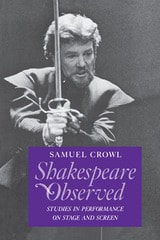
Shakespeare Observed
Studies in Performance on Stage and ScreenSamuel Crowl
Ohio University Press, 1993
Crowl’s study demonstrates the surprising resonances between Roman Polanski's 1971 film of Macbeth and Adrian Noble's heralded recent production of the play for The Royal Shakespeare Company; argues that Orson Welles's films of Othello and Cabins at Midnight are not only brilliant remaining of Shakespeare in another art form but make a powerful contribution to our contemporary understanding of performance as interpretation; and chronicles the impact of Peter Hall's creation of the Royal Shakespeare Company in 1960 on performance approaches to Shakespeare in the past thirty years.
Shakespeare Observed provides full interpretative readings of key recent Shakespeare productions in England and includes an intimate behind-the-scenes glimpse into the rehearsal process which produced Ron Daniels's emotionally charged version of Romeo and Juliet for the RSC in 1980. The final chapter uses Kenneth Branagh's highly successful film of Henry V as a summary example of the trends and influences Crowl's study traces, seeing the film as gathering its interpretative energies from both Olivier's famous film version of the play and Adrian Noble's stage production featuring Branagh as the king.
Written in a style which places a premium on capturing the vivid and often dazzling moments of stage and film performances of Shakespeare, Crowl's study will be of interest to the avid film and theatergoer as well as to the scholar and student. Shakespeare Observed joins a growing list of recent critical works which have significantly expanded and redefined the boundaries of Shakespeare studies in our time.
Shakespearean Educations
Power, Citizenship, and PerformanceCoppélia Kahn
University of Delaware Press, 2011
Published by University of Delaware Press. Distributed worldwide by Rutgers University Press.
Shipping Out
Race, Performance, and Labor at SeaAnita Gonzalez
University of Michigan Press, 2025
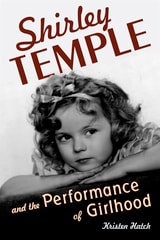
Shirley Temple and the Performance of Girlhood
Hatch, Kristen
Rutgers University Press, 2015

SiC Power Module Design
Performance, robustness and reliabilityAlberto Castellazzi
The Institution of Engineering and Technology, 2022
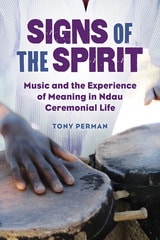
Signs of the Spirit
Music and the Experience of Meaning in Ndau Ceremonial LifeTony Perman
University of Illinois Press, 2020
Perman's encounters with the spirits, the mediums who bring them back, and the accompanying rituals form the heart of his ethnographic account of how the Ndau experience ceremonial musicking. As Perman witnessed other ceremonies, he discovered that music and dancing shape the emotional lives of Ndau individuals by inviting them to experience life's milestones or cope with its misfortunes as a group. Signs of the Spirit explores the historical, spiritual, and social roots of ceremonial action and details how that action influences the Ndau's collective approach to their future. The result is a vivid ethnomusicological journey that delves into the immediacy of musical experience and the forces that transform ceremonial performance into emotions and community.
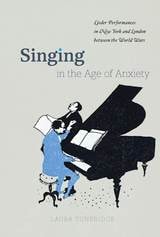
Singing in the Age of Anxiety
Lieder Performances in New York and London between the World WarsLaura Tunbridge
University of Chicago Press, 2018
Laura Tunbridge explores the renewed vitality of this refugee musical form between the world wars, offering a fresh perspective on a period that was pervaded by anxieties of displacement. Through richly varied case studies, Singing in the Age of Anxiety traces how lieder were circulated, presented, and consumed in metropolitan contexts, shedding new light on how music facilitated unlikely crossings of nationalist and internationalist ideologies during the interwar period.
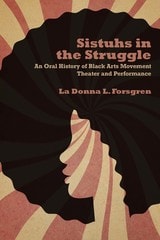
Sistuhs in the Struggle
An Oral History of Black Arts Movement Theater and PerformanceLa Donna L. Forsgren
Northwestern University Press, 2021
Outstanding Academic Title, CHOICE
The first oral history to fully explore the contributions of black women intellectuals to the Black Arts Movement, Sistuhs in the Struggle reclaims a vital yet under-researched chapter in African American, women’s, and theater history. This groundbreaking study documents how black women theater artists and activists—many of whom worked behind the scenes as directors, designers, producers, stage managers, and artistic directors—disseminated the black aesthetic and emboldened their communities.
Drawing on nearly thirty original interviews with well-known artists such as Ntozake Shange and Sonia Sanchez as well as less-studied figures including distinguished lighting designer Shirley Prendergast, dancer and choreographer Halifu Osumare, and three-time Tony-nominated writer and composer Micki Grant, La Donna L. Forsgren centers black women’s cultural work as a crucial component of civil rights and black power activism. Sistuhs in the Struggle is an essential collection for theater scholars, historians, and students interested in learning how black women’s art and activism both advanced and critiqued the ethos of the Black Arts and Black Power movements.
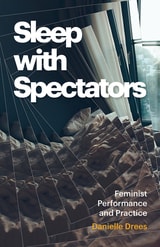
Sleep with Spectators
Feminist Performance and PracticeDanielle Drees
University of Minnesota Press, 2026
A rejuvenating look at sleep’s integral role in feminist practice, critique, and imagination
Inequality is notoriously exhausting to confront, but through theater, performance art, and theory, feminist artists and thinkers have explored a radical counter to this exhaustion: sleep. Centering creative work on this restorative practice, Sleep with Spectators is a refreshing and visionary counterhistory of feminism that offers sleep as a tool for imagining new ways of living—ones that prioritize not only rest but also care and interdependence.
Taking performance as a unique means of perceiving private and unconscious aspects of daily life, Danielle Drees draws from opera, plays, and avant-garde theater to find instances of sleep and sleeplessness as novel embodiments of core feminist concerns. Among her subjects are Sarah Kane’s free verse text 4.48 Psychosis; María Irene Fornés’s queer drama of racial–sexual transformation, Enter THE NIGHT; and Regina José Galindo’s America’s Family Prison, in which Galindo, her partner, and their baby spent twenty-four hours in a “family-sized” cell rented from a private prison outfitter. Adeptly engaging this fascinating collection of international archival material through the lenses of Marxist feminism, trans and queer studies, and disability studies, Sleep with Spectators illuminates how sleep performances reveal and critique inequalities rooted in gender, sexuality, race, class, and disability.
Idiosyncratic and interdisciplinary, Sleep with Spectators charts an original path through the feminist performance archive, presenting new ways of indexing injustice and interrogating the political conditions of rest.
Retail e-book files for this title are screen-reader friendly.
So Much Wasted
Hunger, Performance, and the Morbidity of ResistancePatrick Anderson
Duke University Press, 2010
Social Choreography
Ideology as Performance in Dance and Everyday MovementAndrew Hewitt
Duke University Press, 2005
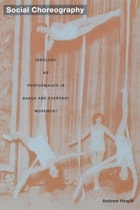
Hewitt focuses on the period between the mid-nineteenth century and the early twentieth and considers dancers and social theorists in Germany, Britain, France, and the United States. Analyzing the arguments of writers including Friedrich Schiller, Theodor Adorno, Hans Brandenburg, Ernst Bloch, and Siegfried Kracauer, he reveals in their thinking about the movement of bodies a shift from an understanding of play as the condition of human freedom to one prioritizing labor as either the realization or alienation of embodied human potential. Whether considering understandings of the Charleston, Isadora Duncan, Nijinsky, or the famous British chorus line the Tiller Girls, Hewitt foregrounds gender as he uses dance and everyday movement to rethink the relationship of aesthetics and social order.
Sounding Human
Music and Machines, 1740/2020Deirdre Loughridge
University of Chicago Press, 2023
From the mid-eighteenth century on, there was a logic at work in musical discourse and practice: human or machine. That discourse defined a boundary of absolute difference between human and machine, with a recurrent practice of parsing “human” musicality from its “merely mechanical” simulations. In Sounding Human, Deirdre Loughridge tests and traverses these boundaries, unmaking the “human or machine” logic and seeking out others, better characterized by conjunctions such as and or with.
Sounding Human enters the debate on posthumanism and human-machine relationships in music, exploring how categories of human and machine have been continually renegotiated over the centuries. Loughridge expertly traces this debate from the 1737 invention of what became the first musical android to the creation of a “sound wave instrument” by a British electronic music composer in the 1960s, and the chopped and pitched vocals produced by sampling singers’ voices in modern pop music. From music-generating computer programs to older musical instruments and music notation, Sounding Human shows how machines have always actively shaped the act of music composition. In doing so, Loughridge reveals how musical artifacts have been—or can be—used to help explain and contest what it is to be human.
Sounding the Center
History and Aesthetics in Thai Buddhist PerformanceDeborah Wong
University of Chicago Press, 2001
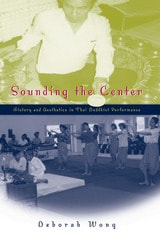
Drawing on her extensive fieldwork, Wong lays out the ritual in detail: the way it is enacted, the foods and objects involved, and the people who perform it, emphasizing the way the performers themselves discuss and construct aspects of the ceremony.
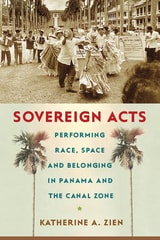
Sovereign Acts
Performing Race, Space, and Belonging in Panama and the Canal ZoneZien, Katherine A.
Rutgers University Press, 2017
Winner of the 2017 Annual Book Prize from the Canadian Association of Latin American and Caribbean Studies (CALACS)
Sovereign Acts explores how artists, activists, and audiences performed and interpreted sovereignty struggles in the Panama Canal Zone, from the Canal Zone’s inception in 1903 to its dissolution in 1999. In popular entertainments and patriotic pageants, opera concerts and national theatre, white U.S. citizens, West Indian laborers, and Panamanian artists and activists used performance as a way to assert their right to the Canal Zone and challenge the Zone’s sovereignty, laying claim to the Zone’s physical space and imagined terrain.
By demonstrating the place of performance in the U.S. Empire’s legal landscape, Katherine A. Zien transforms our understanding of U.S. imperialism and its aftermath in the Panama Canal Zone and the larger U.S.-Caribbean world.
Space in Performance
Making Meaning in the TheatreGay McAuley
University of Michigan Press, 2000
The book's theoretical and methodological framework is both semiotic and phenomenological, based in part from the seminal work of Anne Ubersfeld, from direct observation of the rehearsal process, and from documentation and analysis of professional performances. The situation of the academic observer in the rehearsal room has much in common with that of the ethnographer in the field, and contemporary ethnographic practice provides a third theoretical and methodological perspective to this study.
Performance studies is an emerging discipline, and it is still evolving appropriate methodologies. The multi-faceted approach adopted here will engage theater and performance studies specialists, those concerned with modes of representation in contemporary culture, and students of theater, semiotics, architecture, set design, acting and performance theory. It also offers a great deal to theater practitioners as well as to spectators interested in deepening their appreciation of theater art. It is written in a simple, accessible way, and the theory always emerges from descriptions of practice.
"An excellent study that imaginatively summarizes, synthesizes, and intelligently critiques a wide range of previous theory and practice while making an important new contribution to the field of theater studies." --Marvin Carlson, City University of New York
Gay McAuley is Director of the Centre for Performance Studies, University of Sydney.
Speaking Truths
Young Adults, Identity, and Spoken Word ActivismValerie Chepp
Rutgers University Press, 2022
Drawing upon detailed observations and in-depth interviews, Chepp tells the story of a diverse group of young adults from Washington, D.C. who use spoken word to create a more just and equitable world. Outlining the contours of this approach, she interrogates spoken word activism’s emphasis on personal storytelling and “truth,” the strategic uses of aesthetics and emotions to politically engage across difference, and the significance of healing in sustainable movements for change. Weaving together their poetry and personally told stories, Chepp shows how poets tap into the beautiful, emotional, personal, and therapeutic features of spoken word to empathically connect with others, advance intersectional and systemic analyses of inequality, and make social justice messages relatable across a diverse public. By creating allies and forging connections based on friendship, professional commitments, lived experiences, emotions, artistic kinship, and political views, this activist approach is highly integrated into the everyday lives of its practitioners, online and face-to-face.
Chepp argues that spoken word activism is a product of, and a call to action against, the neoliberal era in which poets have come of age, characterized by widening structural inequalities and increasing economic and social vulnerability. She illustrates how this deeply personal and intimate activist approach borrows from, builds upon, and diverges from previous social movement paradigms. Spotlighting the complexity and mutual influence of modern-day activism and the world in which it unfolds, Speaking Truths contributes to our understanding of contemporary social change-making and how neoliberalism has shaped this political generation’s experiences with social injustice.
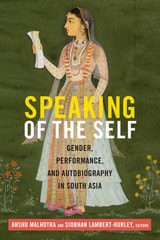
Speaking of the Self
Gender, Performance, and Autobiography in South AsiaAnshu Malhotra and Siobhan Lambert-Hurley, editors
Duke University Press, 2015
Contributors: Asiya Alam, Afshan Bokhari, Uma Chakravarti, Kathryn Hansen, Siobhan Lambert-Hurley, Anshu Malhotra, Ritu Menon, Shubhra Ray, Shweta Sachdeva Jha, Sylvia Vatuk
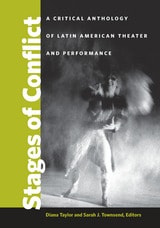
Stages of Conflict
A Critical Anthology of Latin American Theater and PerformanceDiana Taylor and Sarah J. Townsend, Editors
University of Michigan Press, 2008
"An invaluable resource to teachers of Latin American theater, with texts that provide an accurate panorama of Latin American theater."
---Adam Versenyi, University of North Carolina at Chapel Hill
"A most welcome and needed collection . . . Not only is it the first English-language anthology of theater and performance in Latin America from the Conquest onward, but it also includes excellent introductory and background material . . . certain to become an essential source book."
---Marvin Carlson, City University of New York
"A rich resource for teachers and students, and for everyone intrigued by the history of performing Latin America . . . Diana Taylor and Sarah Townsend locate an animating tension between indigenous and colonial performance practices, and between the irreducibly local character of performance and the insistent pressure---as visible in the sixteenth century as in the twenty-first---of a globalizing, often oppressive modernity."
---W. B. Worthen, Barnard College, Columbia University
Stages of Conflict brings together a vast array of dramatic texts, ambitiously tracing the intersection of theater and social and political life in the Americas over the past five centuries. Including eighteen works faithfully translated into English, the collection moves from a sixteenth century Mayan dance-drama to a 2003 production by the first published indigenous playwright in Mexico. Historical pieces from the sixteenth century to the present highlight the encounter between indigenous tradition and colonialism, while contributions from modern playwrights such as Virgilio Pinero, Jose Triana, and Denise Stolkos take on the tumultuous political and social upheavals of the past century.
The editors have added comprehensive critical commentary that details the origins of each play, affording scholars and students of theater, performance studies, and Latin American studies the opportunity to view the history of a continent through its rich and diverse theatrical traditions.
Diana Taylor is Director of The Hemispheric Institute of Performance and Politics and Professor of Performance Studies and Spanish at New York University. Her books include the award-winning volume The Archive and the Repertoire: Performing Cultural Memory in the Americas.
Sarah J. Townsend is a doctoral student at New York University.
Staging Ageing
Theatre, Performance and the Narrative of DeclineMichael Mangan
Intellect Books, 2013
Staging Masculinity
The Rhetoric of Performance in the Roman WorldErik Gunderson
University of Michigan Press, 2000
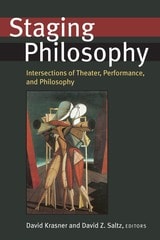
Staging Philosophy
Intersections of Theater, Performance, and PhilosophyDavid Krasner and David Z. Saltz, Editors
University of Michigan Press, 2010
Staging Philosophy raises issues of critical importance by providing case studies of various philosophical movements and schools of thought, including aesthetics, analytic philosophy, phenomenology, deconstruction, critical realism, and cognitive science. The essays, which are organized into three sections—history and method, presence, and reception—take up fundamental issues such as spectatorship, empathy, ethics, theater as literature, and the essence of live performance. While some essays challenge assertions made by critics and historians of theater and performance, others analyze the assumptions of manifestos that prescribe how practitioners should go about creating texts and performances. The first book to bridge the disciplines of theater and philosophy, Staging Philosophy will provoke, stimulate, engage, and ultimately bring theater to the foreground of intellectual inquiry while it inspires further philosophical investigation into theater and performance.
David Krasner is Associate Professor of Theater Studies, African American Studies, and English at Yale University. His books include A Beautiful Pageant: African American Theatre, Drama, and Performance in the Harlem Renaissance, 1910-1920 and Renaissance, Parody, and Double Consciousness in African American Theatre, 1895-1910. He is co-editor of the series Theater: Theory/Text/Performance.
David Z. Saltz is Professor of Theatre Studies and Head of the Department of Theatre and Film Studies at the University of Georgia. He is coeditor of Theater Journal and is the principal investigator of the innovative Virtual Vaudeville project at the University of Georgia.
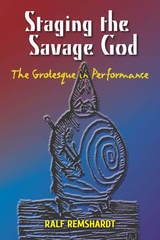
Staging the Savage God
The Grotesque in PerformanceRalf Remshardt
Southern Illinois University Press, 2004
In this broadly conceived study, Ralf Remshardt delineates the theatre’s deep connection with the grotesque and traces the historically extensive and theoretically intensive relationship between performance and its “other,” the grotesque. Staging the Savage God: The Grotesque in Performance examines the aesthetic complicity shared by the two in both art and theatre and presents a general theory of the grotesque.
Performing the grotesque is both a challenge to a culture’s order and the affirmation of certain ethical principles that it recognizes as its own. Remshardt investigates the aesthetics and ideology of grotesque theatre from antiquity—in works such as The Bacchae and Thyestes—to modernity—in Ubu Roi and Hamletmachine—and opens up new critical possibilities for the analysis of both classical and avant-gardetheatre.
Divided into three sections, Staging the Savage God first interrogates the grotesque as primarily a visual artistic and theatrical mode and then inventories various critical approaches to the grotesque, establishing the outlines of a theory with regard to drama. In the most extensive part of the study, Remshardt shifts his emphasis to the theatre of the grotesque, from self-consuming tragedies and the modernist trope of the artificial human figure to the characterology of the grotesque. Remshardt’s conclusion takes bold steps toward unraveling the paradox inherent in the grotesque theatre.
Written in an engaging style and aided by nine illustrations, Staging the Savage God is a comprehensive and rigorous study that incorporates critical approaches from disciplines such as philosophy, psychoanalysis, art history, literature, and theatre to fully investigate the historical function of the grotesque in performance.
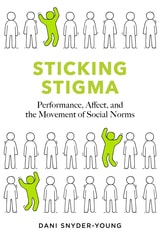
Sticking Stigma
Performance, Affect, and the Movement of Social NormsDani Snyder-Young
Vanderbilt University Press, 2026
Applied theater projects have been used to reduce the stigma related to many health conditions including bipolar disorder, HIV, suicide bereavement, mental illness, autism, and substance use disorder. Beyond this applied theater tradition, theater and performance studies tend not to use the framework or language of stigma very often. Stigma is a more commonly used framework in social science fields such as health and sociology. However, theater and performance regularly attends to the material and affective violence of stigma power: oppression, dispossession, abjection, objectification, expulsion. Snyder-Young examines a set of activist performance projects attempting to use the force of stigma to redistribute and recenter social power.
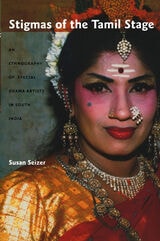
Stigmas of the Tamil Stage
An Ethnography of Special Drama Artists in South IndiaSusan Seizer
Duke University Press, 2005
Special Drama is looked down upon by the middle- and upper-classes as too popular, too vulgar, and too “mixed.” The artists are stigmatized: people insult them in public and landlords refuse to rent to them. Stigma falls most heavily, however, on actresses, who are marked as “public women” by their participation in Special Drama. As Susan Seizer’s sensitive study shows, one of the primary ways the performers deal with such stigma is through humor and linguistic play. Their comedic performances in particular directly address questions of class, culture, and gender deviations—the very issues that so stigmatize them. Seizer draws on extensive interviews with performers, sponsors, audience members, and drama agents as well as on careful readings of live Special Drama performances in considering the complexities of performers’ lives both on stage and off.

Stories Find You, Places Know
Yup'ik Narratives of a Sentient WorldHolly Cusack-McVeigh
University of Utah Press, 2017
For the Yup’ik people, places are also social actors that react to human actions and emotions. Stories tell how people learn about each other through encounters on the land, and thereby places also learn about people. Places comment on human behavior through the land's responses to specific actions. Stories variously reveal ideas about human associations and relationships between humans and nonhuman beings. Pointing to a systematic correlation between places and narrative elements that has not been previously explored, this volume makes a unique contribution to the literature on place.
Winner of the Brian McConnell Book Award from the International Society for Contemporary Legend Research.
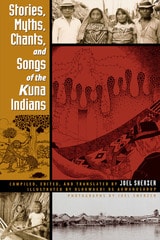
Stories, Myths, Chants, and Songs of the Kuna Indians
Compiled, edited, and translated by Joel Sherzer
University of Texas Press, 2004
The Kuna Indians of Panama, probably best known for molas, their colorful appliqué blouses, also have a rich literary tradition of oral stories and performances. One of the largest indigenous groups in the South American tropics, the majority of them (about 70,000) reside in Kuna Yala, a string of island and mainland villages stretching along the Caribbean coast. It is here that Joel Sherzer lived among them, photographing and recording their verbal performances, which he feels are representative of the beauty, complexity, and diversity of the oral literary traditions of the indigenous peoples of Latin America.
This book is organized into three types of texts: humorous and moralistic stories; myths and magical chants; and women's songs. While quite different from one another, they share features characteristic of Kuna literature as a whole, including appreciation of their environment and a remarkable knowledge of their plants and animals; a belief in spirits as an important component of their world in curing, magic, and aesthetics; and, especially, great humor and a sense of play.
Vividly illustrated by a Kuna artist and accompanied by photographs that lend a sense of being present at the performances, the texts provide readers with a unique aesthetic perspective on this rich culture while preserving an endangered and valuable indigenous oral tradition.
Storying the Self
Performance and CommunitiesJess Moriarty and Ross Adamson
Intellect Books, 2023
Through a wide array of texts and methodologies, Storying the Self spotlights autoethnographic research—and pushes the discipline in new directions. This edited volume aims to explore critical and creative approaches to understanding the self in relation to vital social, cultural, and political spheres. Chapters touch on memory and nostalgia, voluntourism in Malawi, the importance of intersectionality, documentary filmmaking, epilepsy, and other experiences to examine the role of the self, as both researcher and storyteller.
Storying the Self features contributions by Ross Adamson, Suzy Bamblett, Emily Bell, Jenni Cresswell, Hannah Davita Ludikhuijze, Sandra Lyndon, Vanessa Marr, Éva Mikuska, Jess Moriarty, Deirdre Russell, Louise Spiers, Holly Stewart, and Lucianna Whittle. It is the first book in Intellect’s innovative new series Performance and Communities, which celebrates, challenges, and researches performance in the real world.
Storytelling In Daily Life
Performing NarrativeKristin M. Langellier and Eric E. Peterson
Temple University Press, 2004
Subject–Object Art Theory
Pyotr Pavlensky
Seagull Books, 2025
Pyotr Pavlensky turns state violence into his medium—now, in his own words, he reveals the theory behind the fire.
Pyotr Pavlensky’s Subject–Object Art Theory is both a manifesto and a method—an incendiary redefinition of what art can and should be in an era of increasing repression. Known for his radical public events, such as setting fire to government buildings, stitching his lips shut, or nailing his own body to the ground, Pavlensky has been called a provocateur. In this book, he offers his own framework: subject–object art, a practice that redefines the position of art with respect to power and forces state mechanisms to work for art.
Venturing past the confines of political art, he examines the historical intersections of art and power, situating his work within a lineage of radical avant-garde movements. Whether seen as a guide or an act of defiance in itself, Subject–Object Art Theory urges the reader to rethink artistic freedom but as a means of bringing art back to its true independence.
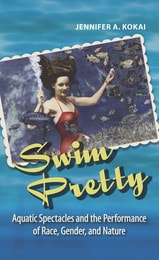
Swim Pretty
Aquatic Spectacles and the Performance of Race, Gender, and NatureJennifer A. Kokai
Southern Illinois University Press, 2017
Examining dramatic works in water and performances at four water parks, Kokai shows that the evolution of these works and performances helps us better understand our ever-changing relationship with the oceans and their inhabitants. Kokai sorts the regard for and harnessing of water in aquatic spectacles into three categories—natural, tamed, and domesticated—and discusses the ways in which these modes of water are engaged in the performances throug an aesthetics of descension. Ultimately, this study links the uncritical love of aquatic spectacles to a disregard for the rights of marine animals and lack of concern for the marine environment.
Swimming Science
Optimizing Training and PerformanceEdited by G. John Mullen
University of Chicago Press, 2018
Writing to competitive and novice swimmers alike, contributors to this volume break down every aspect of the sport. Swimming Science covers physiology, psychology, and safety, as well as hydrodynamics, nutrition, and technique. Each chapter examines these topics through a series of practical questions. What are the forces acting on you when you swim, and how do your muscles best generate propulsion against those forces? How much protein, salt, and iron should a swimmer consume, and how does energy from carbohydrates compare to energy from fats? How important is the “swimmer’s physique” in competitive swimming, and is technique or strength more necessary for generating speed? These questions are examined with the aid of explanatory diagrams and illustrations, and the book can be used to search for particular topics, or read straight through for a comprehensive overview.
Whether you are a competitive swimmer looking to optimize your performance or just beginning to dip a toe into the sport, Swimming Science is a must-read.