Results by title
376 books match the query 'Racism' and 20 start with s
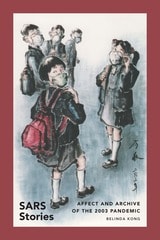
SARS Stories
Affect and Archive of the 2003 PandemicBelinda Kong
Duke University Press, 2024
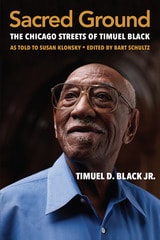
Sacred Ground
The Chicago Streets of Timuel BlackTimuel D. Black Jr., as told to Susan Klonsky, edited by Bart Schultz
Northwestern University Press, 2019
Sacred Ground opens in 1919, during the summer of the Chicago race riot, when infant Black and his family arrive in Chicago from Birmingham, Alabama, as part of the first Great Migration. He recounts in vivid detail his childhood and education in the Black Metropolis of Bronzeville and South Side neighborhoods that make up his "sacred ground."
Revealing a priceless trove of experiences, memories, ideas, and opinions, Black describes how it felt to belong to this place, even when stationed in Europe during World War II. He relates how African American soldiers experienced challenges and conflicts during the war, illuminating how these struggles foreshadowed the civil rights movement. A labor organizer, educator, and activist, Black captures fascinating anecdotes and vignettes of meeting with famous figures of the times, such as Duke Ellington and Martin Luther King Jr., but also with unheralded people whose lives convey lessons about striving, uplift, and personal integrity.
Rounding out this memoir, Black reflects on the legacy of his friend and mentee, Barack Obama, as well as on his public works and enduring relationships with students, community workers, and some very influential figures in Chicago and the world.
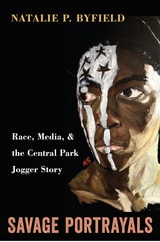
Savage Portrayals
Race, Media and the Central Park Jogger StoryNatalie Byfield
Temple University Press, 2014
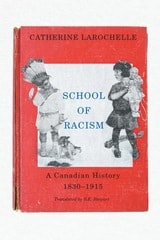
School of Racism
A Canadian History, 1830–1915Catherine Larochelle
University of Manitoba Press, 2023
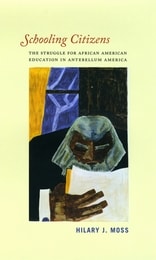
Schooling Citizens
The Struggle for African American Education in Antebellum AmericaHilary J. Moss
University of Chicago Press, 2009
While white residents of antebellum Boston and New Haven forcefully opposed the education of black residents, their counterparts in slaveholding Baltimore did little to resist the establishment of African American schools. Such discrepancies, Hilary Moss argues, suggest that white opposition to black education was not a foregone conclusion. Through the comparative lenses of these three cities, she shows why opposition erupted where it did across the United States during the same period that gave rise to public education.
As common schooling emerged in the 1830s, providing white children of all classes and ethnicities with the opportunity to become full-fledged citizens, it redefined citizenship as synonymous with whiteness. This link between school and American identity, Moss argues, increased white hostility to black education at the same time that it spurred African Americans to demand public schooling as a means of securing status as full and equal members of society. Shedding new light on the efforts of black Americans to learn independently in the face of white attempts to withhold opportunity, Schooling Citizens narrates a previously untold chapter in the thorny history of America’s educational inequality.
Segregation by Experience
Agency, Racism, and Learning in the Early GradesJennifer Keys Adair and Kiyomi Sánchez-Suzuki Colegrove
University of Chicago Press, 2021
Early childhood can be a time of rich discovery, a period when educators have an opportunity to harness their students’ fascination to create unique learning opportunities. Some teachers engage with their students’ ideas in ways that make learning collaborative--but not all students have access to these kinds of learning environments.
In Segregation by Experience, the authors filmed and studied a a first-grade classroom led by a Black immigrant teacher who encouraged her diverse group of students to exercise their agency. When the researchers showed the film to other schools, everyone struggled. Educators admired the teacher but didn’t think her practices would work with their own Black and brown students. Parents of color—many of them immigrants—liked many of the practices, but worried that they would compromise their children. And the young children who viewed the film thought that the kids in the film were terrible, loud, and badly behaved; they told the authors that learning was supposed to be quiet, still, and obedient. In Segregation by Experience Jennifer Keys Adair and Kiyomi Sánchez-Suzuki Colegrove show us just how much our expectations of children of color affect what and how they learn at school, and they ask us to consider which children get to have sophisticated, dynamic learning experiences at school and which children are denied such experiences because of our continued racist assumptions about them.

Sensory Experiments
Psychophysics, Race, and the Aesthetics of FeelingErica Fretwell
Duke University Press, 2020
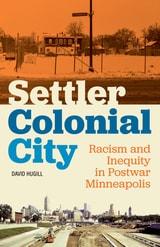
Settler Colonial City
Racism and Inequity in Postwar MinneapolisDavid Hugill
University of Minnesota Press, 2021
Revealing the enduring link between settler colonization and the making of modern Minneapolis
Colonial relations are often excluded from discussions of urban politics and are viewed instead as part of a regrettable past. In Settler Colonial City, David Hugill confronts this culture of organized forgetting by arguing that Minnesota’s largest city is enduringly bound up with the power dynamics of settler-colonial politics. Examining several distinct Minneapolis sites, Settler Colonial City tracks how settler-colonial relations were articulated alongside substantial growth in the Twin Cities Indigenous community during the second half of the twentieth century—creating new geographies of racialized advantage.
Studying the Phillips neighborhood of Minneapolis in the decades that followed the Second World War, Settler Colonial City demonstrates how colonial practices and mentalities shaped processes of urban reorganization, animated non-Indigenous “advocacy research,” informed a culture of racialized policing, and intertwined with a broader culture of American imperialism. It reveals how the actions, assumptions, and practices of non-Indigenous people in Minneapolis produced and enforced a racialized economy of power that directly contradicts the city’s “progressive” reputation.
Ultimately, Settler Colonial City argues that the hierarchical and racist political dynamics that characterized the city’s prosperous beginnings are not exclusive to a bygone era but rather are central to a recalibrated settler-colonial politics that continues to shape contemporary cities across the United States.
Shades of White Flight
Evangelical Congregations and Urban DepartureMark T. Mulder
Rutgers University Press, 2015
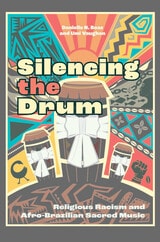
Silencing the Drum
Religious Racism and Afro-Brazilian Sacred MusicDanielle N. Boaz and Umi Vaughan
Amherst College Press, 2024
Silencing the Drum exposes the profound struggle of Afro-Brazilian sacred music against escalating intolerance. Danielle N. Boaz and Umi Vaughan blend legal scholarship with ethnomusicology, offering a compelling narrative rooted in interviews with religious leaders, musicians, and activists across Brazil. This multidisciplinary exploration examines the relentless attacks against the practitioners of Afro-Brazilian religions—from discriminatory noise complaints in Bahia to vigilante violence in Rio de Janeiro.
The volume integrates multimedia elements including musical samples to vividly illustrate the struggles and resilience of Afro-Brazilian communities in the face of discrimination. As Silencing the Drum confronts the larger global issues of racism and religious freedom, it provides essential insights for scholars, activists, and anyone passionate about human rights and cultural preservation.
Silent War
Furedi, Frank
Rutgers University Press, 1999
"The Silent War transcends the disciplinary line that divides race relations from international relations. It is an enterprise in sociological investigation which seeks to mobilize the insights of history to clarify how the consciousness of race has evolved." - Kofi Buenor Hadjor
Racial identity has been one of the defining characteristics of the twentieth century. Yet, argues Frank Furedi in this provocative study, advocates of racial identity have long felt uncomfortable with the racialized global order which they created.
Furedi traces the history of Western colonial racist ideology and its role in subjugating non-Western peoples. He analyzes the changing perception of racism in the West and how the use of "race" has altered during the course of the twentieth century.
Focusing on the Second World War as the critical turning point in racist ideology, Furedi argues that the defeat of Nazism left the West uneasy with its own racist past. He assesses how this was redefined in the postwar period-especially during the Cold War- and demonstrates that, although white supremacist views gradually became obsolete in international affairs, Western nations were initially unwilling to accept criticism of their past and sought to portray racism as a natural part of human condition. As a result the West continued to adopt the moral high ground well into the postwar period, to the ultimate detriment of non-Western nations.
Silicon Valley Imperialism
Techno Fantasies and Frictions in Postsocialist TimesErin McElroy
Duke University Press, 2024
Slavery's Descendants
Shared Legacies of Race and ReconciliationJill Strauss
Rutgers University Press, 2019
Slavery’s Descendants brings together contributors from a variety of racial backgrounds, all members or associates of a national racial reconciliation organization called Coming to the Table, to tell their stories of dealing with America’s racial past through their experiences and their family histories. Some are descendants of slaveholders, some are descendants of the enslaved, and many are descendants of both slaveholders and slaves. What they all have in common is a commitment toward collective introspection, and a willingness to think critically about how the nation’s histories of oppression continue to ripple into the present, affecting us all.
The stories in Slavery’s Descendants deal with harrowing topics—rape, lynching, cruelty, shame—but they also describe acts of generosity, gratitude, and love. Together, they help us confront the legacy of slavery to reclaim a more complete picture of U.S. history, one cousin at a time.
Funding for the production of this book was provided by Furthermore, a program of the J. M. Kaplan Fund (https://www.furthermore.org).

Sovereigns, Quasi Sovereigns, and Africans
Race and Self-Determination in International LawSiba N’Zatioula Grovogui
University of Minnesota Press, 1996
Sovereigns, Quasi Sovereigns, and Africans was first published in 1996. Minnesota Archive Editions uses digital technology to make long-unavailable books once again accessible, and are published unaltered from the original University of Minnesota Press editions.
In this trenchant critique, Siba N'Zatioula Grovogui demonstrates the failure of international law to address adequately the issues surrounding African self-determination during decolonization. Challenging the view that the only requirement for decolonization is the elimination of the legal instruments that provided for direct foreign rule, Sovereigns, Quasi Sovereigns, and Africans probes the universal claims of international law.
Grovogui begins by documenting the creation of the "image of Africa" in European popular culture, examining its construction by conquerors and explorers, scientists and social scientists, and the Catholic Church. Using the case of Namibia to illuminate the general context of Africa, he demonstrates that the principles and rules recognized in international law today are not universal, but instead reflect relations of power and the historical dominance of specific European states.
Grovogui argues that two important factors have undermined the universal applicability of international law: its dependence on Western culture and the way that international law has been structured to preserve Western hegemony in the international order. This dependence on Europeandominated models and legal apparatus has resulted in the paradox that only rights sanctioned by the former colonial powers have been accorded to the colonized, regardless of the latter's needs. In the case of Namibia, Grovogui focuses on the discursive strategies used by the West and their southern African allies to control the legal debate, as well as the tactics used by the colonized to recast the terms of the discussion.
Grovogui blends critical legal theory, historical research, political economy, and cultural studies with profound knowledge of contemporary Africa in general and Namibia in particular. Sovereigns, Quasi Sovereigns, and Africans represents the very best of the new scholarship, moving beyond narrow disciplinary boundaries to illuminate issues of decolonization in Africa.
Siba N'Zatioula Grovogui is assistant professor of political science at Johns Hopkins University. He previously practiced law in his native Guinea.
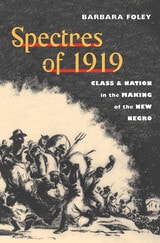
Spectres of 1919
Class and Nation in the Making of the New NegroBarbara Foley
University of Illinois Press, 2002
A look at the violent “Red Summer of 1919” and its intersection with the highly politicized New Negro movement and the Harlem Renaissance
With the New Negro movement and the Harlem Renaissance, the 1920s was a landmark decade in African American political and cultural history, characterized by an upsurge in racial awareness and artistic creativity. In Spectres of 1919 Barbara Foley traces the origins of this revolutionary era to the turbulent year 1919, identifying the events and trends in American society that spurred the black community to action and examining the forms that action took as it evolved.
Unlike prior studies of the Harlem Renaissance, which see 1919 as significant mostly because of the geographic migrations of blacks to the North, Spectres of 1919 looks at that year as the political crucible from which the radicalism of the 1920s emerged. Foley draws from a wealth of primary sources, taking a bold new approach to the origins of African American radicalism and adding nuance and complexity to the understanding of a fascinating and vibrant era.
Staking Claim
Settler Colonialism and Racialization in Hawai'iJudy Rohrer
University of Arizona Press, 2016
Author Judy Rohrer brings together an analysis of racial formation and colonization in the islands through a study of legal cases, contemporary public discourse (local media and literature), and Hawai‘i scholarship. Her analysis exposes how racialization works to obscure—with the ultimate goal of eliminating—native Hawaiian indigeneity, homeland, nation, and sovereignty.
Staking Claim argues that the dual settler colonial processes of racializing native Hawaiians (erasing their indigeneity), and indigenizing non-Hawaiians, enable the staking of non-Hawaiian claims to Hawai‘i. It encourages us to think beyond a settler-native binary by analyzing the ways racializations of Hawaiians and various non-Hawaiian settlers and arrivants bolster settler colonial claims, structures, and white supremacist ideologies.
State Anti-Intellectualism and the Politics of Gender and Race
Illiberal France and BeyondÉric Fassin
Central European University Press, 2024
Eric Fassin examines the trend of State anti-intellectualism in France using the nation as a case study to demonstrate that this tendency is not limited to ostensibly illiberal regimes. He argues that today’s world requires an examination of this phenomenon beyond Cold War geopolitical divisions and highlights a global shift towards authoritarian neoliberalism. His book is a plea for the political urgency of intellectual work in a global moment of political anti-intellectualism.
The book covers the period from President Sarkozy to Prime Minister Valls and includes both firsthand and public cases of attacks against academics, not only in France, but also in Brazil, Hungary, Russia, Turkey, and the United States, with examples of State racism and the argument of the State against antiracism. The book also considers issues of censorship and cancel culture, concluding with Fassin’s firsthand account of attacks on him from the far-right.
Still The Big News
Racial Oppression In AmericaBob Blauner
Temple University Press, 2001
Blauner launched his concept of internal colonialism in the turbulent 1960's, a period in which many Americans worried that racial conflicts would propel the country into another civil war. The notion that the systematic oppression of people of color in the United States resembles the situation of colonized populations in Third World countries still informs much of the academic research on race as well as public discourse. Indeed, today's critical race and whiteness studies are deeply indebted to Blauner's work on internal colonialism and the pervasiveness of white privilege. Offering a radical perspective on the United States' racial landscape, Bob Blauner forcefully argues that we ignore the persistence of oppression and our continuing failure to achieve equality at our own peril.

Structures of Indifference
An Indigenous Life and Death in a Canadian CityMary Jane Logan McCallum
University of Manitoba Press, 2018
Suspended Apocalypse
White Supremacy, Genocide, and the Filipino ConditionDylan Rodríguez
University of Minnesota Press, 2009
Suspended Apocalypse is a rich and provocative meditation on the emergence of the Filipino American as a subject of history. Culling from historical, popular, and ethnographic archives, Dylan Rodríguez provides a sophisticated analysis of the Filipino presence in the American imaginary. Radically critiquing current conceptions of Filipino American identity, community, and history, he puts forth a genealogy of Filipino genocide, rooted in the early twentieth-century military, political, and cultural subjugation of the Philippines by the United States.
Suspended Apocalypse critically addresses what Rodríguez calls "Filipino American communion," interrogating redemptive and romantic notions of Filipino migration and settlement in the United States in relation to larger histories of race, colonial conquest, and white supremacy. Contemporary popular and scholarly discussions of the Filipino American are, he asserts, inseparable from their origins in the violent racist regimes of the United States and its historical successor, liberal multiculturalism.
Rodríguez deftly contrasts the colonization of the Philippines with present-day disasters such as Hurricane Katrina and Mount Pinatubo to show how the global subjection of Philippine, black, and indigenous peoples create a linked history of genocide. But in these juxtapositions, Rodríguez finds moments and spaces of radical opportunity. Engaging the violence and disruption of the Filipino condition sets the stage, he argues, for the possibility of a transformation of the political lens through which contemporary empire might be analyzed, understood, and perhaps even overcome.