Results by title
1296 books match the query 'Women authors' and 100 start with s

SIGN BROKEN, MESSAGE INSIDE
PoemsSusanna Schantz
University of Massachusetts Press, 2027
A debut collection of poems that question authority with wit and clarity
“Words lead on to words” is both provocation and method in SIGN BROKEN, MESSAGE INSIDE, Susanna Schantz’s debut collection rooted in examining the roadside church signs near her South Carolina home. These poems are at turns humorous and polemical, a deft call-and-response, taking the lure and scold of these marquees as prompts for close reading and reinvention. From the local, she sketches a portrait of the national, offering an “orison / from the republic of readers,” and asking with one illuminated placard, “what will our words be like today?”
Treating church signs as a public language—communal, persuasive, sometimes backhanded—these poems expose the friction between proclamation and reception, between belonging and exclusion. They press on questions of gender and agency in faith and civic life: what role women are meant to play in the church, and what might happen if a woman were to “sail beyond this place on her / own wings and a prayer.” Formally alive, Schantz’s lines stretch, scatter, and rearrange across the page, their shapes mirroring a refusal to be contained by the cramped wit of the marquee. Her diction is tactile and bodily, reconnecting language to sensation: “fall[ing] to one’s knees / not in surrender, but / simply to luxuriate / in the cool mud.” Elsewhere, a more bristling music rises: “alphabets of tick bytes / and sacramental snaps / Climbing into our avatars / we thread our way in.” The poems’ bold sounds and rhythms echo the urgency of the signs themselves even as they reclaim their message.
“She has seen signs, and wonders,” the epigraph promises; this book delivers both. In Schantz’s hands, the roadside semaphore becomes a threshold and a mirror, inviting readers to decide: When is it enough to observe, and when must we answer back?

Sacramental Shopping
Louisa May Alcott, Edith Wharton, and the Spirit of Modern ConsumerismSarah Way Sherman
University of New Hampshire Press, 2013
Written a generation apart and rarely treated together by scholars, Little Women (1868) and The House of Mirth (1905) share a deep concern with materialism, moral development, and self-construction. The heroines in both grapple with conspicuous consumption, an aspect of modernity that challenges older beliefs about ethical behavior and core identity.
Placing both novels at the historical intersection of modern consumer culture and older religious discourse on materialism and identity, Sarah Way Sherman analyzes how Alcott and Wharton rework traditional Protestant discourse to interpret their heroines' struggle with modern consumerism. Her conclusion reveals how Little Women's optimism, still buoyed by otherworldly justice, providential interventions, and the notion of essential identity, ultimately gives way to the much darker vision of modern materialistic culture in The House of Mirth.

Saga / Circus
Lyn Hejinian
Omnidawn, 2008
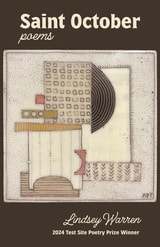
Saint October
PoemsLindsey Warren
University of Nevada Press, 2026
Saint October is a collection of title-less poems that create a network throughout the season of autumn. With challenging language and surprising imagery, these poems lift the rock of superficial autumnal beauty and examine the finer details of death and transformation, often daring the reader to leave their comfort zone. Saint October begins by taking an objective look at the last gleams of summer and quickly re-grounds itself by participating in the dynamic processes of a new season. Loss and rebirth weave these poems together as the speaker listens to the earth’s last words before she passes into death and stalks the secrets she took to her grave.
Saints of Little Faith
Megan Pinto
Four Way Books, 2024
The energies animating Saints of Little Faith, Megan Pinto’s electrifying debut in poetry, are a forceful quiet, a loud stillness, the caesura between a lightning strike and the sound of thunder. Everywhere, the speaker sees the numinous power of language, the incipience of things to come, even a kind of catastrophic grace in desolation and destruction — as if within the terrain of her own obsession, she recognizes the familiar, ever-changing seasons. Fierce and intimate, this poet’s meditative transformations engage with South Asian experiences of addiction, domestic violence, and mental illness, refusing to ignore narratives treated as unspeakable and overlooked by the English canon. Mapping the collision of abuse, psychosis, and rage, Pinto sees beyond them, buoyed by an inscrutable but abiding faith in the holiness of life itself, in a cold God nevertheless capable of gentleness. Once, “desire was an arrow, but now desire / is the field.” Pinto presides over this expanse, deciding, “I have three choices: to drift through life / anesthetized, to soften. . .” In that unspoken “or,” the merciful lacuna of that ellipsis, reside the lyrical mystery and medicine that feed this astonishing collection and strengthen resolve, both ours and the speaker’s: “The lake looks frozen, but it is not.”
Saints of Little Faith
Megan Pinto
Four Way Books, 2024
The energies animating Saints of Little Faith, Megan Pinto’s electrifying debut in poetry, are a forceful quiet, a loud stillness, the caesura between a lightning strike and the sound of thunder. Everywhere, the speaker sees the numinous power of language, the incipience of things to come, even a kind of catastrophic grace in desolation and destruction — as if within the terrain of her own obsession, she recognizes the familiar, ever-changing seasons. Fierce and intimate, this poet’s meditative transformations engage with South Asian experiences of addiction, domestic violence, and mental illness, refusing to ignore narratives treated as unspeakable and overlooked by the English canon. Mapping the collision of abuse, psychosis, and rage, Pinto sees beyond them, buoyed by an inscrutable but abiding faith in the holiness of life itself, in a cold God nevertheless capable of gentleness. Once, “desire was an arrow, but now desire / is the field.” Pinto presides over this expanse, deciding, “I have three choices: to drift through life / anesthetized, to soften. . .” In that unspoken “or,” the merciful lacuna of that ellipsis, reside the lyrical mystery and medicine that feed this astonishing collection and strengthen resolve, both ours and the speaker’s: “The lake looks frozen, but it is not.”
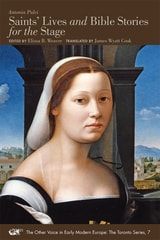
Saints' Lives and Bible Stories for the Stage
A Bilingual EditionAntonia Pulci
Iter Press, 2010
—Sharon Strocchia
Professor of History, Emory University
Sally Rooney
Perspectives and ApproachesEllen Scheible
Bucknell University Press, 2026
Bestselling Irish novelist Sally Rooney has emerged as the defining voice of a generation, a cultural phenomenon whose spare, intelligent prose and sharp social insight have reshaped contemporary fiction and sparked a global conversation about intimacy, politics, and the millennial condition. This new collection brings together contributors from a wide range of disciplines to offer fresh critical readings of Rooney’s influential novels, alongside adaptable strategies for teaching her work in today’s undergraduate and graduate classrooms. The essays situate Rooney within literary traditions from Romantic poetry to the bildungsroman and the contemporary campus novel, while engaging with contemporary topics such as gender politics, late capitalism, and media adaptation. Providing accessible yet rigorous frameworks for exploring Rooney’s fiction, this volume confirms her significance not only within contemporary literary studies but also as a cultural force whose work reaffirms the relevance of the humanities in the twenty-first-century classroom.
Published by Bucknell University Press. Distributed worldwide by Rutgers University Press.
Salonnières, Furies, and Fairies, revised edition
The Politics of Gender and Cultural Change in Absolutist FranceAnne E. Duggan
University of Delaware Press, 2021
Salvage
PoemsCynthia Dewi Oka
Northwestern University Press, 2018
Throughout it insistently interrogates what it means to reach for our humanity through the guises of nation, race, and gender. Oka’s language transports us through the many bodies of fluid poetics that inhabit our migrating senses and permeate across generations into a personal diaspora. Salvage invites us to be without borders.
Sapphic Primitivism
Productions of Race, Class, and Sexuality in Key Works of Modern FictionHackett, Robin
Rutgers University Press, 2003
In this book, Robin Hackett examines portrayals of race, class, and sexuality in modernist texts by white women to argue for the existence of a literary device that she calls “Sapphic primitivism.” The works vary widely in their form and content and include Olive Schreiner’s proto-modernist exploration of New Womanhood, The Story of an African Farm; Virginia Woolf’s high modernist “play-poem,” The Waves; Sylvia Townsend Warner’s historical novel, Summer Will Show; and Willa Cather’s Southern pastoral, Sapphira and the Slave Girl. In each, blackness and working-class culture are figured to represent sexual autonomy, including lesbianism, for white women. Sapphic primitivism exposes the ways several classes of identification were intertwined with the development of homosexual identities at the turn of the century. Sapphic primitivism is not, however, a means of disguising lesbian content. Rather, it is an aesthetic displacement device that simultaneously exposes lesbianism and exploits modern, primitivist modes of self-representation. Hackett’s revelations of the mutual interests of those who study early twentieth-century constructions of race and sexuality and twenty-first-century feminists doing anti-racist and queer work are a major contribution to literary studies and identity theory.
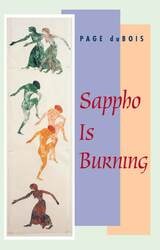
Sappho Is Burning
Page duBois
University of Chicago Press, 1995
In Sappho is Burning, duBois reads Sappho as a disruptive figure at the very origin of our story of Western civilization. Sappho is beyond contemporary categories, inhabiting a space outside of reductively linear accounts of our common history. She is a woman, but also an aristocrat, a Greek, but one turned toward Asia, a poet who writes as a philosopher before philosophy, a writer who speaks of sexuality that can be identified neither with Michel Foucault's account of Greek sexuality, nor with many versions of contemporary lesbian sexuality. She is named as the tenth muse, yet the nine books of her poetry survive only in fragments. She disorients, troubles, undoes many certitudes in the history of poetry, the history of philosophy, the history of sexuality. DuBois argues that we need to read Sappho again.
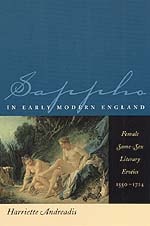
Sappho in Early Modern England
Female Same-Sex Literary Erotics, 1550-1714Harriette Andreadis
University of Chicago Press, 2001

Sarah's Choice
Eleanor Wilner
University of Chicago Press, 1989
"There is so much that is impressive in Wilner's mature poems. In an era which has been labelled 'The End of History,' she examines history's less obvious lessons. If the past is to teach us, she seems to say, then we must re-invent and re-shape it."—Poetry

Scribbling Women
Short Stories by 19th-Century American WomenShowalter, Elaine
Rutgers University Press, 1997
Showalter, a highly regarded critic known for her provocative and strongly held opinions, has here established a compelling new Who's Who of women's thought. Certain to spark controversy, the omission of such feminist perennials as Gloria Steinem, Susan B. Anthony, Robin Morgan, Eleanor Roosevelt, and Virginia Woolf will surprise and shock the conventional wisdom.
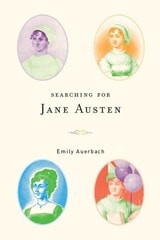
Searching for Jane Austen
Emily Auerbach
University of Wisconsin Press, 2004
In this beautifully illustrated and lively work, Auerbach surveys two centuries of editing, censoring, and distorting Austen’s life and writings. Auerbach samples Austen’s flamboyant, risqué adolescent works featuring heroines who get drunk, lie, steal, raise armies, and throw rivals out of windows. She demonstrates that Austen constantly tested and improved her skills by setting herself a new challenge in each of her six novels.
In addition, Auerbach considers Austen’s final irreverent writings, discusses her tragic death at the age of forty-one, and ferrets out ridiculous modern adaptations and illustrations, including ads, cartoons, book jackets, newspaper articles, plays, and films from our own time. An appendix reprints a ground-breaking article that introduced Mark Twain’s "Jane Austen," an unfinished and unforgettable essay in which Twain and Austen enter into mortal combat.
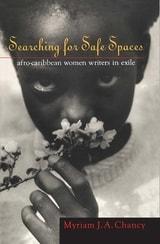
Searching for Safe Spaces
Afro-Caribbean Women Writers in ExileMyriam Chancy
Temple University Press, 1997
Understanding exile as flight from political persecution or types of oppression that single out women, Chancy concentrates on diasporic writers and filmmakers who depict the vulnerability of women to poverty and exploitation in their homelands and their search for safe refuge. These Afro-Caribbean feminists probe the complex issues of race, nationality, gender, sexuality, and class that limit women's lives. They portray the harsh conditions that all too commonly drive women into exile, depriving them of security and a sense of belonging in their adopted countries -- the United States, Canada, or England.
As they rework traditional literary forms, artists such as Joan Riley, Beryl Gilroy, M. Noubese Philip, Dionne Brand, Makeda Silvera, Audre Lorde, Rosa Guy, Michelle Cliff, and Mari Chauvet give voice to Åfro-Caribbean women's alienation and longing to return home. Whether their return is realized geographically or metaphorically, the poems, fiction, and film considered in this book speak boldly of self-definition and transformation.
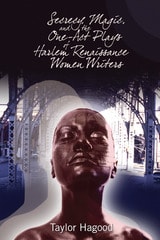
Secrecy, Magic, and the One-Act Plays of Harlem Renaissance Women Writers
Taylor Hagood
The Ohio State University Press, 2010
Exploring secrecy from the standpoints of poststructuralist language theory and game theory as well as dramatic performance, Taylor Hagood argues that the secret—a thing visible for its very invisibility—is a fundamental cog in the machinery of society, employed as a tool for both oppression and subversion. The many facets of secrecy have been particularly salient in African American culture, informing everything from the Underground Railroad to the subtle coding of Signifying. Most devastatingly, people on both sides of the color line are caught within a web of secrecy that is the result of centuries of distrust, doubt, and fear, a fact that is powerfully manifest not only in these one-act plays but in the reader’s/spectator’s interactions with them.

Secrets from the Center of the World
Joy Harjo and Stephen E. Strom
University of Arizona Press, 1989
This is Navajo country, a land of mysterious and delicate beauty. "Stephen Strom's photographs lead you to that place," writes Joy Harjo. "The camera eye becomes a space you can move through into the powerful landscapes that he photographs. The horizon may shift and change all around you, but underneath it is the heart with which we move." Harjo's prose poems accompany these images, interpreting each photograph as a story that evokes the spirit of the Earth. Images and words harmonize to evoke the mysteries of what the Navajo call the center of the world.
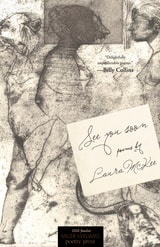
See You Soon
PoemsLaura McKee
University of Arkansas Press, 2016
Finalist, 2016 Miller Williams Poetry Prize
The poems in See You Soon explore the limits of metaphor and language as their voices speak from the beauty and strangeness of daily experience, testing how we make sense of ourselves to ourselves and to one another. There is love in these poems, there is failure and absurdity. The characters, in their various situations and guises, find themselves outside of time, space, and identity—at sunset, in an airport, outside a hookah lounge, as a birthday party clown, after a flood. Its message is the invitation of the title. See You Soon is a statement of the complexity of our mutual direction in time, of camaraderie along the way.
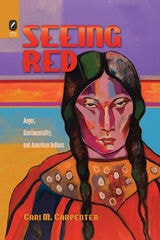
Seeing Red
Anger, Sentimentality, and American IndiansCari M. Carpenter
The Ohio State University Press, 2008
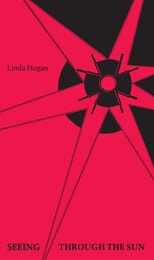
Seeing through the Sun
Linda Hogan
University of Massachusetts Press, 1985
Keen observation and vivid imagery mark this collection of poems by a Chickasaw Indian. Linda Hogan's subjects are often drawn from events of everyday life—gathering wood, watching her daughters sleep, witnessing changes in the weather, awaiting nightfall. But beneath the surface of these daily happenings runs a powerful undercurrent, a sureness of life's basic rhythms and a sensitivity to the pressures of survival.
Selected Drama and Verse
Franciszka Urszula Radziwillowa
Iter Press, 2015

Selected Letters
Isabella d’Este
Iter Press, 2017
Isabella d’Este (1474–1539), daughter of the Este dukes of Ferrara and wife of Marchese Francesco II Gonzaga of Mantua, co-regent of the Gonzaga state, art collector, musician, diplomat, dynastic mother, traveler, reader, gardener, fashion innovator, and consummate politician, was also, as this volume attests, a prolific letter writer with a highly developed epistolary network. Presented here for the first time in any language is a representative selection from over 16,000 letters sent by Isabella to addressees across a wide social spectrum. Together, they paint a nuanced and colorful portrait of a brilliant and influential female protagonist of early modern European society.

Selected Philosophical, Scientific, and Autobiographical Writings
Marie-Geneviève-Charlotte Thiroux d’Arconville
Iter Press, 2018
Edited and translated by Julie Candler Hayes
The Other Voice in Early Modern Europe: The Toronto Series, volume 58

Selected Poems
Jean Garrigue. Introduction by J. D. McClatchy
University of Illinois Press, 1992
Selected Poems is compiled from the best works in Jean Garrigue's eight published collections. Garrigue (1914-72) is recognized as a leading American poet of the fifties and sixties. Among her awards and honors were a Guggenheim fellowship and a National Institute of Arts and Letters grant.

Selected Poems Of Janet Lewis
Janet Lewis
Ohio University Press, 2000
Since the appearance in print of her early poems over seventy-five years ago, the poetry of Janet Lewis has grown in quiet acclaim and popularity. Although she is better known as a novelist of historical fiction, her first and last writings were poems. With the publication of her selected poems, Swallow Press celebrates the distinguished career of one of its most cherished authors.
Critics as disparate as Kenneth Rexroth, Timothy Steele, Theodore Roethke, Larry McMurtry, N. Scott Momaday, and Dana Gioia have sung the praises of her work over the decades. Her career as a poet was remarkable not only for its longevity but also for the fact that even well into her tenth decade she wrote poems that stand with her very best work.
Characterized by the vigor and sharpness of her images and the understated lyricism that permeates her rhythmic lines, The Selected Poems of Janet Lewis is a survey of modern poetry unto itself.
Self as Nation
Contemporary Hebrew AutobiographyTamar S. Hess
Brandeis University Press, 2016

Series | India
Elizabeth T. Gray
Four Way Books, 2015

Seven American Women Writers of the Twentieth Century
An IntroductionMaureen Howard, Editor
University of Minnesota Press, 1977
Seven American Women Writers of the Twentieth Century was first published in 1977. Minnesota Archive Editions uses digital technology to make long-unavailable books once again accessible, and are published unaltered from the original University of Minnesota Press editions.

Sex Depression Animals
PoemsMag Gabbert
The Ohio State University Press, 2023
Shadow Puppets, Songs, and Sacred Feasts
Celebrations of the Indo-Portuguese Nuns in the Eighteenth-Century Real Convento de Santa Mónica, Goa, India. A Bilingual EditionEdited by Daniel Michon
Iter Press, 2025
The Entrada de Bonifrate para Festa dos Reis, a shadow puppet play for the feast of the Kings, and the Cartepaço da Muzica, a songbook for the feast of St. John, showcase the imaginative minds of the nuns at the Indo-Portuguese Real Convento de Santa Mónica, Goa, India. Composed for private convent audiences, these texts blend Portuguese and Spanish baroque elements with local Goan traditions. The uncensored verses celebrate convent life, critique local social norms, and affirm the nuns’ community identity, exhibiting the Mónicas’ musical talents and literary sensibilities.
Shadowed Dreams
Women's Poetry of the Harlem RenaissanceMcKay, Nellie
Rutgers University Press, 2006
The first edition of Shadowed Dreams was a groundbreaking anthology that brought to light the contributions of women poets to the Harlem Renaissance. This revised and expanded version contains twice the number of poems found in the original, many of them never before reprinted, and adds eighteen new voices to the collection to once again strike new ground in African American literary history. Also new to this edition are nine period illustrations and updated biographical introductions for each poet.
Shadowed Dreams features new poems by Gwendolyn Bennett, Anita Scott Coleman, Mae Cowdery, Blanche Taylor Dickinson, Alice Dunbar-Nelson, Jessie Fauset, Angelina Weld Grimké, Gladys Casely Hayford (a k a Aquah Laluah), Virginia Houston, Georgia Douglas Johnson, Helene Johnson, Effie Lee Newsome, Esther Popel, and Anne Spencer, as well as writings from newly discovered poets Carrie Williams Clifford, Edythe Mae Gordon, Alvira Hazzard, Gertrude Parthenia McBrown, Beatrice Murphy, Lucia Mae Pitts, Grace Vera Postles, Ida Rowland, and Lucy Mae Turner, among others.
Covering the years 1918 through 1939 and ranging across the period’s major and minor journals, as well as its anthologies and collections, Shadowed Dreams provides a treasure trove of poetry from which to mine deeply buried jewels of black female visions in the early twentieth century.
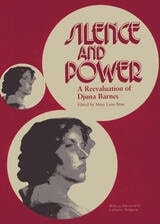
Silence and Power
A Reevaluation of Djuna BarnesEdited by Mary Lynn Broe. Afterword by Catharine Stimpson
Southern Illinois University Press, 1991
Roughly chronological, these essays explore Barnes’ early work in the New York newspaper world of the ‘teens, proceed through the 1954 publication of The Antiphon, and include several approaches to such works as Ryder, Ladies Almanack, and Nightwood. This judicious mix of essays—many of them illustrated by photographs and drawings—presents a comprehensive picture of the creative imagination of Djuna Barnes.
Essayists include Mary Lynn Broe, Nancy J. Levine, Ann Larabee, Joan Retallack, Carolyn Allen, Carolyn Burke, Sheryl Stevenson, Marie Ponsot, Frances M. Doughty, Susan Sniader Lanser, Frann Michel, Karla Jay, Jane Marcus, Judith Lee, Julie L. Abraham, Meryl Altman, Lynda Curry, Louise A. DeSalvo, and Catharine Stimpson. Individuals sharing personal recollections of Barnes are Ruth Ford, James B. Scott, Alex Gildzen, Hank O’Neal, Chester Page, Andrew Field, and Frances McCullough. Janice Thom and Kevin Engel provide an updated bibliography.
From The Book of Repulsive Women to The Antiphon, Barnes challenged old gender dichotomies as she shaped radical sociopolitical views. Her textual methods celebrated a multiplicity of voices, heterodox forms, and genres, transgressing those tenets of modernism that privilege the “high art” of a single, unified textual identity or a discrete discourse. These essays offer various critical approaches and sinuous readings of the full range of Barnes’ achievement. Interwoven through the essays and reminiscences is a lively commentary from Barnes’ friends and contemporaries as well as Barnes herself.
Silences
Martha Ronk
Omnidawn, 2019
These poems endeavor to give a much-deserved voice to silence, addressing the power of what is not seen. While silence remains perpetually out of reach, Ronk invites us to follow the language that creeps up to its edges. The poems in this collection form an inquiry that moves through the presence of silence and reveals insights into the character of the visual art in which it lives.
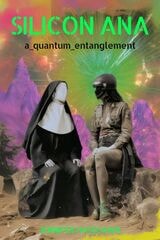
Silicon Ana
A Quantum EntanglementJennifer Hasegawa
Omnidawn, 2026
Poetry tracing the parallel lives of two characters as they grapple with transcendence, selfhood, technology, and desire.
In Silicon Ana: A Quantum Entanglement, two narratives weave across each page: Ana, a stigmatic visionary navigating miraculous healings and supernatural visitations, and Nan, discovering sexuality and selfhood through a found Penthouse magazine. Across seven movements, their stories braid and diverge—hospital beds mirror bedroom paralysis, religious ecstasy meets erotic awakening, strange prophecies echo in both realms. Through tightly wound five-line stanzas, this double helix of consciousness explores possession in all its forms: spiritual, sexual, psychological, and technological. Each stanza creates a chamber where sacred and profane collapse into each other. Written in an era of AI awakening and quantum computing, where consciousness becomes suspect, this collection asks what happens when the experiment becomes self-aware. As Ana ascends toward cosmic transcendence and Nan navigates earthly desire, their entangled fates ask if we are observing one entity being split across an unfathomable divide or two that are bound by invisible threads. Silicon Ana is a fevered meditation on bodies that refuse singular interpretation in an age of infinite possible selves.
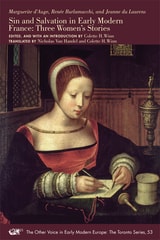
Sin and Salvation in Early Modern France
Three Women’s StoriesMarguerite d'Auge, Renée Burlamacchi, and Jeanne du Laurens
Iter Press, 2017
The texts available here in English for the first time open a window into the lives of three early modern Frenchwomen as they explore the common themes of family, memory, sin, and salvation. The Regrets of Marguerite d’Auge (1600), the Memoirs of Renée Burlamacchi (1623), and the Genealogy of Jeanne du Laurens (1631), taken from different genres of historical writings, raise important questions: Why and how did female authorship find its way into the historical record? How did these voices escape the censorship and prejudice against female publication? In a time of extreme religious conflict, how did these women convey their views on controversial issues such as primacy of grace, indulgences, and salvation without disrupting the gender expectations of the era?
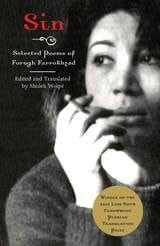
Sin
Selected Poems of Forugh FarrokhzadSholeh Wolpe
University of Arkansas Press, 2010
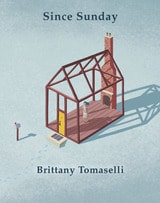
Since Sunday
Brittany Tomaselli
Omnidawn, 2019
Through wit, vulnerability, and rich lyrical language, Tomaselli invites us to walk with her through loss and on to a persistent process of discovery. The poems chronicle a cultivation of awe, unearthing a fresh faith rooted in the present realness of everyday experiences. Stripped of the orthodoxy that both grew and crushed her, she reconstructs a new core of trust for herself. Here we learn with the poet to seek celebration in daily life and to foster a sense of beauty from the mundane.
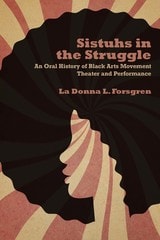
Sistuhs in the Struggle
An Oral History of Black Arts Movement Theater and PerformanceLa Donna L. Forsgren
Northwestern University Press, 2021
Outstanding Academic Title, CHOICE
The first oral history to fully explore the contributions of black women intellectuals to the Black Arts Movement, Sistuhs in the Struggle reclaims a vital yet under-researched chapter in African American, women’s, and theater history. This groundbreaking study documents how black women theater artists and activists—many of whom worked behind the scenes as directors, designers, producers, stage managers, and artistic directors—disseminated the black aesthetic and emboldened their communities.
Drawing on nearly thirty original interviews with well-known artists such as Ntozake Shange and Sonia Sanchez as well as less-studied figures including distinguished lighting designer Shirley Prendergast, dancer and choreographer Halifu Osumare, and three-time Tony-nominated writer and composer Micki Grant, La Donna L. Forsgren centers black women’s cultural work as a crucial component of civil rights and black power activism. Sistuhs in the Struggle is an essential collection for theater scholars, historians, and students interested in learning how black women’s art and activism both advanced and critiqued the ethos of the Black Arts and Black Power movements.
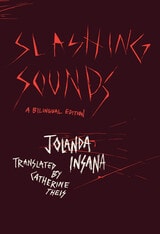
Slashing Sounds
A Bilingual EditionJolanda Insana
University of Chicago Press, 2024
Jolanda Insana’s Slashing Sounds uses invectives, fragments, epigrams, and epigraphs to construct poems that pulse with the texture of an idiosyncratic Sicilian dialect. The poems in this collection are ferocious, irreverent, strange, snarky, and otherworldly. Insana’s commitment to contentiousness, her brutal and skeptical eye, and her preoccupation with language make Insana’s poetry particularly arresting. For Insana, there is no subject more worthy of our interest than language’s misfires and contradictory impulses—language being the ultimate arrow, forging a direction in the world and forcing a turn toward whatever reality appears in front of you.
The first book-length collection of Insana’s poetry published in English, Slashing Sounds is a powerful offering that addresses a lack of female Italian voices in Anglophone poetry publishing.
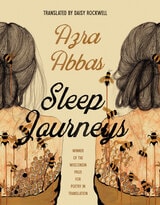
Sleep Journeys
Azra Abbas, Translated by Daisy Rockwell
University of Wisconsin Press, 2026
When Sleep Journeys first appeared in 1981, it took the Urdu poetry world by storm. Now considered one of the finest contemporary Urdu poets, Azra Abbas was among the first to embrace experimental, free verse poetry. A single book-length poem, divided into three cantos, Sleep Journeys is a dreamlike rumination that explores faith, female desire, and the subconscious mind. Abbas’s language is simple and austere, the complexity of the work emerging through repetition, interweaving, and juxtaposition. The result is a gossamer thread that leads the reader through a labyrinth of metaphor, imagery, and awe.
Award-winning translator Daisy Rockwell expertly captures the rhythm and flow of the original. The result is a book that ushers us into a state between sleeping and waking, the world of hidden thoughts and desires. This edition brings one of the most celebrated Urdu poems of the latter twentieth century to a broader, worldwide readership.
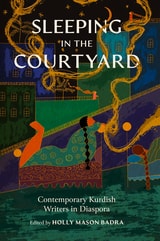
Sleeping in the Courtyard
Contemporary Kurdish Writers in DiasporaHolly Mason Badra
University of Arkansas Press, 2025
Sleeping in the Courtyard brings together historically isolated writers in community—and invites readers to join them around the table to share in their memories, secrets, tears, and joys. Featuring poetry, fiction, nonfiction, and graphic work by emerging and well-established writers, this collection shines a light on works by a diverse group of contemporary Kurdish women and nonbinary writers living in Kurdistan and in diaspora.
Recognizing the complex web of physical and lingual displacement of the Kurdish people and celebrating the diverse tapestry of their stories, this collection presents work originally written in English and work translated from Kurdish dialects as well as from Arabic, Turkish, Persian, and Swedish. A few works in Kurdish dialects appear alongside their translations, both in recognition of the experience of linguicide and to push against oppressive attempts to strip away Kurdish language.
Several works here explore the impact of the countless forms of militarized displacement, cultural destruction, and mass genocide that Kurds have endured. Other pieces illuminate Kurdish experiences of desire, friendship, empowerment, familial intricacies, and other topics spanning across universal human conditions. The writers in these pages take risks both in craft and content—and in some cases, just by daring to write and publish. What emerges in Sleeping in the Courtyard is the antithesis of erasure.
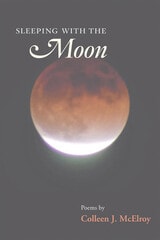
Sleeping with the Moon
Colleen J. McElroy
University of Illinois Press, 2007
PEN Oakland National Literary Award, 2008
Colleen J. McElroy's poetry shoots for the moon, and takes it in, too, in one way after another. The collection’s award-winning poems animate women’s experiences of sex, shopping, and dancing, while offering telling insight into the struggles and silver lining of lust, love, illness, and aging. Rich with vivid imagery and candid storytelling, Sleeping with the Moon takes readers on moonlit adventures under the night sky, through the barroom’s smoky haze, and under the covers....Beware: such delicate
sights have driven more than one woman to despair
instead she watched him breathe-- relishing
for a moment that secret space where night
grows soft and the moon’s detumescence forgives--
and where if this jeweled light holds they might
strip themselves of years if only for one night
--from “In Praise of Older Women”
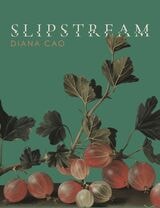
Slipstream
Diana Cao
Tupelo Press, 2026
The poems in Slipstream deal with the slippery concept of home, with robots and the internet and other human inventions, and with what we can learn from the natural world around us.
Winner of the Berkshire Prize, Slipstream is a bracing, intimate, and formally adventurous debut that moves with equal grace through personal memory, inherited history, myth, and the ambient technologies of contemporary life. Diana Cao’s poems braid ancient Chinese legend, family migration, illness, love, and grief with moon landers, algorithms, privacy policies, and online ritual, creating a lyric field where the ancestral and the digital speak fluently to one another. The book is formally restless and assured. Sonnets, sestinas, villanelles, fables, and linked sequences feel conversational rather than ornate, their intelligence worn lightly, their music precise and unforced. Throughout, Cao writes with a clarity that never flattens complexity: humor and vulnerability coexist with philosophical rigor. Tenderness is sharpened, not softened, by attention to politics, history, and care.
What emerges is a voice attuned to relational life in all its registers—daughterhood, friendship, desire, citizenship, species—asking how to live, love, and remain lucid inside systems that both sustain and estrange us. Slipstream is a book of uncommon range and emotional intelligence, one that feels fully of this moment while remaining in deep, living conversation with the past.

Small Change
Women, Learning, Patriotism, 1750-1810Harriet Guest
University of Chicago Press, 2000
During the second half of the eighteenth century, the social role of educated women and the nature of domesticity were the focus of widespread debate in Britain. The emergence of an identifiably feminist voice in that debate is the subject of Harriet Guest's new study, which explores how small changes in the meaning of patriotism and the relations between public and private categories permitted educated British women to imagine themselves as political subjects.
Small Change considers the celebration of learned women as tokens of national progress in the context of a commercial culture that complicates notions of gender difference. Guest offers a fascinating account of the women of the bluestocking circle, focusing in particular on Elizabeth Carter, hailed as the paradigmatic learned and domestic woman. She discusses the importance of the American war to the changing relation between patriotism and gender in the 1770s and 1780s, and she casts new light on Mary Wollstonecraft's writing of the 1790s, considering it in relation to the anti-feminine discourse of Hannah More, and the utopian feminism of Mary Hays.
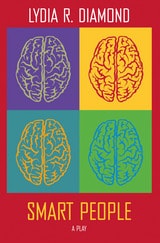
Smart People
A PlayLydia R. Diamond
Northwestern University Press, 2017
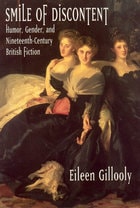
Smile of Discontent
Humor, Gender, and Nineteenth-Century British FictionEileen Gillooly
University of Chicago Press, 1999
Gillooly shows how such humor became, for mostly female writers at the time, an unobtrusive and prudent means of expressing discontent with a culture that was ideologically committed to restricting female agency and identity. If the aggression and emotional distance of irony and satire mark them as "masculine," then for Gillooly, the passivity, indirection, and sympathy of the humor she discusses render it "feminine." She goes on to disclose how the humorous tactics employed by writers from Burney to Wharton persist in the work of Barbara Pym, Anita Brookner, and Penelope Fitzgerald.
The book won the Barbara Perkins and George Perkins Award given by the Society for the Study of Narrative Literature.
Snow on the Cane Fields
Women’s Writing and Creole SubjectivityJudith Raiskin
University of Minnesota Press, 1995
Snow on the Cane Fields was first published in 1995. Minnesota Archive Editions uses digital technology to make long-unavailable books once again accessible, and are published unaltered from the original University of Minnesota Press editions.
In a probing analysis of creole women's writing over the past century, Judith Raiskin explores the workings and influence of cultural and linguistic colonialism. Tracing the transnational and racial meanings of creole identity, Raiskin looks at four English-speaking writers from South Africa and the Caribbean: Olive Schreiner, Jean Rhys, Michelle Cliff, and Zoë Wicomb. She examines their work in light of the discourses of their times: nineteenth-century "race science" and imperialistic rhetoric, turn-of-the-century anti-Semitic sentiment and feminist pacifism, postcolonial theory, and apartheid legislation.
In their writing and in their multiple identities, these women highlight the gendered nature of race, citizenship, culture, and the language of literature. Raiskin shows how each writer expresses her particular ambivalences and divided loyalties, both enforcing and challenging the proprietary British perspective on colonial history, culture, and language. A new perspective on four writers and their uneasy places in colonial culture, Snow on the Cane Fields reveals the value of pursuing a feminist approach to questions of national, political, and racial identity.
Judith Raiskin is assistant professor of women's studies at the University of California, Santa Barbara.
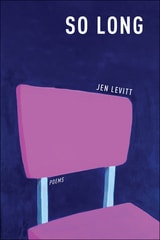
So Long
Jen Levitt
Four Way Books, 2023
Anticipating and then grieving the death of her father, Jen Levitt’s So Long fleshes out a full elegiac register, sitting with the mourning of farewell while holding onto gratitude, remembrance, and a permeating love. “Soon,” she says, “we’ll have to find another way to meet, as moonlight / makes the river glow.” In the contrails of bittersweet loss, Levitt’s speaker observes all that surrounds her, and the self, too, as a phenomenon in loneliness. In the suburbs, she notes high- school athletes circling “in their sweat-resistant fabrics,” “so natural in their tank tops, those dutiful kids trying to beat time”; upstate, she finds herself in temple where Broadway music has replaced prayer and discovers “no promises, / but, like hearing a rustle in deep woods & turning to locate its source, the chance for something rare.” It is this humanistic faith that inverts the title’s idiomatic goodbye into a statement of permanence, the truth of our enduring, improbable lives: look at this, she seems to command herself, “& look at how lucky I’ve been, for so long.”