Results by title
18284 books match the query 'United States' and 1181 start with s
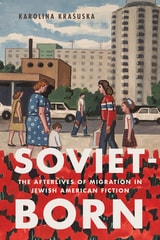
Soviet-Born
The Afterlives of Migration in Jewish American FictionKarolina Krasuska
Rutgers University Press, 2024
Entering an immigrant, Soviet-born standpoint creates an alternative and sometimes complementary pattern of how the Eastern and Central European past and present resonate with American Jewishness. The novels, short stories, and graphic novels considered here often stage strikingly fresh variations on key older themes, including cultural geography, the memory of World War II and the Holocaust, communism, gender and sexuality, genealogy, and finally, migration. Soviet-Born demonstrates how these diasporic writers, with their critical stance toward identity categories, open up the field of what is canonically Jewish American to broader contemporary debates.
This book is also freely available online as an open-access digital edition.
Sowing the American Dream
How Consumer Culture Took Root in the Rural MidwestDavid Blanke
Ohio University Press, 2000
From 1840 to 1900, midwestern Americans experienced firsthand the profound economic, cultural, and structural changes that transformed the nation from a premodern, agrarian state to one that was urban, industrial, and economically interdependent. Midwestern commercial farmers found themselves at the heart of these changes. Their actions and reactions led to the formation of a distinctive and particularly democratic consumer ethos, which is still being played out today.
By focusing on the consumer behavior of midwestern farmers, Sowing the American Dream provides illustrative examples of how Americans came to terms with the economic and ideological changes that swirled around them. From the formation of the Grange to the advent of mail-order catalogs, the buying patterns of rural midwesterners set the stage for the coming century.
Carefully documenting the rise and fall of the powerful purchasing cooperatives, David Blanke explains the shifting trends in collective consumerism, which ultimately resulted in a significant change in the way that midwestern consumers pursued their own regional identity, community, and independence.
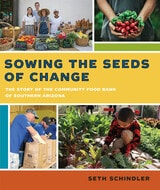
Sowing the Seeds of Change
The Story of the Community Food Bank of Southern ArizonaSeth Schindler
University of Arizona Press, 2021
The numbers are no less shocking in southern Arizona: one in six residents, and one in four children, are food insecure. How can this be in the richest country in the world? This book explores that paradox and the innovative solutions that one organization has developed to create a healthier, more secure tomorrow for the less fortunate among us.
The Community Food Bank of Southern Arizona (CFB) is one of the oldest and most respected food banks in America. It is a widely recognized leader not simply in providing hunger relief but in attacking the root causes of hunger and poverty through community development, education, and advocacy. In 2018, Feeding America—the national organization of food banks—named it “Food Bank of the Year.” The CFB serves as a model for all nonprofits to follow, no matter their mission.
This profusely illustrated book chronicles the CFB’s amazing success and evolution from a tiny grassroots hunger-relief organization to one with more than six thousand workers and an annual budget exceeding $100 million. The book gives voice to the thousands of CFB participants past and present, weaving their profiles and quotes throughout the book. These profiles personalize the history of the CFB and give readers an insider’s perspective on the people and events that shaped the food bank’s success. It shows how individuals working together can help prevent hunger and break the cycle of poverty that is its cause.
The aim of Sowing the Seeds of Change is not to laud the CFB’s achievements. It is to demonstrate to readers that the war against hunger, despite the obstacles, can be won. And not tomorrow. Now!
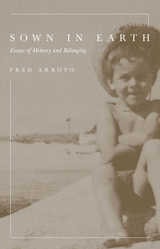
Sown in Earth
Essays of Memory and BelongingFred Arroyo
University of Arizona Press, 2020
In Sown in Earth, Arroyo often roots his thoughts and feelings in place, expressing a deep connection to the small homes he inhabited in his childhood, his warm and hazy memories of his grandmother’s kitchen in Puerto Rico, the rivers and creeks he fished, and the small cafés in Madrid that inspired writing and reflection in his adult years. Swirling in romantic moments and a refined love for literature, Arroyo creates a sense of belonging and appreciation for his life despite setbacks and complex anxieties along the way.
By crafting a written journey through childhood traumas, poverty, and the impact of alcoholism on families, Fred Arroyo clearly outlines how his lived experiences led him to become a writer. Sown in Earth is a shocking yet warm collage of memories that serves as more than a memoir or an autobiography. Rather, Arroyo recounts his youth through lyrical prose to humanize and immortalize the hushed lives of men like his father, honoring their struggle and claiming their impact on the writers and artists they raised.

Space Is the Place
The Lives and Times of Sun RaJohn Szwed
Duke University Press, 2020
Space of Detention
The Making of a Transnational Gang Crisis between Los Angeles and San SalvadorElana Zilberg
Duke University Press, 2011

Spaceflight and the Myth of Presidential Leadership
Edited by Roger D. Launius and Howard E. McCurdy
University of Illinois Press, 1997
Setting the tone for the collection, NASA chief historian Roger D. Launius and Howard McCurdy maintain that the nation's presidency had become imperial by the mid-1970s and that supporters of the space program had grown to find relief in such a presidency, which they believed could help them obtain greater political support and funding. Subsequent chapters explore the roles and political leadership, vis-à-vis government policy, of presidents Eisenhower, Kennedy, Johnson, Nixon, Ford, Carter, and Reagan.

Spaces between Us
Queer Settler Colonialism and Indigenous DecolonizationScott Lauria Morgensen
University of Minnesota Press, 2011
We are all caught up in one another, Scott Lauria Morgensen asserts, we who live in settler societies, and our interrelationships inform all that these societies touch. Native people live in relation to all non-Natives amid the ongoing power relations of settler colonialism, despite never losing inherent claims to sovereignty as indigenous peoples. Explaining how relational distinctions of “Native” and “settler” define the status of being “queer,” Spaces between Us argues that modern queer subjects emerged among Natives and non-Natives by engaging the meaningful difference indigeneity makes within a settler society.
Morgensen’s analysis exposes white settler colonialism as a primary condition for the development of modern queer politics in the United States. Bringing together historical and ethnographic cases, he shows how U.S. queer projects became non-Native and normatively white by comparatively examining the historical activism and critical theory of Native queer and Two-Spirit people.
Presenting a “biopolitics of settler colonialism”—in which the imagined disappearance of indigeneity and sustained subjugation of all racialized peoples ensures a progressive future for white settlers—Spaces between Us newly demonstrates the interdependence of nation, race, gender, and sexuality and offers opportunities for resistance in the United States.
Spain and the American Civil War
Wayne H. Bowen
University of Missouri Press, 2011
Spain and the Plains
Myths and Realities of Spanish Exploration and Settlement on the Great PlainsRalph H. Vigil
University Press of Colorado, 2007
Spain and the Plains introduces and documents Spanish exploration of and migration to the Plains, examines the myths that shaped Spanish exploration and the pragmatic realities of exploration and settlement, and documents racism and misrepresentation that Hispanic groups encountered in the nineteenth and twentieth centuries. Contributors show how early explorers, shaped by the intellectual context of the Renaissance, sought mythical locales: the fountain of youth, the straits of Anian, and the city of Quivira. They describe how exploration shifted to emphasize military and economic gains in the eighteenth and nineteenth centuries. Essays portray the diaspora of Spanish settlers and reconstruct daily life in their settlements on the Plains.
This unique collection paints a clear picture of a crucial but often misrepresented and neglected era in American and Spanish history.
The editors, all authors of previous books, are affiliated with the Center for Great Plains Studies at the University of Nebraska-Lincoln, where Frances W. Kaye is a professor of English, John R. Wunder is a professor of history and journalism, and Ralph H. Vigil is a professor emeritus of history and ethnic studies. Contributors include Félix D. Almaráz Jr., Thomas E. Chávez, Frances W. Kaye, Russell M. Magnaghi, Ralph H. Vigil, Waldo R. Wedel, and John R. Wunder.
Spain's Long Shadow
The Black Legend, Off-Whiteness, and Anglo-American EmpireMaría DeGuzmán
University of Minnesota Press, 2005
England and the Netherlands, Spain’s imperial rivals of the sixteenth and seventeenth centuries, imagined Spain as a land of cruel and degenerate barbarians of la leyenda negra (the Black Legend), in league with the powers of “blackest darkness” and driven by “dark motives.” In Spain’s Long Shadow, María DeGuzmán explores how this convenient demonization made its way into American culture—and proved essential to the construction of whiteness. DeGuzmán’s work reaches from the late eighteenth century—in the wake of the American Revolution—to the present. Surveying a broad range of texts and images, from Poe’s “William Wilson” and John Singer Sargent’s El Jaleo to Richard Wright’s Pagan Spain and Kathy Acker’s Don Quixote, Spain’s Long Shadow shows how the creation of Anglo-American ethnicity as specifically American has depended on the casting of Spain as a colonial alter ego. The symbolic power of Spain in the American imagination, DeGuzmán argues, is not just a legacy of that nation’s colonial presence in the Americas; it lives on as well in the “blackness” of Spain and Spaniards—in the assigning of people of Spanish origin to an “off-white” racial category that reserves the designation of white for Anglo-Americans. By demonstrating how the Anglo-American imagination needs Spain and Spaniards as figures of attraction and repulsion, DeGuzmán makes a compelling and illuminating case for treating Spain as the imperial alter ego of the United States. Cross-cultural and interdisciplinary, ambitious in its chronological sweep, and elegant in its interpretation of literary and visual works, DeGuzmán’s book leads us to a powerful new understanding of the nature—and history—of American ethnicity.
Spanish Colonial Tucson
A Demographic HistoryHenry F. Dobyns
University of Arizona Press, 1976

Spanish Expeditions into Texas, 1689-1768
By William C. Foster
University of Texas Press, 1995
Mapping old trails has a romantic allure at least as great as the difficulty involved in doing it. In this book, William Foster produces the first highly accurate maps of the eleven Spanish expeditions from northeastern Mexico into what is now East Texas during the years 1689 to 1768.
Foster draws upon the detailed diaries that each expedition kept of its route, cross-checking the journals among themselves and against previously unused eighteenth-century Spanish maps, modern detailed topographic maps, aerial photographs, and on-site inspections. From these sources emerges a clear picture of where the Spanish explorers actually passed through Texas.
This information, which corrects many previous misinterpretations, will be widely valuable. Old names of rivers and landforms will be of interest to geographers. Anthropologists and archaeologists will find new information on encounters with some 139 named Indian tribes. Botanists and zoologists will see changes in the distribution of flora and fauna with increasing European habitation, and climatologists will learn more about the "Little Ice Age" along the Rio Grande.

Spanish Peaks
Land and LegendsConger Beasley, Jr.
University Press of Colorado, 2006

Spanish Texas, 1519–1821
Revised EditionBy Donald E. Chipman and Harriett Denise Joseph
University of Texas Press, 2010
Winner, Kate Broocks Bates Award, Texas State Historical Association
Presidio La Bahía Award, Sons of the Republic of Texas
A Choice Magazine Outstanding Academic Book
Modern Texas, like Mexico, traces its beginning to sixteenth-century encounters between Europeans and Indians who contested control over a vast land. Unlike Mexico, however, Texas eventually received the stamp of Anglo-American culture, so that Spanish contributions to present-day Texas tend to be obscured or even unknown. The first edition of Spanish Texas, 1519–1821 (1992) sought to emphasize the significance of the Spanish period in Texas history. Beginning with information on the land and its inhabitants before the arrival of Europeans, the original volume covered major people and events from early exploration to the end of the colonial era.
This new edition of Spanish Texas has been extensively revised and expanded to include a wealth of discoveries about Texas history since 1990. The opening chapter on Texas Indians reveals their high degree of independence from European influence and extended control over their own lives. Other chapters incorporate new information on La Salle's Garcitas Creek colony and French influences in Texas, the destruction of the San Sabá mission and the Spanish punitive expedition to the Red River in the late 1750s, and eighteenth-century Bourbon reforms in the Americas. Drawing on their own and others' research, the authors also provide more inclusive coverage of the role of women of various ethnicities in Spanish Texas and of the legal rights of women on the Texas frontier, demonstrating that whether European or Indian, elite or commoner, slave owner or slave, women enjoyed legal protections not heretofore fully appreciated.
Spanish and Empire
Nelsy Echavez-Solano
Vanderbilt University Press, 2007
Spanish-Language Newspapers in New Mexico, 1834-1958
A. Gabriel Meléndez
University of Arizona Press, 2005
Gabriel Meléndez details the education and formation of a generation of Spanish-language journalists who were instrumental in creating a culture of print in nativo communities. He then offers in-depth cultural and literary analyses of the texts produced by los periodiqueros, establishing them thematically as precursors of the Chicano literary and political movements of the 1960s and ’70s.
Moving beyond a simple effort to reinscribe Nuevomexicanos into history, Meléndez views these newspapers as cultural productions and the work of the editors as an organized movement against cultural erasure amid the massive influx of easterners to the Southwest. Readers will find a wealth of information in this book. But more important, they will come away with the sense that the survival of Nuevomexicanos as a culturally and politically viable group is owed to the labor of this brilliant generation of newspapermen who also were statesmen, scholars, and creative writers.
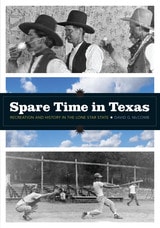
Spare Time in Texas
Recreation and History in the Lone Star StateBy David G. McComb
University of Texas Press, 2008
What do Texans' pastimes and recreations say about their characters? Looking at Texas history from a new angle, David McComb starts from the premise that how people spend their leisure time may well reveal more about their true natures and interests than the work they do or their family connections. In this innovative book, McComb traces the history of various types of recreation in Texas, gathering significant insights into the characters of Texans from the pleasures they have pursued.
Reflecting the frontier origins of Texas, McComb starts with the recreations that were most popular with men in a crude, still-developing society—drinking, gambling, and whoring. He goes on to show how, as Texas became more civilized, so did its diversions. He describes how Texans have connected with nature in parks and zoos; watched football and baseball in great stadiums such as the Astrodome and Cotton Bowl; discovered the pleasure of reading in public and university libraries; and enjoyed radio, TV, movies, and live theater in places such as Houston's Alley Theatre.
This recreational history reveals that Texans are open-minded and generous; that they respect the land; oppose prostitution but indulge in gambling and drinking; support racial and gender rights; love zoos; champion libraries; take pride in theatrical productions; and adore sports.
Spare the Rod
Punishment and the Moral Community of SchoolsCampbell F. Scribner and Bryan R. Warnick
University of Chicago Press, 2021
Spare the Rod traces the history of discipline in schools and its ever increasing integration with prison and policing, ultimately arguing for an approach to discipline that aligns with the moral community that schools could and should be.
In Spare the Rod, historian Campbell F. Scribner and philosopher Bryan R. Warnick investigate the history and philosophy of America’s punishment and discipline practices in schools. To delve into this controversial subject, they first ask questions of meaning. How have concepts of discipline and punishment in schools changed over time? What purposes are they supposed to serve? And what can they tell us about our assumptions about education? They then explore the justifications. Are public school educators ever justified in punishing or disciplining students? Are discipline and punishment necessary for students’ moral education, or do they fundamentally have no place in education at all? If some form of punishment is justified in schools, what ethical guidelines should be followed?
The authors argue that as schools have grown increasingly bureaucratic over the last century, formalizing disciplinary systems and shifting from physical punishments to forms of spatial or structural punishment such as in-school suspension, school discipline has not only come to resemble the operation of prisons or policing, but has grown increasingly integrated with those institutions. These changes and structures are responsible for the school-to-prison pipeline. They show that these shifts disregard the unique status of schools as spaces of moral growth and community oversight, and are incompatible with the developmental environment of education. What we need, they argue, is an approach to discipline and punishment that fits with the sort of moral community that schools could and should be.
Spare the Rod
Punishment and the Moral Community of SchoolsCampbell F. Scribner and Bryan R. Warnick
University of Chicago Press, 2021
This is an auto-narrated audiobook edition of this book.
Spare the Rodtraces the history of discipline in schools and its ever increasing integration with prison and policing, ultimately arguing for an approach to discipline that aligns with the moral community that schools could and should be.
In Spare the Rod, historian Campbell F. Scribner and philosopher Bryan R. Warnick investigate the history and philosophy of America’s punishment and discipline practices in schools. To delve into this controversial subject, they first ask questions of meaning. How have concepts of discipline and punishment in schools changed over time? What purposes are they supposed to serve? And what can they tell us about our assumptions about education? They then explore the justifications. Are public school educators ever justified in punishing or disciplining students? Are discipline and punishment necessary for students’ moral education, or do they fundamentally have no place in education at all? If some form of punishment is justified in schools, what ethical guidelines should be followed?
The authors argue that as schools have grown increasingly bureaucratic over the last century, formalizing disciplinary systems and shifting from physical punishments to forms of spatial or structural punishment such as in-school suspension, school discipline has not only come to resemble the operation of prisons or policing, but has grown increasingly integrated with those institutions. These changes and structures are responsible for the school-to-prison pipeline. They show that these shifts disregard the unique status of schools as spaces of moral growth and community oversight, and are incompatible with the developmental environment of education. What we need, they argue, is an approach to discipline and punishment that fits with the sort of moral community that schools could and should be.
Spark of Independence
The American Revolution in the Northern Colonies, 1775–1776Michael Cecere
Westholme Publishing, 2024
The Independence Trilogy (Spark of Independence, United for Independence, March to Independence) seeks to answer one simple question. What happened in the thirteen colonies after bloodshed erupted at Lexington and Concord in April 1775 until independence was declared in July 1776?
For the Northern colonies, the traditional view is that they reacted as one in their opposition to Great Britain, each sending troops to Massachusetts to help form an Army of Observation that within two months of Lexington became the Continental Army. This is indeed what happened, and the events at Lexington and Concord, Bunker Hill, and the siege of Boston had a tremendous impact on each New England colony.But so too did other events that occurred in New Hampshire, Massachusetts, Rhode Island and Connecticut. Clashes with the British navy in far-away Machias, on the coast of present-day Maine, as well as in Boston Harbor, Massachusetts Bay, Buzzards Bay, Narragansett Bay, and the Long Island Sound; the destruction of Falmouth (present-day Portland, Maine), the bombardment of Stonington, Connecticut, and the threatened destruction of Portsmouth, New Hampshire, and Newport, Rhode Island, all contributed to the growing sentiment for independence that grew in New England following the outbreak of war. New Englanders, too, participated in the American effort to seize Canada in 1775 with troops under Colonel Benedict Arnold who marched through the wilderness of Maine to Quebec. New Englanders also joined General Philip Schuyler and participated in the capture of St. Jeans and Montreal. New England soldiers captured Fort Ticonderoga in New York just a few weeks after Lexington, and of course most notably, the Continental Army that besieged Boston in 1775 was comprised almost entirely of New England volunteers.
Like its companion volumes, Spark of Independence: The American Revolution in the Northern Colonies, 1775–1776 by historian Michael Cecere extensively uses primary source documents to explore both the well known and less-known clashes and events that occurred during the fifteen months between Lexington and Concord and the Declaration of Independence, and how these events contributed to the growing support across the colonies for independence from Great Britain by 1776.
Sparrow and the Hawk
Costa Rica and the United States during the Rise of Jose FigueresKyle Longley
University of Alabama Press, 1997
Using Costa Rica as a example, Longley carefully examines the development of the successful relationship between a nonindustrialized country and the United States, revealing the complex forces at work in resistance and accommodation.
During World War II and the immediate postwar era, both the United States and Costa Rica experienced dramatic changes. The United States assumed world leadership and the accompanying responsibilities; Costa Rica encountered far-reaching difficulties that culminated in the Civil War of 1948 and the rise to power of José Figueres. Longley examines why the United States supported Figueres and emphasizes the history and role of Costa Ricans, primarily the figueristas, in maintaining good relations in such a difficult era. Figueres implemented economic and political nationalism, which produced domestic and international tensions, and in spite of its rejection of similar policies in Guatemala and Iran, the United States supported Figueres against domestic and foreign threats.

Spartan Band
Burnett's 13th Texas Cavalry in the Civil WarThomas Reid
University of North Texas Press, 2005
Spatial and Discursive Violence in the US Southwest
Rosaura Sánchez and Beatrice Pita
Duke University Press, 2020
Speak No Evil
The Triumph of Hate Speech RegulationJon B. Gould
University of Chicago Press, 2005
Although college speech codes have been overturned by the courts, Speak No Evil argues that their rise has still had a profound influence on curtailing speech in other institutions such as the media and has also shaped mass opinion and common understandings of constitutional norms. Ultimately, Gould contends, this kind of informal law can have just as much power as the Constitution.
Speak Truth to Power
The Story of Charles Patrick, a Civil Rights PioneerMignette Y. Patrick Dorsey
University of Alabama Press, 2010
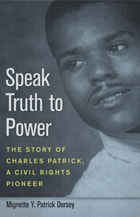
"Patrick did not intend to become a civil rights pioneer, but a minor dispute over a parking spot led to his arrest, beating while in custody, and eventual legal tribulations. His daughter's account of his ordeal is well researched, beautifully narrated, and extremely informative." —Journal of Southern History
On December 11, 1954, Charles Patrick drove to downtown Birmingham to buy a Boy Scout uniform for his son. Christmas traffic around the downtown department stores was heavy, and Patrick circled unsuccessfully until at last a streetside spot opened up and he began to pull in. As he did so, he was cut off by a woman who ordered him out of the way, as she was the wife of a city police officer. Patrick pulled away, remarking, "Ma’am, he doesn’t own the streets of Birmingham."
Normal low-level urban hassle? Not in 1954 Birmingham, when the woman was white and Patrick black. The woman reported to her husband that a black man had sassed her, and Patrick was summarily arrested, charged with disorderly conduct, and placed in a cell where he was beaten by the husband and another police officer.
Usually that would have been the end of it, but Patrick was not the sort of man to meekly endure an injustice. He found an attorney, went to court to fight the charges, and brought his assailants to justice--as whites, blacks, politicians and the press offered public support.
This book tells the story of Patrick’s quest for justice in segregated Alabama on the eve of the civil rights movement and represents a telling instance of the growing determination of African Americans to be treated fairly, part of the broadening and deepening stream of resolve that led to the widespread activism of the civil rights movement.
Speaker Jim Wright
Power, Scandal, and the Birth of Modern PoliticsBy J. Brooks Flippen
University of Texas Press, 2018
Honorable Mention, Ramirez Family Award for Most Significant Scholarly Book, Texas Institute of Letters, 2019
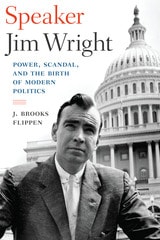
Jim Wright made his mark on virtually every major public policy issue in the later twentieth century—energy, education, taxes, transportation, environmental protection, civil rights, criminal justice, and foreign relations, among them. He played a significant role in peace initiatives in Central America and in the Camp David Accords, and he was the first American politician to speak live on Soviet television. A Democrat representing Texas’s twelfth district (Fort Worth), Wright served in the US House of Representatives from the Eisenhower administration to the presidency of George H. W. Bush, including twelve years (1977–1989) as majority leader and speaker. His long congressional ascension and sudden fall in a highly partisan ethics scandal spearheaded by Newt Gingrich mirrored the evolution of Congress as an institution.
Speaker Jim Wright traces the congressman’s long life and career in a highly readable narrative grounded in extensive interviews with Wright and access to his personal diaries. A skilled connector who bridged the conservative and liberal wings of the Democratic party while forging alliances with Republicans to pass legislation, Wright ultimately fell victim to a new era of political infighting, as well as to his own hubris and mistakes. J. Brooks Flippen shows how Wright’s career shaped the political culture of Congress, from its internal rules and power structure to its growing partisanship, even as those new dynamics eventually contributed to his political demise. To understand Jim Wright in all his complexity is to understand the story of modern American politics.
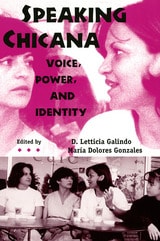
Speaking Chicana
Voice, Power, and IdentityD. Letticia Galindo
University of Arizona Press, 1999
Part 1. Reconstruction: Language Varieties, Language Use, and Language Attitudes
1. Crossing Social and Cultural Borders: The Road to Language Hybridity, María Dolores Gonzales
2. Fighting Words: Latina Girls, Gangs, and Language Attitudes, Norma Mendoza-Denton
Part 2. Reflection: Testimonios
3. Speaking as a Chicana: Tracing Cultural Heritage through Silence and Betrayal, Jacqueline M. Martínez
4. The Power of Language: From the Back of the Bus to the Ivory Tower, Christine Marín
5. Challenging Tradition: Opening the Headgate, Ida M. Luján
6. Mexican Blood Runs through My Veins, Aurora E. Orozco
Part 3. Innovation: Speaking Creatively/Creatively Speaking
7. Searching for a Voice: Ambiguities and Possibilities, Erlinda Gonzales-Berry
8. Sacred Cults, Subversive Icons: Chicanas and the Pictorial Language of Catholicism, Charlene Villaseñor Black
9. Caló and Taboo Language Use among Chicanas: A Description of Linguistic Appropriation and Innovation, D. Letticia Galindo
10. Máscaras, Trenzas, y Greñas: Un/Masking the Self While Un/Braiding Latina Stories and Legal Discourse, Margaret E. Montoya
Speaking Up, Speaking Out
Lived Experiences of Non-Tenure-Track Faculty in Writing StudiesJessica Edwards
Utah State University Press, 2020
Each chapter suggests tangible ways that writing departments and supporters can be more thoughtful about their policies and practices as they work to create more equitable spaces for NTTF. Speaking Up, Speaking Out considers the rhetorical power of labeling and asserts why contingent faculty, for far too long, have been compared to and against TT faculty and often encouraged to reach the same or similar productivity with scholarship, teaching, and service that TT faculty produce. The myopic ideas about what is valued and whose position is deemed more important impacts contingent faculty in ways that, as contributors in this collection share, effect and affect faculty productivity, emotional health, and overall community involvement.
Contributors: Norah Ashe-McNalley, Sarah Austin, Rachel Azima, Megan Boeshart Burelle, Peter Brooks, Denise Comer, Jessica Cory, Liz Gumm, Brendan Hawkins, Heather Jordan, Nathalie Joseph, Julie Karaus, Christopher Lee, John McHone, Angie McKinnon Carter, Dauvan Mulally, Seth Myers, Liliana M. Naydan, Linda Shelton, Erica Stone, Elizabeth Vincelette, Lacey Wootton
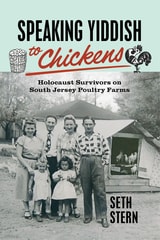
Speaking Yiddish to Chickens
Holocaust Survivors on South Jersey Poultry FarmsSeth Stern
Rutgers University Press, 2023
Most of the roughly 140,000 Holocaust survivors who came to the United States in the first decade after World War II settled in big cities such as New York. But a few thousand chose an alternative way of life on American farms. More of these accidental farmers wound up raising chickens in southern New Jersey than anywhere else. Speaking Yiddish to Chickens is the first book to chronicle this little-known chapter in American Jewish history when these mostly Eastern European refugees – including the author’s grandparents - found an unlikely refuge and gateway to new lives in the US on poultry farms. They gravitated to a section of south Jersey anchored by Vineland, a small rural city where previous waves of Jewish immigrants had built a rich network of cultural and religious institutions.
This book relies on interviews with dozens of these refugee farmers and their children, as well as oral histories and archival records to tell how they learned to farm while coping with unimaginable grief. They built small synagogues within walking distance of their farms and hosted Yiddish cultural events more frequently found on the Lower East Side than perhaps anywhere else in rural America at the time. Like refugees today, they embraced their new American identities and enriched the community where they settled, working hard in unfamiliar jobs for often meager returns. Within a decade, falling egg prices and the rise of industrial-scale agriculture in the South would drive almost all of these novice poultry farmers out of business, many into bankruptcy. Some hated every minute here; others would remember their time on south Jersey farms as their best years in America. They enjoyed a quieter way of life and more space for themselves and their children than in the crowded New York City apartments where so many displaced persons settled. This is their remarkable story of loss, renewal, and perseverance in the most unexpected of settings.
Author Facebook page (https://www.facebook.com/YiddishtoChickens)
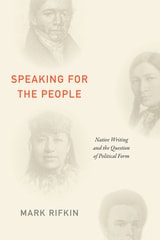
Speaking for the People
Native Writing and the Question of Political FormMark Rifkin
Duke University Press, 2021
Speaking in Social Contexts
Communication for Life and Study in the U.S.Robyn Brinks Lockwood
University of Michigan Press, 2018
The text provides language to use for a variety of functions as they might related to life on a university campus: offering greetings and goodbyes, making introductions, giving opinions, agreeing and disagreeing, using the phone, offering assistance, asking for advice, accepting and declining invitations, giving and receiving compliments, complaining, giving congratulations, expressing condolences, and making small talk. Users are also taught to think beyond the words and to interpret intonation and stress (how things sound).
Each of the 10 units includes discussion prompts, language lessons, practice activities, get acquainted tasks (interacting with native speakers), and analysis opportunities (what did they discover and what can they apply?).
Speaking of Abortion
Television and Authority in the Lives of WomenAndrea L. Press and Elizabeth R. Cole
University of Chicago Press, 1999
Speaking of Alabama
The History, Diversity, Function, and Change of LanguageEdited by Thomas E. Nunnally
University of Alabama Press, 2019
Thomas E. Nunnally’s fascinating volume presents essays by linguists who examine with affection and curiosity the speech varieties occurring both past and present across Alabama. Taken together, the accounts in this volume offer an engaging view of the major features that characterize Alabama’s unique brand of southern English.
Written in an accessible manner for general readers and scholars alike, Speaking of Alabama includes such subjects as the special linguistic features of the Southern drawl, the “phonetic divide” between north and south Alabama, “code-switching” by African American speakers in Alabama, pejorative attitudes by Alabama speakers toward their own native speech, the influence of foreign languages on Alabama speech to the vibrant history and continuing influence of non-English languages in the state, as well as ongoing changes in Alabama’s dialects.
Adding to these studies is a foreword by Walt Wolfram and an afterword by Michael B. Montgomery, both renowned experts in southern English, which place both the methodologies and the findings of the volume into their larger contexts and point researchers to needed work ahead in Alabama, the South, and beyond. The volume also contains a number of useful appendices, including a guide to the sounds of Southern English, a glossary of linguistic terms, and online sources for further study.
Language, as presented in this collection, is never abstract but always examined in the context of its speakers’ day-to-day lives, the driving force for their communication needs and choices. Whether specialist or general reader, Alabamian or non-Alabamian, all readers will come away from these accounts with a deepened understanding of how language functions between individuals, within communities, and across regions, and will gain a new respect for the driving forces behind language variation and language change.
Speaking of America
Great Conversations at the Library of CongressDavid M. Rubenstein
Duke University Press, 2026
Featuring interviews with eminent historians, journalists, and writers, Speaking of America brings together nineteen wide-ranging conversations from philanthropist and financier David M. Rubenstein’s long-running Congressional Dialogues series of interviews at the Library of Congress. Highlights include Ken Burns on documenting American history, Stacy Schiff on Samuel Adams, Manisha Sinha on Reconstruction, and David McCullough on the American frontier.
Published in association with the Library of Congress
Featuring interviews with eminent historians, journalists, and writers, Speaking of America brings together nineteen wide-ranging conversations from philanthropist and financier David M. Rubenstein’s long-running Congressional Dialogues series of interviews at the Library of Congress. Rubenstein and his guests bring to life notable figures, events, and trends drawn from American history and culture and beyond.
Highlights include Ken Burns on bringing American history to life, Stacy Schiff on Samuel Adams, Manisha Sinha on Reconstruction, David McCullough on the American frontier, Beverly Gage on J. Edgar Hoover, Chris Wallace on the presidential election of 1960, Evan Thomas on Justice Sandra Day O’Connor, Eric Schmidt on artificial intelligence, Arthur Brooks on happiness, and David Grann on The Wager, his best-selling story of shipwreck and mutiny. Taken together, the conversations in Speaking of America all build toward the same shared message of dialogue, cooperation, and the importance of knowledge and reflection, highlighting how the study of history can enrich our understanding of current-day challenges in politics and policy.
Speaking of Crime
The Language of Criminal JusticeLawrence M. Solan and Peter M. Tiersma
University of Chicago Press, 2004
Speaking of Crime answers these questions and examines the complex role of language within our criminal justice system. Lawrence M. Solan and Peter M. Tiersma compile numerous cases, ranging from the Lindbergh kidnapping to the impeachment trial of Bill Clinton to the JonBenét Ramsey case, that provide real-life examples of how language functions in arrests, investigations, interrogations, confessions, and trials. In a clear and accessible style, Solan and Tiersma show how recent advances in the study of language can aid in understanding how legal problems arise and how they might be solved.
With compelling discussions current issues and controversies, this book is a provocative state-of-the-art survey that will be of enormous value to legal scholars and professionals throughout the criminal justice system.
Speaking of Crime
The Language of Criminal JusticeLawrence M. Solan, Peter M. Tiersma, and Tammy Gales
University of Chicago Press, 2025
An essential introduction to the use and misuse of language within the criminal justice system, updated for a new generation.
Does everyone understand the Miranda warning? Why do people confess to a crime they did not commit? Can linguistic experts identify who wrote an anonymous threatening letter? Since its first publication, Speaking of Crime has been answering these questions. Introducing major topics and controversies at the intersection of language and law, Lawrence M. Solan, Peter M. Tiersma, and Tammy Gales apply multidisciplinary insights to examine the complex role of language within the US justice system.
The second edition features in-depth discussions of recent cases, new legislation, and innovative research advances, and includes a new chapter on who interprets the laws governing linguistic contexts. Thoroughly updated and approachable, Speaking of Crime is a state-of-the-art survey that will be useful to scholars, students, and practitioners throughout the criminal justice system.
Speaking of Race and Class
The Student Experience at an Elite CollegeElizabeth Aries
Temple University Press, 2012
In Speaking of Race and Class, the follow-up volume to her groundbreaking Race and Class Matters at an Elite College, Elizabeth Aries completes her four-year study of diversity at a prestigious liberal arts college. Here, the 58 students—affluent, lower-income, black, and white—that Aries has interviewed since they were Amherst freshmen provide a complete picture of what and how each group learned about issues of race and class.
Aries presents the students’ personal perceptions of their experiences. She reveals the extent to which learning from diversity takes place on campus, and examines the distinct challenges that arise for students living in this heterogeneous community. Aries also looks more broadly at how colleges and universities across the country are addressing the challenges surrounding diversity. Speaking of Race and Class testifies to the programming and practices that have proven successful.
Speaking the Unspeakable
Marital Violence among South Asian Immigrants in the United StatesAbraham, Margaret
Rutgers University Press, 2000
Over the past 20 years, much work has focused on domestic violence, yet little attention has been paid to the causes, manifestations, and resolutions to marital violence among ethnic minorities, especially recent immigrants. Margaret Abraham’s Speaking the Unspeakable is the first book to focus on South Asian women’s experiences of domestic violence, defined by the author as physical, sexual, verbal, mental, or economic coercion, power, or control perpetrated on a woman by her spouse or extended kin. Abraham explains how immigration issues, cultural assumptions, and unfamiliarity with American social, legal, economic, and other institutional systems, coupled with stereotyping, make these women especially vulnerable to domestic violence.
Abraham lets readers hear the voices of abused South Asian women. Through their stories, we learn of their weaknesses and strengths, and of their experiences of domestic violence within the larger cultural, social, economic, and political context. We see both the individual strategies of resistance against their abusers as well as the pivotal role South Asian organizations play in helping these women escape abusive relationships.
Abraham also describes the central role played by South Asian activism as it emerged in the 1980s in the United States, and addresses the ideas and practices both within and outside of the South Asian community that stereotype, discriminate, and oppress South Asians in their everyday lives.
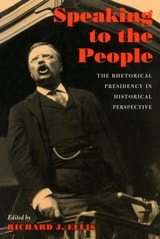
Speaking to the People
The Rhetorical Presidency in Historical PerspectiveRichard Ellis
University of Massachusetts Press, 1998
Spearheads for Reform
The Social Settlements and the Progressive Movement, 1890-1914Davis, Allen
Rutgers University Press, 1985
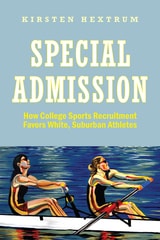
Special Admission
How College Sports Recruitment Favors White Suburban AthletesKirsten Hextrum
Rutgers University Press, 2021
Special Admission contradicts the national belief that college sports provide upward mobility opportunities. Kirsten Hextrum documents how white middle-class youth become overrepresented on college teams. Her institutional ethnography of one elite athletic and academic institution includes over 100 hours of interviews with college rowers and track & field athletes. She charts the historic and contemporary relationships between colleges, athletics, and white middle-class communities that ensure white suburban youth are advantaged in special athletic admissions. Suburban youth start ahead in college admissions because athletic merit—the competencies desired by university recruiters—requires access to vast familial, communal, and economic resources, all of which are concentrated in their neighborhoods. Their advantages increase as youth, parents, and coaches strategically invest in and engineer novel opportunities to maintain their race and class status. Thus, college sports allow white, middle-class athletes to accelerate their racial and economic advantages through admission to elite universities.
Special Education in the 21st Century
Margret A. Winzer
Gallaudet University Press, 2000
In the late 20th century, a tidal wave of calls for reform and inclusion of special needs students swept over public special education. The current debates over implementing these themes today are authoritatively addressed by 19 distinguished scholars in this thorough volume. Organized into three cohesive sections, it begins with the issues of educational reform and the emerging discourses of disability and integration in the inclusion movement. Respective chapters appraise specific arguments for inclusion and the federal legislation and litigation surrounding and supporting special education.
The second part features the thorny issue of assessment, the technological revolution in special education, and the disposition of teacher training. The third section scrutinizes the inclusion of various populations of students with exceptional needs, particularly how teachers can make an easy transition from ideology to educational practice.
Special Education in the 21st Century sets the standard for extrapolating future directions by wisely weighing classroom practices for different groups and the technical problems of resources, management, social groupings, instructional design, and the supposition that teachers will automatically change to accommodate an even greater diversity of learners.
Specializing the Courts
Lawrence Baum
University of Chicago Press, 2010
Most Americans think that judges should be, and are, generalists who decide a wide array of cases. Nonetheless, we now have specialized courts in many key policy areas. Specializing the Courts provides the first comprehensive analysis of this growing trend toward specialization in the federal and state court systems.
Lawrence Baum incisively explores the scope, causes, and consequences of judicial specialization in four areas that include most specialized courts: foreign policy and national security, criminal law, economic issues involving the government, and economic issues in the private sector. Baum examines the process by which court systems in the United States have become increasingly specialized and the motives that have led to the growth of specialization. He also considers the effects of judicial specialization on the work of the courts by demonstrating that under certain conditions, specialization can and does have fundamental effects on the policies that courts make. For this reason, the movement toward greater specialization constitutes a major change in the judiciary.
Species at Risk
Using Economic Incentives to Shelter Endangered Species on Private LandsEdited by Jason F. Shogren
University of Texas Press, 2005
Protecting endangered species of animals and plants is a goal that almost everyone supports in principle—but in practice private landowners have often opposed the regulations of the Endangered Species Act, which, they argue, unfairly limits their right to profit from their property. To encourage private landowners to cooperate voluntarily in species conservation and to mitigate the economic burden of doing so, the government and nonprofit land trusts have created a number of incentive programs, including conservation easements, leases, habitat banking, habitat conservation planning, safe harbors, candidate conservation agreements, and the "no surprise" policy.
In this book, lawyers, economists, political scientists, historians, and zoologists come together to assess the challenges and opportunities for using economic incentives as compensation for protecting species at risk on private property. They examine current programs to see how well they are working and also offer ideas for how these programs could be more successful. Their ultimate goal is to better understand how economic incentive schemes can be made both more cost-effective and more socially acceptable, while respecting a wide range of views regarding opportunity costs, legal standing, biological effectiveness, moral appropriateness, and social context.
Spectacles of Reform
Theater and Activism in Nineteenth-Century AmericaAmy E. Hughes
University of Michigan Press, 2014
In the nineteenth century, long before film and television arrived to electrify audiences with explosions, car chases, and narrow escapes, it was America's theaters that offered audiences such thrills, with "sensation scenes" of speeding trains, burning buildings, and endangered bodies, often in melodramas extolling the virtues of temperance, abolition, and women's suffrage. In Spectacles of Reform , Amy E. Hughes scrutinizes these peculiar intersections of spectacle and reform, revealing that spectacle plays a crucial role in American activism. By examining how theater producers and political groups harnessed its power and appeal, Hughes suggests that spectacle was—and remains—central to the dramaturgy of reform.
Engaging evidence from lithographs to children's books to typography catalogs, Hughes traces the cultural history of three famous sensation scenes—the drunkard suffering from the delirium tremens, the fugitive slave escaping over a river, and the victim tied to the railroad tracks—assessing how they conveyed, allayed, and denied concerns about the rights and responsibilities of citizenship. These images also appeared in printed propaganda, suggesting that the coup de théâtre was an essential part of American reform culture. Additionally, Hughes argues that today's producers and advertisers continue to exploit the affective dynamism of spectacle, reaching an even broader audience through film, television, and the Internet.
To be attuned to the dynamics of spectacle, Hughes argues, is to understand how we see. Consequently, Spectacles of Reform will interest not only theater historians, but also scholars and students of political, literary, and visual culture who are curious about how U.S. citizens saw themselves and their world during a pivotal period in American history.
Specters of War
Hollywood's Engagement with Military ConflictBronfen, Elisabeth
Rutgers University Press, 2012
Specters of War looks at the way war has been brought to the screen in various genres and at different historical moments throughout the twentieth century and into the twenty-first. Elisabeth Bronfen asserts that Hollywood has emerged as a place where national narratives are created and circulated so that audiences can engage with fantasies, ideologies, and anxieties that take hold at a given time, only to change with the political climate.
Such cultural reflection is particularly poignant when it deals with America’s traumatic history of war. The nation has no direct access to war as a horrific experience of carnage and human destruction; we understand our relation to it through images and narratives that transmit and interpret it for us. Bronfen does not discuss actual conflicts but the films by which we have come to know and remember them, including All Quiet on the Western Front, The Best Years of Our Lives, Miracle at St. Anna, The Deer Hunter, and Flags of Our Fathers. Battles and campaigns, the home front and women-who-wait narratives, war correspondents, and court martials are also explored as instruments of cultural memory. Bronfen argues that we are haunted by past wars and by cinematic re-conceptualizations of them, and reveals a national iconography of redemptive violence from which we seem unable to escape.
Spectral Aesthetics
Visualizing the Crisis of Migrant DisappearanceChina Medel
University of Texas Press, 2026
Analyzing how artists reimagine migrant disappearance and visibility at the US–Mexico border.
In the mid-1990s, the US government implemented Prevention through Deterrence, a major buildup of troops, walls, and surveillance around El Paso and San Diego. Cut off from these crucial urban crossings, migrants flowed into the dangerous surrounding deserts, where some ten thousand have since died. This is all according to plan: Pentagon documents describe the strategy of funneling migrants toward “mortal danger.”
In this bracing critique, China Medel explores the aesthetics enabling and resisting the crisis of migrant death. The nation-state’s performance of sovereignty along the border, predicated on mass casualties, is tolerated and even celebrated, thanks to the images in our heads of racialized and therefore criminal bodies, made invisible as they disintegrate in the baking sand. Spectral Aesthetics shows how state officials and mainstream media, relying on postracial ideologies and white-supremacist agendas, collectively foster this picture of a brown body so abject that it is disposable. In close readings of artworks contesting this murderous visual regime, Medel discovers an alternative kind of sight, one emphasizing the ghostly traces of the dead. These are images not of the individual “alien” but of life itself, indisposable.
Spectres of 1919
Class and Nation in the Making of the New NegroBarbara Foley
University of Illinois Press, 2002
A look at the violent “Red Summer of 1919” and its intersection with the highly politicized New Negro movement and the Harlem Renaissance
With the New Negro movement and the Harlem Renaissance, the 1920s was a landmark decade in African American political and cultural history, characterized by an upsurge in racial awareness and artistic creativity. In Spectres of 1919 Barbara Foley traces the origins of this revolutionary era to the turbulent year 1919, identifying the events and trends in American society that spurred the black community to action and examining the forms that action took as it evolved.
Unlike prior studies of the Harlem Renaissance, which see 1919 as significant mostly because of the geographic migrations of blacks to the North, Spectres of 1919 looks at that year as the political crucible from which the radicalism of the 1920s emerged. Foley draws from a wealth of primary sources, taking a bold new approach to the origins of African American radicalism and adding nuance and complexity to the understanding of a fascinating and vibrant era.
Speculators And Slaves
Masters, Traders, And Slaves In The Old SouthMichael Tadman
University of Wisconsin Press, 1996