Results by title
4127 books match the query 'Science' and 313 start with s
Science and the Humanities
Moody E. Prior
Northwestern University Press, 1962

Science and the Renewal Of Belief
Russell Stannard
Templeton Press, 2004
Originally published in Great Britain and now updated and available for the first time in a U.S. edition, this book is a critically acclaimed work by a renowned theologian-scientist.
Russell Stannard is known for cutting through highly technical data and presenting it clearly and simply. In Science and the Renewal of Belief he sheds light on ways in which science and religion influence each other and can help each other. Science and logic cannot establish belief, he says, but belief can be confirmed and renewed with the changed perspective of modern science.
The many reviews of the U.K. edition of his book cite his lucid presentation of relativity and quantum theory, and the way he uses relativity to explore time and eternity, and indeterminacy to comment on free will. He is also praised for offering fresh insight into original sin, the trials experienced by Galileo, the problem of pain, the possibility of miracles, the evidence for the resurrection, the credibility of incarnation, and the power of steadfast prayer. By introducing simple analogies, Stannard clears up misunderstandings that have muddied the connections between science and religion, and suggests contributions that the pursuit of physical science can make to theology.
Science and the Search for Meaning
Perspectives from International ScientistsJean Staune
Templeton Press, 2006
As the organizer of some of the most important meetings in science and religion in Europe, Jean Staune is in a core position to report on the dialogue between science and religion, primarily from the views of scientists. In this book, the translation of a recent French edition, he presents "audacious and rigorous" articles by fifteen renowned leaders in the field, of whom four are Nobel Prize winners. They represent nine countries and seven religions.
Each of the authors in this volume responds in a different way, addressing naturalism, materialism, the nature of consciousness, reductionism, and the quest for meaning.Two paradigms emerge, with those who say that God (or direction) can exist in the universe because we can understand certain things, while others say that God exists because we cannot understand the universe altogether. Their reflections on the accessibility and the mystery of the world show the extraordinary abstract revolution that took place in science during the twentieth century and the way this establishes a bridge between science and religion.
Contributors are Nobel Prize winners Christian de Duve, Charles Townes, Ahmed Zewail, and William D. Phillips; as well as Paul Davies, Bernard d'Espagnat, Thomas Odhiambo, Ramanath Cowsik, Jean Kovalevsky, Thierry Magnin, Bruno Guiderdoni, Trinh Xuan Thuan, Khalil Chamcham, Michael Heller, and Philip Clayton.

Science and the University
Edited by Paula E. Stephan and Ronald G. Ehrenberg
University of Wisconsin Press, 2007

Science as Power
Discourse and Ideology in Modern SocietyStanley Aronowitz
University of Minnesota Press, 1988
Science as Power was first published in 1988. Minnesota Archive Editions uses digital technology to make long-unavailable books once again accessible, and are published unaltered from the original University of Minnesota Press editions.
Science has established itself as not merely the dominant but the only legitimate form of human knowledge. By tying its truth claims to methodology, science has claimed independence from the influence of social and historical conditions. Here, Aronowitz asserts that the norms of science are by no means self-evident and that science is best seen as a socially constructed discourse that legitimates its power by presenting itself as truth.
Stanley Aronowitz is professor of sociology in the graduate school of City University of New York. His books include Working Class Hero: A New Strategy for Labor and, with Henry Giroux, Education Under Siege.

Science as Practice and Culture
Edited by Andrew Pickering
University of Chicago Press, 1992
Andrew Pickering has invited leading historians, philosophers, sociologists, and anthropologists of science to prepare original essays for this volume. The essays range over the physical and biological sciences and mathematics, and are divided into two parts. In part I, the contributors map out a coherent set of perspectives on scientific practice and culture, and relate their analyses to central topics in the philosophy of science such as realism, relativism, and incommensurability. The essays in part II seek to delineate the study of science as practice in arguments across its borders with the sociology of scientific knowledge, social epistemology, and reflexive ethnography.

Science as Service
Establishing and Reformulating American Land-Grant Universities, 1865–1930Edited by Alan I Marcus
University of Alabama Press, 2015
The Morrill Land-Grant College Act of 1862 created a series of institutions—at least one in every state and territory—with now familiar names: Michigan State University, Ohio State University, Purdue University, Rutgers University, the University of Arizona, and the University of California, to name a few. These schools opened educational opportunities and pathways to a significant segment of the American public and gave the United States a global edge in science, technical innovation, and agriculture.
Science as Service provides an essential body of literature for understanding the transformations of the land-grant colleges established by the Morrill Act in 1862 as well as the considerable impact they had on the history of the United States. Historians of science, technology, and agriculture, along with rural sociologists, public decision and policy makers, educators, and higher education administrators will find this an essential addition to their book collections.
Science as a Carreer Choice
Theoretical and Empirical StudiesBernice T. Ediuson
Russell Sage Foundation, 1974
Science as a Process
An Evolutionary Account of the Social and Conceptual Development of ScienceDavid L. Hull
University of Chicago Press, 1990
"In Science as a Process, [David Hull] argues that the tension between cooperation and competition is exactly what makes science so successful. . . . Hull takes an unusual approach to his subject. He applies the rules of evolution in nature to the evolution of science, arguing that the same kinds of forces responsible for shaping the rise and demise of species also act on the development of scientific ideas."—Natalie Angier, New York Times Book Review
"By far the most professional and thorough case in favour of an evolutionary philosophy of science ever to have been made. It contains excellent short histories of evolutionary biology and of systematics (the science of classifying living things); an important and original account of modern systematic controversy; a counter-attack against the philosophical critics of evolutionary philosophy; social-psychological evidence, collected by Hull himself, to show that science does have the character demanded by his philosophy; and a philosophical analysis of evolution which is general enough to apply to both biological and historical change."—Mark Ridley, Times Literary Supplement
"Hull is primarily interested in how social interactions within the scientific community can help or hinder the process by which new theories and techniques get accepted. . . . The claim that science is a process for selecting out the best new ideas is not a new one, but Hull tells us exactly how scientists go about it, and he is prepared to accept that at least to some extent, the social activities of the scientists promoting a new idea can affect its chances of being accepted."—Peter J. Bowler, Archives of Natural History
"I have been doing philosophy of science now for twenty-five years, and whilst I would never have claimed that I knew everything, I felt that I had a really good handle on the nature of science, Again and again, Hull was able to show me just how incomplete my understanding was. . . . Moreover, [Science as a Process] is one of the most compulsively readable books that I have ever encountered."—Michael Ruse, Biology and Philosophy
Science by the People
Participation, Power, and the Politics of Environmental KnowledgeAya H. Kimura
Rutgers University Press, 2019
Citizen science—research involving nonprofessionals in the research process—has attracted both strong enthusiasts and detractors. Many environmental professionals, activists, and scholars consider citizen science part of their toolkit for addressing environmental challenges. Critics, however, contend that it represents a corporate takeover of scientific priorities. In this timely book, two sociologists move beyond this binary debate by analyzing the tensions and dilemmas that citizen science projects commonly face. Key lessons are drawn from case studies where citizen scientists have investigated the impact of shale oil and gas, nuclear power, and genetically engineered crops. These studies show that diverse citizen science projects face shared dilemmas relating to austerity pressures, presumed boundaries between science and activism, and difficulties moving between scales of environmental problems. By unpacking the politics of citizen science, this book aims to help people negotiate a complex political landscape and choose paths moving toward social change and environmental sustainability.
Science for All
The Popularization of Science in Early Twentieth-Century BritainPeter J. Bowler
University of Chicago Press, 2009
Recent scholarship has revealed that pioneering Victorian scientists endeavored through voluminous writing to raise public interest in science and its implications. But it has generally been assumed that once science became a profession around the turn of the century, this new generation of scientists turned its collective back on public outreach. Science for All debunks this apocryphal notion.
Peter J. Bowler surveys the books, serial works, magazines, and newspapers published between 1900 and the outbreak of World War II to show that practicing scientists were very active in writing about their work for a general readership. Science for All argues that the social environment of early twentieth-century Britain created a substantial market for science books and magazines aimed at those who had benefited from better secondary education but could not access higher learning. Scientists found it easy and profitable to write for this audience, Bowler reveals, and because their work was seen as educational, they faced no hostility from their peers. But when admission to colleges and universities became more accessible in the 1960s, this market diminished and professional scientists began to lose interest in writing at the nonspecialist level.
Eagerly anticipated by scholars of scientific engagement throughout the ages, Science for All sheds light on our own era and the continuing tension between science and public understanding.
Science for Sale
The Perils, Rewards, and Delusions of Campus CapitalismDaniel S. Greenberg
University of Chicago Press, 2007
With Science for Sale, acclaimed journalist Daniel S. Greenberg reveals that campus capitalism is more complicated—and less profitable—than media reports would suggest. While universities seek out corporate funding, news stories rarely note that those industry dollars are dwarfed by government support and other funds. Also, while many universities have set up technology transfer offices to pursue profits through patents, many of those offices have been financial busts. Meanwhile, science is showing signs of providing its own solutions, as highly publicized misdeeds in pursuit of profits have provoked promising countermeasures within the field.
But just because the threat is overhyped, Greenberg argues, doesn’t mean that there’s no danger. From research that has shifted overseas so corporations can avoid regulations to conflicts of interest in scientific publishing, the temptations of money will always be a threat, and they can only be countered through the vigilance of scientists, the press, and the public.
Based on extensive, candid interviews with scientists and administrators, Science for Sale will be indispensable to anyone who cares about the future of scientific research.
Science for the People
Documents from America's Movement of Radical ScientistsSigrid Schmalzer
University of Massachusetts Press, 2018
For the first time, this book compiles original documents from Science for the People, the most important radical science movement in U.S. history. Between 1969 and 1989, Science for the People mobilized American scientists, teachers, and students to practice a socially and economically just science, rather than one that served militarism and corporate profits. Through research, writing, protest, and organizing, members sought to demystify scientific knowledge and embolden “the people” to take science and technology into their own hands. The movement's numerous publications were crucial to the formation of science and technology studies, challenging mainstream understandings of science as “neutral” and instead showing it as inherently political. Its members, some at prominent universities, became models for politically engaged science and scholarship by using their knowledge to challenge, rather than uphold, the social, political, and economic status quo.
Highlighting Science for the People's activism and intellectual interventions in a range of areas—including militarism, race, gender, medicine, agriculture, energy, and global affairs—this volume offers vital contributions to today's debates on science, justice, democracy, sustainability, and political power.
Science from Sight to Insight
How Scientists Illustrate MeaningAlan G. Gross and Joseph E. Harmon
University of Chicago Press, 2013

Science in America
A Documentary History, 1900-1939Edited by Nathan Reingold and Ida H. Reingold
University of Chicago Press, 1981

Science in Latin America
A HistoryEdited by Juan José Saldaña
University of Texas Press, 2006
Science in Latin America has roots that reach back to the information gathering and recording practices of the Maya, Aztec, and Inca civilizations. Spanish and Portuguese conquerors and colonists introduced European scientific practices to the continent, where they hybridized with local traditions to form the beginnings of a truly Latin American science. As countries achieved their independence in the nineteenth century, they turned to science as a vehicle for modernizing education and forwarding "progress." In the twentieth century, science and technology became as omnipresent in Latin America as in the United States and Europe. Yet despite a history that stretches across five centuries, science in Latin America has traditionally been viewed as derivative of and peripheral to Euro-American science.
To correct that mistaken view, this book provides the first comprehensive overview of the history of science in Latin America from the sixteenth century to the present. Eleven leading Latin American historians assess the part that science played in Latin American society during the colonial, independence, national, and modern eras, investigating science's role in such areas as natural history, medicine and public health, the eighteenth-century Enlightenment, politics and nation-building, educational reform, and contemporary academic research. The comparative approach of the essays creates a continent-spanning picture of Latin American science that clearly establishes its autonomous history and its right to be studied within a Latin American context.

Science in Medieval Islam
An Illustrated IntroductionBy Howard R. Turner
University of Texas Press, 1997
During the Golden Age of Islam (seventh through seventeenth centuries A.D.), Muslim philosophers and poets, artists and scientists, princes and laborers created a unique culture that has influenced societies on every continent. This book offers a fully illustrated, highly accessible introduction to an important aspect of that culture—the scientific achievements of medieval Islam.
Howard Turner opens with a historical overview of the spread of Islamic civilization from the Arabian peninsula eastward to India and westward across northern Africa into Spain. He describes how a passion for knowledge led the Muslims during their centuries of empire-building to assimilate and expand the scientific knowledge of older cultures, including those of Greece, India, and China. He explores medieval Islamic accomplishments in cosmology, mathematics, astronomy, astrology, geography, medicine, natural sciences, alchemy, and optics. He also indicates the ways in which Muslim scientific achievement influenced the advance of science in the Western world from the Renaissance to the modern era. This survey of historic Muslim scientific achievements offers students and general readers a window into one of the world's great cultures, one which is experiencing a remarkable resurgence as a religious, political, and social force in our own time.

Science in Nineteenth-Century America
A Documentary HistoryEdited by Nathan Reingold
University of Chicago Press, 1985
Science in Print
Essays on the History of Science and the Culture of PrintEdited by Rima D. Apple, Gregory J. Downey, and Stephen L. Vaughn; Foreword by James A. Secord
University of Wisconsin Press, 2012
Ever since the threads of seventeenth-century natural philosophy began to coalesce into an understanding of the natural world, printed artifacts such as laboratory notebooks, research journals, college textbooks, and popular paperbacks have been instrumental to the development of what we think of today as “science.” But just as the history of science involves more than recording discoveries, so too does the study of print culture extend beyond the mere cataloguing of books. In both disciplines, researchers attempt to comprehend how social structures of power, reputation, and meaning permeate both the written record and the intellectual scaffolding through which scientific debate takes place.
Science in Print brings together scholars from the fields of print culture, environmental history, science and technology studies, medical history, and library and information studies. This ambitious volume paints a rich picture of those tools and techniques of printing, publishing, and reading that shaped the ideas and practices that grew into modern science, from the days of the Royal Society of London in the late 1600s to the beginning of the modern U.S. environmental movement in the early 1960s.

Science in Translation
Movements of Knowledge through Cultures and TimeScott L. Montgomery
University of Chicago Press, 2000
"[A] book of great richness, as much for its examples as for its ideas, which keenly illustrate the development of knowledge across languages and epochs. It is a book to read and reread. Its subject is important; it is ours, it is our history." -André Clas, Meta: Journal des Traducteurs
"[T]his book . . . seems to stand alone on the shelf. A good thing, therefore, that it is so full of good things, both in the content and the prose." —William R. Everdell, MAA Online
"[A]n impressive work. . . . By reminding us of the role of diverse cultures in the elevation of science within a particular nation or civilization, the book makes a substantial contribution to the postmodern worldview that emphasizes multiculturalism." —Choice

Science in the Age of Computer Simulation
Eric Winsberg
University of Chicago Press, 2010
Computer simulation was first pioneered as a scientific tool in meteorology and nuclear physics in the period following World War II, but it has grown rapidly to become indispensible in a wide variety of scientific disciplines, including astrophysics, high-energy physics, climate science, engineering, ecology, and economics. Digital computer simulation helps study phenomena of great complexity, but how much do we know about the limits and possibilities of this new scientific practice? How do simulations compare to traditional experiments? And are they reliable? Eric Winsberg seeks to answer these questions in Science in the Age of Computer Simulation.
Scrutinizing these issue with a philosophical lens, Winsberg explores the impact of simulation on such issues as the nature of scientific evidence; the role of values in science; the nature and role of fictions in science; and the relationship between simulation and experiment, theories and data, and theories at different levels of description. Science in the Age of Computer Simulation will transform many of the core issues in philosophy of science, as well as our basic understanding of the role of the digital computer in the sciences.
Science in the Age of Sensibility
The Sentimental Empiricists of the French EnlightenmentJessica Riskin
University of Chicago Press, 2002
Riskin argues that sentimental empiricism brought together ideas and institutions, practices and politics. She shows, for instance, how the study of blindness, led by ideas about the mental and moral role of vision and by cataract surgeries, shaped the first school for the blind; how Benjamin Franklin's electrical physics, ascribing desires to nature, engaged French economic reformers; and how the question of the role of language in science and social life linked disputes over Antoine Lavoisier's new chemical names to the founding of France's modern system of civic education.
Recasting the Age of Reason by stressing its conjunction with the Age of Sensibility, Riskin offers an entirely new perspective on the development of modern science and the history of the Enlightenment.

Science in the American Southwest
A Topical HistoryGeorge E. Webb
University of Arizona Press, 2002
Science in the Archives
Pasts, Presents, FuturesEdited by Lorraine Daston
University of Chicago Press, 2017
With Science in the Archives, Lorraine Daston and her co-authors offer the first study of the important role that these archives play in the natural and human sciences. Reaching across disciplines and centuries, contributors cover episodes in the history of astronomy, geology, genetics, philology, climatology, medicine, and more—as well as fundamental practices such as collecting, retrieval, and data mining. Chapters cover topics ranging from doxology in Greco-Roman Antiquity to NSA surveillance techniques of the twenty-first century. Thoroughly exploring the practices, politics, economics, and potential of the sciences of the archives, this volume reveals the essential historical dimension of the sciences, while also adding a much-needed long-term perspective to contemporary debates over the uses of Big Data in science.

Science in the Forest, Science in the Past
Edited by Geoffrey E. R. Lloyd and Aparecida Vilaça
HAU, 2020
Science in the Forest, Science in the Past is a pioneering interdisciplinary exploration that will challenge the way readers interested in sciences, mathematics, humanities, social research, computer sciences, and education think about deeply held notions of what constitutes reality, how it is apprehended, and how to investigate it.

Science in the Marketplace
Nineteenth-Century Sites and ExperiencesEdited by Aileen Fyfe and Bernard Lightman
University of Chicago Press, 2007
Science in the Marketplace reveals this other side of Victorian scientific life by placing the sciences in the wider cultural marketplace, ultimately showing that the creation of new sites and audiences was just as crucial to the growing public interest in science as were the scientists themselves. By focusing attention on the scientific audience, as opposed to the scientific community or self-styled popularizers, Science in the Marketplace ably links larger societal changes—in literacy, in industrial technologies, and in leisure—to the evolution of “popular science.”

Science in the Medieval World
Book of the Categories of NationsBy Sa`id al-Andalusi
University of Texas Press, 1991
During the Middle Ages, a thriving center for learning and research was Muslim Spain, where students gathered to consult Arabic manuscripts of earlier scientific works and study with famous teachers. One of these teachers was Sa'id al-Andalusi, who in 1068 wrote Kitab Tabaqat al-'Umam, or "Book of the Categories of Nations," which recorded the contributions to science of all known nations. Today, it is one of few surviving medieval Spanish Muslim texts, and this is its first English translation.
Science ('ulum), as used by Sa'id and other scholars of that period, is a broad term covering virtually all aspects of human knowledge. After initial discussions of the categories of nations that did or did not cultivate science, Sa'id details the specific contribution of nine nations or peoples-India, Persia, Chaldea, Greece, Rome, Egypt, the Arab Orient, al-Andalus, and the Hebrews. He includes the names of many individual scientists and scholars and describes their various contributions to knowledge, making his book a significant work of reference as well as history.
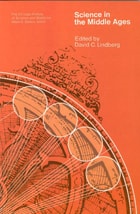
Science in the Middle Ages
Edited by David C. Lindberg
University of Chicago Press, 1980
The book is not encylopedic, for it does not attempt to provide all relevant factual data; rather, it attempts to interpret major developments in each of the disciplines that made up the medieval scientific world. Data are not absent, but their function is to support and illustrate generalizations about the changing shape of medieval science. The editor, David C. Lindberg, has written a Preface in which he discusses the growth of scholarship in this field in the twentieth century.
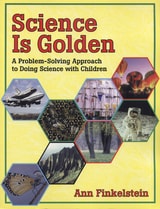
Science is Golden
A Problem-Solving Approach to Doing Science with ChildrenAnn Finkelstein
Michigan State University Press, 2002
The first book of its kind, Science is Golden discusses how to implement an inquiry-based, problem-solving approach to science education (grades K-5). Finkelstein shows parents and teachers how to help students investigate their own scientific questions. Rather than a set of guidelines for science fair projects, this book presents a method for helping students expand their creativity and develop logical thinking while learning science.
Starting with an introduction to the "brains-on method," Science is Golden explains brainstorming, experimental controls, collecting data, and how to streamline children's questions about science so that the questions define an experiment. Students will learn how to: ask good questions; clarify terminology; research, plan, and design experiments and controls; test assumptions; collect and analyze data; present results to others; and collaborate with adults.
Science is Golden is consistent with the National Science Education Standards proposed by the National Academy of Sciences, and the Michigan Essential Goals and Objectives for Science Education (K-12) from the Michigan State Board of Education.

Science of Naples
Making Knowledge in Italy's Pre-Eminent City, 1500–1800Edited by Lorenza Gianfrancesco and Neil Tarrant
University College London, 2024
Long neglected in the history of Renaissance and early modern Europe, in recent years scholars have revised the received understanding of the political and economic significance of the city of Naples and its rich artistic, musical, and political culture. Its importance in the history of science, however, has remained relatively unknown. The Science of Naples provides the first dedicated study of Neapolitan scientific culture in the English language. Drawing on contributions from leading experts in the field, this volume presents a series of studies that demonstrate Neapolitans’ manifold contributions to European scientific culture in the early modern period and considers the importance of the city, its institutions, and its surrounding territories for the production of new knowledge.
Individual chapters demonstrate the extent to which Neapolitan scholars and academies contributed to debates within the Republic of Letters that continued until deep into the nineteenth century, and how studies of Neapolitan natural disasters yielded unique insights that contributed to the development of fields such as medicine and volcanology. Taken together, these studies resituate the city of Naples as an integral part of a scientific culture that has increasingly globalized and present a rich and engaging portrait of the individuals who lived, worked, and made scientific knowledge there.
Science of Science and Reflexivity
Pierre Bourdieu
University of Chicago Press, 2004
Science of Science and Reflexivity will be welcomed as a companion volume to Bourdieu's now seminal An Invitation to Reflexive Sociology. In this posthumous work, Bourdieu declares that science is in danger of becoming a handmaiden to biotechnology, medicine, genetic engineering, and military research—that it risks falling under the control of industrial corporations that seek to exploit it for monopolies and profit.
Science thus endangered can become detrimental to mankind. The line between pure and applied science, therefore, must be subjected to intense theoretical scrutiny. Bourdieu's goals in Science of Science and Reflexivity are to identify the social conditions in which science develops in order to reclaim its objectivity and to rescue it from relativism and the forces that might exploit it. In the grand tradition of scientific reflections on science, Bourdieu provides a sociological analysis of the discipline as something capable of producing transhistorical truths; he presents an incisive critique of the main currents in the study of science throughout the past half century; and he offers a spirited defense of science against encroaching political and economic forces.
A masterful summation of the principles underlying Bourdieu's oeuvre and a memoir of his own scientific journey, Science of Science and Reflexivity is a capstone to one of the most important and prodigious careers in the field of sociology.

Science on American Television
A HistoryMarcel Chotkowski LaFollette
University of Chicago Press, 2012
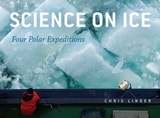
Science on Ice
Four Polar ExpeditionsChris Linder
University of Chicago Press, 2011
An oceanographer and award-winning photographer, Linder chronicles four polar expeditions in this richly illustrated volume: to a teeming colony of Adélie penguins, through the icy waters of the Bering Sea in spring, beneath the pack ice of the eastern Arctic Ocean, and over the lake-studded surface of the Greenland Ice Sheet. Each trip finds Linder teamed up with a prominent science journalist, and together their words and pictures reveal the day-to-day details of how science actually gets done at the poles. Breathtaking images of the stark polar landscape alternate with gritty, close-up shots of scientists working in the field, braving physical danger and brutal conditions, and working with remarkable technology designed to survive the poles—like robotic vehicles that chart undersea mountain ranges—as they gather crucial information about our planet's distant past, and the risks that climate change poses for its future.
The result is a combination travel book and paean to the hard work and dedication that underlies our knowledge of life on earth. Science on Ice takes readers to the farthest reaches of our planet; science has rarely been more exciting—or inspiring.

Science on a Mission
How Military Funding Shaped What We Do and Don’t Know about the OceanNaomi Oreskes
University of Chicago Press, 2021
What difference does it make who pays for science?
Some might say none. If scientists seek to discover fundamental truths about the world, and they do so in an objective manner using well-established methods, then how could it matter who’s footing the bill? History, however, suggests otherwise. In science, as elsewhere, money is power. Tracing the recent history of oceanography, Naomi Oreskes discloses dramatic changes in American ocean science since the Cold War, uncovering how and why it changed. Much of it has to do with who pays.
After World War II, the US military turned to a new, uncharted theater of warfare: the deep sea. The earth sciences—particularly physical oceanography and marine geophysics—became essential to the US Navy, which poured unprecedented money and logistical support into their study. Science on a Mission brings to light how this influx of military funding was both enabling and constricting: it resulted in the creation of important domains of knowledge but also significant, lasting, and consequential domains of ignorance.
As Oreskes delves into the role of patronage in the history of science, what emerges is a vivid portrait of how naval oversight transformed what we know about the sea. It is a detailed, sweeping history that illuminates the ways funding shapes the subject, scope, and tenor of scientific work, and it raises profound questions about the purpose and character of American science. What difference does it make who pays? The short answer is: a lot.

Science on the Air
Popularizers and Personalities on Radio and Early TelevisionMarcel Chotkowski LaFollette
University of Chicago Press, 2008
Marcel Chotkowski LaFollette transports readers to the early days of radio, when the new medium allowed innovative and optimistic scientists the opportunity to broadcast serious and dignified presentations over the airwaves. But the exponential growth of listenership in the 1920s, from thousands to millions, and the networks’ recognition that each listener represented a potential consumer, turned science on the radio into an opportunity to entertain, not just educate.
Science on the Air chronicles the efforts of science popularizers, from 1923 until the mid-1950s, as they negotiated topic, content, and tone in order to gain precious time on the air. Offering a new perspective on the collision between science’s idealistic and elitist view of public communication and the unbending economics of broadcasting, LaFollette rewrites the history of the public reception of science in the twentieth century and the role that scientists and their institutions have played in both encouraging and inhibiting popularization. By looking at the broadcasting of the past, Science on the Air raises issues of concern to all those who seek to cultivate a scientifically literate society today.

Science without Laws
Ronald N. Giere
University of Chicago Press, 1999
Giere does not question the major findings of modern science: for example, that the universe is expanding or that inheritance is carried by DNA molecules with a double helical structure. But like many critics of modern science, he rejects the widespread notion of science—deriving ultimately from the Enlightenment—as a uniquely rational activity leading to the discovery of universal truths underlying all natural phenomena. In these highly readable essays, Giere argues that it is better to understand scientists as merely constructing more or less abstract models of limited aspects of the world. Such an understanding makes possible a resolution of the issues at stake in the science wars. The critics of science are seen to be correct in rejecting the Enlightenment idea of science, and its defenders are seen to be correct in insisting that science does produce genuine knowledge of the natural world.
Giere is utterly persuasive in arguing that to criticize the Enlightenment ideal is not to criticize science itself, and that to defend science one need not defend the Enlightenment ideal. Science without Laws thus stakes out a middle ground in these debates by showing us how science can be better conceived in other ways.
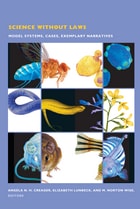
Science without Laws
Model Systems, Cases, Exemplary NarrativesAngela N. H. Creager, Elizabeth Lunbeck and M. Norton Wise, eds.
Duke University Press, 2007
Contributors examine the role of the fruit fly Drosophila and nematode worms in biology, troops of baboons in primatology, box and digital simulations of the movement of the earth’s crust in geology, and meteorological models in climatology. They analyze the intensive study of the prisoner’s dilemma in game theory, ritual in anthropology, the individual case in psychoanalytic research, and Athenian democracy in political theory. The contributors illuminate the processes through which particular organisms, cases, materials, or narratives become foundational to their fields, and they examine how these foundational exemplars—from the fruit fly to Freud’s Dora—shape the knowledge produced within their disciplines.
Contributors
Rachel A. Ankeny
Angela N. H. Creager
Amy Dahan Dalmedico
John Forrester
Clifford Geertz
Carlo Ginzburg
E. Jane Albert Hubbard
Elizabeth Lunbeck
Mary S. Morgan
Josiah Ober
Naomi Oreskes
Susan Sperling
Marcel Weber
M. Norton Wise
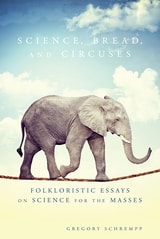
Science, Bread, and Circuses
Folkloristic Essays on Science for the MassesGregory Schrempp
Utah State University Press, 2014
In Science, Bread, and Circuses, Gregory Schrempp brings a folkloristic viewpoint to the topic of popular science, calling attention to the persistence of folkloric form, idiom, and worldview within the increasingly important dimension of popular consciousness defined by the impact of science.
Schrempp considers specific examples of texts in which science interpreters employ folkloric tropes—myths, legends, epics, proverbs, spectacles, and a variety of gestures from religious tradition—to lend credibility and appeal to their messages. In each essay he explores an instance of science popularization rooted in the quotidian round: variations of proverb formulas in monumental measurements, invocations of science heroes like saints or other inspirational figures, the battle of mythos and logos in parenting and academe, how the meme has become embroiled in quasi-religious treatments of the problem of evil, and a range of other tropes of folklore drafted to serve the exposition of science.
Science, Bread, and Circuses places the relationship of science and folklore at the very center of folkloristic inquiry by exploring a range of attempts to rephrase and thus domesticate scientific findings and claims in folklorically imbued popular forms.

Science, Community, and the Transformation of American Philosophy, 1860-1930
Daniel J. Wilson
University of Chicago Press, 1990
The author situates the emergence of professional philosophy in the context of the professionalization of American higher education and articulates, in the case of philosophy, the structures and values of a professional discipline. One of the most important consequences of this transformation was a new emphasis on communal theories of truth. Peirce, Dewey, and Royce all developed sophisticated and important theories of community as they were engaged in reshaping and redefining the limits of philosophy. This book will be of great importance for those interested in the history of philosophy, the rise of professions, and American intellectual and educational history, and to all those seeking to understand the contemporary revival of pragmatic thought and theories of community.

Science, Conservation, and National Parks
Edited by Steven R. Beissinger, David D. Ackerly, Holly Doremus, and Gary E. Machlis
University of Chicago Press, 2016
Examining the major challenges of parks and protected areas throughout the world, contributors provide answers to a number of key conservation questions, such as: How should stewardship address climate change, urban encroachment and pollution, and invasive species? How can society, especially youth, become more engaged with nature and parks, and are there models to guide interactions between parks and their neighbors? What are appropriate conservation objectives for parks in the Anthropocene? Charting a course for the parks of the next century, Science, Conservation, and National Parks is certain not only to catalyze the continued evolution of US park conservation policy, but also to be an inspiration for parks, conservation, and management worldwide.
Science, Curriculum, and Liberal Education
Selected EssaysJoseph J. Schwab
University of Chicago Press, 1982
Schwab participated in what Daniel Bell has described as the "most thoroughgoing experiment in general education in any college in the United States," the College of the University of Chicago during the thirties, forties, and fifties. He played a central role in the curriculum reform movement of the sixties, and his extraordinary command of science, the philosophy of science, and traditional and modern views of liberal education found expression in these exceptionally thoughtful essays.
Science, Faith and Society
Michael Polanyi
University of Chicago Press, 1964
Polanyi aims to show that science must be understood as a community of inquirers held together by a common faith; science, he argues, is not the use of "scientific method" but rather consists in a discipline imposed by scientists on themselves in the interests of discovering an objective, impersonal truth. That such truth exists and can be found is part of the scientists' faith. Polanyi maintains that both authoritarianism and scepticism, attacking this faith, are attacking science itself.
Science, Money, and Politics
Political Triumph and Ethical ErosionDaniel S. Greenberg
University of Chicago Press, 2001
Science, Race, and Ethnicity
Readings from Isis and OsirisEdited by John P. Jackson
University of Chicago Press, 2002
Science, Religion, and Mormon Cosmology
Erich Robert Paul
University of Illinois Press, 1992

Science, Society, and the Search for Life in the Universe
Bruce Jakosky
University of Arizona Press, 2006
Astrobiology is the relatively new, but fast growing scientific discipline that involves trying to understand the origin, evolution, and distribution of life within the universe. It is also one of the few scientific disciplines that attracts the public’s intense curiosity and attention. This interest stems largely from the deep personal meaning that the possible existence of extraterrestrial life has for so many. Whether this meaning relates to addressing the “Big Questions” of our existence, the possibility of encountering life on other planets, or the potential impact on our understanding of religion, there is no doubt that the public is firmly vested in finding answers.
In this broadly accessible introduction to the field, Bruce Jakosky looks at the search for life in the universe not only from a scientific perspective, but also from a distinctly social one. In lucid and engaging prose, he addresses topics including the contradiction between the public’s fascination and the meager dialogue that exists between those within the scientific community and those outside of it, and what has become some of the most impassioned political wrangling ever seen in government science funding.

Sciences from Below
Feminisms, Postcolonialities, and ModernitiesSandra Harding
Duke University Press, 2008
Describing the work of the post-Kuhnian science studies scholars Bruno Latour, Ulrich Beck, and the team of Michael Gibbons, Helga Nowtony, and Peter Scott, Harding reveals how, from different perspectives, they provide useful resources for rethinking the modernity versus tradition binary and its effects on the production of scientific knowledge. Yet, for the most part, they do not take feminist or postcolonial critiques into account. As Harding demonstrates, feminist science studies and postcolonial science studies have vital contributions to make; they bring to light not only the male supremacist investments in the Western conception of modernity and the historical and epistemological bases of Western science but also the empirical knowledge traditions of the global South. Sciences from Below is a clear and compelling argument that modernity studies and post-Kuhnian, feminist, and postcolonial sciences studies each have something important, and necessary, to offer to those formulating socially progressive scientific research and policy.
Scientific Babel
How Science Was Done Before and After Global EnglishMichael D. Gordin
University of Chicago Press, 2015
So how did we get from there to here? How did French, German, Latin, Russian, and even Esperanto give way to English? And what can we reconstruct of the experience of doing science in the polyglot past? With Scientific Babel, Michael D. Gordin resurrects that lost world, in part through an ingenious mechanism: the pages of his highly readable narrative account teem with footnotes—not offering background information, but presenting quoted material in its original language. The result is stunning: as we read about the rise and fall of languages, driven by politics, war, economics, and institutions, we actually see it happen in the ever-changing web of multilingual examples. The history of science, and of English as its dominant language, comes to life, and brings with it a new understanding not only of the frictions generated by a scientific community that spoke in many often mutually unintelligible voices, but also of the possibilities of the polyglot, and the losses that the dominance of English entails.
Few historians of science write as well as Gordin, and Scientific Babel reveals his incredible command of the literature, language, and intellectual essence of science past and present. No reader who takes this linguistic journey with him will be disappointed.

Scientific Explanation
Philip Kitcher and Wesley C. Salmon, Editors
University of Minnesota Press, 1962
Scientific Explanation was first published in 1962. Minnesota Archive Editions uses digital technology to make long-unavailable books once again accessible, and are published unaltered from the original University of Minnesota Press editions.
Is a new consensus emerging in the philosophy of science? The nine distinguished contributors to this volume apply that question to the realm of scientific explanation and, although their conclusions vary, they agree in one respect: there definitely was an old consensus.
Co-editor Wesley Salmon's opening essay, "Four Decades of Scientific Explanation," grounds the entire discussion. His point of departure is the founding document of the old consensus: a 1948 paper by Carl G. Hempel and Paul Oppenheim, "Studies in the Logic of Explanation," that set forth, with remarkable clarity, a mode of argument that came to be known as the deductive-nomological model. This approach, holding that explanation dies not move beyond the sphere of empirical knowledge, remained dominant during the hegemony of logical empiricism from 1950 to 1975. Salmon traces in detail the rise and breakup of the old consensus, and examines the degree to which there is, if not a new consensus, at least a kind of reconciliation on this issue among contemporary philosophers of science and clear agreement that science can indeed tell us why.
The other contributors, in the order of their presentations, are: Peter Railton, Matti Sintonen, Paul W. Humphreys, David Papineau, Nancy Cartwright, James Woodward, Merrilee H. Salmon, and Philip Kitcher.
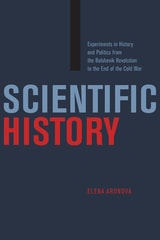
Scientific History
Experiments in History and Politics from the Bolshevik Revolution to the End of the Cold WarElena Aronova
University of Chicago Press, 2021
The book explores the intertwined trajectories of six intellectuals and the larger programs they set in motion: Henri Berr (1863–1954), Nikolai Bukharin (1888–1938), Lucien Febvre (1878–1956), Nikolai Vavilov (1887–1943), Julian Huxley (1887–1975), and John Desmond Bernal (1901–1971). Though they held different political views, spoke different languages, and pursued different goals, these thinkers are representative of a larger motley crew who joined the techniques, approaches, and values of science with the writing of history, and who created powerful institutions and networks to support their projects.
In tracing these submerged stories, Aronova reveals encounters that profoundly shaped our knowledge of the past, reminding us that it is often the forgotten parts of history that are the most revealing.