Results by title
5448 books match the query 'History and criticism' and 403 start with s
Shakespeare Only
Jeffrey Knapp
University of Chicago Press, 2009
Shakespeare and the French Poet
Yves Bonnefoy
University of Chicago Press, 2004
Translated specifically for an American readership, Shakespeare and the French Poet also features a new interview with Bonnefoy. For Shakespeare scholars, Bonnefoy enthusiasts, and students of literary translation, Shakespeare and the French Poet is a celebration of the global language of poetry and the art of "making someone else's voice live again in one's own."
Shakespeare and the Idea of Western Civilization
R.V. Young
Catholic University of America Press, 2022

Shakespeare at the Cineplex
The Kenneth Branagh EraSamuel Crowl
Ohio University Press, 2005
Samuel Crowl’s Shakespeare at the Cineplex: The Kenneth Branagh Era is the first thorough exploration of the fifteen major Shakespeare films released since the surprising success of Kenneth Branagh’s Henry V (1989). Crowl presents the rich variety of these films in the “long decade: between the fall of the Berlin Wall and the terrorist attacks on September 11, 2001.” The productions range from Hollywood-saturated films such as Franco Zeffirelli’s Hamlet and Michael Hoffman’s A Midsummer Night’s Dream to more modest, experimental offerings, such as Christine Edzard’s As You Like It. Now available in paperback, Shakespeare at the Cineplex will be welcome reading for fans, students, and scholars of Shakespeare in performance.
Shakespeare in Theory
The Postmodern Academy and the Early Modern TheaterStephen Bretzius
University of Michigan Press, 1997
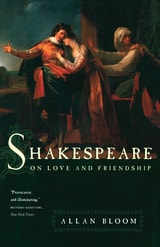
Shakespeare on Love and Friendship
Allan Bloom
University of Chicago Press, 2000
This volume includes essays on five plays, Romeo and Juliet, Anthony and Cleopatra, Measure for Measure, Troilus and Cressida, and The Winter's Tale, and within these Bloom meditates on Shakespeare's work as a whole. He also draws on his formidable knowledge of Plato, Rousseau, and others to bring both ancients and moderns into the conversation. The result is a truly synoptic treatment of eros—not only a philosophical reflection on Shakespeare, but a survey of the human spirit and its tendency to seek what Bloom calls the "connectedness" of love and friendship.
These highly original interpretations of the plays convey a deep respect for their author and a deep conviction that we still have much to learn from him. In Bloom's view, we live in a love-impoverished age; he asks us to turn once more to Shakespeare because the playwright gives us a rich version of what is permanent in human nature without sharing our contemporary assumptions about erotic love.
"Provocative and illuminating." —Michiko Kakutani, New York Times
"A brilliant analysis of the erotic ugliness and the balancing erotic grace of The Winter's Tale . . . and Bloom makes more sense of [Measure for Measure] than anyone else I have read." —A. S. Byatt, Washington Post Book World
At his death in 1992, Allan Bloom was the John U. Nef Distinguished Service Professor in the Committee on Social Thought at the University of Chicago. He is the author of several books, including Shakespeare's Politics (with Harry V. Jaffa) and The Closing of the American Mind.
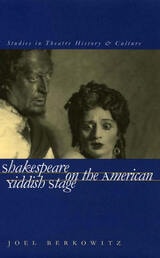
Shakespeare on the American Yiddish Stage
Joel Berkowitz
University of Iowa Press, 2002
The professional Yiddish theatre started in 1876 in Eastern Europe; with the assassination of Tsar Alexander II in 1881, masses of Eastern European Jews began moving westward, and New York—Manhattan’s Bowery and Second Avenue—soon became the world’s center of Yiddish theatre. At first the Yiddish repertoire revolved around comedies, operettas, and melodramas, but by the early 1890s America's Yiddish actors were wild about Shakespeare. In Shakespeare on the American Yiddish Stage, Joel Berkowitz knowledgeably and intelligently constructs the history of this unique theatrical culture.
The Jewish King Lear of 1892 was a sensation. The year 1893 saw the beginning of a bevy of Yiddish versions of Hamlet; that year also saw the first Yiddish production of Othello. Romeo and Juliet inspired a wide variety of treatments. The Merchant of Venice was the first Shakespeare play published in Yiddish, and Jacob Adler received rave reviews as Shylock on Broadway in both 1903 and 1905. Berkowitz focuses on these five plays in his five chapters. His introduction provides an orientation to the Yiddish theatre district in New York as well as the larger picture of Shakespearean production and the American theatre scene, and his conclusion summarizes the significance of Shakespeare’s plays in Yiddish culture.
Shakespeare the Illusionist
Magic, Dreams, and the Supernatural on FilmNeil Forsyth
Ohio University Press, 2019
In Shakespeare the Illusionist, Neil Forsyth reviews the history of Shakespeare’s plays on film, using the basic distinction in film tradition between what is owed to Méliès and what to the Lumière brothers. He then tightens his focus on those plays that include some explicit magical or supernatural elements—Puck and the fairies, ghosts and witches, or Prospero’s island, for example—and sets out methodically, but with an easy touch, to review all the films that have adapted those comedies and dramas, into the present day.
Forsyth’s aim is not to offer yet another answer as to whether Shakespeare would have written for the screen if he were alive today, but rather to assess what various filmmakers and TV directors have in fact made of the spells, haunts, and apparitions in his plays. From analyzing early camera tricks to assessing contemporary handling of the supernatural, Forsyth reads Shakespeare films for how they use the techniques of moviemaking to address questions of illusion and dramatic influence. In doing so, he presents a bold step forward in Shakespeare and film studies, and his fresh take is presented in lively, accessible language that makes the book ideal for classroom use.
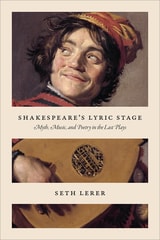
Shakespeare's Lyric Stage
Myth, Music, and Poetry in the Last PlaysSeth Lerer
University of Chicago Press, 2018
As Seth Lerer shows in this pioneering book, Shakespeare’s late plays invite us to contemplate that very question, offering up lyric as a displaced and sometimes desperate antidote to situations of duress or powerlessness. Lerer argues that the theme of lyric misalignment running throughout The Tempest, The Winter’s Tale, Henry VIII, and Cymbeline serves a political purpose, a last-ditch effort at transformation for characters and audiences who had lived through witch-hunting, plague, regime change, political conspiracies, and public executions.
A deep dive into the relationship between aesthetics and politics, this book also explores what Shakespearean lyric is able to recuperate for these “victims of history” by virtue of its disjointed utterances. To this end, Lerer establishes the concept of mythic lyricism: an estranging use of songs and poetry that functions to recreate the past as present, to empower the mythic dead, and to restore a bit of magic to the commonplaces and commodities of Jacobean England. Reading against the devotion to form and prosody common in Shakespeare scholarship, Lerer’s account of lyric utterance’s vexed role in his late works offers new ways to understand generational distance and cultural change throughout the playwright’s oeuvre.
Shakespeare's Once and Future Child
Speculations on SovereigntyJoseph Campana
University of Chicago Press, 2024
Politicians are fond of saying that “children are the future.” How did the child become a figure for our political hopes? Joseph Campana’s book locates the source of this idea in transformations of childhood and political sovereignty during the age of Shakespeare, changes spectacularly dramatized by the playwright himself. Shakespeare’s works feature far more child figures—and more politically entangled children—than other literary or theatrical works of the era. Campana delves into this rich corpus to show how children and childhood expose assumptions about the shape of an ideal polity, the nature of citizenship, the growing importance of population and demographics, and the question of what is or is not human. As our ability to imagine viable futures on our planet feels ever more limited, and as children take up legal proceedings to sue on behalf of the future, it behooves us to understand the way past child figures haunt our conversations about intergenerational justice. Shakespeare offers critical precedents for questions we still struggle to answer.
Shakespeare's Politics
Allan Bloom
University of Chicago Press, 1981
In essays looking at Julius Caesar, Othello, and The Merchant of Venice, Bloom shows how Shakespeare presents a picture of man that does not assume privileged access for only literary criticism. With this claim, he argues that political philosophy offers a comprehensive framework within which the problems of the Shakespearean heroes can be viewed. In short, he argues that Shakespeare was an eminently political author. Also included is an essay by Harry V. Jaffa on the limits of politics in King Lear.
"A very good book indeed . . . one which can be recommended to all who are interested in Shakespeare." —G. P. V. Akrigg
"This series of essays reminded me of the scope and depth of Shakespeare's original vision. One is left with the impression that Shakespeare really had figured out the answers to some important questions many of us no longer even know to ask."-Peter A. Thiel, CEO, PayPal, Wall Street Journal
Allan Bloom was the John U. Nef Distinguished Service Professor on the Committee on Social Thought and the co-director of the John M. Olin Center for Inquiry into the Theory and Practice of Democracy at the University of Chicago. Harry V. Jaffa is professor emeritus at Claremont McKenna College and Claremont Graduate School.
Shakespeare's Rome
Republic and EmpirePaul A. Cantor
University of Chicago Press, 2017
In Shakespeare’s Rome, Cantor examines the political settings of Shakespeare’s Roman plays, Coriolanus and Antony and Cleopatra, with references as well to Julius Caesar. Cantor shows that Shakespeare presents a convincing portrait of Rome in different eras of its history, contrasting the austere republic of Coriolanus, with its narrow horizons and martial virtues, and the cosmopolitan empire of Antony and Cleopatra, with its “immortal longings” and sophistication bordering on decadence.
Shakespeare's Tribe
Church, Nation, and Theater in Renaissance EnglandJeffrey Knapp
University of Chicago Press, 2004
To be sure, Renaissance playwrights rarely sermonized in their plays, which seemed preoccupied with sex, violence, and crime. During a time when acting was regarded as a kind of vice, many theater professionals used their apparent godlessness to advantage, claiming that it enabled them to save wayward souls the church could not otherwise reach. The stage, they argued, made possible an ecumenical ministry, which would help transform Reformation England into a more inclusive Christian society.
Drawing on a variety of little-known as well as celebrated plays, along with a host of other documents from the English Renaissance, Shakespeare's Tribe changes the way we think about Shakespeare and the culture that produced him.
Winner of the Best Book in Literature and Language from the Association of American Publishers' Professional/Scholarly division, the Conference on Christianity and Literature Book Award, and the Roland H. Bainton Prize for Literature from the Sixteenth Century Society and Conference.
Shakespeare, Brecht, and the Intercultural Sign
Antony Tatlow
Duke University Press, 2001
Reflecting on how, why, and to what effect knowledges and styles of performance pollinate across cultures, Tatlow demonstrates that the employment of one culture’s material in the context of another defamiliarizes the conventions of representation in an act that facilitates access to what previously had been culturally repressed. By reading the intercultural, Tatlow shows, we are able not only to historicize the effects of those repressions that create a social unconscious but also gain access to what might otherwise have remained invisible.
This remarkable study will interest students of cultural interaction and aesthetics, as well as readers interested in theater, Shakespeare, Brecht, China, and Japan.
Shakespearean Territories
Stuart Elden
University of Chicago Press, 2018
Shakin' Up Race and Gender
Intercultural Connections in Puerto Rican, African American, and Chicano Narratives and Culture (1965–1995)By Marta E. Sánchez
University of Texas Press, 2006
The second phase of the civil rights movement (1965-1973) was a pivotal period in the development of ethnic groups in the United States. In the years since then, new generations have asked new questions to cast light on this watershed era. No longer is it productive to consider only the differences between ethnic groups; we must also study them in relation to one another and to U.S. mainstream society.
In "Shakin' Up" Race and Gender, Marta E. Sánchez creates an intercultural frame to study the historical and cultural connections among Puerto Ricans, African Americans, and Chicanos/as since the 1960s. Her frame opens up the black/white binary that dominated the 1960s and 1970s. It reveals the hidden yet real ties that connected ethnics of color and "white" ethnics in a shared intercultural history. By using key literary works published during this time, Sánchez reassesses and refutes the unflattering portrayals of ethnics by three leading intellectuals (Octavio Paz, Daniel Patrick Moynihan, and Oscar Lewis) who wrote about Chicanos, African Americans, and Puerto Ricans. She links their implicit misogyny to the trope of La Malinche from Chicano culture and shows how specific characteristics of this trope—enslavement, alleged betrayal, and cultural negotiation—are also present in African American and Puerto Rican cultures. Sánchez employs the trope to restore the agency denied to these groups. Intercultural contact—encounters between peoples of distinct ethnic groups—is the theme of this book.
Shaming into Brown
Somatic Transactions of Race in Latina/o LiteratureStephanie Fetta
The Ohio State University Press, 2018
In Shaming into Brown: Somatic Transactions of Race in Latina/o Literature, Stephanie Fetta asserts that our bodies are fundamental to how we live and how we make meaning. Anchored by two psychoanalytic theories, bioenergetic analysis developed by Alexander Lowen and affect theory put forth by Silvan Tomkins, Fetta examines Latinx fiction to draw attention to the cultural role of the intelligent, emotional, and communicative body—the soma—in relation to shame. She argues that we bring the soma—the physical, emotive, and social register of our subjectivity—to the text as we do to our lives,proposing that the power of racialization operates at the level of somatic expression and reception through habituated, socially cued behaviors that are not readily subject to intentional control.
Fetta examines shame beyond individual experiences, looking at literary renderings of the cultural practice of racial shaming that are deeply embedded into our laws, hiring practices, marketing strategies, and more. Grounding her analysis in the works of Gloria Anzaldúa and Cherríe Moraga, Shaming into Brown focuses on exposing the underpinnings of racialized shame and does so through analyzing “scenes of racialization” in prominent works by authors such as Junot Díaz, Sandra Cisneros, and Oscar Zeta Acosta.
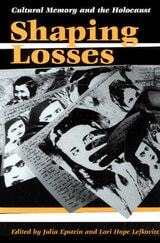
Shaping Losses
CULTURAL MEMORY AND THE HOLOCAUSTEdited by Julia Epstein and Lori Hope Lefkovitz
University of Illinois Press, 2001
This eloquent volume examines how memoirs, films, photographs, art, and literature, as well as family conversations and personal remembrances, embody the impulse to preserve what is destroyed. The contributors -- all distinguished women scholars, most of them survivors or daughters of survivors--examine classic memorializations such as Claude Lanzmann's film Shoah and Roman Vishniac's photographs of prewar Jews as well as several less-well-known works. They also address ways in which children of survivors of the Holocaust--and of other catastrophic traumas--struggle with inherited or vicarious memory, striving to come to terms with losses that centrally define them although they experience them only indirectly.
Shaping Losses considers the limitations of Holocaust representations and testimonies that capture shards of the experience but are necessarily selective and reductive. Contributors discuss artistic efforts to "preserve the rawness" of memory, to resist redemptive closure in Holocaust narratives and public memorials, and to prevent the Holocaust from being sealed in "the cold storage of history." The authors probe the nature of memory and of trauma, studying the use of language within and outside a traumatic context such as Auschwitz and pinpointing the qualities that make traumatic memory ineffable, untransmittable, and perhaps unreliable. Within the "haunted terrain of traumatized memory" that all Holocaust testimonies inhabit, the impulse to give form to emptiness--to shape loss--emerges as a necessary betrayal, a vital effort to bridge the gap between history and memory.
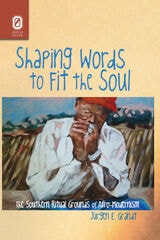
Shaping Words to Fit the Soul
The Southern Ritual Grounds of Afro-ModernismJürgen E. Grandt
The Ohio State University Press, 2009
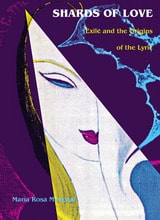
Shards of Love
Exile and the Origins of the LyricMaría Rosa Menocal
Duke University Press, 1994
It is in exile that Menocal locates the founding conditions for philology--as a discipline that loves origins--and for the genre of love songs that philology reveres. She crosses the boundaries, both temporal and geographical, of 1492 to recover the "original" medieval culture, with its Mediterranean mix of European, Arabic, and Hebrew poetics. The result is a form of literary history more lyrical than narrative and, Menocal persuasively demonstrates, more appropriate to the Middle Ages than to the revisionary legacy of the Renaissance. In discussions ranging from Eric Clapton's adaption of Nizami's Layla and Majnun, to the uncanny ties between Jim Morrison and Petrarch, Shards of Love deepens our sense of how the Middle Ages is tied to our own age as it expands the history and meaning of what we call Romance philology.
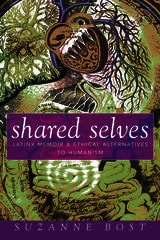
Shared Selves
Latinx Memoir and Ethical Alternatives to HumanismSuzanne Bost
University of Illinois Press, 2019
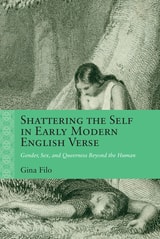
Shattering the Self in Early Modern English Verse
Gender, Sex, and Queerness Beyond the HumanGina Filo
Northwestern University Press, 2026
Rejecting the ideals of stability and sexual mastery demanded of masculine subjects, early modern English poets threw the limits of bodies and selves into question to embrace erotic experiences of genderqueer and transspecies embodiment and affiliation. Through close readings of still-canonical and lesser-read writers including William Shakespeare, John Donne, and Thomas Traherne, Gina Filo shows how these experimental encounters at the limits of the human were inextricable parts of the early modern literary and sexual imaginaries.
In its exploration of nonnormative forms of erotic attachment and embodiment, Shattering the Self in Early Modern English Verse: Gender, Sex, and Queerness Beyond the Human contributes to the burgeoning fields of early modern trans and ecocritical studies while also drawing on contemporary queer theory. Filo neither seeks to naively recuperate a fantasized past nor cedes relationality, sociality, or generativity to the normative. Instead, she shows how the embrace of erotic possibility, flexible, unstable subjectivities, and querying of the limits of “the human” were core features of early modern poetics, reconfiguring our understanding of English literary history and queer relationality today.
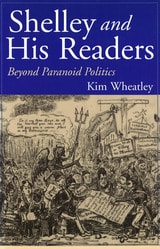
Shelley and His Readers
Beyond Paranoid PoliticsKim Wheatley
University of Missouri Press, 1999
In Shelley and His Readers, the first full-length critical analysis of the dialogue between Shelley's poetry and its contemporary reviewers, Kim Wheatley argues that Shelley's idealism can be recovered through the study of his poetry's reception. Incorporating extensive research in major early-nineteenth-century British periodicals, Wheatley integrates a reception-based methodology with careful textual analysis to demonstrate that the early reception of Shelley's work registers the immediate impact of the poet's increasingly idealistic passion for reforming the world.
Wheatley examines Shelley's poetry within the context of Romantic-era "paranoid politics," a simultaneously empowering and disabling dynamic in which the reviewers employ a heightened language of defensiveness and persecution that paints their adversaries as Satanic rebels against orthodoxy. This "paranoid style" displays a preoccupation with the efficacy of the printed word and singles out radical writers such as Shelley as sources of social contamination.
Using Shelley's Queen Mab to illustrate his early radicalism, Wheatley demonstrates that the poet, like his contemporary reviewers, is caught up in paranoid rhetoric. Failing to challenge the assumptions underlying the paranoid style-conspiracy and contagion-in this poem Shelley takes merely a defiant, oppositional stance. However, Shelley's later poems, exemplified by Prometheus Unbound and Adonais, circumvent the reviewers' rhetoric through their boldly experimental language, a process registered by the reviewers' own responses. These less explicitly political poems transcend the dynamics of cultural paranoia by shifting to an apolitical conception of the aesthetic. In collaboration with its early readers, Shelley's poetry thus moves momentarily beyond paranoid politics.
The final chapter of this study argues that the posthumous reception of Adonais uniquely replicates the elegiac moves and complex idealism of the poem, concluding with a discussion of how the Shelley circle aestheticized the poet after his death.
Shelley and His Readers offers a new approach to the question of how to recuperate Romantic idealism in the face of challenges from both deconstructive and historicist criticism. Its innovative use of reception-based analysis will make this book invaluable not only to specialists of the Romantic period but also to anyone interested in new developments in literary criticism.
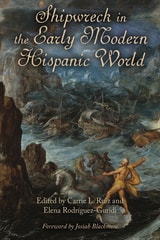
Shipwreck in the Early Modern Hispanic World
Carrie L. Ruiz
Bucknell University Press, 2022
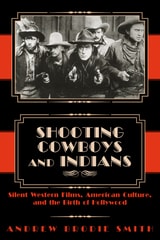
Shooting Cowboys and Indians
Silent Western Films, American Culture, and the Birth of HollywoodAndrew Brodie Smith
University Press of Colorado, 2003
Tracing the western from its hazy silent-picture origins in the 1890s to the advent of talking pictures in the 1920s, Smith examines the ways in which silent westerns contributed to the overall development of the film industry.
Focusing on such early important production companies as Selig Polyscope, New York Motion Picture, and Essanay, Smith revises current thinking about the birth of Hollywood and the establishment of Los Angeles as the nexus of filmmaking in the United States. Smith also reveals the role silent westerns played in the creation of the white male screen hero that dominated American popular culture in the twentieth century.
Illustrated with dozens of historic photos and movie stills, this engaging and substantive story will appeal to scholars interested in Western history, film history, and film studies as well as general readers hoping to learn more about this little-known chapter in popular filmmaking.
Shouting Softly
Lines on Law, Literature, and CultureAllen Mendenhall
St. Augustine's Press, 2020
The work is given in three parts. The first section on law explores legal minds, rules and commentary on seminal jurisprudence. The second part explores literature and the influence of the writer and the disconcerting truths stories often seek to convey. Thirdly, Mendenhall delves into culture and the more obvious situations wherein we gain insight into our manner of living, and here Mendenhall exudes a Southern accent that in no way compromises his universal bearings. One of the highlights is his echo of Larry Seidentop’s question: “If we in the West do not understand the moral depth of our own tradition, how can we hope to shape the conversation of mankind?” This is all the more meaningful given that Mendenhall is a member of the Millennial generation, and part of the intellectual minority who sees the urgency of “a studied appreciation for nuanced story and linguistic narrative.”

Show Me Your Environment
Essays on Poetry, Poets, and PoemsDavid Baker
University of Michigan Press, 2014
In Show Me Your Environment, a penetrating yet personable collection of critical essays, David Baker explores how a poem works, how a poet thinks, and how the art of poetry has evolved—and is still evolving as a highly diverse, spacious, and inclusive art form. The opening essays offer contemplations on the “environment” of poetry from thoughts on physical places and regions as well as the inner aesthetic environment. Next, Baker looks at the highly distinctive achievements and styles of poets ranging from George Herbert and Emily Dickinson through poets writing today. Finally, he takes joy in reading individual poems—from the canonical to the contemporary; simply and closely.
Showdown
Confronting Modern America in the Western FilmJohn H. Lenihan
University of Illinois Press, 1980
[brings] new levels of scholarship and sophistication to the study of
western films.... Should prove useful in the classroom, both for social
history and film history courses. It will introduce readers to a new way
to view some of the old horse operas that they had once taken for granted
as fluffy entertainment."
-- Western American Literature
'"The best of the recent
books to deal with Westerns produced since World War II --- in fact, probably
the best recent study of the Western."
-- Journal of the West
"Recommended for the
student of film and the hardcore film buff. The rest of you will be surprised,
delighted, perhaps even angered by some of the conclusions Lenihan has
come to."
-- Film World
Siblings in Tolstoy and Dostoevsky
The Path to Universal BrotherhoodAnna A. Berman
Northwestern University Press, 2015
Anna A. Berman’s book brings to light the significance of sibling relationships in the writings of Tolstoy and Dostoevsky. Relationships in their works have typically been studied through the lens of erotic love in the former, and intergenerational conflict in the latter.
In close readings of their major novels, Berman shows how both writers portray sibling relationships as a stabilizing force that counters the unpredictable, often destructive elements of romantic entanglements and the hierarchical structure of generations. Power and interconnectedness are cast in a new light. Berman persuasively argues that both authors gradually come to consider siblinghood a model of all human relations, discerning a career arc in each that moves from the dynamics within families to a much broader vision of universal brotherhood.
Sight Unseen
Beckett, Pinter, Stoppard, and Other Contemporary Dramatists on RadioElissa S. Guralnick
Ohio University Press, 1994
In Sight Unseen radio drama, a genre traditionally dismissed as popular culture, is celebrated as high art. The radio plays discussed here range from the conventional (John Arden’s Pearl) to the docudramatic (David Rudkin’s Cries from Casement), from the curtly conversational (Harold Pinter’s A Slight Ache) to the virtually operatic (Robert Ferguson’s Transfigured Night), testifying to radio drama’s variety and literary stature. Two of the plays included in this study pose aesthetic questions—the role of art in politics (Howard Barker’s Scenes from an Execution), and the nature of artistic excellence (Tom Stoppard’s Artist Descending a Staircase).
Guralnick contends that well-crafted radio plays tend to meld to their medium so naturally that they cannot be transferred to the theater or to film without being diminished. Each play is thus shown to exploit, to special effect, one of radio’s fundamental features: its invisible stage (Barker and Stoppard), its affinity to music (Ferguson and Beckett), its ability to imitate the mind’s subjectivity (Kopit and Pinter), its association with world events through features and the news (Rudkin). As for the question of radio’s relation to the theater, the issue is engaged in the work of John Arden, who dares to portray a theatrical stage on the airwaves, while intimating that the radio offers contemporary playwrights an incomparable boon: creative conditions roughly equivalent to those enjoyed by Shakespeare.
Sightlines
Race, Gender, and Nation in Contemporary Australian TheatreHelen Gilbert
University of Michigan Press, 1998
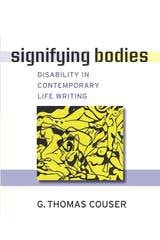
Signifying Bodies
Disability in Contemporary Life WritingG. Thomas Couser
University of Michigan Press, 2010
"Thomas Couser's Signifying Bodies comes at a crucial moment when debates about physician assisted suicide, genetic engineering, and neo-natal screening are raising the question of what constitutes a 'life worth living' for persons with disabilities. Couser's work engages these debates by exploring the extensive number of personal narratives by or about persons with disabilities. As Couser brilliantly demonstrates through synoptic readings, these works challenge the 'preferred rhetorics' by which such narratives are usually written (triumphalist, gothic, nostalgic) while making visible the variegated nature of embodied life."
---Michael Davidson, University of California, San Diego
"Signifying Bodies shows us that life writing about disability is . . . everywhere. . . . From obituary to documentary film to ethnography to literary memoir to the law, the book casts a wide net, detailing how various written and filmed responses to disability both enact and resist conventional narrative patterns. [This] not only broadens our idea about where to look for life writing, but also demonstrates how thoroughly stereotypes about disability mediate our social and artistic languages---even when an author has (so-called) the best intentions."
---Susannah B. Mintz, Skidmore College
Memoirs have enjoyed great popularity in recent years, experiencing significant sales, prominent reviews, and diverse readerships. Signifying Bodies shows that at the heart of the memoir phenomenon is our fascination with writing that focuses on what it means to live in, or be, an anomalous body---in other words, what it means to be disabled. Previous literary accounts of the disabled body have often portrayed it as a stable entity possibly signifying moral deviance or divine disfavor, but contemporary writers with disabilities are defining themselves and depicting their bodies in new ways. Using the insights of disability studies and source material ranging from the Old and New Testaments to the works of authors like Lucy Grealy and Simi Linton and including contemporary films such as Million Dollar Baby, G. Thomas Couser sheds light on a broader cultural phenomenon, exploring topics such as the ethical issues involved in disability memoirs, the rhetorical patterns they frequently employ, and the complex relationship between disability narrative and disability law.
G. Thomas Couser is Professor of English at Hofstra University.
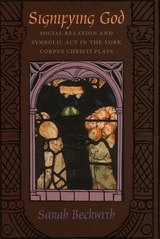
Signifying God
Social Relation and Symbolic Act in the York Corpus Christi PlaysSarah Beckwith
University of Chicago Press, 2001
Introducing a radical new understanding of these plays as "sacramental theater," Beckwith shows how organizing the plays served as a political mechanism for regulating labor, and how theater and sacrament combined in them to do important theological work. She argues, for instance, that the theology of Corpus Christi in the resurrection plays can only be understood as a theatrical exploration of eucharistic absence and presence. Beckwith frames her study with discussions of twentieth-century manifestations of sacramental theater in Barry Unsworth's novel Morality Play and Denys Arcand's film Jesus of Montreal, and the connections between contemporary revivals of the York Corpus Christi plays and England's heritage culture.
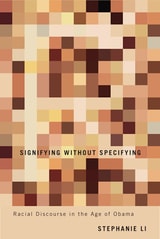
Signifying Without Specifying
Racial Discourse in the Age of ObamaLi, Stephanie
Rutgers University Press, 2011
On the campaign trail, Barack Obama faced a difficult task—rallying African American voters while resisting his opponents’ attempts to frame him as “too black” to govern the nation as a whole. Obama’s solution was to employ what Toni Morrison calls “race-specific, race-free language,” avoiding open discussions of racial issues while using terms and references that carried a specific cultural resonance for African American voters.
Stephanie Li argues that American politicians and writers are using a new kind of language to speak about race. Challenging the notion that we have moved into a “post-racial” era, she suggests that we are in an uneasy moment where American public discourse demands that race be seen, but not heard. Analyzing contemporary political speech with nuanced readings of works by such authors as Toni Morrison, Jhumpa Lahiri, and Colson Whitehead, Li investigates how Americans of color have negotiated these tensions, inventing new ways to signal racial affiliations without violating taboos against open discussions of race.
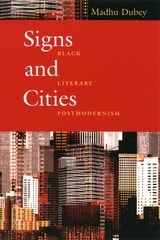
Signs and Cities
Black Literary PostmodernismMadhu Dubey
University of Chicago Press, 2003
Dubey shows how black novelists from the last three decades have reconsidered the modern urban legacy and thus articulated a distinctly African-American strain of postmodernism. She argues that novelists such as Octavia Butler, Samuel Delany, Toni Morrison, Gloria Naylor, Ishmael Reed, Sapphire, and John Edgar Wideman probe the disillusionment of urban modernity through repeated recourse to tropes of the book and scenes of reading and writing. Ultimately, she demonstrates that these writers view the book with profound ambivalence, construing it as an urban medium that cannot recapture the face-to-face communities assumed by oral and folk forms of expression.
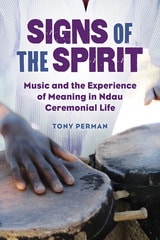
Signs of the Spirit
Music and the Experience of Meaning in Ndau Ceremonial LifeTony Perman
University of Illinois Press, 2020
Perman's encounters with the spirits, the mediums who bring them back, and the accompanying rituals form the heart of his ethnographic account of how the Ndau experience ceremonial musicking. As Perman witnessed other ceremonies, he discovered that music and dancing shape the emotional lives of Ndau individuals by inviting them to experience life's milestones or cope with its misfortunes as a group. Signs of the Spirit explores the historical, spiritual, and social roots of ceremonial action and details how that action influences the Ndau's collective approach to their future. The result is a vivid ethnomusicological journey that delves into the immediacy of musical experience and the forces that transform ceremonial performance into emotions and community.
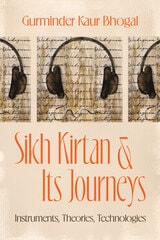
Sikh Kirtan and Its Journeys
Instruments, Theories, TechnologiesGurminder Kaur Bhogal
University of Chicago Press, 2025
Kirtan—the sung expression of sacred verses—spans the Indian subcontinent, but it plays a unique role in the Sikh faith. In Sikh Kirtan and ItsJourneys, musicologist Gurminder Kaur Bhogal introduces the devotional tradition of kirtan, examining it alongside the writings of holy figures, the Sikh Gurus and Bhagats, and its practice among musicians. The long-established tradition of kirtan originated in a canon of instruments and songs, each of which produces a singular spiritual and worldly effect when kirtan is sung. However, the realities of colonization and migration have necessitated changes to these canonical practices. Bhogal offers a deep exploration of the traditions that gave rise to kirtan and a robust portrait of the many transformations kirtan has undergone, particularly in the wide-ranging Sikh diaspora, dedicating special attention to marginal kirtan players such as women and innovators developing digital techniques and styles. A practicing kirtaniya, Bhogal has spent her life studying and performing this music, steeped in the histories and controversies her book describes.
Through a rigorous explanation of the traditions and evolutions of kirtan, Bhogal ultimately shows that kirtan is fluid, multi-faceted, and ever-changing because it reflects the shifting spiritual needs and musical tastes of devotees and practitioners across the world. Moreover, wherever kirtan is offered and received, it heightens corporeal vibrations between practitioners and devotees to motivate a sense of social purpose, social responsibility, and selfless service.
Silence and the Rest
Verbal Skepticism in Russian PoetrySofya Khagi
Northwestern University Press, 2013
Scholars have long noted the deeply rooted veneration of the power of the word—both the expressive and communicative capacities of language—in Russian literature and culture. In her ambitious book Silence and the Rest, Sofya Khagi illuminates a consistent counternarrative, showing how, throughout its entire history, Russian poetry can be read as an argument for what she calls “verbal skepticism.” Although she deals with many poets from a two-century tradition, Khagi gives special emphasis to Osip Mandelstam, Joseph Brodsky, and Timur Kibirov, offering readings that add new layers of meaning to their work. She posits a long-running dialogue between the poets and the philosophers and theorists who have also been central to the antiverbal strain of Russian culture. Unlike its Western counterpart, the Russian philosophical and theological doubt of the efficacy of the word still grants the author, and literature itself, an ethical force—the inadequacies of language notwithstanding.
Silent Film
Able, Richard
Rutgers University Press, 1996
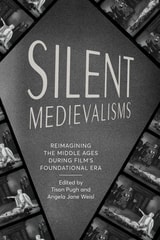
Silent Medievalisms
Reimagining the Middle Ages During Film’s Foundational EraEdited by Tison Pugh and Angela Jane Weisl
The Ohio State University Press, 2026
Contributors:
Kimberly Ball, Elizabeth Coggeshall, John Haines, Kevin J. Harty, Valerie B. Johnson, Tison Pugh, Sabina Rahman, Carol L. Robinson, Robert Squillace, Alexandra Sterling-Hellenbrand, Alfred Thomas, Laura E. Wangerin, Angela Jane Weisl
Simulcast
Four Experiments in CriticismBenjamin Friedlander
University of Alabama Press, 2004
A provocative overview of avant-garde American poetry of the past 25 years that raises important questions about the practice of criticism.
Simulcast offers long overdue, highly opinionated, and penetrating examinations of a flourishing movement in American letters by one of its most perceptive practitioners. The four “experiments” in literary criticism gathered in this volume vary in style and point of view. Taken together, they reassess the fundamental relationship between poetry and criticism.
“The Anti-Hegemony Project” is a satire, employing the rhetoric of journalism and the colloquial exchanges of online fan groups to analyze one of the earliest appearances of a poetry community on the World Wide Web: the “Poetics List” maintained at the State University of New York, Buffalo. “Poe’s Poetics and Selected Essays” is a collection of polemical essays on subjects ranging from modernism to language poetry. The third experiment, “The Literati of San Francisco,” is a detailed portrait of the figures and ideas at the heart of an important literary scene a decade after language poetry’s inception. The final essay, “A Short History of Language Poetry,” provides a less polemical, more sober and even-handed analysis of that movement from its origins to the present and its prospects for the future.
These critical interventions and essays are important studies of an evolving poetic field, but they also represent an evolution in criticism itself. Friedlander’s unorthodox methodology is to create a critical text by rewriting prior examples of criticism, among them Jean Wahl’s A Short History of Existentialism and Edgar Allan Poe’s "Literati of New York City." The resulting critiques are themselves a kind of poetry. They explore the issues of style versus substance, artifice versus authenticity, and plausibility versus truth, while the shifts in perspective call into question the authority of any one critical account.
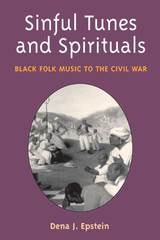
Sinful Tunes and Spirituals
Black Folk Music to the Civil WarDena J. Epstein
University of Illinois Press, 1981
Sing Them Over Again to Me
Hymns and Hymnbooks in AmericaEdited by Mark A. Noll and Edith L. Blumhofer
University of Alabama Press, 2006
Hymns and hymnbooks as American historical and cultural icons.
This work is a study of the importance of Protestant hymns in defining America and American religion. It explores the underappreciated influence of hymns in shaping many spheres of personal and corporate life as well as the value of hymns for studying religious life. Distinguishing features of this volume are studies of the most popular hymns (“Amazing Grace,” “O, For a Thousand Tongues to Sing,” “All Hail the Power of Jesus’ Name”), with attention to the ability of such hymns to reveal, as they are altered and adapted, shifts in American popular religion. The book also focuses attention on the role hymns play in changing attitudes about race, class, gender, economic life, politics, and society.
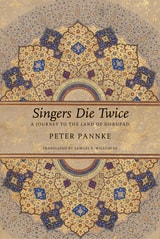
Singers Die Twice
A Journey to the Land of DhrupadPeter Pannke
Seagull Books, 2013
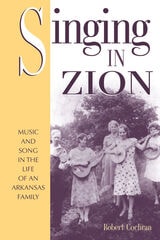
Singing in Zion
Music and Song in the Life of One Arkansas FamilyRobert Cochran
University of Arkansas Press, 1999

Singing in the Wilderness
Music and Ecology in the Twentieth CenturyWilfrid Mellers
University of Illinois Press, 2001
Beginning with two turn-of-the-century operas--Frederick Delius's A Village Romeo and Juliet and Claude Debussy's Pelléas et Mélisande -- that present humankind as lost in a tangled wood that is at once internal and external, Mellers develops the theme of wilderness in sociological, psychological, ecological, and even geological terms. He discusses Leoš Janá ek's Cunning Little Vixen ("the ultimate ecological opera") as a parable of redemption and explores the delicate yet dangerous equilibrium between civilization and the dark forest in works by Charles Koechlin and Darius Milhaud. Elements of wilderness and the city combine to infuse the music of Heitor Villa-Lobos and Carlos Chávez with a blend of primitivism and sophistication, while a creative tension between desert landscape and industrial mechanization inspires the works of Carl Ruggles, Harry Partch, Steve Reich, and Australia's Peter Sculthorpe. The volume culminates in a discussion of two American urban folk musicians, Duke Ellington and George Gershwin.
By suggesting how the "musicking" of ecological issues articulates twinned perspectives on music and our place in the world, Mellers raises intriguing questions about the links among tradition, talent, learning, and instinct. Brimming over with fresh ideas and unexpected cross-pollinations, Singing in the Wilderness is a stimulating addition to the oeuvre of a distinguished and inventive scholar.
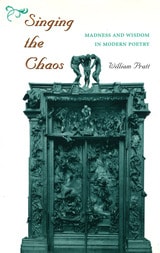
Singing the Chaos
Madness and Wisdom in Modern PoetryWilliam Pratt
University of Missouri Press, 1996
Singing the Chaos: Madness and Wisdom in Modern Poetry combines both a historical and a critical approach toward the works of major British, American, French, German, and Russian poets. Comprehensive in scope and arranged chronologically to survey a century of high poetic achievement, the study is unified by Pratt's overriding argument that "modern poets have endowed a disintegrating civilization with humane wisdom by 'singing the chaos' that surrounds them, making ours a great age in spite of itself."
In developing this central theme, Pratt brings alive the energy, the freshness, and the originality of technique that made Baudelaire, Pound, Yeats, Rilke, Eliot, and others the initiators of the revolution in poetry. He brings a more complete, clearer perspective to other major themes: modernism as an age of irony; poets as both madmen and geniuses; the modern poet as tragic hero; the dominance of religious or visionary truths over social or political issues; and the combination of radical experiments in poetic form with an apocalyptic view of Western civilization. His detailed treatment of the Fugitive poets and his recognition of their prominent role in twentieth-century literature constitute an important historical revision.
Brilliantly informed, insightful, and, above all, accurately sympathetic to the points of view of the poets Pratt presents, Singing the Chaos is that rare book that belongs on all shelves devoted to modernist poetry.
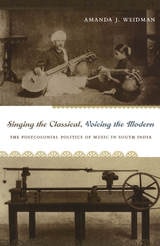
Singing the Classical, Voicing the Modern
The Postcolonial Politics of Music in South IndiaAmanda J. Weidman
Duke University Press, 2006
Combining ethnographic observation derived from her experience as a student and performer of South Indian music with close readings of archival materials, Weidman traces the emergence of this politics of voice through compelling analyses of the relationship between vocal sound and instrumental imitation, conventions of performance and staging, the status of women as performers, debates about language and music, and the relationship between oral tradition and technologies of printing and sound reproduction. Through her sustained exploration of the way “voice” is elaborated as a trope of modern subjectivity, national identity, and cultural authenticity, Weidman provides a model for thinking about the voice in anthropological and historical terms. In so doing, she shows that modernity is characterized as much by particular ideas about orality, aurality, and the voice as it is by regimes of visuality.
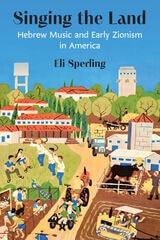
Singing the Land
Hebrew Music and Early Zionism in AmericaEli Sperling
University of Michigan Press, 2024
Exploring the history, events, contexts, and tensions that comprised what may be termed the ‘Zionization’ of American Jewry during the first half of the twentieth century, Eli Sperling analyzes primary sources within the historical contexts of Zionist national development and American Jewish life. Singing the Land offers insights into how and why musical frameworks were central to catalyzing American Jewry’s support of the Zionist cause by the 1940s, parallel to firm commitments to their American locale and national identities. The proliferation of this widespread American Jewish-Zionist embrace was achieved through a variety of educational, religious, economic, and political efforts, and Hebrew music was a thread consistent among them all.
Singing the Lord's Song in a Strange Land
Hymnody in the History of North American ProtestantismEdith L. Blumhofer
University of Alabama Press, 2008
Music and song are important parts of worship, and hymns have long played a central role in Protestant cultural history. This book explores the ways in which Protestants have used and continue to use hymns to clarify their identity and define their relationship with America and to Christianity. Representing seven groups—Baptists, Presbyterians, Lutherans, Mennonites, Holiness, Hispanics, and Evangelicals—the nine essays reveal how hymns have helped immigrants to establish new identities, contributed to the body of worship resources, and sustained ethnic identity.
Individual essays address the music of the Old-Fashioned Revival Hour, America’s longest running and most successful independent radio program; singing among Swedish evangelicals in America; the German hymn tradition as transformed by Mennonite immigrants; the ways hymnody reinforces themes of the Wesleyan holiness movement; the history of Mercer’s Cluster (1810), a southern hymnal that gave voice to slaves, women, and native Americans; and the Presbyterian hymnal tradition in Canada formed by Scottish immigrants.