Results by title
22279 books match the query 'Social Science' and 1635 start with s
Schoolbook Nation
Conflicts over American History Textbooks from the Civil War to the PresentJoseph Moreau
University of Michigan Press, 2004
-Gary B. Nash, Director of the National Center for History in the Schools
Taking Frances FitzGerald's textbook study America Revised as a point of departure, Joseph Moreau in Schoolbook Nation challenges FitzGerald's premise that the 1960s were the beginning of the end of the glory days of American history education.
Moreau recounts how in the late twentieth century, cultural commentators such as historian Arthur Schlesinger Jr. and politician Newt Gingrich preached that a new identity crisis had shaken American history in the sixties, and that the grand unified view of our past had given way to various interest groups, who dismantled the old national narrative while demanding a more "inclusive" curriculum for their children.
Moreau discovered, however, that American history, while grand, has never been unified. Delving into more than 100 history books from the last 150 years, the author reveals that the efforts of pressure groups to influence the history curriculum are nearly as old as the mustiest textbook. "For those who would influence textbooks and teaching-Protestant elites in the 1870s, Irish-Americans in the 1920s, and conservative politicians today-the sky has always been falling," according to Moreau.
Schoolbook Nation offers a history lesson of its own: when the story of the past is written or rewritten, truth is often a victim. With its comprehensive treatment of the subjects of honesty and politics in the teaching of history, this is an essential book on the side of truth in a complex debate.

Schoolcraft's Expedition to Lake Itasca
Philip P. Mason
Michigan State University Press, 1993
Scientist, explorer, historian, and Indian agent Henry Rowe Schoolcraft's name must be included in the pantheon of early nineteenth-century adventurers who were in the vanguard of American expansion into the heart of the continent. While some, individuals like William Clark, Meriwether Lewis, John C. Fremont, and Kit Carson did not stop until they reached the Pacific Ocean, others took it as their task to explore the cast, unknown interior; chief among this group was Henry Rowe Schoolcraft. Originally issued by Michigan State University Press in 1958, Schoolcraft's Expedition to Lake Itasca contains a semi-official report of his 1832 trip to the upper Mississippi region. His purposes for exploring the area, now part of Minnesota, were to quell a feud between warring Chippewa and Sioux factions and to locate the Mississippi headwaters. Although he did not stop the fighting, Schoolcraft did discover the river's true source and left us an unsurpassed account of life in the region in the 1830s. Anyone interested in the early white exploration of the upper Midwest should own a copy of this valuable resource.

Schoolcraft's Indian Legends
Mentor L. Williams
Michigan State University Press, 1991
Material presented here is drawn primarily from Henry Rowe Schoolcraft's 1839 edition of Algic Researches—a rare, yet often cited publication. However, stories from two later Schoolcraft collections, Oneota and The Myth of Hiawatha, are also included in an appendix. Thus, a representative view of the entire body of Schoolcraft's published Indian legends is available in a single volume.
With a new forward by Phillip P. Mason, this book is designed to reacquaint America with one of its often-neglected geniuses. It is apparent when studying Schoolcraft's writing that he was clearly one of the first European Americans to recognize the merit and value of the Native American heritage as expressed in oral tradition.
Critics have been divided in their assessment of Schoolcraft's contribution to the collection and preservation of Native American lore. The tide of interpretation has seen Schoolcraft's work achieve an initial popularity, only to be rejected by members of the 1920s intelligentsia, the same individuals who critically embraced (and seldom properly attributed) Henry Wadsworth Longfellow's adaptations of Schoolcraft's work. However, Schoolcraft received renewed attention, first in the 1950s, when Williams undertook to collect and edit the original volumes, and again today when the value and validity of the Native American oral tradition has, once again, been "discovered."
Schoolcraft's Narrative Journal of Travels
Mentor L. Williams
Michigan State University Press, 1992
This important Henry Rowe Schoolcraft work, first issued by Michigan State University Press in 1953, is now available as the second title in MSU Press's Schoolcraft Series. The book was originally published in 1821 under the long and pretentious title Narrative Journey of travels through the Northwestern Regions of the United States, extending from Detroit through the Great Chain of American Lakes to the Sources of the Mississippi River, Performed as a Member of the expedition under Governor Cass, in the Year 1820; it recounts Schoolcraft's participation in the John C. Calhoun-sponsored 1820 expedition to explore the cast, uncharted territory stretching from the upper Great Lakes into what is now northern Minnesota.
This volume, a marvelous blend of reportage, scientific findings, and the author's personal observations, contains a wealth of information about geography and topography woven together with vivid descriptions of scenic beauty, Native American culture, and day-to-day life as a member of an exploring expedition.

Schoolcraft's Ojibwa Lodge Stories
Life on the Lake Superior FrontierPhilip P. Mason
Michigan State University Press, 1997
Schooled and Sorted
How Educational Categories Create InequalityThurston Domina
Russell Sage Foundation, 2023
Some educational categories have broadly egalitarian consequences. Indeed, Domina, Penner, and Penner argue that when societies enroll young people in school, making them students, they mark them as individuals who are worthy of rights. But other educational categories reinforce powerful social categories—including race, gender, and class—and ultimately reproduce social and economic inequality in society. Elite colleges, tracked high schools, and elementary school gifted programs provide not only different educational experiences, but also create merit and inequality by sorting students into categories that are defined by the students who are excluded.
Schooled & Sorted highlights that many of the decisions that define educational categories occur in school-based committee meetings and other relatively local settings. The local nature of these decisions provides many opportunities to define educational categories differently, and for school communities to bring about change.
Schooled & Sorted is an illuminating investigation into the ways sorting within schools translates into inequality in the larger world. While some educational categorization may be unavoidable, the authors suggest ways to build a more equitable system—and thus a more equitable society.
Schooling Citizens
The Struggle for African American Education in Antebellum AmericaHilary J. Moss
University of Chicago Press, 2009
While white residents of antebellum Boston and New Haven forcefully opposed the education of black residents, their counterparts in slaveholding Baltimore did little to resist the establishment of African American schools. Such discrepancies, Hilary Moss argues, suggest that white opposition to black education was not a foregone conclusion. Through the comparative lenses of these three cities, she shows why opposition erupted where it did across the United States during the same period that gave rise to public education.
As common schooling emerged in the 1830s, providing white children of all classes and ethnicities with the opportunity to become full-fledged citizens, it redefined citizenship as synonymous with whiteness. This link between school and American identity, Moss argues, increased white hostility to black education at the same time that it spurred African Americans to demand public schooling as a means of securing status as full and equal members of society. Shedding new light on the efforts of black Americans to learn independently in the face of white attempts to withhold opportunity, Schooling Citizens narrates a previously untold chapter in the thorny history of America’s educational inequality.
Schooling Without Labels
Parents, Educators, and Inclusive EducationDouglas Biklen
Temple University Press, 1992
Douglas Biklen closely examines the experiences of six families in which children with disabilities are full participants in family life in order to understand how people who have been labeled disabled might become full participants in the other areas of society as well. He focuses on the contradictions between what some families have achieved, what they want for their children, and what society and its social policies allow. He demonstrates how the principles of inclusion that govern the lives of these families can be extended to education, community life, and other social institutions.
The parents who tell their stories here have actively sought inclusion of their children in regular schools and community settings; several have children with severe or multiple disabilities. In discussing issues such as normalization, acceptance, complete schooling, circles of friends, and community integration, these parents describe the challenge and necessity of their children's "leading regular lives."
In the series Health, Society, and Policy, edited by Sheryl Ruzek and Irving Kenneth Zola.

Schooling for Refugee Children
A Social Justice Perspective Informed by Children from SyriaEleanore Hargreaves, Brian Lally, Bassel Akar, Jumana Al-Waeli, and Jasmine Costello
University College London, 2024
Schooling for Refugee Children is a collaboration between five authors who explore their interactions with refugee children displaced from Syria to the Lebanese borders and London. Through a program of carefully tailored research activities, the authors analyze the children’s representations of their journeys and current circumstances, particularly focusing on questions of ongoing schooling in the face of displacement. The children’s experiences are expressed through their own words and drawings, disrupting the stereotype of children as receivers rather than empowered actors, and challenging traditional solutions for improving schooling. Throughout, the children are eloquent about their schooling in the context of displacement. Their views and illustrations depict a keen awareness of social justice issues, including the distribution of wealth, recognition of status, and representation of voice. In this way, the book brings to light important representations of some empowering experiences lived through by refugee children from Syria, as well as their thoughts on what has helped their learning and what can be done better. The children’s need for care and a sense of belonging in their schools and their new communities is given particular emphasis throughout the book, represented by one child, who simply requested, “Add some more love!”
Schooling for Refugee Children is invaluable for educators, policymakers, and anyone interested in refugee education and social justice. By centering the voices of refugee children, the book sheds light on their unique perspectives and needs, challenging conventional approaches to improving schooling for displaced populations.
Schools Betrayed
Roots of Failure in Inner-City EducationKathryn M. Neckerman
University of Chicago Press, 2007
The problems commonly associated with inner-city schools were not nearly as pervasive a century ago, when black children in most northern cities attended school alongside white children. In Schools Betrayed, her innovative history of race and urban education, Kathryn M. Neckerman tells the story of how and why these schools came to serve black children so much worse than their white counterparts.
Focusing on Chicago public schools between 1900 and 1960, Neckerman compares the circumstances of blacks and white immigrants, groups that had similarly little wealth and status yet came to gain vastly different benefits from their education. Their divergent educational outcomes, she contends, stemmed from Chicago officials’ decision to deal with rising African American migration by segregating schools and denying black students equal resources. And it deepened, she shows, because of techniques for managing academic failure that only reinforced inequality. Ultimately, these tactics eroded the legitimacy of the schools in Chicago’s black community, leaving educators unable to help their most disadvantaged students.
Schools Betrayed will be required reading for anyone who cares about urban education.
Schools Under Surveillance
Cultures of Control in Public EducationMonahan, Torin
Rutgers University Press, 2009
Schools for Sale
Disinvestment, Dispossession, and School Building Reuse in PhiladelphiaJulia McWilliams, Ariel H. Bierbaum, Amy J. Bach and Elaine Simon
University of Chicago Press, 2026
School districts across the United States have closed thousands of schools since 2000 to cope with chronic underfunding and budget crises, declining enrollment, and poorly maintained buildings. Our knowledge about school closures has focused on battles over closure decision-making and the impacts of closing schools on communities of color in the immediate aftermath of these decisions. But what of the large, sometimes magisterial, formerly public spaces once at the center of community life? How do these now vacant buildings change daily life in the surrounding neighborhood?
In Schools for Sale, Julia McWilliams, Ariel H. Bierbaum, Amy J. Bach, and Elaine Simon examine how school closures change the spatial and social arrangements of neighborhoods. Following a series of school closures in Philadelphia, the authors draw from research in urban studies, education, planning, and geography to explain how race, place, and capital merge to influence the trajectory of closed schools in Black and Brown communities and their surrounding neighborhoods. Some closed schools are repurposed as charter schools, upending the role those buildings have historically played in bringing communities together. Other buildings are sold for commercial development, caught up in cycles of gentrification even as developers foster programs to support community members. Others are left vacant or are demolished in the heart of their neighborhoods, decisions that reflect not only disinvestment in Black communities but the sobering reality of environmental racism.
Drawing needed attention to one of the significant consequences of school closures, Schools for Sale imparts a deeper understanding of the connections between place, race, and education amid broader urban transformations, prompting us to consider how school districts can work toward a new vision for public education and community development.

Science
Steve Fuller
University of Minnesota Press, 1998
Science Communication Online
Engaging Experts and Publics on the InternetAshley Rose Mehlenbacher
The Ohio State University Press, 2019
Bringing together genre studies and the rhetoric of science, Mehlenbacher examines a range of new forms of science communication that challenge traditional presumptions about experts and nonexperts—including Twitter and Reddit AMAs, crowdfunding proposals such as Kickstarter and Experiment.com, civic-minded databases such as Safecast, and the PLOS blogging network. Science Communication Online illustrates the unique features of these genres and connects them to their rhetorical functions and the larger context leading to their emergence and evolution—from the democratization of science, challenges to expertise and expert status, and new political economies. Science Communication Online captures the important moment we find ourselves in now—one not defined by science and society but science in society.
Science Fiction Cinema
Between Fantasy and RealityCornea, Christine
Rutgers University Press, 2007
Offering a broad historical and theoretical reassessment of science fiction, Christine Cornea explores the development of this popular genre in cinema from its very beginnings to the present day. Each chapter offers analyses of particular films, situating them within a wider historical/cultural context while also highlighting a specific key thematic issue. Cornea provides vital and unique perspectives on the genre, including discussions of the relevance of psychedelic imagery, race, the “new woman of science,” generic performance, and the prevalence of “techno-orientalism” in recent films. Enriching the book are new interviews with some of the main practitioners in the field, such as Roland Emmerich, Paul Verhoeven, Ken Russell, Stan Winston, William Gibson, Brian Aldiss, Joe Morton, Dean Norris, and Billy Gray. While American films are Cornea’s main focus, she also engages with a range of examples from other countries and explains why science fiction lends itself well to transnational reception.
Among the many films discussed are The Day the Earth Stood Still, The Body Snatchers, Forbidden Planet, The Quatermass Experiment, 2001: A Space Odyssey, Demon Seed, Star Trek: The Motion Picture, Star Wars, Altered States, Alien, Blade Runner, The Brother from Another Planet, Back to the Future, The Terminator, Predator, The One, Dark City, The Matrix, Fifth Element, and eXistenZ.

Science Wars
Andrew Ross, ed.
Duke University Press, 1996
At a time when scientific knowledge is systematically whisked out of the domain of education and converted into private capital, the essays in this volume are sharply critical of the conservative defense of a value-free science. They suggest that in a world steeped in nuclear, biogenic, and chemical overdevelopment, those who are skeptical of technology are more than entitled to ask for evidence of rationality in those versions of scientific progress that respond only to the managerial needs of state, corporate, and military elites. Whether uncovering the gender-laden assumptions built into the Western scientific method, redefining the scientific claim to objectivity, showing the relationship between science’s empirical worldview and that of mercantile capitalism, or showing how the powerful language of science exercises its daily cultural authority in our society, the essays in Science Wars announce their own powerful message. Analyzing the antidemocratic tendencies within science and its institutions, they insist on a more accountable relationship between scientists and the communities and environments affected by their research.
Revised and expanded from a recent issue of Social Text, Science Wars will provoke thought and controversy among scholars and general readers interested in science studies and current cultural politics.
Contributors. Stanley Aronowitz, Sarah Franklin, Steve Fuller, Sandra Harding, Roger Hart, N. Katherine Hayles, Ruth Hubbard, Joel Kovel, Les Levidow, George Levine, Richard Levins, Richard C. Lewontin, Michael Lynch, Emily Martin, Dorothy Nelkin, Hilary Rose, Andrew Ross, Sharon Traweek, Langdon Winner

Science and Medicine in Twentieth-Century China
Research and EducationJohn Z. Bowers, J. William Hess, and Nathan Sivin, Editors
University of Michigan Press, 1988
Science and Social Inequality
Feminist and Postcolonial IssuesSandra Harding
University of Illinois Press, 2006
In Science and Social Inequality, Sandra Harding makes the provocative argument that the philosophy and practices of today's Western science, contrary to its Enlightenment mission, work to insure that more science will only worsen existing gaps between the best and worst off around the world. She defends this claim by exposing the ways that hierarchical social formations in modern Western sciences encode antidemocratic principles and practices, particularly in terms of their services to militarism, the impoverishment and alienation of labor, Western expansion, and environmental destruction. The essays in this collection--drawing on feminist, multicultural, and postcolonial studies--propose ways to reconceptualize the sciences in the global social order.
At issue here are not only social justice and environmental issues but also the accuracy and comprehensiveness of our understandings of natural and social worlds. The inadvertent complicity of the sciences with antidemocratic projects obscures natural and social realities and thus blocks the growth of scientific knowledge. Scientists, policy makers, social justice movements and the consumers of scientific products (that is, the rest of us) can work together and separately to improve this situation.

Science and the Creative Imagination in Latin America
Edited by Evelyn Fishburn and Eduardo L. Ortiz
University of London Press, 2004
Chapters include: Darwin in South America: Geology, Imagination and Encounter Walking Backward to the Future: Time, Travel and Race Natural Parts and Unnatural Others: A reflection on Patrimony at the Turn of the 19th Century On the Transition from Realism to the Fantastic in the Argentina of the 1870s: Holmberg and the Six of Cordoba Literature and Science in Martinez Estrada's Work The Nature Effect in Latin American Science Publications: The Case of the Journal Redes Two Scientific Traditions in Martin Fierro Heisenberg's Uncertainty Principle in Contemporary Spanish American Fiction Constructing Postcoloniality: Scientific Enquiries in Cien Anos de Soledad Holograms and Simulacra: Bioy Casares, Subiela, Piglia The Desert Poetics of Mario Montalbetti: Writing, Knowledge, Topologies
Science as Practice and Culture
Edited by Andrew Pickering
University of Chicago Press, 1992
Andrew Pickering has invited leading historians, philosophers, sociologists, and anthropologists of science to prepare original essays for this volume. The essays range over the physical and biological sciences and mathematics, and are divided into two parts. In part I, the contributors map out a coherent set of perspectives on scientific practice and culture, and relate their analyses to central topics in the philosophy of science such as realism, relativism, and incommensurability. The essays in part II seek to delineate the study of science as practice in arguments across its borders with the sociology of scientific knowledge, social epistemology, and reflexive ethnography.
Science as a Carreer Choice
Theoretical and Empirical StudiesBernice T. Ediuson
Russell Sage Foundation, 1974
Science by the People
Participation, Power, and the Politics of Environmental KnowledgeAya H. Kimura
Rutgers University Press, 2019
Citizen science—research involving nonprofessionals in the research process—has attracted both strong enthusiasts and detractors. Many environmental professionals, activists, and scholars consider citizen science part of their toolkit for addressing environmental challenges. Critics, however, contend that it represents a corporate takeover of scientific priorities. In this timely book, two sociologists move beyond this binary debate by analyzing the tensions and dilemmas that citizen science projects commonly face. Key lessons are drawn from case studies where citizen scientists have investigated the impact of shale oil and gas, nuclear power, and genetically engineered crops. These studies show that diverse citizen science projects face shared dilemmas relating to austerity pressures, presumed boundaries between science and activism, and difficulties moving between scales of environmental problems. By unpacking the politics of citizen science, this book aims to help people negotiate a complex political landscape and choose paths moving toward social change and environmental sustainability.

Science in the Forest, Science in the Past
Edited by Geoffrey E. R. Lloyd and Aparecida Vilaça
HAU, 2020
Science in the Forest, Science in the Past is a pioneering interdisciplinary exploration that will challenge the way readers interested in sciences, mathematics, humanities, social research, computer sciences, and education think about deeply held notions of what constitutes reality, how it is apprehended, and how to investigate it.
Science of Science and Reflexivity
Pierre Bourdieu
University of Chicago Press, 2004
Science of Science and Reflexivity will be welcomed as a companion volume to Bourdieu's now seminal An Invitation to Reflexive Sociology. In this posthumous work, Bourdieu declares that science is in danger of becoming a handmaiden to biotechnology, medicine, genetic engineering, and military research—that it risks falling under the control of industrial corporations that seek to exploit it for monopolies and profit.
Science thus endangered can become detrimental to mankind. The line between pure and applied science, therefore, must be subjected to intense theoretical scrutiny. Bourdieu's goals in Science of Science and Reflexivity are to identify the social conditions in which science develops in order to reclaim its objectivity and to rescue it from relativism and the forces that might exploit it. In the grand tradition of scientific reflections on science, Bourdieu provides a sociological analysis of the discipline as something capable of producing transhistorical truths; he presents an incisive critique of the main currents in the study of science throughout the past half century; and he offers a spirited defense of science against encroaching political and economic forces.
A masterful summation of the principles underlying Bourdieu's oeuvre and a memoir of his own scientific journey, Science of Science and Reflexivity is a capstone to one of the most important and prodigious careers in the field of sociology.

Science without Laws
Model Systems, Cases, Exemplary NarrativesAngela N. H. Creager, Elizabeth Lunbeck and M. Norton Wise, eds.
Duke University Press, 2007
Contributors examine the role of the fruit fly Drosophila and nematode worms in biology, troops of baboons in primatology, box and digital simulations of the movement of the earth’s crust in geology, and meteorological models in climatology. They analyze the intensive study of the prisoner’s dilemma in game theory, ritual in anthropology, the individual case in psychoanalytic research, and Athenian democracy in political theory. The contributors illuminate the processes through which particular organisms, cases, materials, or narratives become foundational to their fields, and they examine how these foundational exemplars—from the fruit fly to Freud’s Dora—shape the knowledge produced within their disciplines.
Contributors
Rachel A. Ankeny
Angela N. H. Creager
Amy Dahan Dalmedico
John Forrester
Clifford Geertz
Carlo Ginzburg
E. Jane Albert Hubbard
Elizabeth Lunbeck
Mary S. Morgan
Josiah Ober
Naomi Oreskes
Susan Sperling
Marcel Weber
M. Norton Wise

Science, Bread, and Circuses
Folkloristic Essays on Science for the MassesGregory Schrempp
Utah State University Press, 2014
In Science, Bread, and Circuses, Gregory Schrempp brings a folkloristic viewpoint to the topic of popular science, calling attention to the persistence of folkloric form, idiom, and worldview within the increasingly important dimension of popular consciousness defined by the impact of science.
Schrempp considers specific examples of texts in which science interpreters employ folkloric tropes—myths, legends, epics, proverbs, spectacles, and a variety of gestures from religious tradition—to lend credibility and appeal to their messages. In each essay he explores an instance of science popularization rooted in the quotidian round: variations of proverb formulas in monumental measurements, invocations of science heroes like saints or other inspirational figures, the battle of mythos and logos in parenting and academe, how the meme has become embroiled in quasi-religious treatments of the problem of evil, and a range of other tropes of folklore drafted to serve the exposition of science.
Science, Bread, and Circuses places the relationship of science and folklore at the very center of folkloristic inquiry by exploring a range of attempts to rephrase and thus domesticate scientific findings and claims in folklorically imbued popular forms.

Sciences from Below
Feminisms, Postcolonialities, and ModernitiesSandra Harding
Duke University Press, 2008
Describing the work of the post-Kuhnian science studies scholars Bruno Latour, Ulrich Beck, and the team of Michael Gibbons, Helga Nowtony, and Peter Scott, Harding reveals how, from different perspectives, they provide useful resources for rethinking the modernity versus tradition binary and its effects on the production of scientific knowledge. Yet, for the most part, they do not take feminist or postcolonial critiques into account. As Harding demonstrates, feminist science studies and postcolonial science studies have vital contributions to make; they bring to light not only the male supremacist investments in the Western conception of modernity and the historical and epistemological bases of Western science but also the empirical knowledge traditions of the global South. Sciences from Below is a clear and compelling argument that modernity studies and post-Kuhnian, feminist, and postcolonial sciences studies each have something important, and necessary, to offer to those formulating socially progressive scientific research and policy.

Scientific Freedom under Attack
Political Oppression, Structural Challenges, and Intellectual Resistance in Modern and Contemporary HistoryEdited by Ralf Roth and Asli Vatansever
Campus Verlag, 2020

Scientific Knowledge
A Sociological AnalysisBarry Barnes, David Bloor, and John Henry
University of Chicago Press, 1996
The authors, all noted for their contributions to science studies, have organized this book so that each chapter examines a key step in the process of doing science. Using case studies from cognitive science, physics, and biology to illustrate their descriptions and applications of the social study of science, they show how this approach provides a crucial perspective on how science is actually done.
Scientific Knowledge will be of interest not only to those engaged in science studies, but also to anyone interested in the practice of science.

Scotland's Forgotten Treasure
The Visionary Romances of George MacDonaldColin Manlove
Aberdeen University Press, 2017
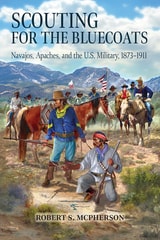
Scouting for the Bluecoats
Navajos, Apaches, and the U.S. Military, 1873–1911Robert S. McPherson
University Press of Colorado, 2022
—Kent Powell, Senior historian at Utah Division of State History and editor of Utah State Historical Quarterly (retired)
"Scouting for the Bluecoats examines the important role that Navajos played in military operations during the last quarter of the nineteenth and beginning of the twentieth centuries. Unlike the famous Navajo code talkers of World War II, little has been written about these men who served in some of the most challenging and noteworthy struggles against the Apaches. Until now, their story has been forgotten. Navajo skills in understanding and tracking a wily foe across an inhospitable landscape proved to be essential elements in ending the Apache wars. For those interested in the recruitment and deployment of the scouts, measures taken to counter enemy tactics, and the challenge of obtaining recognition for their service, this book is an invaluable source and a must-read for any serious scholar of Navajo history."
—Ronald P. Maldonado, Tribal historic preservation officer (retired), Navajo Nation
Scrap Theory
Reproductive Injustice in the Black Feminist ImaginationMali D. Collins
The Ohio State University Press, 2025
Scratchin' and Survivin'
Hustle Economics and the Black Sitcoms of Tandem ProductionsAdrien Sebro
Rutgers University Press, 2024
The 1970s was a golden age for representations of African American life on TV sitcoms: Sanford & Son, Good Times, The Jeffersons. Surprisingly, nearly all the decade’s notable Black sitcoms were made by a single company, Tandem Productions. Founded by two white men, the successful team behind All in the Family, writer Norman Lear and director Bud Yorkin, Tandem gave unprecedented opportunities to Black actors, writers, and producers to break into the television industry. However, these Black auteurs also struggled to get the economic privileges and creative autonomy regularly granted to their white counterparts.
Scratchin’ and Survivin’ discovers surprising parallels between the behind-the-scenes drama at Tandem and the plotlines that aired on their sitcoms, as both real and fictional African Americans devised various strategies for getting their fair share out of systems prone to exploiting their labor. The media scholar Adrien Sebro describes these tactics as a form of “hustle economics,” and he pays special attention to the ways that Black women—including actresses like LaWanda Page, Isabel Sanford, and Esther Rolle—had to hustle for recognition. Exploring Tandem’s complex legacy, including its hit racially mixed sitcom Diff’rent Strokes, he showcases the Black talent whose creative agency and labor resilience helped to transform the television industry.

Scream for Me, Africa!
Heavy Metal Identities in Post-Colonial AfricaEdward Banchs
Intellect Books, 2023
Scream for Me Africa! examines the hard rock and metal scenes in five African countries: Botswana, Togo, South Africa, Kenya, and Ghana. Edward Banchs interviewed musicians, producers, and fans in each country to create vivid pictures of each of these rarely discussed scenes. The book considers how the subculture of heavy metal is viewed in postcolonial Africa and examines how musicians on the continent have stepped forward to make this genre their own. It looks at Africa's blossoming scenes through various themes, including hybridity, othering, and political tensions.

Scream from the Shadows
The Women’s Liberation Movement in JapanSetsu Shigematsu
University of Minnesota Press, 2012
More than forty years ago a women’s liberation movement called ūman ribu was born in Japan amid conditions of radicalism, violence, and imperialist aggression. Setsu Shigematsu’s book is the first to present a sustained history of ūman ribu’s formation, its political philosophy, and its contributions to feminist politics across and beyond Japan. Through an in-depth analysis of ūman ribu, Shigematsu furthers our understanding of Japan’s gender-based modernity and imperialism and expands our perspective on transnational liberation and feminist movements worldwide.
In Scream from the Shadows, Shigematsu engages with political philosophy while also contextualizing the movement in relation to the Japanese left and New Left as well as the anti–Vietnam War and radical student movements. She examines the controversial figure Tanaka Mitsu, ūman ribu’s most influential activist, and the movement’s internal dynamics. Shigematsu highlights ūman ribu’s distinctive approach to the relationship of women—and women’s liberation—to violence: specifically, the movement’s embrace of violent women who were often at the margins of society and its recognition of women’s complicity in violence against other women.
Scream from the Shadows provides a powerful case study of a complex and contradictory movement with a radical vision of women’s liberation. It offers a unique opportunity to reflect on the blind spots within our contemporary and dominant views of feminism across their liberal, marxist, radical, Euro-American, postcolonial, and racial boundaries.
Screen Captures
Film in the Age of EmergencyStephen Lee Naish
Lever Press, 2026
Screen Traffic
Movies, Multiplexes, and Global CultureCharles R. Acland
Duke University Press, 2003
Integrating film and cultural theory with close analysis of promotional materials, entertainment news, trade publications, and economic reports, Acland presents an array of evidence for the new understanding of movies and moviegoing that has developed within popular culture and the entertainment industry. In particular, he dissects a key development: the rise of the megaplex, characterized by large auditoriums, plentiful screens, and consumer activities other than film viewing. He traces its genesis from the re-entry of studios into the movie exhibition business in 1986 through 1998, when reports of the economic destabilization of exhibition began to surface, just as the rise of so-called e-cinema signaled another wave of change. Documenting the current tendency toward an accelerated cinema culture, one that appears to arrive simultaneously for everyone, everywhere, Screen Traffic unearths and critiques the corporate and cultural forces contributing to the “felt internationalism” of our global era.

Screening Asian Americans
Feng, Peter X
Rutgers University Press, 2002
This innovative essay collection explores Asian American cinematic representations historically and socially, on and off screen, as they contribute to the definition of American character. The history of Asian Americans on movie screens, as outlined in Peter X Feng’s introduction, provides a context for the individual readings that follow. Asian American cinema is charted in its diversity, ranging across activist, documentary, experimental, and fictional modes, and encompassing a wide range of ethnicities (Filipino, Vietnamese, Indian, Japanese, Korean, Chinese, and Taiwanese). Covered in the discussion are filmmakers—Theresa Hak Kyung Cha, Ang Lee, Trinh T. Minh-ha, and Wayne Wang—and films such as The Wedding Banquet, Surname Viet Given Name Nam, and Chan is Missing.
Throughout the volume, as Feng explains, the term screening has a twofold meaning—referring to the projection of Asian Americans as cinematic bodies and the screening out of elements connected with these images. In this doubling, film representation can function to define what is American and what is foreign. Asian American filmmaking is one of the fastest growing areas of independent and studio production. This volume is key to understanding the vitality of this new cinema.

Screening China
Critical Interventions, Cinematic Reconfigurations, and the Transnational Imaginary in Contemporary Chinese CinemaZhang Yingjin
University of Michigan Press, 2001
Screening Culture, Viewing Politics
An Ethnography of Television, Womanhood, and Nation in Postcolonial IndiaPurnima Mankekar
Duke University Press, 1999
Mankekar examines both “entertainment” narratives and advertisements designed to convey particular ideas about the nation. Organizing her study around the recurring themes in these shows—Indian womanhood, family, community, constructions of historical memory, development, integration, and sometimes violence—Mankekar dissects both the messages televised and her New Delhi subjects’ perceptions of and reactions to these messages. In the process, her ethnographic analysis reveals the texture of these women’s daily lives, social relationships, and everyday practices. Throughout her study, Mankekar remains attentive to the tumultuous historical and political context in the midst of which these programs’ integrationalist messages are transmitted, to the cultural diversity of the viewership, and to her own role as ethnographer. In an enlightening epilogue she describes the effect of satellite television and transnational programming to India in the 1990s.
Through its ethnographic and theoretical richness, Screening Culture, Viewing Politics forces a reexamination of the relationship between mass media, social life, and identity and nation formation in non-Western contexts. As such, it represents a major contribution to a number of fields, including media and communication studies, feminist studies, anthropology, South Asian studies, and cultural studies.
Screening Genders
The American Science Fiction FilmGabbard, Krin
Rutgers University Press, 2008
The book begins with a general introduction that traces the movement of gender theory from the margins of film studies to its center. The ten essays that follow address a range of topics, including screen stars; depictions of gay, straight, queer, and transgender subjects; and the relationship between gender and genre. Widely respected scholars, including Robert T. Eberwein, Lucy Fischer, Chris Holmlund, E. Ann Kaplan, Kathleen Rowe Karlyn, David Lugowski, Patricia Mellencamp, Jerry Mosher, Jacqueline Reich, and Chris Straayer, focus on the radical ideological advances of contemporary cinema, as well as on those groundbreaking films that have shaped our ideas about masculinity and femininity, not only in movies but in American culture at large.
The first comprehensive overview of the history of gender theory in film, this book is an ideal text for courses and will serve as a foundation for further discussion among students and scholars alike.
Screening Morocco
Contemporary Film in a Changing SocietyValérie K. Orlando
Ohio University Press, 2011
Screening Neoliberalism
Transforming Mexican Cinema, 1988-2012Ignacio M. Sánchez Prado
Vanderbilt University Press, 2014
Screening Precarity
Hindi Cinema and Neoliberal Crisis in Twenty-first Century IndiaMegha Anwer and Anupama Arora
University of Michigan Press, 2025
Screening Race in American Nontheatrical Film
Nadia Allyson Field and Marsha Gordon, editors
Duke University Press, 2019
Contributors. Crystal Mun-hye Baik, Jasmyn R. Castro, Nadine Chan, Mark Garrett Cooper, Dino Everett, Allyson Nadia Field, Walter Forsberg, Joshua Glick, Tanya Goldman, Marsha Gordon, Noelle Griffis, Colin Gunckel, Michelle Kelley, Todd Kushigemachi, Martin L. Johnson, Caitlin McGrath, Elena Rossi-Snook, Laura Isabel Serna, Jacqueline Najuma Stewart, Dan Streible, Lauren Tilton, Noah Tsika, Travis L. Wagner, Colin Williamson

Screening Sex
Linda Williams
Duke University Press, 2008
Combining stories of her own coming of age as a moviegoer with film history, cultural history, and readings of significant films, Williams presents a fascinating history of the on-screen kiss, a look at the shift from adolescent kisses to more grown-up displays of sex, and a comparison of the “tasteful” Hollywood sexual interlude with sexuality as represented in sexploitation, Blaxploitation, and avant-garde films. She considers Last Tango in Paris and Deep Throat, two 1972 films unapologetically all about sex; In the Realm of the Senses, the only work of 1970s international cinema that combined hard-core sex with erotic art; and the sexual provocations of the mainstream movies Blue Velvet and Brokeback Mountain. She describes art films since the 1990s, in which the sex is aggressive, loveless, or alienated. Finally, Williams reflects on the experience of screening sex on small screens at home rather than on large screens in public. By understanding screening sex as both revelation and concealment, Williams has written the definitive study of sex at the movies.
Linda Williams is Professor of Film Studies and Rhetoric at the University of California, Berkeley. Her books include Porn Studies, also published by Duke University Press; Playing the Race Card: Melodramas of Black and White from Uncle Tom to O. J. Simpson; Viewing Positions: Ways of Seeing Film; and Hard Core: Power, Pleasure, and the “Frenzy of the Visible.”
A John Hope Franklin Center Book
November
424 pages
129 illustrations
6x9 trim size
ISBN 0-8223-0-8223-4285-5
paper, $24.95
ISBN 0-8223-0-8223-4263-4
library cloth edition, $89.95
ISBN 978-0-8223-4285-4
paper, $24.95
ISBN 978-0-8223-4263-2
library cloth edition, $89.95
Screening Social Justice
Brave New Films and Documentary ActivismSherry B. Ortner
Duke University Press, 2023
Screening Trafficking
Prudent and PerilousYana Hashamova
Central European University Press, 2018
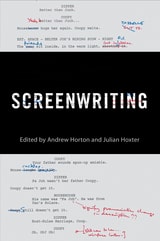
Screenwriting
Horton, Andrew
Rutgers University Press, 2014
Reaching back to the early days of Hollywood, when moonlighting novelists, playwrights, and journalists were first hired to write scenarios and photoplays, Screenwriting illuminates the profound ways that screenwriters have contributed to the films we love. This book explores the social, political, and economic implications of the changing craft of American screenwriting from the silent screen through the classical Hollywood years, the rise of independent cinema, and on to the contemporary global multi-media marketplace. From The Birth of a Nation (1915), Gone With the Wind (1939), and Gentleman’s Agreement (1947) to Chinatown (1974), American Beauty (1999), and Lost in Translation (2003), each project began as writers with pen and ink, typewriters, or computers captured the hopes and dreams, the nightmares and concerns of the periods in which they were writing.
As the contributors take us behind the silver screen to chronicle the history of screenwriting, they spotlight a range of key screenplays that changed the game in Hollywood and beyond. With original essays from both distinguished film scholars and accomplished screenwriters, Screenwriting is sure to fascinate anyone with an interest in Hollywood, from movie buffs to industry professionals.
Screwing the System and Making it Work
Juvenile Justice in the No-Fault SocietyMark D. Jacobs
University of Chicago Press, 1990